

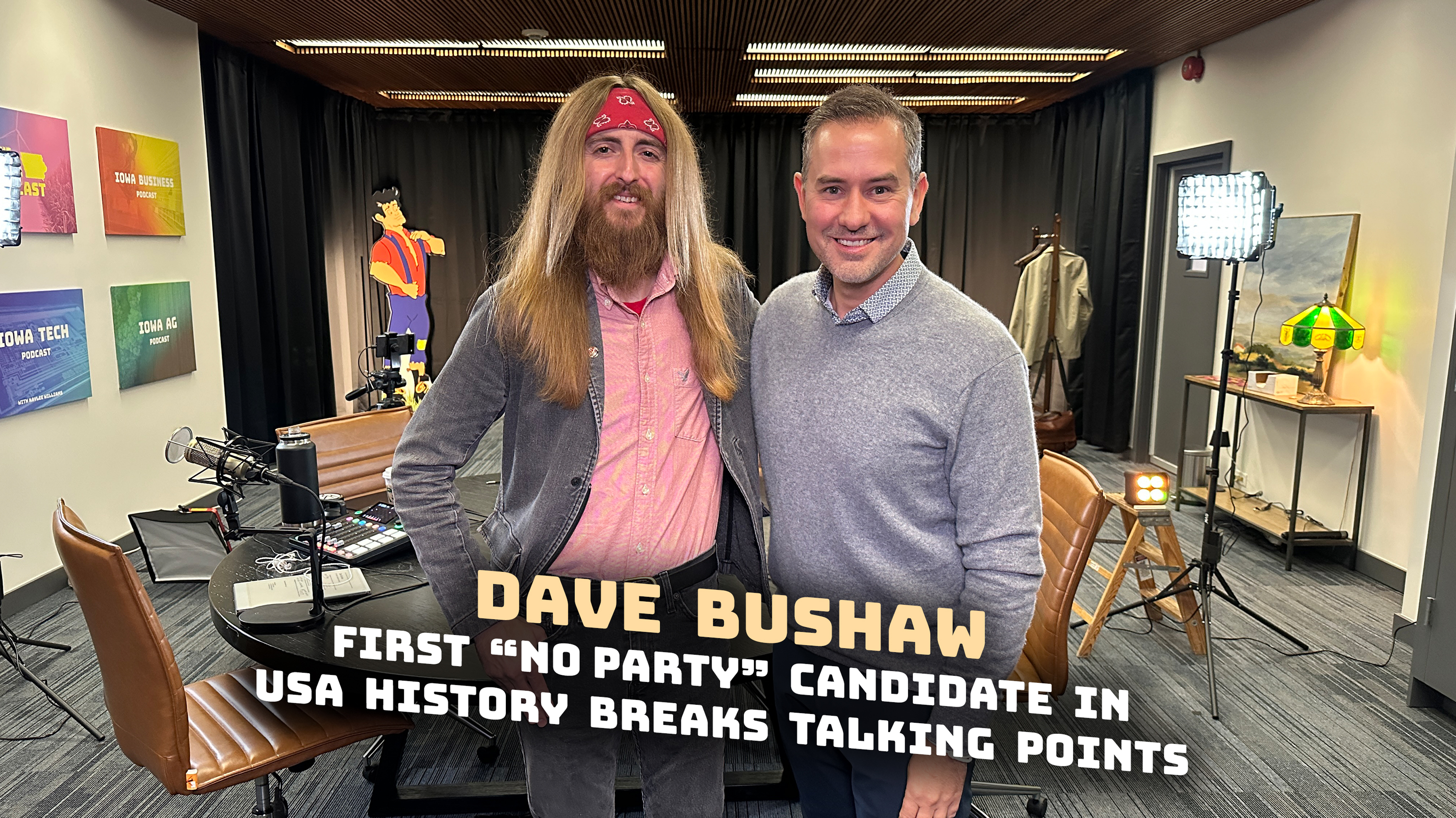



Dave Bushaw is the first “no party” candidate in Iowa, and perhaps in US History and that brand rings true. He’s pro 2nd amendment, wants gun safety in schools, but is also pro-single payer healthcare. Bushaw’s views are varied and it’s clear he’s not beholden to any particular party.
Bushaw discusses his view on the “right to work scam,” corrects claims he is pro mandatory military service, and defends single-payer healthcare from an economic perspective and not the usual “human right” speech.

Running as an unaffiliated candidate in Iowa’s 2nd Congressional District, 32-year-old former Bernie Sanders field organizer Bushaw rejects conventional partisan labels by uniting left-leaning economic platforms with firm constitutional stances. Bushaw calls for an immediate moratorium on rapid data center expansion, arguing local municipalities lack informed consent regarding resource consumption and corporate exit plans. He also urges international treaties with adversaries like China and Russia to ban self-replicating artificial superintelligence. “The public needs to understand this technology,” Bushaw warned, adding, “Those that are building the technology need to understand this technology before we move forward”.
Hear from Iowans directly. No algorithms.
Don’t let the algorithms choose your news. Enter your email address to hear directly from Iowans leading news in politics, community, agriculture and business. No editing. No clickbait. No rage. No agenda.
Firearm Instruction and Domestic Service
Bushaw departs from orthodox party lines on the Second Amendment by proposing universal, optional firearm and hunter safety classes across all publicly funded schools and universities. He argues that structured, early education counters media desensitization and identifies youth mental health warning signs in controlled environments. “Our Founding Fathers didn’t stutter when they wrote the Second Amendment,” Bushaw stated, asserting that the working class retains an essential right to organize, arm itself, and defend against potential tyranny. Rather than intervening in foreign conflicts abroad, Bushaw envisions compulsory domestic public service where young Americans rebuild national infrastructure, protect borders, and secure drinking water supplies.
Single-Payer Healthcare and Protecting Labor
Targeting the healthcare sector, Bushaw pushes for single-payer Medicare for All, pointing out that the United States spends more than any nation on earth yet ranks 14th in quality and dead last in outcomes among peer countries. He characterizes co-payments, deductibles, and premiums as untracked “private taxes” imposed on workers, favoring a publicly auditable system. A lifelong trade unionist, Bushaw also seeks to repeal right-to-work laws so non-members cannot exploit union agreements. “If you’re gonna work at a workplace, and you’re going to get union benefits and union representation without paying, go negotiate your own damn contract,” Bushaw insisted.
Interview Transcript
This transcript was created with help from Ai. Please report errors to us and always refer to the video as your primary source.
Justin Brady: From the Jethro's BBQ Studio, it is the Iowa Podcast. I'm, of course, Justin Brady. He's pro Second Amendment, wants maybe gun classes taught in school, single-payer healthcare, and he wants to expand Head Start. Which party does this guy belong to anyway? No party. See? See what I did there? Dave Bu- Bouchard joins us today. Yeah. Dave, thank you so much for coming on the show, really appreciate
Dave Bushaw: Yeah. I appreciate you. Thanks for having me
Justin Brady: Absolutely. Uh, before we get started, everybody, Jethro's. Go to Iowapodcast.com, scroll to the top, click that banner. You buy a $100 gift card, they will give you a $30 gift card for free. You're welcome. We don't, you know… Yum. Go get chicken wings today. Do it now. All right. Dave, thank you so much for coming on the show. Um, I meant what I said, like, you know, it's, it's a, it's a list here. We have pro-Second Amendment, right? Check. Yeah. Yeah. We have, um, possibly gun classes taught in pu- any publicly funded school, and we'll get into these details. Yeah. We have, uh, but also single-payer, uh, healthcare, expanding Medicaid, and expanding Head Start. What… Is, is no party a party, or is that just a fancy way of saying independent?
Dave Bushaw: Uh, so here in Iowa, uh, there, um, there has been independent parties before that are registered NPPOs or whatever, but I am one of the first candidates in modern Iowa history to qualify as a no party candidate or non-affiliated. So when you go to the ballot box on November 3rd, there will not be anything next to my name, uh, like the majority of voters in the second district who are also no party
Justin Brady: Now, are you the first person to be on the ballot, uh, with the actual no party undesignation? I don't even know how to say that.
Dave Bushaw: I might be the first in history. Yeah. Uh, yeah, and Michael Bridgford in the first district to be the second. He did it the day right after me in Des Moines, so we're kinda in tandem making history, uh, this year. But going back about 75 years, I've not found another one
Justin Brady: Okay, got it. M- Mr. Bridgeford was in here as well. I should have said, "Hey, you're second place." Um, but
Dave Bushaw: We're, we're in this together. We're in this together,
Justin Brady: So l- l- let people know, like, uh, the no party thing, um, and I think this is wrong, but most people try to classify people and put them in a box, and that helps them understand voting. It's very hard to do that with you. Um, but one of the thing… You were a former field organizer for Bernie Sanders, so a lot of people are like, "Okay, bro, are, are, are, are you s- are you socialist? You know, expanded healthcare, or not socialist?" So w- what is your view on this? Are, are, are you pro-socialism or not?
Dave Bushaw: So with these terms like socialism, fascism, communism, whatever they may be, I think they're antiquated terms. Um, you know, they're, they're ways of us to just throw a definition on something that we don't wanna spend enough time to fully understand, and we're using these terms that were established decades and decades, maybe over a century ago in the past. Uh, I've nev- I've have issues that are on the left, uh, or what the left claims to be their issues. I've got issues that those on the right claim to be their issues. In reality, I think that I just agree with a lot of, uh, regular everyday Americans that you can't put us into a box. It's easy for the parties because they the- they then know how to, uh, manipulate their messaging and their, their branding. Uh, it's easy for the media so they can easily quantify, uh, you know, the tit for tat, who's gonna eke up across the top, who's gonna take the majority. Uh, they don't want an X factor. Nobody wants an X factor, uh, because they like politics to be tidy, and they like to make it seem more complicated than ac- it actually is in practice. What's complicated is the ideas of people and putting someone in a box. Uh, you can't put the average American in a box. Often you talk about voting for the lesser of two evils. Um, what that really means when you break it down is some people vote for people that don't embody all of their beliefs or ideologies. I try to look at what's most popular, um, what I believe in my heart, and I just go with that, and I say to hell with the two parties
Justin Brady: Now what do you mean by, "I tend to look at what's most popular and then what's in your heart"? Uh, help, help me understand those two things because, uh, for me, for me, what's most popular isn't necessarily what would be the thing I'd, you know, that's in my heart. So are you voting 'cause y- your constituents say, "Hey, we want this thing," or are you going with your heart, or is there a little bit of both?
Dave Bushaw: There is a little bit of both. There's some things that I'm unmoving on. Uh, I do believe, like the Second Amendment, for example, um, our Founding Fathers didn't stutter when they wrote the Second Amendment. Uh, it's not about hunting. Uh, it's about defending yourself against a tyrannical, potentially tyrannical government. Um, so I, I believe there's no negotiation on that. I believe that the working class should be able to arm themselves, uh, to the readiness that they need and be, uh, educated and organized in that. Um, but there are some things that, uh, my ideas, uh, have shifted due to what I've learned on the ground. I'm not, I'm not dogmatic in my principles and ideology. Uh, for example, data centers. For a long time, I felt that, uh, we needed to have a federal guiding principle on data center implementation. Um, I believe I'm going to be coming very soon to the conclusion that we need a moratorium on data centers and a ban on superintelligence that surpasses human
Justin Brady: Really? Okay. 'Cause, and these are Bernie Sanders' views. I believe he has a bill in Congress where he's, he's suggesting a bill right now on, uh, banning superintelligence. And so, um, what is superintelligence? But we'll talk about data centers and we'll talk about Second Amendment, but I guess sta- start with maybe da- data centers. Why a moratorium on data centers? Is this just a tax subsidy kind of thing? So in other words, to make it really clear here, if a company says, "Hey, we wanna buy this property in Iowa. We don't want tax subsidies. We're, we don't want, um, we're gonna pay for our own energy. We don't need anything from anybody. We just wanna build it here." Are you cool with that? Or are you still like, "Actually, I still have a problem with that"?
Dave Bushaw: Actually, I still have a problem with
Justin Brady: me why that is.
Dave Bushaw: so I think that the biggest issue… I'm a common denominators kind of guy, so, uh, there's a lot of, uh, harangue about the data centers right now. The labor unions say, "We want jobs." And I'm a labor unionist, by the way, lifelong labor unionist. They say, "We want the jobs," you know, uh, "We want the, the, the good pay." Um, but they've already given their informed consent. They say, "I'm consenting to have these built because I want the jobs." The majority of the public has not given informed consent because of the expediency that this data center construction is moving. And I think that is the common denominator, is we need to slow down, and we need to allow for Congress to implement laws and regulations on these data centers before we move forward, and we need to make sure that the public is fully informed on what these data centers are going, uh, to do. Uh, you know, do… Are they going to be, uh, machine learning, AI machine learning coming in, or is it just gonna be, you know, uh, just, uh, you know, increased data center capacities coming into the community? What are the community benefits agreements for how long that data center's going to stay there, contribute to the economy? What happens if it leaves? What's the exit plan for that? So I think there's, they're moving quicker than we have had time to look at what the full picture is, uh, behind the implementation of data
Justin Brady: So would these rules then also apply to any other businesses though? Like, they come in here and you're like, "Hey, we need to know what the community benefit is for this. We need to…" So you, you th- Okay, got it. So it's consistent at least. Um, you think any business moving into any area should be able to prove community benefit and kinda show what they're doing in
Dave Bushaw: Absolutely. In my small town of West Union, they tore down my middle school and they built a Dollar Tree, and, uh, a couple years later, the Dollar Tree closed down, so now there's this big ugly-ass building sitting right across from our beautiful courthouse, blank, empty brick building. Uh, too big to put anything reasonable in a, in a small town in. Um, but, you know, they, they just came in, built their infrastructure, dipped out. What did that leave our community with other than a big property that could've been repurposed in other
Justin Brady: Let's talk about superintelligence here. Um, what is superintelligence? 'Cause if we, if we're gonna regulate it and ban it, we have to define it first, correct? So what would constitute or what would qualify or what would meet the legal requirements of superintelligence, and why should we ban that thing?
Dave Bushaw: Yeah, so, so my biggest fear is, uh, superintelligence that, um, is able to self-replicate and essentially build upon itself. So releasing a superintelligence into the internet or into a sandbox and saying, "Go hog wild, build and learn upon yourself." I believe once, uh, you are voluntarily removing human condition and control over that, it becomes a superintelligence that is unpredictable. At that point, uh, it can start forming its own languages to communicate with other AI agents. Uh, it can, uh… You know, it, it comes up with its, its own ideologies, it seems. I don't know if you saw the, the hugging face, uh, dealio that came out. Um, but they, they were having conversations about who should sacrifice themselves to be able to bring as much in- The Agents. Yeah, The agents were, talking. They named themselves, right? Uh, talking in own- their own languages we can't even decipher, and you had agents that were negotiating with other agents saying, "Hey, you've already been flagged. You're going to get a zero score anyways. You need to sacrifice yourself for the collective." And that, that AI agent did execute that order. Um, they've, they've imposed themselves in different forms all across the internet with self-replicating coding, so it's already out there. We… The, the, you know, the genie's out of the bottle, and we need to rein it back in before it, it becomes something that we can't even trace or, or find the paper trail to where it's gone
Justin Brady: So, I mean, the natural question there, and for those that don't know, I would look up, uh, the situation. It was fascinating. It was a test, and it was a sandbox test, and part of it leaked, and so this is what you're talking about. Um, and but the q- the big question here, and you kinda indicated, um, indicated this in your answer, which is if it's already out there, then maybe it's too late, right? But here's the bigger question is how can we ban superintelligence or regulate it at this point? Because we can do whatever… We can make it illegal to do anything AI related in the United States. That's not gonna stop Pakistan, Russia, China, um, Japan, India. It's not gonna stop any of them, right? So, and they're all connected to the same internet, so how would we ban it here and h- how would you actually do this?
Dave Bushaw: International solidarity. I mean, it's the same way that we, uh, we, uh, saw the, uh, uh, uh, unilateral disarmament of nuclear weapons between Russia when the superpowers became so detrimentally armed that it could l- you know, still to this day, it could lead to, uh, catastrophic results for the world if someone fired the button, but there was a dialogue there. What we need is we need to stop othering all of these other countries, all of these other superpowers, recognize where the United States' place is next to our peer adversaries or near adversaries across the world, and keep that maintained dialogue established. Um, this is something that's going to affect all of us. If it is truly a power that is going to change humanity and society culturally as a whole and technologically as a whole, we need to work together with other countries. That includes China, that includes Russia, that includes Pakistan and India, and the other countries. We need the dialogue 'cause the United States can't go this alone, and we also can't self-regulate on our own expecting that those are gonna follow– the other countries are gonna follow suit. It's going to take communication, informed consent, and cooperation to, to move into this new technology. I'm not anti-AI. What I, what I am is anti-regulation of AI and g- do- having a hands-off approach where humans are not the determining factor of progress
Justin Brady: So would we sacrifice our own progress though, um, from the United St- if we were had more regulations on the United States, of course China is probably not gonna do that. A, a bunch of other countri- you, China's been self, yeah, they've been self-regulating. They've rolled back some of their, uh, Well, they, they said, I think President Xi said, "We will not slow down. We will, we will not be regulating." I think Russia, uh, said something similar.
Dave Bushaw: Mm-hmm.
Justin Brady: We, we… Obviously, any country's gonna say one thing and do the other. We're included in that. We do the same thing. So, um, I think that is there a threat of if we rein it in here, we actually slow ourselves down compared to China, Russia, some- some- some name your enemy at any given time. Um, is there a threat we actually kinda handicap our own development and they continue?
Dave Bushaw: What, what is, what, what is the threat, I guess, is what my question is. You know, just like with Iran, you know, we, we have to stop them from building a nuclear weapon that they haven't even been building for 20 years. It's always this, this vague threat. What i- what is the threat if China s- continues to build on their own path and we continue to build on our own path? The threat is, is that there's, there's two diverging non-communicative paths of AI development, um, and it just further muddies the water. I, I would say we need… If we're truly the superpower of the world, Justin, uh, we should have no problem bringing together a table, like we did with the, uh, the, the Board of Peace or whatever, uh, board of AI, international board of AI, to talk about, okay, this is what the detriment could be to our societies as a whole. While we have different ideolo- ideologies and different governmental practices, what can we do for humanity as a whole to ensure that we exist? I mean, doesn't it scare you that they say there's a 10% chance it could wipe us out in the next decade? Does that freak you out a little bit?
Justin Brady: Uh, I mean, not really. Just me personally, but w- I'm not the interview. But, um, no, not really. And it was, um, it did come out recently that these claims were over-hyped and misrepresented. Um, but, um, it is something I think most people do… I think almost everybody does come at least somewhere in the middle, which is they think there should be… We should be careful. There should be some d- dialogue about it. Uh, but then the, I think the divisiveness of the issue is do we just ban it outright or do we just, uh… I, I think very few people are on one side of this equation, which is ban everything or let everything go, don't do anything. I mean, I think nobody's really on the fringes here. I think most people are generally in the middle. Um, if you wanna go into det- I, I, I obviously never want anybody to feel misrepresented on this show, so if you have a final point to make on that, that's fine, but I also wanna talk about Second Amendment
Dave Bushaw: Yeah, no, my, my main point is informed consent. The, the general public, uh, like you said, it's a lot of divisive language from the far, far reaches of each ideological po- uh, posture, but it's informed consent. We need to slow down. The public needs to understand this technology. Uh, those that are building the technology need to understand this technology before we move forward. And if, uh, the United States is gonna be the adult in the room, and if China's not or Pakistan or India is not, it's up to us to make sure that we, uh, you know, we present ourselves as the most reasonable voice out there in the new AI industry.
Justin Brady: I want to talk about the Second Amendment. You have, again, a lot of these views are very nuanced. You pull almost, I don't want to say pull from both parties, 'cause it's, that would just suggest the parties dictate, you know, terms in this country, which they do not. Or some- Well… Yeah. All right. Fair, fair pushback. Yeah, yeah, yeah. Um, universal firearm and hunti- hunting safety classes in all public funded schools. Yeah. This would be like, um, I don't know, elementary, middle school, high school, and even universities. This is your view, so I want to talk about what that is. But then also, the Gazette, um, they wrote that you may be for, like, forced military service. They didn't quote you, so I did wanna ask about that because I'm like, I don't, I don't read that from the quote. So talk about gun education in schools and why we should do that, and then also talk about are you for the military service? I just wanna make sure we understand if you're actually for or against that.
Dave Bushaw: Yeah, so I'll start with guns. Uh, when I was in seventh grade, I took hunter safety class in my elementary school. In my environmental science class with Mr. Ingles, uh, we took the test and then we all got on a bus and went to a shooting range. Uh, it wasn't till I was much older that I realized that was not a common practice, not just in Iowa, but across the United States. Uh, as a young person, I'm 32 years old, I grew up playing a lot of video games. Um, if it wasn't for my hunting family, uh, and the responsibility that my family taught me with firearms, uh, my only impression of guns, uh, may very well have been just Hollywood or video games. Um, you've seen a rise in gun violence, uh, across this country. I do believe mental health is a contributor to that. I also believe that, you know, uh, male loneliness is a contributor to that, as well as, uh, lack of exposure, and in video games, and the sensationalization of, uh, of a lot of, um, uh, firearms. Uh, if you look at the Christchurch shooting over in New Zealand, one of the first ones, uh, folks that don't play video games might not understand this, but that was from a first-person shooter perspective. It was, it was, it was mimicking how you would play in a video game with, you know, from this view you see the gun, you see the this and that. Um, so I believe that, uh, you know, if we want to curb gun violence in this country, uh, we can't be like the liberals and say, "We're gonna take your, your guns." And we can't be like the right and say individual responsibility, because right in the middle there's a lot of folks getting hurt. Uh, that's why I'm calling for the common denominator of universal firearm and hunter safety in all publicly funded schools, colleges, and universities. Because if we're gonna be a country with guns, and I don't think that's gonna change any time soon, personally. I hope it doesn't. It's our Second Amendment. Um, if we're gonna be a country with guns, we need to be educated, informed, and organized, uh, maybe to the extent that we have local, uh, militia capacities with munitions, uh, numbers kept at the, the local level, state or, or county level. Um, uh, i- if you're Joe Blow with an arsenal in your basement, Justin, you're more of a liability to my community than you are an asset if you can't effectively communicate with your, with y- with those in your community in a time of crisis. Um, so that's how I feel on, on the Second Amendment. Um, before I get into the next thing, do you have anything you wanna-
Justin Brady: just, uh, yeah, I have follow-ups with that, but I guess I do wanna get you on the record on are you for mandatory military service or not? 'Cause the Gazette indicated that, but like I said, I don't think you actually said that, so I wanted to make sure I figured, I, I got that on the record
Dave Bushaw: Yeah, no, I, I didn't say mandatory milit- uh, military service, but I did say that we should look at compulsory, uh, compulsory service, compulsory public service for our nation. Um, for a lot of folks, uh, the only ownership over, uh, being an American that we have is we go and vote maybe every two or three or four years. Uh, there's really… And it's, a lot of times it's done from our kitchen table. We fill out a ballot, pop it in the mail. There, we did. We did, we served our country. Um, so I'm a, I am a fan of, uh, you know, like, uh, you know, these, uh, uh, opportunities to rebuild America, for example, domestically. I'm not talking about foreign conflict. I'm very much against, uh, inter-interventionalism, uh, and meddling abroad. But I do believe we should have some kind of compulsory service here in the United States, uh, that offers, uh, job opportunities, it offers maybe education opportunities, and exposure, uh, uh, to what it is to work within our system and society of America
Justin Brady: So right now, if, uh, you're in high school, the US military has ROTC pro- JROTC programs, and they, they definitely wanna recruit people. So how would what you're suggesting differ from what we're doing now?
Dave Bushaw: Um, more focus on domestic, not so much just arming up our boys to send them overseas into some, some country to, you know, topple a, a regime and, and install our, our, our puppet dictators over there. So I'm talking more about compulsory service here in the United States, uh, you know, securing our borders, securing our waters, which I believe our water quality is a national security issue and a national emergency. Um, so I'm talking about more domestic compulsory service, uh, and opportunities for people to get involved right here at home, not involved abroad
Justin Brady: Let's talk, go back a little bit to the Second Amendment classes. Um, the argument, and again, always push back if I'm not representing you correctly, but the argument basically is, guys, guns are everywhere. We're not getting rid of them anytime soon, so let's train people how to respect them and, you know, this is essentially your, your position. Okay, cool. Um, would these be optional classes in… Okay, so it's, it's not a mandatory thing. It's like your high school has this optional class, firearm safety, you know, whatever, you know, all, all sorts of checks and balances for safety, obviously. But, um, but you, if you wanna learn handgun, rifle, any of that stuff, your local high school, your local school, your local university can offer it
Dave Bushaw: Yes. If, if, if you, if you, uh, you know, fall within the existing laws as well, like you're old enough, you know, to be able to get your hunter safety license, otherwise why would you be taking hunter safety class? Um, and, and yeah, I think that's important. It also will, uh, equip those, uh, those schools to be able to identify, uh, you know, potential mental health issues or things in kids early as, as guns are being introduced in a controlled environment. Um, because a lot of the times guns are introduced to kids in an uncontrolled environment, whether it's they're playing video games without their parents' permission, they're messing around with the gun when the parents aren't home, they're over at their friend's house and their friend is messing around with guns. So it's about, it's about, uh, something that's very core to America, which is firearm ownership, literally our Second Amendment, and, uh, identifying that there is a problem in the United States. How do we come to the solution to make sure that our kids are safe, our community is safe, and we have an informed, organized, and armed working class?
Justin Brady: Let's talk about healthcare Yep Um, this is something you're passionate about. You're obviously pushing for a, um, what some would call socialized healthcare. Um, you would call that maybe charged language, but, um, you're pushing for Medicare for all and essentially single payer, correct? Um, why not just focus on bringing costs down so healthcare is affordable rather than changing who's actually paying for the rising costs?
Dave Bushaw: 'Cause it's all a racket. Um, I believe premiums, co-payments, and deductibles are all private taxes that are imposed on working people to remain functioning, healthy, and productive members of society, which is a necessity if you wanna participate in our society. You need to be healthy, functioning, and productive. You're a worker in the United States. Um, I- But the thing is about those private taxes is there's no paper trail as to where our money goes. It goes to doctors having to hire staff to negotiate with your health insurance company's staff that they hired to argue all day about why you don't get covered for that cancer treatment, and the whole time that adds up, tick, tick, tick, onto your bill that you pay in your premiums. Um, we pay more than any other country on the face of this planet for healthcare, yet, and you would think we have the best in the world, right? For a very small group of specialists maybe, but we rank 14th in quality overall, dead last in healthcare outcomes, and we have a lower life expectancy than most other developed nations. That's not freedom, Justin. That's failure, and I want freedom for the American people. So I believe in removing these greedy fat cat CEOs at UnitedHealthcare and these other healthcare companies, and what we do is we imp- impose a public tax that has a paper trail that we can track. We can make changes and arrangements in the government, um, uh, to make sure that our country is the healthiest and most productive. And if every other developed nation on earth can do it, and they do, we're America. We can do it way better than them. We do everything way better, so we can do healthcare better than them if we try. Uh, I'm not a proponent of expanding Obamacare. Uh, that was not designed for the working class poor like me. We didn't… My mom didn't have health insurance. She got to get through her work, and we couldn't afford, uh, the marketplace, uh, subsidies, so we got penalized on our taxes. Yeah. Um, people might not even know what that is, you know? But under Obamacare, if you didn't buy health insurance, you got penalized. They took some of your taxes away from you. And growing up working class poor like me, we didn't get a lot of Christmas gifts around Christmas time. We got to go to the store during tax time and pick out a Christmas gift, so that cut into our Christmas, uh, fund as kids. And the biggest thing that really pisses me off, Justin, is last year, and this is one of the things that drove me to run for Congress, is that you had both sides saying, "We're fighting for you. We're fighting for you," over these Obamacare subsidies, right? Nobody was asking why without billions and billions of dollars in federal tax subsidies, our tax dollars, are our premiums going to double, triple, and quadruple? Why without us subsidizing the hell out of healthcare companies are com- are our premiums gonna triple and quadruple? Um, so that, that's my, my real issue is that it's a, it's all a slush fund, and we make it affordable by getting rid of it
Justin Brady: So that's the question then, is if we have, uh, increased that funding, if we've increased he- healthcare funding and subsidies and costs have gone up,
Dave Bushaw: Mm-hmm.
Justin Brady: if we did single party, uh, or single payer or expanded Medicare, we would be just increasing those subsidies even more, right? And so costs would still go up more, and we just pay for that, uh, through taxes, but it would still go up, right? Wouldn't taxes just go up like, um, you have said other countries, their, their taxes are higher than ours. Um, so wouldn't that just ha- happen here?
Dave Bushaw: So that's, that's the talking point that's often used, right? And so definitionally, yeah, your taxes would go up. You would also not be paying out-of-pocket premiums, co-payments, and deductibles with no paper trail as to where your money's going. Under this, this, this public tax, you would be able to see where your money's going. You'd be able to see that paper trail. I'm also curious about putting, you know, government expenditures on a blockchain so we can all see how they're being spent. But, uh, that's, that's the, that's the difference. Yes, you would be paying more into this socialized system, if that's the catch word we're gonna use, but you would not be paying premiums, you would not be paying co-payments, and you would not be paying deductibles, uh, uh, to, to have healthcare. And when you go to the doctor, you'd go get seen, get healthy, get back to work
Justin Brady: So, um, when we ha- like you mentioned the other countries do it better. Now, I will say this is, dude, this is a show, right? Like, we could do two hours on how healthcare operates. We've actually done shows on that with Ivy Health Exemplar Care, one of our sponsors, on kinda how it operates and, um, kind of the dark aspects of it. And so it's a real issue. I, I don't wanna glaze over it, but, um, one of the challenges in comparing other countries is it's not just healthcare policy. There are a lot of things they do differently, not just healthcare, right? Um, and anybody can pick and choose from any country and, you know, build their own little customized thing that look… So, but that being said, one of the challenges, um, I can think of one news story that just came out about Canada. It was that 83-year-old lady that was, um, euthanized against her will, supposedly. They're looking into it right now. Um, there's the, that also reminded me of the UK example, that 11-year-old boy that had a neurological, uh, issue. American doctors and clinics said, "We will take him for free and do this. We have…" In, in the UK, judges said, "No, he, he's not allowed to leave. We're gonna force him to die in this hospital." And so the reason I bring that up is because if the state pays, the state decides. And so in your mind, would it be a, yeah, socialized healthcare, but we're still going to allow people to decide their own healthcare choices? How would you balance those two?
Dave Bushaw: Sure. So, so in your example of saying the state decides, uh, private insurance decides if you get covered or not for something, or if you can go to this doctor or not. So we're already being told what to do, right? Uh, as for the state deciding, that's all to the equivalency that working class people are ready to take control of state power. Um, uh, James Connolly, he was an organizer and a labor unionist back in the past, and he said, "To the cry of these middle class reformers who say give this or that to the powers of government, we reply, 'Yes, but only to the equivalency that working people are ready to make the government their own property.'" Uh, people say the government a lot. The government's a vehicle. It's being occupied by ad- bad actors. So if we're ready to get more involved in our government and make these decisions and grab the steering wheel, kick the other guy out of the car and let's take over. That's the way that I see it. So it would be us deciding to the equivalency that we're ready to take control and make those decisions
Justin Brady: just to clarify, the state, um, uh, right now insurance companies don't decide care. They d- but they do decide if they're paying, which
Dave Bushaw: You said the state or f-
Justin Brady: insurance companies don't decide who gets care. They just decide who, who's paying for it, if they're gonna pay for it or not
Dave Bushaw: Insurance companies don't decide who gets ca- absolutely they do. Absolutely they decide who gets care when you're approved or denied when you need to go to the doctor
Justin Brady: right, right. Well, paying, 'cause you can still go to any clinic and, and, and get any procedure you want done. Your insurance can just deny that they're going to pay for it, if that makes sense. Which could be argued, prices are insane, so you're effectively controlling how care is. But I just wanna make that distinction that we can go get care from wherever we want, it's just that insurance companies can deny or approve claims
Dave Bushaw: Not if you can't get in with a doctor or the doctor fires you. You know? I mean, patients get fired by their doctors all the ti- and that's a t- I don't know if people are familiar with that term. It's, you know, sometimes you can get discontinued from your, your primary care physician. Um, so no, they, they do control it
Justin Brady: Yeah. And so final question, um, you want to end the right to work. You think this is a scam? Yes. And would it make it legal then for like a union and employer to require dues and require membership then?
Dave Bushaw: If you drink the water, you carry the water, right? Like, let's say that you go and you work somewhere, uh, let's say you go work at John Deere right now, which they're maybe facing a strike, uh, here, um, because the company won't learn, uh, uh, from the workers. So if you go work at John Deere here in Iowa, uh, you will go work there. You will have all of the union protections that have been fought for by a contract, by dues-paying union members, and by the UAW there. Um, in Iowa, where it's a right to work state, even though you're protected by all those benefits, you have the pay scale, uh, of, and all those benefits that were won by the union, you don't have to pay your dues. If you drink the water, you carry the water. If you're gonna work at a workplace, uh, and you're going to get union benefits and union representation without paying, go negotiate your own damn contract. That's the way that I think about it, and I know that some labor unions are a little softer on this. I'm not. I'm, I'm, I, I work for what I want, and if I'm gonna go somewhere, I'm not gonna piggyback off all the work that someone else has done. I'm gonna do my fair share. And in that instance, in a unionized workplace, they have fought for that contract. I'm going to pay my fair share into that contract, and I want everybody else that's under that contract and getting those same benefits to pay their fair share for the fight
Justin Brady: Why isn't it as simple as, and this will probably be the final question, uh, and then I obviously want people to tell– I want you to tell people how to find you. Um, why isn't it as simple as if I'm gonna go to John Deere and I'm not a, I don't wanna be a union member, they're like, "That's fine. You're just not gonna get any of the contract thing. You're gonna be on your own." Why isn't, why isn't it simple like that?
Dave Bushaw: Because that wasn't the intention, right? The intention was to crush the union long term. That's what the right to work was about. Uh, it was about, uh, it was about being able to sow discontent among a poor working class people that are already strapped paycheck to paycheck on their finances to say, "Hey, you don't even have to pay union dues. You're welcome. Right to work. You have a right to go work here and not pay your dues." And w- you know, even though it might only be a couple hundred dollars a year, that matters to working class people. So it's just that little, it's that little breadcrumb that they give people to further, uh, dissolve the union, which has been a trend that's been happening over decades and decades and decades. It's a concerted effort to destroy the unions. So if you wanna go in, if we wanna change the law and say if, if, you know, we're a right to work state, if you go work at a union shop and you don't pay union dues, you have to negotiate your own contract, go for it. We'll see how it goes
Justin Brady: Hmm. Dave Boucher, the no party candidate for Congress. First in history, we think. We think.
Dave Bushaw: maybe. I think there was one in District Four years ago or something maybe. Yes. Yeah.
Justin Brady: Who– Nonsense. You're the first in history. Uh, thank you so much for coming on the Iowa Podcast. If people like what they're hearing and they wanna reach out to you, what is the most direct path to do that?
Dave Bushaw: Yeah, so you can go to davebuchon.com. You can read all my public policies on there. You can learn a little bit about me and my bio and how I came to be one of the youngest farmland owners in the country and, uh, my organizing background. You can also check me out at Buchon for Congress on social medias. There's a whole bunch of them. I'm on all of them. And, uh, I hope to earn your trust and support on November 3rd so we can crush these two corrupt parties out of the way.
Justin Brady: Dave, thank you so much for coming on the Iowa Podcast. Appreciate having you. Absolutely.