


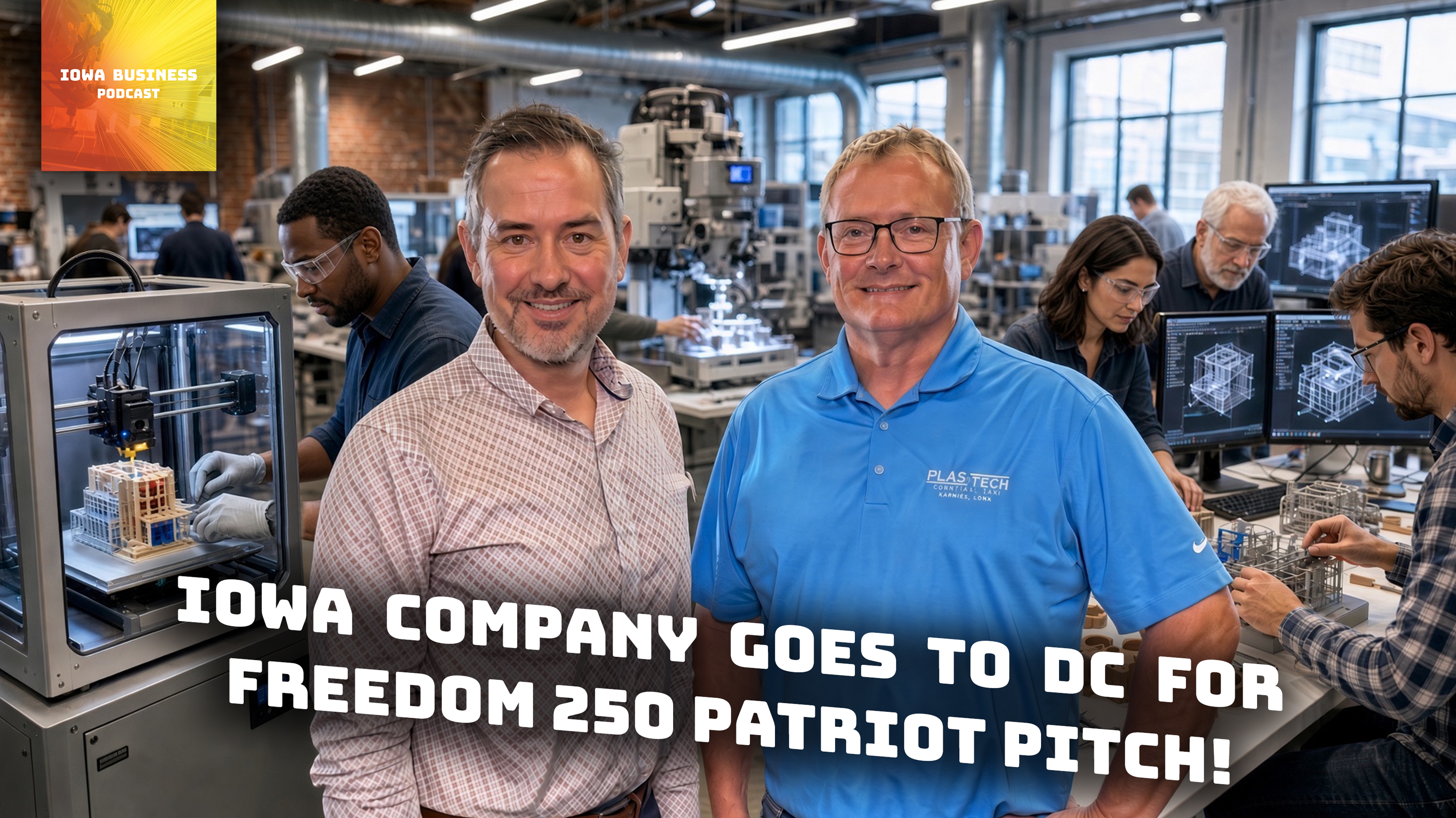
Update (Oct. 21, 2026): Plas-Tech Tooling won first place in the U.S. Small Business Administration’s Million Dollar Pitch Competition, the final round of the SBA’s Patriot Pitch, taking the $400,000 top prize. Dean Sonquist and his sons Andrew and Ryan pitched to a celebrity judging panel in Washington, D.C., in a program that began streaming Oct. 20.


Iowa-based Plas-Tech has been named one of five national finalists out of 1,182 applicants) to pitch in the SBA Freedom 250 Patriot Pitch competition and CEO Dean Sonquist joins us in studio to discuss. $1 Million in total prizes is available to finalists Sonquist heads to Washington DC September 18th!
Sonquist explains the increase they’ve been seeing as companies bring manufacturing back home to the USA from countries like China. He also notes how new companies and smaller startups are beginning to build new products at smaller volume, and how Plas-Tech is meeting those growing midwest needs.

Sonquist is taking Midwest manufacturing to the national spotlight as a top-five finalist in Washington, D.C., competing in the Freedom 250 Patriot Pitch Competition for a share of a $1 million prize pool. Supported by local Small Business Administration advisers at North Iowa Area Community College, Sonquist’s company has evolved over 33 years from a garage startup into a 50-employee precision machining operation. Plas-Tech serves heavy equipment, high-tech agriculture, and food processing industries, with Minnesota accounting for over 50% of its customer base.
Reshoring Demand and Rapid Speed
Sonquist emphasized that supply chain disruptions since 2020 have dramatically accelerated the reshoring of American manufacturing. While overseas orders from China or India often require six-to-nine-month lead times and massive inventory commitments, regional clients increasingly demand quick turnarounds. Plas-Tech frequently reverse-engineers replacement parts for foreign-made equipment in local processing plants, sometimes fulfilling emergency requests within hours. Highlighting Plastek’s operational focus, Sonquist noted, “Being responsive is the biggest thing that’s helped us grow.” When advising entrepreneurs on prototyping and domestic production, Sonquist stresses capital efficiency. “I wanna be a good steward of someone else’s capital,” Sonquist said, pointing to Plastek’s hands-on approach to machining prototypes before client tooling begins.
Hear from Iowans directly. No algorithms.
Don’t let the algorithms choose your news. Enter your email address to hear directly from Iowans leading news in politics, community, agriculture and business. No editing. No clickbait. No rage. No agenda.
In-House Training and Retention
To address regional trade skill shortages and declining community college tool-and-die enrollments, Plas-Tech developed its own internal training curriculum utilizing state 260E grants. About a third of Plas-Tech’s workforce holds formal trade degrees, while in-house programs train remaining staff on blueprints, applied math, and workplace communication. With his sons Andrew and Ryan joining the leadership team to ensure succession, Sonquist prioritizes employee retention. “We work with the employees to make sure we’re giving every opportunity to keep them if they wanna be there,” Sonquist said, attributing low turnover to competitive wages, a 6% 401(k) match, and flexible management.
Interview Transcript
This transcript was created with help from Ai. Please report errors to us and always refer to the video as your primary source.
Justin Brady: [00:00:00] 1 million prize is going to happen in Washington, DC from the Freedom 250 Patriot Pitch Competition. And one of the finalists is in studio today. That is Dean Sundquist, the president of Plas-Tech. I’m, of course, Justin Brady. We’re in the Jethro’s BBQ studio, and this is the Iowa Business Podcast. Dean, thank you so much for coming on the show, and congrats.
Dean Sonquist: Thank you. Thank you. I do appreciate you, uh, taking the time to, uh, put me on your podcast.
Justin Brady: absolutely. Maybe we’ll do a follow-up segment in the future if you’ve won the million dollars, so Well, it’s really not just a million
Dean Sonquist: per person. It’s, uh, a million total prize pool- Yeah … split, split up,
Justin Brady: Oh, split up. Well, we’ll talk about the details on that in a little bit. Before we get started, everybody, of course, we appreciate Dentons Davis Brown for sponsoring and collaborating with this show. Honest, they don’t just send money, they actually send experts to break down legal issues for free for you.
[00:01:00] So if you’re ever like, “I don’t know how to do…” They literally come in here for free. 15-minute shots. We had Brianna Young on here talking about how easy business succession planning is, but also why most owners ignore it at their peril. Not a good idea. Listen to that. It’s free, duh. Also, Joellen Whitney on AI guardrails and privacy concerns that actually reduce legal exposure.
One of her crazy arguments was a lot of people, a lot of businesses are collecting too much data. That can actually be a legal liability. Fascinating interview. If you wanna see both of them, super easy. Iowapodcast.com/business. They’re, like, both right there. Dean, thank you so much for coming in here. Um, the, the person who put me, put you on my radar was SBA Administrator Brad Zaun.
He’s a big fan, clearly, so thank you, Administrator Zaun, for pointing that out. Tell everybody, uh, break this down, what the Freedom 250 Patriot Pitch Competition is. Sounds like five… You’re in the top five finalists going to DC to pitch. Yep. That [00:02:00] happens, I think, September 18th. 18th,
Dean Sonquist: 18th, yep, on a Friday.
Justin Brady: Tell us about that.
Dean Sonquist: So we were, uh, presented this information for this, uh, Freedom 250 pitch from our local SBA office in Mason City at NIACC, and, uh, they kind of got the information late, or they weren’t really for sure what to do with it, and they decided, “Hey, um, who would fit the bill- bill for someone to put an application in for it?”
And they said, “Well, let’s try Plas-Tech.” And so they came over, talked to us about it, and with our story, uh, and their help, they helped us put together the actual pitch to get us into the top 10. And, uh, it was a quite a whirlwind. We had actually six days to put it together. And, uh, so yeah, it went, it went quick and, uh, a lot of guidance from, uh, again, I’ll give a quick shout-out to, uh, Katie [00:03:00] Karstens and, uh, Brooke Bemler over at, uh, the, uh, Papa John Center at NIACC, and they’ve been…
They were great to work with. Um, but anyway, we put it together and it was submitted to the, to the state level, uh, with, uh, Ryan Lincoln and, uh, then we found out, “Hey, we made the top 10. Wow.” Okay. Well, that was kind of crazy. And then, you know, which that’s a lot of good recognition, but it almost really didn’t mean anything unless you made the top five.
So hence, uh, we waited, you know, a few more weeks, three, three, four weeks, and, uh, one morning early, I got an email said, “Congratulations, uh, you made the top five.” And it’s like, “Whoa, I guess things just got real with us.” But, uh, yeah, it’s been awfully exciting and, uh, uh, had a lot of dignitaries come up, um,
Justin Brady: Di- wait, Dignitaries. What does that
mean? Well,
Dean Sonquist: again, Brad Zaun came up, Ryan, uh, um, [00:04:00] there’s a few others from the SBA, SBDC that came up, um, and also at the federal level, um, Lisa Shimkat came out to Plas-Tech and, last week and kind of wanted to see what we do, who we are, kind of what our story is and, uh-
Justin Brady: Little bit of national focus on Iowa manufacturing.
Dean Sonquist: It’s kind of nice ’cause, uh, a lot of people think we got, uh, hog, hogs, and, uh, corn here in the state and
Justin Brady: okay, this is a thing because a lot of people th- yeah, like you said, a lot of people, Iowa, Midwest is, uh, agriculture, which is true. I mean, that’s like the big driver. A lot of people don’t understand, or sh- I guess I should ask this in the form of the que- uh, question. Do you see that a lot of people don’t understand that the Midwest is ac- actually a really insane manufacturing powerhouse?
Like, there’s a lot going on here
Dean Sonquist: Oh, absolutely. There’s, uh, um, one of our largest customers is a Fortune 500 company. Um, and in our town we have two large, uh, tire [00:05:00] service/crane manufacturers in our town, which are, you know, between them they probably employ anywhere 800, 8, 900 people in a town of 3,000, Garnett. Um, then to the north of us is Winnebago Industries.
Um, you know, half an hour south is Hagie, uh, who is als- who’s owned by John Deere now. So yeah, there’s, there’s a lot happening, just people just don’t see it. You know, when you drive through a small town, you just, uh, don’t see it
Justin Brady: Yeah, the- it’s interesting. I’m watching a YouTuber now, um, Smarter Every Day. He’s a guy named Destin, and it’s really interesting watching him try to manufacture, uh, something in the United States, and, like, the, the problems he’s going through. D- And, and I’m, I’m, like, watching this thing and I’m like… I send him a message.
I’m like, “Bro, did you try coming to the Midwest? Like, we, we do that stuff.” Like, he’s talking about how hard it is to find certain manufacturers, and I’m like, “I, I know two people that do that. Like, what are you doing?” Like, amazing channel, but I think most people don’t… They, they don’t think of the Midwest [00:06:00] for manufacturing, but my word, um, we’ve got a lot going on.
Uh, I wanted to ask about, uh, I know that around 2020, things in manufacturing in the United States started to change. Mm-hmm. Which is, um, it used to be the old way of thinking is ship it to Mexico, ship it to China, uh, that’s economically advantageous. Right. And 2020, just looking at the P&L sheet alone, not, you know, a, a, you know, hire Americans or any of that stuff.
Just looking at profit and stability, tool transfers started to, to happen the other way- Right … which is people were starting to bring… And we can talk about what tools are and that kind of thing. So I wanna talk about how even since 2020, people were starting to move manufacturing in the United States.
I’m gonna ask about why and what you’re seeing. But real quick, real quick, can you explain just a 30,000-foot, two-sentence view of what you do? You make plastic stuff, but you also tool m- the, the pla- for the plastic stuff. Can you explain what those things are?
Dean Sonquist: So my roots back [00:07:00] 30, 33 years ago we’ve been in business now, but, um, I was an injection mold builder by trade and, uh, started our business that way. Um, kinda moving, moving down the timeline here, our customers also said, “Hey, since you’re building this, can you machine plastic? Can you machine steel? Can you do this and that?”
So, you know, it’s the same type of equipment, um, sa- same technical people, and, uh, yeah. So we kinda, I’d like to say pivot. That’s what we did. So now our largest, uh, presence now is production machining
Justin Brady: Okay. Yeah, so two, two aspects here. What you guys started out doing is molding, um,
Injection molding. And so, um, the, there, for those that don’t know, there needs to be a tool. It’s a metal thing, and you, you squirt plastic in there, and that creates the components for most of the consumer products you use, the phone in your pocket, all this stuff.
Um, and then because you’re doing the metal shaping, machining to [00:08:00] make the plastic injection molding, people are like, “Hey, B- you’re already messing with metal. Can you also make parts and stuff out of metal?” So you’re like, “Yeah.” So that’s basically what you’re doing. Um, so are you seeing at Plas-Tech the f- the, the trend, the national trend that people are starting to move stuff back into the country?
Have you seen that? It, was it 2020 is kind of when things started to turn, or was it earlier?
Dean Sonquist: was during the time of our life that I really don’t wanna reference, COVID time. Um, but yeah, that’s what happened. And, and, uh, our business really took off. Um, my two sons came on in, in, uh- Mm … during that time. And, uh, what we seen was the products, uh, coming from India, China especially, um, even Mexico, were kind of lost, if you will.
Um, no one was, uh… It was, wasn’t accounted for. There’d be containers coming over, you know, coming in the California Long, Long, uh, Long Beach Port, and [00:09:00] parts that contain… In, in a container, but they didn’t even know where they ended up. So we got a call from our, uh, our, uh, customers and say, “Hey, these are on a container somewhere, but we need…
It’s critical to, to our manufacturing process that we have these parts.” So, you know, in a matter of a, anything from days to hours, we were diving into it and helping them out, get their parts to them. Um, you know, being responsive is the biggest thing that’s helped us
grow. Days?
Justin Brady: or hours?
Dean Sonquist: Yeah, there’s been hours.
Yes, yes,
Justin Brady: You can s- how, how– Wow, okay. How, how– What kind of orders were these? were these like 10,000, 20,000 unit orders? Well, started
Dean Sonquist: Well, to get started, it may have been just a couple hundred, but, um, our, uh, third-largest customer now, um, I was driving down a, a road and I got called from one of the, uh, general managers, and he said, “Uh, why don’t you ever come in and see us?” And I said, ” Well, you know, I was going to, [00:10:00] but, uh, just never quite got there.”
Um, marketing is a very small part of us. We, you know, uh, operate a lot by word of mouth and, you know, that. But we… He said, “We’ve got some parts that are problems and we need some help.” And, uh, I, uh, um, got, got the file sent to us, got them back to the office, said, “We need to figure out how do we can do this.”
Um, we had material on hand, what they needed, um, ’cause it’s all about us stocking material is a big thing. And, uh, the next day, uh, myself and my two sons, uh, delivered parts up to them, southern Minnesota company, and, uh, you know, the rest is history. They seen what we could do. So yeah, that was a 24-hour turnaround from raw bar stock sitting on the shelf to finished components ready to go in their product.
Justin Brady: with technology allowing smaller companies to thrive, right? Like, um, you know, technology, AI is going to accelerate this of course, is allowing smaller companies to thrive in regional [00:11:00] areas or, or it’s, it’s also allowing, um, what, what’s the right word here? It’s allowing people to scale in product niches.
That it used to be not possible. It was way too expensive, but now those costs are coming down. Um, are you seeing greater demand, but, um, not as high volume, but just greater demand for more niche companies and founders and startups that are, like, not as well-funded, but focused on niches that are profitable?
Like, are, are you seeing that trend?
Dean Sonquist: We are, we are. Um, you know, the, the, the old stigma was if you order from China, you’re gonna have to wait six to nine months to get the product over, plus then you need to stock six months of inventory and reorder again. So what happens is, uh, uh, manufacturers make a change, engineering makes a change, uh, the end consumer wants something different, and how do you pivot having, you know, 15,000 of the widget that just does not suit, suit the bill anymore?
Now you have to [00:12:00] start over again, where us, the, the responsibility to the customer through purchasing departments, um, they can hold a lot less inventory. And again, we can react in a matter of… You know, typical orders you like to have four to six weeks on, but, you know, as long, as long as, you know, we’re, uh, uh, an agreement, even a gentleman’s agreement, a handshake, um, we’ll- we stock parts for people.
It’s– That’s just who we are
Justin Brady: Yeah. Are you seeing a… Okay, so because those timeframes, you said six to nine months, because those timeframes are so long, you’ll have people order, like, you know, a couple million units, and even if there’s something kinda wrong with them, too bad, uh, and then you gotta wait for the next gen version of that, which is usually a couple years later.
Because these timelines are shortened, I would guess it’s because you’re really close, you’re really easy to work with, you’re domestic. Um, because these timelines have shortened, you were talking about, like, things [00:13:00] turning in a month or something. Are you seeing smaller orders, but people are making…
Basically, instead of just a product, you’re seeing product, uh, evolution. Like, you’re seeing multiple versions of a product and more continuous improvement in shorter amounts of time. Are you seeing this?
Dean Sonquist: of the big, uh, um, core fundamentals of our company is to work with people on prototyping. Um, you know, design for manufacture is a big thing. So we’ll- Yeah. We will work with them to get to the point of that product, yes, that’s what they need or that is what the assembly line needs. Um, and, and to do it in, in, uh, in very short timeframe because, you know, engineering has an ex- has a lot of expense going through it.
They don’t wanna sit and wait for, uh, weeks, months, you know, to get product. Um, a lot of times we work directly with the engineers to help that. Uh, it’s a good situation and, you know, you, you went over people’s trust. Um, that’s [00:14:00] definitely something that we 100% believe in, so
Justin Brady: Not to mention, a lot of people are getting wise to the fact that if you send your parts out to China and work with Chinese facilities on engineering, they’re just gonna rip off your IP and give it to a competitor in China. Like, that’s liter- no protection
there’s no protection. They don’t care. Um, this is h- what they do.
They copy. They’re very great at copying. They don’t innovate, they copy. And so when we innovate over here and we manufacture over there, they’re like, “Cool idea,” and then they’ll just rip it off and give it to another organization. I think this is probably another reason people are trying to, um, make in America, because there’s IP protection over here if you have a unique idea.
Um, I wanna talk about something you, um, the NIACC relationship- Yep … and the Papa John relationship, um, probably two separate things, but you do training programs with these for students. Um, tell me about that and what you’re seeing with the Iowa student population. Are they excited about skilled trades? I know this has been a challenge for years.
It, it [00:15:00] sounds like you’re getting the talent you want.
Dean Sonquist: Well, we, we… I would say that the, the a- availability of young, um, you know, uh, high school graduate, um, students coming through, it’s down. It, it is, you know. Um, younger people want instant gratification. They, you know, getting your hands dirty is, is something a little different than it was, you know, when I went through it 40 years ago.
So I’m a… As I’ve stated, I am a big proponent of community colleges. Uh, that’s where I went. I went to DMACC in Ankeny back in the ’80s, and, uh,
um- Great school …
had, had… Yeah, absolutely a great school, had some great instructors, and, uh, took it and, and now here’s I am. I got a, you know, with a, uh, business going.
But, um, branch back off to the NIACC, they had a tool and die program. Now they’re kind of scaling back
Justin Brady: Oh, they’re stealing that
Dean Sonquist: They are, because they just struggled with the new, new, uh, with the [00:16:00] traditional students, where a lot of our… We’ve got, oh, I would say a third of our employees, we’ve got 50 employees, are actual, uh, trade school graduates.
So it’s been, it’s been a good thing to, um, bring on that. You know, we don’t have a… We do have, you know, some four-year people, but, um, if, if they’re not coming in trained, we actually have a training program set up, uh, internally with our community college. They helped us through some of the 260E grants that the state does.
So, um, that has been a huge help, absolutely.
Justin Brady: So you, okay, got it. So the community co- colleges, it sounds like you’re seeing a little bit of a pullback, that they’re like, “Ah, we’re, we don’t know if there are a lot, enough students for us to-“
Dean Sonquist: DMACC even is seeing the same thing. I talked with an instructor there, and, uh,
Justin Brady: Is this just lack of interest?
Dean Sonquist: Um, yeah. You know, you got… You don’t have the kids that are working on their cars at nights anymore, you know. You know, kind [00:17:00] of the tinkering with their hands stuff. It’s just, it’s a, it’s a very tough trade for people to get into, you
Justin Brady: Yeah. So how
Dean Sonquist: lot of the push for ele- the, you know, um, electrician, for plumbers and stuff. Well, those, uh, and weld, those are… Those programs are always full at the, uh, at the community college level. But the, the tool and die/machinist programs are just tough
Justin Brady: This, this is gonna, this could be a problem because those, uh, the demand for these products are growing- Yes … at a really fast rate. And so if we don’t have talent to create this stuff, that’s gonna be a pro- I know they’re actually pretty good paying jobs too. Um, so you’re, it sounds like because you see the writing on the wall here, you have your own programs in-house- Yeah
to train people. It sounds similar to, uh, I know, uh, I’m friends with the Accumold people. I know they have something similar too. So you’re taking this on yourself to train these students up?
Dean Sonquist: Right. And it’s also kind of a precursor as we decide, you know, go through some pre-testing to find out, you know, does someone have the, the [00:18:00] acumen to do this? So, and then once, once they come on, we have all of our normal training from safety to forklift and everything. But from that point, then we take it to blueprint reading, and then we take it to, uh, math, um, and even w- even looking to expand a little bit more with communications and, and, uh, you know, that is a big thing anymore that, um, with the digital age, everybody have a cell phone, they don’t know how to talk.
Justin Brady: Interesting
Dean Sonquist: yeah. So we’re trying to- safe. Exactly. We’re trying to- I’ve heard that … I’ve heard about
develop a, a, a, in a sense, a well-rounded employee. Um, that’s why I will always say that, uh, um, our seasoned workers, the older ones who’ve been in different careers coming to us, they’ve seen different places.
They, they come on and, uh, they appreciate what we have, and we appreciate their, their, their, their, their ability to work, to w- every day, to get to work on time, to put [00:19:00] in a fair day’s work for a fair day’s pay. It’s a big thing, so
Justin Brady: You, you mentioned the communication aspect. I’ve heard this before. Or, and, and there, there may be a non-answer to this, which is 100% fine. Are, have you fixed that? Like, I, I’ve heard this several ti- I’ve heard this from clinical, uh, child psychologists too, and families saying that, um, that the COVID era combined with the texting way, you know, way people communicate has hurt some of our youngsters and their communication ability.
So are you just basically working on communication skills internally, or are you guys still trying to figure that out?
Dean Sonquist: I would probably say we’re trying to figure it out. Yeah. There’s, um… Yeah, the COVID time when everybody was distant and it was a face on a computer or a text, um, it’s kinda sad what happened to our, you know, let’s just say to our world. Um, I’m a big one, and I know my wife likes to give me grief about it, but if I got a question, I like to pick, pick up the phone and that call.
“Well, why don’t you send them a text or wait till they…” No, I, I’m okay [00:20:00] to call and get the answers that we need,
Justin Brady: Yeah. And some, some youngsters, um, very bright, intelligent youngsters are like, “I, I can’t, I can’t call. Like, how do I do that?” Text only. Yeah. It’s, it’s interesting. Um,
Dean Sonquist: But it’s interesting. Yes. Yes
Justin Brady: so I guess my question is then, you, you… The talent coming in is harder to find, but you see, I think in previous interviews or news articles I read, you seem to be fine on the talent side for now at least.
Are you just doing better on retention?
Dean Sonquist: Retention is, uh, very good for us. Um, Why is that? Uh, multiple things, I guess. Uh, we pay our, our starting wage and our continued growth, uh, scales are higher than our area. Um, we realize that we have to do that. We’re– we compete against, uh, uh, other people that might have an ESOP plan, you know. So we, we kick up the, you know, the 401.
We do a full match up to 6% on it, and we got healthcare, dental, [00:21:00] uh, short, short-term, long-term disability, uh, vacation, you know, of course, like everybody, paid holidays. But the big thing with us is we understand that life happens with people. You know, if someone has something that comes up, you know, we’re not gonna ding them and take points away from them and try to find a way to fire them.
We work with the employees to make sure we’re giving every opportunity to keep them if they wanna be there. So, and that’s… We feel that tur- personal touch is, has really what’s allowed us to elevate to 50 plus employees and to keep them. So we, we don’t have a lot of turnover. You know, it’s, it’s tough out of the gate, you know, when someone comes in to figure out if it’s really a career for them.
But once they’re in, um, you know, uh, I get a lot of compliments from the people on the floor that, you know, “I wish I would’ve found you 10 and 20 years earlier.” so…
Justin Brady: Hmm. What is the main driver of your business now? [00:22:00] Is it manufa- is it other manufacturing clients? Is it consumer products? Is it profe- what is
Dean Sonquist: Our, our, uh, our main customers are, um, over the road, uh, trucks from cranes, tire service, concrete mixers, refuse trucks. Uh, high-tech ag is a big one. Um, and then we branch down to the food service, to the egg plants, to, um, a lot of different, per se, support parts. Um, we see a lot of demand for a lot of plants that get put up from feed processing, again, egg and pork plants.
Um, the assembly or the, the machines come in from Italy or Germany or wherever, and to get replacement parts is not real easy. So- Oh. So a lot of times we’re reverse engineering stuff for them, and, uh, probably for still way less of a price, and the ability to, uh, respond [00:23:00] to get stuff to them is… That’s another thing that’s elevated us.
But, you know, our, our big pitch that we’re doing, getting back to the pitch, is that, um, we’re doing what we can to reshore here back in the States. That’s what we’re doing here is, you know, let’s make it… It’s an American product, but let’s make it American-made,
Justin Brady: This is interesting. So you’re seeing over here people buying machines from Italy or Germany or what- whatever, and having trouble getting parts. Of course, the EU right now is not in the best shape.
Dean Sonquist: Nope. Right
Justin Brady: and so that problem will probably get worse, I would guess, based on some of the decisions they’re making over there.
But what you’re saying is you don’t need… If you have a larger operation and you can’t afford downtime, you don’t need to wait for them to ship you parts. We will reverse engineer it and make it for
you. Um, so you’re kind of slowly swapping in American-made parts into foreign, uh, equipment. Is this a growing business then?
Yeah.
Dean Sonquist: Yes. Yes. Really? Yeah, that’s, it’s, it’s definitely, uh, on the forefront of, um … You know, we’re very vast. We’re a [00:24:00] job shop, and we do a lot of different things, as we stated. But, uh, it is definitely a demand ’cause we’ve got, we’ve got a feed plant, uh, uh, within quarter of a mile from us, and we’ve got, like I say, a lot of egg plants, and we’ve got, uh, food packaging plants.
And the equipment is all overseas, and, uh, they need parts.
Justin Brady: Yeah. Are you also… I mentioned, when you mentioned some of the industries you were in there, it sounds somewhat regional. So does the Midwest, um, represent most of your customers?
Dean Sonquist: It does. It is. Yeah. Um, we do have, you know, we’re very heavy in the state of Minnesota, is actually over 50% of our business. Um, Wis- we have Wisconsin, Iowa, Illinois. Um, we do have a good customer down in Orlando, Florida, which is, which is actually, um, a subsidiary of a, of a, of a larger conglomerate.
But, um, and I’m working now with an [00:25:00] entrepreneur out of Arizona that, uh, wants to come back and, uh, uh, build product in Iowa, ’cause he’s originally from Iowa, and doesn’t wanna deal with anybody out there. He wants to deal back in with someone from Iowa because he knows who, what he’s gonna get.
Justin Brady: This is a thing, by the way. There’s
a, there’s a contact I have, they have a lot of staff in San Francisco, um, but they use an Iowa address. They have people here, uh, also, tons of people here, but they default to the Iowa address, and I’m like, “Hey, you’re tech. Why don’t you use the San Francisco address?”
And he’s like, ” People don’t trust San Franciscans.” Nope. They, they see the Iowa address and they’re like, “Oh, we can relate to you. You’re honest people,” he goes, “We use… You know, that’s why w- that’s still our headquarters and we haven’t moved.” I was like, “That’s crazy.” Um, you mentioned entrepreneur from Arizona wanting to move things to…
Um, I’m sure this is kind of a, a, uh, well, I know this is a big thing, which is smaller and smaller shops building bigger and bigger projects. Uh, companies [00:26:00] don’t need the 100 employees like they used to. Um, w- I guess, I guess the question is, um, what’s the advice for new builders, people who have never built a thing, but they have the funding, they have a great idea, they have the market, they know their distribution plan, they just want a shop to build the thing.
What’s the advice to entrepreneurs that wanna build a thing in Iowa and they come to you? Like, what do they need to bring with them? Do they need to be prepared? Do they just say, come with a napkin and say, “Here’s what I want. Build it.” What is the… What’s that product or the, what’s the process look like?
Dean Sonquist: We’ve, we- as you mentioned a napkin, I’ve worked off of napkin sketches before. Oh, yeah, absolutely. You know, worked with just someone talking about a product. Um, we’ll go any way from a SolidWorks drawing, solid, you know, a, a 3D step file, you name it. We’ll work all the way through it, whatever’s, whatever they have to work with.
Um, and then [00:27:00] our big thing is that we wanna push them to the prototype. Let’s make sure that this is exactly what you want. Um, being, again, from Iowa, I wanna be a good steward of someone else’s capital. There’s no reason to build it, do it again, build it again, you know, none of that. We wanna, we wanna see, uh, success as soon as possible in that, in the early stages of manufacturing.
So if we go through the right processes, um, let’s, let’s define the… You know, is it what you need? Is it, is it gonna be cost, uh, cost advantageous? Um, is it easy to manufacture? Is assembly there? Have you thought about packaging? All of that stuff. Um, you know, wanna work with them through the whole process that we can.
We’re not, we’re not experts by any way, shape, or form in as we go down with packaging and distribution of that stuff. That’s definitely not us, but it is something that we can help advise them on, and there are people here. Uh, and again, I [00:28:00] use, you know, our community college, I use CIRAS at Iowa State to help out.
I refer people there too. So, um, it’s, it’s kind of a… Help is out there. Just because it’s your product, you might think it’s the best thing since sliced bread, but you need to put it in front of other people’s eye- Yeah … you know, uh, eyes and just get a feel for it. Can this sell? Is this what people need?
Justin Brady: Yeah. Do that before you start
Dean Sonquist: before you hard tool up, yes.
Justin Brady: mentioned prototyping. Are you doing that with 3D printing then since it’s small scale?
Dean Sonquist: yep, some 3D printing, but, uh, a lot of times we will actually machine the c- machine a prototype, whether it’s out of plastic, aluminum, steel, whatever, so, so they can have a real item in their hand to make a decision. So yeah.
Justin Brady: Yeah, that’s good advice. Um, I guess the last question I have is your sons, I think, Ryan and Andrew? Yep. They joined the business, uh, couple year, four or five years ago or something
Dean Sonquist: Andrew came on in, uh, ’19, and Andrew, and, and, and [00:29:00] Ryan come on in ’20. Um, you know, right at the height of the COVID time there, so.
Justin Brady: your wife is a co-founder of the company too,
right?
Dean Sonquist: Yes, we both s- we’re both, uh, say 50/50 owners back, uh, started 33 years ago, we incorporated. Um, we started in a garage. Uh, I had a, had a job as a mold builder, um, at a, uh, battery, uh, cellular battery plant in Mason City, Iowa.
So I was building molds over there, and had some opportunities with a few, uh, entrepreneurs that hit me up and say, “Hey, you’re doing this. Can you help me here?” So, you know, by that time I put in a, a piece of equipment in the garage and added on to my garage, put some piece of equipment in there, and then next thing I know I, we kicked my wife’s car out of the other part of the garage, so now it was a four-car garage.
And then a couple years in there and then we built our f- first building in ’96 in the industrial park, and we’ve had four expansions since then and looking at another one here as we go forward. But, um, mentioned our, my s- my [00:30:00] sons in there. You know, suc- succession is a big thing that something happens to me, I can’t be at work tomorrow, I wanna make sure that our customers are taken care of.
I wanna make sure that our employees are taken care of. You know, everything through it that the business still can go on if I’m not there. So it, that’s a, that’s a big thing to me
Justin Brady: Yeah. It’s a big thing to Iowans. It’s a big thing to your customers. Uh, obviously they wanna buy local, support local. And these days, I don’t know if it used to be this way pre-2020, uh, I mean, it kinda was, but these days buy local is no longer a flag to be flown to get sympathy or sales. It’s, it’s legit a logistic advantage for companies now due to how responsive companies are, how technology’s changing things.
Proud you’re in Iowa. Um, Dean Sundquist, the president of Plas-Tech, thank you so much for coming on the Iowa Business Podcast. What’s the website if people wanna reach out?
Dean Sonquist: Uh, http://www.plastectooling.com
Justin Brady: Awesome. Dean, thank you so much for coming on the show.
Dean Sonquist: Thank you very much
Justin Brady: [00:31:00] Absolutely