

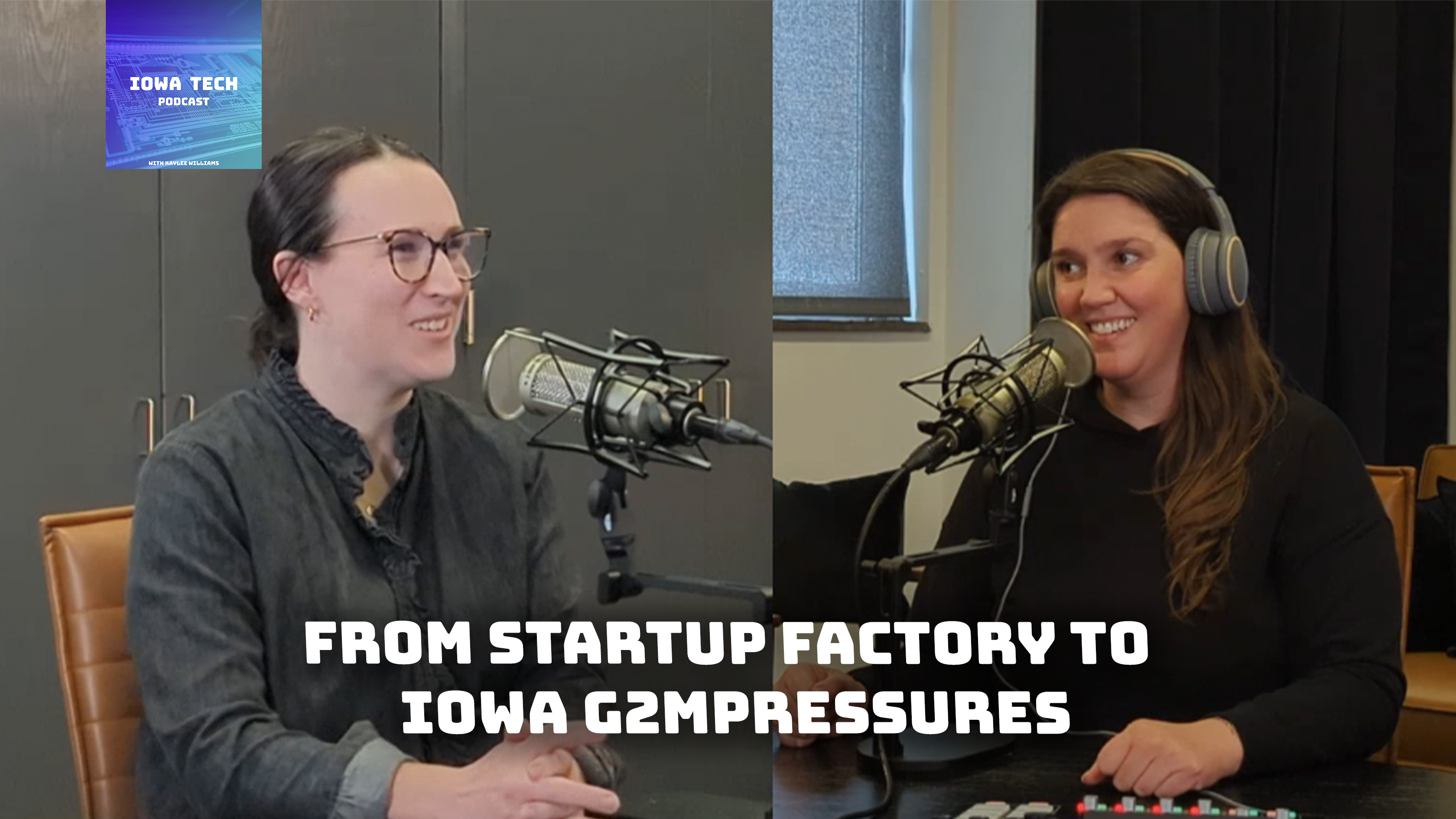


Host Kaylee Williams welcomes guest Hannah Kirkendall, program manager of the ISU Startup Continuum under the ISU Pappajohn Center for Entrepreneurship. The Continuum comprises three linked, founder-driven programs designed as sequential on- and off-ramps along a startup journey: ISU Startup Factory (an incubator-style intro program), ISU Venture Mentoring Service (VMS), and the Iowa Go-to-Market Accelerator (G2M), delivered in partnership with VentureNet Iowa, BioConnect Iowa, and the ISU Startup Factory.
Startup Factory helps founders create a commercialization plan anchored by a milestone chart—clarifying the next objectives to get off the ground. VMS, modeled after MIT’s approach, offers team-based mentorship: each startup works with 2–4 mentors via a mutual opt-in process, with founders setting cadence, goals, and scope over a six-month period before reassessment. G2M is a small, cohort-based accelerator with no fixed curriculum, tailored to two common needs: tightening for first revenue or preparing for a first capital raise. Support includes messaging, pitching, and financial work led by Hannah, director Peter Hong, and EIR John Kallen, alongside a deep bench of service providers.
Hear from Iowans directly. No algorithms.
Don’t let the algorithms choose your news. Enter your email address to hear directly from Iowans leading news in politics, community, agriculture and business. No editing. No clickbait. No rage. No agenda.
Programs are industry-agnostic, focused on tech-enabled, scalable models. No ISU affiliation is required—reflecting the land-grant mission—though many participants are university researchers. All programs are free and primarily virtual, enabling statewide and even global participation.
A Roadmap for Success
The “Continuum” isn’t just a single program; it’s a sequential journey tailored to a startup’s specific stage of development:
- ISU Startup Factory: An 18-week incubator-style “on-ramp” for early-stage tech-enabled businesses begins in early August.
- ISU Venture Mentoring Service (VMS): Based on a proven MIT model, this program matches founders with a team of two to four mentors for collaborative, founder-driven guidance accepts on a rolling basis with onboarding every other month.
- Iowa Go-To-Market (G2M) Accelerator: A highly tailored, small-cohort program focused on helping startups secure their first revenue or raise capital starts mid-April, with another cohort in October. Apply now at iowag2m.org with Applications on the ISU Pappajohn Center website.

Hannah’s path includes roles with Techstars Iowa’s inaugural class and Techstars Anywhere; earlier, she worked in nonprofit development and program management in Portland. Trends she sees: increasing AI integration and a strong Iowa culture of founders helping founders. Her advice to early-stage entrepreneurs: don’t hesitate to say “I don’t know,” reach out, and tap the collaborative ecosystem (Venture School, ISU programs, SBDC). You get out what you put in.
Interview Transcript
This transcript was created with help from Ai. Please report errors to us and always refer to the video as your primary source.
Kaylee Williams: Hi, and welcome back to the Iowa Tech Podcast. It’s your host, Kaylee Williams, and I am here in the Jethro’s Barbecue Studio. Now, some listeners have asked me if the giant jethro’s cutout is still in the room, because as you may recall, it used to be in the studio when we. Recorded out of Gravitate. Happy to report. It is still here. In fact, it’s behind the camera. So he looks at me every time I’m in here and it still startles me. So if you were curious, for those who are wondering, he’s still here. Jethro’s still hanging out. He’s still eight feet tall and scaring me when I glance over at it. So today we have Hannah Kirkendal in the studio. Thank you so much for being here, Hannah.
Hannah Kirkendall: So happy to be here. Thanks for having me.
Kaylee Williams: So Hannah, I’ve known you for, well, pretty much since I started in my role at Anno Venture, so it’s been like almost four years now. You are the program manager for the ISU startup Continuum. Tell us what that means.
Hannah Kirkendall: Yeah, you bet. Um, so at ISU, we, underneath the umbrella of the Papa John’s Center for Entrepreneurship, we run several programs that reach out to startups, um, across the state. And so we like to think of them as on a continuum, um, because we kind of see this as a pa, an entrepreneurship. Startup journey path. Um, the programs have on-ramps, off-ramps, uh, like you would see on, you know, a highway. Um, and so the programs are the ISU Startup Factory. This is car like intro program. It’s kind of an incubator style program. And we also offer a mentorship program called the ISU Venture Mentoring Service. Um, listeners may have heard of the other ones at, um, at University of Iowa. Um. And then we also operate the Iowa Go To Market Accelerator, um, which is a partnership with internet, Iowa Bio Connect, Iowa and the ISU startup factory.
Kaylee Williams: that’s a lot of programs all under your roof. You must be a busy lady.
Hannah Kirkendall: We are busy but they all are related, so it’s, it’s good to keep track.
Kaylee Williams: Can startups do more than one of those programs or is it meant to be sort of, you do one at a certain stage of growth and then you’re off to the races and you don’t need any more support?
Hannah Kirkendall: We see them as being kind of sequential. Um, it doesn’t necessarily me mean you do one exactly right after the other. Um, you might need some time in between programs being ready for the next thing. Um, but yeah, we like to see startups, especially, you know, the earlier you are. The Startup Factory is a really great fit. Um, once you’ve completed Startup Factory, um, the mentorship program is a really good next step. When startups can complete Startup factory, they leave the program with um, a commercialization plan that we’ve helped them develop. So really high level, but it Kind of the meat of it is this milestone chart. So it kind of plans out what are the next big, um, objectives that I have to get my company off the ground. And that is a great thing to bring to a new pool of, uh, group of mentors to work on together, uh, with help. And after you’ve worked on that then you might be ready for the services we provide at, um, Iowa G two M.
Kaylee Williams: Okay. I, I can totally see how chronologically that would work and what I really like about. The milestones approach is that so often founders don’t really know what to do next. You know, they can see the end goal, they know what they wanna be, but backing into how you actually tactically arrive at that growth
Hannah Kirkendall: mm-hmm.
Kaylee Williams: Can be really tricky. So before You bring them to the mentors, you sort of give them that checklist of here’s what you need to accomplish. And now what makes the venture mentoring service different from just any other mentorship program? Yeah,
Hannah Kirkendall: Definitely it is, what makes it unique is it’s team mentorship. Um, so many other mentorship programs match individuals with individuals. And, um, our approach, which is actually modeled off of the program that MIT runs and has been running for over 20 years, um, is we match one startup with. Two to four mentors, and they all work together as a team. They meet at the same time. Um, in our program we have them. um, when the founders come in, they craft kind of a, a really detailed ask. We, we ask them, what are the, your biggest gaps? What are your biggest goals? And um, that’s kind of the information we present to our pool of Mentors Mentors say, Ooh, yes, I can help with this. This is where I, wanna dig in. And we create a small team. Um, everyone, it’s kind of a mutual opt-in Scenario
Kaylee Williams: pull, not a push. Exactly.
Hannah Kirkendall: And um. and then the, it’s really founder driven. So that’s, that’s, a really key point of all of our programs. we don’t have cash to offer, we don’t have, It’s all educational. Everything is driven by the founder. Um, and so especially in this mentorship program, the, the founder really sets the cadence. They set the objectives, they craft that scope of work and the mentors kind of slot themselves in based on their expertise or where where they think they can add the most value. And they work together for six months um, At that six month mark. We’ll, we will take a look. Um, is this still a good team composition? Is this, is the founder kind of holding up their end of the bargain? Um, are they like ready to graduate? Are they ready for like a real board, you know? Um, so we, just kind of take a look and, and add more people, different people, whatever the company needs at that point.
Kaylee Williams: just, and are you working with startups across any industry, or is it focused on only bio or only IT companies? What does that look like? Yeah.
Hannah Kirkendall: Yeah, we are, um, like industry agnostic. Um, our requirements for these programs are, um, tech enabled, scalable business model for the startup factory. Um, so we look at a lot of things. Um. we are very generous in that kind of interpretation at, especially at the startup factory level. Um, for VMS, same kind of, um. Criteria applies. We wanna see founders that have. Done at least a little business education. Um, they’ve worked on this idea for a while. They’ve done some customer discovery, they’ve got a little something To work on. Ideas. Our mentors just, it isn’t a great fit for our mentors in that program to just kind of brainstorm ideas. We’ve got other resources in the community for that. Um, and, and, uh, so that’s kind of the. what we’re looking at.
Kaylee Williams: Okay. And are these startup founders, typically researchers at the university, do you have to be affiliated with the university to participate in any of these programs?
Hannah Kirkendall: I’m so glad you asked. No, you do not. Um, we take our land grant institution mission very seriously, and so all of our programs serve. Any company in Iowa, um, you do not need to be affiliated with ISU to participate in any of them. However, many of our participants are researchers or faculty or staff from the university. Um, which means when you participate in the startup factory, you are exposed to lots of really interesting kinds of technologies. It means the cohorts are really diverse. Um, lots of different kinds of ideas, um, and expertise. Um. the expertise in the room. We’re on Zoom and our, and our call is, um, it’s really cool to watch people, the founders help. each other.
Kaylee Williams: I’m sure you’ve seen some startups that have come through that Got you excited, gave you the zoomies
Hannah Kirkendall: Oh definitely. Yes. There’s, um, world changing technology coming out of ISU.
Kaylee Williams: Do any come top of mind that you can share with us?
Hannah Kirkendall: Oh. um, I always like, my mind always goes blank when people ask me this question cause there’s so many
Kaylee Williams: and I put you on the spot. Full disclosure, I did not prepare her for these questions, so she’s really shooting from the hip here.
Hannah Kirkendall: No, I’m totally, it’s totally cool. We’ve got, We’ve seen a ton of really interesting, um, AI solutions. Obviously this is, it’s big. Um, but. you know, coming out of the university there’s a lot of like brain power kind of behind that, which is very cool. Um, we also see a lot of interesting technologies around like material sciences, so like. We have, you know, new metal alloys and, um, battery technologies. Um, really interesting deep tech stuff.
Kaylee Williams: I love it. you know, I never would’ve thought that deep tech would be so fascinating to me, just coming from a software world and not really being like a scientist myself, but, or a researcher. But it is really cool when you start to look at how these new technologies are creating problems that the new technologies are being developed to solve. Like absolutely finding a new metal alloy. Mm-hmm. That’s
Hannah Kirkendall: And battery technologies and the impact on, yeah. Yep. Absolutely.
Kaylee Williams: So tell me about the G two M accelerator. You mentioned this is sort of the third piece of what You called the continuum. What happens at that juncture? Yeah.
Hannah Kirkendall: Yes. So this program, um, is unique in compared to other accelerators in that we don’t have a set curriculum. Um, it’s a small cohort based program that we offer twice a year. Um, so we’re, look, we look at three to four companies at a time, and the program is designed to provide individualized and tailored support to those startups to help them either. get ready to bring in that first revenue. So they’re, they’re just like a step away from Getting dollars in the door through sales and they need to just kind of tighten things up or they’re ready to, Um, you know, raising their first round of capital is kind of the next thing on their to-do list. And so they need to tighten things up to get ready for that. Um, so those are the two buckets of needs that we try to serve in that program. Um, so we do, uh, messaging work. We do pitch work, we do, um, Financial stuff, and we do all of this through, um, a regular cadence in meeting with our teaching team, which is myself and Peter Hong, the director, as well as our entrepreneur and residence John Callan. And by leveraging, um, a really deep network of service providers. Um, And who have, who volunteer their time, who offer us great rates, um, on services for these founders. So we try to leverage all of the great supporters, um, in our community to provide that help to those founders.
Kaylee Williams: you’re really, it’s like you’re lifting up the ecosystem and surrounding these companies with the very resources that they’re gonna need to grow. Legal, accounting, marketing, Um, sales, business development. I mean, these are the blocking and tackling of early stage companies that are, to your point, past the idea stage Yes. And have hopefully a bench of mentors that they can continue to work with as they scale. Mm-hmm.
Hannah Kirkendall: Mm-hmm.
Kaylee Williams: But they’re, you know, they’re ready to go. they’re ready to execute.
Hannah Kirkendall: exactly.
Kaylee Williams: Very cool, Hannah. Are these programs free? Do they cost money or equity?
Hannah Kirkendall: Um, they are completely free, uh, to the participants. So you pay nothing, you just you give your time. It’s, it’s, you get out of it what you put into It’s what we like to say.
Kaylee Williams: Yeah, I’m sure of it So how, if I’m a founder and I’m listening to this and I’m like, oh my gosh, this is free. I can do this. It’s, you know, close by ish. Um, for, for, many people, I’m sure it’s a little bit of a, you know, maybe a drive. But if you’re living in Ames, of course it’s right there. And it sounds like some of it’s virtual or
Hannah Kirkendall: almost all of it is virtual actually. Oh yeah. So that’s another one of the things that, um, the program, I this was before I joined, but the programs pivoted to virtual during the pandemic. And when Peter and I joined in early 2021, we were like, this is actually working. Um, we can, and that’s was actually part of my experience coming in. Um. was running some virtual programming and so we decided to keep it. And it’s allowed us to serve founders from all over the state. Um, in fact, uh, we’ve served founders who are in different parts of the world. Um, so it’s, uh, it’s been a good model for us, So
Kaylee Williams: that’s incredible. So totally accessible, totally free. Yes. You get out what you put in. Yep. what are the key dates when founders could actually start to access the programming? I’m I’m assuming there’s application deadlines, things like that
Hannah Kirkendall: there. Um, we will talk to you at any point about which programs feel best, um, for you which ones you might want to be pursuing, but Startup Factory. So the kind of entry program runs on the academic semester, more or less. Um, it’s about 18 weeks long, so our next group will start in early August. Um, that application is on the ISU Papa John Center website. Um. So that’s a startup factory. That’s kind of the next on-ramp for that. the ISU Venture Mentoring Service. We take applications on a rolling basis for that because we onboard ventures, Um, every other month Essentially. So that one is kind of always, we’re always bringing in new companies for that one. So if that appeals, um, that application is also on our website. Then G two M uh, runs is a six month program. The next one starts in mid-April. So we are, we are actually trying to finalize a short list of potential companies for this next cohort. If you think this is gonna be like, I have to do G two M right now, Get your application in today. um, but um, that one is on Iowa G2 m.org is where you can
Kaylee Williams: Okay. Okay.
Hannah Kirkendall: that, one. And then the next cohort would start in October
Kaylee Williams: In October, so you have a little time. Yeah. Um, okay. And we will put all these links in our show notes, so if you wanna click through And and follow the process. Um, Hannah, I wanna shift gears a little bit and talk about you. How did you get involved in this work? You mentioned that when you came to the start of continuum, you had some experience doing virtual programming. So tell us about that and what, what was your prior life before this?
Hannah Kirkendall: it’s, it’s, I kind of came to the startup space in a very roundabout way.