

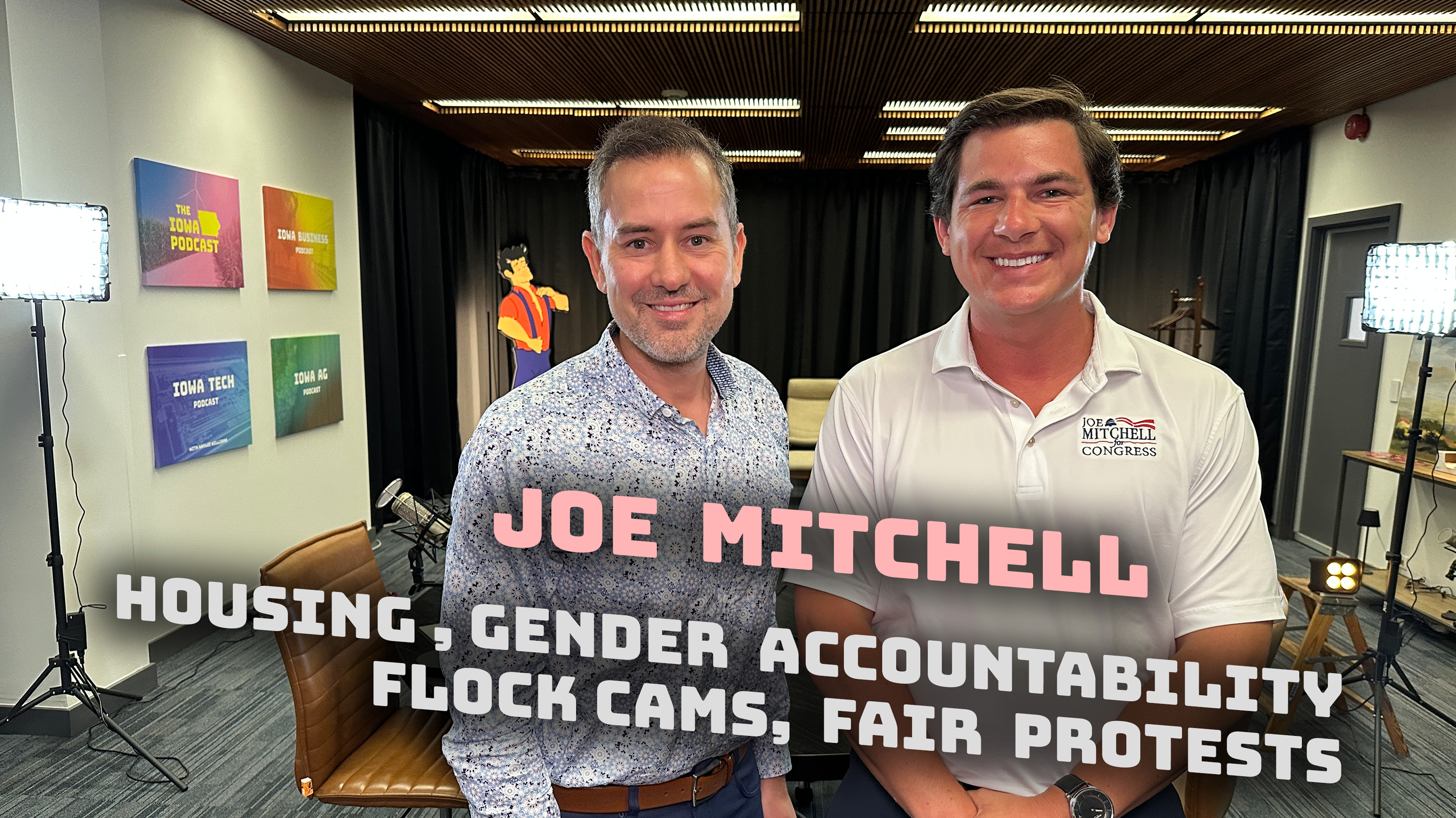


The Former Great Plains Regional Admin of HUD is running for Congress. Joe Mitchell discusses his friendship with Charlie Kirk, what Kirk would have to say about Iowa State Fair protests, accountability for healthcare providers who pushed gender surgeries, and how both incentives and regulations are driving up housing prices.
The Trump appointee also explains his thinking on flock cameras, mass surveillance, and addresses concerns on his tough stance against lobbying. Does it conflict with his former experience hiring lobbyists?

Mitchell highlighted data illustrating America’s housing crisis during a recent interview. Economic shifts have pushed the average age of a first-time homebuyer from 28 in 1970 and 33 in 2020 up to 40 in 2024. “The average age of a first-time home buyer is 40 years old,” Mitchell stated, noting that “that shows that the American dream is becoming out of reach for far too many Americans”.
Housing costs have drastically outpaced earnings. In 1970, the average home price of $40,000 was double the average $20,000 household income. By 2024, average home prices reached $420,000—more than five times the average household income of $81,000—as housing prices jumped 50% in certain regions. Supply shortages worsened as single-family home construction fell from 24 million units built between 1990 and 2010 to only 6 million between 2011 and 2020. To spur development, Mitchell argued, “Republicans are not keen on incentives and Democrats are not keen on deregulation, and we need both”.
Hear from Iowans directly. No algorithms.
Don’t let the algorithms choose your news. Enter your email address to hear directly from Iowans leading news in politics, community, agriculture and business. No editing. No clickbait. No rage. No agenda.
Anti-Corruption and Ethics Platform
Addressing broader governance, Mitchell outlined an anti-corruption platform targeting Washington’s political system. Key proposals include refusing corporate PAC funds, enforcing 12-year term limits in both congressional chambers, and enacting a lifetime ban on former lawmakers becoming lobbyists. He also called for prohibiting individual stock trading by members of Congress to curb conflicts of interest. “We have to stop politicians from getting rich in Washington with insider information,” Mitchell emphasized.
Interview Transcript
This transcript was created with help from Ai. Please report errors to us and always refer to the video as your primary source.
Justin Brady: [00:00:00] It is the Iowa Podcast. I’m Justin Brady, and of course, it is recorded in the Jethro’s BBQ studio. Those have asked, “Do you have chicken wings in there?” No, we’re working on it. We should do that. Iowa 2 for Congress is heating up. We had Lindsey James in here, and now we have Joe Mitchell in here, who’s running for that. Of course, Trump-appointed former Great Plains regional admin for HUD over Iowa, Kansas, Missouri, and Nebraska. Thank you so much for coming on the show.
Joe Mitchell: Justin, good to be here
Justin Brady: So I think we’re gonna talk about some housing stuff, obviously. Something you you know, you know a lot about. housing is a big concern for a lot of people. We’re gonna ask, what does that even mean? How do we control for that? Before we do, Jethro’s, like I said, is a sponsor. Go to iowapodcast.com, click that Jethro’s banner. If you buy a $100 gift card, they will send you a $30 gift card for free. That’s pretty cool. Um, Joe, like I said, thank you so much for coming in here. You were a Trump-appointed, uh, regional admin for HUD. And of course, like, like I [00:01:00] said, Iowa, Kansas, Missouri, Nebraska. Housing is one of the big issues that kind of just sticks around. The thing about housing that bothers me is everyone talks about the term affordable housing. We need more affordable housing, but then no one actually defines what affordable housing is or what we’re supposed to do about it. So according to the conversations you’ve been having with constituents, or not constituents, but with voters, what is affordable housing? How do we define that, and what can be done about it as housing is kind of running up on us?
Joe Mitchell: Sure. So a, a few of the statistics I like to talk about. Number one, the average age of a first-time home buyer is 40 years old
Justin Brady: What?
Joe Mitchell: In 2024 it was 40 years old. So think about that. So that’s not a good statistic. It’s a really bad one that shows that the American dream is becoming out of reach for far too many Americans, and it was 33 years old in 2020. So went up seven years over those four years, [00:02:00] which happened to be under Joe Biden and the Democrats’ control, but a lot of that was inflation, reckless spending, drove up cost, uh, much harder to build homes at that point. But what’s more alarming is if you go back to 1970. In 1970, the average age of a first-time home buyer was, you know, 28, 29 years old, and that was essentially the, the average age of a first-time home buyer until about 2000. And the other, um, facts to look at is, again, take the year 1970, 1975. When you look at average income to average price of a house, average income, call it was $20,000 household income, well, it was two times of the average household income to be able to afford the average price of a home. So let’s say it was $40,000 was the average price of a home in 1970. Now it’s five times. So the average household income [00:03:00] in, call it 2024, was $81,000 and the average hou- you know, price of a house was 420,000. So this is where, you know, we have these discrepancies. You have, um, you know, clearly barriers that are far greater for this generation than there has been in the past for our parents’ or grandparents’ generation to afford a home specifically. And what we know is that being able to buy your first home, build that equity, that is always the first step to achieving that American dream.
Joe Mitchell: [00:04:00] [00:05:00] And that American dream is to be able to buy your home, uh, pay off, you know, the loan to your house and, you know, have that asset then sitting there and be able to live in that and, you know, be able to retire and, um, you know, have a good life and give your children a better life. And so if we’re not able to, you know, have a system in place for, you know, people my age, I’m 29 years old, you know, people that, you know, are in their 30s even can’t afford a home, then they, they really can’t afford the American dream. And so we have to do a number of things, including deregulation. I think what we [00:06:00] do on the state level with incentives, we do a really nice job with incentivizing developers to build modest workforce housing. But DC does not do the same great job that Iowa has done. You know, DC has made things far too complicated. They’ve put in way too much red tape and compliance, um, in the incentive programs and the tax credit programs they have put forth for years now just haven’t worked and they’re inefficient And we’ve actually built far less homes in the last, you know, call it 15 years than the prior 40 years before that
Justin Brady: Is it, is it, is it that simple then? We haven’t built a lot of homes, therefore there is not as much inventory, and w- we know if there’s not a ton of inventory, prices go up. It’s, you know, very simple economics. So if the problem is we’re not building a lot of homes, what is the regulation that is stopping us from building those homes?
Joe Mitchell: another thing I want you to think about. So from 1990 to 2010, we built 24 million single-family homes. So from [00:07:00] 2011 to 2020, you only built six million single-family homes. So you, you were building 12 million a decade for those two decades, and then you went to build six million a decade after the global financial crisis. And so this is where everything is about competition. And as a developer, if I’m building in a town or a community, neighborhood, and I’m the only developer there where I can dictate what the prices are versus if I have competition that comes in and can compete with me on what those prices should be, either for a for-sale product or for a rent product. And so, you know, it, it does come down to simple supply and demand that we have not kept up with the demand with our supply, and so now you have a housing crisis which is out of control. And also wages have went up as well. It’s, there’s two different variations to that where wages should be increasing, and they were, um, for a few years, and then, you know, again, really the last [00:08:00] five years, they, uh, you started to see them, you know, stabilize and, and plateau, which is not good, while you’ve seen housing prices increase by 50% in some parts of the country
Justin Brady: I wanna ask about the regulation piece though, because overregulation suggests there are some regulations that are stopping progress, right? So if, you know, in Congress you wanna propose a bill, this is just an example, right? In Congress, you’re gonna re- propose a bill. You know about housing, so you’re like, “Hey, here are the regulations that are causing this problem. I’m gonna propose a bill that rolls back these regulations.” What are those regulations we roll back?
Joe Mitchell: so there’s a number of things. So it– the federal government doesn’t have a building code and an energy code in place. It’s, it’s dictated by the state and local governments. What the federal government can do though, is incentivize state and local governments to deregulate their building and energy code. So the building and energy code are dictated by the International Code Council. And so what, what I would like to do, and this is what, kind of the inverse of what the Biden administration [00:09:00] did. So the Biden administration, what they did is they said, “If you want an FHA loan and you’re building… If you’re, you know, D.R. Horton or Lennar or Pulte Homes,” a lot of these home, big home builders, “If you’re gonna build these new homes and you want your customers to have a FHA loan, then you have to have a regulatory floor of, you know, regulations have to be up to this, to this point. And you have to have an energy code that is, you know, a 2024 energy code to be able to get that.” So a lot of times these energy codes, for instance, they’ll say you have to get this kind of insulation, you have to have… You know, you can’t use two-by-fours, you have to use two-by-sixes. Um, you have to, you know, have s- a certain amount of outlets around, you know, each room. Um, you know, if you’re building an apartment complex, call it, you have to have, you know, EV charging stations. So it’s all part of this kind of, you know, what I call a green new scam, uh, to use less emissions, u- use less natural gas. What I would like to do is the opposite of that though. [00:10:00] I would like to say, “We’re gonna have a regulatory ceiling,” because if we’re giving you money as the federal government, and the state governments do this as well, but if you’re the federal government giving out money for low-income housing tax credits or giving people loans for an FHA loan, then ultimately, you know, you should be building something that is affordable and is not just subsidized by the federal government. And right now you have units, apartment units that are subsidized by the federal government up to hundreds of thousands of dollars for a studio apartment because of the regulations that are in place, um, via the incentives from the energy code or local and state government. So it’s, it’s semi-complex, but w- it– to put it in, you know, a basic framework, is we need to come up with the most, you know, basic safety regulations you should have in a home, put that in place and say, “Hey, you can’t get incentives unless you’re actually gonna have a common sense building and energy code in place.” Also what I tell people, [00:11:00] I was
Justin Brady: really quick on that though, you mentioned some of these programs, the re- housing prices are still going up despite the incentives. So why entertain the idea of incentives at all if that doesn’t seem like that’s helping either? Is there a scenario where you would push for, to make housing affordable for Iowans, rolling back incentives and regulations? Why wouldn’t that work?
Joe Mitchell: so most of– I, I don’t agree with most of the federal incentives that are in place. I think we have some really great incentives here in Iowa, like the Workforce Housing Tax Credit, which is one of a kind. It’s probably the best, um… It’s the best tax credit and incentive that we have in the United States, I would say. And I think more states should, uh, model what we’ve done here under the leadership of, you know, Governor Reynolds and, you know, Debi Durham, Iowa Economic Development Director. They’ve done a fantastic job with the Workforce Housing Tax Credit and also the Redevelopment Tax Credit. I’d like to go back one second to the, the regulatory piece on just in general. You didn’t [00:12:00] have a building code and an energy code prior to, like, 1970. Many people were born and raised in a house that was built before 1970, including me. So I was– The, the first home we lived in, um, was built in the 1920s, and so it, again, it did not have, you know, this state-of-the-art building and regulatory code and energy code. And my parents felt perfectly safe raising me and my brothers, you know, in that house. And most people grew up in an older home. Most people did not grow up in a home that was built in the last 25 years. And so, you know, this is where we have to kind of put our thinking caps on and say, you know, “Were things that bad for these homes that were built in the 19, you know, 50s, 60s, and 70s? And if we’re really that concerned about safety, then what’s the argument not to just, you know, ban buying homes in general that were built before 1970?” Well, we’d say that’s, that’s ludicrous. That’s crazy. And, you know, so this is where it’s like [00:13:00] we need to allow people to make decisions on if you don’t wanna have continuous, you know, um, you know, installation in their home and, you know, if you don’t wanna have, you know, a, a plug-in every 12 feet, you don’t need to do that. You don’t, you don’t need to pay for that, and you can pay less, um, you know, for a house that has, you know, maybe, uh, you know, less… You know, uh, it’s not up to the, to the code of the energy code and the building code of 2025.
Justin Brady: some of the standards now on hou- and we’ll obviously- moving o- move on here ’cause I don’t wanna spend the whole interview on just housing,
Joe Mitchell: ‘Cause we could. We could spend the I know we talking about it, know we could. But basically what you’re saying is, and you can do a light pushback if I’m wrong, but basically what you’re saying is, “Hey, it’s okay to try to get people to be safe, but we’ve been a little heavy-handed on housing regulations.
Justin Brady: These things, all these extra reg- regulations are adding cost, and all these extra regulations are also limiting the field of who can make this stuff. So if we roll back that stuff, costs come down.” Is this basically the idea?
Joe Mitchell: a- and, and also what I tell people is I say Republicans are not keen on incentives and [00:14:00] Democrats are not keen on deregulation, and we need both. And that’s what I told people all the time when I was at HUD, when I was at the Federal Housing Finance Agency, was that we have to work together. We need deregulation and incentives to make it work
Justin Brady: I know you have a personal story. A little bird told me, someone in your comms team who will go unnamed, but he knows who he is, um, that you had a personal Charlie Kirk story. So I wanted to briefly ask about that, um, and then I have a follow-up question, but I wanna briefly ask about that
Joe Mitchell: So I met Charlie in Des Moines here, uh, September 10th of 2019. So that was six years ago to the date that he was assassinated, um, last year on September 10th of 2025. And I go to this event, and I was a state representative at the time. I was 22 years old, and I was the youngest state house member at the time in, in the legislature. And I go to this event to meet Charlie and to get my p- photo with him. I was a, um, you know, fan of his, listened to his podcast, list- listened to his show, was a fan of Turning Point USA. And he [00:15:00] meets me, I tell him my story briefly, you know, 30-second interaction, and he gives me his number. And he texts me and says, you know, “This is Charlie Kirk. Let’s meet for coffee in the Holiday Inn Cafe after this and talk about your story, talk about how to get more young conservatives elected to local and state offices across this country.” So we sat down for two hours after he did this, this speech at the Holiday Inn by the airport. And, um, fast-forward a year later, he gives me seed money to start this organization called Run Gen Z to help young conservatives run for school board, run for city council, run for state legislative seats. And we partnered with Turning Point USA, got a lot of our recruits, you know, from going to their conferences and speaking at those conferences. And, you know, then Charlie was the one who called me last year to help with the transition team to the new administration. So he was the senior advisor to the presidential personnel team for the president, one of his most trusted [00:16:00] advisors. So he was vetting senior level staff to go into the administration, asked me to help with that, and that’s when I get picked as the chief of staff to the Federal Housing Finance Agency. And so, you know, he’s had a huge influence on my life. Um, every time I had an interaction with him, it was just him wanting to get things done and, like, wanting to help people out like myself, um, and how can we advance, you know, the conservative agenda and help save this country. That’s what he was focused on. And, you know, so obviously, you know, last year I consulted him about running for, um, running for Congress and running for this race. That was last August was the last time I seen him. I think it was, uh, August… Is today August 16th?
Justin Brady: Oh boy. Roughly.
Joe Mitchell: Okay. So the last time I seen him was August 16th of, of last year. And, you know, September 8th I did my press release, and he was the last person that, that saw that press release. And it goes out, and I was talking to his team about [00:17:00] bringing him here for a big rally and endorsement and all that from Turning Point Action. And then September 10th, he’s assassinated right in front of us all on national TV. And that was, you know, incredibly difficult for myself. Um, it was even more difficult for his family, even, you know, friends closer to him, his Turning Point, you know, family. And, you know, it really, I think, changed the trajectory of not only, you know, my race and how I feel about things personally, but also the country and the times that we’re in right now. And so, you know, he was a, he was a friend, he was a mentor, um, he was somebody that had a massive impact on my life
Justin Brady: What do you think? Um, State Fair, we’ve seen, uh, shouting at Rob Sand now. Um, some kinda terrible things in my opinion. Um, and now we’ve also seen some trolling and shouting at Representative Miller-Meeks, both of which I think are unfair on Iowan. [00:18:00] Um, Charlie, whether you love him or hate him, right, he had, he had the people that agreed with him, he had the people that strongly disagreed with him, but I think both sides, at least reading Twitter and reading reactions, both sides agreed that at least he did that and he showed people how to disagree with humility and respect. What do you think he would think, um, seeing this, um… And it was TPUSA people. I don’t, I don’t know the names of the people. I don’t know them personally. But what do you think he would say seeing the harsh treatment of, uh, Auditor Sand and seeing the harsh treatment of Representative Miller-Meeks?
Joe Mitchell: So, you know, Turning Point’s been at the Iowa State Fair for years, and they always, um, have their signs that they make, and they always have, you know, students and, you know, staff, and they go around and they, they have heckled Democrat politicians, specifically federal Democrat politicians wanting to run for presidential office for a long time, including when Charlie was alive. And, you know, ultimately what I would like to focus on [00:19:00] is, you know, Charlie’s legacy himself was going and having discourse and having conversations with, with college students. He wasn’t about making fun of or, uh, demeaning, you know, people that, you know, weren’t in public office and they were just having, trying to have an honest conversation. But he absolutely was very critical of people that were running for office, um, at the highest level and, and criticizing them. Um, you know, and ultimately he was taken out for doing that as well. He was, he was taken out for exercising his First Amendment right and doing what he stood for
Justin Brady: Do you think these steps go too far then? Do you think this was a respectful dialogue, or do you think it went too far?
Joe Mitchell: What I’m more concerned about is the, the actual violence that’s happening in this country. You know, like him getting shot in the neck and killed. You know, the president getting shot in the face the year before. I was just with Leader Steve Scalise, um, this past week, and, you know, he was shot on the baseball field He was, crazy far leftists. And so I’m much more [00:20:00] concerned not with, um, people using their voice and if they wanna, you know, yell, you know, crazy things or heinous things. It’s much different than using violence and, and assaulting people. You know, we just had… It was a tracker, um, you know, from the NRCC or wherever they’re from, and, you know, they were trying to ask, you know, my opponent Lindsay a question the other day, and somebody on her team slapped the phone out of their hand, you know. And so, you know, I think ultimately, um, you know, I think the, the violence is what we need to try to stop and tell people that, you know, they shouldn’t, you know, assault people and they shouldn’t, um, use violence to, you know, settle their, their, their disagreements
Justin Brady: Yeah. Um, I wanna talk about the– This is something you’ve actually gotten a couple questions on online. Um, I don’t know your answer, and so sometimes what I do is I scroll X and I see frequent questions and no responses to those questions. Now, that does not mean you’re avoiding questions, ’cause people fire hundreds of thousands of questions at people [00:21:00] online. You can’t answer everything. Right So I figured, ” Oh, this seems to be a pattern. This is kinda in the news.” Supreme Court ruled, uh, broad cellphone location sweeps as unconstitutional. You tweeted that out positively, saying this is a good thing. Right. Uh, we should always, um, maintain privacy for Iowans, for, for citizens. Does that apply to flock cameras? Is it time we take these things down?
Joe Mitchell: So the flock cam is– So there’s two things on this, and this is a debate that I think is worthwhile and worth having. Um, you know, the first thing is we always have to worry about our civil liberties. And, you know, I, I do understand the arguments that this is Big Brother and that you are tracked everywhere you go with these flock cameras. On the other side, you know, there’s the question about safety and, you know, can we reduce the crime rates if we have, you know, these flock cameras up? You know, Benjamin Franklin famously said, um, “If you’re willing to give up, you know, liberty for safety, you deserve neither.” And so, you know, I tend to agree with what the founders said in that, you know, I think we should be [00:22:00] very skeptical of, you know, allowing a mass surveillance state from, from happening, and I think we have a lot of issues in the federal government and a lot of examples of them using mass surveillance not for good.
Justin Brady: Right.
Joe Mitchell: And so- Sheriffs,
Justin Brady: uh, and police tracking former girlfriends and stuff like that with these flock
Joe Mitchell: But my other thing is, though, with it, is that you have crazy radical left district attorneys and county attorneys not prosecuting criminals as it is. So even if they have the evidence for people committing certain crimes and tracking them, will we even in certain parts of the country have people prosecuted for crimes that they did?
Justin Brady: I mean, it sounds like you’re making an argument then for not having them at all. If, if the evidence they’re collecting isn’t being actioned on and you’re concerned about privacy, am I hearing that you’d like to get rid of them?
Joe Mitchell: I mean, again, I haven’t made a, a final decision on exactly, um, how I, how I feel about it, but I, I’m for prosecuting criminals, but I’m also pr- preserving [00:23:00] people’s, you know, safety and, or sorry, liberty. Um, and so this is where, you know, it’s something that, you know, I, I would like to hear more on the debate, you know. But a- again, I think protecting liberty needs to come before anything else
Justin Brady: Okay. Um, one of the… Your real estate company helped found the Iowa Real Estate Developers Association. Yep. They obviously, you probably know where this is going, spent $75,000 on lobbying. I don’t- disagree with lobbying, just to be clear. No. I think lobbying’s fine. I know it’s a dirty word people throw around, but people have pointed out, you have mentioned that the system works for lobbyists. Right. And you have paid lobbyists $75,000, or the organization has. Right. So I guess people wanna know, like, uh, are you really working for lobbyists, or were you in the system and saw how bad it is and are working to oppose it? What’s your message to voters?
Joe Mitchell: so the first thing is I was never a registered lobbyist, and the, the left [00:24:00] has said that, the media has said that. They’ve just blatantly lied. My opponent has They’ve called You a lobbyist? me a Oh yeah, I can’t-
Justin Brady: find any lobbyist declarations that You’re a lobbyist.
Joe Mitchell: So, this is where the, the Democrats, my opponent, the media, they’ve, they’ve lied about this. I’ve asked them to correct, to correct the record. Second of all, I did, uh, run the Iowa Real Estate Developers Association, and there is a trade association for every industry and every profession- Yep … in the entire state. Whether you’re a teacher, whether you’re an attorney, whether you’re an engineer, electrician, whatever you do, there’s a trade association for you out there. For nurses, for doctors. And so… And we should have trade associations to represent our interests. That’s a good thing. What I have said is that you shouldn’t be a legislator, you shouldn’t be a congressman or congresswoman, and then leave office to go lobby because you have all this network, and to me, you’re utilizing then your self-interest. Because you’re in office and you’re thinking about that next career step. “Okay, well, I’m gonna do this [00:25:00] for one or two more terms, and then I’m gonna g- I’m gonna get out.” So now when you’re voting on bills, whether that be in the legislature or in Congress, in, in DC it’s even s- that much more of a, of a monstrosity, and it’s that much more of a, of a corrupt system, is you’re thinking about, “Well, I don’t wanna make, you know, this person in the lobby upset, or this corporation upset, or this government relations firm upset, because I want a job with them afterwards.” Got it. And so I think it plays to people’s self-interest, and the lobby likes that, the system likes that, because they’re thinking about who they’re gonna recruit for the next four, six to eight years to come lobby for their firm so their clients have a better position. Um,
Justin Brady: So would we see a bill from you then when you’re in Congress saying, “Hey, um, ban, complete outright ban once you leave Congress. Absolutely no lobbying for 10, 20, 30 years permanently”? so we, we’ve talked about that. That’s one of our main platforms, is you have to stop the [00:26:00] legislator or lawmaker to lobbyist pipeline. And so that’s one of our main points in our campaign. So I would say forever. I wouldn’t, wouldn’t even put a time limit on it. And, you know, but this is… This all goes into our anti-corruption platform that we’ve been running on.
Joe Mitchell: So we’ve said, number one, we’re not taking any corporate PAC money. So no money from BlackRock, no money from Pfizer, no money from Goldman Sachs, and we’ll be the only Republican in Washington not taking corporate PAC money. The only one. Second of all, you have to have term limits. And so I said 12 years in the House, 12 years in the Senate, plenty of time to get your agenda done. I’m only 29. I, I don’t wanna be up there when I’m 80 years old for the next 50 years. That sounds awful to me. Sounds terrible. And then the third thing is you have to stan- stop the insider trading that happens, where you have people like Nancy Pelosi, they go up there, they’re worth about $2, they come out, they’re worth about $200 million. I think that’s wrong. We have to stop politicians from getting rich in Washington with insider information. And then that last thing’s the lawmaker to lobbyist pipeline. So [00:27:00] we’ve really focused on how can we stop the corruption in Washington. It’s a bipartisan platform that we’re running on. We’ve been running on this since Se- since September. So a lot of people, you know, they go into the primary, they have a different set of, you know, uh, issues and, and policies that they’re promoting, and then in the general election, then they shift their position. We have not done that. We have been solid on that platform since the beginning. It’s a uniparty. It’s a, you know, bipartisan issue to take, um, you know, take up these issues and get these across the finish line to stop the corruption in Washington and make sure that Washington is working for the people, not the special interest
Justin Brady: we, I mean, there is the list of, uh, Congress people who have allegedly benefited substantially off insider trading, and if people go look at that list, we’ll post it in the show notes, you will see blue and, um, blue names and red names there. So is the solution then, um, that i- if you’re in Congress, no single stock trading? Like, you can invest in index [00:28:00] funds and ETFs, and that’s fine because generally if the market does well, those do well. Or is it straight up you can’t invest at all? Where… Is it just individual stocks?
Joe Mitchell: I think we should allow people to invest in index funds and it’s just, it’s the individual stocks. It’s where you’re going into a briefing, you’re getting briefed on it could be energy policy or healthcare. You saw this with COVID. You had all these lawmakers, they were getting the brief about COVID and what was happening with the coronavirus weeks before the general public knew about it. And then you had all these lawmakers selling off their stocks in individual companies, buying stocks in other companies. And so that’s where the corruption is, is brewed from, is this, is this secret information they’re privy to that other people aren’t. So it’s, it’s the single stocks that we have to stop from being able to be, uh, transacted amongst the, the elected officials
Justin Brady: Secretary Kennedy and, uh, I believe the vice president posted a video, I [00:29:00] wanna say it was last week, on their Wolves in White Coats report, which… And this is an issue, not this issue specifically, but the issue of gender is one you have posted on your website that it’s male and female. Yeah, That’s gender. So my question for you is, if that’s gender, and their report basically said that health providers were pushing things, uh, pushing surgeries to under 18, gender surgeries, to create patients for life. So I would assume you’d think that’s wrong So if you do think that’s wrong, should they be held accountable, and how,
Joe Mitchell: Yeah, they should. Yeah, the, the medical doctors or providers, uh, mutilating children should be held ac- held accountable. Uh, whether that’s, you know, licenses being, uh, revoked, you know, whether that be some sort of, you know, fine they pay or, you know, them being charged with something. But you should not be mutilating children under the age of 18 and allowing them to have sex changes. I think that’s a very common sense thing, by the way. I think most Iowans agree with that. Most [00:30:00] Americans agree with that. And this is where, you know, it’s, it’s funny to me that the Democrat Party, you know, they would have probably, uh, a much larger leg up, um, especially this election, if they would just course correct on some of these very basic common sense issues- Mm that we shouldn’t allow kids to have sex changes. My opponent said it’s life-saving surgery for these kids to have sex changes. And I’ve said she thinks six-year-olds can have sex changes ’cause she’s never declared at what age they shouldn’t be able to have a sex change. You know, this is the sort of stuff where the average person, whether you’re an Iowan or anywhere else in the country, people say, “Yeah, that’s really too far for me.” Mm. Um, you know, a- and, and there’s, there’s things like that that are just the most com- you know, biological men shouldn’t be able to play in women’s sports. Biological men shouldn’t be able to go to women’s locker rooms. Stuff like that is such an easy layup if you’re a Democrat to just say, “Yeah, that’s common sense. I agree with that.” But they’re, they’re afraid of their base, and they don’t wanna say these [00:31:00] things, and they’re worried about being primaried because they have people on the far left that are so radicalized that, you know, think that, um, you know, up is down and down is up, that they’re worried about losing elections
Justin Brady: You mentioned healthcare professionals, um, pushing this maybe, and a- again, policy’s one thing, running for, you know, the- these things are nuanced, but you, you mentioned maybe they should have their licensure revoked. Um, is it stop there, or what other accountability measures you’d, would you take?
Joe Mitchell: I think we need to make sure that kids under 18 stop having sex changes. I think that’s where what- whatever, uh, whatever length we need to go to to make sure that happens, I think that’s a just cause to make sure that, you know, this common sense approach of, you know, listen, you can do whatever you want after 18. I don’t care, uh, whether you’re Republican or Democrat, you know, most people don’t care what you’re doing after the age of 18. But when you’re under 18, you know, there’s a lot of things that you can’t do, and one of those things shouldn’t be, you know, changing, um, your [00:32:00] sex
Justin Brady: Hmm. Joe Mitchell running for Congress, uh, Iowa 2. Obviously appreciate you coming in here. If people wanna learn more about your platform, wanna reach out to you, what’s the way to do
Joe Mitchell: Yeah. Well, you can go to our website, joemitchell.com. It’s pretty simple. It’s just my name, uh, joemitchell.com. We’d love to have your support. If you live in Northeast Iowa in any of the 22 counties, I’d love to have your vote on November 3rd. And, um, even if you’re not in one of our counties, we’d love to have your support via a contribution or donation. And so you guys can go to joemitchell.com. Justin, really appreciate you having me on
Justin Brady: Joe, thanks so much for coming on the show [00:33:00] [00:34:00]