



Update, Nov. 5, 2026: John Norwood (D) lost the 2026 race for Iowa state treasurer to Roby Smith (R).


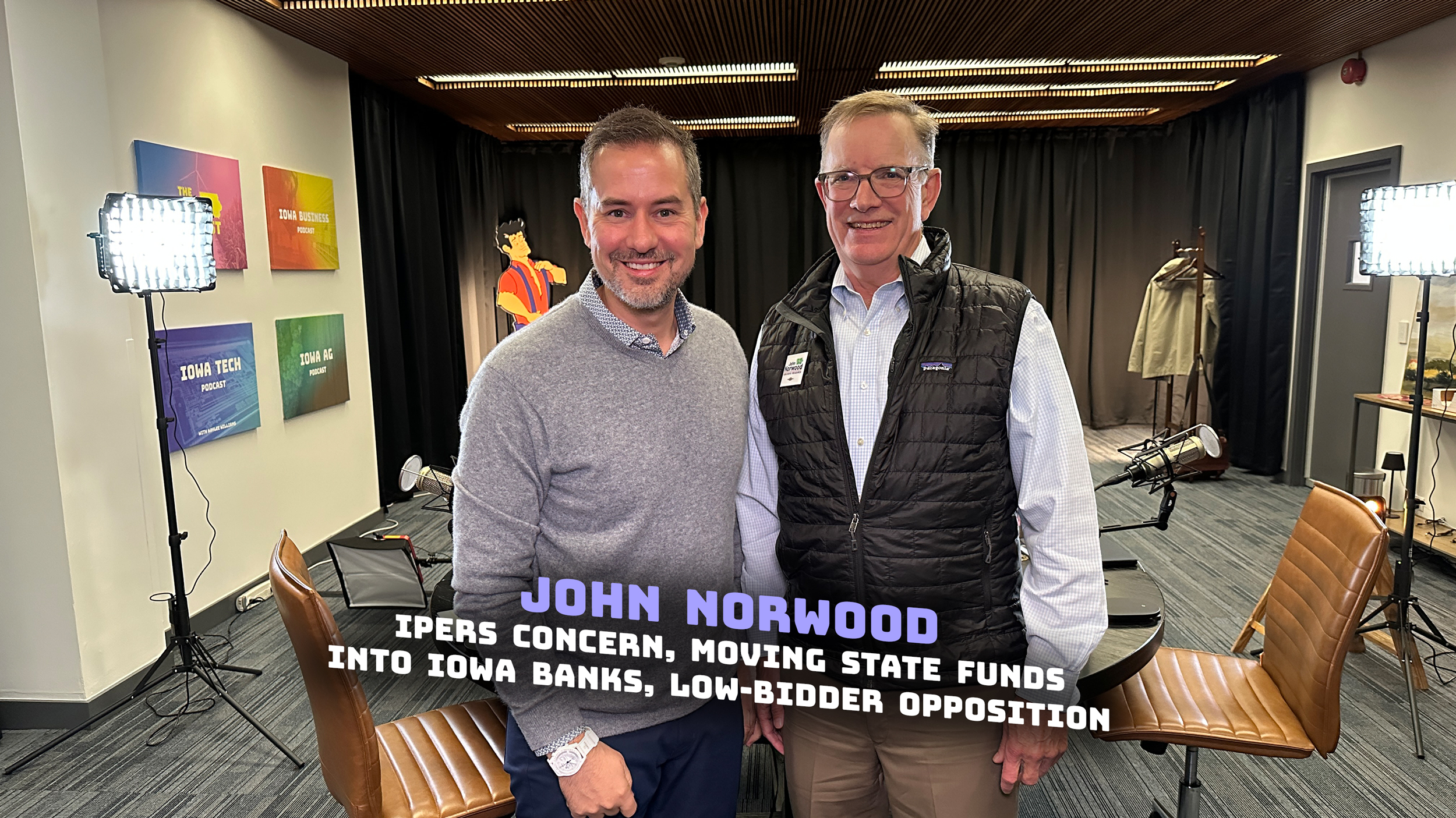
Iowa State Treasurer Candidate John Norwood explains his IPERS concerns, discusses the problems with Iowa officials selecting lowest-bidders on state projects, and shares how he’d pull state funds from national banks into Iowa banks.
Despite Iowa Republicans being clear about supporting IPERS with no intention to change it, Norwood shares why he is still concerned. He also explains the economics behind moving 2.5 billion dollars of state funds into Iowa banks, he says even if the investment returns are lower, the overall state economic impact is worth it.

Norwood raised concerns over the governance of the Iowa Public Employees’ Retirement System (IPERS), which serves 424,000 members—representing one in six adult Iowans. The $47 billion fund distributes $2.5 billion annually to retirees, underpinning local rural economies. Beyond legislative threats eroding its membership base, Norwood spotlighted administrative turnover, misconduct dismissals, and an unfilled risk officer vacancy. “We have a $46, $47 billion fund apparently that we don’t think needs to have a risk management function,” Norwood stated, urging that the board oversee executive hiring rather than the governor.
Hear from Iowans directly. No algorithms.
Don’t let the algorithms choose your news. Enter your email address to hear directly from Iowans leading news in politics, community, agriculture and business. No editing. No clickbait. No rage. No agenda.
Serving as the People’s CFO
Addressing Iowa’s fiscal path, Norwood warned that tax cuts alongside high spending have produced a $1.2 to $1.3 billion structural budget deficit. He cautioned that exhausting reserves threatens Iowa’s triple-A bond rating. Norwood framed the treasurer as an aggressive, independent fiduciary rather than a passive bookkeeper. “The treasurer reports to the people of Iowa,” Norwood asserted, “and should be bringing a perspective that’s not blue or red, but green.” He argued that spending $330 million on private school vouchers creates severe opportunity costs for struggling public school districts.
Placing Iowa’s Billions in Local Banks
To revitalize Iowa’s economy, Norwood proposed redirecting public capital back into local institutions. Roughly $2.5 billion in state funds currently sits in out-of-state investments such as commercial paper and Treasuries. “Well, the more money that we can keep here in Iowa, earning that competitive return with our banks and credit unions, then there’s a second bottom line impact,” Norwood explained. With Iowa financial institutions holding $300 billion on balance sheets, Norwood argued these deposits would fund loans for housing, infrastructure, and small businesses.
Interview Transcript
This transcript was created with help from Ai. Please report errors to us and always refer to the video as your primary source.
Justin Brady: From the Jethro’s Barbecue Studio, I’m Justin Brady, and taxes were cut, but spending remained kinda high. And so what would a new treasurer actually do about that? Well, we’re gonna ask today with John Norwood, who is running for treasurer in Iowa. John, thank you so much for coming in the
John Norwood: Justin, it’s great to be here with you and your viewers
Justin Brady: Yeah, I know this is a contentious issue, so it’s something we’re gonna dive into today. There are multiple sides, multiple angles. We’ll see where you fall on everything. Uh, so John, like I said, thank you so much for coming in here. We get right into the things on, on this show. So I wanna start with IPERS. IPERS. Let’s now y- you’ve been talking a lot about how we need to protect IPERS. You have concerns about IPERS. Yeah. But I can’t find really anywhere where Republicans have said they’re going to do anything about it. So do you have special information? Or what, what’s really going on with IPERS? Because I don’t, I don’t think there are any suggested changes to it.
John Norwood: I think there’s a, a number of things we should be looking at IPERS. Um, first I’d– I would like to sort of talk about the importance of IPERS, get people to understand, you know, uh, what IPERS is. It’s our public employee pension fund. Why it’s important. It’s an incredibly important, on one hand, a recruitment and retention tool for our public employees. These are 424,000 members, about a third in retirement, two-thirds, uh, working. Uh, one in eight Iowans, if we take out the 20% of Iowa, the 2.3 million that are kids, it’s actually one in six adult Iowans is a member of I- IPERS.
Justin Brady: in six are on IPRs.
John Norwood: Iowans. One in six, yeah. I- is, is an adult, yeah, on IPERS. And, um, IPERS is a $46, $47 billion fund, and that fund is comprised of, um, contributions from the employees and from the employers. And together, that money plus the earnings on the fund pays out about $2.5 billion to, uh, retired, uh, almost two, $2.5 billion to retired Iowans. So it’s an incredibly important, uh, part of the economy, particularly in our rural areas. Those retired teachers they’re sure living in Iowa and, and paying to support that economy. So we don’t wanna tear apart IPERS. Man, I, I would tell you though, there’s… Right here in Des Moines, coffee not too long ago with a retired, uh, CEO from a financial services company who gave me the 19 reasons why we shouldn’t have IPERS. So if somebody at the top of the pyramid is talking about privatizing IPERS, then I think we should pay attention.
Justin Brady: Well, individual citizens talk about all sorts of crazy stuff, right? And I’m not saying that idea’s crazy. I don’t know enough about it to make that determination. But if I was, um, just taking what my friend said about government, like government, you know what government’s role should be? They should give me free cheeseburgers every day. Like, You know, we… So the question is, you are concerned about IPERS, and so I wanna know where those concerns come from. Are politicians or Republicans or groups saying we need to get rid of
John Norwood: Yeah. Well, so let’s track the history. The history back in two thousand and eighteen, there was t- legislation introduced to pr- to privatize IPERS. The DOGE report that came out recently, uh, in ’25, I think it was, was talking about giving other options, essentially, uh, uh, beginning to sh- try to shift employees IPERS, otherwise IPERS-eligible employees away from IPERS. And it’s a foundation that four hundred and tw- you know, thir- 20,000 people, you have a base of people that are working, and those people are helping support the retirem- of the people in retirement. So those are examples of how, uh, privatization, it wouldn’t necessarily be an all in one piece, but begin to, begin to chip away at the base of IPERS. Another two recent examples were the 200 IT positions that the governor then, uh, fired or readdressed, uh, moved into the private sector. Well, those were IPERS, uh, el- eligible… Those were IPERS positions that were privatized, essentially. The three hundred and thirty million dollars that we’re paying for private school vouchers, that’s not money that’s going t- for public school teachers. That’s going for private school teachers. So these are all examples of how, uh, IPERS, the, the, the, the base of the membership begins to get moved away from that public employee
Justin Brady: So just to be fair, it does sound like your concerns ar- around IPERS aren’t that… ‘Cause I know that Reynolds has said IPERS isn’t going anywhere. Pat Grassley has says, “We have no interest in privatizing it.” That may or may not be true. We, we, I can’t read their minds, but what you’re basically saying is, “I’m seeing some of the signals, I’m reading some of the tea leaves, and here’s something I’m concerned about, and I wanna get ahead of any discussion around eliminating IPERS.” You can make a rebuttal or a, a comment on that, and then I have other questions,
John Norwood: Yeah, I think there’s those, those pieces that are important that we have to keep our eye on the ball here. That, uh, uh, I think the way that this begins to be undermined is by the membership of an– of eligible positions gets moved away. That base, you know, that base narrows the, in the pyramid. Uh, and then it becomes, I think, harder to main that– maintain that kind of a fund, uh, in a healthy way. We also have management issues. We have a lot of, uh, management, uh, or mismanagement issues. We have the former, uh, CEO who was hired by Governor Reynolds in 2020, was under investigation and resigned, uh, Greg Schmortzke. Uh, his number two that he had brought from Kentucky pension system, fired from the Kentucky pension system, that I think it w- thought it was a good idea to bring that person to I- to the IPER system. Well, he was fired for misconduct. Then we had the management team about two years ago fire the chief risk officer at the time, and we haven’t filled that position. So we have a $46, $47 billion fund apparently that we don’t think needs to have a risk management function.
Justin Brady: and you’ve mentioned the, the CEO getting fired. You’ve mentioned concerns cor- And frame this correctly, please, but you’ve mentioned concerns about the office becoming maybe a little too political in that sense,
John Norwood: Too politicized. Yeah, y- one of the interesting things is that the board of directors, the treasurer sits on the, uh, board of directors, one of seven voting members, the only member of the board that’s directly elected by the people of Iowa. And, uh, the board doesn’t do the hiring and firing of the CEO. I, I don’t think that’s in step with, uh, you know, modern practices. I think the board should be doing the hiring and firing of the IPERS CEO. Of course, that would be a legislative decision to do that. But I don’t, I don’t think it’s, it’s really good conduct to have a red or a blue governor deciding, uh, who the CEO should be of, uh, of, uh, IPERS, partic-particularly if there’s concerns about, you know, the philosophy of, uh, the governor in terms of how they feel about IPERS. Well, you know, that, that really shouldn’t be the chief motivation in hiring somebody. It, it should be the CEO who can then hold the management team accountable. There’s a whistleblower lawsuit going on from the, uh, risk officer who was fired, and the risk officer int-interestingly didn’t report to the board of directors. I mean, you would think that the board of direct- the risk officer might rep- uh, report to the board of directors to be the eyes and ears for the board to make sure… We have examples in our recent history of bank boards, things going off the rap- the rails, Silicon Valley Bank, as an example, that faced insolvency. yeah Yeah, because then they… One of the excuses that they had for, “Oh, we didn’t know. We didn’t have a risk officer to help us.” So, you know, there ought to be, uh, for a $46, $47 billion fund, in my opinion, there ought to be a risk officer. If the risk officer doesn’t report to the person he’s supposed to be, you know, monitoring monitoring, that person reports to the board of directors. So there structurally there’s issues. It’s not just me saying this. This is… You know, the Financial Times has written on this subject in, in May of this year, talking about the governance issues. Professor Erik Lie from the University of Iowa, chair of that department and a forensic expert, has also raised issues, lack of transparency in the fund. Part of the problem may have to do with performance bonuses that were introduced in 2022 after Mike Fitzgerald left, left the office. That’s part of what the whistleblower is alleging, is that the management team was cooking the books basically f- to help with performance bonuses
Justin Brady: saying the management team is cooking the books? I don’t know
John Norwood: that’s, that’s what the, the whistleblower is alleging, and we don’t know. I
Justin Brady: yeah. I just wanna it’s
John Norwood: similar… There’s a lot we don’t know, You know, we didn’t know with the, uh, Des Moines school superintendent what was going on until, you know, people started looking more carefully. And right now there’s no– there’s very little transparency into what’s going on in IPERS. It’s another reason why the governor… You know, the governor shouldn’t, in my opinion, be the person that’s hiring and firing the, uh, uh, uh, the CEO of that organization because now potentially you have– you introduce politics. If some-something goes wrong, where now maybe we don’t wanna get to the bottom of things ’cause that wouldn’t look good
Justin Brady: So there are– You have talked, uh, a lot of issues, right? ESAs, union labor, property taxes, farm trade. You’ve been talking about a lot of issues that some people would say, “Well, that– John, that’s, that’s legislative. That comes from the legislature.” And so I think some people might wanna know, okay, you know, we understand that you have concerns about the office being politicized, but this kinda sounds like you’d politicize the office. How do you respond to that?
John Norwood: that I pu- publicized, uh, Ipers
Justin Brady: No, just, um, the, the– You mentioned the CEO being fired, um, and you mentioned that was being a little too politicized. And then some people might say, “Well, you’re bringing up some political issues though yourself, some issues that would be controlled by the legislature and not your office.” So
John Norwood: get to– Yeah. There, there’s a connection though, Justin, between, uh, fiscal policy and fiscal management. The treasurer is the fiscal manager for the state. The treasurer has three different hats. One’s the state’s banker. We’re managing the money coming in and going out of the treasury. We’re investing some of that money on the short-term basis. Uh, we’re making sure that the money is protected. Ideally, we wanna make sure that the money’s working harder for Iowans. We can talk about that.
Justin Brady: Yeah,
John Norwood: The second hat is the pension fiduciary hat we’ve just been speaking about. Uh, the role of the treasurer… The treasurer doesn’t get to decide a lot of these issues, but the treasurer, I think, uh, can elevate and make transparent and help with accountability. In the same way that the auditor, auditor looks backwards on the money that’s already been spent. Well, we ought to have a treasurer who’s looking forward, who’s engaged, provides an independent perspective, the people’s fiduciary. Uh, and that’s the third hat, is the CFO for, for the state. Uh, and so I think that, uh, you know, what doesn’t… Fiscal policy doesn’t end up touching fiscal management, right? Policy gets approved, and then it has a dollar and cents impact. And so the, as the C- the state’s CFO, I, I think there’s a role to play. The s- the treasurer doesn’t report to the governor. Treasurer doesn’t report to the legislature. The treasurer reports to the people of Iowa and should be bringing a perspective that’s not blue or red, but green. Here’s the dollar and cents reality of what we’re seeing. If we’re not careful, if we run our, our structural budget deficit, for example, the $1.2, $1.3 billion structural budget deficit, at some point, we’re gonna run out of our savings. We’re gonna spend that money down. What’s gonna happen? What’s Wall Street gonna start saying if, uh, we have no more money or the riskiness of our ability to borrow is questioned, we lose our triple A bond rating? That happened to Kansas. That happened to Kansas in 2012 when they got upside down with, with, with their, uh, you know, taxing and spending decision-making.
Justin Brady: And we, we’ll go into that as well because that’s a good
John Norwood: connection. That’s, that’s why the treasurer as the people’s CFO… I mean, what business where you– in Wall Street, you don’t you’re not asking, you’re not interested in what the CFO has to say with that business.
Justin Brady: Yeah. And so one of the, this is, you, you bring up, uh, investing, like b- good investing strategies here for Iowa, growing revenue. Yeah. Good, all good things. Um, and let me bring up this thing. It’s not a trick question. There are probably- Yeah … it’s almost a good answer, good answer. There might not be a bad answer. So I guess maybe I’m serving you up an easy one, John. You’re lucky. I don’t know. We’ll
John Norwood: softballs, please, Justin.
Justin Brady: Um, Iowa banks right now have about two and a half billion dollars. You’ve mentioned this. Two and a half… Excuse me, Iowa has about two and a half billion in other banks it looks like. And so you have mentioned bringing a lot of that money into Iowa banks. Would you still do that, though, if the interest rates were lower? Because you’ve mentioned, like, “Oh, we’re doing that to…” I, I don’t remember what the, um, the actual term was, but you said somewhere, “We’re doing that to make money or make…” Well, if we brought money, if we brought that two and a half billion that you wanna bring to Iowa banks, and we’re making less interest, is that a good trade-off?
John Norwood: Yeah. Let’s, let’s for the viewers kind of, uh, paint the big picture, I think, of, of how we help, uh, h- how capital helps fuel the economy. So we co- we collect money, it comes into the treasury, and the treasury pays out some of this money to our schools and our municipal governments, as an example. And there’s about two and a half billion dollars that gets, gets paid out to these two groups collectively, and there’s a portion of that, uh, two and a half billion that gets invested and gets invested out of state. Maybe it’s going into commercial paper, it’s going into U.S. Treasuries. It’s, it’s going some- some other place. It’s basically money, it’s capital that’s going to fuel somebody else’s economy, and we get a return for that. Now, the return part is the investment return, the earnings. That’s, that’s the good part. The opportunity car- part that we’re missing is what I just said. That money becomes somebody else’s capital to help grow- Yes the other economy. Well, the more money that we can keep here in Iowa, earning that competitive return with our banks and credit unions, then there’s a second bottom line impact. What’s the impact, John? Well, banks and credit unions make loans. How do they make loans? They have to have deposits. Those deposits, if more of that two and a half billion dollar stays in this state, then that is money that becomes capital that can help fuel the economy. Our economy is in the ditch. I mean, it’s down, I don’t know if it’s 50th, 49th, 48th. It’s crappy. You can pick which number it is, but it’s crappy. And so one of the ways we can make that money work harder… As the treasurer, I don’t get to spend the money, but I can work on making it work harder, working with the, uh, legislature as a financial educator, and, uh, thinking about how do we keep more of that money circulating, working in Iowa to grow our economy. Money that gets lent to the small businesses that I work with all across this state, money that gets built to, uh, used to, uh, help build new homes, supply jobs, build infrastructure. These are all things that have to do with growing our economy, and some of them have to do with affordability.
Justin Brady: Mm-hmm.
John Norwood: this is clearly… This is really a very, I think, uh, important thematic that we need to think more cl- carefully
Justin Brady: Yeah, it’s a g- it’s a good topic that I don’t think most people think about. And basically to summarize this, and I always encourage guests to push back if I don’t summarize it correctly, but to summarize this, you’re basically saying, sure, we could get more returns by going to a larger bank. Like, we could get more, a higher percentage by going to a larger bank, sure. However, that’s not looking at the full, that’s not looking at the full spectrum, or that’s not looking at the, the thing from the 30,000-foot view. What you’re saying is, sure, higher interest elsewhere maybe, but we also, the impact to the community and eventually tax revenues, ’cause if people are growing, there, there’s more tax revenue. We’re better off holding that money locally because that actually serves the economy and the state and the citizens better. Is this a fair
John Norwood: and some communities do that. Rob Bixeman… And, and I wouldn’t say it’s not necessarily we have to give up return to send the money elsewhere.
Justin Brady: It’s just a different return
John Norwood: in– Well, or just maybe the return is coming from a different place. Sure And even in, in, for argument’s sake, in theory, if we had to give up a few basis points, that might be worth doing. Maybe we need to come w- come up with some incentives, because from the state’s perspective, that would be an, a, a good way to juice the economy. Can- Compared to, say, you know, giving away a whole bunch of tax money to try to attract somebody.
Justin Brady: This may be invest in our, the businesses that are already here in Iowa.
John Norwood: Yeah. I mean, doesn’t that make
Justin Brady: Yeah. Th- this may be a ticky-tack question, and it’s, uh, I don’t know the answer. I do remember talking to a bank executive years ago about a new startup, and they said, “Oh, we’re not interested in this company because they don’t have enough money.” And then within a year or so, that startup had to go elsewhere because they were making too much money for the bank, and that was the first time I was like, “Wait a minute. I- some Iowa banks, some community banks actually can’t handle tons of money. There’s a cap.” And so my question is: how do we place that two and a half billion in Iowa? Do we distribute it through a lot of different banks? Do we bring some of it? How do you manage that?
John Norwood: I mean, there may be different ways to do that. So the two pooled funds that I– we’ve been talking about already do some of the investing in Iowa, so maybe it’s a question of getting them to do more. That might be a, an easier, quicker way to do it. Uh, we also have examples of how, uh, in Iowa the treasurer’s office is used, uh, in, uh, h-has programs, LIFT is one of them, where essentially we’re using some of that sh- the state’s money to then invest through the banks and the credit unions. Maybe we have to come up with some kind of a pooled fund. Uh, you know, collectively, the Iowa banks and credit unions, I think, have about $300 billion on their balance sheets. So we’re talking about two and a half billion compared to 300 billion. So… And some of this is a distribution issue. You know, there’s some areas that have smaller banks, and maybe they’re not s-set up to this. When I asked this question in the bankers’, uh, in one of their recent summits, and, you know, West, West Bank’s, uh, uh, CEO, West Bank’s a publicly traded bank, so it’s one of our bigger, bigger banks here in Iowa. I mean, he said, “Nope.” He says, “Bring it on. We want more money.” So, you know, let’s listen first to our own businesses, our own financial infrastructure. Invest here first in Iowa. Some, some communities already get this. Rob Bixeman, mayor of, uh, Le Mars, an independent and I, uh, know e- uh, have gotten to know each other, and, you know, we were talking on this topic. He’s like, “John, we don’t send the money out. We don’t participate in that pool. We keep the money here in our banks
Justin Brady: put it in their ice cream investment fund is what they put it for in
John Norwood: there’s a multiplier. You know, he c- he, he said it was seven. For every dollar here we, we keep, it’s generates seven bucks in an economic activity. Some people say, “No, no, that’s too high. That’s too aggressive.” Well, maybe it’s three bucks, or maybe it’s a buck. But the idea is that by keeping the deposits here, we can help ourselves as a state. We, we can get a second return we need to be thinking about. So that’s part of what we need to do in the treasurer’s role is think about how do we make this money work harder?
Justin Brady: You’ve been critical of the tax cuts and not just the tax cuts, the whole picture here. You’ve been critical of the fact that we’re spending more than we’re taking in right now, and there is a… The Republicans would say, “We know. We planned on this. Um, ITR Foundation, the gap was planned,” is, is what I, what I keep hearing. “The gap was planned. We already know. This was the plan from day one.” So the question i- you know, there, there are surpluses parked in the Taxpayer Relief Fund to c- cover what they call the tax cut transition, and the reserves remain, and Iowa still has a triple A rating. So p- the, the Republicans would say, “John, this isn’t a problem. We know the spending is exceeding income, and we have a… This has all been planned.” What would you… How do you reply
John Norwood: this is like the couple where the husband tells the wife, and they just bought this new expe- super expensive home, and he says, “Don’t worry, honey, I’m gonna get that promotion.” And so, you know, the problem is, is the savings account is going down, and our economy is in, is, you know, a- among the worst performing, and we’re heavily dependent on agriculture in this state. We’re the number two state in terms of the total dollar value of our agriculture, only behind the state of California. And as a percentage of our state product, I think agriculture, we’re the most concentrated. So, you know, part of this supposed recovery plan that they’re talking about, they, they don’t have control over many of the levers. I mean, what kind of plan is that? It’s like, well, maybe this will work, but, you know, half of this we don’t even control ourselves. So I don’t think that’s responsible. That’s not prudent. As the person, you know, as the state’s fiduciary, you gotta, you gotta push back on things that really don’t seem or sound very re-realistic. And so we gotta begin to think about, well, what happens when the money’s gone? When the rainy day money is gone, uh, and we don’t have revenues coming back, uh, or, um, you know, the expenses are what they are, how do we begin to bring that budget back in balance? One of the things we could do is look at the $330 million we spend on private school vouchers. And I’ve tested this even with the people who are pro-voucher. You ask them, you say, “Hey, we’re facing this structural budget deficit. We’re spending all this money, and it’s kind of a runaway train. What do you– How do you feel about reintroducing the means testing? Now, should, should taxpayers be paying millionaire families to send their kids to private school? I mean, Dowling’s just down the street. My kids are Valley High School, uh, graduates, and the those were archrivals. But man, doesn’t Dowling turn out some incredible students, you know? But do we need to be funding some of that? And most of those people say, “No, of course not. We don’t, we don’t need to be spending taxpayer money to do this.” So we gotta understand there’s an opportunity cost. When we spend the $330 million on private school vouchers, that’s money that can’t go elsewhere. I’ll give you two examples that I’ve heard on the trail last probably 10 days. I’ve traveled over 30,000 miles around the state of Iowa, talking to big city mayors and little city mayors, teachers, you know, business owners, and so forth. Well, here’s two from the public school realm, and public schools are foundational to our society, both in the United States and also to Iowa. You take away… If you don’t have a strong public school in a rural community, good luck with that community being able to compete, and good luck to that community having, um, an identity. So public schools are foundation- foundational to the economy. A school board member from Shelby says to me, “Hey, John, you know, we have a, a special needs student And a special needs student, and public schools are obligated to take all the students. And we’re talking about eight, you know, 8,100 bucks being, you know, doled out for a student going to a public school or a private school. This student costs $180,000 per year, 180,000. The state picks up 30 to 40,000 of the 180, and the school district, which has 30 or 40 students, has to come up with the rest. I mean, this is a far different picture than, uh, West Des Moines I just mentioned or Waukee, uh, that has, you know, students coming out of their ears. This is a major hit for that, for that school district. And, um, you know, the– so the financial, the economics of school districts varies greatly by the size of the school district. Um, the, uh, is the school population stable? Is it increasing? Is it declining? What’s the property tax base of that school district look like? And so this is one of the conversations we really need to have. Can we afford to be paying, you know, millionaire families to send their kids to, you know, Dowling, and then we got a special needs student, and this school is trying to figure out how to scrape the nickels to get… Or not the nickels, the hundreds, tens of thousands of dollars to pay for this student that probably the private school is not gonna say, “Hey, yeah, I’ll take on the $180,000 student.” One other example that’s important for your viewers and listeners to understand. At a coffee in, uh, Newton, a blind, uh, teacher came. She’s blind, and she says, “John, I teach blind students in Des Moines, and, uh, we don’t have the money in our budget to pay for the reading materials for the blind students, the braille reading materials, and we’re told that auditory is sufficient.” I mean, can you imagine that? “Hey, we’re not gonna teach our kids to read. We think listening is, is sufficient.” I mean, those to me are, like, shocking. And so we, we gotta understand, uh, there’s not a free lunch, and, uh, if we’re facing a 1.2 when… And that number keeps bouncing around. We just had, you know, the big beautiful bill and Medicaid reimbursements. That bounced around. That’s gonna be, um, I don’t know, 90, 180 million. So these are big numbers. These are– We’re talking in like hundreds of millions of dollars.
Justin Brady: these are– You’re bringing up big issues, big numbers, things that we’ve debated on this show many times with a lot of, uh, people in the legislature, right? So the, it comes back to, “Okay, John, we hear what you’re saying, but as a, as the state’s CFO, you’re handed a budget, you don’t write the budget.” So what’s your pitch to Iowans? Is it, “At least I’m a voice in the room, and I can help policy be set,” or is it, “I will use my pulpit and shout from the rooftop thing, things I disagree with”?
John Norwood: Well, I think again, come– the CFO, you know, the CFO, go, go to the business example. The CFO has an opinion. The C- the CFO isn’t necessarily a decision-maker.
Justin Brady: Mhm.
John Norwood: Maybe it’s the CEO or maybe it’s the board of directors, and the board of directors, the e-equivalent to that would be the legislature. But you know what leadership… A lot of leadership boils down to, and in certainly in my 30 years in business and finance and so forth, you start with really good… Be a good listener. You gotta be a good listener. I think y-you’re in a unique position if you’re this, the treasurer, the, the CFO of the state of Iowa, because as I mentioned, you, you’re elected by all the people to bring, you know, some fiscal common sense to to the state. And you have a perspective, you have access to data, so you can understand a lot of what… If, if you’re, if you got that– If you have the vision and you have the understanding of numbers as to what might make some sense. And so the role of the treasurer, I think in part, is to ask better questions. This is what I do in my work with my business owners. They don’t do what I say because I’m, I’m the decision-maker. They’re the decision-maker. I have to persuade, I have to influence. But it starts with good, uh, uh, better questions, educating, uh, working with people. The legislature, of course, would be one of the, one of the key, uh, audiences. But the other is the o- is Iowans. Iowans have to understand, you know, where the money is going, and there’s not a lot of transparency right now, I think, in terms of where the money’s going and why and so forth. And so the CFO, I think, can bring more, uh, accountability and transparency, as I just spoke about, looking out the windshield, helping people understand where we’re going. And if it’s, if it’s not in a good direction, then I think there should be an obligation of the CFO to say that, the treasurer to say, “Hey, we’re… This is not looking real good here, friends, right now.”
Justin Brady: There is a one issue you’re, you’ve talked about, about low bidding, and like we shouldn’t just go after the low bid because it looks good on a budget sheet, but later we have to spend four- This reminds me of a little strip of, uh, a little strip of 35 between Ankeny and Des Moines, and when my car hits this little strip, it’s, it’s, uh, north part of Ankeny before you get to Oralabe or before you get to First, my car starts shaking from left to right. Because I have, um, like grippy tires. Yeah. And I don’t, I, I don’t remember the… It’s called groove drift or there’s something. and I’m like, “It’s supposedly a safety thing.” Yeah. But I’m like, “How safe is it- Yeah … when my car is, like, swerving when it gets to this point?” So this is a thing, and if you c- if you’ve driven down 35 in that area, you’re like, “Is my car about ready to fall apart?” No, it’s the way the concrete was made. Apparently, it’s on purpose. I think it’s absurd. But this always thinks about was this a low bid thing? So one of the things you say, which I agree with, is like we shouldn’t go after the low bid. We should go after the things that last a long time. But, and here’s, but here’s the thing you mentioned. You said it should be built right the first time using skilled union labor. What if the right the first time, in some cases, isn’t union labor? Hmm. Then do we go after that organ- do we allow, give the contract to that company even if they’re not union, but they do better work?
John Norwood: Well, I would– I’d like to s-sort of, uh, start at the 40,000-foot level on, on this topic. So I think I would start with the idea that, uh, low price, a low-price bid doesn’t necessarily mean low cost. And so you have to look at the life cycle, the f- the, the cost over time. And what we’re seeing, I think, since we changed the bidder language, uh, in the legislature to what’s called low-cost responsible bidder, we, we haven’t done a good enough job in defining what responsible means. And so we have examples. Sioux City’s a good example with their law enforcement correction prison center. They sp- I don’t know, spent $70 million initially to do that, and turned out that the, I don’t know, the architect, the designer, the construction people didn’t know what they’re, really know what they’re doing. Now they have all sorts of issues. They have to go back and, and, f- and fix a bunch of stuff. And so another example here is in Waukee, school board member told me, “We’re building this aquatic center, and we’re being forced to take the, um, the low-cost bid of a, of a contractor that’s never done this before.” So I think it, it… What I’m saying is not just you have to go hire union labor. What I’m, what I’m saying is let’s put the decision-makers, give them more flexibility. If I’m a school board, if I’m the city council, if I’m the board of supervisors, we can b- we can introduce, uh, you know, some– We’re allowed to have some judgment as to whether bidders are qualified or not, and we don’t have to just go with the one that has the lowest number on, uh, the page.
Justin Brady: So you’re, you’re basically saying the people making the decisions or handling the project should have a lot more autonomy to
John Norwood: have more autonomy, yeah. And, and so, and I think there’s another aspect. And so when, as you get into more… The legislature outlawed PLAs, and so project la- labor agreements. When you get into bigger, more expensive, more complicated projects with more moving parts, and it really pays to have somebody who knows what they’re doing, often that means skilled labor, and that’s, those are our, our, our union members. And guess what? They happen to live in Iowa too, you know? Going back to the theme of let’s invest in our people
Justin Brady: absolutely. So to land the plane on that, if the, the company that has a demonstrated history of work, it ha- and it’s, and it’s more quality work, is not union for a contract here in Iowa, you’re okay with using them
John Norwood: Yeah, I don’t– I’m not requiring to say you have to use union labor. Yeah. But I think we need to give union labor the opportunity where it has a competitive advantage to be part of that process. We’re not- right The other end of the spectrum is we’re not forcing somebody to take the low-cost bidder who doesn’t know what they’re doing simply because it’s low cost.
Justin Brady: if we are doing that, uh, I can learn how to do projects pretty quick, so I’ll take all your contracts. I don’t know if I’ll be able to deliver them on… Do you wanna in on that? You want in on that? We’re gonna start a company, and so we’ll take all these contracts. I don’t know what I’m doing, but I’m gonna
John Norwood: It would be like the doc- this would be like, the doctor,” you know? “Hey, uh, we’re gonna w- I want you, uh, you know, Justin, to take the low-cost, uh,” you know, Wellmark says, “I want you to take the low-cost knee replacement doctor.” And then you start doing some checking, you’re like, “This doctor’s never done a knee
Justin Brady: made of wood? John Norwood, uh, running for treasurer for Iowa. If people like what they’re hearing and they want to learn more information, what is the easiest way to
John Norwood: Yeah, a couple ways. Norwood, the number four, iowa.com is our website. And, uh, if you have thoughts or ideas, I’m a lifelong learner. Send those in. We read every email. Citizens for John Norwood on Facebook, you can kind of see us running around and in the 3,000 miles. There’s sort of a storyline there.
Justin Brady: John, thank you so much for coming on the Iowa Podcast
John Norwood: It’s been great being here with you