

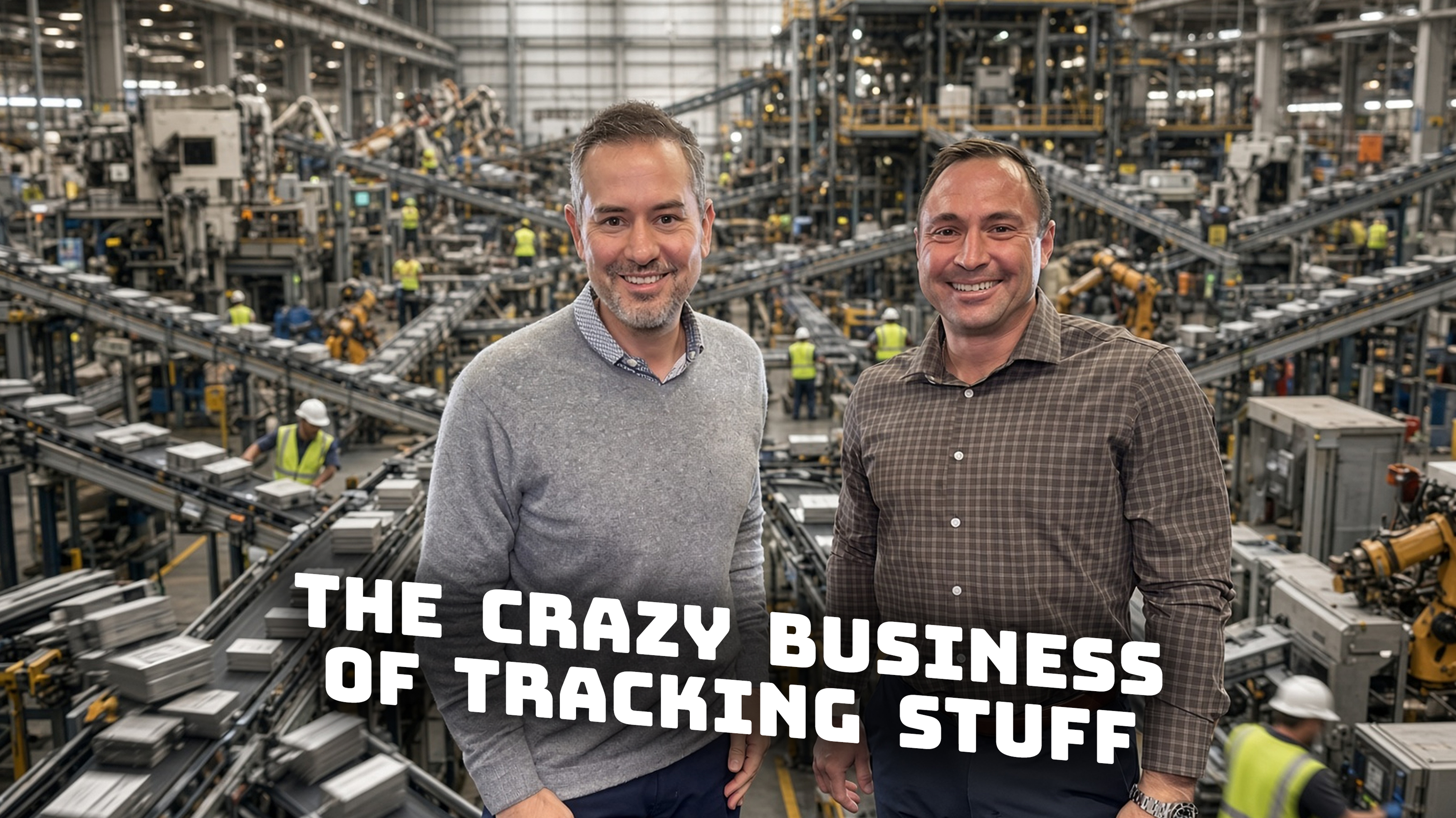


The larger a company gets the harder it becomes to track items, products and parts. Kyle Bermel, CEO of Metalcraft explains how they’ve perfected their technology and approach over decades, evolving from metal name plates, to bar codes, RFID tags, and even tech that can track a single corn kernel.
Bermel says the company got its start with metal stapler tags but throughout the years the company has evolved as manufacturing processes became more complicated. He even explains how some of their tracking tech can automatically categorize and locate items even if they weren’t put in the right storage location.

Mason City-based Metalcraft, Inc. has spent 76 years evolving from a metal nameplate maker into a high-tech asset-tracking innovator, according to CEO Bermel. The company’s origin story began when Bostitch misspelled the printing on 20,000 staplers, prompting Metalcraft’s founder to craft corrective metal plates. Today, the manufacturer serves agriculture, healthcare, defense, and logistics using barcodes and passive UHF RFID inlays. “We really don’t care what the technology that you use is to track those items,” Bermel explained. “We just wanna provide you the best solution to do that.” That mindset drove the 2017 launch of Grey Trunk RFID software, opening a 2021 Ames design facility, and prototypes tracking individual corn kernels.
Preparing for Next-Generation Tracking
Through a partnership with Iowa State University—whose research collaboration led to Metalcraft’s folded on-metal RFID tag concept in 2006—Bermel’s team tracks emerging technologies, including passive Bluetooth, environmental RFID sensing, and computer vision. “Our why statement as a business is we thrive on challenges to make the complex simple for our customers,” Bermel noted. By pairing RFID with AI, robotics, and GPS-guided yard scanners, Metalcraft helps manufacturers eliminate production bottlenecks and overcome Iowa’s persistent labor shortages through automated, real-time inventory mapping.
Leading a 100% Employee-Owned Manufacturer
Bermel, who joined as an RFID engineer and launched an internal innovation team in 2015 before completing a six-year succession plan to become CEO four years ago, also guided a major ownership milestone in 2025. Metalcraft consolidated the remaining 35% outside shares into its 65% employee stock ownership plan (ESOP) trust, securing 100% trust ownership for the next 30 years. “It makes my job really easy because we don’t have employees, we have member owners,” Bermel said, adding that “they are responsible for the sustainability and the long-term viability of that organization.”
Interview Transcript
This transcript was created with help from Ai. Please report errors to us and always refer to the video as your primary source.
Justin Brady: From the Jethro’s BBQ studio, I’m Justin Brady, and this is the Iowa Business Podcast. As manufacturing comes to the United, United States, more of it, uh, comes back, tool transferring come back, a lot of things are coming back. The science and engineering of tracking stuff is difficult. If you’re in an operations role, you have a manufacturing role, anything like that, you know that just tracking things across your organization, physical things, it’s actually kind of difficult. It’s actually pretty hard. That’s what we’re talking about today. A local Iowa company has been doing this for a long time. They continue to evolve in this space. Kyle Bermel, the CEO of Metalcraft Incorporated, joins us today from Mason City. Kyle, Thanks for coming on the Iowa
Kyle Bermel: Hey. Yeah, thanks for having me. Appreciate it.
Justin Brady: Absolutely. Okay. So, um, Kyle, we’re gonna talk about the whole breakdown on what, where you guys have evolved over the years. Um, but you guys… Can, can you give us the overall broad view of what it means to track things- Yeah … in the organization? You started out, I think, tracking staplers. Is this right?
Kyle Bermel: Yeah, that was our first, uh… So we, we say identifi- identifying and tracking. So, um, our, our stapler story is great, and, uh, it’s what we say our origin story is. And, uh, it started, uh, Bostitch Stapler Company, they had a, a challenge. They, uh, were used to pad print on the top of those staplers, and they misspelled, uh, the wording on 20,000 staplers. So our founder created a, a metal nameplate and printed it properly, and then, uh, they just laid it over the misprint, and voila, it’s fixed. And so that was, uh… They completely changed their process on how they manufactured, how they, uh, personalized those staplers moving forward, and, you know, the, the rest is really history. So started with a metal nameplate
Justin Brady: And then now you’ve evolved though, because now it’s like, you know, any organization, they have millions of dollars more of assets everywhere, where, you know, computers, equipment, pieces of things. And so you’ve evolved to tracking… Is there any limit what you don’t track these days? I mean, you track pretty much everything. What are the major categories that you’re tracking and how are you doing
Kyle Bermel: yeah, that’s what I like about our business. We’re really diverse. Um, you know, we, we do a lot in, uh, ag. Uh, that’s really where the metal, uh, nameplate started. Um, do a lot in healthcare. We do government defense. Um, we do, um, logistics, uh, manufacturing, WIP, work in process type applications. It really just depends. And, and, uh, for Metalcraft, uh, you know, how we diversify ourselves in the space is we, we really don’t care what the technology that you use is to track those items. We just wanna provide you the best solution to do that.
Justin Brady: Yeah. And so it’s not just tags on things, ’cause you’re also doing RFID.
Kyle Bermel: Yep. Barcode, RFID, all of it.
Justin Brady: all of it. Yeah, ’cause you start out just digits.
Kyle Bermel: Yeah. Just
Justin Brady: into metal and attached to, things. Right. But you guys are doing two different things, which is you’re tracking stuff, um, with tags, RFID. You’re also have, like, a software component ’cause, you know, just having things on… Having, uh, tags and RFIDs on stuff doesn’t really help me because now it’s like, okay, great. Now I ha- what do I do? Write down barcodes in a ledger? In, like, a, like, an Excel spreadsheet, and then, like, you know. So you kinda have the whole solution figured out.
Kyle Bermel: Yeah, and, and we’ve continued to figure that out as we’ve gone, um, in the, you know, 76-year-old company, so we’ve seen a lot. Um, as we’ve, uh, continued to progress in the tracking space, we’ve, uh, identified needs, uh, for our customers. And so we started into the software space in 2017, and, uh, we launched an out-of-the-box RFID solution. It’s called Grey Trunk RFID. It was for small to medium-sized businesses that wanted to get into RFID. And, um, after we saw the need and, and the desire for customers to do that, we also saw, you know, there was some bigger opportunities for us, and that’s really where our newest, uh, venture in our business services side is. So that’s when we send our people in, uh, do site surveys, site assessments, help the customer, uh, add value to their operation, and identify how and what they need to go and track their assets. So it might be putting in barcode scanners, it might be putting in RFID readers, it might be, uh, tying to their systems, whatever it may be that they need to help, uh, track their it- items. ‘ Justin Brady: Cause the problem there is that in some cases people don’t know, they, like, they don’t come to you and saying, “We need a barcode system or an RFID system.” They have a complicated operation. They don’t know… They know they need to track things. They don’t know the most efficient way to do that, so you kind of come in really, really early and you’re like, “Here’s how you could design this process within the confines of the current operation that you have.” Correct. Yeah. We use, um, you know, our expertise to g- ’cause we’ve seen it in different, uh, spaces and, uh, to go and figure out what they need. And, uh, you know, the more value we can add from that standpoint, the better off we’re gonna be as a business as well
Justin Brady: Yeah. So tell me about the RFID stuff. How, like, how much can you track? Are we, are we tracking things down to what level and what, um, are, are we tracking things that are throw-awayable, or are we tracking only permanent things? Give us a few examples of the RFID technology.
Kyle Bermel: RFID is extremely broad. Um, it’s been, uh, you know, and we– W- what I’m talking about specifically is passive UHF RFID. Um, you know, everyone, uh, has some form of RFID in their pocket with their credit cards, that’s NFC, their phones have NFC, all of those things. Uh, we’re specifically… I mean, we do NFC, but most of our, our business is done with passive UHF. And, uh, so you know, that, that allows for, um, inexpensive tags. So yes, it can go on consumables, but some of them are permanent or fixed assets or, um, you know, where we really win too, is for durable assets that need to last quite a while. So, uh, think of like returnable containers that need to go through a wash cycle or vehicle tracking that goes through your, um, car wash, right? Those types of tags that need to stay on there, uh, until they don’t. Um, that’s w- really where we win as well. But yeah, we, we’ve– I mean, the types of RFID applications that you see are, uh, just wild. Um, one of the crazy projects, we were tracking corn kernels,
Justin Brady: Wait, no. wait. whoa, What now? How do you do… Okay. Wha- All right.
Kyle Bermel: It’s just a, you know, a tiny tag that, uh, dr- gets, um, gets put onto a, a seed of co- a corn kernel, and, uh, they’re using it through the process.
Justin Brady: So you’re tracking… Wait, back up, back up. You’re tracking, um, ’cause you, you guys track inventory, you guys track stuff for companies. You can track individual corn kernels
Kyle Bermel: Yeah. I mean, you’re not gonna tag every corn kernel, but there’s some applications that they might wanna tag one in, you know, whatever, uh, amount. So I don’t wanna say too much, but yeah, it’s a, it’s a neat application.
Justin Brady: You don’t wanna say too much? What does that? mean?
Kyle Bermel: so, you know, some of it, Some of it’s, uh, you know, in prototyping and things like that. Oh. But yeah, some of the applications that we see are, are extremely challenging, and those are the really w- the ones that we like, right? Uh, our, our why statement as a business is we thrive on challenges to make the complex simple for our customers and, and, uh, you know, that’s really what we try to do.
Justin Brady: So you’re– Okay, so you’re tracking obviously permanent things, consumable things, w- uh, things that are, you know, have a very short s- shelf life to things that have a very shel- long shelf life. But you can operate under some pretty insane constraints, which is something as small as a corn kernel that also has a very short shelf life. Can you talk about the technology behind something like that? Are you h- putting a little, like, dissolvable thing? Are you putting a transmitter inside the corn kernel yourself? Are you Micro laser etching? a code on it?
Kyle Bermel: most of, most all of our applications are, um, what we call an inlay. So that would be a, a piece of material that has a, an aluminum antenna on it. Sometimes it can be other metals. And then we attach a small IC onto it. So, um, depending on, you know, what the application is and how it needs to be used, we can design those inlays, uh, with specific size and read performance requirements for the customer’s application. And we, we really, uh, grew that, into that space. We brought on a, a new facility in Ames, Iowa, uh, around COVID in 2021, and, um, that’s actually just where I was before. Now we’re trying to expand that, uh, facility. But, um, so, so that we can, we have the designers on staff that can go and build that out for our customers, and it’s been a, a great benefit for us
Justin Brady: Now is this something like the corn kernel? I’m obsessed with the corn ker- We’re going to spend, by the
Kyle Bermel: I see this. I think it’s a cool statement. Yeah, yeah. Um,
Justin Brady: we’re going to spend the next 20 minutes on corn kernels just to everybody can… No, just we’re not gonna do that. But, but it is fascinating because I do understand, uh, I used to have a client, people know there’s a backstory here, but I used to have a client in, uh, micro manufacturing. So I understand the, the difficulty of operating at small, especially something like corn, that there’s no two kernels are the same. Right. Right? So I understand the limitations there. Um, i- but is this something that’s actually transmitting then, or is this… ‘Cause it doesn’t sound like it’s just a barcode
Kyle Bermel: No, yeah. It, it, it’s a, it’s a passive UHF RFID tag,
Justin Brady: of a like bounces,
Kyle Bermel: Correct. And yeah, that’s how it works. So, uh, you know, a reader sends a signal through an antenna. The– An inlay that we manufacture, uh, receives that signal, powers up the chip, and then responds with the information needed
Justin Brady: So I, I wanna ask about… This is, ’cause this is so interesting because the company started out tracking staplers. I would, I would guess that that line of the business probably is, is either gone or not exactly profitable these days. And so you have made several evolutions. You’ve gone through these metal plates, stamping numbers, barcodes, RFID now. Um, as tech… And you see this because you’re in all these operations, you’re in a lot of different verticals. Where’s it gonna go? Yeah. Because RFID right now is pretty sexy stuff. Yeah. It’s pretty useful. But, uh, as a company, you’ve stayed relevant for a long time. So what is that next thing that you’re like, “Hey, we know in the back of our mind RFID’s hot now, but we know in the next y- you know, blank years, it’s gonna phase out and this thing’s gonna replace it.” What’s the next
Kyle Bermel: Absolutely. Yeah. Um, there’s, there’s a lot of different things that will, that will take its place. Um, that’s really why we did our business services side, uh, so that we can be at the forefront of finding those out. Um, w- the, the couple I see, um, we- we’re pretty heavily into passive RFID sensing, so not just the ability to read an RFID tag, but, you know, figure out some element. Is it– Is there moisture present? Is there metal in the vicinity? Is there, uh… What’s the temperature? Those types of things. Uh, that will be one of them. And then the next one I think is, uh, passive Bluetooth. So everyone understands Bluetooth technology. You know, most of them have a battery. Uh, there’s a new, uh, technology coming out with passive Bluetooth. I think that’s, uh, definitely gonna, uh, be in the, the realm, uh, of conversation. And then, um, you know, the one that I always get worried about in the future is vision, uh, you know, taking over, uh, and moving our cheese, as we say in our business, you know, ch- uh, changing, uh, our trajectory. So those are all the ones that we’re, we’re tying closely to and, and trying to figure out where we play at, but, uh, that’s really why we did the business services, so that we understand it and how it can add value to the customer.
Justin Brady: And when you say vision, I think what you’re saying is that the fear being that AI and computer vision can get so good at tracking with surveillance systems or high-resolution cameras that you don’t need to attach any barcodes to the things themselves. Right. Right? You-
Kyle Bermel: be direct part marking, lot of different ways to, you know, identify a specific item. Yeah
Justin Brady: Do you think that I, I– Maybe I’m wrong, but do you think there’s ever going to be a future where we have that level of visual coverage on every possible angle? Like, that seems
Kyle Bermel: Well, ever’s a long time. In our lifetime, maybe not, but, um, you know, I, I don’t ever wanna be someone that says, you know, ever. Right Um, but, you know, yeah, there will become a time at some point where if it’s, you know, even the, how a, how a thing operates or hums or whatever, you know, it might not be vision, it might be sound, whatever it might be, there are gonna be ways to identify things. In the next 30 years? Maybe not, right? Sure. Um, but, um, hopefully I’m, I’m, uh, still around to see it,
Justin Brady: How is, um, AI and automation, because a, a lot of people, even Iowans, don’t understand how advanced we are in manufacturing in the state. Yeah. They’re like, “Iowa’s an ag state.” I’m like, “And manufacturing.” And you don’t really m- connect the dots until you talk to people in other states, and they’re like, what do you do in Iowa?” You know. Um, and so I guess, I guess the question is, how has AI and automation changed the business right now in a good way? Um, I mean, probably there’s no bad way, but how, how, is AI and automation, how are you working with AI and automation tools with the current I- RFID tags right now? I’m assuming these things are very intricat- intricately connected.
Kyle Bermel: would say, um, you know, AI is obviously in a, in a different spot. I’m not saying it from an AI standpoint, but, uh, w- with RFID and AI, it’s, it’s in the early inception phase still. We, we do see a lot and I, I think we see the need for RFID helping the AI, uh, with identifying it. Uh, we think that’s a huge thing. We don’t have a ton of customers right now that are doing it, and, you know, we’re pretty tied to the industry, and we are not seeing that quite yet. Um, I, I would say maybe mostly in the retail space, that’s really the, the leader from an RFID standpoint in how, um, RFID is used in specific applications. It’s kind of been the driver of, uh, RFID kind of proving the way. Um, and so we, we actually don’t sell a ton into the retail space because we like selling things that have a little margin in them. But, um, that– I can see it being used more there, like what’s needed f- where, where do we need our inventory, all of those things, um, and using AI to, to help with that decision-making.
Justin Brady: Yeah. I mean, you– I know you guys have an innovation pipeline, so are there future cases and future scenarios you’re like, “Ooh, as Optimus or as Figure come into the workplace, and as these computer vision systems come into the workplace, here’s where we fit really, really well, and we’re getting ready for this, and sales is getting really excited about it.” What are those areas?
Kyle Bermel: of that’s our, our work in process in manufacturing. That’s really where our business services has taken off and how, um, the RFID can help those manufacturing companies make better business decisions on the product floor m- as the product’s being made.
Justin Brady: Yeah. So Is this like commu- like a RFID and the antenna systems communicating to AI and automation processes so that, um, which is too much for a person to track. Mm-hmm But, um, um, an AI system could say, like give you almost a real-time data map of where all your product is and what’s slow and potential, potential heat map of problems in a manufacturing facility where you’re like, “Huh, our product is al- always hitting a bottleneck right here.”
Kyle Bermel: Yep. And, and you can do that right now with RFID, it’s just with when you add AI to it, it’s faster. You’re seeing more predictive as opposed to reactive. Uh, so yeah, it’s, it’s definitely, um, uh, gonna happen and will, uh, will happen. We just– One of the… You, you know, you brought up the heat map and y- the location stuff. We just, uh, did a, a really cool install, uh, down in Mississippi. Uh, we built a golf cart with GPS on it that had RFID readers so that they, the, the company can figure out where all of their things are that they just placed there. It’s a steel yard, so they lay down steel pipes, and they need to find them, and then they need to find out, like, what’s the best route, you know, to get it to a certain place. All of those things can be done, uh, with the RFID tags
Justin Brady: Because they have everything tracked. They have all, the pipe tracked
Kyle Bermel: all tagged. Yep. It’s all tagged. They’re, they’re moving through the yard m- daily to figure out where everything is and if it’s gotten moved to one spot or another. It’s, it’s a pretty cool application.
Justin Brady: actually interesting- because they’re not pre-tracking it. They’re not like when they drop things off- they’re not like saying, ” I put that in lot one.” M- Maybe they are to a point.
Kyle Bermel: here’s the thing with that. I… You know, that’s the, the… You know, everyone thinks that’s what you would do.
Justin Brady: Yeah.
Kyle Bermel: Sh- It’s only as good as the, the human doing it- Correct then, right? So I mean, your process is only as good as
Justin Brady: a lot of administrative work.
Kyle Bermel: Yeah. And, you know, uh, as people turn over or, you know, things get busy, did I put it in the right spot? Now you know, right? You know.
Justin Brady: So now it’s just like, let the people do their job. Yeah. If you have an open lot, if you have an open spot, just put it there. Yeah. And then we’re gonna run a golf cart through and it’ll automatically categorize everything for you- Exactly. is essentially what you’re doing. Yeah. Um, how is… ‘Cause you, obviously Mississippi, I know you work with companies a- uh, all over the world, I think. Yeah. Um, let’s, uh, let me ask an Iowa specific question because this is the community in which you live and operate. Are we different in Iowa? Like are we leading in anywhere particular? Are we doing things differently? Are we maybe getting behind the curve in manufacturing? Are we getting ahead of the curve? Are we keeping up with the curve? Where are we at here?
Kyle Bermel: Yeah, it’s a, I mean, it’s a broad spectrum. I think, uh, we’re right, we’re right in the thick of it. I don’t necessarily think we’re, we’re leading, but we’re not lagging either. Um, yeah, I feel really good about the manufacturers that we work with in Iowa, and I know that there’s also, uh, companies that, that can benefit in the state, um, from using a technology like this.
Justin Brady: Yeah. Interesting. I wanna ask about the ISU partnership. Yeah Um, because you, you’ve partnered with ISU on the pipeline on creating new stuff. Yeah. Tell us about that. What, what, what’s involved with that?
Kyle Bermel: Yeah, they have a, um… You know, we, we like the engineering college a lot at Iowa State, um, and we also tie to them in multiple ways, you know, through the engineering school, but also we have a facility down there, uh, through the research park. Uh, so, um, dual facet there. But in the past, we’ve used them, uh, for various projects and research projects. Uh, one of them is still a product that we sell quite a bit of, is a on-metal RFID tag. RFID and, and metal don’t typically go well together, right? Physics.
Justin Brady: is it interrupt
Kyle Bermel: It does. It does. It shorts it out, in essence. So, um, in 26, twen- 2006, um, created a concept, uh, about a folded, uh, RFID tag, and we were able to figure out how to manufacture that, and, uh, we’ve been, you know, building a version of that ever since. So it’s been, it’s been a really nice partnership for us.
Justin Brady: That’s interesting. Yeah. I guess- you don’t really think of, um, thing– when things get really, really small, um, low energy, they’re lower, Way low energy or no energy And also when things get really, really small, they’re less robust, So there’s more interference. there are more issues. So yeah, if you’re putting an antenna on a metal thing, the metal is another antenna. That poses some issues
Kyle Bermel: Well, it can, and can, it can solve some problems too. We’ve, we’ve had applications where we’ve actually used the metal of an item to be the antenna. So I mean- Sure, uh, just, it just depends, you know, what you’re trying to solve and, and that’s why you have to look at each application specific.
Justin Brady: What’s the relationship look like? You mentioned you’re at the research park. Are you Like working
Kyle Bermel: We’re a lessee of them. I mean, we, we lease from them office space or, uh, manufacturing space actually, uh, for, from that standpoint. And what that does is that opens you up to, um, you know, all of the equipment that they offer at the s- school or might have available, you know, easy access to the professors, easier to get interns. Um, that’s really, uh, a, a nice, uh, opportunity for us. And there’s a lot of businesses in Iowa. We’re not novel in this, but there’s a lot of businesses in Iowa that utilize that. Mm-hmm. Sure. Yeah. And it’s, it’s proved very, very well.
Justin Brady: So their students are working with you sometimes- to find solutions and stuff like
Kyle Bermel: that. Absolutely. Yep. And you can partner with them on specific capstone projects or there’s a whole gamut of different ways you can partner with Iowa State.
Justin Brady: And do you ever have some students surprise you over there where they’re like, you know, you have all your engineers and people working on a problem, then one of their students is like, “Well guys, have you done this before?” And you’re like, wait, what did you just say- Have you had that situation
Kyle Bermel: we have in in a smaller scale, but yeah. I mean, it’s always, you know, uh, with anything is if you get a new set of eyes, fresh set of eyes, uh, it works out really well.
Justin Brady: Fresh set of foolish eyes. People who don’t know- that this is not possible- and therefore do it anyway. There’s a really cool story, a company that I used to work with, and he had all these top PhD level engineers and he said, “I wanna do this thing.” And all of them are like, ” You Can’t do that. thing.” And he’s like, “Cool, then why do I need any of you?” And He fires them all. And he gets a bunch of students that don’t know it can’t be done. and He says, “I know it can be done. Figure it out.” And of course, they figure it out. So I lo- I love that. I love that story. Tell me about, I know you made this transition. I wanna ask about how you did it and why you did it. Uh, is it, and correct me if I’m wrong on the date, is it 2025 you transitioned to be an employee-owned company?
Kyle Bermel: Yeah. so, um-
Justin Brady: us about that…
Kyle Bermel: so we’re, uh, we are 100% ESOP, so we’re 100% em- employee owned. Uh, we actually were 100% employee owned prior to 2025, but we had, uh, 65% of the business owned by the ESOP trust, and then the other 35% owned by outside of the ESOP trust, but people that worked at the organization. So in 2025, uh, we were becoming a mature ESOP, uh, so we were running out of shares to allocate to our members moving forward and, uh, got everyone together, the 35%, and, um, you know, worked on a sale to the trust. So selling the remaining 35% back to the company for the ESOP to set it up for another 30 years. So, um, it was, uh, it was a great move for, uh, the outside, uh, investors. It was a great move for the members of the ESOP, uh, and the company as a whole.
Justin Brady: And so how did you do this? Like, uh, you know, was this a pretty difficult process? Was it a bunch of lawyers? Was it a… ‘Cause you have current shareholders- you know? So you have to get them on- board, and you have to convince them it’s good for the company. How did– Tell me about that process.
Kyle Bermel: Yeah, it was unique too because I was all three too. So like I was the company, I owned outside and then I obviously owned inside the ESOP as well. So Yeah, yeah. So I mean it, yeah, it was, it was a lot. I mean, I think a lot of the, uh, getting the members on the outside the ESOP on board, they, they were extremely selfless from the standpoint. They understood the benefit, uh, to the organization, which is, you know, they, they work at, uh, and also their, their fellow members, and I think that helped, uh, with the, with the process. You know, there were some levers that we could have pulled that, you know, wouldn’t have made it as lucrative for them. But, um, ultimately everyone was on board and it, it was really smooth or relative to what it could have been, and I’ve heard some horror stories of, you know, those 100% transactions. Um, uh, we fortunately did not have anything like that, and it’s, um, you know, we’re two years in, uh, continuing to grow the share price after the, after the sale and, uh, yeah, it’s just a great, great thing for our member owners
Justin Brady: You mentioned talking about the benefits of such a transition. Um, what would that be? What are the be- for those who are like, “Well, I don’t… We’re– I just, you know, we, we have private owners, couple private owners, handful of private owners,” and what would be the benefit of doing an employee-owned organization at all? What’s the value to
Kyle Bermel: Yeah. So, I mean, there’s, for the people selling on the original transaction, there’s a benefit because there’s a tax benefit. But, um, for the, the company and the owners inside the ESOP, you know, it makes my job really easy because, uh, we don’t have employees, we have member owners, right? And they are responsible for the sustainability and the long-term, um, viability of that organization. So it’s really easy to motivate members because, um, you know, their future relies on the, the performance of the business in the short term and the long term
Justin Brady: W- the, um, w- tell me about the story. You, you weren’t CEO, you weren’t, like, the founder of the organization. You started as an RFID engineer, I
Kyle Bermel: That’s
Justin Brady: And then you worked your way up to CEO. Tell me about that process.
Kyle Bermel: Yeah, I, I started as a RFID engineer, and I didn’t even know how to spell RFID. So, uh, yeah. Um, uh, I, I was recruited into the organization just because of, um, you know, they liked the background that I had of being a, a farm kid that worked hard and, and, uh, you know, could learn. And, um, I did know how to, to, to write some code. Um, so, um, started with the organization, and then they started putting me in leadership roles, uh, you know, running specific teams in the organization. And then, uh, in 2015, I started what we call our innovation team, and that was really, uh, uh, just a small team within the organization. It wasn’t our primary role, but our goal was to challenge the status quo of the business. You know, how we sell, who we sell to, what’s the future look like. And, um, from that, we, we found our, um, Grey Trunk, right? So we– Our, our, um, our out-of-the-box RFID solution. We proposed that to the, um, to the leadership team at the time, and actually, they rejected it the first time. And then,
Justin Brady: they do.
Kyle Bermel: exactly. And then it made us better, right? And so we went back to the drawing board, figured out what needed to happen, and then, um, when we launched that, they asked me to run that and, um, get that off the ground, and that’s what got me onto the leadership team. And, and right around that time, um, Steve Doerfler, he’s our previous CEO, and he’s a mentor of mine and, um, you know, con- uh, just a, a great, great man. Um, he was working with me on, you know, trying to get better and how to– trying to figure out what the future looked like. And, uh, he started a, a, it was about a six-year succession plan. And, uh, so went from on the leadership team as the VP of technology to COO to president and then CEO. I’ve been in that role for four years now.
Justin Brady: As, uh, ’cause you used to be in the innovation team, so your job was basically, um, looking into the future, Pitching ideas at leadership And having them rejected. Yeah. All the time.
Kyle Bermel: Yeah, All the time. All the time. This is,
Justin Brady: you know, this- is what in those departments are used to. Yeah. It doesn’t mean mean they’re wrong, it just means that leadership d- can’t see it often. So does this change the way you are a CEO now? Uh, like, or do you fully realize that you’re getting pretty great ideas pitched at you a lot that you’re biased to speak against? Has this changed how you lead?
Kyle Bermel: Um, yeah, a little bit. I, I, I actually, um, push my team to, to come up with more of those ideas. And I think maybe some of what I, I do wrong is, um, still they think of me as the idea generator, you know? And, and trying to get out of the way, uh, of that. And I, I’ve tried to, like trying to step back more from being on the product development team and things like that, ’cause that’s actually what I really love, right? I love solving those challenges. Um, so I, I do recognize that’s a blind spot of, of mine. I need to, I need to allow them to, to fully go. But, um, it’s– in the past year, it, it’s gotten better, and, uh, starting to see some of our, our great young talent, uh, bring in ideas and, and being able to, to, um, feel, uh, like they can really bring them and, and pitch them and okay to fail, that type of thing, so.
Justin Brady: Last question. is that you have a very, very data-rich view of global manufacturing operations and, of course, Iowa manufacturing operations. Um, as manufacturing right now, I think, you know, trade are, is a little tur- is, is a little turbulent, for lack of a better term. What is the big Iowa threat, or is it an opportunity that Iowan, Iowa manufacturing really needs to get out ahead of?
Kyle Bermel: Well, I think if you talk to anyone, it’s, it’s the labor force. So finding ways to… I mean, at least what I hear, right? Um, and when I’ve seen– Finding ways like, uh, tracking to, uh, you know, be more productive with fewer people and, and utilize the technologies that are around to, to increase your throughput. I think that’s really where we’re gonna win, uh, as Iowa, ’cause I don’t… There aren’t a ton of people flowing into the state. I, I don’t know the exact stats. I’m sure you do. But, um, you know, um, we just need to get, we need to get more productive with the people we have.
Justin Brady: Mm-hmm. Does that- include, um, getting AI to fill some of those gaps?
Kyle Bermel: It includes AI, it includes, you know, technology in many different facets, not just, um, you know, language models or anything like that, but, uh, robotics and, and RFID like we’re talking about, and vision and all of the things, uh, and, and really tying those all together, uh, to, to get your, get your throughput up
Justin Brady: Yeah, and this is… We’re not gonna go into this topic in detail today, but everybody who’s like, “P- oh man, AI’s disrupting jobs.” I’m like, “Yeah, show me the jobs. Like, every single… Like, the AI, what AI is coming for is severely, um, severe job shortage areas. Um, and, uh, if you, like anybody who has the whole AI ruining the economy viewpoint, I would suggest that you go to frontline workers themselves in manufacturing in all these areas and ask them about job shortage areas. And you’ll be like, “Oh, maybe we need this yesterday.” Uh, Kyle Bermel, the CEO of Metalcraft Incorporated in Mason City, thank you for coming on the Iowa
Kyle Bermel: for having me. It was great
Justin Brady: wanna reach out to you guys, see what you’re all about, how do they do that?
Kyle Bermel: Yeah, idplate.com is our, uh, our URL. Um, and we are pretty active on Facebook and, um, and Twitter as well.
Justin Brady: Kyle, Thanks so much for coming on the show.
Kyle Bermel: Appreciate it