


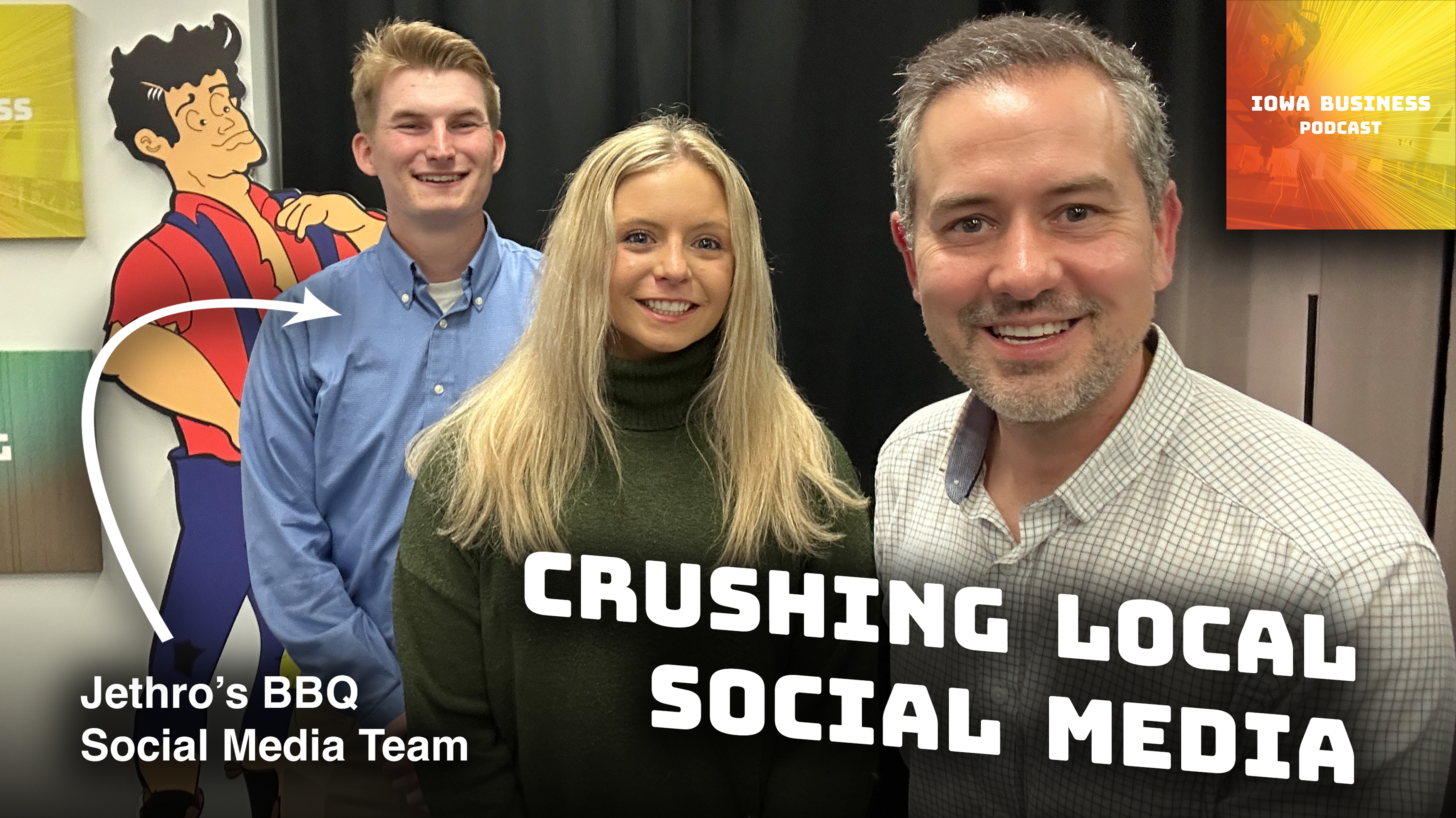


Tens of thousands of views for balancing drinks on a server tray? Jethro’s BBQ social media team posts content that, upon first inspection, doesn’t seem to have anything to do with their line of business. But clearly something is working. Social media leads, Mason Jeffries and Macy Dirksen, discuss people is more important than tech.
Jeffries and Dirksen, both University of Iowa, Tippie College of Business grads, explain the method behind the madness and why business owners over complicate social media marketing. They explain why short videos of antics and getting tossed into dish water are more relatable to viewers than what most other local business owners do.

The marketing team behind Jethro’s BBQ and Splash is redefining local social media by prioritizing human relationships over technological gimmicks. University of Iowa Tippie College of Business graduates Dirksen and Jeffries have shifted away from traditional, polished food advertisements toward zany, relatable content featuring their staff. This strategy routinely captures between 10,000 and 20,000 views per post on platforms like TikTok and Instagram. “Our big mindset is that people do love seeing other people, and we’ve noticed that through our socials,” Jeffries explained, noting that spotlighting standout servers from Google and Yelp reviews drives deep community connection.
Dirksen, who frequently bartenders to maintain direct contact with consumers, emphasized tailoring content to specific platform demographics rather than cross-posting identical material. While TikTok captures a younger crowd with short-form videos, Facebook and X serve an informational role driven by graphics and food photography. “But it really matters when it comes to social media because people love relatable content, funny content,” Dirksen noted regarding their unconventional video style. Beyond digital spaces, the duo leverages community-oriented campaigns, including a reading program that engaged 7,000 local children and targeted fundraisers for organizations like Girls on the Run.
Hear from Iowans directly. No algorithms.
Don’t let the algorithms choose your news. Enter your email address to hear directly from Iowans leading news in politics, community, agriculture and business. No editing. No clickbait. No rage. No agenda.
Optimizing the Consumer State of Mind
When measuring return on investment (ROI), the team carefully segments free social media outreach from high-cost print and venue advertising. Using scheduling tools like Pop Menu, they design campaigns that align with a consumer’s physical environment and state of mind. For instance, venue ads at Hilton Coliseum remain minimalist to respect the audience’s attention span, avoiding complex calls-to-action like QR codes in transient environments. Ultimately, their overarching digital and physical strategy remains grounded in authenticity. As Dirksen stated, “Our motto is people over everything, and that’s just one of our values.”
🫶
This show is a collaboration. IowaPodcast.com collaborates with loved Iowa brands to bring value to listeners. Brands compensate our hosts directly for their time. Learn more
Interview Transcript
This transcript was created with help from Ai. Please report errors to us and always refer to the video as your primary source.
Justin Brady: From the Jethro’s BBQ Studio, I’m Justin Brady. And in a weird turn of events, we have the Jethro’s team in the Jethro’s BBQ Studio. I think we just ripped the time-space continuum today. But we’re talking about local social media for businesses, ’cause this is one area that they all struggle with. Now, for those that don’t know, I work full-time PR comms, uh, for some bigger companies on the side. This is, like, my side fun local project. But it’s the same problem nationally. People struggle with social. And of course, being the Jethro’s BBQ Studio, I talk to Bruce, I talk to the Jethro’s people sometimes, and I was like, “Why is your social so freaking crazy? Like, you have people balancing cups on a tray, and you have the people throwing people into dishwashers and stuff, and it’s, like, 15,000 views for some of these things. Like, what is going on over there at Jethro’s?” And, and Bruce is like, “I think you should just talk to Macy Dirksen and Mason Jeffries,” who do all the social stuff. Of course, some Tippie College of Business University of Iowa grads with us as well. Thank you, both of you, for coming in the studio.
Macy Dirksen: Thank you having us
Justin Brady: Thank you. Is it weird to be in your own studio that you’ve never been in before?
Mason Jeffries: A little bit,
Macy Dirksen: but we’re happy to be here.
Justin Brady: little bit, yeah. No, we’re happy to be here. Of course, we’re all joined by Jethro. He’s off in the corner. We’ll take a selfie with him, and we’ll post that to all the socials. Um, first of all, I want to, uh… Obviously, I appreciate you being in here. You guys are absolutely crushing it. Because what I see most, uh, businesses do, most restaurants do, is they just post the same crap. They just post, like, pictures of food or stuff that’s not very interesting. You guys obviously post pictures of food. That’s fine. But you add in a layer of creativity, and you’re getting crazy views, like 10,000 views or, in, in some cases, 15,000, 20,000 in some cases, for stuff that I think most business owners would be like, “I don’t understand why that. Like, isn’t our star the food? Isn’t our star the product?” But you guys are focusing on these zany stories and the people, and getting crazy results. So we wanna go into detail on how you guys are doing this today. Can we start with, um, social media? Can we start with that? I wanna talk about the, the social media aspect, how you guys are planning that. Before we do, though, also wanna give a shout-out to our business spon- sponsor, Dentons Davis Brown. They actually have lawyers that sponsor us, uh, with other- us on the show. Jethro sponsors the whole studio, and then Dayton- Dentons Davis Brown sponsors the business show. And what they do is they bring in their talent in here to answer questions on the legislative session, on immigration, how that works from a business perspective, on HR recruiting and talent, and on the state of M&A deals here in Iowa. So go check all that stuff out at Iowapodcast.com/business but let’s start with one thing, your, your overall ethos, I guess, on, like, people connect with people. They don’t con- really connect with brands. I don’t know who wants to go first on that one.
Macy Dirksen: Permiss
Mason Jeffries: Um, so yeah, our, our big mindset is that people do love seeing other people, and we’ve noticed that through our socials. Um, we will end up getting way more views on things that have features of, you know, people or our guests, our, our servers, just people behind the brand that, that really make it run. Um, it, it, it’s cool to see, um, in this day and age that that still matters. People wanna connect with other people. And we’re doing it through, through different ways, different community events that we’re in, and, um, we’ve just had a really, really fun time exploring that opportunity because, I mean, there are opportunities with graphics to present information and, and do the things that we need to do to get our message acro- across, but it’s important to, to still maintain that, that connection to the community
Justin Brady: Yeah, so you’re doing that by highlighting these, like why do these stories, these, these, uh, you know, balancing cups and throwing people in dishwashers, like, uh, I don’t even know if you know what I’m referring to. You probably do. Why does this, like, I think business owners look at this and they’re like, A, why does this work? And B, how, how would this grow a social media following, in this case, for Jethro’s? Like, w- why does it work and how does that grow a following?
Macy Dirksen: Sure, sure. It, it is a little risky and that can be scary for a lot of businesses just because it’s not the most professional, um, polished looking form of advertising. But it really matters when it comes to social media because people love relatable content, funny content. That, that’s really what’s gonna get the views. While, um, you might see a picture of one of our amazing Papo’s burgers, um, that’s great, but that’s not gonna push, um, more views quite as much as something like balancing the trays or getting dunked in the, uh, um, the dishwasher. So yeah, that was me.
Justin Brady: Oh, you wait, th- you were the one who got… That was oh, so you’re you gotta… the team
Macy Dirksen: yep. You gotta really commit.
Justin Brady: Mm-hmm. I was like, “How did you find someone willing to do that?” And so of course, one of the social media marketing people were volunteering themselves. Really?
Macy Dirksen: you really…
Mason Jeffries: we are the ones that have to
Macy Dirksen: Yep.
Mason Jeffries: We’re paying.
Justin Brady: the ones. Yeah. So if you wanna see Macy get thrown into a, a sink, um, go watch the social media profile. Uh, one of the things that you note is that l- and this is another thing that brands struggle with, that TikTok isn’t Facebook, isn’t Instagram, and I feel like people think I should just do, throw… And truthfully, because we post so much content, we do post the same stuff across all channels. We just publish to everything. But from a brand standpoint, and at least a Jethro’s and Splash standpoint, y- one of the things you sent me earlier is you, same content doesn’t work for every platform. Like, you have to understand these platforms are very different. What does that mean for a business owner?
Macy Dirksen: Absolutely. Well, I think you just have to know your audience. Um, in something like a platform such as TikTok, that’s just gonna be a younger crowd. Um, they have different preferences. They have different things that they like watching, as opposed to Facebook. They want, might want more information, uh, more of those food photos. Um, so it’s really just about knowing the audience, I would say
Mason Jeffries: Yeah, I, I would 100% agree with that. I think that a lot of times you’ll see TikTok and Instagram being more of that younger generation on those platforms, and then Facebook and, and Twitter or X, whatever you wanna call it, um, those are gonna be more information-driven, um, guests that we’re getting our message out to. So that, that works well for graphics or food photos, um, whereas TikTok and, and Instagram, we’re trying to do more with short format content. Um, those are the, the fun videos like you referenced of us throwing Macy in the, in the sink or, or things like that. So yeah
Justin Brady: How do you know? Because you mentioned, like, you n- have to know your audience and know the platform. How do you know what, like, the Jethro’s or what the Splash audience wants on those platforms? How do you figure that out?
Macy Dirksen: I would say there’s two parts to that question. So as far as platform, um, every platform has a form of analytics at, uh, some level, and it kind of gives you the key to what your audience is. You can see the age range on most, the gender, uh, geograph- graphical location in most cases. So that kind of just gives you an easy tool, like say, who’s, who’s watching my videos and how can I cater to them? Um, what do they like? What kind of food are they interested? What kind of specials would they want? Things like that. Um, and then as far as the difference between maybe Splash or Jethro’s, um, obviously that’s just a different type of consumer. Um, where we see that Splash, they care a lot more about the food. They wanna see those beautiful, uh, lobsters, um, the crab, these giant shellfish platters. Um, but where Jethro’s is just more of a, a casual vibe and they like more of the people. Uh, there’s a strong support in the staff, um, and yeah, it’s just, uh,
Mason Jeffries: No, 100%. Yeah, we, we, uh, have noticed that with Splash, they’re looking for that fine dining. They’re looking for that experience-driven where, um, we’ll do like classes for them where they get to experience like different spirits and, and learn more about those, those different spirits. You had Rex on a couple, couple months ago and he talked- Yeah, that’s right extensively about it. Um, but, uh, yeah, we, we like to push some of those types of ideas on, on Splash. They, they’re looking for those events and, and whatnot. But with Jethro’s, it’s more community-oriented, it’s more family-friendly, um, people that are looking for, for value opportunities. Um, so we’ll do more, more of those types of promotions and, and put those across our, our platforms.
Justin Brady: Are you like, uh, reaching, are you like, uh, surveying or asking your customers what they want a lot on social media? Are you just looking at the numbers and saying, “This stuff didn’t do so well, this stuff did do well, so we’re going to do more of the stuff that did well”? Are you jumping onto like, everyone on Instagram right now is doing this trend, we’re gonna jump on then, to that too, and like g- get inside that momentum? Are you doing, which of those are you doing more of? Are you doing all of it?
Mason Jeffries: Yeah, I think we do a lot of all those things you just mentioned. Um, but we also look at all of our reviews as well across all our platforms. So using Google reviews, um, Yelp reviews, all of those, um, helps, helps us kinda see a bigger picture. Um, so we have some servers that get tons of amazing reviews, and those are the people that we wanna, wanna spotlight and, and shed light on because people like celebrating other people and their accomplishments,
Justin Brady: So hold on. Okay, hold on. You are looking at reviews when people give name shout-outs. Mm-hmm. And then you are taking those workers, those staff, those servers, and you’re highlighting them in social media. Really? That’s cr- so I guess the idea there is that these people made some kind of connection with the customers, so we’re going to ex- amplify that connection to more people.
Mason Jeffries: Exactly, yeah
Justin Brady: That’s, that’s a, that’s a really good idea. I love that. Um, do you do any kind of… So is that your primary driver of listening to customer then through reviews, or do you have any other tactics?
Macy Dirksen: I would also say we are lucky enough to both, um, be in the restaurants quite frequently, and we get a lot of, like, feedback just from our guests in general just by hearing what they have to say. Um, I’ll be bartending at Jethro’s, uh, quite often, and people will tell me if they saw one of our emails, um, our TikTok. I was the TikTok girl for a minute, so,
Justin Brady: You are the TikTok. What does that… We’ll ask about what that means
Macy Dirksen: but, um, yeah, so we really get that firsthand kind of feedback, which, um, a lot of people don’t get. Um, but we’re lucky enough to have that firsthand, um,
Mason Jeffries: Yeah, no, it, it’s, it’s true. Like we, we are in stores quite a bit, whether it, we’re getting content or even helping out in those stores, um, for bigger events. And when we do that, we also interact with the servers themselves that are putting in that hard work, and they let us know what’s working for them and, and how we can improve, and we like to take that feedback. And maybe they haven’t seen an Emme Necker challenge in a couple weeks. Mm. So then we’ll, we’ll post about that and, and then we might have two or three the next week. So it’s, it’s cool things like that where we can see what is working, what isn’t working, and then push people kind of towards the direction that we’d, we’d like to see them go.
Justin Brady: This is interesting because I think some larger brands have very removed marketing teams that don’t really un- ‘Cause I deal with this a lot, and they don’t really understand what the customer wants. They don’t really know who their customer is. And so one of the things that marketers will preach a lot is get closer to the audience and talk to them and understand. And this is something, whether by design or whether just, you know, Jethro’s is, has, you know, staff wearing multiple hats, whatever the reasoning is, this is something that you guys are doing, is that, you know, you said you’re bartending. So you’re talking to people one-on-one a lot. And so it sounds like this may be one of the strategic advantages you have in digital and social media marketing. Correct me if I’m
Macy Dirksen: No, a- absolutely. I think it, it gives us a, a huge advantage. Um, but I mean, for those that aren’t able to get so close to the consumer, we do look at analytics quite a lot, too. Um, we’re able to see conversions by the amount of reservations we get at Splash, for example, um, the impressions on any of our posts. So we do, we do take those things into consideration as well
Justin Brady: You mentioned earlier, I don’t know if it was you, Mason, or Macy, I don’t know if you said this, but you mentioned, uh, a little bit about that you guys have community-focused content too. So it’s not just the content, but you also do community-focused activities, um, which seems to drive some attention to your socials as well. Can you talk about that?
Mason Jeffries: Yeah, I mean, do you wanna talk about the reading program a little bit?
Macy Dirksen: Oh, sure, yeah. So, um, one awesome opportunity we’ve started within the last year is our reading program. Um, throughout the school year, we provide, uh, kids free, uh, kids meal certificates, um, when they hit their reading goal, and that’s just kind of a partnership we have with, uh, the teachers at local elementary schools. And, um, this summer, we’ve also integrated that into the libraries. Um, we’ve had about, I think, 7,000 kids sign up, so, um, really encouraging reading. That’s, uh, one thing we do for the community. Um, then we also do a lot of little things on a daily basis, a lot of, um, donations to, um, local charities, and we work very closely with local schools. Um, just anything we can. And, um, while yes, we do use that for our social media as just, like, kind of to show how much we care about our community and how much we wanna give back. And by highlighting that on our different platforms, um, we hope that people get that message that, uh, we wanna present
Mason Jeffries: Yeah, no, it’s something that we’re really passionate about, especially with like those fundraisers that she kinda talked about. We’ll do like long drawn out fundraisers for, for folks or we’ll do one day events. Uh, like recently we did a one day fundraiser for Girls on the Run, um, which is a, a big organization here in central Iowa, and we wanted to raise some money for them and all the great programs that they have. Um, and that drove traffic to our restaurant, but also was something that feels good for everybody to be a part of
Justin Brady: That’s … See, this is interesting because some of the, some of your more successful campaigns actually started with contributing and donating or getting more involved with the community, and I think most people separate those things. I think most people just, um, don’t understand that when you get involved and give to your community, the community note, does notice that, and they get excited by that, and they wanna do business with businesses that think like they do.
Mason Jeffries: Mm-hmm.
Macy Dirksen: Absolutely
Justin Brady: Um, you mentioned, um, there, I mean, there’s basically, you guys have a lot of messages you’re balancing all the time, and a, a lot of posts, a lot … I see a lot of activi- How … Do you just randomly post this stuff when the idea strikes? Are you, like, a responsive to trend, or, or is this, do you have a content calendar? Is this planned out? Should people be planning this stuff out months in advance and scheduling? Should they be responding in more, like, um, in the moment, or is it a little bit of mixture of both?
Mason Jeffries: I, I think it, that it’s exactly that. It’s a, it’s a mixture of both. Um, we do like to be really in the moment and, and post those stories of events that are going on or places that we’re at with things like our Jethro’s Express mobile food truck, um, or even, like, different, like, events downtown at the Casey Center. May- maybe we’ll have a concert going on right there, and we wanna get more, more people in the door. Um, but then there are those instances where you gotta have a plan. Like, we have some big things coming up here, here soon, like for Splash, we have, uh, “Wicked’s” coming to town. So we wanted to do a big campaign, um, regarding “Wicked,” and, um, we have planning documents that are pages long looking for ways that we can be interactive with the, the community and, and folks that are really excited and passionate about “Wicked.” Um, so we’re gonna decorate our, our Splash location. We’re going to, um, do a, a thing in August for people that dine with us. Um, they get entered into a drawing to win some tickets. Um, so we’re doing a bunch of different stuff to both drive traffic into our locations, but also, um, doing it in a calculated way, uh, that we can plan it out, have good scheduled content so it’s consistent, and, and folks can… aren’t overwhelmed with, like, us posting the same thing every single day for, for two weeks leading out to the event. We can, we can extend it a longer period of time, create that awareness early, and then, you know, start to, to dive a little bit deeper into repetitive posts as they come
Justin Brady: Do you have this, like do you use a tool to schedule it or is it mostly like you have it paper mapped out and then, you know, during that day you just post it?
Mason Jeffries: Both. Both. Uh, I mean yeah. We’ll, we’ll end up planning out, um, using like Documents, um, and then we use like Google Calendar. We use, um, Excel spreadsheets, all those tools, um, to just get a overall, uh, landscape of what we wanna do, and then we have a service called Pop Menu that we use that, um, we can enter in our posts, schedule them out. That way we can go and work on, on other projects and not have to be, you know, clicking the button Post Now, um, and instead we can do it all in one fell swoop
Justin Brady: Is there, um… It’s a lot. Like, you guys are doing a lot. N- ’cause I know you do digital ads too, and I think you’re both responsible for other advertising. Like, y- are you both responsible for, like, almost all the marketing at this
Macy Dirksen: we get to share all of it
Justin Brady: prioritize then? Because that’s a lot. It’s in, in, in building promotions, social promotions, digital ads. Um, that’s… How do you schedule or organize all that information? ‘Cause that seems like a quite a bit of stuff.
Macy Dirksen: It, it is a lot. Um, I think we just try to prioritize what we know works best for us. We get a really great response out of sponsored posts on Facebook and our Google Ads, so those are the top two we try to monitor very closely. Um, and as far as social media goes, we’re able– We have things coming up where we’re, um, well aware of them weeks, if not a month in advance, and we can kind of plan those all in one go. And then as things come at us, we just take ’em on, um, one thing at a time
Mason Jeffries: Yeah. I mean, we’ll end up doing contracts and stuff like that for different venues. Like one, for example, would be Hilton Coliseum up in Ames. We had to, had to go through and, um, get that contract organized months in advance, and then we knew, okay, we have, have to create some creative to go inside the, the restrooms there. And then from there we, we planned out, okay, where are we gonna do our printing from? Um- Mm … worked on that, and then we went, went in once the contract was finalized and, um, got those prints and, and put them up in the bathrooms. And overall that, that system works out well as long as there’s good communication behind it
Justin Brady: Yeah. And so tell me about the communication because I know that it’s like there is the desire to… Uh, and there are two schools of thought here, right? Like one is impressions and visibility and exposure. Just get the brand, hit people as many times as you can so they don’t forget who you are. And then there’s the other camp that’s like, “Yeah, but we wanna track ROI.” So they’re putting QR codes and they’re putting like special coupons on things and all that. Like I, I… Is there– Do you guys have a basic thought process where you’re like in one camp or the other? How do you prove ROI or is that too, like trying to collect too much data on your side actually makes it confusing for customers? Like what, is there a balance? What, what’s your school of thought?
Macy Dirksen: Sure. Sure. I would say that, um, things like social media. Social media is free. You can post whatever you want at any time, no cost to you. So things that are a little bit riskier without the QR codes, we can do that. We can delete it at any time we want. We can track the analytics any time we want. But with something, um, such as print advertising, that’s gonna be more long-term. We usually have a coupon in there. We will have a QR code. Um, it’s a lot more expensive. So those, we… Correct me if I’m wrong, Mason, but those are the things that we feel like we need to prove the ROI. Mm-hmm. Because i- if, why are we spending thousands of dollars if it’s n- zero
Mason Jeffries: Yeah, if it’s not working.
Justin Brady: Yeah, for sure. So how do you know which one to… ‘Cause like u- up in Ames, I did see the Jethro in the bathroom,
Mason Jeffries: Mm-hmm.
Justin Brady: and there’s, there’s no call to action. It’s just like, “Hey, we’re here.” That was it. Like, h- how, you know
Mason Jeffries: I think that there’s, uh, a school of thought, um, within marketing where too much information can just become noise.
Justin Brady: Oh
Mason Jeffries: if you’re, if you’re sending out too many signals to the audience, then they get overwhelmed and, and they don’t care. Um- Sure … so for example, with, with being up in Ames, we decided it’s best that we just put out a message of, “Hey, we’re here. Come join us after the game.” And, and then they’re thinking about, “Okay, I saw this cool rib platter when I was, was washing my hands in the bathroom. Now I’m thinking about ribs throughout the rest of the second half. And guess what? Now I’m thinking about it on my drive home. Where are we going for dinner? We’re going to get ribs at Jethro’s.” Right. So it, it’s one of those things where you wanna present a message that’s memorable and, and clean and clear in that setting. Whereas if you’re posting something in a magazine or, or something like that in a, in a digital print, you can take the time to, to put a QR code with maybe a special or a deal that they can capitalize on, because they’re taking the time to, to read through that, and they’re gonna end up u- utilizing that.
Justin Brady: Okay, so you’re actually optimizing for the state of mind that the c- for the customer when and where they are. So you’re actually… This is interesting because what you mentioned, you just mentioned state of mind. You mentioned contrasting state of mind, and you said, um, so I think this is the important takeaway for this, um, i- is you mentioned if they’re, you know, at the bathroom or at Ames, they’re obviously not gonna sit there and interact with an ad, right? They’re definitely not gonna pull their phone out in a bathroom and start snapping pictures. That’s not gonna… But you’re like, if it’s a magazine or they’re sitting there, then they may, ’cause they actually have that state of mind where they’re, no one’s looking at them weird. They can pull their phone up and scan something. So you’re actually thinking of, and correct me if I’m wrong, but you’re thinking through the state of the mind and customer behavior at the time when that advertising touchpoint hits them. Is there a st- is it just kind of as simple as what’s the result we want and when are they gonna interact with this?
Mason Jeffries: Essentially, yeah. I mean, we don’t wanna overcomplicate things for, for our consumers. We want them to experience the, the advertisement in a way that’s digestible for them in the moment of, of contact with it. Um, so with things like social media platforms, we can put that link in there. We can put a phone number, and if they’re scrolling through, they’ll take the time maybe to click on that link and book a reservation for Splash. Whereas if you’re in those moments of I’m at a sporting venue and we’re running, um, an advertisement where it’s on the ribbon board or something like that, those are opportunities where they’re not gonna be able to really interact with a QR code.
Justin Brady: Sure. Yeah, that’s fascinating. Um, one of the things that I haven’t heard today, and I think this is probably intentional, is, uh, you have spent very little time going back to specific tech. Like, you’ve spent very little time talking about, like, the specific way to use technology, and, and here’s the coolest thing on Instagram right now. You’ve started to focus more on how your customers think, how often you talk to your customers. You’ve talked about how your employees think, state of mind. You’re, you’re really talking more about relationships over the technology piece. So do your relationship with customers and your relationship with staff, does that kinda drive how you use the tech? Like, is it relationship first and then tech just supports that?
Macy Dirksen: Absolutely. I think it, our motto is people over everything, and that’s just one of our values. And I think y- people can tell when you put, uh, their best interests over the technology, what is gonna make the most money. The, our guests, they receive that, and they’re gonna make their choices going forward based off of how we act
Justin Brady: Yeah, so it’s basically, um… No, I, I actually like this because, um, it’s essentially focus on the individual, focus on the relationship, and then the technology is how, how do we, how do we make that relationship more tight? How do we, um, how do we build that relationship? And the technology’s simply a way to do that. Uh, last question before I let you go, obviously, I appreciate your time. You’re both from Tippie College of Business? Like University
Mason Jeffries: State of Iowa?
Macy Dirksen: Go Hawkeyes.
Justin Brady: you…
Mason Jeffries: Go Hawks
Justin Brady: make your way, um, to running all the marketing stuff at Jethro’s and working at Dr- Like, um, did you guys know each other there? I think you mentioned earlier you didn’t, you both kinda figured that out later. Tell me about the little background of what you learned from Tippie College of Business and what you guys focused on.
Macy Dirksen: Sure. I mean, uh, I can start. So I actually worked at the Coralville location, Jethro City, uh, Jethro’s, um, in Iowa City, um, throughout college. So while I was getting my marketing degree, I kind of knew everything about Jethro’s, the ins and outs. Um, and I mean, I got the best education I could there. I knew, um, I wanted to do something with marketing. Social media is my passion, and it just so happened that they were looking for someone and, um, I got really close with, uh, the team here. Uh, and then Mason came along and it just so happened that he also came from Tippie, but, um, yeah, best business school in the state.
Justin Brady: your story here? We gotta finish on your story too
Mason Jeffries: Yeah, so- Finish that story. Yeah, yeah. So I was, um, at Tippie as well, and after graduation, um, I went to the Iowa Events Center and worked there in their operations department. Mm. And learned a lot about facilities and kind of got to see the ins and outs of how different marketing, um, can be seen within those spaces. Um, and then from there, an opportunity present- presented itself with Jethro’s, um, and I capitalized on it ’cause growing up I would always go and get my Thursday boneless wing special or, or whatever it might be. And, um, just loved j- just loved the brand so much that it just was a natural fit
Justin Brady: Yeah. Well, you guys are doing a great job. It’s like, you know, if anybody’s out there, just go copy them. Like, seriously. Like, uh, obviously if you’re another restaurant, don’t copy them, just do terrible things. But, um, yeah, you do- guys are doing a fantastic job. It’s really entertaining content. And of course, we really appreciate partnering with Jethro’s and Splash. It’s been a lot of fun. So thank you for coming on the Iowa Business Podcast, to both of you
Macy Dirksen: Thank
Mason Jeffries: for having us, Justin