

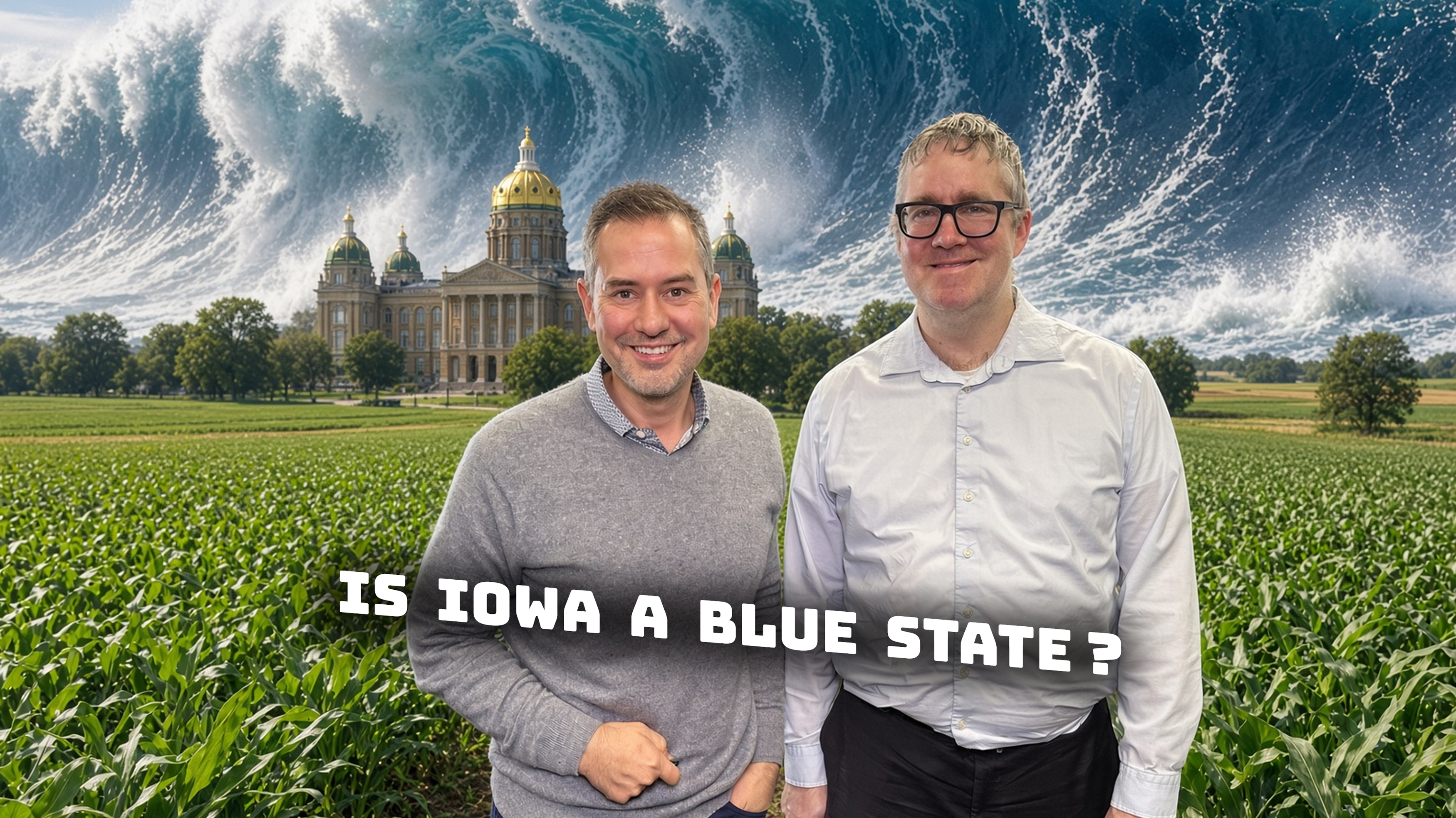



Do we call it a blue wave? A blue earthquake? All of the above? Lucas Grundmeier, Opinion Editor at The Des Moines Register breaks down Iowa’s historic Nov 3rd election and gives his observations.
Iowa Democrats almost swept all state and federal offices, and while Republicans will keep a majority in the State House and State Senate, it’s clear the Democrats playbook worked, and the GOP has to take evasive action quickly.
Iowa Election Night, 2026
Grundmeier analyzed the systemic cracks in the state’s recent Republican dominance. While the GOP retained legislative power with an estimated 56-44 seat edge in the House and a nearly static Senate, statewide results diverged sharply. Traditional down-ballot strength fractured, spanning from comfortable re-elections for Secretary of State Paul Pate and Agriculture Secretary Mike Naig to bottom-tier finishes for candidates like Zach Lahn and Ashley Hinson. “I think that, um, one thing I always think is a top line rule in Iowa elections is that Iowans love incumbents,” Grundmeier said, pointing out the historic nature of Attorney General Brenna Bird being ousted in a state accustomed to decades-long tenures.
Hear from Iowans directly. No algorithms.
Don’t let the algorithms choose your news. Enter your email address to hear directly from Iowans leading news in politics, community, agriculture and business. No editing. No clickbait. No rage. No agenda.
County Margins and Messaging Faults
The shift was driven by stark county-level data reversals following Donald Trump’s 13-point statewide victory in 2024. In staunchly conservative Sioux County—where Republicans routinely bank on 90-10 margins for a 10,000-vote advantage—the spread narrowed to approximately 80-20, allowing Sand and Democrat Josh Turek to chip away vital margins. Meanwhile, Lee County completely flipped to Sand after backing Trump by 28 points two years prior. Grundmeier noted that leaning into “Make America Healthy Again” themes failed to rescue Republican contenders. “It certainly is hard to look at the White House, uh, and see a coherent, uh, MAHA direction, uh, there,” Grundmeier observed regarding Lane’s regulatory critique.
Realignment Versus a Two-Year Window
Rather than declaring Iowa permanently purple or blue, Grundmeier cautioned against sweeping historical conclusions. Despite Democrats capitalizing on candidate quality and patriotic messaging, Republicans still command a formidable voter registration edge across Iowa. “One thing I will probably be saying as I put our, uh, report together,” Grundmeier stated, “is that, you know, this election sets up the next two years and nothing more than that”.
Interview Transcript
This transcript was created with help from Ai. Please report errors to us and always refer to the video as your primary source.
Justin Brady: From the Jethro’s BBQ Studio, it is the Iowa Podcast special election version. It- I don’t– How do you start something like this? Um, there wasn’t a blue wave, it was more like a blue earthquake, and tsunami, and tornado, and tidal wave all at the same time maybe here in Iowa. We’re gonna break all that down, of course, with Lucas Grundmeier, the editorial board overseer and opinion section editor of the Des Moines Register. Did I get the title right first? I didn’t even run that by you.
Lucas Grundmeier: That was, uh, a little more ornate than maybe, uh, I, I tend to say opinion editor. It’s a little more economical with the words, but
Justin Brady: uh, obviously, uh, Iowans have opinions, and your inbox is probably going to see plenty of those here, uh, in the next week or two. Probably already has had plenty of opinions, so we’re gonna get all into that today. Before we do, if you want a $30 gift card from Jeth- Jethro’s for free, go to iowapodcast.com, scroll to the top. If you want $30 gift card, buy $100 gift card from them, from that thing up top on iowapodcast.com. That’s what I’m trying to say. So really cool, kind of a BOGO deal if, if you will. Anyway, um, w- I had, um… We, we’ve been talking about this issue now for six months. I had Kathie Obradovich in here, of course, the Capitol Dispatch, before the election talking about is Iowa really a red state? ‘Cause I kind of thought that Iowa was a purple state. And, uh, I don’t mean insult… I’m not gonna insult anybody, but there are bad candidates who are great people. They just don’t have good campaigns, the issues don’t resonate, whatever. I kind of thought in the past the Democrat Party just didn’t have candidates that really resonated, but I didn’t think it was a red state. W- Are w- Can w- Do we even call Iowa a purple state anymore, or is th- or are we in suddenly a blue state now? I,
Lucas Grundmeier: I think it’d be going a bit far to say a blue state. Um, and you know, obviously as everyone knew would be the case, Republicans still have some solid majorities in the legislature. And you know, if you look at the– One of the interesting things I think to look at is the seven statewide races, Senate and then the, uh, statewide offices and the w- really wide range in Republican vote totals in those range from Zach Lahn and Ashley Hinson at the bottom up to Paul Pate and Mike Naig kinda cruising to re-election for Secretary of State and, uh, Secretary of Agriculture.
Justin Brady: Yeah, that was surprising. Um, becau- yeah, Mike Naig and Paul Pate seem to be fine, but almost the entire ticket, uh, I think Taylor Wettach was announced this morning that
Lucas Grundmeier: I believe that’s
Justin Brady: yeah, that he got it. So, um, yeah, absolute complete domination by the Democrat Party. But like, uh, Auditor Sand, now Governor Sand has said he’s going to be have– he, he’s going to have to be working with a GOP legislature, which as of right now and is, is looking that’s going to be the case, right? Yeah.
Lucas Grundmeier: It’s roughly 56-44 in the House and, uh, Senate, uh, you know, with four-year terms kind of different dynamic, uh, you know, way of election. It only moved by about one seat. One Democratic incumbent lost, in fact.
Justin Brady: Yeah. So, um, Iowa went for Trump 13 points in the election, and that’s not what it looked like yesterday.
Lucas Grundmeier: No
Justin Brady: Just to– So give us the, give us the full breakdown here. What, what, what were some of the things that the newsroom, the opinion s- e- everybody at the Des Moines Register was kind of like, uh… What’s been the internal chatter, and what are the things that surprised people, and what are the things that they’re like, “Eh, we kind of saw that coming”?
Lucas Grundmeier: Yeah. I mean, in no particular order, um, to stick with those statewide factors for a moment, I, I think that, uh, candidate quality is obviously, uh, plays a role in this. And when you heard, um, Republicans, um, saying that Rob Sand is an extreme liberal and he is, uh, you know, disingenuous and lying to you, um, I’m not even saying that they’re absolutely wrong, but I think that anyone who has some political awareness or had met Sand at one of his 200 town halls over the past year and a half, uh, wondered if that really washed, you know, th-those kind of, uh, warnings, uh, about who, uh, he is politically. Um, so I think that, um, Rob Sand certainly is someone who Uh, apart from any label, uh, you know, helped the ticket. Clearly, you know, just like everywhere, the national environment had a lot to say about what happened here. Um, and that’s particularly true in the races for Congress, um, where I, I think the really straightforward argument of give Democrats control of those chambers and you’ll have a more combative maybe, but a, uh, less, this is a strong word, but sycophantic, uh, dynamic, uh, between the executive and legislative branches. Um, and, you know, I, I, I’m not one who claims to be great at tea leaf reading. I thought that when you also heard semi-Republicans say that Iowa has resisted waves before, I thought there was something to that potentially. Uh, it didn’t really turn out that
Justin Brady: Yeah. So what, what were some of the big surprises on… I don’t know if the Register has a Slack channel or anything like that, or
Lucas Grundmeier: we use
Justin Brady: internal… You use Team- Really? Yeah. You use Teams? Come on, guys. No, just kidding. Um, what were some of the surprises that you saw in those threads? ‘Cause this’ll obviously shape how news is written today. What were some of the surprises? Were people like, “Wait, what?” Like any, any shockers, or were people like, “Yeah, we kinda saw this coming. I already had half this piece basically written”?
Lucas Grundmeier: Yeah. I, I mean, uh, again, not claiming expertise, but I think everyone is aware of challenges the polling industry has faced in recent cycles. Mm-hmm. Mm-hmm. So, uh, numbers in Iowa were, you know, pretty consistent-
Justin Brady: Pretty good
Lucas Grundmeier: leading up to the election, but your confidence in them, uh, certainly, uh, was not anywhere close to absolute. So I think that seeing not only, uh, you know, starting out in Florida and then coming west, uh, those expectations be not just accurately measuring Democratic strength, but maybe even understating it in some cases. I think that was a s- a surprise. Um, I think that, um, one thing I always think is a top line rule in Iowa elections is that Iowans love incumbents. Uh, we sent- Interesting … we sent Senator Grassley and Senator Harkin, uh, two very different politicians, back to Washington for year after year after year. Uh, we had, uh, Governor Branstad and Governor Ray for, like, 30 out of 40 years in this state. Um, uh, so
Justin Brady: And that’s
Lucas Grundmeier: And that’s over. Yes. With that in mind, um, I’m not surprised by, uh, Mike Naig and, uh, Paul Pate doing well. I am surprised that Iowans were discouraged enough with Brenna Bird to, uh, kick her out as attorney general.
Justin Brady: Hmm. Also true. Yeah, that’s interesting about Iowans liking incumbents. Clearly that era, at least for now, is gone. Um, yeah, with the, with what happened last night. You mentioned the polling. I think in the past, um, and here are some of the rumors. I think we actually interacted with this on X a little bit, but like, um, there has been fallout from polling in the past. Like, and polls aren’t accurate. I think even like as recent as, and this isn’t polling, this is I think Kalshi and Polymarket gave like Feenstra a 98% chance on primarying Lahn, right? And of course it slipped and completely flipped at the last second. So people have been using betting markets and polling for a little while. They’ve been, you know, the rumor was that Republicans just aren’t re- responding to polls at all. All these polls are completely wrong. H- Nationally, have the pollsters successfully adjusted? ‘Cause the numbers looked pretty close to polling. Now obviously polling can’t ever predict anything, but these, this is pretty darn close. Like it, you know, people even in Texas were like, “Talarico has zero chance,” and, you know,
Lucas Grundmeier: Texas is not gonna go blue. Abbott
Justin Brady: “Texas is not gonna go blue. Abbott, there’s no way in heck…” Both were true. So have the pollsters figured it out? Have they adjusted and calibrated correctly?
Lucas Grundmeier: It is a great question, and I know neither of us is claiming to, uh, be the scientists who are, uh, figuring that out. Um, but, you know, either they were lucky or they have figured some things out. Um, you know, one of the simpler to understand problems is lack of response, and we all, you know, know what we respond and don’t on our phones.
Justin Brady: Yeah. Mm-hmm.
Lucas Grundmeier: uh, you know, I don’t… You know, even in my job, it sometimes behooves me to answer a strange number, but I still very rarely do that.
Justin Brady: Yeah, I mean, I do wonder if they got more responses or found clever ways to get responses, ’cause I just got spam calls and texts. I don’t respond to those. Right. So I do wonder if they figured out a, a different way of polling or, um, or, or… I, I don’t know how you calibrate polls. I guess maybe, may, uh, maybe a future show should be getting a pollster in here to tell us. But, um,
Lucas Grundmeier: That would be good. Uh, I mean, there’s recalled vote, um, you know, that helps you assess whether your sample is, uh, in line with the actual- Yeah … electorate. Um, but you also heard pollsters saying that they were pretty sure a decent number of people were lying to them about who they voted for in 2024. And I,
Justin Brady: Interesting
Lucas Grundmeier: you know, if that’s based on instinct, I don’t know how you’ll scientifically adjust for that. Um, uh, there’s a lot of, uh, it’s not a place I’m looking to make a career shift into, let’s put it that
Justin Brady: a career shift into No kidding. You mentioned, um, Sand’s messaging, and you mentioned the, you know, he’s singing “America the Beautiful,” he’s flying the American flag. And I know that nationally Democrats have been accused of kind of getting away from some of what they consider nationalistic, um, icons and verbiage, and he didn’t do that at all. He was very like, “Let’s…” Here’s the– Here’s a, a trend I see. I want to get your take on this, but I almost feel like the Democrats in Iowa kind of ran on a, not stealth, I don’t know what the right word to call this, but almost a faith and ‘Murica platform to cut into the GOP, which kind of worked, I think. Like Sand is doing “America the Beautiful,” he’s talking about faith, and he’s talking about, you know, legacy voting. I think Politico asked him, like, “Would you want Joe Biden or Kamala,” you know, “s reaction or endorsement?” He’s like, “Pass.”
Lucas Grundmeier: Like- Yeah
Justin Brady: Very like, um, trying to be that unifying message. We have Turek, the Olympian, holding the flag everywhere, um, working– “I’m gonna work with Trump on the border.” We have James, uh, and Trone Garriott, who are both ministers, kind of in that faith category. So it’s– I don’t know if this is a safe thing to say, but did the Democrats out-‘Murica and out-faith in the Republicans? Did they cut into that block?
Lucas Grundmeier: I think they probably did cut in. I mean, in the crassest political terms, I think that’s obviously a good choice on the part of Rob Sand and others to, um, not only not shun, but to embrace, you know, symbols of patriotism,
Justin Brady: Mm-hmm.
Lucas Grundmeier: uh, and things that are, uh, commonplace among Iowans. Um I, um, it may be going a bit far to say that they, like, cornered that market.
Justin Brady: Right. I
Lucas Grundmeier: And you’re not saying that, um, that’s the only thing that happened, obviously. But, um, no, I, I think that’s a reasonable, uh, framing.
Justin Brady: Yeah. I, it, it is interesting because I, I mean, both James and Trone Garriott are both really ran on the fact that they were ministers. And I’m like, “When have I seen this? I don’t think I’ve ever seen anybody, like, leading with this,” and they’re clearly that worked. And-
Lucas Grundmeier: same for Adam Hamilton in Kansas and
Justin Brady: Oh, really?
Lucas Grundmeier: he is, uh, I, I, I don’t know a lot about him, but he’s an evangelical minister, I guess. Um, which that’s a departure from Trone, Garriott, and James too
Justin Brady: I mean, I think that they came– It’s funny because I think all these candidates, of course, are just almost, almost a complete clean sweep in the state. Um, I think they came in with the mindset that I will be working with the GOP majority, so I really– So the candidates that had that unifying message in the primaries that I’m gonna work across the aisle and here’s how I’m going to do it, here’s how I’m gonna be specific, that, that, I mean, that really resonates. Like, people want the working across the aisles. People maybe want the end of, um, some of the tumultuous stuff we’ve seen. You know, they, they want people who, whether, what, no matter what party they’re in, people are just like, “I want someone who’s gonna say, ‘I’m gonna work with the other side of the aisle. I, I believe in this country, great country, America. I wanna work…’” That seems to be the message that resonated, whereas maybe the GOP got comfortable.
Lucas Grundmeier: Yeah, I think that is also fair. And I mean, another thing that isn’t rocket science is that, uh, Republicans, uh, have a– I don’t know the, what the margin ended up at, but a very sizable advantage in voter registration in this state, uh, over Democrats. Independents are still a solid, um, third block, and of course, your party registration doesn’t say how you’ll vote- Right … in a particular race, particular election, but it is a, um, a place where Democrats are starting downhill, uh, from a downhill position, uh, when they run statewide in Iowa, and I’m sure that that, uh, shapes how they frame their appeal to prospective
Justin Brady: I don’t have the numbers. You might. So if you don’t have the numbers, just say, “Dude, I don’t have those yet.” But, um, is this a matter of issues driving people to the polls, or is this a matter of, like, Republicans not really advancing their agenda and people not going to the polls? Was this a– So in other words, was this a, um, a motivating election where people really got out there and voted for the candidate they wanted to, or is this a matter of Democrat or Republicans saying, “I’m not feeling it. I’m not gonna hit the polls”? ‘Cause I see a lot of Republicans posting like you g- you know, about their own party, like leading voices like Matt Walsh, Tommy Lahren, Ben Shapiro. I see a lot of these people saying, “You know what, GOP? You deserve every second of this.”
Lucas Grundmeier: Um, I don’t have that at my fingertips. Yeah. Uh, one thing that my colleague, uh, Brianne Pfannenstiel, the chief political reporter at the Register wrote about- And you updated it. Yes. And every day, really. Yeah. Well, and I– we put the push-out alert that, “All right, that’s done. Time to talk caucuses.” Yep.
Justin Brady: Oh, great.
Lucas Grundmeier: Uh, and it’s, that’s not exaggeration. Yeah. But anyway, she, before the election, wrote about places to watch, uh, as results started coming in, and one of them was Sioux County, which is, you know, a heavily, heavily Republican county. Uh, a place where, um, turnout is often strong and a place where, you know, in a election where in a lot of rural counties Republicans are maybe winning, like, 80 to 20, they might go 90-10- Mm. -in Sioux County and get a 10,000-vote bump, uh, which is a lot when you’re trying to offset the margins in Polk and Johnson and Linn Counties. Um, yesterday, uh, both Ashley Hinson and Zach Lahn got about a 10,000-vote bump in those counties. I haven’t done the work to go back to see how that compares to ’22, uh, or other Senate elections, um, or ’18, which was a more competitive governor race in Iowa than ’22. Um, so I don’t have, I don’t have a systematic answer on that, but I, I– it did appear that they got, margin-wise, close to what the Republicans g- what, uh, Republicans often get in that region of the state. Um, the, um, the percentages, th- they weren’t, they weren’t that 90-10 that you might hope for if you’re a Republican looking to get elected statewide. It was closer to 80-20, both in the Senate and governor. So Rob Sand was picking up a few votes in Sioux County, a- as was, uh, Josh Turk.
Justin Brady: Yeah. I mean, there, the other story is Lee County, right? Because Lee County went Trump 28 points, 28 points in 2024. It just went for Sand. And that’s also significant because, I don’t know what it is about Lee County, but that, that Lee County was the center of that steel mill announcement. Yeah. So you’d think, you know, Trump 28 points in 2024 combined with the steel announcement that’s supposed to bring all these jobs, you’d think Lee County would at least hold some kind of lead. But no. So I guess the big question is, is at least for now, is MAGA dead? And was Trump’s endorsement kind of the kiss of death?
Lucas Grundmeier: That’s an interesting question as well. Um, I’ll come back to it. I also saw, uh, a reporter, um, thinking that the result in Iowa was the death knell for MAHA.
Justin Brady: Oh, interesting
Lucas Grundmeier: because of Zach Lahn’s, you know, very direct, um, campaigning on that, uh-
Justin Brady: Didn’t seem to resonate.
Lucas Grundmeier: No. And, you know, RFK has been here a couple, three times in the past year. Um, we had a Iowa MAHA bill that, um, in my view, had good and bad parts, uh, that was passed this past spring, or passed into law. Um, and yeah, that, that was certainly not enough to overcome everything else going on, wh- whatever advantages it might have delivered for Zach Lahn
Justin Brady: I did see, uh, again, going back to some of the themes, I did see some, um, prominent conservative podcasters and media people. One of them, I can’t remember, uh, where– I can’t remember which po- It was the Al- It was, uh, Culture Apothecary. It’s Alex Clark is the host of this, uh, Turning Point, uh, brand, and one of the things she said months ago was, “Maha Moms,” this is a group, I guess, “Maha Moms are not going to be very forgiving with some of the anti-Maha stances from the Trump administration.” S- I think she was specifically talking about the glyphosate EO. Uh, what- however you feel on glyphosate, um, apparently Maha Moms kinda feel betrayed. Yeah. And so you do wonder if the Maha movement really got people excited, but maybe Trump’s follow-through or their pers- or his perceived follow-through on the Maha movement kinda unwound that movement already.
Lucas Grundmeier: I think that’s a good point. Um, it certainly is hard to look at the White House, uh, and see a coherent, uh, Maha direction, uh, there. And I, I thought, uh, Lahn, when we spoke to him, uh, a couple times as an editorial board, was compelling, uh, on that point. He obviously wasn’t afraid of saying, “I think the EPA is garbage and, you know, industry captured and, uh, these o- other regulatory aspects of government aren’t working.” Um, and, um, you know, you will find, I’m sure, that the FDA and the EPA always have critics. Uh, and so that to just label the whole enterprise, uh, corrupt, I, I think, I, I thought that had a chance of resonating with Iowans.
Justin Brady: but it d- yeah, it didn’t. Um, interesting thing about Lahn is before he was actively running, um, we had covered water quality, cancer rates, and pesticides, herbicides, are they linked or not? We’ve covered that story here, and it just never really resonated. Like, I, you know, even I had, uh, Dr. Deming on here, Deming Cancer Center, and some of the things he said blew my mind. And I’m like, “Oh my gosh, this will absolutely go viral.” Like, this will, um… You know, nutrition, we’ve had nutritionists, dieticians who brought up just some crazy research, and I’m like, “Well, this will definitely just blow up.” I remember telling friends and family, “This one’s going to completely blow up ’cause of the stuff they said.” Crickets. Like, it was some of the worst performing stuff. And now you have these topics that actually, you know, Rob Sand was running heavy on. A lot of people were running heavy on him. Yeah. Is this just a trend, or did Lahn kind of change the talking points in Iowa so at least maybe his legacy is he was able to change some talking
Lucas Grundmeier: Yeah, uh, I don’t have a necessarily better explanation than, uh, Zach Lahn made it easier to talk about, more common to talk about. Um, you know, as I was deleting press releases from my inbox this morning, I did see, um, Chris Jones, the Democratic candidate for Secretary of Agriculture, his, uh, concession statement, and he said, “We changed the conversation,” and I think that’s accurate too.
Justin Brady: Yeah, I did get that one too.
Lucas Grundmeier: Yeah. Um, uh, ’cause he certainly would’ve been a huge departure from anyone- Yeah … that had ever been in that office before.
Justin Brady: he was really hitting hard on that messaging. To his credit, definitely hitting hard on that messaging very early on.
Lucas Grundmeier: Yes. And, you know, he is one who has– I mean, he wrote the book, uh, uh, about the, the Swine Republic book, and, uh, he has been, uh, independently vocal, and he’s someone that we’ve gone to as a source for a n-number of years, including back when he was at the University of Iowa and trying to sound these alarms. Uh, w-water quality and– is a franchise topic for the Register editorial board, and, you know, don’t need to get into how an editorial board is a strange concept and, uh, uh, y-you know, the institution that we kind of profess it to be. But, uh, that’s something we’ve been writing about to deaf ears, at least among policymakers, for a great many years. So we, you know, we’ve welcomed, uh, the additional discussion, uh, that’s come from Zach, people like Zach Lahn and Chris Jones, uh, in this cycle. And I think a lot of Iowans are, maybe excited is the wrong word for something as discouraging as, you know, cancer-causing pollution. But, um, uh, I think a lot of people are anticipating what, uh, the change in government might mean for, um, more effective approaches.
Justin Brady: Interesting. I, I just connected the dots right now as you were talking about this, but you brought up Maha, uh, a moment ago, and of course talking about Chris Jones and Zach Lahn. Basically the people who led with Maha kind of stuff, ’cause Ch- I would call Chris Jones kind of a Maha message. I, I don’t know if he would agree with
Lucas Grundmeier: that Probably not, but,
Justin Brady: not. Um, yeah.
Lucas Grundmeier: at 30,000 feet, that’s
Justin Brady: I had a, a listener catch me somewhere, um, and they were like, “Appreciate the inter- you know, appreciate the interviews. Is it just me or…” And I, I don’t, I’m not gonna give up– Well, th- this person says, “I’m a Republican, um, so and, uh, but I, I really don’t… You know, I, I think the Republicans have screwed me, and I don’t like the Democrats either.” You know, you’ve probably heard this speech a lot. I don’t like either side. They’re both crazy. Um, but they said, “You know what’s interesting is I think I will be definitely voting for, uh, Zach Lahn and Chris Jones because I feel like they share the same views.” And I was like, “Oh, that’s a, that’s an interesting point. I never thought about that.” I actually asked Zach about that on, when he was on the show. I was like, “Are you gonna endorse a Democrat?” Interestingly enough, though, the, those two people who were probably loudest about with the Maha message, I’m sure, you know. Sorry, Chris Jones, we don’t agree with that framing. But the two people who were loudest in Iowa about the Maha framing happened to be the two outliers that lost, including Chris Jones, who w- lost in a complete blue wave.
Lucas Grundmeier: Lost in a complete blue wave Right. That is, uh, I agree that that’s a interesting observation. Uh, I, I don’t really know how to completely fit the pieces together. Um, and you know, one of the campaign talking points was that Rob Sandison’s actually serious about water quality and he’s beholden to his family. Uh, I, I, you know, I– certainly that was at least overstated in my view. Uh, uh, the proof will be in the pudding, I guess, in, uh, what action his administration takes. And, you know, one of the things that will be really important in that is who he has lead the Department of Natural Resources. I mean, you’ve had not just Democrats, but, um I, what the right fra- uh, environmentalists in general who have been accusing, uh, that department under Kim Reynolds and under Kayla Lyon, the director, as, you know, being incredibly industry-friendly and not really, uh, uh, looking out for the protection of natural resources as that agency’s charter would be
Justin Brady: Yeah, for sure. So you mentioned, um, probably final question, maybe I can squeeze another one in there, but- Sure … you mentioned you were cleaning out your inbox. I’m curious if just subject line, ’cause I know, I know how you guys read. It’s a real quick subject, maybe the first sentence, delete, you know? And you guys, ’cause couple hundred pitches a day sometimes, you have to go really quick. Have you seen any just gut reaction intuition themes developing? Because if, you know, people write opinion pieces for The Register, they go through you, and so have you seen like, “Oh, this is an interesting thing. Iowans feel this way,” or, “I didn’t expect to see this”? Have you seen a theme develop already?
Lucas Grundmeier: Um, uh, not so much. Um, y- you know, I, I think that, uh, one thing I will probably be saying as I put our, uh, report together is that, you know, this election sets up the next two years and nothing more than that.
Justin Brady: Yeah
Lucas Grundmeier: you know, those national coattails presumably will either not be as strong or maybe completely absent in 2028 at the– And, you know, Rob Sand will have a record, uh, by then for Iowans voting for the legislature to run on. Um, you know, obviously we don’t know anything else about the ’28 contest. But, um, yeah, I- I’m very skeptical of, um permanent shift type of narratives. Uh-
Justin Brady: Well, especially after the massive sweep Trump had just two years ago, and now it’s a mass… It’s almost
Lucas Grundmeier: it’s a mass… It’s almost like
Justin Brady: I almost feel like party affiliation is dwindling before our very eyes.
Lucas Grundmeier: Maybe, yeah And people
Justin Brady: are like, you know, “No, this is dumb. I don’t like it. I’m voting for the competitor now.” And no, this is, you know, it seems like party affiliation’s g- almost gone.
Lucas Grundmeier: Well, and, you know, both just in terms of being prepared, but also the ambivalence I talked about, about whether to, um, believe in polls. I, I had, uh, two columns ready to go last night, one for a Rob Sand win, one for a Zach Lahn win. And in the Lahn column that will never be– see the light of day, uh, I, I said, “If Iowa Democrats can’t win in this environment, are they ever going to win?” Um.
Justin Brady: Interesting
Lucas Grundmeier: And that didn’t come to pass, so, uh, you know, we’re back to, uh, you know, w-where we started. Uh, are we purple, red, blue, so-something else? Uh, but I w- you know, if, um, someone who I think it’s fair to say Iowa Democrats saw as their generational candidate in a really good year for Democrats couldn’t get over those voter registration and other humps, um, I don’t know where they would have gone from there.
Justin Brady: Last question, and this, this can be a quick one, but b- basically due to the returning status of Iowa being a purple state, maybe even a blue state, does that give us a better chance to get the Iowa caucuses, like the Democrats back into Iowa for the Democrat and GOP caucuses, or is that ship sailed?
Lucas Grundmeier: I would definitely lean toward that ship has sailed. It, it can’t hurt. It can’t hurt. And, uh, the, again, the editorial board that I lead, I’ve been, uh, trying to push us toward the tr- stop trying to make fetch happen. It’s not going to happen, uh, viewpoint on that, which, uh, I’ve also been confused by the pot shots you get from Jeff Kaufmann, the Iowa Republican chair, every time the national Democrats set up a different calendar. He says, “Iowa Democrats didn’t try.” I’m like, “Eh, I think they did try. They just were ignored
Justin Brady: Yeah. Uh, Lucas Grundmeier of the editorial board and of course, uh, opinion editor of the Des Moines Register. Thank you for coming down here and breaking down this post-election absolutely wild ride. I’m sure the next two years, you know, good luck on caucuses.
Lucas Grundmeier: Yes. Thanks. And thanks for the invitation, Justin. It’s good to talk to you