

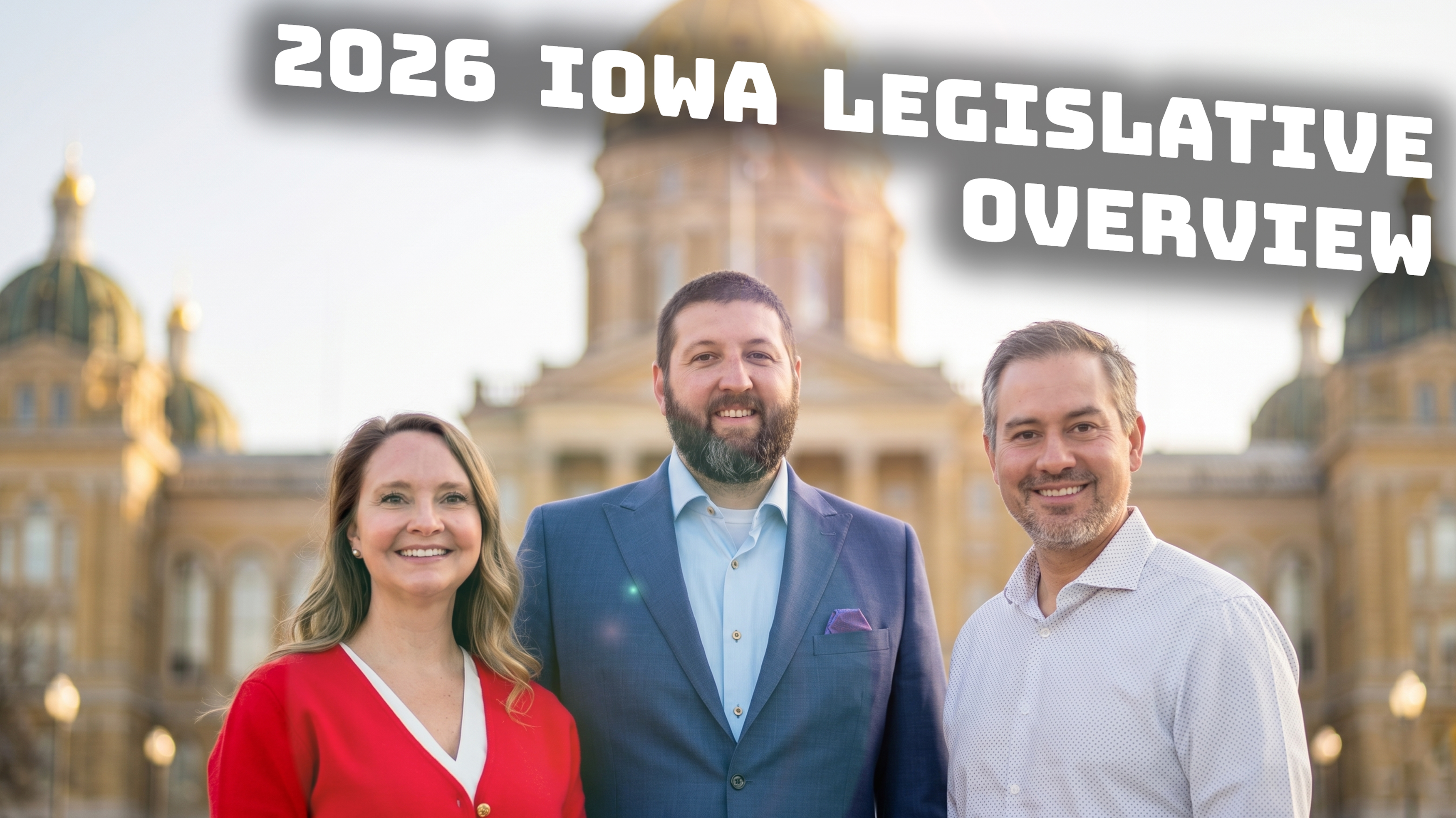
Following a 112-day legislative marathon that stretched 12 days past its traditional limit, the Iowa Legislature adjourned on May 3rd, leaving a massive stack of paperwork on Governor Kim Reynolds’ desk. Dentons Davis Brown Special Counsel Sydney Gangestad and Logan Murray break down the details.
Out of more than 1,400 bills introduced during the session, lawmakers successfully enrolled roughly 206 pieces of legislation—a 16% passage rate heavily influenced by upcoming 2026 primary and general election dynamics.
Property Tax Reform
A primary focal point of the session was comprehensive property tax reform, a system that had not seen a major structural overhaul since the 1970s. After intense 11th-hour negotiations, lawmakers passed a final bill by capping city and county levies at 2% while preserving the state’s traditional rollback system and a 10% homestead exemption. Reflecting on the prolonged negotiations, Dentons Davis Brown Special Counsel Sydney Gangestad noted, “It was the final piece really to unlock the 2026 legislative session, and essentially, the final bill is designed to slow the growth of property taxes over time, especially for homeowners, while still allowing local government some flexibility for new developments with voter-approved projects.”
Eminent Domain Battles
Conversely, the highly contentious debate surrounding landowner rights and the use of eminent domain for private carbon capture pipelines ultimately stalled without a resolution between chambers. Special Counsel Logan Murray highlighted the political complexity of the standoff, observing, “The House Republicans pushed through a bill within the first couple of weeks of session, and then the Senate took their bill and rewrote it, putting up guardrails on how this type of project should be set forth in the state.” Oddly both sides claimed victory.
Water Quality and Pediatric Cancer Funding
The intersection of public health and economic development also took center stage, particularly regarding Iowa’s elevated cancer rates and infrastructure. Lawmakers approved a “farm-to-faucet” proposal that creates five new water monitoring and grant programs, including a $25 million appropriation for Central Iowa Water Works’ nitrate removal facility. To fund critical healthcare research, the state turned to alternative revenue streams, passing a new tax on vapor and nicotine pouch products to secure $3 million for pediatric cancer research. Commenting on the shifting public perception of environmental health, Gangestad emphasized, “Many of Iowa’s biggest policy conversations that we’re having right now, agriculture, cancer rates, infrastructure, economic growth, they all now intersect with water quality.”

Iowa business owners are liable for data their website collects!
Iowa’s consumer data privacy law went into effect on January 1, 2025, but Ai’s advances in 2027 will open a new can of worms for Iowa business owners. Dentons Davis Brown data privacy and cyber…
Keep reading
How productive Ai lands you in legal hot water
Well-intentioned, ethical use of Ai tools with proper IT guardrails can still pose privacy concerns and put your company into legal hot water says Jo Ellen Whitney, an employment attorney at Dentons Davis Brown. She…
Keep reading
Iowa business succession planning attorney makes it easy
The majority of business owners are putting their own businesses at great risk. Few have a plan if they were suddenly incapacitated or pass away. Iowa business succession planning attorney Breanna Young of Dentons Davis…
Keep readingThanks to Dentons Davis Brown for collaborating with The Iowa Business Podcast to bring incredible value to our listeners! Collaborators compensate our hosts directly for their time and effort crafting exclusive content.

Interview Transcript
This transcript was created with help from Ai. Please report errors to us and always refer to the video as your primary source.
Justin Brady: [00:00:00] From Iowapodcast.com, I’m Justin Brady, and the legislative session is over, and what are the impacts for you, your businesses? What are the impacts for the state? That’s a lot of legal mumbo jumbo, and I’m definitely not a lawyer. I’m not an attorney, so I brought in a few ringers from Dentons Davis Brown.
Sydney Gangestad and Logan Murray, both special counsel, join us in the Iowapodcast.com studio to break it all down, and what does it actually mean for you? It’s a lot of stuff to go over, so thank you both for coming in the studio.
Sydney Gangestad: Yeah. Thanks for having us today, Justin.
Justin Brady: This’ll be super fun.
Logan Murray: Happy to be here.
Justin Brady: There’s some standard, I, I would call it, like, standard stuff that everyone kind of was tracking the whole year. It’s not much of a surprise, not a big, not big news. But then there are some milestones and key things that happened. Who wants to start and go over that?
Sydney Gangestad: The legislature just adjourned sine die on May 3rd. Uh, we were slated for a 100-day legislative [00:01:00] session. We went about 12 days over.
Um, as you said, there was a lot that happened this legislative session. So there were over 1,400 bills that were introduced, and yeah. Um, and actually about 206 of those were enrolled. So about 16% of the bills that were introduced were enrolled, so that means that they ha- they either are down on the governor’s des- desk wait- awaiting her signature, or they’ve already been signed.
Um, she has 30 days to sign those bills, so we’re currently in that veto period. But yeah, a lot happened this legislative session. It was really heavily shaped by, um, election politics. Obviously, people are thinking about the 2026 ele- uh, election, um, both the primary that’s coming up in, in a few weeks, as well as the November general.
And then, um, property tax reform, of course, that was for everybody, and we can de- take a deeper dive into that. Uh, state budget pressures and Medicaid funding challenges, so some of that came, um, after some federal legislation that was passed and that impacted a little bit of what we did with the state budget.
Uh, water quality, [00:02:00] eminent domain and landowners’ rights, right? That is an issue that has continually come up for the last three general assemblies and remains unresolved after this legislative session, and just generally healthcare and quality of life.
Justin Brady: the eminent domain thing has been a huge issue, but it kind of ended up as a huge non-issue yet again. It… Are there, are there pressures against it or for it? Um, it looks like, Logan, you have some thoughts on
Logan Murray: Project. Yeah, so there are pressures on all sides of this issue, and there have been pressures on all sides of this issue for almost five years now. And the House Republicans have really been out on the forefront Of trying to fight against the use of eminent domain for private gain, you know, in this specific instance, the carbon capture pipeline.
Uh, depending on who you talk to, some of the House Republicans may want to support the pipeline but just do not want the use of eminent domain. There’s speculation that others within the House Republican caucus want to [00:03:00] use this as a way to tank that type of project, viewing it as a holdover from the Green New Deal that President Biden had been pushing.
Uh, as far as the Senate Republicans go, there has been a kind of a longstanding wanting to see this type of project go forward and trying to figure out what type of potential compromise there could be when it comes to protecting landowner rights, but also allowing economic development in the state.
And that’s kind of what we saw again this year. The House Republicans pushed through a bill within the first couple of weeks of session. Uh, it was a much simpler bill than what the governor vetoed last year. Uh, the bill last year had insurance requirements and land set-offs and just very complicated, drew in potentially water pi- uh, waterways as well as oil pipelines and some things that were actually for public use.
This year, their bill was very simple. It said, “No use of eminent domain for [00:04:00] carbon capture pipelines.” And then the Senate took their bill and rewrote it in, uh, not the same type of complicated way that the House did last year, but put up guardrails on how this type of project should be set forth in the state.
And ultimately, uh, there was no agreement that could be reached between the chambers, so for another year, a bill n- did not move forward. And depending on who you talk to, both sides are claiming that as a victory, which is unique. You would think the folk- It’s super weird, isn’t it? You would think the folks that want to prohibit it would be like, “We lost another year.”
Uh, but there was recently a ruling in the middle of session in South Dakota that many people believe put another damper on the carbon capture pipeline. So not being able to get something done per se this year wasn’t ne-necessarily a death blow because of what had happened in South Dakota. And interestingly enough, as we’re recording this [00:05:00] podcast, there was a article in the Des Moines Register this morning that Summit has, uh, submitted a revised proposal- Mm
taking out eight counties from this proposed, uh, project. Uh, and I think it’s about 200 miles worth of the project and 400 properties.
Justin Brady: Oh, opted out.
Logan Murray: Oh. Uh, so their revised plan-
Justin Brady: the revised…
Logan Murray: removes those because they’re looking at a different route and, you know, a potential different destination.
Justin Brady: this one’s weird in that it almost seems both parties are kind of for it but also against it and we don’t really know who’s– what positions are what.
Logan Murray: Absolutely, and you saw that last year with the bill that the governor ultimately vetoed. It was a group of 12 Senate Republicans teaming up with the vast majority of the Senate Democrats to go against Senate leadership, which in my decade up there, I have never seen the Senate majority leader, the Senate president, and the rest of the Senate leadership team minus one [00:06:00] member all vote against a bill and it still gets sent down to the governor’s office.
Talk about bipartisanship.
Justin Brady: Yeah.
Sydney Gangestad: Creates really unusual coalitions across party lines.
Justin Brady: Yeah, for sure. For sure. We also saw the passage of property right? Property tax reform, which is businesses have been wanting this for quite some time and this actually got through this
Sydney Gangestad: Yes. Property tax reform, right?
Property tax has been a major issue in the state of Iowa, um, over the cl- course of the last few general assemblies. Um, there was a, a property tax bill that was passed, HF 718, in what, what year? Remind me.
Logan Murray: 22, I think. 22 or
Sydney Gangestad: So building from that, um, you know, overall our Iowa property tax code has not seen a reform since the ’70s.
And so- Since the ’70s? Yes, a comprehensive
reform. Yeah, comprehensive.
Logan Murray: the current rollback system is about 50 years
Justin Brady: remember has
Sydney Gangestad: Um, so the– it remains a-a major issue for the
legislature. If you talk to lawmakers up at the Capitol, when they talk about, you know, [00:07:00] what they heard on the doors, um, from constituents, it was that, you know, folks…
Rec– folks have admitted to the legislature that their, their property taxes are high, and they would like to see their property taxes, um, come down, right? And that’s fair, right? We want– Folks want some type of property tax relief. Uh, and I think most Iowa lawmakers agree that property ta- our Iowa property tax system needed reform.
It’s just, again, how do we get there? Um, and I would agree s- very similar to what Logan was talking about, the… as it related to eminent domain. We saw a few different approaches, uh, for property tax this year. The Senate released a bill that was very similar to the bill that they had released in 2020, uh, five, which was a comprehensive property tax reform.
Um, it had a lot of f-facets of, of the bill that provided, uh, property tax relief, but also added types of, um, diversification of, uh, of revenue sources for lo-local government. Um, we also saw this year the governor introduce her own tax plan. So [00:08:00] after having a number of roundtables in communities throughout the state, throughout the interim, the governor and her, uh, tax team came up with a plan and introduced that bill early on in the session.
And then we also had another, uh, competing bill, the House bill. And the House bill was a lot, uh, more simple. It was, uh, specific to, um, the overall cap on, on levies for cities and counties and putting that cap at 2%, which is something that, um, many people had called for, uh, over the course of the last two years.
Um, and so, you know, I, I, again, I think everyone had a very similar goa-goal of slowing growth. It was just, how do we get there? Um, it was a very large discussion throughout the entirety of session. So the– all, you know, both of the chambers as well as the governor introduced their bills early on in the legislative session, and, uh, ultimately, final negotiations on the property tax bill did not Uh, were not resolved until the very 11th hour of session, right?
Yeah, so-
Logan Murray: a-and by 11th hour, she means, uh, the [00:09:00] 36th hour of a 38-hour legislative marathon
Sydney Gangestad: It was the, the final piece really to, to unlock the 2026 legislative session, and it… essentially, the final bill is designed to slow the growth of property taxes over time, um, especially for homeowners, while still allowing local government some flexibility for new developments with, uh, voter-approved projects.
I would say the full impacts of this, it will be very hard for us to, to fully understand or realize the impacts of this until several years, um, down the, down the way. Um, overall, I’d say cities and counties will be generally limited in how much additional property tax revenue they can collect each year.
There are some specific exemptions for things like new construction or… and voter-approved taxes, but again, the o- the overall idea is to really to, to slow the growth of local property taxes over time. Um, the rollback system, um, that Logan had referenced previously, that actually will stay in place. Um, that, uh, rollback [00:10:00] system does protect homeowners from seeing huge spikes, uh, in taxable value.
Um, but of course, like the, uh, a, a large goal of the legislature was to keep property taxes consistent, so it’s not surprising that we s- that rollback system was ultimately maintained. Um, homeowners should see more immediate relief through this new homestead exemption that was included, which is a homestead exemption that’s worth 10% of a home’s value.
Um, business related, our Iowa businesses will continue receiving the commercial and industrial property tax credit. Um, in earlier proposals of the bill, some of the proposals I had mentioned, those proposals would have eliminated this, but ultimately lawmakers voted to keep it, so that’s really important for Iowa businesses.
Um, the bill also limits some future tax increment financing, TIF, as we
Justin Brady: yeah. There’s some TIF changes.
Sydney Gangestad: Yeah. Some TIF changes. Yeah, some TIF changes. Um, some, you know, uh, you know, again, the goal here was to create more transparency and, and, and [00:11:00] control, so it allows for TIF, um, but in a responsible manner. And, you know, the folks who were voting for this bill, um, wanted to make sure that there were, there was transparency for the, the taxpayers, the property taxpayers, and they, they, the, the, um, the guardrails that they’ve put on TIF, they think allow for, for responsible use of, of TIF as it, as we move forward into the future.
Justin Brady: and for those that don’t know, TIF, uh, I think– I don’t know if the, what the concerns are there, but the concerns were that that money maybe… I don’t know who wants to describe what TIF is and why this is significant in, in like a 30-second thing. But basically, there were no limitations for that.
It could just kinda go on and on and on, and they wanted– I think the idea here is that they wanted to direct that money out back into the general fund rather than having it diverted. Uh, I what am I getting wrong here? Is that a, is that– It’s probably not the best
that’s why you guys are in
Sydney Gangestad: It’s quite here. No.
Logan Murray: is very complicated
Sydney Gangestad: No, I think that that’s accurate, right?
And so I think that there– the state wanted to ensure that there was more control [00:12:00] over, over the util- the use of TIF, so that localities, you know, instead of them just having the ability to, uh, create an urban renewal district and, and, and hen- and create a TIF,
Justin Brady: there-
Sydney Gangestad: um, that there would be more voter control over what that, what that TIF district looked like.
So now, uh, in the future going forward, uh, projects that are utilizing TIF Ju- January 1, 2027 and after, um, will have to have, uh, a voluntary agreement between, uh, both the locality as well as the schools. And-
Justin Brady: that’s actually a really good way to summarize that. And then there were also cancer rates ‘ cause, um, we’re talking about water a lot now.
I don’t
remember talking about that when I was a kid that much, there are actually a lot of implications in the new bill on water quality, um, both for personal but also for businesses as well, implications on both.
Logan Murray: Yeah, so the– Near the end of session, Secretary Naig and Governor Reynolds had worked with the legislature to introduce this farm-to-faucet proposal, which basically it did a lot of things, but it [00:13:00] recalibrated three existing programs that were across two state agencies five new programs, including a water monitoring program, a revolving loan fund for, uh, primarily rural communities that are looking to improve their wa- uh, water system, and then some wastewater grants, as well as buffer strip grants, uh, just to improve the quality of water, uh, across the state, as well as nitrates are a very popular point of discussion right now, and $25 million was, uh, set aside for Central Iowa Water Works to, uh, build their nitrate removal facility.
Um, so obviously with all the pressure on water quality, you’re hearing a lot about it in the gubernatorial campaigns. Uh, you’ve recently heard that Congressman Zach Nunn had– uh, was able to s-secure some federal funding for water quality projects. It’s something that’s not going away. It j- doesn’t just impact individuals [00:14:00] when businesses are out trying to recruit, uh, folks to move to Iowa to look at, uh- start building their life here, start building their businesses here.
People are concerned when they hear that there could be water quality issues. So it’s important for, you know, the state to focus on that, not just from, you know, the personal standpoint, the potential cancer standpoint, but also from the economic development standpoint.
Justin Brady: Yeah, absolutely. Any final thoughts on that?
Sydney Gangestad: Yeah, no, I, I agree. I think many of Iowa’s biggest policy conversations that we’re having right now, agriculture, cancer rates, infrastructure, economic growth, they all now intersect with water quality.
Um, yeah, very much. And to your point, um, it’s not something that we had maybe historically heard, um, a concern for, but I think now the de- the debate is increasingly not whether Iowa, uh, should invest in water quality, but whether the cur- current approach is moving quickly enough. So it’s like, how much, how fast, how can we scale up quickly?
And, um, Secretary Naig and the governor had a, had a really great [00:15:00] plan that they released at the end of session, and we’re really grateful that they are investing in wa- water quality at the rates that, that, that they are. Um, and that bill will be signed into law
Logan Murray: Next week, yep. And then as far as the cancer rates go, there are a number of other proposals. One of them that a lot of people felt very good about was a pediatric cancer funding. So they put $3 million, uh, going forward for pediatric cancer funding. Uh, we were at several of the subcommittees. Uh, it’s being funded by a tax on vapor products and pouch products.
Uh, you had families with children that had been impacted by pediatric cancer come in and talk about how the radiation that they would receive was based on research on adults. So when you have a much smaller body and not as well developed, uh, it certainly causes different types of issues than normal.
So this research is there to help figure out different ways to treat pediatric [00:16:00] cancer.
Justin Brady: Sydney Gangestad and Logan Murray of Dentons Davis Bown- Brown, both special counsel, of course, over there. Thank you so much for coming and giving us this really lightning-fast overview. We appreciate
Sydney Gangestad: Thank you. Yeah. The, the legislative session is multifaceted. There’s a lot that happens in a short amount of time, and we’re happy to be able to be here to break it down
Justin Brady: Thank you to both of you.
Sydney Gangestad: Yeah. Thank you.