



Audio version:
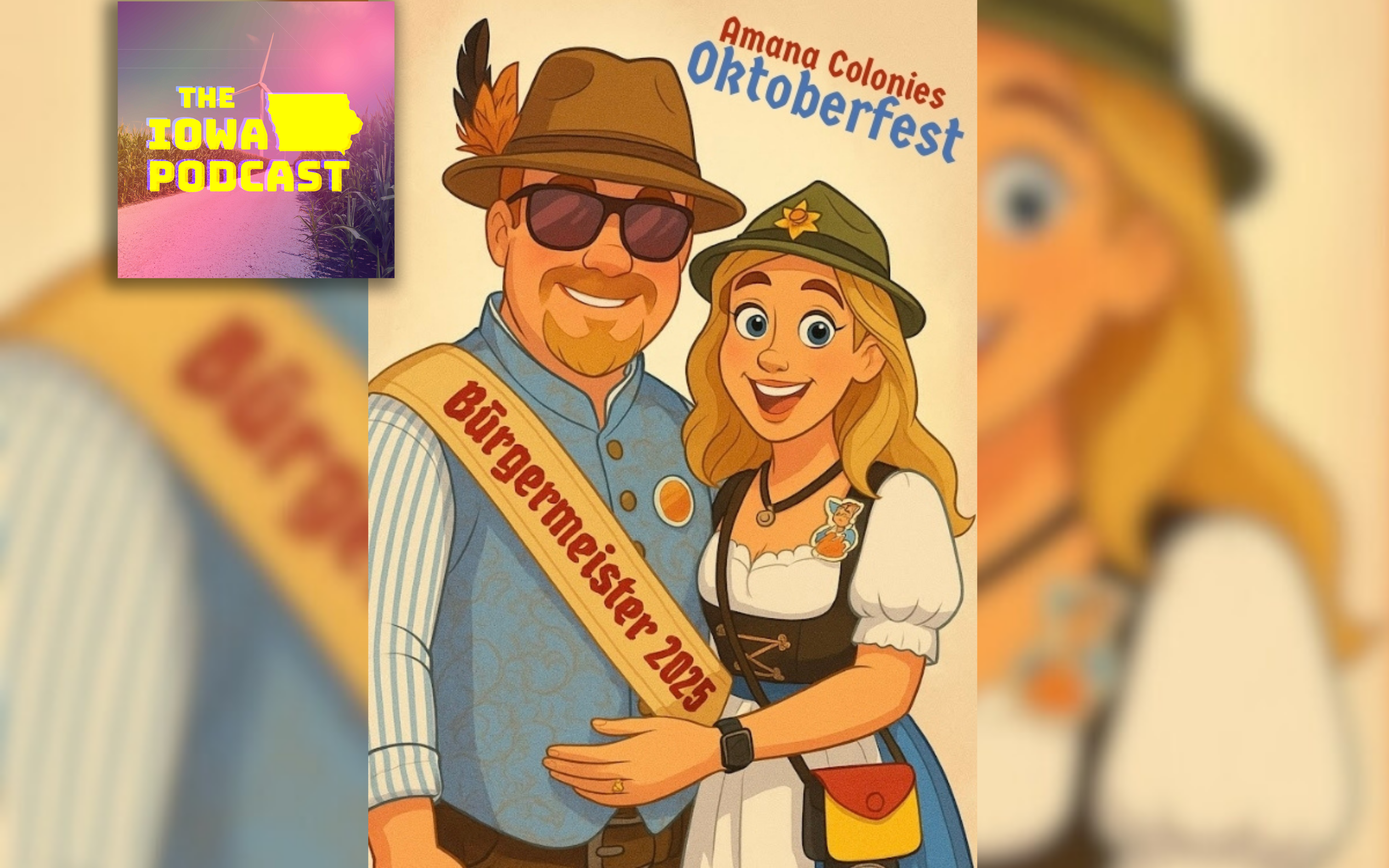
This month the Amana Colonies Oktoberfest celebrates its 60-year anniversary and the Amana Colonies Bürgermeister himself, Jon Childers, joins us to explain the special occasion, free sausages, local bands, and of course… Lots of beer! He also explains the backstory, why the Amana communal living experiment failed and why they’re not Amish!
The Amana Colonies are an Iowa institution, but most Iowans don’t actually understand their importance. They don’t understand the communal society was run by their church, or how they actually embraced technology vs the Amish community they’re often confused for. Childers, who is also the Executive Director of the Amana Heritage Society, explains their rich history.
Oktoberfest in Amana: From Jaycees Fundraiser to National Legacy
“They all said, oh, okay, well, we can try it. But… they just had to make sure that what they were doing had some cultural relevance to it,” Childers recalls of the event’s cautious early beginnings. Today, the four-day event draws thousands with live polka bands, traditional German food, bratwurst, and even an Alpine-costumed Burgermeister leading parades and keg tappings. Amana’s celebration, kicking off October 2, includes new acts like the Polka Police alongside longtime festival staples.
“We are the oldest [Oktoberfest] in the state, and we are one of the oldest even in the whole country,” says Childers. The Amana Heritage Museum plays a central role, hosting a ceremonial bratwurst giveaway and beer garden before the festival procession.
Four Days of Food, Music, and Tradition in the Heart of Iowa
While many associate the Amana Colonies with a simple, agrarian lifestyle or even mistake it for Amish country, Childers draws a sharp distinction. “We are completely different,” he says. Unlike the Amish, the Amanas embraced technology early, guided by a philosophy of efficiency and shared labor. “The faster we get our work done, the more time we can spend in church,” was the prevailing sentiment.
Rage-free Iowa news in your inbox
Justin, David, & Kaylee cover Iowa news, agriculture, business and tech. No clickbait. No agenda. If you support our vision, subscribe today!
The community was not only religious but also forward-looking. The Amanas were home to early woolen mills, large-scale communal agriculture, and later, Amana Refrigeration, which played a major role in introducing microwave technology to American homes. “We had the first tractor in Iowa County in 1913,” Childers adds.
Not Amish: The High-Tech Heritage of the Amana Colonies
He further explains that Raytheon’s purchase of Amana Refrigeration in the 1960s wasn’t coincidental—it was strategic. Raytheon wanted to use Amana’s home appliance capabilities to bring radar technology to civilian kitchens, resulting in the first mass-market microwave ovens. By then, the Amanas had already hosted early field testing for GPS in agriculture, partnering with Rockwell Collins due to the community’s large, consolidated farmland.
This unique blend of religious order and technological innovation is rooted in the community’s German origins. Formed by radical pietists in the early 1700s, the group sought to leave behind religious orthodoxy and build a community centered on shared labor, spiritual reflection, and economic cooperation.
From Radical Pietists to Rural Innovators: A German-American Story
Childers explains that the group began migrating to the U.S. in the 1840s, eventually founding seven villages in Iowa between 1855 and 1861. These villages were deliberately communal—residents didn’t own personal kitchens or private land. Meals were shared, work was assigned, and housing was provided. The communal model persisted until 1932, when American individualism and generational change led to a reorganization into private enterprise.
“They said, this is working out so great, why don’t we make a constitution that just says we’re going to live this way for as long as we can,” Childers says. But as younger members began to express desires to be artists, engineers, and mechanics—roles not formally supported in the communal structure—the group chose to adapt rather than disband.

Communal Roots and the Shift Toward Individual Freedom
Today, Childers carries on that legacy not only by leading the museum and festival efforts, but by serving as a cultural ambassador. Dressed in traditional Bavarian attire—including a rabbit-hair hat bought in Salzburg—he educates the public about the real story of the Amanas, their contributions to Iowa, and why they’re often misunderstood.
“People would be critical and say, ‘Well, I don’t see any buggies around.’ But no, we are completely different,” he emphasizes. In preserving the past, the Amanas offer modern Iowans a blueprint for balancing tradition and progress.
The Burgermeister’s Mission: Preserving Identity, Clarifying History
With events scheduled October 2–5 and expected attendance in the thousands, Oktoberfest in Amana remains one of Iowa’s most cherished cultural events. Tickets and information are available at amanacolonies.com, and visitors are advised to book lodging in nearby Coralville or Cedar Rapids due to high demand.
“We feel that it’s very much a value for the money,” Childers concludes. “It’s a whole weekend of fun.”