


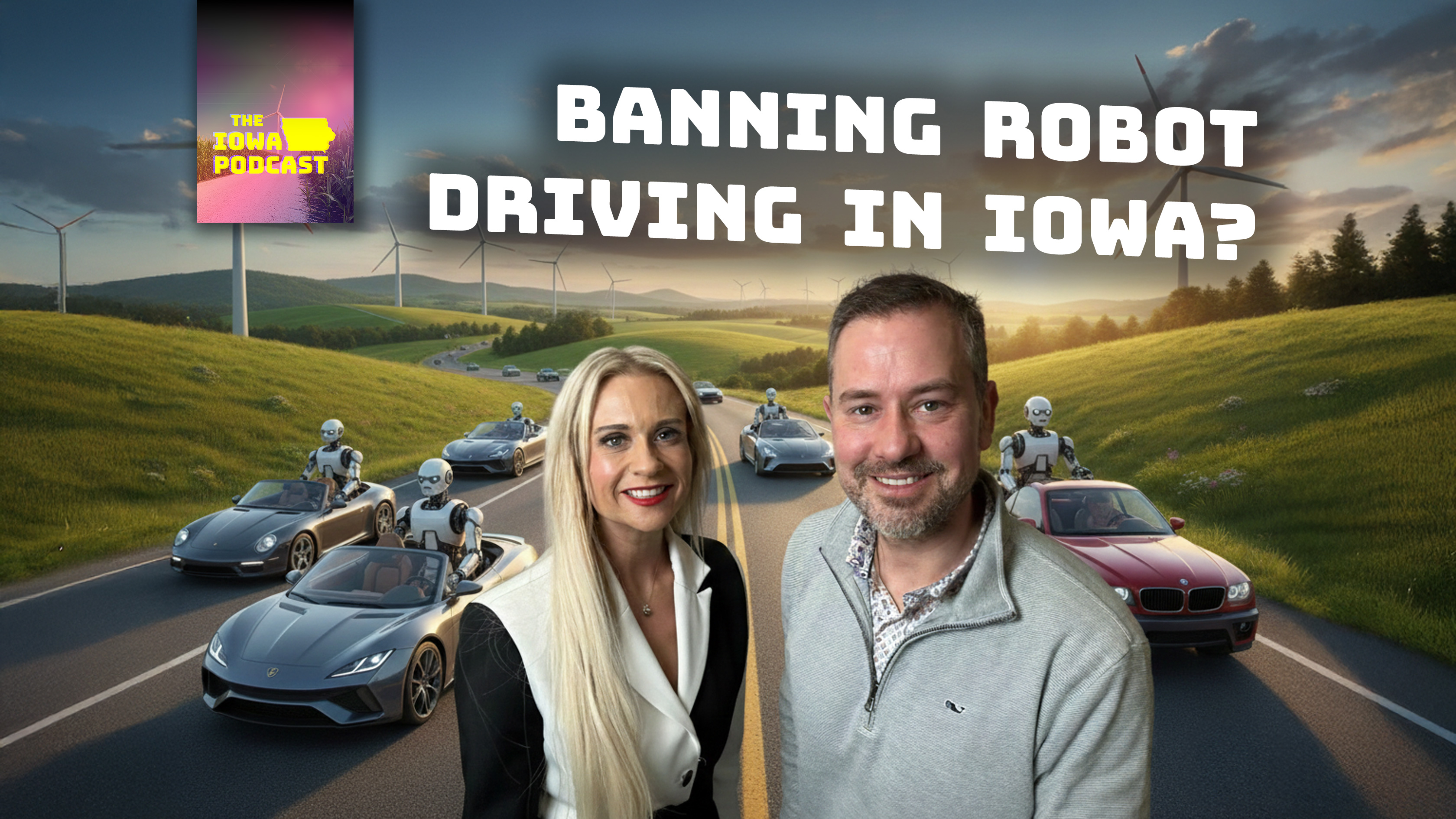


As the Iowa Legislature navigates the accelerating reality of autonomous vehicles, State Representative Megan Jones (R-Sioux Rapids) is seeking a delicate balance between technological innovation and public safety. But the current state of the bill may create a regulatory framework that inadvertently bans them entirely.
Speaking on The Iowa Podcast, Jones, who chairs the House Transportation Subcommittee, addressed the evolution of bills like HF 2375, HSB 598, HF 2673, which aim to define the “rules of the road” for driverless technology in the Hawkeye State.
Jones expressed a notable degree of caution regarding the current reliability of the technology, admitting, “I just don’t know if we’re quite ready for all of this, if the technology really isn’t there or if the technology is overcorrecting.”
Hear from Iowans directly. No algorithms.
Don’t let the algorithms choose your news. Enter your email address to hear directly from Iowans leading news in politics, community, agriculture and business. No editing. No clickbait. No rage. No agenda.
Hazardous materials and autonomous vehicles in Iowa
While some initial legislative drafts were seen as overly restrictive, Jones emphasizes that the current focus is on managing high-risk scenarios, such as the transport of hazardous materials by commercial vehicles. But the bill doesn’t define hazardous materials, meaning there would be a legal grey area on what can actually be transported.
”When I envisioned this bill, I was, we were thinking more of like the tanker trucks.” Jones said. “I’m not so much concerned about the gallon of bleach that leaks. I’m concerned about the tanker truck, that’s basically a missile that’s driving down I-35.”
Liability in Iowa for autonomous vehicles

The legislator also highlighted the administrative hurdles of regulating a field that shifts almost weekly. One area of significant uncertainty remains the “legal gray area” regarding liability during autonomous operation. Under current versions of the bill, liability would always fall to the owner. This would apply in scenarios where a family member may be borrowing the vehicle, choosing to operate it in autonomous mode, or if vehicle breaks due to manufacturer problems.
Jones appears open to refining the legislative language to protect innocent owners, noting, “maybe we need to clarify some language there just to, to ensure that there are some protections for people who just happen to be in autonomous mode.”
Despite the complexities, Jones remains committed to a deliberate, Iowan-centered process. Rather than rushing into permanent standards, she indicated a preference for observation: “we’re just gonna have this discussion, see where it goes, see where Iowans wanna be.” she said indicating she’s open to feedback.”
Interview Transcript
This transcript was created with help from Ai. Please report errors to us and always refer to the video as your primary source.
Justin Brady: I’m Justin Brady. This is the Iowa Podcast proudly recorded in the Jet Rose barbecue studio. Autonomous cars, man, they’re like everywhere. They’re gonna take over, but. Are they gonna survive in Iowa? We don’t actually know that yet. There are some bills being considered and some look to be maybe favorable, but others look to maybe not be so favorable. We’re gonna discuss that today with the chair of the Transportation Subcommittee representative Megan Jones. Representative Jones, thank you so, so much for coming in the studio. Thank
Megan Jones: you for having me.
Justin Brady: Absolutely. you like barbecue? I do. And obviously Jethro sponsors the studio. You know, I like chicken wings. I know I need to get outta my comfort zone, but I just keep doing that. So if you want a $30 free gift card from Jethro’s Barbecue, go buy a hundred dollars gift card from our website right now. Go to Iowa podcast.com. If you click that banner up there, you’re gonna go to a gift card website, buy the a hundred dollars gift card, and they’ll send you a $30 gift card, which is cool. So anyway. Representative Jones, obviously, thank you so much for coming in here. Um, there are a bunch of bills with a bunch of letters. Um, first it was HF 2375, then HSB 5 98, now HF 26 73. Basically all that Scrabble uh, Scrabble stuff is essentially an autonomous car regulations. Right. And so,
Megan Jones: we’ve got two bills right now that are moving um, on autonomous vehicles and they’ve both been moving and so they each get new numbers as they move Through the legislative process. So. uh, they’re a Little bit hard to follow, but yep, there’s two different bills.
Justin Brady: the big question I wanna start with is the auto, the first bill was actually very restrictive for autonomous cars. It would almost make it impossible for any of them to operate in the state. Right. That’s been changed. Um, but is this more of like, in, in your opinion, is this more of a Luddite concern thing, new technology, scary? Or are there some legitimate concerns around autonomous cars that legislators are looking at and trying to anticipate?
Megan Jones: Yeah, you know. I, I was, I’m really open to autonomous vehicles. I’m kind of a techie person myself and, um, you know, I’m, I’m totally open to having them in, in Iowa. I brought this to my committee and, uh. I was really surprised at the reaction. Um, some, some folks have cars that are self-driving and they were like, absolutely not. Should we just be letting these cars run around? Really? Yeah. I was really surprised. And Um, you know, maybe. it’s because the transportation committee tends to err on the side of, of safety and you know, at the end of the day we talked about it and they said, we can always repeal this.
Justin Brady: Oof.
Megan Jones: And, And so, so I thought that was a really interesting take on it. You know, once the technology is there, they said, well, we can always repeal this law. And I thought, well, that was, that’s really interesting. Um, and you know that, that video, um, of the train hitting the robot that was stuck on the tracks, um, did you, did you see that?
Justin Brady: seen that. No.
Megan Jones: Well, so this. this. Robot delivery vehicle, um, got stuck on some train tracks. Oh,
Justin Brady: the little tiny one. Yeah. Yeah.
Megan Jones: a tiny one. Yeah, yeah, yeah. Well, and That’s that’s just it, Justin. So that’s, that’s it. When that, when that train ran that robot over. I think we were all like, oh, and then, I, then I thought, what if that? was a person? Sure. Right. And I, I think we all felt bad for that robot and then it was like, wait, that, that was a robot. Right. We all felt bad for it and I don’t know why we. felt bad for it, but at the end of the day, we all felt bad for the robot and it was like. What, what if that was a person? Sure. Right, and, and what if that was a person stuck on those tracks in a self-driving car? Right. Um, and so I think we’re having a really good conversation. I don’t know if these bills are gonna make it across the finish line, but at least we’re having that conversation as to where, what we need to do here, if anything, on on, on these self-driving cars.
Justin Brady: mentioned something interesting, and this isn’t a bad or good thing, but, um, it’s ne neither bad nor good, but you mentioned some of the people on the subcommittee actually had autonomous cars themselves, and for that reason they’re like, yeah, we shouldn’t allow these things on the road. Tell me more about that. Have they, did they have issues or concerns they brought up to you?
Megan Jones: Yeah, they’re having to override it. and, uh, and, and you know, maybe that’s a, a, um, overreaction or an overcorrection. I’m not sure. Um, you know, I know my car myself. Um, some of the safety features, it alerts on deer that don’t exist. Right. Or you know, or. or it’ll say that, you know, the heat sensors are on, on vehicles that, you know, semi-truck trailers or, or things like that. And, and you just kind of wonder like, why, why is that alerting there? Um, so. I just don’t know if we’re quite ready for all of this, um, if the technology really isn’t there or if the technology is overcorrecting. Um, but I was really surprised by that conversation.
Justin Brady: Yeah, that is surprising. I will say I have a autonomous car myself. Mm-hmm. And it drives a hundred percent autonomously. Uh, I can’t probably say a hundred percent, maybe 95%. Um, so I do understand the concern of, well, autonomous cars will do crazy stuff. You know, get it. Mine, mine doesn’t. But I get that. You know, it’s a very logical, reasonable concern in my opinion. Um, but I would point out that mile for mile driven, uh, I don’t know, I’m not familiar with all the individual car companies data, but I know Tesla shares their data quite a bit and mile per mile. Autonomous cars today are still safer than human beings at this point. At this point. Isn’t that amazing?
Megan Jones: Isn’t that amazing? Yeah,
Justin Brady: is. And so is there just an expectation that the technology is going to. Get worse over time. Is that one of the concerns or that we’ve, or that like the data’s not accurate?
Megan Jones: I, I don’t know. Or maybe it’s just, maybe it’s just relinquishing the control, right? I, I, I don’t know. You know, it, I, I think this conversation is really fascinating because it, it is something like you know, when we all went through driver’s ed, uh, our, our parents were sitting in the, in the passenger seat, and they would pretend to pump the fake brake, right? And. Florida.
Justin Brady: floor to the foot. To the
Megan Jones: Right, right. Um, and, and I think some of these conversations are Kind of like that. Like we’re just, we’re maybe the technology is there and we’re just not ready for it, or we’re not ready to admit that it’s there. I’m not sure. Um, so it. You know, I’m not sure these bills are gonna make it. We’re gonna have, I actually have a conversation with the majority leader today on where these bills are gonna go. Um, but I think ultimately we’ll probably have a bigger conversation in the Republican caucus to see where we’re gonna go. But I, and I should note on that note, um. One of these bills was sponsored by a Democrat, uh, uh, Dan Goa and,
Justin Brady: The initial version. Yeah. Yeah.
Megan Jones: And you know what? I have. him, I have him, uh, floor managing it, which, um, is kind of interesting just from a, uh, procedural perspective because typically, um, because we’re in the majority, Republicans run bills, right? So it it’s typical that, that the majority party runs runs the bills. We floor manage the bills. He was the sponsor of the bill, so I gave it to him. Um, and I’ve been pulled aside quite a few times. Do you know, do you know that there’s Democrat running the running that bill? And, and I said, Yeah. you? know what? Right. right. He’s, the, he was the sponsor of the bill. It’s his bill. He’s on my committee, he’s my ranking member. Um, he’s interested in the subject and so I, I gave it to him to run and, um. I think it was just kind of an, an extension of bipartisanship. Um, and I think that’s something that we forget all too often that we play really good in the legislature. I
Justin Brady: agree with that a lot. We do forget that, um, I think the original bill with, um, Gaza’s name on it basically banned all commercial uses of autonomous vehicles and dict and, and like did, basically made it a law that there had to be a person there for all commercial uses. This would be, if we ever get robo taxis in Iowa, they wouldn’t be operable if we had basically any commercial use of any auto autonom. Even the semis not operable. It would essentially. Get rid of any autonomous vehicle operation in the state, which means if Nebraska legalizes it, people would essentially go around the state, you know, like all this autonomous ve So between that bill, I think that was H HF 2375. Yeah. And what we have now, what are some of the major changes? And is OSA is, is everybody on board with these or is there still disagreement?
Megan Jones: Yeah. You know, I think where that becomes a really interesting conversation from the commercial perspective is where the other bill plays, plays in. And so that’s, that’s house file 2375
Justin Brady: I, and I should say really quickly, that would also ban the Des Moines airport’s future use of autonomous buses as well. ’cause I know they’re looking into
Megan Jones: They’re, they are looking into that. So the way I read the bill is that it only applies to highways. And so, so I think that’s, that’s just our, our, our street structure. But the, the airports are interpreting that differently, so We’ll, we’ll have to either clarify that for them, or maybe they’ll
Justin Brady: But I cut you off. Sorry about that. But
Megan Jones: no, no, no, no.
Justin Brady: what were the main changes so far, and what’s the debate on
Megan Jones: Yeah, so where. um, sorry, what I think it, it, where these two bills are playing together is that, um, when it comes from the commercial perspective is that, uh, the bill that Representative Wood is running, um, says that you can’t have autonomous commercial vehicles, um, semi trucks, commercial vehicles that, uh, are carrying hazardous liquid material. And so you reminded me of that when you said that vehicles would have to drive around Iowa because, um. That is, that is a different conversation when we have autonomous vehicles that are carrying hazardous materials. Um, and I think that that really struck a chord with me as like, oh, okay, well that’s a different, that’s a different element in this conversation. Um. Ghost’s amendment. I think tones down the restrictions a little bit. I think he is trying to, you know, listen to everybody, listen to the parties. I think he’s trying to listen to the, he’s trying to have a conversation with the airports, trying to figure out what their concerns are, how he can make those adjustments when it comes to defining, you know, highways and straits and, and making exemptions for the airport. So, um, if this bill is gonna make it across the finish line, I think it’s gonna look different. I think we are gonna, you know, have some exemptions in there, clarify some things, um, make sure that this. Bill is a little bit more future proof, um, so that we can, we can adjust a little bit easier and kind of maybe slide in to, uh, to the technology.
Justin Brady: I, I’m glad you brought up the hazardous materials and future proofing, because I get it. I, I’m reading the bill and I’m like, okay, I understand the concerns Personally, I don’t agree with them, but I totally get it. But like, uh, let’s talk about the hazardous materials because, and you did add something, um, and I don’t know if this is in the bill yet, or maybe you’re working on a version of it. You added liquid and before that didn’t appear in the bill, and so I guess people would ask, well wait. There’s not really a definition of hazardous materials. So someone, if it was an eager lawyer wanting to sue like an Amazon delivery vehicle, for example, in other, we don’t have ’em here in Iowa, everybody, but in other states they have autonomous rivian. Um, now, I don’t know, I think they’re still driving them, obviously regulatory, but if an Amazon vehicle were to crash and bleach leaked outta the back or even a battery, if liquid’s not in the bill, those technically would be hazardous materials. So. You’d have a bunch of drivers saying, well, I mean, okay, that still makes all roboto taxis and delivery vans, illegal operators, because they technically are transporting materials that could be considered by some to be hazardous. Right.
Megan Jones: So I, I think what the, the wood bill is going after is, uh, is commercial semi-truck, so people who have c dl. So I don’t, I don’t think it’s. so, but, but you bring a, a good point because there are Amazon and semi-truck, Right. So, and they don’t always know what’s in their, what’s in their hall, right. So, um,
Justin Brady: Amazon does, and they know what’s in your house too,
Megan Jones: and that’s a whole different level of surveillance, right? So, uh, so, so yeah. That’s, that’s, a really good point. And, and look, these packages, they, they go through a lot. I mean, we all have had that package kind of leak out as it comes in the door, you know? Um, so, so that’s a really great point. What, what that, what that looks like, and maybe we need to put some stipulations there about, you know, how much of a hazardous liquid material they’re hauling. ’cause I think. When I envisioned this bill, I was, we were thinking more of like the tanker trucks. Right. Um, that’s, that’s really my concern. I’m not so much concerned about the gallon of bleach that leaks. I’m, I’m concerned about the, the tanker truck. you know, that’s basically a missile that’s, you know, driving down, you know, I 35.
Justin Brady: Right, right. I mean, but like if I was, if I was, you know, 30 years from here, I would say, well, we shouldn’t allow human drivers because I’ve seen human drivers crash and I’ve seen them cause like these pipe bombs on the, you know, like, so the same logic that invalidates an a robot driver, I could use that against humans and say, well, humans are far worse. They kill. How many people is it annually? A quarter million of people or something that don’t fact check? Well actually go ahead and fact check me on that. They kill a lot of people. Drivers don’t exactly have a great track record either. And so I understand the concern of trying to anticipate the future, but I’m also like, guys, don’t we wanna say like, let, let’s talk about hazard materials and stay on that through line or stay on that topic for a second. When it comes to hazard autonomous vehicles and transporting hazardous materials like in future proofing, I’m kinda like, wait a minute. In the future, aren’t there going to be cases where we want autonomous vehicles to transport hazardous materials because we don’t want people near them, and so will we be kind of. Putting ourselves in a regulatory framework where things that are a net positive for Iowa are actually, as you mentioned, we’re kind of stuck because someone years ago said, well, we can just repeal it.
Megan Jones: Yeah. You know, I think that’s a really great point. Like at what point, you know, have we crossed that threshold where technology. has actually, you know. Helped us. And what, and at what point are we willing to accept that it’s that it’s beneficial in our safety world. Right. So, um, I think that’s a great conversation and I think we’re gonna continue to have that conversation And, um. Every day I learn about a different piece of technology in our, in our transportation world.