

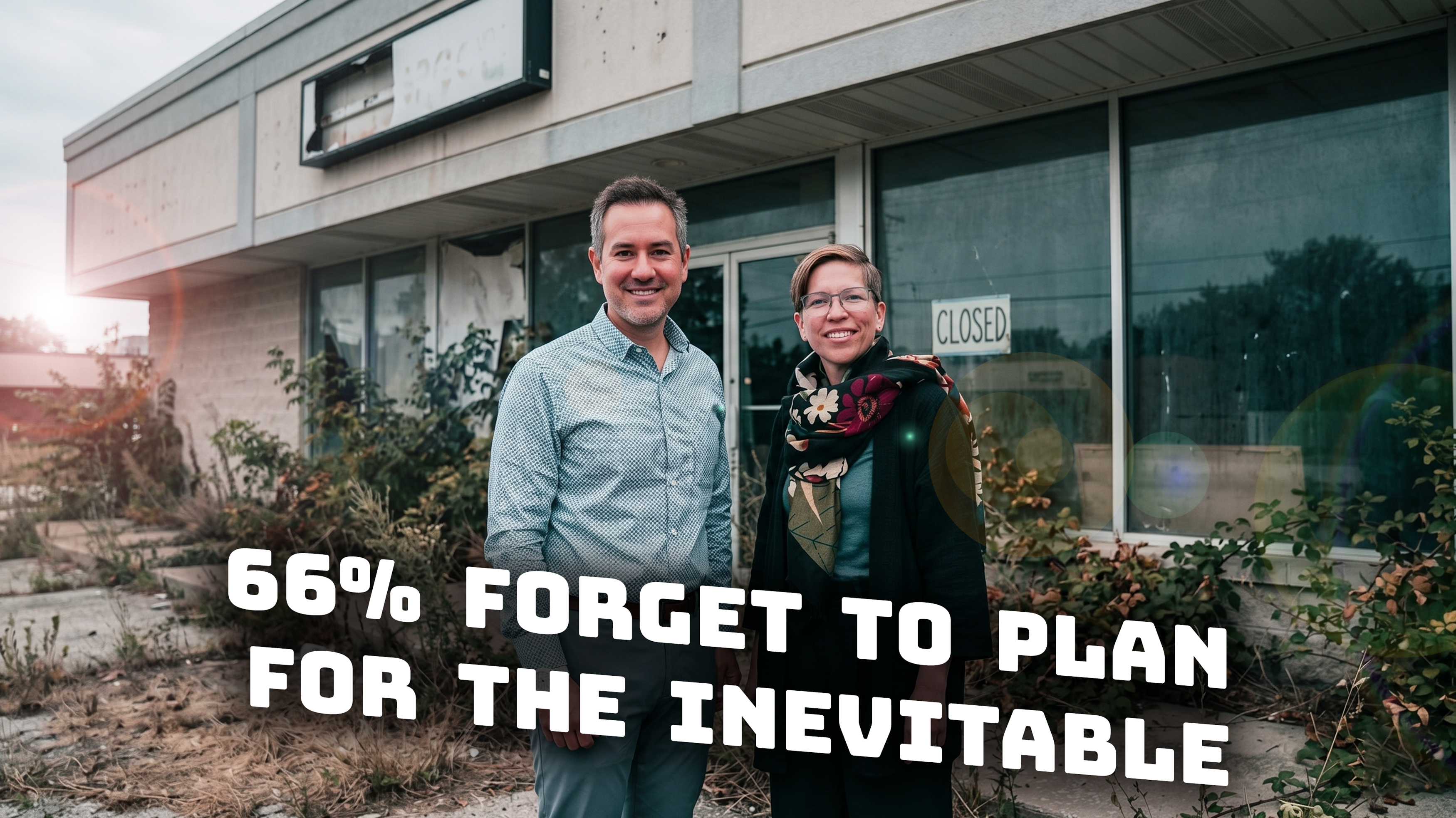


The majority of business owners are putting their own businesses at great risk. Few have a plan if they were suddenly incapacitated or pass away. Iowa business succession planning attorney Breanna Young of Dentons Davis Brown says it’s shockingly easy to plan for, and shockingly expensive if you forget.
The lack of “documented clarity” hurts employees and family. Some business owners assume nothing will happen to them. Others minimize the central role they play and why documentation of institutional knowledge is vital. With proper planning however, you spare family, employees, clients, and your vision from being disrupted.

Justin Brady
A striking majority of American small business owners are operating without a safety net. According to Young, a survey of U.S. business owners revealed that only about one-third possess a comprehensive, well-documented succession plan. This widespread lack of preparation leaves businesses highly vulnerable to sudden disruptions. Young explained that, “Succession planning is what happens to the assets, in this case a business, in the event of disability, in the event of death, or other triggering event.” A proper plan delineates future day-to-day management decisions and determines who will benefit financially, noting that these two responsibilities do not always fall to the same individuals. Without this proactive strategy, families and remaining business partners are often thrust into an expensive, time-consuming emergency mode to maintain operational continuity.
Hear from Iowans directly. No algorithms.
Don’t let the algorithms choose your news. Enter your email address to hear directly from Iowans leading news in politics, community, agriculture and business. No editing. No clickbait. No rage. No agenda.
Mitigating IRS Risks and Operational Chaos
Failing to establish a succession plan invites intense operational confusion and potentially devastating financial consequences from federal tax authorities. Young emphasized that, “The more carefully that the client plans and lays everything out and leaves as little to negotiation or interpretation as possible, the less room there is for disputes to arise.” These disputes can occur among heirs, employees, shareholders, or even the IRS regarding company valuation.
When an owner passes away, the estate must be appraised for federal estate tax purposes. Young warned, “If there’s no written document that specifies how that business will be valued, there’s more room for the IRS to dispute what the value of the business is.” Proper planning utilizes mechanisms like buy-sell agreements and valuation discounts to legally minimize the taxable estate. Furthermore, strategic planning can incorporate life insurance to inject liquidity into an estate, facilitating equitable distribution among heirs without forcing the liquidation of the business itself.

Defining a clear corporate purpose is critical for growing companies.
The famed Sam Altman and Elon Musk dispute behind OpenAi could have been easily avoided had they dialed up John Pietila of Dentons Davis Brown. Pietila breaks down why corporate purpose and social purpose are…
Keep reading
Iowa business owners are liable for data their website collects!
Iowa’s consumer data privacy law went into effect on January 1, 2025, but Ai’s advances in 2027 will open a new can of worms for Iowa business owners. Dentons Davis Brown data privacy and cyber…
Keep reading
How productive Ai lands you in legal hot water
Well-intentioned, ethical use of Ai tools with proper IT guardrails can still pose privacy concerns and put your company into legal hot water says Jo Ellen Whitney, an employment attorney at Dentons Davis Brown. She…
Keep readingInterview Transcript
This transcript was created with help from Ai. Please report errors to us and always refer to the video as your primary source.
Justin Brady: [00:00:00] From Iowapodcast.com, I’m Justin Brady. One third of you business owners could be screwed right now. One third are at risk if you, the owner, dies, you have a disability, you are incapacitated for whatever reason, you have to leave the country to help a loved o- whatever it may be, one third of you are at risk for succession, like your business. What will happen? What… Do you even know what will happen at this point? Dramatic pause. You’re probably like, “Crap, I don’t actually know.”
Hmm. Perfect timing, ’cause Brianna Young, an attorney and of course shareholder at Dentons Davis Brown joins us today to break down this topic. Brianna, thank you so much for coming in the studio.
Breanna Young: Thank you for having
me
Justin Brady: This obviously we really appreciate the collaboration and partnership we have with Dentons Davis Brown.
Can we start really broadly? Some people may roll their eyes, but I think this is a good place to start, is what [00:01:00] is succession planning?
W- w- how do we define that, and what’s the point? Like why is that even useful?
Breanna Young: Succession planning is what happens to the assets, in this case a business, in the event of disability, in the event of death, or other triggering event. So as it relates to a business, that might include, you know, who will take over, um, the management decisions, the day-to-day keeping the business running, who will benefit from the business financially, and sometimes the people who are running the business in a succession plan aren’t necessarily those who benefit financially from it.
So a good succession plan will incorporate all of those sort of key, um, key persons and the business itself and determine what’s, what’s gonna happen if those contingencies occur.
Justin Brady: And do you see that a lot of business owners have not planned for this at all? Do you see that [00:02:00] often?
Breanna Young: I do see that often. Yeah, you, you mentioned that one-third number, which is interesting.
Justin Brady: That was, that was her, your
number by the way.
Breanna Young: were paying
Justin Brady: I was paying Absolutely. yeah
Breanna Young: Yeah. So, so, um, there was, there was a study of, or a survey of US business owners that did find that only about a third of small business owners in the US have a plan that is well-documented and thought out and comprehensive for their business.
So it is very common to not have anything planned and, um, we always n- nobody likes to plan for the inevitable. And so I think that, um, that a lot of business owners don’t have a plan for that reason.
Justin Brady: Actually, so this is interesting, is that I kind of got it wrong. And this is important because I said a third of you are at risk, but wh- what you’re saying is only a third have actually planned this correctly. So [00:03:00] that’s way worse. Yeah.
Breanna Young: yeah.
Justin Brady: So what, what is included when we talk about succession planning? Are there any broad categories to what is succession planning, like just the broad bullet points?
Breanna Young: Yeah. Succession planning for, for a small business can include, um, if, if the, if the key owner, the current generation or current owner is unable to continue, um, making decisions for the business, who’s gonna step in? Who’s gonna be able to do those things on behalf of the business? Um, w- what’s the rest of the team gonna look like?
Are there other key employees who are gonna continue, um, in the business to try to keep that continuity? Is there gonna be a buy-sell agreement that’s triggered at that time? Um, and then who are the beneficiaries? So sometimes in a succession plan, there are, um, there are family members or charities who will inherit sort of the fruits of the labor and the income [00:04:00] from the business, which might not always be the same as the people who are making the decisions.
So a good, um, succession plan will incorporate all of those aspects.
Justin Brady: So what are, what are the w- the negatives? Like, you don’t do this thing, you don’t have a succession plan.
Fine. Here are the things that will happen to you then
Breanna Young: There can be disputes that arise without a succession plan, and there can be disputes that arise with a succession plan too, but I find that the more carefully that the client plans and lays everything out and leaves as little to negotiation or interpretation as possible, the less room there is for disputes to arise.
And that can be disputes among family members, um, in the next generation who’s inheriting, disputes among employees and other shareholders or other owners of the business, and then also disputes, um, pertaining to valuation with the [00:05:00] IRS. So without planning, um, if, if you don’t plan, those decisions will have to m- be made still, but you don’t have the luxury of choice.
You don’t have the luxury of time because it’s, um, now you’re in emergency mode
Justin Brady: Yeah. you mentioned IRS. I think that would be the last thing most business owners would think of in the, a succession plan. They’re like IR- how does the IRS factor into this? But you mentioned that IRS valuation disputes, like this is a thing if you don’t have a good succession plan?
Breanna Young: Mm-hmm. Yeah, IRS valuation disputes can, can become really, really important. So if one of the shareholders or partners or LLC members, business owners dies and their estate needs to be assessed or appraised for IRS purposes, um, it’s possible that they might have a federal estate [00:06:00] tax issue that their executor or trustee needs to address.
And if there’s no written document that specifies how that business will be valued, there’s more room for the IRS to dispute what the value of the business is. And, um, with a business owner who dies owning an interest in an entity, there are oftentimes valuation discounts that can apply for, um, lack of marketability or a minority interest, and it can be harder to, um, substantiate those and prove to the IRS that those apply because typically when a person dies, you want the estate to be as small as possible for value purposes, right?
Because the IRS looks at the federal estate tax threshold. And so if we can get those discounts that can apply to business interests, that can help decrease [00:07:00] the value of the taxable estate and maybe reduce or eliminate taxes. One of the things that the IRS looks at in that is what type of buy-sell agreements are in place, what do the documents say?
A good succession plan can help with all of that
Justin Brady: I would almost be willing to guarantee, um, everyone who doesn’t have this in place has absolutely no idea that the IRS issue alone will absolutely crush that business and, and like get things stuck, right? If they don’t have a succession plan, I think most people are like, “Oh, it just goes to the family.
Everything will be fine. It’s not a big…” But you, but you’re saying is, okay, cool, even if your entire family, everybody is just aligned with you magically, which probably isn’t the case, um, you still have an IRS valuation problem because you didn’t have this plan ahead of time. So I think that’s kind of a wake-up call for a lot of people.
I wanna go something, I wanna go back to something you said, which was you mentioned, and you [00:08:00] kind of, uh, mentioned this i- and kind of signaled to me it was important, but you mentioned when there is a triggering event, um, that y- it puts people in more of a reactionary state. And when people, when the owner suddenly dies, when the owner has to, is incapacitated, something happens, they’re in the hospital, and companies are thinking reactively, including maybe even the owner, w- do you see a lot of mistakes that happen because things are rushed through, and does this cause damage down the road?
Breanna Young: I do. I, I had a situation arise, and I’ll, I’ll anonymize some of the
Justin Brady: you did? Yeah. I’d like- I’m sure people would like to hear about
Breanna Young: yeah. Yeah, absolutely. So a situation arise where the father was the business owner and, um, was a very successful business owner, and there were different businesses that owned sub-businesses, and it was kind of a– There was a whole chart of what owns what entity, and he knew all of that information.
He knew what contracts there were [00:09:00] with vendors. He knew what employees got bonuses when. But the problem was that that information was all just inside of
Dad’s head, right? Right. And he died tragically at, uh, a very young age and didn’t have any plan in place, so no will, no trust, no buy-sell agreement or anything like that.
And so his heirs were very young, um, some of them weren’t even adults yet, and were left trying to figure out, ” Okay, how do we, first of all, keep this business running to keep it viable and preserve value? How do we reassure the employees who are here that we’re gonna keep the lights on, they’re gonna get their paychecks?
And how do we, how do we run the business?” Um, because n-none of it was documented because none of us like to think that this is ever going to be something that’s gonna happen to us. And so in that [00:10:00] case, um, we were able to untangle it all and figure out what owns what and who gets paid when and what vendors and contracts there are and what outstanding loans there are.
But it took a long time, and it was really expensive because we needed to bring in outside business experts to help with all of those things. Whereas if there were a plan put in place ahead of time, all of that could have happened seamlessly and with far less expense
Justin Brady: basically they were ha- they had to go from 40 hours a week, r- rough example, to like 80 hours.
Nothing’s organized and clients could leave. What’s interesting is even, I, I think most business owners, even business owners that are, like, in it for their family and their employees, or peop- or business owners who are vision and mission driven, like, all of them want the business to continue, to continue succeeding at achieving the vision and mission, or to protect employees and, um, their family.[00:11:00]
And so it makes a lot of sense why this should be something people do. You me- you mentioned this earlier too, I wanna go back to this, this is very important, which, who controls the business might be separate from who actually owns and gets the benefit from the business. Like, these are two different things?
Breanna Young: It can be, yeah. So think about, um, a business, let’s use a farm as an example. So, um, mom and dad have a farm, and they have two kids. One is the, the kid who’s there and farms with mom and dad, and has for, you know, 40 years, and he’s out in the fields. He’s working, um, to, to keep the fa- farm going, keep it growing.
The other kid is, um, has interests that lie elsewhere, and he, you know, maybe lives out of town and isn’t involved with the farm. Yeah. And mom and dad wanna treat the kids equally in their estate plan, but how do you do that? And I’m using a [00:12:00] farm as an example here, but it could be any kind of business where one family member’s involved and maybe others are not.
And so one way to, to balance that estate, the, the shares that each of them would receive from the estate, is maybe the on-farm kid or the business kid receives an interest in the company after mom and dad die, and the other kid receives an equal amount of cash. So have the company appraised after mom and dad die.
Whatever that appraised value is, the other child receives a like amount of cash, an, an equal amount of cash. Um, and w- with that, it’s very common to pair that with, um, life insurance so that there’s some liquidity to the estate.
Justin Brady: Oh, interesting
Breanna Young: but that, that needs to be done carefully as well because there can be some, uh, tax issues.
There was a U.S. Supreme Court case called the Connolly case that, um, [00:13:00] sort of clarified, and in some cases, treat- changed how life insurance is treated when you’re valuing a company. Oh. So you wanna k- work with a good planning team who understands all of the intricacies of, of life insurance and the other moving pieces if you’re using that as part of the plan.
But it, it can be a great way to add liquidity because not everybody has just, you know, whatever the business is worth, you know, $10 million just sitting around. You buy a life insurance com- uh, policy, but you wanna make sure that that policy’s properly owned, has proper beneficiaries to meet the IRS requirements, so it’s not getting, uh, it increasing the size of the taxable estate.
Justin Brady: It sounds like the majority of your job then is not necessarily, uh, handling fights. It’s basically getting documented clarity up front so that there aren’t as much fights and combative [00:14:00] behavior and breakdowns in either friends, family, or co-founders. Um, Brianna Young, attorney and shareholder at Dentons Davis Brown, what’s the most direct way to reach out to you if people are like, “Crap, uh, this is not, not on my radar.
It needs to be”? How can they reach out to you?
Breanna Young: They can reach out on our website at dentons.com. My email address is brianna.young@dentons.com,
Justin Brady: excellent. Brianna, thank you so much for coming in the Iowapodcast.com studio, and again, thank you for the partnership with us. We really appreciate it
Breanna Young: Thank you. I appreciate you
🫶
This show is a collaboration. IowaPodcast.com collaborates with loved Iowa brands to bring value to listeners. Brands compensate our hosts directly for their time. Learn more