

Update, Nov. 4, 2026: Chris Jones (D) lost the 2026 race for Iowa secretary of agriculture to Mike Naig (R).


Jones says the runoff and nitrate issues are entirely preventable if we change regulations around farming. He also suggests new state funding to help farmers re-design their fields but also suggests farmers may have to contribute new tax revenue to get our water problems under control.
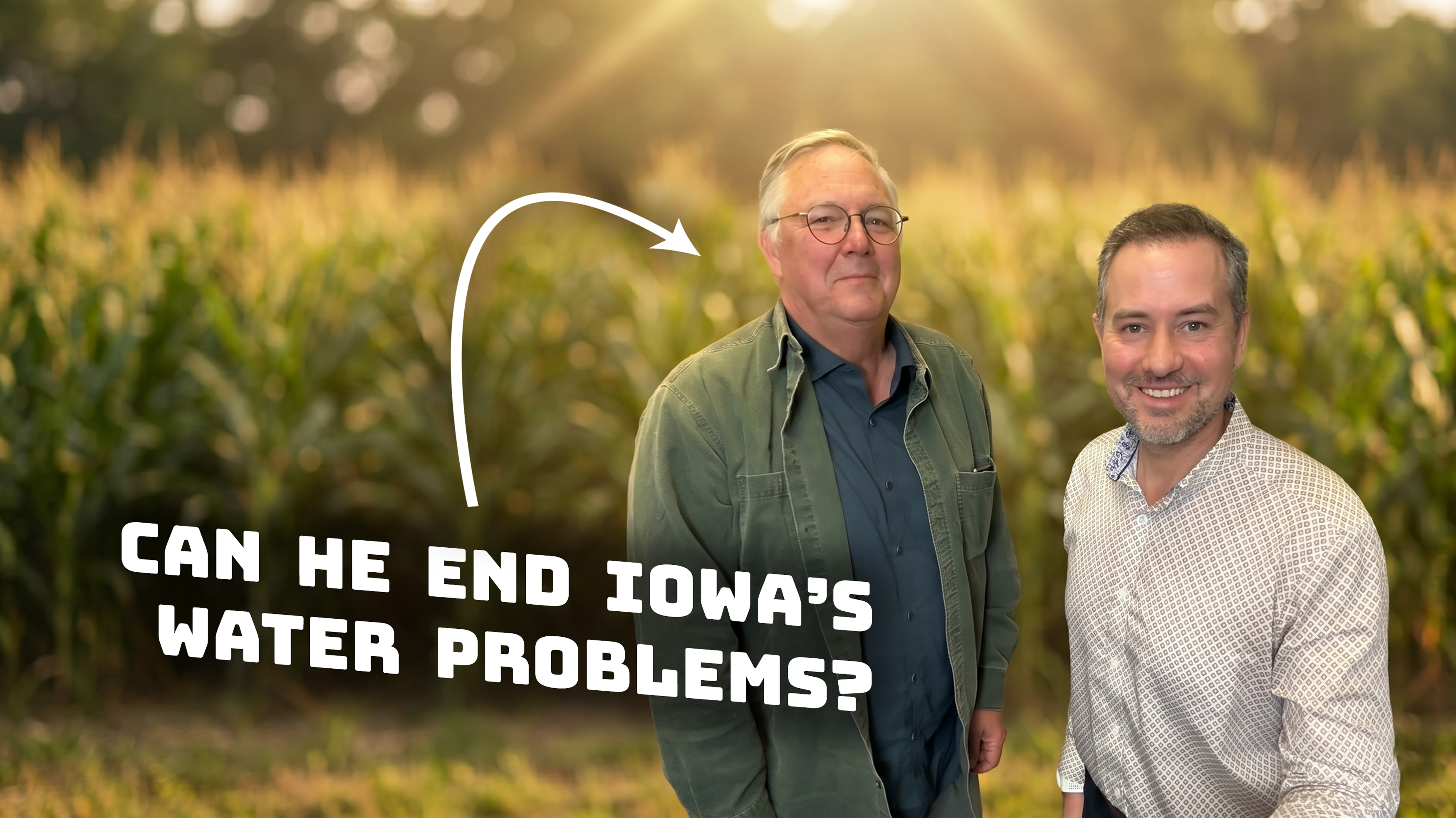
In the past, the Secretary of Agriculture position wasn’t a race that demanded a lot of attention. As most Iowans become increasingly concerned with Iowa soil health and water quality however, the race has taken more attention and Chris Jones hopes his solutions for Iowa water quality will land him the job. Jones discusses how he proposes to fix the “upstream” problems and what regulations may be necessary.

Hear from Iowans directly. No algorithms.
Don’t let the algorithms choose your news. Enter your email address to hear directly from Iowans leading news in politics, community, agriculture and business. No editing. No clickbait. No rage. No agenda.
Mandating Conservation and Reducing Pollution
Jones argues that Iowa’s current corn-soybean agricultural system has become “untenable” due to its impact on water quality, specifically citing high nitrate levels that affect over 60 communities. To address this, he proposes specific mandates such as banning fall tillage and questions the application of fall anhydrous ammonia. Jones also advocates for a mandatory 50-foot buffer between row crops and perennial streams to protect riparian areas.
Reforming Crop Insurance and Subsidies
Jones highlights how the federal farm bill currently prioritizes four main crops, creating a “perversity” where farmers grow corn and soy in unsuitable environments simply because revenue is guaranteed. He suggests that the state and federal government should expand subsidies to include more sustainable crops like oats or provide “off-ramps” for farmers to transition to different systems. Jones believes taxpayer money is better spent helping farmers diversify than on temporary fixes for existing pollution.
Opposing Liability Shields for Pesticide Manufacturers
In response to discussions about legal protections for chemical companies, Jones took a firm stance against liability shields for those producing pesticides and herbicides. He argues that companies must remain responsible for the long-term health outcomes of their products, especially since it can take decades to understand their true environmental and human impact. Jones expressed concern over the “gutting” of federal oversight agencies, which he believes makes local accountability even more critical. “These companies need to be held responsible for the outcomes of their products because, look, some of this stuff, as I said, we’re not gonna know for a long time,” Jones explained.
Transitioning to Pasture-Raised Livestock and Local Processing
Jones advocates for moving marginal land out of row-crop production and back into pasture for grazing cattle, which he claims produces superior environmental and water quality outcomes. He suggests that the state should support the infrastructure needed for this transition, such as fencing and specialized equipment. Additionally, he supports reducing regulatory burdens to allow farmers to sell meat directly to consumers, which would require increasing local meat processing capacity. “If we want small-scale livestock production, we need local meat processing capacity,” Jones noted while discussing the need for a system focused on human nutrition rather than just commerce.
Interview Transcript
This transcript was created with help from Ai. Please report errors to us and always refer to the video as your primary source.
Justin Brady: From the Jethro’s BBQ Studio, this is the Iowa Podcast. And is it just me or does, like, Every Iowan care about agriculture. now? I don’t know. May- when I was a kid, it didn’t seem like we cared That much, There were like top two issues or three issues. But Now, every Iowan really cares a lot about water, air, and agriculture. Like, this is a big, big issue, so this year the Secretary of Ag Race. is probably going to be much, much… There’s probably gonna be way more attention on that than in previous years. And of course, the Democrat running for the Secretary of Agriculture position is Chris Jones, who joins us today. Thanks for coming on the show. Yeah, thanks for
Chris Jones: thanks for having me,
Justin Brady: Absolutely. Happy you’re here.
Chris Jones: Yeah, great. Glad to be
Justin Brady: We’re gonna dig into all the issues. Um, you have a, A bunch of issues you’re running on. Of course, water, and of course, uh, corn and soy. We’re, and, um, there’s a, there’s a… I’m not gonna list it all. We’ll just get into it here in a Second before we do, if you like Chicken. wings,’cause it’s all I eat at Jethro’s BBQ, go to Iowapodcast.com, scroll to the top. If you click that banner and buy a gift card, they will throw in a $30 gift card for free. And if you go by Jethro’s, just tell them the Iowa Podcast sent you. Uh, Chris, like I said, thank you so much for coming on the show. happy to dive into this. This has been a hot issue. Um, Rob Sand, Democrat running for governor, recently announced some policies, I think last Week as of recording this. Uh, we just had Zach Lane in here Talking. about food and water. This kind of a really, really hot issue, and I think Iowans are getting kind of sick and tired of drinking Water with high nitrates. Personally, we filter our water at home. and I see the levels increasing on My own little meter at home. I don’t know how scientific that is, so there’s a full, Full. disclosure there. But I’m gonna read you a quote from your press release that you just sent me last week. Um, it says, “Upstream polluters face no mandates to modify practices that generate the pollution in the first place.” So what mandates would you institute when you became the Secretary of Agriculture?
Chris Jones: Well, I think we need to, uh, reconfigure our agricultural system. I think step one is, uh, to, uh, create a system that’s not gonna first– uh, not gonna pollute in the first place. How can we, uh, get that system? How can we develop it? I think there’s a lot of farmers right now that would like to transition to a system that’s more sustainable, more resilient, and so that would include a diversity of crops. It would include animals and pastoral systems. Uh, but there’s gonna be some farmers that don’t wanna do that. They’re gonna wanna stay in the fast lane of corn, uh, soy, and CAFO, and ethanol. And I think, um- We’ve come to a time where that needs to be regulated. I think saying that the corn-soy system, uh, must be unregulated when it comes to environmental outcomes is just not a credible position anymore. We see down here in Des Moines, there’s 600,000 people. They have their water supply held hostage, uh, month after month, year after year, and I just think for the long term, that is an untenable situation for the state of Iowa. We have other communities, uh, where the nitrate is similar, Iowa City, Cedar Rapids, Cedar Falls, Waterloo, Boone, Manchester, and about 60 others approximately. Ottumwa’s another one. And so it’s– this is just an untenable situation. I think it has come to a head this year. That’s right. I think people are frustrated, worried because of the cancer, uh, issues, and so I think time h- the time has come to develop some common sense regulations for the corn-soy
Justin Brady: I think the cancer rates and the attention on the cancer… I mean, obviously this wasn’t an overnight thing. The cancer rates have been rising in Iowa for a little while. But I think- the cancer rates is what people– is what is causing Iowans to step back and say, “Wait a– hold up. What the heck is… going on?” And this- is why… Well, now it could be other things, right? We don’t actually know, and I think the little gray area is why we see almost this intellectual civil war. And I’ve talked to candidates about this in the past on, like, water and food quality and organic and regenerative, and, like, s- it’s almost like it’s not really a Republican-Democrat issue. In some cases it kind of is, and then in other cases it isn’t. I feel like political battle lines are being drawn on these issues. But I wanna go back to… You, you teased A lot of things- there. We’re gonna dig into all of them. But I wanna go back to that word mandate, and you mentioned regulations should… You know, we’ve been kinda putting up with this for a while. It might be time to regulate some things. What it, like, specifically, what does that look like? Are we banning paraquat? Are we banning herbicides? Are we banning certain pesticides, only certain categories? What does that look like?
Chris Jones: Well, I think, you know, we need to get creative here about how we create rules for this system. And so I don’t think anybody wants thousands of environmental cops, you know, uh, wandering the hinterlands
Justin Brady: Also true,
Chris Jones: to write tickets to farmers. That’s not what we’re talking about here. And so we need, uh, some policies that are gonna get the behaviors that we want. And so, for example, uh, anhydrous ammonia applied in the fall. We know that that’s a bad practice. We’ve known it for decades. Uh, we know when farmers apply anhydrous in the fall, they use more. Uh, why do they use more? Well, because they know they’re gonna lose some percentage of it Some larger percentage of it if they apply in the fall, and it’s cheaper in the fall. And so for example, we could ban fall anhydrous. We could tax it so that the price, uh, is similar or equivalent to what farmers could expect in the spring. And so that’d be one way to get the behaviors we want is, is to tax fall anhydrous. Uh, some other things we need to do, we need to ban fall tillage. We… Especially after a soybean harvest. Iowa State has been putting out guidance on fall tillage since the 1980s. It all says one thing, “Don’t do it.” Why do we allow this? It increases soil erosion. It increases, um, nutrient loss. It’s a common sense practice. We need to buffer our streams. We have, uh, crops growing right up to the brink of streams. We know that’s a terrible practice. It’s Conservation 101 to buffer streams. Minnesota has a law requiring a 50-foot setback from all perennial streams for, um, row crops. We need that here in Iowa. We need to protect our streams. If we cannot re- protect these riparian areas, then it truly is hopeless. And so there’s things like this we could do, these are but three examples, uh, that we could do to shore up the pollution here from the corn and soy
Justin Brady: Got it. So I’m hearing some pretty clear policies I’m hearing some, uh, bans, some regulations, some new rules. Um, w- would there be any chemical bans though? Any pesticide, herbicide? Um, we had Lane in here, uh, last week, I wanna say, who would ba- I think he said he would straight up, like paraquat needs to go. It just needs to be done. We need to ban it. Um, would we, would we go that far if you were the Secretary of Agriculture?
Chris Jones: Well, of course, the Secretary of Agriculture doesn’t have the capacity to ban one thing or another, and so th- you know, that has to come from other agencies. I think a way to think about this is how can we, create a farming system that doesn’t require those And so if you’re gonna insist on growing a carpet of corn from the Missouri River to the Mississippi River, uh, guess what? You’re gonna need some chemical, you know, if we’re gonna insist on doing that. And so let’s create a system where farmers don’t need that stuff or at least need less of it. And so I think that’s the conversation we need to have. If there are chemicals that, uh, we know with a reasonable degree of certainty that are causing negative outcomes here in Iowa, then I think banning them, uh, is prudent. But, you know, I’m not in a position to say one thing or another should be banned right now.
Justin Brady: Sure. You mentioned the corn and soy thing, and you mentioned this on your website as well, and I think a lot of Iowans don’t understand the reason there is so much corn and soy, or at least one of– It’s a complicated issue, as you know. But one of the iss- the reasons corn and soy dominate the Iowa agricultural landscape is because in the farm bill, that i- the insurance, the crop insurance is Subsidized by- the farm bill to encourage that kind of growing. And so farmers are doing this because they’re like, “Well, this is a guaranteed income, and if my crops are wiped out by, you know, hail, then I’m…insured. I’m fine.” That insurance doesn’t cover, or at least covers to a lesser extent, other crops. So would we see any changes in Iowa that would increase subsidies for other crops, or would you tackle that a- another way?
Chris Jones: doesn’t- So that’s right. Uh, the farm bills focus on four main crops, corn, soy, uh, cotton, and wheat. And crop insurance is the number one subsidy program. It does create a lot of perversity in our farming systems. And so, for example, we grow crops where we shouldn’t be growing them. Um, and that’s not just the case in Iowa, it’s another case. You can see corn being grown in Wyoming, in the Texas Panhandle, and, uh, the foothills of Colorado, and, you know, places where we just should not be growing corn. And so this is because of the federal farm bill and the policy that comes from that. And so the crop insurance program does need to be revisited. Is this good for Iowa? I would say, uh, in many cases it is not. And so it doesn’t just insure the crop. Farmers can also insure their revenue, right? And so this is– There’s some real perversity here with the crop insurance If we extended subsidies to other crops, would we get more of those other crops? Of course, we would. Uh, Ronald Reagan said, “If you want more of something, you subsidize it. If you want less of something, you tax it.” And so that’s, you know, how we have… That, that’s how we should be looking at farm policy here and how we can get the decisions that we want in terms of environmental outcomes and water quality. And certain the crop– Certainly, the crop insurance subsidy is something we need to look
Justin Brady: Now, how, how do we look at it though? Do we, um, do we give subsidies for crop insurance for people growing, I don’t, uh, like watermelons? I don’t, I don’t know what a Good example is, but, um, or organic apples or s- I, I don’t know what a good example is- but do we give, do we subsidize insurance for all the things the farm bill does not subsidize coverage
Chris Jones: I do think that, uh, other crops need to be considered for, um, farm bill subsidies, yes. And so, you know, do we wanna go through the laundry list? I don’t know. But
Justin Brady: You
Chris Jones: you know, oats are one of the things we talk about in Iowa all the time. Almost every idea for sustainable farming includes oats. And so do we need an insurance program for oats or do we need a subsidy program for oats? Perhaps. You know, we have the world’s largest oat mill here in Iowa in downtown Cedar Rapids. The vast majority of their oats are sourced to Canada, um, and, you know, they don’t even want Iowa oats. So if we wanna grow oats here, you know, we need some policy that creates markets and creates the infrastructure. And so, uh, could farm bill programs help promote oats here? Of course, uh, it c- that could happen. That would happen if we had a farm policy coming from the Farm Bureau that focused on other crops, and I agree we need to do that.
Justin Brady: not just crops, but I think you go into detail on your website about, like, converting farmland into pasture land that would be good for, like, um, sustainably raised beef. And so that, I imagine, is some type of, A, it’s a lot of work, but B, there’s probably some downtime to transition a field like
Chris Jones: So that’s correct. And so we had a lot of pasture land come into corn production after two thou- 2005. Uh, the Renewable Fuel Standard, uh, that was part of the Energy Policy Act of 2005, created a guaranteed market for corn. And so what we saw was that a lot of farmers just decided it was easier to grow corn, uh, and take the corn to the ethanol plant than it was to graze cattle. And so, yes, we need some of this marginal land especially to be, uh, turned back into pasture. It can take some years, that’s right, to go from a crop production back to a productive pasture, and so we need a public support of those sort of decisions. Um, grazing cattle on pasture gives much better environmental outcomes, produces much better water quality than growing corn and soybean. We need more of that if we’re gonna keep that land, uh, as a working land, which I think most landowners that are farming, they want it to be a working land.
Justin Brady: And so what’s the pitch to farmers? Would it be, “We’ll subsidize the year or two years it takes to transition,” or is there a natural market incentive for that?
Chris Jones: So, you know, all these sorts of things, the devils are in the details, right? But, um, you know, we need off-ramps for farmers, and so we need, uh, ways that they can transition to more Resilient and sustainable production systems include a wider diversity of crops that include animals in pastoral settings, and I think it’s fair for the taxpayer to participate in these off-ramps. And so whether that participation takes a form of an insurance or indemnification or maybe helping farmers recapitalize, you know, you might need different types of equipment to grow, you know, other crops. You might need different buildings. You might need fencing, uh, for your cattle, all these sorts of things. I think it’s correct for the taxpayer to participate in this, and it makes much more sense, in my estimation, to spend money in this fashion getting farmers into a system that’s not going to pollute in the first than it is to throw money across the countryside with Band-Aids trying to shore up the pollution from the corn-soy Why don’t we devise a system that’s not gonna pollute in the first
Justin Brady: So you’re saying… Okay, this is interesting because it’s not as simple, what you’re saying is not as simple as, “We’ll just raise taxes in these areas to cover these programs.” And correct me if I’m wrong, Chris, but you’re almost saying we need to realloc- reallocate existing taxpayer money into the right spots that go more metaphorically and in reality upstream.
Chris Jones: Well, you know, the funding mechanisms are gonna be, um, varied, right? And so, um, you know, perhaps, uh, taxation is the answer here. You know, farmers really don’t pay much, uh, tax right now in terms of All their inputs are untaxed. That’s a potential source of revenue. And so like the fall anhydrous example, uh, could we use a revenue from taxing fall anhydrous for some of these off-ramps? And so reallocating money isn’t, uh, necessarily the answer here. I think, you know, we subsidize the corn-soy system now, right, through the crop insurance programs and various other favorable tax policy. Um, could we do the same with these other crops? And so, you know, I’m not ready to say that money from any specific program should be reallocated to get this, but I do think taxation is an important
Justin Brady: Okay, so let’s talk about the other thing that’s been really popular is, um, uh, and there’s, there’s going to be a little crossover with the legislature and the governor’s office obviously here. But where do you stand on, like, the liability shields from a… And again, like I said, you’re, there’s, it’s more of a spectrum here. You can’t come in and wave a magic wand and change the stuff. But this has been a big discussion, and it heavily involves agriculture, obviously. So should we have these liability shields? Should these even be an option for, uh, companies that produce, uh, pesticides
Chris Jones: We should not have liability shields. This should not be an option for us. I think the companies here need to take responsibility for what they’re, uh, selling. I think the whole issue of if the user is following the label, then, you know, they’re– everything’s okay. I, I don’t think that’s the right way to look at it. We know that pesticides and herbicides are used for off-label purposes all the time. We know that happens frequently. We know that happens with Roundup, uh, for example. Um, we know that Roundup gets sprayed here and in other countries to cause this, uh, crop senescence, uh, to cause a uniform die-off of the, of the crop. We know that farmers in Canada are doing that on Canadian oats. And so absolutely there should not be any, sort of immunization of these, uh, pesticide companies really against
Justin Brady: So okay, that’s a pretty clear position. Um, so pull it back if you, if, um, for lack of a better term, if it turns out that you’ve screwed Americans or you’ve done something bad, and again, I, I don’t have the data to suggest any companies with, that are making pesticides and herbicides have that. It’s not my area. I’m not a scientist. Should that data present itself, you’re like, “Nope, free market wins. You’re on your own.”
Chris Jones: I think,
Justin Brady: Or is there… I’m hearing maybe a little nuance
Chris Jones: know, the, the pesticide companies have a responsibility to research their products thoroughly. Of course, they would all claim to be doing that now, but some of these things, um, you know, it can take a couple decades of use before we understand its true consequence on the environment. And so, um, you know, because you’re exposed to something today doesn’t mean you’re gonna get cancer next year. It might mean you’re gonna get cancer 20 years from And so it’s really difficult to construct a regulatory, uh, system around that, uh, concept. And so that’s why the companies need to be responsible for the negative outcomes of their products because, you know, look, some of this stuff, as I said, we’re not gonna know for a long time. And unless we’re willing to really zealously, uh, regulate this, the entrance of these new chemicals onto the marketplace, then these companies need to be held responsible for the outcomes of their products.
Justin Brady: I think that’s fair. So what– Yeah. Okay. So– And again, push back if I’m wrong, but just to summarize that point, you’re basically “I don’t think the shield r- laws are, you know, no shield laws. However anything beyond that, let’s wait for actually some clear-cut data before passing new legislation
Chris Jones: So this country has, uh, famously expedited approval of various pesticides and herbicides at the federal level. And so I think we need more zealous, uh, processes here before this stuff gets produced for use, and this has been the history of it in the United States going back to the post-World War II, uh, chemical era. And so, um, I think the federal government needs to take a stronger role in looking at these, uh, chemicals and, uh, working with the companies to make sure that the human health outcomes, if not eliminated, are at least minimized. But what do we see right now? We see a gutting of our federal agencies, right? Uh, with the Trump administration, we’ve gutted EPA, uh, and a number of other federal agencies, and so we’re actually reducing our capacity to evaluate so again, in the political environment that we’ve had here in the US dating back to the p- post-World War II period, um, we absolutely, uh, must not have shields on these companies. I just– I don’t see that as being a good policy or our state.
Justin Brady: No, I appreciate the clarity. The– Well, here’s one of the things that drives me a little crazy about Iowa You, you hear the top news Um, you hear about regenerative a- I mean, agriculture and regenerative agriculture, organic vegetables, all this stuff is, like, super hippie and, like, crunchy granola and hot. Like, the coolest, you know, the coolest people have the regenerative farms and the clean water. Like, this is the trendy thing. From a global perspective, this is a hot thing. And, you know, California will try to say, like, “That’s us. We’re…” But, like, h- how did we miss such This is– I think this is a both side issue, too, by the way. I see Republicans and Democrats both kind of talking about this same issue. Why aren’t we the number one news story in the country for, like, regenerative agriculture and growing all these sustainable crops and, like, grass-fed beef? Like, why isn’t Iowa the number one news story? Wh- where did we… And this, I think both sides deserve blame for this, but where did we go so wrong on
Chris Jones: absolutely right that both sides contributed to this. You don’t get the condition that we have here without the complicity of both political parties. There’s no doubt about that. Um, you’re right. We could be the leader here. We could be the leader in producing, uh, food in a resilient and sustainable way, uh, with minimal chemical use. We could be a leader in producing, uh Pasture-fed, uh, beef, pasture, um, uh, raised hogs, pasture-raised chickens. We could do all of it here. This is the best place on earth to grow stuff. It’s the best place on earth to raise livestock because we have good soils and we have abundant rainfall, and so we could be doing all of that here. We could be a major force in the US food, uh, production, uh, but we’re not, except in the protein market. And, you know, we grow commodity grains for, um, of corn and soy. To– Corn, 70% of it’s made into ethanol. Uh, the rest is, goes to livestock feed, and then soybean primarily goes to vegetable oil and livestock feed. And so we’re really not producing a lot of edible foods here. We certainly could do that. We have the potential to do it. We could brand it. This could be a huge change and a beneficial change for the state of Iowa.
Justin Brady: That is, um, a impactful statement. Like, Iowa likes to claim that we feed the world, and normally any Iowan you ask, like, “What’s Iowa’s role?” They’d say, “We feed the world. We produce a bunch of food.” But y- what you just said is, well, actually, most of this agriculture does not go to food. It goes to these other things that some people are starting to openly talk about are maybe bad for us or bad for the environment. Again, not a scientist, but is Iowa kind of standing on the opposite side of these new discoveries and new movements?
Chris Jones: So firstly, we don’t even feed Polk County, and so the idea that we feed the world is really, um, it’s just some dishonest rhetoric. In the United States right now, in terms of the dollar value of food, we import more food than we export. And so we’re importing food here in the United States. 97% of the food we eat in Iowa can be sourced elsewhere, and so we’re not feeding the world. We’re not even feeding Iowa. And so I think there’s, um, uh, ways to correct that. You know, we’ve been pigeonholed into this commodity crop production. We grow the commodity crops n-not, uh, only, uh, f-for, um, a variety of reasons, but because it’s easy, right? It’s easy to grow these GMO crops of corn and soy, and, uh, corn grows well here, soybean grows well here, and so it’s easy to farm vast tracts of land. And so that’s the system that our farmers have been pigeonholed into since the emergence of GMO crops in the late’90s. yes, it’s gonna be, uh, a heavy lift to transition to something different. But if we want the environmental outcomes that we want, if we want the clean water that we want, if we want the local foods that we want, if we want healthy foods, then this is what we need to talk about This food system based on commodity grains, what has it done for right? We have a large percentage of the country that’s obese. We, uh, see, uh, lifespans in the United States are actually declining. I th- I think lifespans here in Iowa are also declining and maybe declined about two years. And so let’s talk about this in the context of food. Let’s create a system, an agricultural production system that’s focused on human nutrition and environmental outcomes. What we have is a food production system that’s focused on commerce. so we need to rethink this. How do we get the first thing?
Justin Brady: Last question before I let you out of here is, do we see a change when you’re in office on, farmers being able to sell meat directly?
Chris Jones: So that’s a good question, and I think, uh, that’s something that we need to think about. We– If we want small-scale livestock production, we need local meat processing capacity. And so, yes, I am for regulating the corn and soy system, but is regulation a burden when it comes to getting some beneficial outcomes, like being able to buy meat directly from a farmer? I think perhaps it may be. And so we need to look at, uh, the various policy, uh, framework that surrounds meat and how can we get more small-scale meat production. And if that means some regulatory relief, I think that’s prudent in this
Justin Brady: Got it. So like anything, we’re always clear on this show, laws are complicated. There’s always things we don’t quite see. We can pull one lever and then something else pops out somewhere else. But generally, not making policy decisions on this show certainly, but generally you’re saying, “Yeah, I think we should probably allow or loosen something so farmers can sell directly to Okay. Chris Jones, candidate for Secretary of Agriculture. What is the, uh… Obviously, we appreciate you being on the show. What is the website so people can Learn more about- you and your platforms?
Chris Jones: So it’s chrisjonesforiowa.com. F-O-R is the for. Um, and so yes, you can go there. I have a 32-point, uh, policy platform that’s on the website. Uh, you can learn more about me and my life and my writing and my career and, and all these things, and so please go there and check it out.
Justin Brady: Chris. Jones, thank you so very much for coming in the studio and coming on the Iowa
Chris Jones: You’re welcome. Thanks for having me.