


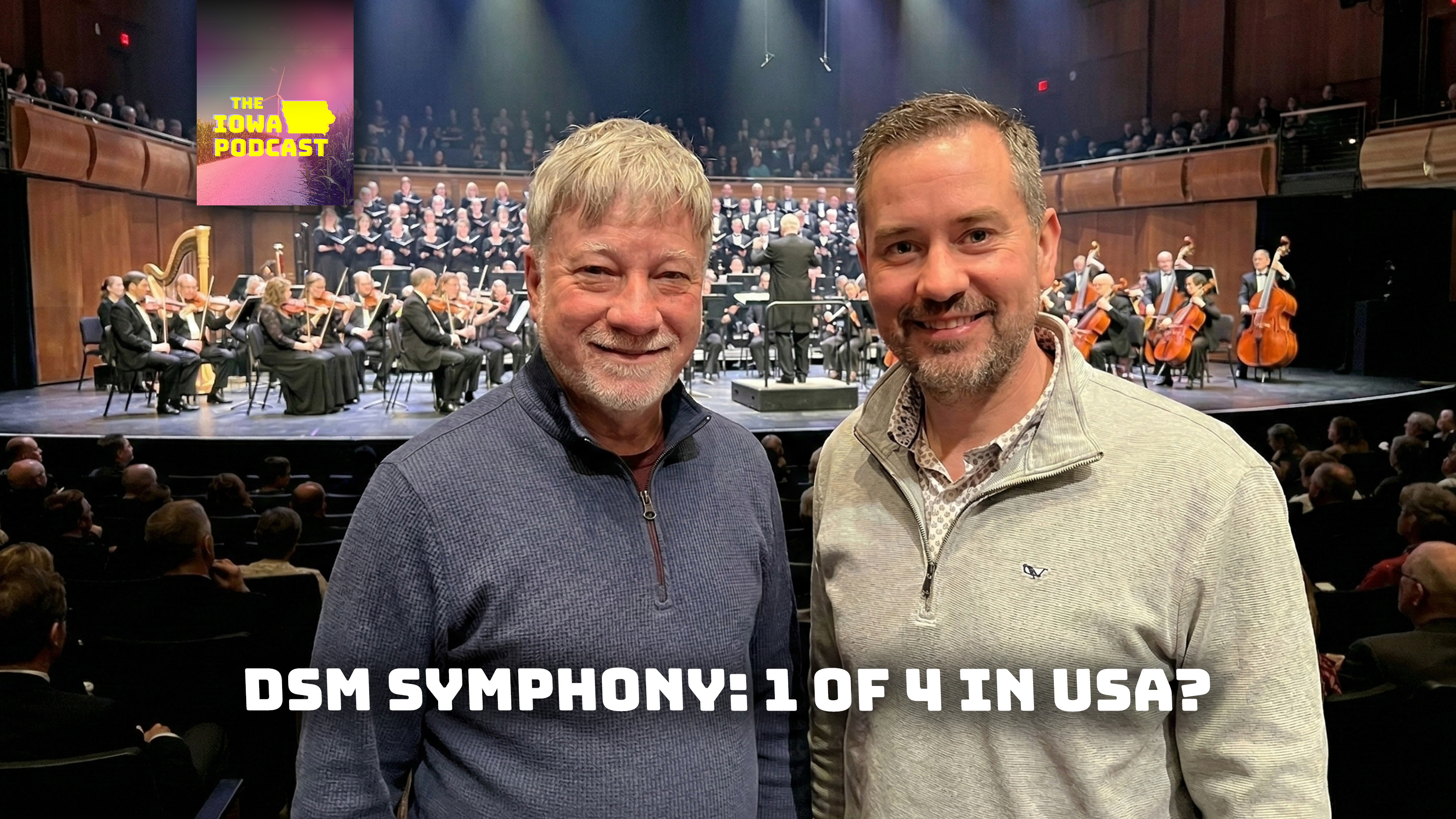


The Des Moines Symphony is finishing their Masterworks series and you only have three chances to see it on March 14 – May 10th. Many Iowans don’t understand how unique their approach is to developing young talent, which will be on full display these Masterworks performances.
The Des Moines Symphony is one of four in the entire country to develop young musicians in their Des Moines Symphony academy and their youth focus will be on display as they complete their Masterworks series featuring the Heartland Youth Choir singing the well known Shaker Hymn “Tis a Gift to be Simple” and 17-year old child prodigy Amaryn Olmeda for Mendelssohn’s Violin Concerto.

Reflection
March 14-15
Get 20% off with code: IowaPodcast
Mozart’s “Prague” Symphony. Smetana’s The Moldau from Má vlast takes and Beethoven’s lyrical Violin Concerto, featuring Stella Chen in her Des Moines Symphony debut.

Hope
April 18-19
Get 20% off with code: IowaPodcast
Copland’s Appalachian Spring. Gershwin’s jazz-infused An American in Paris. Heitzeg’s Symphony In Sculpture. Margaret Bonds’ Music from the Montgomery Variations on The Civil Rights Movement.

Courage
May 9-10
Get 20% off with code: IowaPodcast
Strauss’ Vienna Philharmonic Fanfare. Alpine Symphony featuring 34 brass players. Amaryn Olmeda returns to Des Moines for Mendelssohn’s Violin Concerto.
Des Moines Symphony Masterworks

Giunta, the long-standing leader of the Des Moines Symphony, oversees an ensemble of a scale that often surprises the uninitiated. In the expansive 2,700-seat Des Moines Civic Center, Giunta typically commands 95 musicians, a number that can swell to 130 for the most ambitious repertoire.
This massive presence is amplified by a custom-designed acoustical shell that Giunta likens to a high-performance machine. “It’s like driving a Ferrari—every little thing that you do, they react to because they can hear each other,” Giunta said, noting that the shell juts sound into the hall like a megaphone.
Masterworks 5
The spring season begins with Masterworks Five, titled “Reflections,” a program featuring the music of Smetana and Mozart. Giunta aims to demystify the symphonic experience by utilizing “programmatic music”—works that tell a specific story to ground the listener, such as a musical depiction of the Vltava River. “If you can just have two or three things in a 15 minute piece to hang on to, it makes it a lot more, you appreciate it,” he explained.
Masterworks 6
Masterworks Six centers on the theme of “Hope,” featuring iconic American composers Aaron Copland and George Gershwin. The program also highlights a premiere by Margaret Bonds, a pioneer who was the first African American woman to perform with the all-white, all-male Chicago Symphony in the 1950s. Giunta, who studied under the legendary Leonard Bernstein, emphasizes the importance of accessible, “down-to-earth” musical expression rather than a professorial approach.
Masterworks 7
The season concludes with Masterworks Seven, titled “Courage,” featuring the 17-year-old violin prodigy Amaryn Olmeda. The finale, Richard Strauss’s An Alpine Symphony, requires a “virtuoso orchestra” to depict a literal day in the Alps, from sunrise to sunset. “Our goal is to just, uh, uh, have the, the, the, roof of the civic center crack,” Giunta remarked on the anticipated power of the upcoming performance.
Interview Transcript
This transcript was created with help from Ai. Please report errors to us and always refer to the video as your primary source.
Justin Brady: Iowas real talk. No drama. I’m Justin Brady in the Jethro’s Barbecue Studio. Do you know what Masterworks is? To describe what’s going on at the Des Moines Symphony is Maestro Joseph Junta himself. Thanks for coming in the studio. Always a
Joseph Giunta: a pleasure. Thank you. Glad
Justin Brady: have you here.
Joseph Giunta: Thank you Justin.
Justin Brady: before we get started, everybody, do you want some chicken wings? I, I gotta get outta my comfort zone. I know that. But Jethro’s Barbecue is a great place, and if you want a $30 free gift card, go to Iowa podcast.com. Scroll to the top, click the ban or up there. And if you buy a hundred dollars gift card to get a 31 free I think that’s pretty cool. So Masterworks is here and it’s a big deal. you have a lot of instrumentalists. It’s not a tiny little band you have going on there for those that haven’t been there.
Joseph Giunta: Yeah. No, it’s a, it’s, well, first of all, it’s a big room. The Civic Center seats 2,700. It’s a little large for us, you know, and markets, um, this size, Omaha, Omaha, Symphony’s Hall seats 2000. the Kansas City Hall is 1600, and those places are, you, know, much larger than Des Moines. But, uh, so the size of the hall dictates the size of the orchestra specifically. I didn’t know that specifically. The string section. At least it should. So in our case. uh, when I play most pieces, I’ve got at least 95 musicians on stage with me. Now, if it was a smaller Hall maybe there would be 60 musicians or 65 musicians, and mostly that’s the string section. Jason or Justin. I, I, have, uh, 60 string players, which balances the winds and the brass and makes it a, nice experience for the audience. Yeah,
Justin Brady: I don’t think people understand just how big the Des Moines Symphony Orchestra is, but, um, I wanted to talk about the Masterworks five, uh, six and seven and kind of break those down individually for people. I find that my, my family are a bunch of musicians. and so. but I find that people who aren’t quite musicians and maybe they’re a little uncomfortable, this really helps them understand and enjoy, uh, symphonic music and string music. So let’s start with Masterworks five. This is called, I think it’s just the theme is Reflection. Correct. And it’s kind of a tour of Europe, basically.
Joseph Giunta: it is. And um, you know, when you say classical music played by a symphony orchestra, it, people may think out there that it’s something that’s, uh, that you need to be, um, trained in or you need To appreciate it, appreciate it and whatnot. And I love. Jason, Justin, the fact that you, I always use the analogy of sports because we’re such a great sports society in America that, that, it’s, you can go and watch a football game or a basketball game and not know anything about it and still enjoy it, But if you know something about it. You know how it’s scored, you know about a little bit about defense and offense and some of the players that are playing. You appreciate it that much more, right? And music is exactly the same way. So, uh, we do everything we can do to break down as many barriers as we can in terms of listening to classical music. Um, many people today haven’t had any music education whatsoever. When I was a kid going to public schools, music and art was a very important part of our education. So, uh, with that in mind, we, I try to put together programs that not only are inspiring to the musicians, but also appealing to our audiences. And that’s exactly what these three programs are. This, this spring, uh, this first one, masterworks Five, called Reflections, has music by, uh, Spenta, a Czech composer, and Mozart, who wrote a piece. Inspired by Czech Czechoslovakia. And then on the second half of the program was a young artist named Stella Chen. She’s here, uh, for a whole week in Des Moines, uh, working with our academy students, uh, going into the schools and working with kids and all this, all those touch points. Culminate in young people attending our concerts on the weekend, which is March 14th and 15th in the Civic Center. She’s a violinist. She’s gonna play the Beethoven Violin Concerto. This is a fantastic program even for those people that, um, maybe have never been to a symphony before.
Justin Brady: And so Masterworks five is Mozart and the, Beethoven. And then what was
Joseph Giunta: Ensen I
Justin Brady: I don’t, this is a name probably people aren’t as familiar with. That’s
Joseph Giunta: right. Ensen is a Czech composer. He did for, uh, Czech music in the region, in the region of Czechoslovakia. What Dvo Jacque, also a Czech composer did for music in the world. Czech music in the world as you. Dvorak spent some time in Spillville, Iowa. He lived in, in New York for a while, was the, uh, pre, um, dean of the School of Music at the original Julliard School. So there’s a lot of connections to American Dvorak, but spent in a, was a wonderful regional composer and his music was, um, inspired by. Czech folklore and legend and, uh, the people folk music and whatnot. And this happens to be a piece that’s about the, uh, the, the, uh, MULO River that runs right through the middle of Prague. And you’ll hear, uh, the river starting. You’ll hear little wedding folk dance. You’ll hear the violent St. John’s Rapids, and then eventually the full mouth of the river, which is a beautiful, beautiful, romantic theme that Once people hear it, they’ll recognize it because it’s been used on t television commercials and movies and so on.
Justin Brady: I’ve been to, uh, I’ve been around the world to a lot of like operas and orchestras, and we do something, Or I should say, you do something that’s very unusual, and this is a compliment, but you really have a way of during concerts breaking down what’s happening And what to look for like you just did. Right Now, you actually do that in the, concert itself, And you have a, way of talking to people like myself who are musicians, but also people who have no idea what a string is on a violin. And so I find that to be kind of refreshing. I actually learned some things too. When you’re talking to like non-musicians, I’m like, oh, I didn’t actually know that was the technique they used. I actually learned something new. I really appreciate that that it’s not always over my head. It’s, uh, very much something that I think anybody could really enjoy.
Joseph Giunta: Yeah. It’s hard Justin to put. music into words, you know, I mean, there’s plenty of music that’s has words to it. Uh, Popular music, commercial music, opera and so on. But, but what we do has no words and Um, so, so whenever, whenever you try to if there’s a piece that. describes a certain aspect of life, nature, geography, whatever it happens to be, um. It’s always a little bit easier to explain and say this particular Two minutes of music was inspired by this particular thing. Mm-hmm. And that helps people get through the sort of the, we call that programmatic music, which is music that basically tells a story. And, uh, so, and I love, um, you know, one of my teachers was Leonard Bernstein, who was absolutely The best. At describing music in words and audiences loved him, and, uh, he, he reminded me when I was a teenager studying with him that it was really important to know how to express yourself verbally. not in a professorial manner, but just simply in a practical manner. Here’s a few things in a piece that excites me and excites our musicians about challenging the, and playing this piece for you. And if you can just have two or three things in a 15 minute piece to hang on to, it makes it, makes it a lot more, you appreciate it
Justin Brady: Yeah. Like, ’cause you know, people are a little intimidated if you get really philosophical and introspective and they’re like, ah, this is not for me. Right. uh, you, you dropped this quickly. I wanna expand on it a a little bit. The Artist in Residence program.
Joseph Giunta: Yes. Fred and Charles Hubble. Uh, one of our wonderful. Uh, community leaders that, uh, have given So much back to this community. Uh, they, um, they fund each year an art artist in residence, and it’s usually a young artist that can relate to, to, to, kids their own age. Uh, Stella Chen is, um, an outstanding young violinist. She’s about 22 now. Uh. Just graduated from Julliard and now teaching on the Julia Art faculty has already played with the New York Philharmonic and the Philadelphia Orchestra and the Chicago Symphony. And, uh, she’s a wonderful, brilliant young musician’s. Gonna have a great career ahead of her. So she’ll be here for a whole week. We’ve got 500 students that are, Symphony Academy that she’ll work, she’ll work, with. Uh, she’ll go into the schools and work with some of the orchestras in the, in the school systems. And, um, and. Not just in Des Moines public, but in the region. And so by the end of the week, she’ll have touched maybe, um, I don’t know, a thousand, 1200 kids. Yeah. And then the ultimate, uh, goal is to have each one of those children and their families come to the symphony that weekend course. So that’s coming to the culmination of it. So, uh, we’re pretty excited
Justin Brady: And That’s unusual for symphonies to have this kind of, so the Des Moines Symphony, for those that don’t know, has this very big academy program. This is not a normal thing that symphonies do, even in bigger cities. This is unusual,
Joseph Giunta: Right. We are, there’s 1500 orchestras in this country and, uh, out of the 1500 there are four that actually have schools that they sponsor. And we’re, we’re one of them.
Justin Brady: One of the four in the country is here in Des Moines.
Joseph Giunta: That’s right. And this is this in some cases, some orchestras, it would be their education department. This is definitely our education department and we like to say that it’s sort of cradle to grave kind of, um, teaching that we do there. But we’ve got 23 faculty members, uh, KI four youth orchestras, a wind ensemble, and it just basically enhances what, um, is going on in the classrooms, in the region.
Justin Brady: Yeah. And this is also a theme with your masterwork series, um, is students, because I believe in Masterwork six, and this is the, the theme is hope on this one. Um, it’s Colan and Gershwin, which are, uh, I actually, this is funny. Um, when I was doing research for you today, uh, I always thought Gershwin was European. I, I completely forgot he was an American composer, which my wife is gonna be a dude. What
Joseph Giunta: Yeah. yeah.
Justin Brady: Um, but. Talk about Masterwork six, uh, CO. And the Heartland Youth Choir, I think is
Joseph Giunta: right, That’s right. Masterwork six is on April 18th and 19th. And, uh, it’s titled Hope and we are calling it Hope because, um, there’s these two iconic American composers, which you, me just mentioned. Aaron Copeland and George Gershwin on this program and they, their music. Always sort of looked forward. They were always, uh, Copeland when I was a kid, um, we referred to him as the Dean of American composers. He was, he was a rockstar to us. Um, I, I, knew him at Tanglewood and and he was just, um,
Justin Brady: You knew him?
Joseph Giunta: I did. Yep. Yep. And he, he was, he was a great, A great composer, but an even better person, a wonderful teacher, and, um, kind of a Harvard type intellect, but again, a very down to earth guy. And he was, um, you know, he wrote things like Billy the Kid and, uh, rodeo. And it was it’s just a real, a appealing music. This App Spring that we’re doing, Appalachian Spring is a piece that has, uh, the wonderful folk to tune in, is, um, it is the gift to be simple. And that’s what the, uh, the um, uh. Heartland Youth Choir will be singing with us in this piece. So it’s, it’s a great great piece. And the program ends with the American in Paris of George, George Gershwin. Most people know that from the movies. Um, Gershwin, very popular composer, probably better known for Broadway than Is, than is, um, than. Than a serious music. But this is a great iconic American piece that’s been a part of our repertoire for 50 years. So that’s also, uh, being coupled with Steve Sig, a living American composer, lives in Minneapolis, Steve, um, I commissioned Steve in the Des Moines Symphony. To do three Symphony and Sculptors, which was inspired by the John and Mary Papa John Sculptor Park. Yeah. Um, we did, Um, seven Sculptors in 20 12, 7 more in 2015, and then the rest of ’em in 2019. So we’re taking bits and pieces of this and showing on a big screen so that there’s some really wonderful drone visuals and whatnot. That, that, uh, capture the essence of these sculptors. And then we play music that was inspired by the sculptors. so it’s a fantastic, um, commissioning project that we, we did over the last 10 years that we’re gonna do. And then, um, and then finally this, this, little piece by, um. Mrs. Bonds, who was, uh, the first, uh, African American woman to play with the all white Chicago Symphony males. Uh, in the 1950s, she was an organist and a teacher and a composer, uh, not, not very, uh, well-known during her time. But somebody that was very much forward thinking and uh, I’m delighted. She wrote this piece called The Montgomery Variations. It’s a short piece, but it’s about, basically about civil rights struggles inspired by Martin Luther King. So it’s a piece that’ll be a premier for us with a Des Moines Symphony. And, uh, one that’s important piece, I think to be played, but somebody that was written by a real pioneer. And if I could say the. Un the common theme of all four of these composers is that they were all innovative and forward
Justin Brady: Mm. Mm-hmm. That’s
Joseph Giunta: primarily why we, we titled it Hope.
Justin Brady: And it seems like so many of the civil rights leaders, artists, some of these people who have changed culture, they don’t, really get the notoriety until after they’re gone, it seems like. Well,
Joseph Giunta: Especially if you’re a woman, and especially if you are a minority. That was that was the thing, you know, this was an all male white profession for so many years. And, uh, um, we’re now, you know, finally with, with, uh, with more attention being given in the last four or five years uh, to racial, uh, equality and justice. Uh, it’s, It’s it’s. given us the opportunity to go back and research some of these really fantastic composers that were around, uh, that just haven’t gotten the proper, uh, protocol that they should. So, uh, we’re, we’re happy to be playing this piece
Justin Brady: and sticking with the theme of young people in the symphony, You also have this very young violinist. I don’t, she was extremely young, And, this is, of course, masterwork seven. But she was extremely young when she started. I, I, can’t believe she, she can’t be more than 17 these days. I think. I, I don’t, I might get her, name wrong, but it’s Amarin Omada.
Joseph Giunta: That’s very, that’s very good. Yep. Did I get it? Yes. you, yes you did. Yep. Yep, you did. Yeah. Yeah, exactly. Yeah. She, uh, she was here before with a guest conductor a couple, three years ago. I happened to be in town and go, went to that concert and, uh, she played beautifully. So, uh, I’ve invited her back to play the Medalson Concerto. You’re right, she is about 17 now. Uh, nice. A real. what You would consider. Yep, you did. and and I think you’re right. in real child prodigy. You know, she, she, uh, discovered she, had talent when she was four or five years old, started. the violin right away. And, um, this is, this is another one That’s just gonna have a stunning career ahead of her. So I’m excited about working with her, but really excited on this program is, which is, called, uh, by the way, um. Courage. Um, it takes great courage for a 17-year-old to play the ton violin kerger. That’s, that’s for sure. But then, then this big piece that we’re doing, the Alpine Symphony by the German composer, romantic composer, uh, regard Strauss, the Alpine Symphony, which is one of the great programmatic pieces of all time. It’s, it’s from sunrise to, sunset, a day in the life of. Trying to uh, capture the essence of going, uh, meandering through the Alps. Climbing the Alps. It’s a one of the most fantastic tone poems ever written, and it takes a virtuous orchestra to play at and a large orchestra. Earlier you talked about the size of the De Moines Symphony. Mm-hmm. I’ll have 95, Uh, permanent musicians on stage, plus another 32 brass players to give. can just imagine the spaciousness of the sound, the, the majesty Get the sound that has to be created when you’re climbing the matter horn. Yeah. And that’s, and that’s what we will be doing. So we’ll have an excess 32 brass players, 32 brass players, So we’ll have probably close to 130 musicians on stage with this. And our, our, our goal is to just, uh, uh, have the, the, the, roof of the civic center crack. That’s we’d like to do.
Justin Brady: well you have that new wooden shell too, so maybe that’s gonna crack. We’ll see.
Joseph Giunta: Yeah. We’ll, we’ll have a great time. But this is, uh, one of those once in a lifetime experiences that, uh, comes around, usually only in big cities. And the, the Des Moines Symphony is certainly up to this
Justin Brady: That’s a big sound by the way. I mean, so here’s the, I mean, here’s a weird question. Do you wear some type of ear filters or something up there? cause you’re gonna get like blown
Joseph Giunta: no. No, Um,
Justin Brady: bear it like a rock star.
Joseph Giunta: Yeah. I mean it’s, Yeah. it’s, it’s, you know, I mean, there’s a difference between fullness and loud. So true. So we, that’s a good point. I mean, it’s a really robust sound and, and we want, we want people. To feel the sound. I mean, and you really can sit and feel in some of these halls, the, the sound coming right at you. So in the Civic Center, we’re so lucky to have a, a place where people can hear great music. I mean, it’s a, it’s a, it’s a room that was built for a lot of. Different activities, including Broadway shows and so on. But, uh, they got a lot right in 1979 and then we improved it about five years ago. So it, it’ll be a great experience for our people and a great way to end our season.
Justin Brady: and you’re talking about the shell. Of course. And for those that don’t know if you’re, it’s the first time at the symphony they’ll see this wooden thing behind you. A wooden wall. Yeah. That wasn’t always there. That’s a new thing.
Joseph Giunta: right. right. that was
Justin Brady: big deal when it
Joseph Giunta: put in there. Yeah. Yeah. The, The, the, best concert halls in the world are the ones that were built just for orchestras, meaning that the orchestra and the audience are in the same room, And the greatest ones are the ones that are built straight up. Because sound travels up, it never travels out in the civic center and in a lot of rooms. Um, in cities this size, you have two rooms. We have the room where the orchestra sits, which is which is above us, is the preceding arch, which is where they fly sets And everything. If they do opera or Broadway theater. And that, that, means if the sound then goes up. It disappears. mm-hmm. Mm-hmm. And it doesn’t get out into the hall. So in this case, you’ve got the megaphone effect, and we have this, this beautifully, um, custom design, uh, ac acoustical shell around us and on top of us that then juts the sound out the way a megaphone would, and that gets, uh, gets the sound out. And the best seats in the civic center, your ears have to be above the stage in order because again, the sound travels up. So really the best seats for people to hear. Are about two thirds of the way back to the, to the back wall. Oh. So what, which is, which is amazing and I, so
Justin Brady: people may consider to be in the back or nosebleeds or whatever, um, is actually some of the better seats. And
Joseph Giunta: is, this is, this is ab absolutely aligns with great halls in the world. If you’re the go to the music in Vienna or Queen Elizabeth Hall in London, they’re all the same. You go in the back and you hear better now you can’t see as well back there. So people sometimes have to decide what they want, but, uh, but I’m really, uh, very pleased with the civic center and the sound it creates.
Justin Brady: when you guys announced that you were installing or putting in, or whatever you call or erecting the the shell, I was like, eh, it’ll probably not be a noticeable difference for me ’cause I’m a musician, but I’m not a symphonic musician. I’ve never played in a symphony orchestra in my life. So I was like, eh, I’ll, it’ll probably be barely noticeable, especially because it was like six months or so, but. Between two concerts. I couldn’t compare them next to you know, like next to each other. It’s dramatically different. Yeah. It is a huge difference. That sound just like immerses you, unlike it did before.
Joseph Giunta: Two things, two things happen. Justin, with this. Uh, the first thing that happened with this shell is that for the first time, all the years that I’ve been here, but when we when we designed it, it it allowed the orchestra to hear from left to right in front to back. So, um, the orchestra immediately, the fact that they were able to hear each other. Made it much easier to play together. So the ensemble got got better almost overnight, and now it’s like, it’s like, um, it’s like driving a Ferrari. Uh, it, it’s every little thing that you do, they react to. Mm-hmm. Because they can hear each other. Sure. So that’s one thing. And the second thing is that because of that and because of the, the. Fantastic ensemble, meaning playing together. um, it does something with all of the vibrations so that they jut out in. the hall better and quicker and cleaner so that you’re hearing, uh, what I like to hear. Every orchestra is balanced from the bottom up, so you hear good. Basses, good bassoons, good tuba, all those bass cleft instruments, uh, that resonate. That’s what, that’s what most composers start with. The bass, uh, area. And then you also hear the, the inner lines, the second clarinet, the violas, sort of the tenor and alto sections of the orchestra. you always hear the violin, always hear the theme that we’re natural. We’re humans. we always, our ears always go to a beautiful theme, but the inner voicings are the things that sometimes get muddy. And that creates, um, well, I like to, to pat imagine listening to music with headphones on. Mm-hmm. Uh, or earmuffs on That kind of muffle ness sometimes that you hear. And that’s, and that’s, but, but this has as much clarity for a 2,700 seated auditorium that I’ve ever, ever been in.
Justin Brady: yeah. Well, we appreciate You of course, Iowa podcast.com. We’re also, uh, excited to be one of your media sponsors this year, so thanks for with us.
Joseph Giunta: Very excited about, yeah, we are excited about that too.
Justin Brady: Uh, Joseph Junta, Maestro Joseph Junta of the Des Moines Symphony Orchestra. What is the website so people can go? I know tickets are still available for Masterworks five, six, and seven, so people can see all the dates and buy the tickets. What’s the website?
Joseph Giunta: DM symphony.org. DM symphony.org. DM
Justin Brady: DM symphony.org. Joseph Junta, thank you. so much for coming on the Iowa Podcast.
Joseph Giunta: It’s always a pleasure. Thank you.