


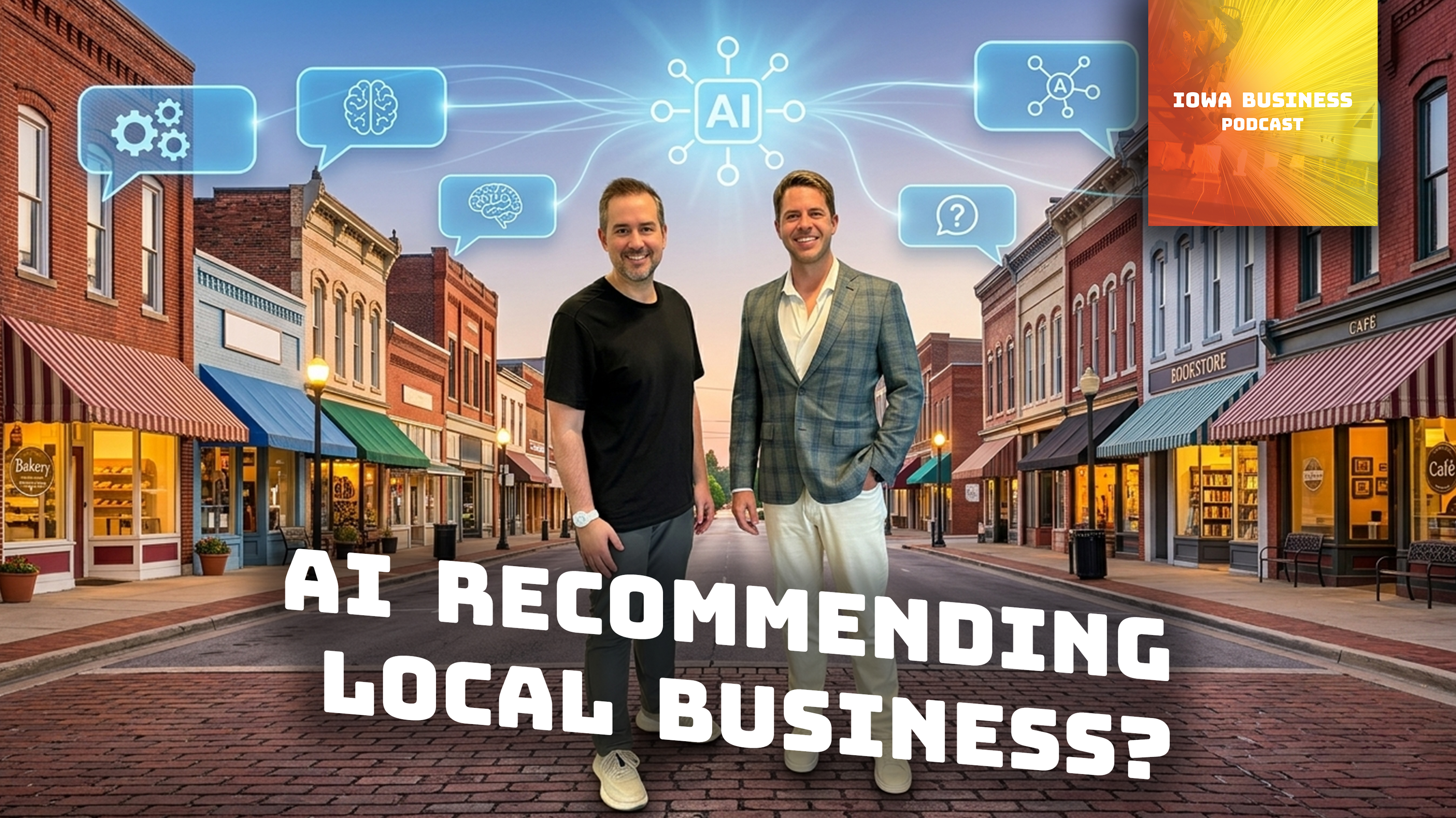


Iowans are using ChatGPT, Gemini, Claude, and Grok to answer questions about where to find local products or services. As a business owner do you have any control over what they say or recommend? Yes. In fact, you can do a lot for free, says Drew Harden, CEO and founder of Blue Compass.
As your customers use traditional Google searches less, savvy business owners must look beyond traditional search engine pratices toward generative engine optimization (GEO).
Harden notes that old school developer strategies like clean build quality, rapid load times, and schema markup remain critical because real-time AI search bots are highly sensitive to bandwidth limitations. However, the foundational rules of the web are evolving. “Today, mentions are kind of the new currency of the web,” Harden explained, noting that smart language models continuously cross-reference digital footprints to build comprehensive corporate profiles automatically.
Ai-Generated Content Won’t Help You
To win the recommendation game, brands must pivot from content quantity to human-centric journalism. While AI can effectively parse sales calls for brainstorm ideas, relying entirely on it to execute copy backfires. Search engines directly penalize automated text, and audiences can immediately sense the deception. Harden emphasizes that localizing content down to specific city and neighborhood levels gives small businesses a massive algorithmic advantage. Furthermore, corporate leadership should elevate individual experts within their companies rather than relying solely on a corporate voice. “Google, especially these days, really, really likes individual voices more than corporate voices or the media or big brands,” Harden shared.
Ultimately, companies must view their websites as essential broadcasting hubs. A Blue Compass study found that 63% of the websites they monitor grew their traffic in 2026 over 2025 by taking content and SEO seriously. “Start looking at it also as a broadcasting unit that sends your content out into the web,” Harden advised.
Interview Transcript
This transcript was created with help from Ai. Please report errors to us and always refer to the video as your primary source.
Justin Brady: I’m Justin Brady, and this is the Iowa Business Podcast. You’ve probably asked Grok or Gemini or ChatGPT or Claude for information, maybe even locally here in Iowa, like, “W- where do I go for this? How do I get this thing?” Have you ever wondered as a business owner, “Wait, where is it getting its information from? How does it, how does it get that information?” And if you’re a really savvy CMO, you’ve said, “And how do I get myself in there?” That’s actually what the topic is today. We’re talking with Drew Harden, the CEO and founder and dog wrangler… Well, no, I’m just kidding. You, you guys have dogs at your workplace. Of Blue Compass here in Iowa. Drew, thank you so much for coming on the show. Absolutely, It’s, uh… You- you’ve been on the show a couple years ago, but things have, as you know, evolved very quickly in AI search, so that’s that’s the topic. We’re gonna dive in really deep. Before we do that, thank you so much to Dentons Davis Brown for sponsoring the Iowa Business Podcast. The way they sponsor is through collaboration. They bring in attorneys. They answer really, really hard questions. Kaylee Blazic Naranjo, uh, discussed how to get H-1B talent without the $100,000 price tag here in Iowa. Jason Stone came in here and talked about the state of Iowa M&A deals in 2026 and why quality matters. And then of course, Beth Coonan came in to discuss the early warning signs that your top talent is about to leave and how to avoid that. So fascinating stuff at iowapodcast.com/business. Go watch it all. Okay, Drew. I guess let’s just start super broad. Can we, as local business owners, can we train, can we teach Gemini, Claude, ChatGPT, and Grok to rank us favorably?
Drew Harden: Yes, you can, and it’s really important to think that way. And we call that GEO, generative engine optimization. It’s kinda like SEO, but a little bit different. Uh, some people call it AEO, answer engine optimization as well. Right. AEO. Yeah. AEO, yeah. And it’s still so new that in the industry, I mean, we don’t really know if it’s called GEO or AEO yet. Oh, okay. They’re using both. Yeah. So I mean, and it– those are a little different. But yes, you can. It takes work. It’s just like SEO. So the first thing to know is search engine optimization, SEO best practices is the first thing to do
Justin Brady: What? It’s the same stuff?
Drew Harden: It’s mostly the same stuff because, you know, these days you think about Google, if you can rank in the top 10 in Google or get on that main page in some way, shape, or form, you know, the odds that you can get that webpage into a platform like Claude or ChatGPT is also pretty good. Because, you know, Google’s whole purpose is to provide valuable content to people, and really that’s what these other, uh, AI platforms want to do as well. So the first thing is you just gotta have good, high quality, original content. And when I say original, you know, we’re really encouraging our clients, don’t recycle a bunch of stuff that’s out there already. Yeah. Make it unique. So an example of this is, you know, recently, um, I wrote a blog article for our website, and I was talking about website sessions. Is, is website traffic down? How all that works. And I started to, you know, find a lot of data out there and cite different sources and link to them in my blog article. But Justin, I realized I’m not bringing anything real new to the
Justin Brady: You’re just remixing what’s already out there. Yeah
Drew Harden: so we have hundreds and hundreds of websites that we’ve created and that we monitor, and so we did a study amongst our websites to see what traffic… And so I was able to cite original data that didn’t exist elsewhere. So anytime you can bring, you know, content that doesn’t exist elsewhere, but that’s really relevant and well-written, not written by AI, but written by a human. You can tweak it with AI or you can get inspiration from AI, but we find human-written content does a lot better. So that’s really important. So that’s one of the ways. And then just simply having a website that loads quickly, that’s more modern. And we find, Justin, that, you know, these different platforms are really adverse to old clunky websites. Mm-hmm. And getting a little more technical, if your website relies on too much JavaScript, that’s not good. And if you think about it, you know, Google, when you do a Google search, the answers are already indexed. Google sends out bots and it indexes things. In other words, it kind of like has the answers ready to go. It just throws them at you. Whereas in most cases, when you do a search on a generative AI platform, it takes a little longer because it does the search in real time. Yeah, it’s actually sending out AI bots and running around the web and looking at things. And therefore, if you have a really clunky, slow website, the bots will say, “Nah, I’m not gonna waste my time with that because I gotta get back quick.”
Justin Brady: Really?
Drew Harden: yes, so so that’s why, you know, not over-relying on JavaScript and things like that is really important. So great content, SEO best practices, um, a website that’s pretty modern and loads quickly. Uh, another thing is schema code. So it’s called schema markup. Still relevant. Extremely relevant.
Justin Brady: this is… Okay, let me, let me ask then, because you’re mentioning old school stuff, old school SEO stuff, like build quality of the website, schema code, okay? It’s like bor- boring developer side stuff. Uh, for those that don’t know, I used to… I have a design background. I’d work with developer people that were smarter than me on the code stuff. Is, is AI still stupid where it, like, it, it, it’s incapable of looking past schema? ‘Cause I- in my mind, I’m like old site, new site, schema, uh, putting ton- you know, 2,000 charac- 2,000 words on the webpage, all these things that we think Google likes. AI’s smarter than that. It doesn’t need all that help. It should be able to just find out whatever’s crawlable and present that information correctly. But you’re saying, no, it actually doesn’t do that. It still relies on some old school SEO stuff.
Drew Harden: So we’ll define schema real quick. So schema
Justin Brady: Yeah, good idea.
Drew Harden: basically code that you put on a webpage that tells search bots and AI bots what your page is all about. This is a language basically that Google, Bing, Yahoo, all the search giants came up with years ago, and it’s always different and it always changes, and you can go see the latest schema code at schema.org. So, like our marketers and developers know it really well. It’s a little technical, so if you’re a marketer, it might– or a business owner, it might be hard. You might want help from a developer. But basically, it’s just like a, a, um, uh… It’s like a s- imagine you’re going down the highway and you see a sign that tells you what’s in that town.
Justin Brady: That’s a good example. I like that
Drew Harden: I thought so too. I just came up with it. Yeah. Thank you. And, uh, actually, I’ve said that many times. So i-it’s, it’s the same thing because it gives the search bots or the AI bots a quick glimpse of what is on your webpage so they don’t have to do the work of looking through everything. And so that’s why the search bots, Google really likes schema markup. And so if you’re serious about getting someone to a webpage on your website, you’ll have good relevant schema markup. That’s one good way to rank in generative engines as well.
Justin Brady: How long is this stuff gonna be relevant? Because AI should be smart enough to look beyond your schema markup, look beyond your meta tags. I mean, I remember when Google actually cared about meta tags, and they haven’t cared about that in 20 years now at this point, right? I don’t remember when the official cutoff was. So how long is it gonna take for them to be smart enough where they don’t need this crap anymore? It’s just like, we know what’s on your page ’cause we can read it. Like, we don’t need your schema. We don’t need meta tags. We don’t need all this stuff. How long is it gonna take to get there? Why are we still seemingly, in my head, relying on really old stuff
Drew Harden: Well, it’s not a matter of being intelligent, it’s a matter of bandwidth really.
Justin Brady: Oh, it’s a bandwidth.
Drew Harden: So it’s– these bots have to travel around, and it takes time, and the quicker they can do it, the better. So I think that’s why something like the code really matters. So it’s gonna be a while. I mean, that sort of thing is really important. Um, but one other thing I would bring up, Justin, that’s a little different from, like, traditional SEO is mentions. You think back to Google and, you know, back in the late ’90s, early 2000s, Google became popular and successful because it did something no other search engine did, which is it ranked websites based on links. Mm-hmm. So when there’s a website out there and another website links to it, that’s kind of like a vote of confidence. You know, Google said, “Okay, that website owner is saying, ‘Hey, this website is valuable and my visitors might benefit from it because I’m linking to it.’”
Justin Brady: It’s no different than someone you trust saying, “Hey, this guy’s legit.”
Drew Harden: Yeah. or go try this restaurant out. yeah. So that was a really good system. Yeah, and links still matter. The more relevant links you can have from other websites that, uh, your audience might visit is very good for your website. Well now, to your point, these days, all these platforms, including generative AI platforms, are so smart that links aren’t as necessary, and today, mentions are kind of the new currency of the web. So what do I mean by that? When it comes to generative engine optimization and getting your content found, it’s not just what you put on your website, it’s what you put on other platforms, and it’s what other people say about you on other platforms. So a while ago, I did a search for my name. I said, “Tell me 10 trivia questions about Drew Harden,” and I did it in like ChatGPT or something, and it gave me 10 questions, and then I looked at the source of each one because it shows a little link. Yeah. Some of them were from my website, some of them were from Blue Compass’s website, but some of them were from LinkedIn. Mm-hmm. And one of them was from YouTube, and one of them said, and this was a little while ago I did this, it says, um, “Did you know Drew Harden’s writing a new book?” And that was tr- Oh that was true. But I thought to myself, “I don’t ever remember telling anyone that.” That’s crazy. That’s creepy. Yeah. How did it know that? And so I looked at the source, and sure enough, a couple months prior, I had been on a podcast, and I just had briefly mentioned, “Oh yeah, and I’m writing a new book about that.” I didn’t even remember it. But it found that, and so that’s why it’s really, if you have a business, it’s really important to go be on all the podcasts you can be on. Mm-hmm. Especially that are relevant to your audience. I just referenced my own brand, and I just got it mentioned via your podcast, and an AI platform might find that mention I just made. It’s the same with YouTube videos. You know, if you can create good YouTube videos, if you have, you know, team members, experts on your team that can go do the same, um, if they can start writing on their social media platforms positively about your brand or your product, things like that. Uh, we were working with a medical organization that have a bunch of amazing doctors, and we’re encouraging them, “Hey, you know-” Go out on your LinkedIn, your Facebook, whatever that might be, and share some of your expertise if you’re the doctor, you know? And so one of the things we’re telling our team, Justin, or, or our clients, Justin, is celebritize your team.
Justin Brady: Mm-hmm.
Drew Harden: Celebritize your team. Google, especially these days, really, really likes individual voices more than corporate voices or the media or big brands. And people these days love what individuals have to say because it’s more authentic. And so if you can find opportunities to, you know, put a webpage up and then cite your experts in your office. And at, at Blue Compass, one of the things we do, you know, when we write articles or content, we will associate a topic matter expert from our team with it and, and cite them as the author. So that sort of thing is really powerful, and we see that to be successful with generative engines.
Justin Brady: So what you’re saying is, um, all these … Now, I would assume Gemini kinda locks out Grok and Anthropic’s Claude out of YouTube scraping to some degree, because some of that stuff is, it’s, it’s uploaded to their platform. Google, YouTube is transcribing your entire show. Whether you provided that or not, it is transcribing the whole thing. I’m assuming Grok can’t sift through or J- or the other tools can’t sift through, but only Gemini kinda has the corner.
Drew Harden: Actually, yeah, yeah, They can. Yeah. It’s crawlable, and maybe not as well as Gemini, but yes. So you can do a search on every other platform I have, and it will find YouTube videos as well
Justin Brady: Wow. Okay. So what– basically these tools are smart enough to, there’s no linking, but if it’s like, well, Drew Harden is talking about this book here, and I have enough context to understand it’s the same Drew Harben, Drew Harden that works at Blue Compass, it’s somehow doing all this investigation stuff and linking and kind of building profiles out there automatically is what you’re saying. So as a CMO, you don’t need to really worry about making sure all the links are right. Just make sure people talk consistently. So when they’re on a show, make sure they say, “Yeah, I’m so and so, the CMO of this company.” Make sure those terms are consistent because that’s kind of your cross-linking
Drew Harden: Yes, that’s correct. That’s correct. And with generative engine optimization, it’s just g- more important than, than SEO is not just what you say about yourself, but what others are saying about you
Justin Brady: Sure. So, the– You mentioned… I’m gonna go back to something you said. You mentioned, like, and we’ve heard this all the time, which drives me a little crazy, but, like, content is king. But you were very clear on not really. It’s basically if you are bringing content to the internet that did not previously exist- Yeah that content is king. And this is different because a lot of writers are used to going out and doing the research. This is a skill I have that’s now useless, kind of. But, um, you know, I was used to, I knew how to go find the answers. I knew the sites to go to. I knew the, these ways to research things. Now, I can do the same thing by pulling up SuperGrok or Gemini. Same thing. Just tell me this information, and it’ll just, it’ll scroll through the Iowa Secretary of State website to find certain business owner information. It will find all that stuff for me, right? It, it does this. So, the people who win now are, have to adjust. CMOs have to adjust ’cause they’re used to sitting behind the computer and creating some content, and it actually did kinda well. Those days are gone. Now people kinda have to get off their rear end and go do a little journalism for their brand and bring new stuff into the internet. This is– Is this what you’re telling us?
Drew Harden: That’s a good way to put it. I hadn’t thought of it as go do a little journalism, but that’s actually a good way to put it. And yes, that’s what I’m saying. Don’t waste your time with quantity. Spend your time on quality and on original quality. And sometimes that’s really intimidating to us, you know, as business owners or working at these different organizations. But you and your team have just, have incredible data, have incredible expertise, have incredible experiences that probably don’t exist elsewhere. And so if you can think of a way to bring that, you know, to your content, that’s really powerful. And one of the best ways to start is probably, you know, what are the biggest questions you get from your clients?
Justin Brady: Right.
Drew Harden: about that.
Justin Brady: Yeah. That’s like the one, I think the one best tip ever is, that I tell people from the content side is keep a notebook by your front desk person, your front office person. If you have people that are like, uh, even your nurses at a healthcare company, if they’re the ones onboarding new patients, keep a fricking notebook by you, and when they ask you a question, just write that question down, and th- there’s, there’s your content for a month right there.
Drew Harden: Really powerful. Yeah.
Justin Brady: like a really good-
Drew Harden: Well, and you can even get more creative with it in the age of AI. I mean, I think if you transcribe all the calls your salespeople have or all the calls your project managers have or whoever that is, and then use AI to parse out what are the biggest questions you’re getting. You know, questions are powerful because it gives you the direction you need to go in
Justin Brady: Yeah, and so here’s one of the concerns I see a lot of people in content, uh, myself included, by the way. So you’re just gonna give me free… You’re on my show now, so you have to give me free advice.
Drew Harden: I have no choice, yeah
Justin Brady: you have no choice in the matter. You can run out the door if you want. The… I have been torn because I write these long summaries of shows, and I spend some time on this, and now I’m kinda like, why? Because I’m going to, and this is where I’m torn, I’m going to spend all this time, I’m going to write these summaries of these shows, I’m gonna try to write a good piece, I’m gonna write a great nut graph, I’m going to try to do… But who, who cares? Because someone is just gonna pull up ChatGPT or Gemini, they’re gonna scrape all that, they’re gonna index it, someone’s going to ask them, and Gemini’s just gonna say, “Here’s stuff I stole. No need to go to the website I stole it from.” So partially, I’m kinda like, why go- why am I gonna create this stuff for you? I’m just gonna create a teaser now that says, “Hey, if you wanna hear about what Drew and I talked about, you’re gonna have to click the show and watch.” So, uh, you know, the long term here is if Google and the rest don’t give us traffic and don’t give us what we want, we’re gonna stop creating content. They Know this, but do they really? Like, should we still do the long form content, or should we paywall some things? Should we gate some things? Should we say, “For the juicy stuff, you gotta sign up for my newsletter”? How much do we give, and how much do we hold back these days?
Drew Harden: One of the things that’s most interesting and annoying to marketers and business owners these days, and that we always hear, is that, yeah, Google’s stealing my content. ChatGPT is taking my
Justin Brady: Yeah.
Drew Harden: Yeah. Claude is us- And they’re charging you for it. Because
Justin Brady: Yes.
Drew Harden: they are crawling your website, and that costs you bandwidth.
Justin Brady: Yeah. True. That’s a great point.
Drew Harden: Yeah. And so it, it is annoying, but this is the world we live in. So one thing I would say is just because that’s happening now doesn’t mean it will happen to the same extent in the future. It seems like that’s what the future is. Uh, and it very well might be. But there’s a new model called pay-to-crawl that’s starting to arise. And-
Justin Brady: Oh, weird …
Drew Harden: I think in, in three years, five years, this will start to become a pretty big thing. And there’s a, a tool called, uh, I think it’s called, uh, Cloudflare that does this right now. Mm-hmm. And you can submit your blog or your website or w- your newsletter or whatever it is, t- and then if one of these AI platforms wants to show that content, they have to pay for it.
Justin Brady: Wow
Drew Harden: Now, we’re already seeing this in, um, this new pay-to-crawl model, basically. Um, we’re starting to see more and more gated content, and we’re seeing some websites now you can go in and you can, in your robot.txt file, which is kinda complicated, but you can tell AI bots to stay away from your website. And some websites are starting to do this, you know, whether that’s good or bad or not. Um, what’s– I’m drawing a blank, Justin. What’s the platform that you can subscribe to? Substack. Yeah. Substack is an example of this. Substack is saying, “Hey, let’s keep the content for ourselves.” So we’re starting to see some reaction to this sort of thing. And also, there’s been quite a few lawsuits. Reddit
Justin Brady: New York Times, I
Drew Harden: New York Times. New York Times. Reddit just- Yeah. Yeah. Uh, Reddit sued Perplexity
Justin Brady: Oh, really?
Drew Harden: Oh, really? Yeah. So there’s starting to be some pushback.
Justin Brady: valuable on it anymore? What a dumpster fire of a platform that is these
Drew Harden: R- Reddit, I
Justin Brady: mean,
Drew Harden: Reddit shows up all the time in these platforms- Yes
Justin Brady: so much. Don’t even
Drew Harden: which is crazy. Yeah. And in Google too, Reddit shows up a lot. And why does that happen? Because these platforms know people want authenticity from real, genuine people. And for better or worse, you go on Reddit, those are, like, real people talking. It’s not generally, like, a corporate brand or something like that. And that’s, again, as a marketer or a business owner, that’s something we have to think about. How can we get authentic messages to our team? Yeah.
Justin Brady: So how far do … How, how far … You, you were mentioning earlier about how AI is, uh, Gemini, Grok, all these LLMs are making the associations for brands. They know Drew, they know what he writes, they know where he hangs out. Yes They can associate you. How far does this go? Like, for Iowa business owners, they’re thinking, “Hey, that’s cool and I really don’t care. I don’t care about any of this. Um, I care that Iowans are gonna find me.” So is there any value? Does AI know I’m local? Like, if a, if a local Iowan is searching for something, is it smart enough to serve up local information? Uh, and I ask this because I asked Grok in my car, I have an AI assistant in my car, and I asked it something, and it said, “Oh, well these three things are nearby you, and these are rated really well, and locals like it.” And I’m like, I asked Grok. I was like, “Hold up. Do you do local things now?” And it’s like, “Of course I do.” So Iowa business owners, how do we take advantage of people looking for products and looking for services around us? Is there a different strategy? Or it’s just like when you’re on a show, just drop the word Iowa a few times so that the AIs know you’re an
Drew Harden: Yes. Yes. Well, that doesn’t hurt. So yes, if you’re here local in Iowa and most of your customers, clients are around here, if this is your target market, then it makes a lot of sense to talk a lot about Iowa and talk a lot about local things, whether it’s in copy or verbally or, or on video or whatever that might be. So that is really important. And, uh, you know, if you own a dog walking business and you have a website, and not once on that website do you mention Iowa or Des Moines or wherever you are, that’s a huge mistake.
Justin Brady: Hmm
Drew Harden: And, you know, if you have a do- if you’re on a podcast and you never mention anything local, that’s a mistake too. But so the more local focus you can put in your content, the better. You know, if you write an article about, um, the best places to walk a dog in the United States, that’s probably not very effective. But if you write an article, the best places to walk a dog in Des Moines, way more effective. That’s very
Justin Brady: even city level, uh, AIs are sensitive to city level?
Drew Harden: Yeah, absolutely. Yeah. Because-
Justin Brady: can we get this? Do we get- to neighborhoods?
Drew Harden: Oh, of course. Yeah. Because all these LLMs can crawl Google Maps. Mm-hmm. It c- I mean, it can crawl everything you can find out there, and so it’s, it’s pretty smart. Yeah
Justin Brady: Yeah, I asked my car, like, uh, when I was in Pella, and I was like, “Tell me, go do a web search for all the, like, hot places where all the tulips are, and then plan a route for me in my car.” And
Drew Harden: Yeah.
Justin Brady: it Yeah, And I was like, “What? What What is happening?” right now?” Uh, are we gonna see then… So I, I know CMOs and digital people out there, I can see their gears turning, and they’re thinking, “Do we keyword stuff on interviews then? Like, do I say things when I’m, when, when I’m on an interview about the Iowa Podcast is the best podcast to listen to, the Iowa Podcast is…” Like, are you, are we gonna have people starting to, like, keyword stuff audibly in interviews?
Drew Harden: I think, I think yes, but naturally. Again, authenticity is the key with all this stuff. Authenticity. So, you know, if you start going on and saying, “I have the best dog walking service around,” like unnaturally in every single… That’s, for years, Google-
Justin Brady: stupid. obviously.
Drew Harden: And it sounds stupid. And that’s the thing, like people can tell. It’s like stock photos. People can tell it’s a fake stock photo. Yeah. When you read AI-written content so often, you can tell, and it just feels true Yeah, that’s true. And it’s the same with the way you write or you say things. So I think you just have to be authentic about it. You know, for years, Google has penalized websites when they do keyword stuffing. In other words, if I’m writing a page and I have Des Moines dog walking, Des Moines… I, I just write that over and over. Yeah. That’s not natural. And so it’s the same with anything. You just got to be authentic and natural.
Justin Brady: So they’re probably going to, I don’t know if pe- penalize is the right word, but if you mention it once, great, but if you keep mentioning it over and over again, Google is not impressed. It’s, like, not gonna really help. Yes. They’re like, “Yeah, we, we heard you the first time. Now you’re just getting annoying.”
Drew Harden: I think so
Justin Brady: Yeah, ’cause there is an, there is an element that obviously you want people to look at this stuff, too, and if you sound like a broken, crazy record, people are gonna think, “This guy’s psychotic. I’m not gonna trust my dog to be walked by this psychopath.”
Drew Harden: Well, and Justin, I think that’s such a great reminder because we have been talking a lot about AI and algorithms and things like that, and it can … All this can sound confusing, but at the end of the day, like, how can you add value to your audience that are people? Yeah. How can you benefit your target audience? How can you benefit people? And that’s, that’s kinda what it’s all about.
Justin Brady: I think AI in some ways, ’cause I am seeing some really awful ways that people are using it, which we’ll get into here in a second. But I do think there is a future where AI will allow us to be more human, because it’s pretty subhuman that when I’m creating content or creating a website, like schema is not human. Or, you know, JavaScript. None of this crap is human. Like, this is stuff we have to spend extra time doing to make sure the robots are happy, right? And so I do think there’s a bright future where we get more focused on quality of content for humans. We don’t really care as much about what old school robots care about, because the AIs are gonna be smart enough to index human content for humans. It’s kinda what I hope is gonna happen, m- maybe not. But, um, the one thing on that, or-
Drew Harden: Well, I was just gonna say I like your optimism there, and you may be, you may be right. But, you know, you think about it, AI is simply, artificial intelligence is a shortcut from the conception of an idea to its execution, and that’s basically what you’re saying. And yes, you know, if AI can take away some of the tedium of what we do and let us focus a little more on the idea and the quality and things like that, um, I, I don’t think you should ever rely 100% on it. I don’t think it should ever take away 100% of the execution. But yeah, if that’s the case, then what you’re saying may be true
Justin Brady: So I want, I want to end this with one thing to not focus on, or one thing to avoid, or several things, and then one thing to focus on, ’cause this is a lot we’ve thrown at people. Yeah. Um, I’m already starting to see AI pitches for this show, and of course the relevancy is, like, hilariously awful. Like, these are, these are early ones. I imagine it’s gonna get better, but, like, people are like… Th- basically the format now I’m seeing is, “Hey, I listened to and enjoyed,” they didn’t, “I listened to and enjoyed this podcast with so-and-so.” Here’s the pivot. “It got me thinking about other nice things, and I’m the nice thing, and you should interview me.” Right. I’m like, first of all, dumb. That sounds terrible. Don’t send one of those to me. I will block you. But I’m starting to see how people are using AI to just spam people more effectively. So this is one area I already would s- tell brands, don’t do that. Still send human pitches. M- maybe that’s the one, maybe there are others. For CMOs, Iowa CMOs out there, what are the things that you’re like, this may be tempting for you to do with AI and search and content. Please do not do that thing. You will regret the day you were born. What is that
Drew Harden: Yeah. I think it’s what I said, Justin, relying 100% on AI to do something. So a great example is writing an article. Wow, we saved so much time because we wrote that whole article with AI. Yes, but it’s almost no value to you because Google directly states in its guidelines, “Stay away from AI-written content,” which is ironic ’cause it creates AI-written content. But you can tell if one of your, you know, customers reads that and they can tell it’s AI, it’s gonna c- come across as fake, and it just doesn’t rank well, and AI-written content generally doesn’t get pulled into the ChatGPTs of the world.
Justin Brady: Now, what if I summarize this transcript? I use a transcript, I take the whole transcript of this show, which is not online anywhere, and I ask AI to summarize the transcript. Does that also count, or should I be manually doing that as well?
Drew Harden: No, I think that’s a great idea. I, I’m not saying you shouldn’t use AI to help with the process, but to write the whole thing… and lead Exactly. So if I was you, I would do that thing. I’d take the transcript, use AI to summarize it, and then I would go through and rewrite it in my own words or something like that. You know, it’s– Or, or help you brainstorm or something like that. Similarly, you know, I think it’s a mistake to use… There’s so many of these tools now, like Google Ads, and you can pretty much use AI to run the whole thing for you. But I think in most cases that’s a mistake, especially if you have a larger ad spend, because a human still does it better. And a platform like Google, every platform that you’re doing ad spend on, they just want you to spend more. And so a human can simply be more efficient with it, better with it, and we see, you know, when our experts do these campaigns, they blow AI out of the water
Justin Brady: Yeah. Yeah, because humans like humans, which is a shocker. Like, you know- I don’t wanna talk to a robot. Like, I even have this problem with, um, uh, someone posted something on a… No, I had a recruiter in here. He was just in here on the business show a couple weeks ago, and we were talking about this very thing, which is recruiters are starting to use AI to screen candidates. And I’m like, you’re let- okay, think about this for just a second. You’re letting robots lead what should be a very human-first process. Like, that didn’t work out well for recruiters, HR, and CHROs for the last 20 years, is letting robots do this stuff. Has not worked out well. Probably if you’re relying on these tools, it’s not gonna work out any better. What is the one thing, again, through a lot of people, what is the one thing that a CMO can take from this that they can, like, just snap into their ecosystem tomorrow and already start winning, like, the AI recommendation, AI search game? What is that one thing they can do?
Drew Harden: Think about the user experience on your website and your content, and just create great, useful experiences. You know, it’s all about the user experience because if you’re really giving a good user experience to your target audience, AI’s gonna take notice and you’re gonna benefit from it. So write, write that good LinkedIn post that’s actually valuable and gives away some of your expertise. You know, have one of your experts film a YouTube video and then make it a, an article on your website as well and cite them and link to the– You know, that sort of thing is really winning right now. And invest in a website that actually performs, that’s loading quickly, that’s modern. You know, if you have a website that’s five years old, 10 years old, you’re losing out. You’re losing out. Websites w- you know, we did this study, and 63% of our websites that we monitor and everything were up in traffic 2026 so far over 2025. And the reason is because these companies take their website seriously. They’re investing in good content. They’re doing SEO. They’re taking it seriously, and it’s still your most important platform. No one can take it away from you
Justin Brady: Wow. So it’s like in, in some ways I think, you know what? Websites maybe in the future are gonna be dead. You’re just gonna have to push content to X, YouTube, LinkedIn. And that’s true. I think you should push stuff there and not try to direct everybo- everybody… Make, make everybody click, right? It’s people on LinkedIn are generally not gonna click to your website. People on X are generally not gonna clip to- click to your website because the platforms don’t want that happening. Right. So make sure to go direct. But also, your website is itself its own platform, and don’t neglect it
Drew Harden: Yeah, and you, you know, you think about a couple years ago, TikTok almost went away. And if you have invested everything into TikTok, all that’s gonna be gone. And we never know what’s gonna happen with all these platforms, so the website is the one platform you own. Another thing, Justin, is stop looking at your website as a place where people only visit. Start looking at it also as a broadcasting unit that sends your content out into the web. It sends it to Google. It sends it to directories. It sends it to Google
Justin Brady: It’s your PR team working 24/7
Drew Harden: It is, and that’s gonna become the case more and more and more, and so your, your source of truth is your website
Justin Brady: Drew Harden, the CEO and founder of Blue Compass. What’s the website so people can reach out to you if they have any questions?
Drew Harden: It is just bluecompass.com and yeah, yeah, we deal with this stuff all the day. We have a team of amazing experts. I learned all this stuff from them, so if any of this sounded smart, it’s just ’cause of them. Uh, amazing team that gets this stuff really well. We do this stuff every day for our clients
Justin Brady: Drew, thank you so much for coming on the Iowa Business
Drew Harden: I appreciate it. Thanks a lot