

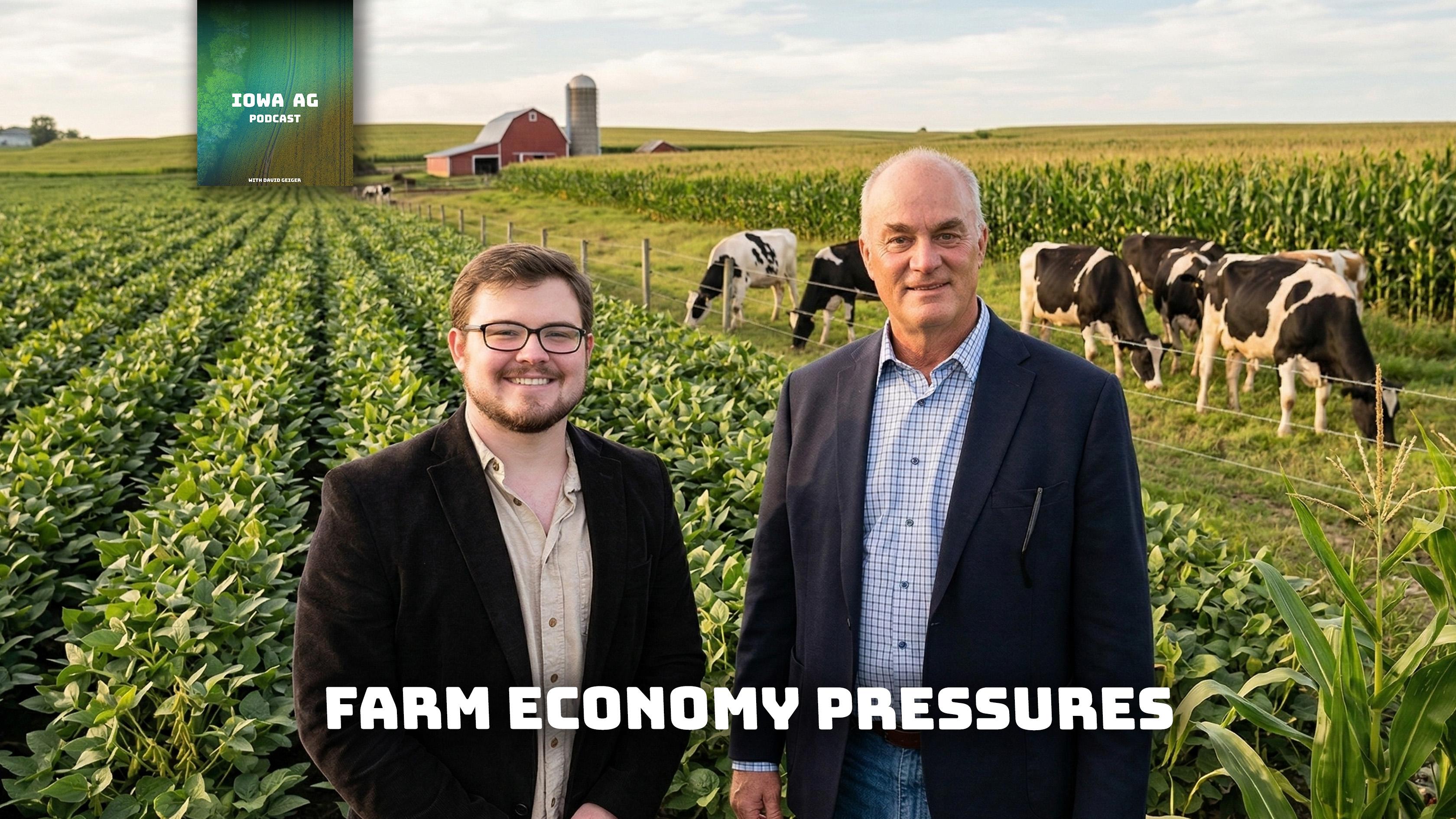


In this episode of the Iowa Ag Podcast, host David Geiger speaks with Mark Mueller, president of the Iowa Corn Growers Association, about the challenges and opportunities shaping the corn industry in Iowa.

Mueller begins by sharing his farming background in northeast Iowa, where he raises corn and soybeans, mentioning a close relationship he has with a nearby dairy operation. That partnership reflects one of the broader themes of diversification and finding ways to add value to farm production.
A major focus of the discussion centers on ethanol policy and the push for nationwide year-round access to E15 gasoline. Mueller explains that while expanded E15 sales would not immediately solve low corn prices, it could help reduce growing corn supplies and provide another outlet for production. He also notes that ethanol blends often lower fuel costs for consumers, making the issue both an agricultural and economic one.
Hear from Iowans directly. No algorithms.
Don’t let the algorithms choose your news. Enter your email address to hear directly from Iowans leading news in politics, community, agriculture and business. No editing. No clickbait. No rage. No agenda.
The conversation then turns to trade. Mueller highlights the importance of international markets for corn, ethanol, and livestock products, noting that exports remain one of the brighter spots in the current farm economy. Countries with growing livestock sectors, including India and Bangladesh, may become important buyers for corn co-products like dried distillers grains in the coming years.
Beyond markets and policy, Mueller emphasizes the role farmers must play in telling agriculture’s story. As farming becomes more complex and fewer Americans have direct ties to agriculture, he says producers must be willing to engage with the public, answer questions about farming practices, and explain the science behind modern crop production.
Finally, Mueller addresses the stress many farmers are feeling amid rising input costs and lower commodity prices. He encourages producers who are struggling to reach out for support and reminds them that organizations like the Iowa Corn Growers Association can help connect farmers with resources during difficult times.
Interview Transcript
This transcript was created with help from Ai. Please report errors to us and always refer to the video as your primary source.
David Geiger: Welcome to the Iowa Ag Podcast. I’m your host, David Geiger here at the Jetro Barbecue Studio, and today we’re gonna have a conversation with the corn growers here in the state. Joining me right now is it’s President Mark Mueller. Mark, thank you so much for joining us. You are the president of the Iowa Corn Growers. Could you give me a little bit of background before we dive into some of the important topics facing corn farmers this year?
Mark Mueller: David, thank you for having me. Uh, I am. a farmer up in northeast Iowa. I farm west of Waverly. I raise Mainly corn, some soybeans, and I work with a Dutch dairy. So I supply them with alfalfa and silage corn for their operation, and I take away the manure. So I view it as a chance to get involved in animal agriculture without. actually having to milk cows.
David Geiger: And uh, I think, as we all know, milking cows requires uh, significantly. more, more at hand type of, uh, work. They’re beating up. Uh, well actually, you know what? I heard once of a guy who, uh, trained his cows so that he had to milk them at noon and so he could sleep in. Yeah,
Mark Mueller: Yeah, That’s a smart guy. I’ll tell you the first thing dad did when he got out of the service and came, back to the farm was he sold off, grandpa’s dairy herd. And I’ve been grateful to him ever since.
David Geiger: He free, he freed all of his descendants,
Mark Mueller: Very much so. Uh, but this is a step at diversification back towards animal agriculture because uh, frankly, Iowa has gotten, Okay. economic forces have pushed us into raising corn and soybeans, and the animals that eat those. Things. So when I get back into dairy a little bit, even if it’s just supplying the dairy with inputs. it’s a Chance of diversification. Uh, I’m trying not to put all my eggs in two baskets, corn and soybeans. I’m trying to split ’em. Into a third basket, the inputs that go towards that dairy. which does have some benefits. And in some years I do make more money on dairy Connections than I do with raising corn soybeans.
David Geiger: That is fascinating and it will be interwoven within our conversation today because those economic pressures that you mentioned have indeed given farmers in the state a bit more limited choice in what’s the most economically viable way to proceed and. Diversification in, in the way you described with with dairy cows is a great way. Another one is ethanol. Making a diversification within the product itself. Having your product do more with the same this end result. And Ethanol has been a really hot topic for years now, specifically EPA conflicts and most recently wins for E 15 for the corn growers, but not Quite wins in totality, just in Midwestern states. What’s the current level of E 15 access for the us?
Mark Mueller: Yeah, We haven’t got that big win which is year-round E 15. Um, and that’s kind of a pity because, okay, the farm economy is on the ropes. Uh, not for everybody, but for most people, things are definitely tougher. We’re entering year number four, Of, uh, tight times. Uh, prices are up. Prices are down grain prices are down. Uh, E 15. Most of my corn goes to an ethanol plant. Uh, the one up in northeast Iowa, shell rock a poet plant. If we had year-round E 15, that wouldn’t be an instant solution overnight to raising corn prices, but it would help soak up the excess corn, the carry out that we have a 2 billion bushel carry out that, uh, we are building up over time. And, and probably within 10 years, we’ll have a 3 billion bushel carry out e 15 won’t solve everything. But it will be a win for farmers and we need a win We haven’t had one for some time. Um, e 15. If ever there was a no no-brainer, this would be it it would save the customer money, it would help clean up our air Uh, it. Would be, it wouldn’t cost the government anything Uh, all they’d have to do is agree to do it and they’re not, i, I am afraid that, um. I’m Afraid that while we get a lot of people that say, yeah, ethanol’s great, For some reason we can’t get it pushed right across the finish line. And that’s not because Iowa Corn and all the other commodity organizations haven’t been trying for that. But we are working against, uh, an opponent with pretty deep pockets who would rather not give up another 5% of the gas tank to ethanol, You’d rather keep gasoline in there. Uh, I’m pretty sure You know who I’m referring to without me actually saying names.
David Geiger: yeah. I, I think I do. Yeah. Yeah. Uh,
Mark Mueller: So that’s what we’re working against and while we have, gotten, um, we’ve gotten verbal support from a lot of legislators, we haven’t gotten the votes necessary to do it, And i would, uh, I would ask your listeners to, well, Okay. Your listeners in Iowa our Iowa delegation is on board with everything we’re doing here. Uh, there are allies they’re working, night and day. I’m talking about senators grassley and Ernst, and I’m talking about our four representatives, and there is some corn state representatives that stand alongside. them, but if you have listeners from other states that don’t necessarily have a dog in the fight? you might encourage, your listeners to contact, I encourage your listeners to contact, uh, their representatives and say, listen, E 15 is not Gonna hurt you and it’s gonna make your gas cheaper. Why would you not be in support of it? Ask your legislator that if he isn’t already. On board with this, uh, issue.
David Geiger: I think of just the choices that you’re given, right? Because uh, I had some family members just this last weekend talking about the gas pump and what they noticed at the gas pump. Mm-hmm. And they were talking about what, you know, what does this mean and what does that mean? Well, there’s, you know, Five options now when you roll up to a pump. And we are becoming more used to that here in Iowa because We have year-round access to that. And it makes the gas stations more comfortable in, in applying certain, certain levels of, of what they want to sell. it gives people the choice of what they want to buy. It doesn’t really do anything other than just let people choose.
Mark Mueller: Agreed. And uh, I have friends in Iowa that, uh. are completely unaware of what E 15 means, even though, you know, Anything built in the last uh, what 25 years is pretty much E 15 approved. And i drive around in the 1966 Buick and I’ve been running ethanol through that for the 40 years I’ve had it, and it still runs fine. People will say, you can’t run ethanol in your old car. It’ll ruin it tell me when that’s gonna be ruined, because at this point, 40 years on is still going strong. Uh, that, and I’m too cheap to buy a new
David Geiger: How many 25 plus year old cars are still rolling on the roads? I, It’s just there’s not very many of them left. And so there, and there’s still the warnings though. You know, there’s still I don’t want to, uh, butter up ethanol too much because I try to be at least be mildly objective, uh, when I talk about agriculture. But when it comes to ethanol production, I guess the, question that is there is why can’t you just have the choice?
Mark Mueller: Right. Consumers should not be denied the choice and they can choose to go with it if they would, or they might not to. But frankly, most people just look at what’s the, cheapest gas out there and that’s it. And gas is not so cheap anymore. I was at the Commodity Classic down in san Antonio, Texas this past week, and when I came back. I flew into Des Moines on uh, saturday afternoon. And I saw the gas prices were like 50 cents higher, uh, than they were when I flew out. Six. Days before. Well that’s, uh, that’s a result of the iran war that we’re may or may not be fighting, right,
David Geiger: A little uncertainty perhaps shaken up the markets a lot of uncertainty.
Mark Mueller: uh, that short term Uh, I don’t want to paint it as a rosy thing It will affect gas prices and gas prices as they go up will help corn prices. But that’s not the way we want to fix corn prices. We want to take care of uh, we want better access to a free. market. Uh, we want transparency. And when we put those things out there, corn will win Corn is an excellent feed stock, not just for fuel. But for chemicals, for fabrics. uh, food, Also, obviously, we mean all the animals that do eat corn Um, corn can be used for so many different things. Uh, so we’re not, we’ve been talking about ethanol up to this point. Uh, And that is where most of our corn, is going. but. we can’t Eat anymore or drive anymore than we already are. I’m an American.
David Geiger: There’s a finite amount.
Mark Mueller: Yeah. Um, I’m an American. I’m doing my part. I’m eating as much as I can, and I’m driving as much as I can. But the fact is that year-round, E 15 we’ll hope help soak up the excess corn we have, and even then it’ll only be for the next few years. And then we’re back to, uh, we’re back to, uh, large Carryouts. And One of the things that Iowa porn is doing, I’m gonna. gonna. Segue into something else. now.
David Geiger: Right, right, right. Um, and, and the segue actually, if, if you pause there for a moment, might be where I, I want to move in. If it’s is in the realm of trade, you want to move
Mark Mueller: well actually I was gonna go to, uh, new products innovation, but I can go to trade as well and I’ll I’ll go to trade first if you’d like.
David Geiger: Well, the reason why I wanted to bring that up is I had one more question to ask just, and this will relate into, to trade, um, because we’ve been spending a bunch of time on ethanol E 15, and part of the reason why I wanted to spend this much time is because as you mentioned, you were a commodity classic and there is a national push from national corn growers and national agriculture groups for something like E 15. How do you take that, bring it back to the local level in Iowa, and then we’re gonna ask the same question with some of the trade issues and some of the other priorities that are seen on that national front.
Mark Mueller: Well, as far as bringing it back to the local. level in Iowa, We already have a congressional delegation at the national and state levels that’s on board with us. Uh, they, uh, consult with Iowa Corn to say, you know, what can we do. How can we tweak this policy? What can we introduce to make things better for the farmer? I mean, we already have a seat at the table, and that’s what you get when you’re a member of Iowa. Corn. You have a chance to uh. They return your phone calls. I’ll say it that ways. Uh, So we’re, when we go to dc, which we will do in July, and I’ve done it every year for, I don’t know, 10, 12 years, what they will have us do. is go around to those congressional offices that don’t have any farm, any significant farm presence, and that’s Most of them We have roughly 40 to 50 congressional representatives, that have serious agriculture in the states. Every state has some, but not necessarily corn, or soybeans. and necessarily front and center. So, uh, I’ll go to DC and I’ll lead a delegation of three or four other people, from other corn states and we’ll Go to the various congressional offices. Uh, last time I think I talked to a Uh, two representatives from Los Angeles. Uh, they both had the, uh, the Port of Los Angeles in their districts. And what do you talk to them? about? The importance?
David Geiger: Well, that’s a pretty important port for agriculture.
Mark Mueller: Yeah. And the importance of imports and exports. Well, of exports for us. Yeah, yeah. Uh, uh, I talked to a delegate, a representative from Florida who was from a pretty Cash district, a poor one, and Ethanol can lower the price of fuel for them. So, you know, that’s a, that’s a, cost savings measure. Um, let’s see. I talked to somebody from from near Maryland. you got the Chesapeake Bay in Maryland, right? right Water quality, we talked to them about, okay, the first impression is, oh, you’re using chemicals galore. You’re dumping stuff on by the gallon. Of course We are not doing that ’cause chemicals are God awfully expensive, as is fertilizer right, Pretty much every other input I use, we’re putting on just enough to grow a crop. And that’s All the farther we’re going. But they had concerns about water quality issues. Well, the Chesapeake Bay is kind of the precursor to the in the Iowa Nutrient Research Education Council. that Iowa Corn Supports. So I was able to talk to them about the steps farmers are taking, to clean up their own water, And in my particular case, uh, I used cover crops and I put in a wetlands, and, uh, did some other things, buffer strips and grass waterways, uh,
David Geiger: new innovations, new experiments to try and improve water quality, that kind of actually, and return it to the place where it was originally inspired from
Mark Mueller: Farmers get tarred with a pretty broad brush. But when you talk to the individual representative. and. we have a way of getting to the, problems that their rep, their constituents face And more often than not we have a solution. And that solution quite often involves our. practices or the Products we produce or where we sell those products, including overseas markets. Um, so. but I don’t wanna sound like a Pollyanna, but frankly, corn can take care of a lot of the economic ills facing, not just farmers, but just The rest of the nation, uh, agriculture leads uh, leads the nation, I think in exports. The value of our exports in agriculture. products is either first or second. and I’m not certain what the exact dollar amount is.
David Geiger: We’ve been fighting with, uh, Illinois, I think for, for that a little bit.
Mark Mueller: Well, there’s no clear, there’s no doubt that Iowa leads Illinois in corn production Uh, it’s less clear as to whether or not they lead us in soybean. production. Right.
David Geiger: It’s the soybean side that I was thinking of. Yeah. Yeah. But corn, corn, we’re still in the lead but
Mark Mueller: They’re, they’re, figuring it out.
David Geiger: So Yeah. Let’s hope that Not too fast though. Okay.
Mark Mueller: Okay. Yeah, that’s, true. we have more corn than we know what to do. With now. So, Uh, exports, we started to talk about that a little bit. Um, that is one of those few bright spots in agriculture. Exports are growing, Uh, we’re moving more corn out of the country. Either in the form of of corn as grain, as dried distillers, grains, which I’ll refer to as DDGs from here on out. uh, meat, or ethanol. Uh, Canada is our biggest ethanol, export market. Uh, and Mexico is our biggest, um. meat customer. So we’re getting corn out of the country in all sorts. of ways. sorts. We have a lot of help from bodies like, uh, the US grains and Bioproducts. Council. They have offices stationed around the world and They are there to promote corn, uh, sorghum and barling. Most of our barley goes down to Mexico. to the brewing industry, and I’ve Done my own part to help. support the barley industry. Uh, Sorghum used to go to China. and now it, uh, India is very interested in our barley. Uh, barley is barley. exports are up even though China is completely out of the market. Right? And then of course, corn, which is going all over the world and is going to be going to more places fairly soon. soon. I just returned from India about, uh, about five weeks ago, four weeks ago, something. like that. And At this point, they’re not ready for our corn. In the form of corn. They can raise their own corn Yeah, but whereas they used to be a corn, uh, corn exporting country and they’d export it to neighboring countries like Bangladesh. They have a growing livestock industry. in particular poultry and dairy. and those. Sectors are pretty much using up all the corn they have now They had no more corn to export, which frees up corn for us, the first shipload of US corn. to Bangladesh in eight years got delivered while I was over there back in January. So we’re getting to those places and in another four or five years, India is forecast to not be able to raise enough corn for their livestock sector. They’re actually expected to need enough corn that would be equivalent to a fourth of the corn that Iowa produces. And that’s just in three or four short. years. Wow. Now, how are they gonna get that corn in if they don’t accept GMO corn? now? Well. They can take, uh, dried distillers grains, the DDGs. I talked about and feed that to their poultry industry. In fact, their Poultry industry. Would love to have Uh, the DDGs, there. Now, uh, last October I had a delegation from India come to my farm. They toured the poet ethanol plant at uh, shell rock, which is where my corn goes to. and then they came over to my place. I live about five miles away and we had a. Picnic On the porch, Uh. Asked ’em what they wanted to have and they wanted beer and burgers, uh, which is not what I expected from a delegation.
David Geiger: From Not a bad choice either.
Mark Mueller: Yeah. Yeah. Pretty good a pretty good choice. And they were, great burgers. Uh, so they were, they were a fun bunch to have, I’ll say it that way. They were just, we had a great time on the porch and they wanted to, they they wanted to buy our inputs and we’re ready to sell it to ’em. We need a trade. deal. I we talked about international trade. We have, we have lots of frameworks announced, Correct. Um, but those frameworks are largely empty. We Need the details filled in and it takes a, long time to get a trade deal. in place. Uh, I think the fastest to trade Deal ever was negotiated was like 200 days. Mostly they take more than a year, sometimes a couple of years. Then they take hundreds of people working on. it. on. them. So,
David Geiger: and if you’re talking 200 countries or more, that’s a lot of time and diplomats and approval. and
Mark Mueller: I know if we, I, I’m gonna guess that maybe by the end of this administration we might have a dozen trade deals with a dozen. Good, solid partners and the rest will just kind of, fall along. But we haven’t got any details yet. We’ve had one, you know, one trade deal with Great Britain, which most of the details. are hammered out. Um. U-S-M-C-A that’s up for review. I guess I’d say to any person, you’re that’s listening to this podcast, uh, get ahold of your res, uh, get ahold of your representative. Get ahold of your senator. Actually, it’s the Senate that approves trade deals. Mm-hmm. So Get ahold of your senator and have them urge the administration to re-approve U-S-M-C-A. It’s supposed to be reviewed, I think every six years or so. But Canada and Mexico. are our two biggest trading partners. Yeah. Why we want,
David Geiger: and that’s a big can of worms to reopen.
Mark Mueller: I know. Why do we want to to. Why do we want to pick a fight with our closest Neighbors and our best trading partners? Uh, like I said Canada’s number one, for ethanol. Mexico’s number one for meat and corn. Uh, we have railroad cars full of corn going over the border because they can’t raise nearly enough corn on their own to feed their livestock industry They have, you know, dairies that have 200,000 cows in ’em and feed lots with tens of thousands of. cows in them. They need our corn. and yeah, There was a bit of a. a You know, a bit of a kerfuffle over GMO corn. Mm-hmm. Entering the country a few years ago, But US Grains Council and the commodity organizations and the folks that we work with on their side of the border all went to the government and said, listen, Yeah, we need us corn. and our Chicken flocks are gonna start starving in four days. And our cattle are gonna,
David Geiger: some, some did, some did, if I recall correctly there, or maybe that, maybe that was a bit more on the negligence issue of the, whoever was managing those, those po possible flocks. But the risk was there mm-hmm. for everybody.
Mark Mueller: Oh, yeah. Um, I, don’t think it was negligence. I think the Corn was shut off and the people that needed the corn uh, didn’t have, weren’t being listened to in the government.
David Geiger: Right. I, I can’t quite recall the details. So that very well could be,
Mark Mueller: well, AMLO was. uh, let’s see, I can’t remember. Manuel Lopez. Obor is,
David Geiger: yep. Yep. Yep. That’s the, uh, former Mexican president.
Mark Mueller: Yes. The former president. And He had this, uh. idea in his head, he probably still does uh, that, uh, genetically modified organism. Yeah. Excuse me, I’ll butcher that up. Genetically modified organisms. uh, are bad. Mm-hmm. Well, we’ve had GMOs for 30 years in the United States, and United States leads the world in the production of, crafty lawyers, and they have been trying like hell to tie one death to, uh, genetically notified organism and they have yet to do it. Right, right. right. Um, it’s not an issue in this country. anymore. It’s safe. 30 years have demonstrated it’s safe and. there’s still some pushback against that. mainly from Europe. Uh, now Europe has managed to, s they were first with the narrative.
David Geiger: They’re also a bit weird too, ’cause they’re very, uh, Very closed off when it comes to protecting their agriculture Mm-hmm. Mm-hmm. And their farmers specifically in Europe.
Mark Mueller: I fault them for that. I mean,
David Geiger: No, you want have your own production. Right? It’s a part of national security.
Mark Mueller: Yeah. Um, but the fact is that when you have free and fair trade, which is what Iowa Corn advocates for. we pretty much win. Uh, we can grow. crops and the livestock, the deta stuff more sustainably, more economically, more efficiently. efficiently Than pretty much anywhere else in the world. Uh, yeah, there’s certain areas of the world that do certain things very well, but, Uh, on the whole, we are the nation’s best producers at all sorts of commodities. Um, but Europe. um, set the narrative, especially in places like Africa I was in Africa a year and a half ago, I believe, almost two years ago. and spoke at another conference, uh, promoted by Grains Council, and there message was not so much sustainability, uh, but are GMOs bad for you And how come you, uh, how many of your children have died from di eating GMOs. Right, right. I was able to cite the example. of the Dairy that I work with, They feed their cows, the GMO corn and alfalfa that I grow, and then their kids get the milk from those cows on their own dairy and so far they are seven and oh as far as kids that are healthy and thriving and all that stuff. Uh, so if there was an issue. um, there is no issue It’s just misperceptions. It’s rumors and it’s in large part ignorance,
David Geiger: misinformation, ignorance, and generalized fear about food Mm-hmm. and how it’s made. I think a lot of that. Is why it’s important to talk about it and be open about what we know and, What we hear Mm-hmm. and whether or not there’s truth or validity to it. Uh, because, and, and, and I I don’t want to dive too much into the weeds because I, I know there’s definitely something I want to talk about as well, uh, in regards to trade, But when you deal with a topic like GMOs, right, you’re dealing with uncertainty, new novelty, and that can create fear, uncertainty with Average people who don’t know anything about their food production or where it comes from or how it’s made, but when you have the evidence of 30 years we’ve been using this and the evidence of. there’s no connections to any problems that we know of. then you know, it, it, it should be something that is delegated to extreme low risk, if none at all. Right? And so that’s an important thing to just talk about and communicate and be open about. But
Mark Mueller: I try to, but oftentimes I don’t have half the time I’m speaking to farmers about, Hey, Here’s what we’re up to. Here’s what we’re doing. Here’s what we Do with your checkoff dollars. It’s money well spent, there’s a return that we can actually, uh, rate a return. That’s very positive. And we can talk. about that. But other half of my time, is spent educating, Uh, non-farm. and here’s the thing that, uh, is annoying. Everybody has warm, fuzzy memories of sitting on the seat of grandpa’s farm all when they were a little child. And So they think I know all about farming. now. It’s kinda like Everybody that ever went to school, Well, I know all about teaching because I went to school Mm-hmm. and I watched a teacher for years. People have this, this, they’re, they’re nice, warm, fuzzy feelings and I can understand that. But agriculture is always been difficult and It has only gotten more complicated. So I have to, Yeah, if you can’t fit something on a bumper, sticker, uh, but you have to explain the science to it. You’ve already lost the battle. Yeah. And here we are trying to explain the benefits. of our practices. the, the, the uses and purposes, the purposes we have in using chemicals, fertilizers, certain inputs. um. Um, we’re not overdoing any of that stuff and we’re trying to reduce by ever more amounts because it’s all expensive People just, that’s not gonna, you have to explain the science to ’em. Uh, nobody has the patience to listen to why a certain fertilizer is necessary at a certain point. And we don’t use any more than we ne need to. or that that Fertilizer might occur. naturally in nature. Let’s talk about nitrates. You know, they’re in the Soil already. Um,
David Geiger: it’s way harder to disprove an assertion than it is to make one. one. And so ultimately what it comes down to is a matter of trust. it, it comes down to uh, and Maybe this is a wrong way of, of saying it, but there a general distrust of farmers from people. Um, and I don’t know if that’s because they distrust the farmers themselves or because, uh, it’s become so much more considered industrial. Mm-hmm. regardless how true that term is or not. Uh, I don’t know what makes that trust or distrust happen, but how do you feel about that and how do you feel? farmers should and are improving trust with your average person.
Mark Mueller: Yeah, farm, it’s incumbent upon farmers to make that first move. Um. I am trusted by the people I know. I have a circle of friends, back in Waverly, None of them are farmers, but they know me well enough to ask me a question about you know, is this or uh, true or is this, uh, good or bad That sort of thing. But farmers as a whole. a lot of us go into farming because we like to work by ourselves and we just want to be left alone Nothing wrong with that But I don’t think we have the luxury anymore of sitting on the sidelines and being silent. when other People are setting the tone, they’re establishing the narrative. They’re getting the first words out there. Um. We farmers need to get out and be public and we need to be spokespeople and we need to write letters to the editor. And we need to be in podcasts like we are doing right here. Um, I, I have such a good message to spread about agriculture, but if I just Sit on that. Good news by myself. um, it’s it’s lost. I mean, people aren’t seeing the efforts that we are making to clean up our water. Uh, uh, people aren’t, uh. aren’t aware of the fact that we only use certain chemicals in certain situations. I have traveled to other parts of the world where they dump everything but spent plutonium on the, crops. I mean, it’s kind of, a case of wow, uh, they use anything they want. I used to raise Suzuki beans. I Don’t anymore, but I did for about four years. Uh, We’ve tried other crops. uh, mizuki beans that we raised. Went to Japan. It’s a dessert bean. In Japan, you have uh, tofu, misu, and anan, anan, which is made out of Suzukis. it’s their dessert. Um,
David Geiger: like the red bean paste type. Yes, Yes. Dessert.
Mark Mueller: Yes. Yeah. Um, and our buyer said, we love your Suzukis because we get most of our Suzuki beans from China. We don’t know what they’re putting on on those beans in China. because there’s no rules or regulations to follow And American farmers. American farmers follow the rules. excuse me. American farmers follow the rules and they, they only put on what’s allowed. and we’ll Take all the zuki beans you have. for Chinese prices. Mm-hmm. Yeah. that point, uh, I was just thinking to myself, curses, uh, I’m not sure how much longer I’m gonna raise Suzuki if I gotta compete against China. Even though the buyer knows that we’re following the rules,
David Geiger: they aren’t willing to pre pay the premium to have that affirmation. that the rules are being followed.
Mark Mueller: Right. I came from India and I had people contact me saying, I’d like you to raise non GMO corn for me. Sure, I’d Love to, but you’re not gonna want to pay the premium that it’s gonna take to get it over there. Yeah, I, I raised non GMO corn and as recently as a couple of years ago, there are buyers for non GMO corn, but by the time I get done with trucking, I’m no farther ahead. In fact, I’m sometimes behind,
David Geiger: depending on, on what it is, I think it can be two, three, $4 more expensive per bushel.
Mark Mueller: Um, I haven’t seen cost figures like that. I mean, I used to do those calculations. and I would’ve said it was maybe. a dollar more expensive to produce and uh, and ship and the premium just wasn’t there to make it. right. Right. It was a wash at best. so. Uh, anyway, uh, we were talking about how farmers need to help educate non-farmers because non-farmers think they, how hard could it be? I had a, I had a cousin who was a computer programmer. down in Texas and he saw, this was around 2010 or 2015, something like that. He saw there was like $7 corn out there and he wanted to come back to the farm and and He Uh, I was renting land from his father. and he, uh, said, well, we could farm together. and I said, well, what do you know about farming? And he said, well, how hard could it be? Now? The conversation went downhill after that.
David Geiger: How many hats do you wanna wear?
Mark Mueller: Yeah, yeah. I wear a lot of different hats. I. am a me. mechanic, I’m a Chemist. I’m a blacksmith, I’m an accountant I’m a computer programmer
David Geiger: right now. You’re a, you’re a public relations, you’re a, you’re an ambassador.
Mark Mueller: I would say I’m a teacher. right now, Yeah. and that’s Probably the most valuable position I could be. I mean, I wear 20 or 30 different hats, uh, depending on the day, Uh, but this is perhaps one of the most important ones. And so, uh, that’s why I’d say I guess if you don’t have a farmer, you know, reach out and contact, one and they’ll spend their time with you. Most of them will. A few of us are kind of grumpy, especially on the time here. Yeah. Don’t bother the guy when he is trying to, plant, but
David Geiger: yeah, that planting, harvest. Leave them alone during those times
Mark Mueller: or come and ride with me in the combine. Right, right, I got a Comfy seat in the combine. and uh, I Guarantee you, I’ll talk you to sleep if you come out. and ride with me. So, um, anyway, uh, but. At farmers, if you have a circle of friends, try to expand that circle of friends to include some people that Are not necessarily on your side. Uh, this week and for the next few weeks, I’ll be meeting with various Uh, people running for political positions. Uh, today I spoke with one particular candidate, uh, for governor and I’ll be talking to some more next week and we’ll be talking to people, uh, that are. That are on the campaign trail and. all of you that are listening, especially if you’re farmers, you need to show up at those events. and just ask them a few questions. See what their stands are on things such as ethanol, or GMOs, or the CO2 pipeline or uh, exports. Uh. E two, You know, just or E 15. Just find out whether or not, um, Where your candidate stands. Mm-hmm. and I guarantee you’re not gonna find somebody that agrees with you. on every single issue. but if you’re a single issue voter, you already know who you’re gonna vote for, right? I guess I’m trying to speak to the people that, uh, haven’t shut their minds down yet. And if you’re insulted by that, well, I’m meant for it to be that way. please, uh, just, oh, uh, be,
David Geiger: be open, be curious. Yes. I think curiosity is an important part of what. is essential to communicating, and not only talking, but listening.
Mark Mueller: Thank you for saving me from myself there. Uh, yes, Just go out and talk and the politicians do want to hear from you. I mean, some of Them will will monopolize the conversation much as I am monopolizing this this one right now. But uh,
David Geiger: you’re here to talk. I’m here to ask a couple dumb questions.
Mark Mueller: I’ll let. you, None of them are done. I’ll let you ask another question. I, think I beat this horse enough here.
David Geiger: No, I, I, I think I, I want to wrap, I, we’ll have to have you on again to talk again. Uh, but I, because I, I don’t want to hold you too long for today, But I think I, I wanna wrap things up and just kind of go off of what you were speaking there a little bit at the end. And that is the communication, but also the stresses that are involved with wearing so many different hats. and having so many responsibilities with so few people to do them all. Mm-hmm. And is especially known during this time when we are about to get into planting season and there is a time for farmers to really be seen, especially on the roads, but also. Really be stressed out. So, uh, with IO corn, uh, folks, the work you guys are doing, um, what are things you like farmers to know and be aware of as they enter this difficult? Most of ’em are gonna know what they’re doing, what they’re gonna be doing on their own field, but just in terms of the community and support networks and, and what’s available for them to hear and listen to and talk about what, what, what’s out there.
Mark Mueller: I’m glad you mentioned that and I probably should have led with that because it is a stressful time. in farming. Um, our Input prices. are high and our market prices for green are low, And there are I’m getting calls. I’ve never, gotten before from farmers who have said, Hey, my banker has shut me. off. Who do you use for a banker? Um, I know that I’ll be around the farm, for another year and hopefully. Okay. I’m a fourth generation. farmer. I hope there will be a fifth generation, mul out there. Uh, but I know that there’s a lot of farms that are, are on the verge of closing down. They’re either gonna retire early Or they’re gonna use up their equity the banks are the banks learn from the 1980s farm crisis, and they’re gonna. I think they’re going to Mercifully shut down farmers before they eat up all their equity. But as a farmer, that’s a tough thing to say. and we are a proud and noble people and we like to go it alone And we’re not always gonna be able to, we’re not always gonna be able to have that. luxury of saying, we did it ourselves. There are. Economic stress is out there. that nobody has faced for decades. you can’t be too, proud right now. I would say this, if you are, if you are, um, you know who you are. If you’re having financial problems, you can’t sleep at night or whatever, Um, if things are getting very tough. Or you know, somebody like that, contact Iowa Corn Contact the Iowa corn growers Association and they will be able to direct you. To somebody that you can at least talk to. Um, you know, we, we talk amongst ourselves. I know that things have not been rosy for the last three or four years, and we might have another golden era of agriculture If some other part of the world gets hit by a meteorite or we have a drought spreads across the dust bowl again, but I don’t wish that upon anybody. Um. we have some, we have some solutions that’ll help a little bit. here and there. I mentioned E 15 approval Uh, I mentioned free trade agreements Um, we have other things that we can, do as well, if we could have some honest transparency in input prices, Um, Senator Grassley has introduced a what’s called the fertilizer research Act, and that would bring some light as to the murky world at, uh, about how fertilizer is uh, priced because we only. have about four suppliers for nitrogen, phosphorus, potassium. Um, I did Corn and I submitted testimony to Grassley’s Senate hearing which was last October. and are working on that. Uh, the Wheels of government turn slowly, but they do turn. uh, yeah. so input prices are another source of stress there, but reach out, contact Iowa Corn and they will help you talk to somebody that might be able to work through this with you. We have resources. It’s up to the farmer. Uh, the member of Iowa Corn to take advantage of them. We have a lot of stuff besides just going out there, and trying to promote E 15. That’s a big deal, but we do other stuff as well.
David Geiger: Absolutely. Mark Mueller is the President of the Iowa Corn Growers Association joining me today. Thank you so much, mark, for taking the time and for sharing that story and all of those stories that you had on this podcast.
Mark Mueller: My pleasure. Thank you. you
David Geiger: Again, this is the Iowa Ag Podcast. I’m your host, David Geiger here at the Jet Rows Barbecue Studio. You can feel free to check out some of the other work I do. I post stuff on Twitter or X, if you like to call it that way, at Geiger reports, and until next time, everybody.