

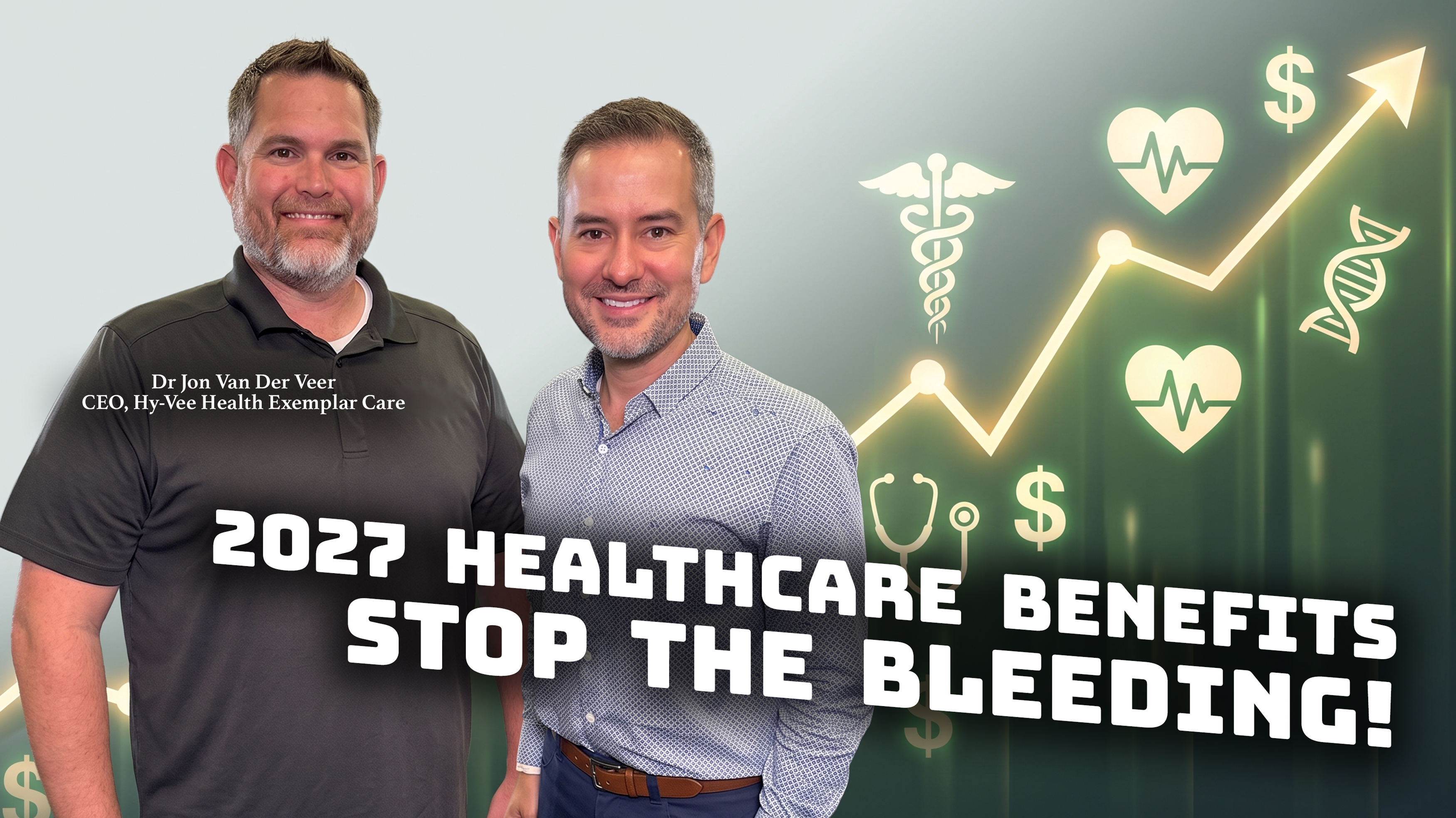
As 2027 comes into view, CFOs are looking at a 12% rise in healthcare benefits for their employees. That’s $19,000 per person and Dr. Jon Van Der Veer, CEO of Hy-Vee Health Exemplar Care explains why Direct Primary Care (DPC) as a benefit offsets those costs. For those looking to stop both the bleeding, while increasing care simultaneously this is your show!
It sounds counterintuitive, explains Van Der Veer. Why would adding DPC as an employee benefit actually offset healthcare premiums for employers? Van Der Veer explains how even though many employees technically have insurance, they’re still “functionally uninsured” which is one cause behind rising chronic conditions, bigger medical bills, and climbing premiums. And that doesn’t even include the rarely calculated cost of sickness and missed work.
Hidden Cost of Functionally Uninsured
With projected healthcare costs reaching an average of $19,000 per person by 2027—driven by recurring annual double-digit renewal increases—employers face an unprecedented financial squeeze. Dr. Jon Van Der Veer, CEO of Hy-Vee Health Exemplar Care, points out that while surging premiums technically count toward employee compensation, workers rarely see the benefit. Instead, two decades of wage stagnation have directly resulted from business capital continually being shunted away from compensation to pay for insurance premiums.
Compounding the problem, high deductibles ranging from $2,000 to $7,000 leave workers struggling to cover routine medical expenses out of pocket, especially given that a majority of Americans lack $1,000 in savings for unexpected medical costs. “So you have insurance, you have a 2,000, 5,000, $7,000 deductible, and so the $19,000 that your employer has put down for your premiums still doesn’t get you anything until you chew through that out-of-pocket,” Van Der Veer explained. This dynamic leaves workers “functionally uninsured,” prompting them to avoid early care for minor conditions like respiratory infections until they escalate into catastrophic, multi-thousand-dollar emergency room visits.
Direct Primary Care as a Strategic Business Pillar
To control erratic spend, Van Der Veer advocates for Direct Primary Care (DPC), a membership model providing unlimited access to primary, urgent, and preventive care without copays or extra fees for on-site labs and X-rays. DPC transforms unpredictable variable claims into a fixed monthly expense while managing chronic illnesses, mental health, and absenteeism.
“From day one, I’ve always said if you change the financial model, you change the care model,” Van Der Veer noted, emphasizing that operating outside standard insurance enables longer appointments and proactive health management.
Rather than passively accepting annual broker rate increases, Van Der Veer urges executive leadership teams to treat healthcare management as an active, year-round business strategy. “When you look at your P&L, I hate to disagree, but you’re in the business of healthcare whether you want to be or not,” he stated, advising leaders to explore direct contracting to protect both their operational bottom line and workforce productivity.
🫶
This show is a collaboration. IowaPodcast.com collaborates with loved Iowa brands to bring value to listeners. Brands compensate our hosts directly for their time. Learn more
Interview Transcript
This transcript was created with help from Ai. Please report errors to us and always refer to the video as your primary source.
Justin Brady: From the Iowa Podcast Studio, I’m Justin Brady, and employers, leaders, CEOs, CFOs, did you… I have a magic, very scary, very terrible number for you, $19,000. It looks like for, that might be the average per person we’re looking at for he- increased healthcare costs or just healthcare cost in general for 2027. $19,000. Good news is employees are getting a raise. Bad news is, uh, you’re not gonna get that raise.
Jon Van Der Veer: No, no, they’re not
Justin Brady: uh, to… Joining us today is Dr. Jon Van Der Veer, the CEO of Hy-Vee Health Exemplar Care. We always love to break down healthcare issues with you, and of course, we appreciate you being a collaborator at Iowapodcast.com. So 8 to 12% rise in 2027. Let’s start broadly. How are CEOs reacting to this, CFOs and leaders reacting to this news?
Jon Van Der Veer: Uh with the same groan and grunt that they usually do And and I say that only because this is year over year over year which you know back in the day if you got a random doubledigit renewal on your insurance premiums like it could be stomached but now it’s every single year when you’re looking at your PL and the second or third largest line item just keeps going up like at some point the business starts to falter because dollars are being shunted away from the business just to pay for premiums which like you you said in just the beginning is uh it’s technically a pay increase if more dollars are going to the employee for that but they are not seeing
Justin Brady: But they’re not seeing
Jon Van Der Veer: 20 years of wage stagnation that has solely resulted out of dollars getting shunted into healthcare premiums. Uh, so take-home pay has not been keeping up because all those dollars have been going somewhere else
Justin Brady: think for a lot of employees, the rising healthcare costs, if they’re getting it covered, is out of sight, out of mind. Um, but do, do these rising deductibles, rising out-of-pocket dollars that employees are spending, does this actually change how they’re using their healthcare benefits in their organizations?
Jon Van Der Veer: Absolutely. This is the term that I lovingly use, uh, as functionally uninsured. So you have insurance, you have a 2,000, 5,000, $7,000 deductible, and so the $19,000 that your employer has put down for your premiums still doesn’t get you anything until you chew through that out-of-pocket. Um, and for a lot of people, they don’t know, because there is no transparency in pricing for most of healthcare, you have no idea what something’s gonna cost, so you’re gonna avoid going. You know that preventive care is supposed to be covered at 100%, but they often will have an additional issue that’s no longer preventive, and you still get a three, $400 bill. And when you look at it, the, uh, majority of Americans don’t have $1,000 sitting in savings to eat up on this stuff. So if you have a $5,000 deductible, you’re gonna have a hard time ever getting to where those benefits kick in and actually cover the care that you need
Justin Brady: the employer’s paying a ton of money to make them insured and give this benefit to them, and it’s a benefit that they essentially cannot use or do not benefit from. So what happens when employees need care, the company technically is providing some financial something for them, but they can’t actually get the care? What– This is probably a ticking time bomb. What does that look like for
Jon Van Der Veer: so a lot of times you’ll see somebody who has a seasonal upper respiratory infection. They get, uh, influenza or RSV or some, some respiratory illness, and they kind of ignore it, kinda gets better, it gets a little worse, and then all of a sudden they’re really sick and you now have something that’s moved into your lungs. You end up with a pneumonia, you end up in the emergency room, and, and some people end up hospitalized. I mean, these things are all still very real conditions that make people really sick. Most people do fine with them. But, um, if you ignore getting it evaluated early on, the likelihood of you needing care downstream at a much higher entry point into the system, uh, goes up drastically. And that’s– There shouldn’t be any reason why if you have an acute illness that typically you could go get seen for, you should do that. And again, getting those barriers knocked down where it’s not gonna scare you on price, um, that’s kinda where we step in and we try to augment whatever, uh, insurance coverage an employer might be paying for an employee. So anyone who comes into our building through their membership doesn’t pay anything extra. There’s no copay. There’s not gonna be a bill afterwards. The X-ray on site doesn’t cost anything, things like that. So, so you can come in when it’s a minor illness and get it taken care of. And, you know, on a fully insured plan, like you’re gonna see an increase the next year, but for a self-funded or level-funded insurance product for an employer, uh, that’s paying the membership versus having five or six people who end up with multi-thousand dollar ER visits or hospital stays. Like, that’s where your spend can really get out of control in a hurry
Justin Brady: Yeah, and you’re talking about the direct primary care model you guys have. Uh, and this is something that now we had, uh, Rich Green, the CEO of DMOS in here last month, and he was talking about, yeah, we put this in place. So the question is, if people pay for the direct primary care model, right? That’s, it looks like additional money leaving out of your pocket, but does it control the overall picture of spend for a company?
Jon Van Der Veer: does. It becomes a fixed cost that you know here’s your number of employees that you’re going to provide this benefit for, um, times whatever that rate is with us, and then you know what that spend is going to be. And you know that your employees now have a benefit. And we’ve had employees from employer groups come in and say, “This is the only true benefit I have ’cause I don’t pay anything.” Oh
Justin Brady: Oh
Jon Van Der Veer: is, I come in, I get the care I need, and if I go somewhere else and, you know, I, I’m gonna have a copay or if I need referred on, yes, care’s gonna end up costing something. But all the basic stuff that we can do in primary care and in urgent care, they don’t pay anything for. So, um, it really ends up being a benefit to the employee. But those things also– So you have that fixed cost, it’s taking out now all the variable cost, all of the visits that would go somewhere else that you were paying a higher rate for, for… So those claims go out of that bucket as well. So it’s not just pouring more money out of your pocket, it’s shuffling which bucket it’s in and then what you get out of that bucket.
Justin Brady: it’s almost like a city pays for a fire department. Like yeah, that costs money. But if we don’t do that and a fire does break out, everything burns down and goes to heck. So this is what the DPC model is doing it’s a fixed cost and you know it’s preventing the entire s- you know, the entire, your entire health from just catastrophically
Jon Van Der Veer: And ultimately, I think some of the costs that we don’t do a very good job of quantifying is, uh, absenteeism and health of a workforce. Um, coming out of the pandemic, the number of people with, uh, behavioral health things, depression, anxiety, um, chronic illnesses, obesity, diet- diabetes, hypertension, all those things have a cost and have missed work opportunities. So again, proactively getting an employer who’s 35, or an employee who’s 35, and making sure they’re doing the right things, they’re sleeping well, they’re managing their stress, they’re exercising, and their diet’s under control, like, that keeps them a more functional and productive employee than, than you’re gonna be able to actually quantify
Justin Brady: So th- this is key because most of the time, um, uh, like hospital benefits, employee benefits, healthcare benefits aren’t looking at the chronic stuff. It’s looking at the catastrophic, when you go to the ER, when something’s broken. What you’re saying is the direct primary care model, um, allows employers to help employees manage the chronic stuff. It’s almost more like a health coach than an emergency kind of thing with the direct primary care model.
Jon Van Der Veer: it’s, it’s building a relationship and it’s, it’s augmenting a service that is scary for people to use, which is the big insurance that they don’t know what it’s gonna do for them- Right … what it’s gonna cost, and so they’re hesitant. And we, we always have employers who say, “Well, how do we know that our employees are gonna use this?” Well, they’re gonna use it the first time they truly need it, and it’s gonna be free to them, and then word of mouth is gonna spread, and you’re gonna have people who go, “No, they really didn’t charge me anything. I got in, I got seen, I got what I needed done for me, and they included labs and X-rays and, and they dispensed a medication, and none of this stuff cost me anything extra.” And it doesn’t take long for that benefit to sink in, um, and that they just really enjoy using it. And so you don’t have to worry about, “Oh, are my employees gonna do this stuff?”
Justin Brady: people often get the insurance thing confused with a direct primary care model. I know that when I’ve talked to my family about it, they’re like, “Oh, is that covered by my insurance?” And I’m like, “No, no, I don’t think you get it.” So can you explain that whole thing?
Jon Van Der Veer: So the direct primary care model is a membership model of an individual or an employer group paying a set fee, uh, for all the services we provide. This is outside of your insurance, and a lot of times it’s added on to people’s insurance through their employer, or they choose to get it because they get the convenience and access that the membership has. Then they get the downstream savings of not having to spend copays and, and higher dollar things that are already included in their monthly membership fee
Justin Brady: is the, the Hy-Vee Health exemplar care model, direct primary care, is your ability to work outside of insurance kind of one of the reasons you keep costs low and you can manage chronic conditions and you can spend more time with people- Yes because you’re operating outside of that
Jon Van Der Veer: Yes. So, um, from day one, I’ve always said if you change the financial model, you change the care model. Um, in the traditional fee-for-service world, the reimbursement continually gets worse, uh, and to make up for that, you increase volume and you’re on a hamst- you’re a hamster on a wheel running as fast as you can to go nowhere. Um, where this model, you know what that structure is and you build the care around that, uh, so you get longer appointments, you get more access, you have other resources delivered to you as well. And that time and relationship is, is really still the most important thing
Justin Brady: What’s crazy is business strategy used to be like ops, marketing, production, whatever, right? Those, those were kind of the pillars. Uh, it, it’s almost like healthcare is now one of the pillars. This is part of the business strategy these days
Jon Van Der Veer: It really is and the number of employers that I talk to leadership teams that say Well we just have our broker or our our insurance agent do this cause we’re not in the business of healthcare Well when you look at your PL I hate to disagree but you’re in the business of healthcare whether you want to be or not And and the bigger you get the bigger those costs uh those costs go and it’s easier to control those as you start to look at some of that scale Like how do you how do you take your large selffunded um pool that you’re spending out every year and how do you start to control some of those things Whether it’s through us direct contracts bundling of services Like people are so used to get insurance do whatever insurance says and there are so many alternatives out there and if you haven’t been exploring this as a leadership team you’re missing out on some real opportunities One for changing the experience your employees have but from the employer standpoint you have an opportunity to go in and dig into a big chunk of money that’s just being mismanaged
***Not transcribed***
Jon Van Der Veer: So one, um, has this been working? Like, you’re looking out over several years, and every year you’re seeing the same thing, and if you don’t change your behavior as a leadership team, you shouldn’t expect a different result. So then, uh, the CEO can ask the CFO, “Okay, what’s our spend going up, and how is that changing?” And then the CFO can– let’s say they have HR running benefits underneath them, say, “Hey, what have we done differently to contain these costs?” And if they say, “Well, the broker said we just keep doing what we’re doing,” somebody has to ask, “Why are we, why are we just having Groundhog Day over and over again and not managing this?” If you reduce cost of something that you’re already paying for, it’s just like making that money. It goes straight to the bottom line. So take the time and do the work that you would expect anyone else in a, in one of your divisions to be looking at budgeting. Like, why wouldn’t you be putting in the time and effort to really explore what the options look like to manage your healthcare spend?
Justin Brady: Yeah, absolutely. Dr. Jon Vanderveer, the CEO of Hy-Vee Health Exemplar Care. Um, if people are listening to this and they want to sign their company up, obviously individually they can sign up as well, but if they wanna sign their company up as a benefit for their employees, how do they do that?
Jon Van Der Veer: Uh, well, there’s a Contact Us page at http://www.exemplar.care. They can email me at jon@exemplar.care. Um, I don’t care if you bring a carrier pigeon and you bring me a note. Um, happy to have the conversations. Uh, you can call the office, um, or my cell’s 319-530-3786. People can reach out any way they see fit, and I think the, the one important thing that gets lost ‘ cause people think this is a benefits question, direct primary care can be added onto your benefits package year-round. It doesn’t have to go through the, the usual benefit piece because it’s not gonna add any out-of-pocket costs or mess up any of those things. Uh, it’s a benefit you can supply to your employees anytime, and you can start getting help managing some of the spend, um, on your insurance plan at any point in the
Justin Brady: Reach out to Dr. Jon and his team at exemplar.care. Dr. Jon, thanks so much for coming back on the
Jon Van Der Veer: Thanks again, Justin. It’s always fun
Justin Brady: Always fun.