

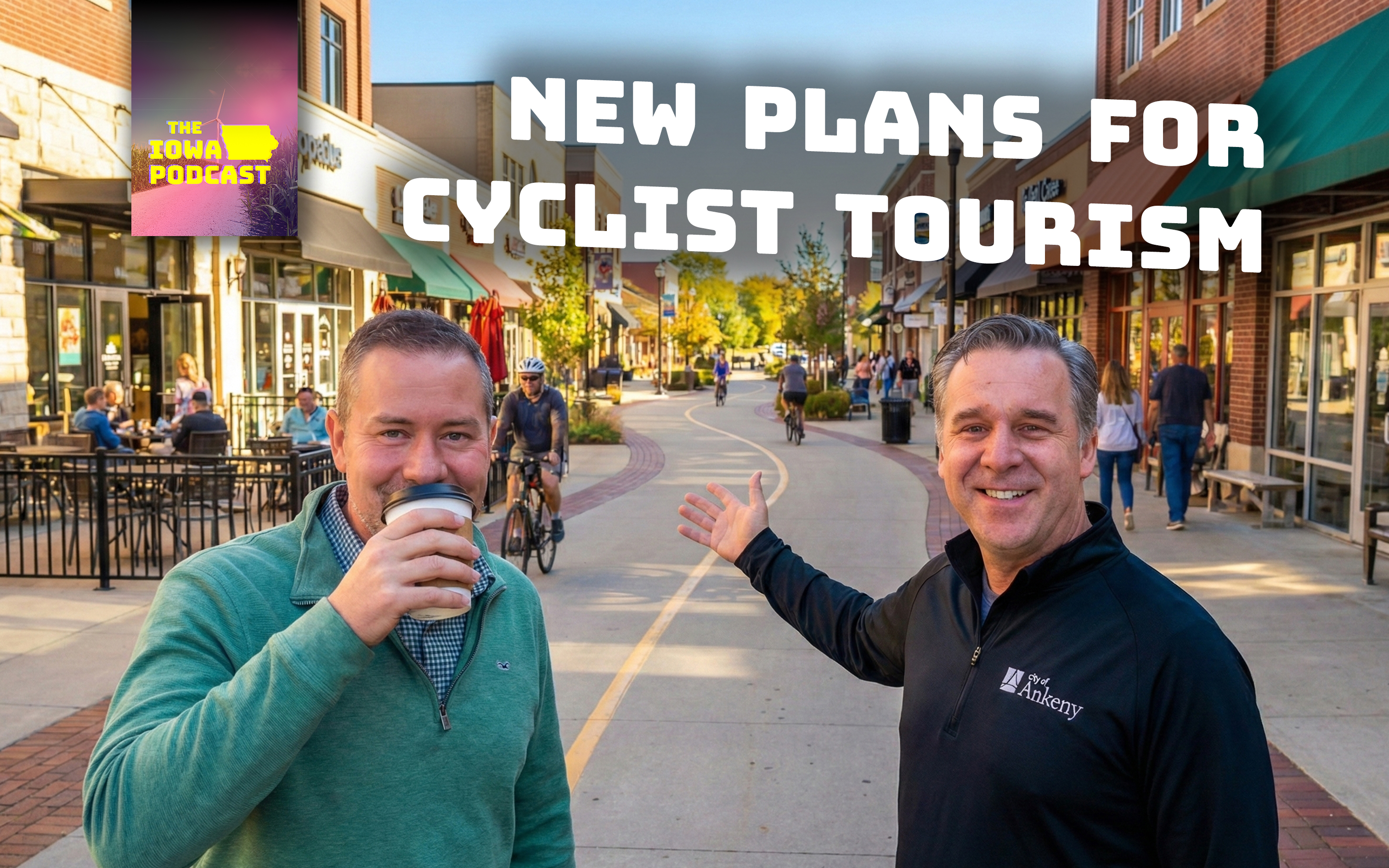


20% of cyclists coming to Ankeny for the High Trestle Trail aren’t from Iowa. The economic potential cyclists bring is estimated to be in the billions, but currently each stay only brings $250 in economic activity. Derek Lord, Ankeny economic development director explains the retail and business opportunity accommodate the massive and untapped revenue potential. Will retailers answer the call?
Lord explains the High Trestle Trail has brought 250,000 cyclists through Ankeny every year. Cutting right through the middle of Uptown, the revenue potential has been immense. Will hospitality companies capitalize on the potential in 2026? Lord also addresses the growth plans for the NE Ankeny annexation, new mixed use retail and apartments in Uptown, and why traffic on Delaware is probably not changing any time soon, especially as new retailers show interest.

High Trestle Trail Amenities
Ankeny is leveraging the High Trestle Trail to drive local economic growth, according to Derek Lord, the city’s Economic Development Director. The city is adding unique features alongside the trail, including a 1,000-linear-foot undulating side path known as the “flow line,” a nighttime “glow trail,” and a 14-acre Experience Park adjacent to historic Uptown Ankeny. Lord noted that cell phone tracking data reveals the High Trestle Bridge draws roughly 250,000 visitors annually, with 20%—about 45,000 people—originating from outside Iowa. “The whole goal here is to create some unique amenities adjacent to the High Trestle Trail to enhance the quality of life for people who live in Ankeny, but also attract more visitors to our community and create kind of an anchor feature in Ankeny,” Lord said.
Hear from Iowans directly. No algorithms.
Don’t let the algorithms choose your news. Enter your email address to hear directly from Iowans leading news in politics, community, agriculture and business. No editing. No clickbait. No rage. No agenda.
Ankeny Tourism Data and Financial Impact of High Trestle Trail
City survey data indicates that overnight trail visitors spend over $250 per day in Ankeny, while day-trippers average $40 per day. Lord highlighted that trail users represent an attractive demographic of high-income earners who ride an average distance of 25 to 27 miles per trip. A key connection between the High Trestle Trail and the Raccoon River Valley Trail now creates a continuous 120-mile paved loop. As Lord explained, “That 120 mile loop really is a good selling point for a long weekend destination in central Iowa”. This local activity reflects broader statewide momentum. Lord cited updated research from the Iowa Bike Coalition showing that “13 years later in 2025, the economic impact of bicycling in Iowa and trails is 1.4 billion,” up from $400 million in 2012 and supporting more than 20,000 jobs statewide.
Urban Expansion and Infrastructure Investment
To capitalize on this traffic, Uptown Ankeny maintains near 100% occupancy across more than 75 businesses, with master planning underway for higher-density mixed-use development. Additionally, the city is advancing two major annexations totaling 1,500 acres near Costco and planning an 18th Street overpass over Interstate 35 set for 2027–2028 to carry 10,000 vehicles daily.
Interview Transcript
This transcript was created with help from Ai. Please report errors to us and always refer to the video as your primary source.
Justin: [00:00:00] Real Iowans. Real talk. No drama. This is the Iowa Podcast. I’m Justin Brady, and of course we’re in the Jethro Barbecue Studio. Ankeny is growing like a weed. I just was up. I mean, I’m up there a lot, but it is just, every time you go up there, there’s 80 new things. What we’re talking about today though is the high trestle trail and something very unusual that the high trestle trail brings to Ankeny that most of you probably don’t think about. So that’s what we’re gonna talk about today with Derek Lore, the Economic Development Director of Ankeny. Derek, thank you for coming on the show.
Derek: Yes, thanks for having me. Excited to have a conversation about Ankeny and the, the Trail Network.
Justin: Yeah, it, it’s, it’s absolutely, I’m, I’m not kidding, like every time I go up there, it’s actually very hard to keep track of all the new stuff. So I’m really excited to get into that before we do Jet Throws barbecue. we love them. if you like Chick, I get chicken wings every time I go. I’m sorry. I’m sorry everybody. That’s just what I do. If you [00:01:00] want a free gift card, go to io podcast.com. Scroll to the top, click the Jethro logo, and if you buy a hundred dollars gift card, they will give you a $30 gift card for free. Do that high trestle trail. So I saw, uh, a new announcement about the flow line. Let’s talk about that. What is a flow line? Why does that matter? What, what? How does that change the high trestle trail?
Derek: Well, the flow lines, it’s a new concept. It’s what we’re calling it, the flow line. I don’t know if it’s a term that’s used nationally or not, but essentially it’s a side path off the high trestle trail that’ll be about a thousand linear feet and it has some rise and fall. So little hills think of like when you’re driving in a car in a rural area and you’re stomach kind of rolls a little bit ’cause you’re going up and down. Um, so it’ll be a fun feature off the trail. It doesn’t impact the trail whatsoever. but you can choose to peel off the trail and go down the flow line. And it should be unwelcome change throughout the course of a day for a rider. Because if you think of trails, they’re as flat as this table. Mm-hmm. [00:02:00] Everywhere across central Iowa and they’re supposed to be. Whereas this really kind of breaks up that monotony and gives you something kind of fun to peel off and do. Uh, that’s a little bit different now. It’s fun for bicyclists break up the day. Um, if you’re pushing a stroller, it’s fun. Uh, if your kids, uh, you know, teenagers or younger on mountain bikes and want to just kind of bounce around the trail a little bit, it’s something fun and different to do. Uh, that you won’t find elsewhere. We also have on the other side, uh, this year we installed the Glow trail. So the GLA just got
Justin: got finished. Yeah, Yeah.
Derek: Yeah. So that’s a nighttime feature. That’s a standard trail, but the whole goal here is to create some unique amenities adjacent to the High Trestle Trail. to enhance the quality of life for people who live in Ankeny, but also attract more visitors to our community and create kind of an anchor feature in Ankeny. With the bridge being at the north end of the High Trestle Trail and this experience park being at the South end,
Justin: Are you basically building up in Ankeny, kind of a central park, not Central Park, but are you building something around the high trestle trail. Because some [00:03:00] people that take the high trestle trail, they’re like, they want to pass through and Are you essentially building out attractions where locals can take advantage of it, but also people passing through can kind of hang out in an Ankeny, just for a second. Is this kind of the
Derek: It’s exactly what we’re trying to do. This experience park centered right, right in the middle of Ankeny, next to uptown, our historic downtown area, it’s a 14 acre park. Um, you could look at it as a Central Park feature. The trail itself isn’t impacted. The trail does not move. What it is is amenities adjacent to the trails for exactly what you said, for, for visitors to linger a little bit longer, uh, for residents to come out, enjoy a new park feature in the community.
Justin: So how many people generally come through that area then? Because High trestle trail is you know, everybody knows the little square. Rotating thing up in near, like it’s between you and Woodard, I
Derek: think. Yeah, yeah, yeah.
Justin: Yeah, yeah, yeah. So how many people end up passing through that within Ankeny then?
Derek: yeah. So in Ankeny thousands of people use Ankeny as [00:04:00] kind of the trail head to the high trestle
Justin: Oh, got it.
Derek: Oh, got it. Uh, we tracked a lot of visitors to Ankeny who stay in Ankeny, uh, to go up to the bridge. ’cause the bridge is always going to be the main feature
Justin: it’s cool. Yeah. It’s
Derek: I mean, it’s rated nationally, it draws, we estimate, uh, based on cell phone data, about 250,000 visitors a year visit. Thehy, resell bridge, just the
Justin: Geez, just The bridge. Just
Derek: the bridge. And what’s more interesting, if you dive into that data, about 20% do not reside in the state of Iowa. Oh. So about
Justin: are coming from outta state Just for this
Derek: 45,000 people a year, uh, you know, based on cell phone data, step foot on that bridge do not live in Iowa. Um, so Ankeny is, is a full service city, hotels, restaurants, all the amenities. So we see Ankeny as really that kind of home base for people, uh, who want to come experience the high trestle trail and, and the bridge.
Justin: So you as an economic development director then are looking at, and I’m sure 20, you said 20% outside of Iowa are visiting. That’s [00:05:00] not, uh, visitors in general. There are other Iowa visitors coming as well. I’m not sure if you have that breakdown, but you as an economic development director are looking at this and saying, oh my gosh, we have a quarter million people coming to Ankeny generally in this area for this bike thing. We gotta do something. Exactly. There’s, there’s revenue to be made here for Ankeny residents by the truckload. So are you having conversations with retailers? Are you having conversations with hotels? I know that you have some up there. Are you looking for more and more, more retailers to take advantage of the high trestle trail attraction?
Derek: Yeah, it’s definitely the data’s part of our story, right? I mean, when you look at Uptown Ankeny, there are businesses there today that would not be there without that trail traffic will. So we, it’s our role in economic development is tell the story. Uh, we’d heard kind of anecdotally that people come to Ankeny, stay in a hotel, use the trail So several, seven, eight years ago, we did a. Comprehensive [00:06:00] study where we did acquire cell phone data, but we did surveys with for individuals along the trail to really begin to understand is there a market here? Are there a lot of people coming and staying to really prove kind of what we’d heard in the community. So we interviewed about 200 plus people along the trail at different locations, on different days, and we found that about 10, 15% were, were there, Um, because of the high trestle trail and 90% of those people were staying in hotels. So part of the,
Justin: 90%
Derek: of the visitors,
Justin: of the visitors visiting the high trestle trail need hotel
Derek: the of, of the 200 plus, we interviewed in Ankeny on random, you know, Thursday and Saturday we’re staying in hotels. So we drilled in a little bit more on the survey questionnaire and asked. How much do you spend on an average day? How much do you spend if you stay the night to really determine what the economic impact really is for our community? And we learned, you know, this is kind of pre rapid inflation [00:07:00] area, but over $250 a day spent by everyone who stays in a hotel visiting the high trestle trail, which makes sense. Um, and then about $40 per day if you’re just out for a day trip. Mm-hmm. Um. And then with the, with the, data we collected along with this from the cell phones, we’re really able to prove that there is a huge opportunity here for not just Ankeny but Central Iowa to capture, you know, new visitors, support our local stores and maybe even track new investment like we’ve already seen in Uptown Ankeny as a direct result of the high trestle trail.
Justin: I, want to ask about the new investment in uptown. Yeah. But you mentioned 90% uh, of expenditures or, or 90% of hotel stays. I, I, I don’t remember the exact number, but it’s a lot of people staying in hotels or visiting high trestle trail. Um, well, first of all, I would guess maybe that drops off in the winter a little bit, but for sure. Yeah. But mostly you have, you know, spring, summer, fall, that’s quite a bit of revenue. But I hear the numbers and I don’t, I, I see [00:08:00] opportunity here. I hear the numbers. $250. And $40 for local. And I’m like, there, that’s low. That, that’s really really low. Like there, so. There are a lot of opportunities here, A lot of opportunities here to capture a ton of, I mean, maybe a couple thousand dollars, Right.
Derek: for a long weekend. Stay
Justin: Yeah. So what are the conversations you’re having with businesses then saying, you need to come here because look at all this revenue you can be making. Who are the players and who are you talking to to get that?
Derek: Yeah. we’ve talked to hotel operators to really look at whether or not they can kind of market their hotel for high trestle
Justin: like additional ones
Derek: like additional ones, either additional ones or, you know, kind of creating a brand around their existing, kind of newer hotels nearby to capitalize on the trail theming, theming, the, the lounge in the hotel related, you know, towards bicy and bicyclists. Um, we’ve had those conversations. It’s really, [00:09:00] you know, our strategy is using the data to try to you know, create that intentional mix of businesses that can capitalize off the off the
Justin: Right, Right,
Derek: right, right. You know, it’s not just, you know, bar bars and restaurants, it’s bicycle shops, it’s ice cream shops, it’s coffee shops. It’s different types of amenities that can all kind of capitalize on the various needs of trail users because what’s unique about trail real users and why Restaurateur love. Being next to a trail is trail users with heavy trail traffic, keep them busy steadily all day long. Sure. Whereas if you know the restaurant industry or you, if you serve breakfast, it’s breakfast, lunch, and dinner, and then the dinner crowd comes sometimes can linger too
Justin: Mm
Derek: over consume. Mm-hmm. Whereas the bicycle restaurants catering to bicyclists. They’re steadily busy all day long and turning tables ’cause people are biking. They don’t stay too long. They’re busy at 9, 10, 11, 12, 1, 2, 3. So it’s a [00:10:00] steady business all day long. With the traffic naturally moving on and new people coming in all day.
Justin: is zoning an issue then? Because the trail is winding, it goes through a bunch of different areas. So do you have issues where businesses are like, I would like to put a spot right here where it’s like there’s nothing there where Zoning’s not allowing me to. So, Derek, come on man.
Derek: Right, right.
Justin: lots of these
Derek: conversations. Yeah. No, I mean we have, what’s nice about the high trestle trail and Ankeny is that bisects our community perfectly through new neighborhoods, old neighborhoods, historic, downtown, industrial areas. commercial corridors. So we have a lot of different options for people. Um, take the new hyper energy. Not something that would fit necessarily in our downtown, but is along Highway 69, which is right next to the high trestle
Justin: Mm-hmm.
Derek: Mm-hmm. and they were able to create a, a patio with benches, seating, bike repair stations. So it’s not just one zoning classification that makes sense for these [00:11:00] businesses that want to be next to the trail. Unfortunately, we have different classifications that fit a lot of, uh, different users.
Justin: Have you identified, and this isn’t, there’s no wrong or right answer here, but have you identified a revenue gap? Like, you know, here’s the, you mentioned $250, um, for people coming from outta state, right? Outta state.
Derek: Staying in a
Justin: Staying in a hotel. Okay. So that could be people from Northwestern Iowa or something. Um, have you identified a revenue gap? Like, you know, currently people are spending two 50. But our data shows they could be spending a thousand or if, have you identified any kind of gap you’re trying to fill?
Derek: haven’t looked into that. Basically what we’ve done is just taken that data and made people aware of, of the economic impact because, you know, part Of it is when we started down this path, um, trails were, were just amenities for people to push a stroller or go jogging or bike through the
Justin: right.
Derek: I mean, we had to really do a lot of outreach and education to change The narrative about trails can actually be leveraged into significant economic impact
Justin: [00:12:00] really People don’t just
Derek: People don’t just people don’t naturally go there. They think Of a trail as a nice amenity like a park is. They don’t see the people coming from out of town. They don’t know that people,
Justin: oh,
Derek: it’s their neighbors. And we have tremendous amount of trail activity by Ankeny residents. But it’s hard to distinguish someone who’s from Wisconsin, um, visiting for the weekend versus someone who lives in Ankeny. So we had to, we’ve had to tell the story pretty significantly and share it broadly in our community to kind of let People kind of think about the trails differently.
Justin: Is that because Iowans don’t understand the uniqueness of the trail system in central Iowa? Bingo. Because, okay, because it seems, I’ll say I was guilty of this a few years ago before doing the show. It seems kind of obvious, like you put concrete in the ground and you bike over it. Every state has that, but the more you go outside of this state, the more you realize it’s actually rare to have this much connected trail systems. And so maybe that’s why people are being [00:13:00] drawn here.
Derek: Incredibly rare. Um, when we bring, when we’ve survey people talk to people from out of state they are just more, couldn’t be more impressed with our trail network. And I think we as Iowans, we take it for granted. It’s what we grew up with, it’s what we know, but I mean, it doesn’t matter what state. We have visitors come to Ankeny, they’re thoroughly impressed with the trail network, not just Kinney, but all of Central Iowa. And I think it’s, you know, arguably we have in Iowa. One of the best trail networks nationwide. Hmm. And I don’t think a lot of people recognize that because they’re not using trails in other
Justin: and they hear, they hear people saying it, but it, they think it’s a rah rah thing. Like, okay, great, Derek, you like Ankeny, you Like, Iowa. That’s your job, man. You know what I mean? But they don’t really understand that, um, the, uh, the mindset of a biker. Which is they don’t want to be stopping all the time and waiting in traffic and waiting for a signal, and they just want to, I mean, they want to clip at like 15, 20, 25 miles an hour and just stay on that [00:14:00] route.
Derek: they do. And the survey data suggests us that we, we, you know, our, our data shows based on the people we’ve talked to um, when we did our survey period, high income earners. Oftentimes drive to get to the trail, like to go long distances, educated
Justin: Interesting. Wow.
Derek: I think the average distance was 25, 27 miles is what the average was So you’re right. They want to go long distances. Huh. and ‘
Justin: cause, ’cause the trestle trail from tip to tip is about 25 miles, right? miles. Yeah. Is there any plans to expand that?
Derek: Yeah. so I believe it was last year, uh, no plans to expand the high trestle trail, itself, but a critical connection was completed last year. Thanks. In large part, ‘ to the Iowa Economic Development Authorities Destination Iowa program, um, that connected the Raccoon River Valley Trail to the high trestle Trail, which
Justin: effectively makes it longer. Yeah.
Derek: what that? does is create 120 mile loop around all of central Iowa. Okay. Uh, From [00:15:00] Walkee to. The west, Ankeny to The east, north to Woodward, south to Des Moines. Get 120 mile paved trail, loop now, which is. Which could be marketed as a real tourist attraction. You know, you look at peer communities in the Midwest that have high rates of outdoor enthusiasts, Madison, Wisconsin, Kansas City, Minneapolis. that 120 mile loop really is a good selling point for a long weekend destination in central Iowa. ’cause you can stay in an Airbnb in Ankeny and go to Waukee one day and stay over there in a hotel or an Airbnb and then come around and and connect. Back to Ankeny and do 120 miles in two days,
Justin: And you’re identifying a key demographic that a lot of retailers, a lot of hospitality companies really wanna get their hooks into, especially if they’re like high income earners. And again, this goes back to the 250, if they’re high income earners and they’re burning some money. 200 fifty’s, nothing, two. There’s a huge opportunity there. So is there an opportunity for like [00:16:00] high-end hotels? Like, uh, what you mentioned like maybe a, I, I’m not gonna name brands, but like a higher-end boutique hotel that is closer to the high trestle trail that advertises like bike storage and stuff like this. Could a hotelier, could a hospitality company like that make some pretty good money that’s just, just freaking sitting there?
Derek: Yeah, I, think there’s an opportunity for, for that, especially maybe not necessarily on the high end hotel side, uh, but definitely if you wanna attract more business, providing the amenities in your hotel that accommodate bicyclists. You know, for example, bike shop. bike repair, bike storage. People don’t wanna leave their bike on their car at night. You gotta be able to fit in the elevator to get ’em up to your room. I think there’s an opportunity to make some tweaks there. I think what we also can expect to see is more Airbnbs, you know, with that, 120 mile loop. oh sure. There’s an opportunity in some of these rural communities take, you know, Jamaica or, or Woodward or places like that, where the summer season could be pretty busy if you’re operating an Airbnb and you’re [00:17:00] targeting, you know, trail users and trail visitors and those visitors. Here’s the thing, if you’re operating a Airbnb in a in Ankeny, for example. those people staying doesn’t, they don’t necessarily have to be from outside the metro. It could be you and your, your group of
Justin: right? Mm-hmm.
Derek: Are gonna do the 120 mile loop and stay. And you live in central Iowa, you’re gonna do the 120 mile loop and, and stay in Ankin. And you might live every day in Urbandale. Yeah, right?
Justin: right? Yeah,
Derek: So it doesn’t have to be people from out, out of state, And I think. the other thing that really demonstrates. the economic impact of, of bicycling and tour bicycle tourism in the state of Iowa is the last time an economic impact study was done related to bicycling in Iowa was 2012. And the the GDP of that overall impact of bi bicycling in Iowa was around 400 million. Okay.
Justin: Oh, so that’s way different now.
Derek: way different now. That was 2012, so they just, the Iowa Bike Coalition just recently [00:18:00] completed an update to that study and 13 years later in 2025, the economic impact of bicycling in Iowa and trails is 1.4 billion. Support.
Justin: they release that?
Derek: Uh, Last summer, Okay. Last summer,
Justin: billion from, what’d you say
Derek: from not quite 400 million.
Justin: That’s, that’s a
Derek: Yeah. And I, the study drills in, and it supports 20 plus thousand jobs in our state. Yeah. Um, the trail network. So it really begins to further that story of, we do have a unique amenity in Iowa, but we oftentimes take for granted that’s having a huge impact on our, on our state.
Justin: and I would re, I guess this is probably a retailer thing, but I would maybe be able to take back what I said earlier, which is that it’s a spring, summer, and fall thing, because at least in Minnesota, winter biking is a big deal. Uh, is there an opportunity for winter biking here in, in Ankeny? Like are, is this kind of also.[00:19:00] Does winter biking in Ankeny, is it going to improve in popularity and bring more money into Ankeny if local hospitality, local retailers provide the infrastructure?
Derek: I think so. I think so. I mean, winter activities not for everyone, right? But with fat tire bikes, we’re seeing more and more of that. You know? Um, people really have to be of the mindset where they’re embracing winter activities to get into it. ’cause your hobby riders in the summer aren’t going to, but do we have people on our trails in the winter paved or not paved? Absolutely.
Justin: Yeah. But this is an infrastructure issue because if I’m a winter biker and I have the gear, which is a lot, they have heated jackets, they have all sorts of stuff. It’s very, very popular. It’s definitely not for me. Um, I used to live in Minnesota. I still think those people who do it are nuts. Yeah. But, um, I grew up in Iowa, lived in Minnesota, came back anyway, um, but. The gear needed like doubles or triples, and so this goes right back to infrastructure again where it whereas. [00:20:00] Are people really interested in doing 120 mile or the Thai trestle trail in the winter and serving, you know, coming into a hotel in Ankeny as their home base, probably, maybe even Minnesotan’s coming down to do that. Probably a lot of opportunity there, but if I don’t have a place to put my bike and I don’t have a hotel room that has, you know, I can hang and dry my gear, like, you know, or a boot. A boot warmer or something like. Maybe Ankeny, some of these retailers and hospitality companies in Ankeny need to go up to Northern Minnesota to take some notes and come down and say, we’re the winter destination. Maybe that’s what’s keeping you away from an, a lot of economic development
Derek: I think that’s an excellent point, not to mention we’re seven to 10 degrees warmer. Right? I think a lot of people know Bentonville, Arkansas, and that’s by Mountain Bike Capital of the world.
Justin: Is it really? Yep. I didn’t know that.
Derek: know that. Bentonville, and if you recently read, um, you know, they’re also seeing a lot of net migration people moving, I think nationwide, that Northwest Arkansas is attracting more people from outta state than I think any other state in the, in the country. Um, so they’re attracting a lot of [00:21:00] new residents and A lot of that’s being driven by. by. their trail network and what they’ve done around bike trails. But I do, I like that point about looking at Minnesota as making Iowa the, the winter destination. ’cause we do have a lot of things going for us.
Justin: you. mentioned the high, and the other thing is uptown you mentioned, and the high trestle trail, of course, goes through Uptown or right by
Derek: right through it. Right through the center of it.
Justin: through the center. And, but it’s uptown is uptown. It’s, it’s been uptown for a few years. And there’s a lot of, I know you guys have been exploring a lot of potential for the Uptown area, uh, updates, new stuff. Yeah. What’s, and you’re trying to fill some of those areas in. What are those, what are the, what’s the status on that?
Derek: Uh, uptown Ankeny is kind of our historic downtown. It has been for years. It’s called Uptown because historically, if you went downtown, you’re going downtown Des Moines. If you’re going to The Central Business district in Ankeny,
Justin: never caught that. Yeah.
Derek: it’s why it’s called that. Um. But you know, 10, 15 years ago it. was pretty sleepy. It was pretty sleepy. The trail definitely had an impact in turning that area around. We had some catalyst [00:22:00] businesses that helped as well. The city invested in big market pavilions for the farmer’s market to drive more traffic to the area. So there’s been some strategic investments That’s enhanced the area. Uh, right now it’s, it’s almost at a hundred percent occupancy. Really. There’s about 75 plus businesses in uptown.
Justin: Oh my
Derek: Oh my gosh. And a handful of those are there because of the trail. The mullets with the rooftop patio drive drives on trail traffic. The events that are held in uptown. as well, there’s ice cream shop. Um, firetruck or brewery, some great restaurants. We’ve seen properties that have, you know, been, for example, heating and cooling companies that have moved on, and the first thing to come in is a restaurant, big patio facing the high trestle
Justin: of the space. Yep. sure.
Derek: we have a handful of undeveloped lots. We’re doing master planning, hopefully kicking off this year for uptown to make sure those last handful of lots, we really get it right. Um, we capitalize on the opportunity with the trail and the momentum that’s currently in uptown, [00:23:00] but it’s a thriving little area. And then for people who, uh, aren’t familiar with Ankeny, it’s not on one of the main arterials. You gotta kind of find it, but it’s a it’s a real nice gem of our community that. Really is our place in Ankeny to continue to kind of create that hometown feel. There’s a lot of, you know, with Easter events and Halloween events and Christmas events with reindeer like. similar to a historic main street in a lot of communities in Iowa.
Justin: So is the plan then more retail slots? More retail zoning or like park and hangout areas or a little bit of
Derek: A little bit of both? Um, the high trestle trails, the central park, that’s not gonna change. We’ve got about 14 acres south of, of uptown for the experience park. But those remaining lots are really gonna be probably restaurant retail, probably more on the restaurant side. We would like to see some higher density housing to get some more density bodies in there on a regular
Justin: Oh, okay.
Derek: Oh, okay. So if we could have some upper floory, upper story housing, we’re [00:24:00] not talking three, four story buildings, but at least some more, more housing in the area. That’s a little greater. Density would help support the businesses that are there on a regular daily basis.
Justin: So a little bit of mixed use coming in uptown soon. So like retailers in the bottom. And maybe a couple floors of like a apartments on the top. Kinda like what you see in the East Village There’s some new stuff in the East Village. Um, are these apartments, are these like luxury condos? What does Ankeny support
Derek: Yeah, likely apartments. Uh, in uptown we have the the nicer condos. a lot of those are centered around the district area, higher end apartments So, uh, uptown’s intentionally a little more of an eclectic, artistic type environment for our community, so likely, likely. On the apartment side,
Justin: What are the plans for? I mean this is a lot of crazy, absolutely nuts, nutty growth. And I don’t say that just ’cause you’re in here. I say that ’cause every time I’m up there it’s like new five things. And one of the knocks on Ankeny is that like, what? What Delaware Right by. Because that’s what everybody goes
Derek: there [00:25:00] for sure.
Justin: the traffic there it’s almost a guarantee. It’s gonna be crazy. ’cause you have the two frontage roads, you have Delaware. So as you’re building out these other things. I know local businesses care about this. I know local residents care about this. Is, are there any plans in Ankeny to control the traffic and make sure it doesn’t get any crazier?
Derek: Yeah. Well traffic on Delaware is, it’s at this point it’s gonna be tough to change that. Right. Um, you know, the deck’s kind of set with access to the interstate, the front edge roads. The fortunate thing is it’s pretty well built out. We’re not gonna see a lot of mu new development on Delaware ’cause there’s. We will probably see some redevelopment, but we’re not gonna see a lot of traffic added. What’s gonna take a little bit of pressure off that is opening up commercial retail development at 36th Street. Um, so we’re already starting, we heard about it recently with Walmart proposing a second store on the north side. I think that that is, yep. That isn’t, isn’t moving forward at this time, but it does show that our community has grown [00:26:00] enough that we’re seeing, starting to see some second location retailers on the north side. And with the opening of the 36th Street interchange, we’re gonna see more restaurants, retail, hotel that on the north side. Which will serve, you know, most of North side Ankeny residents. People are always still gonna need to go to Delaware, but we’re gonna see some of that pattern, some of those patterns shifted a little bit. I think Delaware is still gonna be a regional draw. When you look at people coming from around central Iowa to shop
Justin: Yeah, it’s got everything.
Derek: that day-to-day traffic on the north side will have another opportunity to shop on the north side versus come down to Delaware. So traffic could alleviate a little bit, but it’s probably not gonna be noticeable.
Justin: Right. Um, you mentioned redevelopment. What does that mean in, on the Delaware
Derek: Yeah. Yeah. So we have, you know, there’s buildings on Delaware that have, that have, that are 25 years old. Uh, we saw it last year with a, a nice two story brick bank being demolished and a new. Service business
Justin: Mm.
Derek: It’s kind of the first time we’d seen a, a building on or near Delaware [00:27:00] be demoed for something else. And, you know, as the market, retail market changed, you could see some names go away, buildings be scraped and new buildings go up. ’cause we’re kind of at that point in the evolution of the Delaware Avenue Corridor. But, you know, we don’t, we we want to be busy. I, I mean, when you look at Dave’s hot chicken, have you been to Dave’s hot Chicken yet?
Justin: No. I haven’t.
Derek: It’s on Delaware. When they first to market, first one in the state of Iowa. They just opened on Delaware when they came to Ankeny, where do asked them, where do you wanna be? Wanna be on Delaware? Because that’s where everyone is. That’s where all the traffic is. They know how far people are driving and that’s where people want to be and, and that’s a good thing for the
Justin: Who else wants to be in Delaware right now? That’s not currently there
Derek: Oh, there’s, there’s a lot. I won’t name names, but uh, you can name there’s Yeah, I’m sure. I’m sure you’d welcome that. Yeah. Right, right. No, there’s a lot. I mean, there’s just not vacant lots. I mean, all the, out lots are filled in. There might be a handful of opportunities, but they don’t work for some of the people looking, so the demand still is high for Delaware And if they can’t find a spot on Delaware, they’re looking up [00:28:00] at 36th Street.
Justin: Oh, sure. And they’re probably looking at the new annexation plans you have. What’s the, I know that you’re waiting on state approval for those. How’s that? Moving along? Because that’s like the community state bank is there, Costco is there, you just took a couple, like a thousand acres in the northeast side of Ankin. You’re gonna fill that in? Yep. What’s the status?
Derek: Yep. Yep. So, no, good question. Uh, we have two major annexations, one’s approved, one’s getting close. Um, everything’s on track for approval with the, state, but about 900 acres, kind of east and southeast of Costco. Um, and then about 500 acres straight north of Costco. Up to, up to the hundred 26th Street interchange. So that brings about 1500 acres in. just last, well, this year, uh, when they’re both completed. And the plan is for north of Costco the interstate development to be more office, business park, um, transitioning to the north. Oh,
Justin: Oh,
Derek: So along the interstate. Think of, you know, industrial manufacturing and logistics type businesses. [00:29:00] Maybe a little housing to the east, but then south and east of Costco. It’s a lot more residential, mixed use commercial.
Justin: Okay. so you’re kind of, keeping things almost, uh, 35 is almost separating your residential and your commercial stuff
Derek: on the north side, yeah. but we we anticipate significant residential gross growth east of, 35. Okay. and that’s changing in Part these annexations, but It’s changing in part because now there’s gonna be a amenities on the east side of the interstate, whereas historically there has not
Justin: So you’re also doing mixed use in the northeast side, of Ankeny, where it sounds like more businesses, not necessarily as much industry, but uh, if that makes any sense. Industrial zone. Um, And so you’re, you’re looking at near the Costco area. Some, some bigger businesses and probably some more apartments up there. I
Derek: More apartments for sure. More retail. Restaurants, sit down, restaurants, fast food. And as those amenities build out on the east side of the interstate, it makes it more of an attractive place for people to live on the
Justin: at what point does Des Moines become the suburb of Ankeny
Derek: I don’t think we’ll [00:30:00] hit that point. I don’t think we’ll hit that point. That’s funny. I’m sure they appreciate that. Um. but I think what, what’s, what’s gonna continue, what you’re gonna continue to see is that east side growth. Mm-hmm. And, and we also have planned, uh, first overpass over, uh. Interstate 35. So not an interchange. So one thing that’s critical for the city interesting to continue to grow east is having more connections over, right? Right. So we have planned in 27, 28 an overpass at 18th Street, which is strictly an overpass, and it’ll move the day. It opens 10,000 cars a day from the east to west
Justin: Just promise us, please that you don’t like that you, some of these stay overpasses because like West Des Moines, Um, like every, what should be an overpass in West Des Moines, they like try to connect everything right by that 80 30, that 2 35, 80, 35 connector. Yeah. And it’s crazy out there. Yeah.
Derek: Yeah.
Justin: I’m like, guys, you don’t need, don’t need an on-ramp every
Derek: feet.
Justin: feet, guys. Um, so Derek Lord, the, uh, economic [00:31:00] development director of Ankeny. Thank you for sharing all this stuff with us. If people wanna keep track of all the changes, what’s the easiest, most straightforward way to do that
Derek: Fall is city on Facebook. We did A lot of communications. We push out through the city’s communications department on Facebook. That’s a good way to keep track. Um, And then, uh, read the news. Absolutely. Hopefully we’re, we’re putting a lot of stories out there that attract some attention. Greatly appreciate you inviting me in today. and Absolutely. Talking about Trail Network and central Iowa. A
Justin: A Lot of listeners, uh, from Ankeny, so I know a lot will be really, really excited to hear this. Derek Lord, the Economic Development Director of Ankeny. Thank you so much for coming on the Iowa
Derek: you bet. Thank you. [00:32:00] [00:33:00]