

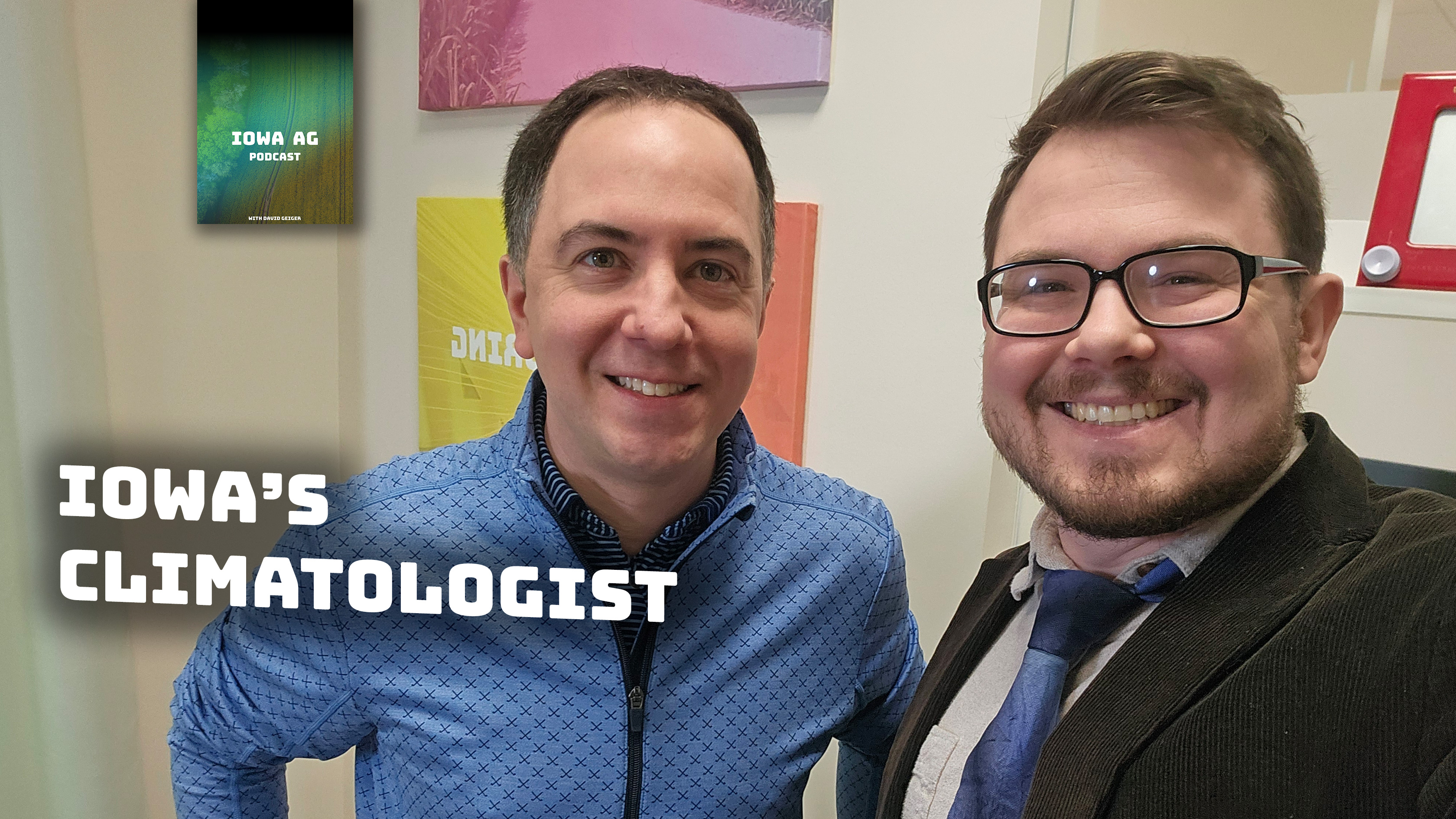


Dr. Justin Glisan, Iowa’s state climatologist, discusses how weather and climate data shape agriculture, infrastructure, and public safety across the state with David Geiger.
Glisan describes the role of the state climatologist as the custodian of Iowa’s 153-year climate record, providing historical context and scientific analysis to help Iowans understand both past and future weather patterns.
Scientific discussions and balancing politics
A key theme of the conversation is communication. Justin explains how he works with farmers, legislators, and the public by providing data rather than directives and encouraging dialogue instead of talking “at” stakeholders. He also addresses the challenges of discussing politically sensitive topics such as climate change, water quality, and extreme weather, stressing the importance of science-based information and transparency.
Hear from Iowans directly. No algorithms.
Don’t let the algorithms choose your news. Enter your email address to hear directly from Iowans leading news in politics, community, agriculture and business. No editing. No clickbait. No rage. No agenda.
Frost Depth in Iowa Agriculture
The discussion covers recent winter conditions and frost depth, explaining how snow cover, soil moisture, and temperature influence spring runoff, infiltration, and drought recovery. Justin explains how Iowa’s relatively shallow frost depth this winter compares to years with deeper freezes and why these differences matter for both farm fields and urban systems.

Geiger and Glisan also explore long-term trends, including Iowa’s recent stretch of historically warm years, changing snowfall patterns, and the increasing concentration of precipitation into fewer, more intense events. Justin emphasizes that climatology relies on 30-year averages and robust datasets, cautioning against drawing conclusions from single extreme events without enough context.
The episode concludes with Glisan vision for the future, including stronger interagency collaboration, improved soil moisture monitoring, and continued trust in scientists whose mission is to protect life, property, and Iowa’s agricultural productivity.
Interview Transcript
This transcript was created with help from Ai. Please report errors to us and always refer to the video as your primary source.
David Geiger: Welcome to the Iowa Ag Podcast. I’m your host, David Geiger here at the Jet Roses Barbecue Studio. Thanks for joining us, and we’re gonna take a look at weather and how that relates to agriculture and urban America as well. Joining me is Justin Glisten. He is. Well, Dr. Justin Glisten, he is the state climatologist of the Iowa Department of Agriculture. Justin and I have spoken many times over the years, and it’s a real pleasure to have you here on the IAG podcast. Dr. Justin Glisen, could you describe what the state climatologist’s job is, just as a quick introduction?
Justin Glisan: Well, first of all, nice to be with you David. Um, state climatologist, there are. Uh, 49 of us, we view ourselves, I think as the weather historian for our state here in the state of Iowa. We have 153 years of records. Precipitation temperature shows us the history of the state agriculturally, but also what weather was behaving back in the 18 hundreds to where we are now, and then projecting those trends out into the future. To help people like our farmers and producers, but also the general public with weather and climate information as we speak. We’re in a cold air outbreak. Uh, people get a, people ask questions about, when’s the last time we’ve seen temperatures like this? Is this a new normal? Will we start to see more cold air outbreaks? How is this impactful? During the winter time for agriculture, are there any impacts? Uh, can we see drought improvement or degradation with the precipitation we get in winter? Uh, so basically you look at my day, no one day is the same as the previous day. I do a lot of, uh, litigation. Uh, observation certifying for slip fall cases, car accidents. Also work with our pesticide bureau on drift cases, uh, and then do a lot of speaking, particularly in winter with winter meetings. Uh, looking at the seasonal outlook, so providing. Uh, scientific information to our sectoral, uh, stakeholders. The legislature’s currently in session, I speak with them often. Uh, so wrapping all of the weather and climate information and then producing products that people can use, uh, that are practical, uh, for their operations, their farms, uh, x, Y, and Z.
David Geiger: And that’s the area I’ve best known for You, known from you? Uh, some of those I had never heard you talk about before. That’s extremely interested. You said 49 total, or 49 others?
Justin Glisan: 49 Other. Well, okay,
David Geiger: F1 per state for sure. I was like, is there a state that doesn’t have a state
Justin Glisan: Currently, Arkansas does not
David Geiger: Oh, right,
Justin Glisan: um, uh, so there’s an ebb and flow of state climatologist. My predecessor, Harry Hiller, was the oldest at the time of his retirement in terms of tenure as a state climatologist. So I was the youngest coming in and in fact, you were my first interview. Uh,
David Geiger: yes. That was ex an extreme, uh, honor to have, honestly. And, uh, I, I had spoken with Harry many times and I was really sad to see him go, but I was like, I would love to talk with the new guy if he’s available. And Justin was just so easily accessible and I really appreciated that.
Justin Glisan: Absolutely.
David Geiger: Justin, when you spoke on some of the details that you have to work with, I think of just as a another way to just introduce what you do for the state and how it relates to agriculture is a topic we talk about very often this time of year, January, is that. Frozen depth, um, level in the soil, which can affect many things over the course of the spring. Where are we at in terms of that? Just as a way to talk about what you do and we can relate it to how that then affects rural and urban America.
Justin Glisan: Yep. So, frost depth, you’ve summed it up pretty well. Uh, we think about how deep the soil profile freezes in winter, and we had the fourth snowiest November, just on the last two days of November across the state. So we had snowpack on the ground. Insulates the surface, doesn’t allow colder air to get into the profile. So as of, uh, early January, the frost step was about five to seven inches. Whereas, uh, you think of last year at this time or the year before, frost depth is anywhere from 18 to 24 inches. So we’re approaching, uh, two feet of frozen soil. Why that’s important is the deeper the frost depth, the more time it takes to thaw that profile. So if we do get precipitation events. End of winter, uh, early spring, we’re more apt to see runoff versus infiltration. Now, with a lack of snowfall on the ground, we’re in a snow drought across the upper Midwest. With this arctic air intrusion that we’ve seen over the last several days, we’re going to increase that frost step, uh, probably 10, 12 inches right now. Now, that’s not exceedingly deep. When you compare to other years in which we’ve had a frost depth of 24 to 36 inches, we think of the may. Uh. A March, 2019 bomb cyclone event, a frozen profile, basically concrete snow on top of that rain on top of that epic flooding in southwestern Iowa. Overall, if you look at where we are now, our soils are generally a little drier. Southern Iowa, Eastern Iowa, those drier soils do freeze deeper and faster. But if you are looking at the outlooks, we do see a trend towards warmer temperatures getting into February, so we could see at least some shallow frost step thawing.
David Geiger: I think too, we also just had a warmer early start to winter, at least observationally. From my perspective, it feels like it was very mild up to just the last couple of weeks in terms of the exceedingly cold weather we’ve
Justin Glisan: sure. So de December was about a degree below average, not extremely cold. Uh, January. January, we were running six degrees above average prior to the outbreak Last week we’re about three degrees above average, still with this cold air. So we have been running warmer. Uh, it was the 25th warmest year on record. 2025. 2024 was the fifth warmest year on record. If you go back five years, the warmest five year stretch. In the observational records, so we have been running warmer.
David Geiger: Wow. Wow. I think of what you just said there, where we were running six degrees above and now we’re only running three degrees, and that’s another side of this topic that co, you know, it’s so broad. It covers so many parts that is just statistics and how they work, how there’s outliers, how there’s trends, how there are multiple factors when it comes to how you can observe the data, and then how you can interpret and communicate the data. What’s your philosophy? When describing and talking about
Justin Glisan: science-based, science-based facts, so we think of climatology as a 30 year average, the last full three decades. So their current climate decade is 1991 to 2020. This gives us an averaging period. It takes several cycles of El Nino, LA Nina, other climate patterns in the Pacific that impact the weather over the United States. So having a 30 year period then allows us to compare events that we’re seeing currently. Uh, are we ap, are we going to see more derecho? That’s a question I get asked often. Um, are winters the fastest warming season? Yes. What are the implications on snowfall, rainfall? You look at the last 30 years. The deficit of snowfall in winter is about five to 10 inches. However, when you look at weak LA Ninas, which we’re currently sitting in, we generally see about six to eight more inches of snow. So we’re filling in that 30 year deficit. But overall, the climatological information that we use is statistically based. Uh, so it’s hard to argue with. It’s purely scientific, it’s observations taken from the National Weather Service in our Coco Raz gauges. Uh, so. Overall, when I talk about climatology or weather information, it has to be science-based because people depend on it for their livelihoods.
David Geiger: Something you mentioned there in terms of you can’t argue with it, and I agree with you completely, but an issue with statistics is it requires some level of information and education in order to understand why you can’t argue with it. Because if we take it from an anecdotal perspective, statistics often don’t make sense, right? If you roll a handful of dice, you know, the odds are if I roll six, six sided dice, it’s gonna be 1, 2, 3, 4, 5, 6. And we know sometimes it could just be all ones or it could be all sixes or it could be a couple twos. And that really messes with our concept of how to expect things. How does that influence you and how you communicate with
Justin Glisan: Sure. So you think of the seasonal outlooks, those are probabilistic, they’re giving us a probability of being above or below that 30 year average. Now you have to have a robust dataset to have pure statistics or statistics that are robust enough that they’re, they can’t be argued against. If you take the August 10th, 2020 derecho, the the costliest severe thunderstorm in the United States history. Try to draw a trend out of that. Sta statistically doesn’t work. Broader data set is needed to tell us statistically if we’re going to see more derechos, for example, into the future,
David Geiger: because we had a while where there were no
Justin Glisan: derechos. Absolutely you would have to go back previous to that 2020 derecho back to 2013. But since that derecho we’ve had seven. Uh, so is it ebb and flow? Are we seeing a new trend towards more straight lined wind events? We don’t know necessarily there’s a specific definition of derecho, but overall, when you talk about statistics, you’re also talking about probabilities of an event occurring. So there’s all kinds of math that goes into our analysis. We can be wrong statistically. That’s why having a more robust data set, that’s why I, when I go do my winter talks or talks around the state, more rain gauges are needed. More weathers, uh, data is needed to produce a more robust. A temperature and precipitation record and that way my successor and successors down the line will continue to add to the history of weather and climate here in Iowa. And luckily as the state climatologist, I’m custodian of those records. They’re the state of Iowa’s records, they’re the general public’s records, uh, but I luckily get to take care of them.
David Geiger: And you do a great job. We know when it comes to weather, oftentimes there’s a general bad rep with meteorologists because folks believe it’s trying to predict the future or saying science can tell us what’s. Coming. But oftentimes, as you just described, it’s more saying, here’s what we know. Here’s the information we have, and this is what those tend to do. And so it’s less of predicting the future, but more interpreting the past?
Justin Glisan: Yes, absolutely. If you could interpret the past and put together, uh, a data set that can, uh, statistically be pushed out into the future via trends, we have, uh, statistical downscaling that we use for climate modeling, uh, that’ll give us a better idea of what we’ve experienced in the past because we can run those climate models backwards if we run those climate models backwards and we’re able to. Uh, produce extreme events that have happened in the past, then we know that the atmosphere that those climate models are producing is physically realistic. We can run those out then, uh, out seasonally, out yearly, out to the end of the 21st century. Give us an idea of the large scale setup in the atmosphere that can support various. Weather events, whether it’s, uh, winter storms during the cold season or severe thunderstorms during the warm season. But yes, having, uh, the interpretation and an analysis of previous events gives us better tools to address those events in the future should they happen.
David Geiger: I think it’s important to bring this up as your specialty is the weather and meteorology. Because when you compare it to agriculture, there are a lot of similarities. There’s just a general, perhaps misunderstanding or a lack of communication of how things work and why they work the way they do. And when you combine them, there are even conflicts in between the two in terms of how much rain. Land can expect to get what soil moisture profiles can be, what level of heat units per day we get during the summer, and how that affects everything thereafter. When you are talking to the folks in the farm community and the folks you know at the capitol, what, how do you differentiate the, the way you speak with them? Or do you, is it the same to everybody?
Justin Glisan: Talk with them. Don’t talk at them. That’s my, uh, modus operandi. We, we have a lot of data. We have a lot of facts, but. Depends on the production. It depends on your soil type, it depends on your, your farming methods. I provide the information and the data to policy makers, hopefully, uh. We get good policies out of it. We talk about the Iowa Drought plan. We, uh, 2020 through 2024, the longest drought since the 1950s, record yields in 2021 and 2022. So the science has really kept up with our hybridization of seeds, for example, to combat drought and wetness. Now, if the trends hold true, we’re going going to see drought and wetness into the future, and it’s going to be more persistent and perhaps more pervasive. So when I’m talking with and not at Farmers, I want to know what their production is based on. I wanna know what tools they use, what they’ve been successful with, what they haven’t been successful with Climate Services is, is is the production of data to produce better results for the sectors. And in here in Iowa it’s agriculture. So being in the Department of Agriculture, I learn something every day about our farmers, how resistant and resilient they are in terms of the weather extremes. But I also get a lot of great questions from them. Also, a lot of good feedback when we talk about the US drought monitor depiction. If that map is not reflective of the on the ground conditions, the state and federal programs that rely on it, and the monies that come out of that. Aren’t gonna be helpful for those farmers. So eliciting feedback from our farmers and legislators and general public is one of the perks of my job because I get to talk with a lot of people
David Geiger: trying to take it from a. Human perspective and, and just you as a person, right? I can also imagine that there would be a lot of pressure in a position like this. You’re dealing with many developments that could destroy someone’s livelihood or homes or even lives, and. I wanted to just ask, do you feel any pressure or feel like people put a lot of pressure on you when you take the data, the numbers that you see, and try to apply it to real life? And do you feel that’s fair?
Justin Glisan: I have a thick skin. As a meteorologist, you have to have a thick, thick skin, particularly on tv. Now, I do some TV interviews. Uh, what I take personally is the impacts that happen to people. Uh, and as meteorologists, we’re trained not to take things personal, but whether impacts everybody. And when you think of like the green. Field, EF four, in the loss of life there, any loss of life is devastating. That’s why we exist for the protection of life and property, national weather service, climate services, anything that we can do to alert the public to impending, uh, disaster. Uh, 40 minutes of lead time for the greenfield tornado saved hundreds of lives potentially. Uh, so don’t take it personal. Of course, you’re gonna get calls, you’re gonna get mail. I get. A few ever so often here and there. Uh. I’m buttressed by the amount of, uh, positive feedback that I get in terms of the, the things that I put out, but also in general, the collaboration that we have with local, state, and federal partners in the climate services, whether it’s the USDA Climate Hub up in aims, the Midwestern Regional Climate Center, our National Weather Service offices. So we’re a team and. Much like insurance. The bigger the pool, the easier it is. Uh, and, um, being a one person shop leveraging the collaborations I have with my partners, uh, makes my job ideal and I can’t imagine having a better job.
David Geiger: Well, I want to know. I have, I want you to know that I have very appreciated you and, and the way you communicate over the last 10 years. So, so I, I want to make sure I say that, uh, because I, I want to do kind of the, the tougher questions back to back because there’s another side to weather, specifically how it impacts agriculture that. Is difficult to, to contend with because it gets political. Now, I don’t want to talk about specifically political things here, but we know that there are issues that people don’t agree on. Like climate change is a big one. How water flows and potentially adds nitrogen into water supplies. This is not, is our two that just are very difficult to talk about because people have very strong thoughts on them. How do you approach that as someone who is here to be an objective speaker for the people of Iowa?
Justin Glisan: Again, science-based information. So of course our climate models, they can project out, uh, several years, several decades into the 21st century. We can use that as large scale guidance on what potentially we can see in terms of extreme weather events. What we can say for certain is we’re going to see extreme weather in the future, and potentially it could be, uh, more, uh, pervasive across the upper Midwest. We also know that we’re, uh, seeing 40% of our precipitation on 10 days a year. Okay? So we’re really frontloading the amount of precipitation within a smaller window. Uh, so my responsibility and the responsibility of other state climatologists and atmospheric scientist. Is to produce products and then give this information to our farmers so that they’re better prepared for these extremes. Now, of course, you can, uh, you can push back on climate change. You’ve got a lot of people out there that put, uh, sexy headlines out for clicks. My background at Iowa State was building climate models and, uh, they do a really good job now. Uh, we talk about, uh, flush events that, that we just saw in, in January because of a warm and dry fall, and then a wet, uh, end of, uh, December, or what, December, I should say. We’re going to see those in the future. That’s just, uh, it’s built into the environment. What we can do is help mitigate these impacts, whether it be saturated buffers that we talk about at the department, uh, no-till cover crop cover crop practices that increase soil health. They increase carbon se sequestration, but they also. Enhance the water holding capacity of the soil profile. So when we do get into more persistent droughts, which we project out into the future, the soils are able to hold onto that moisture for a longer period of time. So to wrap that up into a nice, uh, package and put a bow on top of it. when we talk about changes in the climate system, we are seeing those impacts. More straight line wind events, more hail events. We had the emergence of southern rust, something we haven’t seen in the corn belt because of anomalous flow off of the Gulf in July, the second wettest July on record.
David Geiger: I’ve, I heard five or six different events coincided at the same time to bring what happened about,
Justin Glisan: yep. So it’s a ba, a Black Swan event, but when those events do occur, those ingredients come together and we’ve seen that more often. We talked about the August 10th derecho event. We talk about the December 15th, 2021 tornado outbreak, another serial derecho across the state, 63 tornadoes. So what we are seeing in the trends and what the climate models have showed us in previous decades is an increase in instability in the atmosphere, more thunderstorm activity in winter. Those are the types of trends that we track, uh, based on scientific information. Again, scientific information is what we use on a daily basis to get this information out to various sectors.
David Geiger: I like how you described it as wrapping it all up, putting a tight little bow because I could easily talk to you for an hour of what, I have dozens and dozens of forever questions. I often approach these interviews where I, I don’t have any prepared questions that happen today, and so I just, I’m like, oh, I wonder what that’s like. And I think a way to just conclude or, or go towards the end of this conversation, I want to just approach. What you think is important as a, um, civil servant of Iowa, what would you like to see as the state climatologist for Iowa in the future? Whether it be manpower or uh, communication or broad education, what are you looking at when you look at our current situation and how people approach information that you use and you go, man, it would be really nice to just work towards that. Or, or that would be something, it could even be something that everyone is working on,
Justin Glisan: I think the Iowa Drought play in. Is a, a good distillation of what state agencies can do. This was a collaboration from the, the Department of Natural Resources, the Department of Agriculture, a Department of Homeland Security and Emergency Management. We wrote this over 15 months. We wrote it. To have a, uh, a single basis, a matrix in which communication across state agencies would be more effective in terms of a pervasive drought when we could see crop losses like we did in 2012. So, if I had a wishlist for what, uh, we could do better across the state is trust our scientists, trust our National Weather Service forecasters. Uh, they’re there to protect life and property. They’re not there to be rich. They’re not there to be famous. Uh, they love their jobs. Uh, there’s a lot of pushback in this current climate. Uh, we’re here to help. We’re here to produce the best information based on the best data that we have right now. Now, in terms of looking at it, future projections, you can take that with a grain of salt if you like, but what we’re trying to do. Prepare people for extreme events in the future because we want them to be productive. We want them, mental health is a huge issue with farmers across the state and I, I think about this daily, and I speak with farmers Daily that have, you know, they stress out about things that are beyond their control. We have been talking for 25 years about the potential for a dust bowl in 2025. Never happened. We, we had a, a mud bowl. Wettest a very wet sixth wettest summer on record. So providing the best information, communication amongst groups that may not always agree with each other. We’re here for the common good of the state, and as a an employee of the state of Iowa, I take my role seriously and I know that taxpayers fund us so. That’s where I see, and I still get goosebumps when I drive to the capitol each day because of the people I serve and the state that I serve. So just have, give us a little grace when we talk about things that you don’t necessarily agree with, you can push back and I’m happy to provide information that might be a little more informative. Um, and, and one other thing that I have on my wishlist is a broad scale soil moisture monitoring network for the
David Geiger: There we go. Yeah.
Justin Glisan: Which will have impacts on drought and wetness in the future.
David Geiger: Dr. Justin Glsen is the state climatologist for Iowa with the Iowa Department of Agriculture. Thank you so much for joining us. It truly is always a pleasure talking to you.
Justin Glisan: one of my favorite interviews. Thanks, David.
David Geiger: again, I’m your host, David Geiger. Hit the Jet Rows Barbecue studio. This is the Iowa Ag Podcast. Thank you so much for joining us again, and I’ll see you again next week.