

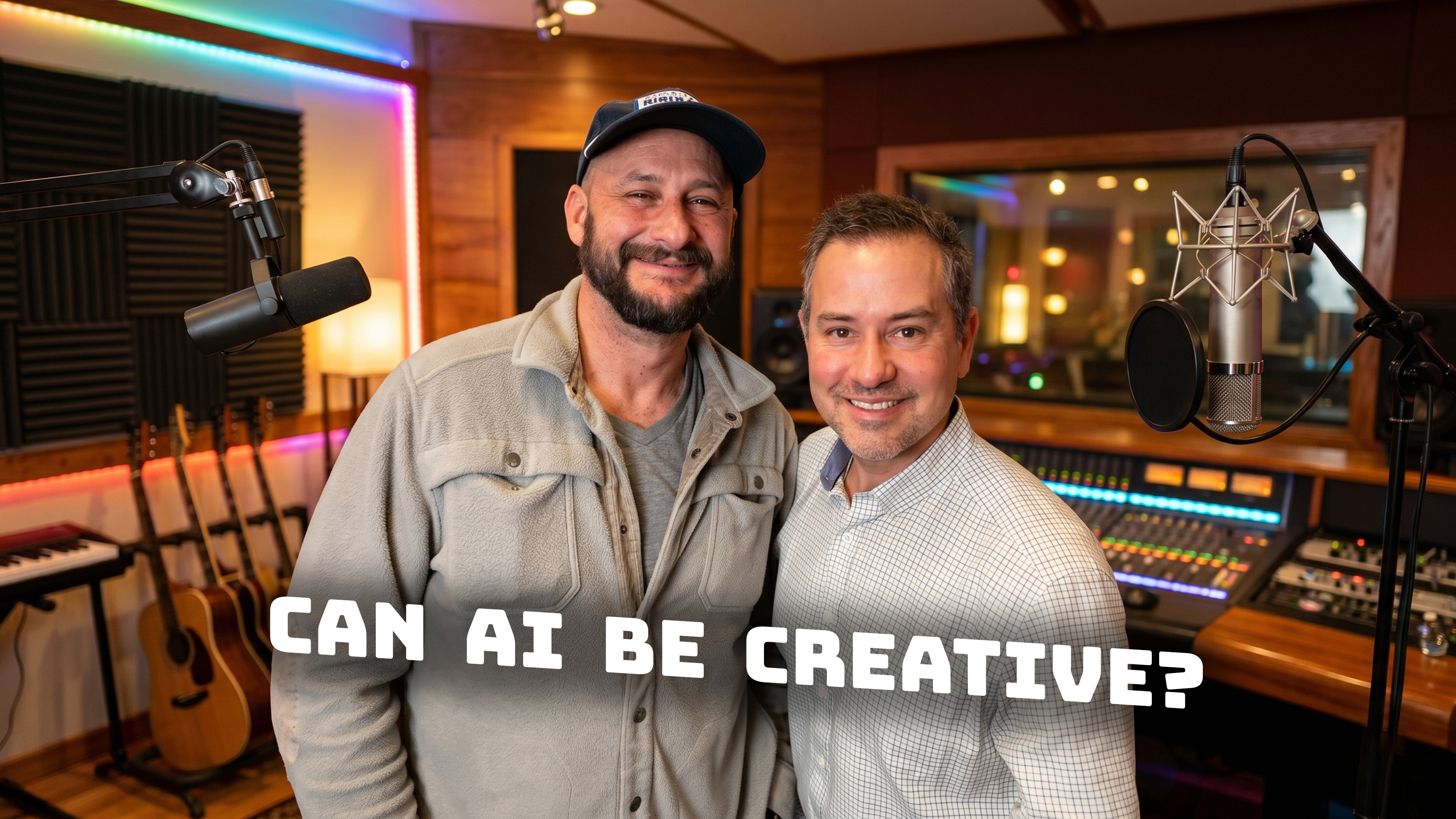


While AI is an incredibly sophisticated “copy paste” tool capable of replicating patterns, can it close the biological “last mile” of creativity that defines true artistry? Tony Bohnenkamp of The Canary Collective, and former member of The Nadas discusses the creative process of composing original music for Kreg Tool. Music requires emotional depth and intent that algorithms cannot simulate. Can Ai experience a rough morning, a personal life event, or a breakup? Can Ai truly replicate the human moods that spur iconic, classic songs?
Hear from Iowans directly. No algorithms.
Don’t let the algorithms choose your news. Enter your email address to hear directly from Iowans leading news in politics, community, agriculture and business. No editing. No clickbait. No rage. No agenda.
The conversation highlights a shift where creative professionals must learn to use AI as an assistant to handle mundane tasks while focusing on the high-level questions that technology cannot answer. Bohnenkamp believes that knowing how to phrase prompts based on professional experience is what will separate seasoned creators from those who simply use AI to “start a podcast”. Ultimately, he views the human experience as the indispensable 20% of work that makes a project great, ensuring that true artists remain a distinct and necessary force in the industry.
Our Partners!
🩺 Subscribe to Hy-Vee Health Exemplar Care
🌾 Watch The World Food Prize Podcast
⚖️ Hurt on the job? Get Nate Boulton’s help
Interview Transcript
This transcript was created with help from Ai. Please report errors to us and always refer to the video as your primary source.
Justin Brady: Real eye ones, real talk. No drama. This is Justin Brady from the Jethro Barbecue Studio and ai. Okay, we’re, we’re talking a lot about ai, but I promise there’s this. AI has been in the news quite a bit, but. Here’s what you don’t know about ai, or at least this is my estimation and my guess. I think AI is actually going to give human, creative people like the creative part of your brain, more ability to flex its muscles. I think creative people who have creative skills are actually going to see more at. And more business and more work because of ai. I know that sounds weird. I know you think AI is creative. I can assure you it’s not. I can also assure you, I know more than you on this. Anyway, uh, Tony Bamp joins us, a musician and of course the owner of the Canary Collective, who is a musician, and you just did a really cool project with Craig Tool. Of course, locally owned Iowa Companies. Congrats on that.
Tony Bohnenkamp: Thank you. Welcome Thanks Justin. Great to be here. Great to meet you. Great to be a part of a cool podcast.
Justin Brady: Yeah,
Tony Bohnenkamp: I’ve never been on a podcast before, so this
Justin Brady: Definitely paid him to say that. Um, the,
Tony Bohnenkamp: the in jet rows,
Justin Brady: jetro
Tony Bohnenkamp: I get some of the free food. Yeah, exactly right. They have the best
Justin Brady: free food from Jethro’s?
Tony Bohnenkamp: I’m saying because of this I’m gonna give
Justin Brady: Oh, yeah. Well, they are our sponsors. So Jethro’s people give Tony free food. There we go. Uh, Jethro’s of course is our sponsor and I’m a chicken wing fan. I just go eat them by the truckload over there and you’re shaking your head over there. You’re a chicken wing, not
Tony Bohnenkamp: Uh, I am, no, I am, and I’m saying I can’t eat truckloads of wings. I’m like, six to eight is my max, so I’m with
Justin Brady: this has already gone off the rails, everybody, but,
Tony Bohnenkamp: as a fellow audio nerd, I have to give you props for your 64 audio earphones. I have some myself. They’re the best I’ve
Justin Brady: this is what he’s referring to. Now this is interesting because this actually gets into what the topic will be, but, um, like. Kind of a weird intro. Yes, but also very like orga, very natural, very authentic feeling. This there I’m gonna make, I’m gonna connect all these dots for you. Before I do that, Jeff Rose Barbecue. If you scroll to the top of Iowa podcast.com, there’s a little banner up there. If you buy a hundred dollars gift card, they will give you a $30 gift card for free. And you can eat a truckload of chicken wings that our guest doesn’t want to eat. But you can have a plate.
Tony Bohnenkamp: full, oh, no, no, no, no. I want to eat them. I just don’t want to eat a hundred of them. And I will say Jethro’s, in my opinion, has the best wings in town.
Justin Brady: So here’s, this is interesting setup because you can always tell a musician, by the way you interview them on a podcast, they’re a little bit more comfortable. They’re a little bit more like off the cuff. They’re a little bit clever and quick witted. And so
Tony Bohnenkamp: it’s a lot of pressure. It’s
Justin Brady: a lot of pressure. It’s a lot of pressure. This, this show better be good. But, um,
Tony Bohnenkamp: It’s gonna be good. As far as you’re concerned, this is the, this is where the, the, uh, I haven’t had This is where the, the, uh, X on this side of the table. So you’re gonna be
Justin Brady: just fine. So actually I’m gonna, I wanna ask you about the Craig tool project. it’s really cool, any Iowans know what Craig tool is. You did this, uh, project where you composed music for them. But actually before I get into that, I wanna, I wanna take things a different direction and we’ll get, we’ll get back to our regularly scheduled programming, but. Do You think this kind of exchange, this kind of quick-witted behavior, this type of just, uh, authenticity, do you think AI will ever be able to replicate this kind of stuff? And I should say for those that don’t know, you’ve also been like a local musician with the Nadas, you compose music and so
Tony Bohnenkamp: play Live shows.
Justin Brady: Live shows, if anybody recognizes the name. It may have been your time with the Nadas, it may have been some of the work you’ve done, but do you think AI will ever replicate the human creative? Process.
Tony Bohnenkamp: Well. Um. I think that it already is in certain ways. I’ll tell you, I’ve seen the commercials for chat, GPT. Mm-hmm. Okay. Um, and they’re the ones where they’ll input a question and then chat. GPT will have witty, well composed response. Like, good for you. Reaching for the stars, let’s take it, let’s take it home. You know, and then it lists off like an exercise program or a, you know, a way to save more money or whatever. And then at the end it’s like, follow these things and you, and I’ll be in the Hall of fame. And so if that’s legit, like of course they had plenty of time to come up with this commercial and the copy and all of that stuff, but like, if that’s the way that chat GPT is interacting with people already, I feel like being able to be, you know, if, if. There’s already, like my wife works for, uh, I dunno if I’m supposed to say other businesses
Justin Brady: You can say any, I dunno, we don’t
Tony Bohnenkamp: works for the ITA group, west Des Moines. And they have, uh, Microsoft copilot, I think it is. Yeah. And, um, that’s specific for their line of work. So as AI becomes more popular know, all encompassing, I think that it’s to develop those things just because information that like, here, let’s put in a. Let’s put in a, uh, uh, comedy set by, by, uh, Matt Rife who’s all crowd work or, you know, whatever. Um, and then it analyzes how he responds to audience interactions builds that tool in its toolbox. I know nothing about AI except for, um, I have this. Thing my wife got me for B computer. Mm-hmm. It’s a little wearable thing. Okay. And it’s got a button on it where you can click it and it will record all the audio and then through a companion app that is free. It will funnel it all down into key points, actionable items, things like that. And so. Um, as you may be able to tell when I start talking about ai, start going in 50
Justin Brady: Mm-hmm.
Tony Bohnenkamp: I do think that it’s gonna be able to do, um, a lot of things like quick witted, comeback interactive, like personal level wanna call it. Um, because it’s, it’s, uh, it just seems to be. Galloping into different parts of our lives and the zeitgeist, um, in ways that nobody could have even imagined. know? Yes. Do I want. AI to figure out how to cure cancer. Absolutely.
Justin Brady: Mm-hmm.
Tony Bohnenkamp: along with that, it’s probably gonna take some of my work away know, medical and composing, or music in general, travel or all the yeah, I, I am, I don’t wanna say that I’m scared of it. Because it’s here and everybody’s just gotta get used to it. Um, I’m looking forward to the ways that I can use it. like if I’m, for instance, I just composed a song for a hamburger company in San And I have not used AI for yet, but I had a prompt typed up in my, you know, I’ve got with the, with the B computer, it’s a prompt I almost hit sand, but I’m like, Nope, I need to take another whack at this myself. But I can see a point where that’s my go-to. Like right now, my go-to rhyme zone.com. You type in a word and it gives you every rhyme, every near rhyme, every, everything. Ab, it’s, you should look it up. It’s insane.
Justin Brady: That’s crazy
Tony Bohnenkamp: accurate too. Like you can’t even believe this quick, how it comes up with that stuff. But that, I feel like that is gonna be the next rhyme zone for me. And it’s just about getting, like I was the guy that didn’t get the iPhone for Then I saw how awesome it had a camera on it. I’m like, I don’t need a phone with a camera on it. I’ve already got a camera and now my phone does everything. I’m the guy that like just figured out how to. Get the 12 o’clock to stop flashing on his VCR last this is, this is
Justin Brady: interesting. I wanna go back to something you said though. ’cause you mentioned you are a little concerned about ai. Kind of impacting your job a little bit. Do you, do you see it happening already or was it just a fear? You do. How do you, okay, so how do you see AI impacting your job as a musician here in Iowa
Tony Bohnenkamp: Let me ask you this. Are you able, and you could edit this out or whatever, are you, if I set you, if I gave you two different clips, song clips, is there Absolutely. I have a song that I did, I’ve released my only record I’ve ever done on I released in There’s a song in there called All Falling Apart. And unbeknownst to me, the first manager of the nadas when I was in the band has done a few different things career wise, but now he’s working on music in Nashville and he sent an AI version of that song from my album. And it was like an, it was like a, it was like an ika, badoo like. 80 Soul
Justin Brady: And you mean it, like took your song, ripped it off, and redid it in a different way? Kind of. Yes. Okay.
Tony Bohnenkamp: Yeah. And when we’re done, I can play the two for you so you can see what I’m
Justin Brady: We’ll put ’em on the website for sure. Yeah.
Tony Bohnenkamp: But, um, and I mean, it is. Super cool. Like it’s so cool, and I can’t even believe that he was able to just feed that song. And I’m sure that he did some prompts and stuff. Yeah. But like, I can’t believe that it took my, it changed some of the words. It changed some of the chord progressions. But it is just, it’s like this Sade. Slow jam thing that is so freaking, I still listen to it all the time, even though I’ve had it for a month. But cool. And so I, sorry. Um, I, uh, he, he sent me that and I listened like, hold on absolutely crazy that it was able to do that with the song. ’cause my song is like a, I’m so My song’s like a, I would say it like, like maybe like daury type
Justin Brady: Mm-hmm. Mm-hmm.
Tony Bohnenkamp: Um, but this is like, it’s just so cool. That’s all I’m gonna say. ’cause it’s just, it’s very cool. But
Justin Brady: it is interesting because AI is an extremely good, what’s the word for it? Uh, copy paste. Yes. I tell people, ai, if you don’t understand how AI works, it is an extremely sophisticated copy paste that works through all media so it can hear, it can hear patterns, video through video, through text, through audio, and it can replicate the patterns. But that’s where it Um, I think people naturally see pattern replication and they’re amazed because we learn pattern replication in school. Yes. And we’re taught that pattern replication is intelligence. Um. In my opinion, pattern replication is a type of intelligence, but it is not intelligence. And this is where I think the conversation diverges because, um, people look at, Ooh, the AI copied that thing, therefore it’s creative. I’m like, is it really creative when something can copy something? I would argue no. I would argue that is not creative, that is a part of creativity. But the ultimate holy grail of creativity is to bring something new into the lexicon or bring something new into the art world that people are like, wait, what is that? Exactly? You know? And so
Tony Bohnenkamp: like that then the AI learns
Justin Brady: yeah, can, can AI replicate the Beatles song? A Beatles song absolutely should, shouldn’t have any problem. Can an AI create. One of the Beatles songs, right? I would argue No Chance in Heck would that ever happen? And so this is my question is, is AI going to disrupt artists or is it going to disrupt the people who copy the
Tony Bohnenkamp: art? Um, I don’t think ai, I’ve never thought about it that way. I don’t think AI is going to be a threat True artists because I think as you well know, there are plenty of people who are artists and And sometimes people can’t tell the difference because the posers approaching take something that the artist has and you know. Times
Justin Brady: Right?
Tony Bohnenkamp: um, to really stand out. But everything goes back to original artist. Mm-hmm. And you can, I feel like with true artists, you can see the difference
Justin Brady: Yeah.
Tony Bohnenkamp: And so I think your point, it’s a good point that it’s, I. don’t think that it’s going to threaten true artists. I, and I also think it’s going to make the posers a strong word, but I think the, the, the want tobe artists or whatever. Yeah,
Justin Brady: whatever. Yeah, whatever you wanna
Tony Bohnenkamp: it’s gonna make them think a lot more about what they do.
Justin Brady: Right. So is this like, when is this how the industry’s going to change? Like I wanna talk about the Craig tool thing, because when you initially posted that I was initially. Happy about it. Like oh, that’s a good move. But also surprised cause I was like a local tool company that makes like they’re hiring artists now to compo. What? Like that, I mean, my day, and this was like, you know, when I was doing marketing like over a couple decades ago when we did ads or when we did videos, we just bought stock stuff. Yeah. We’re not gonna pay the
Tony Bohnenkamp: Well and a lot of people are still doing
Justin Brady: Yeah. And so, but I was like, a local company is hiring someone to compose a song. Is this like a new thing? Are people starting to reach out to you now to compose music for, is this like a new trend happening?
Tony Bohnenkamp: Not really. No. I mean, I’ve all, here’s the, here’s the thing that goes along with what you ev all, most everyone does the stock music route, And so I’ve had a few things here and there, um, that people have asked me to do or that I’ve solicited, like, Hey, I can do this. I’ve never said it, that I can do it better than. What you already have. ’cause I feel like that’s kind of a slap if you wanted, because a lot of times you’ll hear a but you’ll hear it in seven different ads. Yeah. You know, like there’s a Toyota ad and for, Depends, undergarments or whatever. there, but 54.
Justin Brady: There are ads like
Tony Bohnenkamp: you see the, you, you hear this music, it’s the same, literally the same song. And you know that they all got it off of a stock
Justin Brady: right? Service. Yes. Yes.
Tony Bohnenkamp: now they offer subscriptions where you can have our whole catalog for $15 a
Justin Brady: Right.
Tony Bohnenkamp: And so that is the. Definitely the easy, and especially for small businesses and you know, even some large businesses don’t really give a crap about that stuff, um, they’ll go that stock And what I, what I tell everybody I offer is that when I do a song for you, nobody’s ever gonna have it. Nobody’s ever gonna have a different version of it ever again. It’s yours to do with whatever you want. You can put it in a thousand ads. You can have it be the flash page music on your website. Send it out the door to you and it’s yours for And so the stock music sites, as you well know, you have to tell ’em how often you’re gonna use it, what length of
Justin Brady: Mm-hmm.
Tony Bohnenkamp: what you’re gonna use it for, all of those things. And then they. Put that into a calculation and, and tell you how much you have to pay for it. Oh, and by the way, it only lasts for a year. you know, that ad that you have our music in that has to come down in a year because that’s your subscription runs out This is yours forever, and no one else will ever have it.
Justin Brady: Right.
Tony Bohnenkamp: But AI is the same way. You know, you put the same prompts into three different AI bots and they’re all gonna whip out three different versions of stuff. And so, you know, if an AI service costs $5 a month or if advertising. Paying creators to come up with stuff is cost prohibitive because you’re putting money into other things, or you’re a small company or then that’s the good way to go. What I try to do is I try to find out what they were gonna pay and then try to come in somewhere in there without like giving
Justin Brady: me about the process when you worked with Craig Toole. Yeah. Uh, go ahead and adjust your pop filter there too, that way. ’cause anybody listening to pop filter keeps the air from getting into your ears and hurting your eardrums. Um, but tell me about the process with Craig Tool a little bit, because it’s not like they just call you and say, create, create a song for this ad and then that. Um, and I think the creative process is very, very important for people to understand. This sounds like getting in the weeds it, but I think it’s really, really important for them to understand how this process actually works. So from the time they say, Hey, we want you to create some original music for this ad. Go, what does that look like? What does that involve?
Tony Bohnenkamp: So I personally, when it comes to composing music, I love being in the weeds. Like, I love spending an hour trying to find exactly synthesizer sound Um, so I was contacted by them that their creative director used to work with my He knew that I did this and he said it wasn’t anything like, Hey, we’re thinking about this. We’re thinking about this, but we also whack at it. They came in and said, we want a local musician to create some music for And so I always have an initial list of questions, um, like are there lyrics or is it instrumental? Are there certain instruments you want used? Like, you know, say somebody wants some congas and bongos somebody wants an electronic drum kit instead of like a drum kit you see Um, send me three examples of songs that you would like it to sound like. Uh, are there any key marketing words or phrases that you want included in the how long does it need to be? How many different versions? Like for Craig there, they had four different, it was for an Amazon ad There were four different, uh, lengths of cuts. There was six 15 seconds, 30 46 So, you know how many, what, what are the different lengths or how long do you need it to be? What instruments do you want in there? Um, know, is it fast or slow? All those different kinds of things. And then after I get that kind of paired down a little bit, I usually come up with three different ideas and send them to them and ask ’em to pick the one that they liked the best. This one, they liked the first one that I sent Um, and in this case, they wanted something that was kind of like. Modern And so they really like songs that have like the stomps and the claps woo woo woo stuff at the beginning. Not actual words, but just like noises
Justin Brady: Yeah, yeah, yeah.
Tony Bohnenkamp: So you put that all in there. And then I basically just wrote a song. ’cause it was about, um, using the ’cause they came out with the new line of tools. They had all the jigs. For people that are familiar with Craig, um, they invented the pocket hole screw and a jig to hold everything together while you do
Justin Brady: woodworkers all over, all over the world use their
Tony Bohnenkamp: users. Yes. And now they have a line of power tools that fits into all of their jigs. So it’s even more self-sufficient. One package type of a thing. And so, um, they’re like, we want people to take this stuff and go build things and make their lives titled the song Go To Work, and I had my friend Bonnie Finkin, who is, uh, you may be a local musician with an incredible voice, incredible songwriter. Um. She sang. I had a rapper friend of mine named Floto, helped me do like some of the hype words. If you listen to the song, there’s like some yelling and He and I did that. Uh, my friend John Locker, who owns Sonic Factory Studios, played bass. Uh, my friend Brad Seinfeld, who owns Jabber Mouth Media video uh, played guitar. I sang, played Keys, programmed the drums, Uh, produced it with John, and so, uh, I had to come up with four different versions of this song. The, the original song I wrote was the 46 second and for the 32nd version, I took out the verse, added a couple little guitar things at the beginning, so it took up the entire 30 all the while trying to figure out. What tempo it needs to be at. So from start to finish, it is 46 seconds long, but also like a complete musical thought. Like it can’t be a half a chorus and then
Justin Brady: Right.
Tony Bohnenkamp: be a complete musical thought from beginning to end.
Justin Brady: And what you mean by that is you don’t want it to feel like it ends or begins
Tony Bohnenkamp: Correct. Yeah. Like you don’t want, you don’t want to do a big verse and then have everybody wait for the base drop
Justin Brady: and then it doesn’t happen. Tools,
Tony Bohnenkamp: the thing’s So, um, keeping, trying to keep all of those different things in mind. I came up with a chord progression that actually is a great insight into how this process works. The chord progression I used for the song was the chord progression for the solo at the end of Sweet Child of Mine by, uh, guns N It is an E minor to a G to an A to a C to a D, back to an E minor for anyone who is a music nerd like And so like, that’s just there. You’ve, I’m sure you’ve heard the phrase in music, everything’s already been done. You just find different ways to do it. And so this was a different way of doing that chord progression that didn’t sound like a Pearl Um, and so put all that together. Um, I submitted the different versions to them. They liked the entire song. So then it was a matter of, okay, take out the verse, um, and have just the chorus with the little. Padding at the beginning of the end to make it 30 seconds. They didn’t like where it cut. I also wanted the sound of a battery noise clicking in. I added that in there,
Justin Brady: the music
Tony Bohnenkamp: design? Yeah. Yep.
Justin Brady: Interesting.
Tony Bohnenkamp: I also love sound design too, like putting explosions in things and all of that, because, so I’m such a nerd, but I love that stuff so much. Um, but yeah, so then just throwing versions of songs back and forth and, Hey, this one we shot the video yesterday. It actually came in at 29 seconds. And so we like to have that extra th Okay. Well, if I adjust the tempo Yeah. Two beats per minute, then it actually ends quicker.
Justin Brady: how many of these deci you, you’ve mentioned a few things I wanna push into these. You mentioned, um, we want this like the agency. You’re working through an agency or directly Through Craig? Directly Through Craig? yeah. So Craig was giving you a lot and you, you tr kind of sprinkled these things in here and these are the things people don’t give a lot of attention to. Mm-hmm. But these are the things that matter, in my opinion, the most. Um. We want it to really coordinate and, and, and convey a feeling of lives working better and building stuff. You mentioned it needs to have this beginning that’s end the ends or the end in the beginning that are a natural spot and you passed it back and forth and they liked this one and they didn’t like the other one. How much of this was very concrete? Like how much of this could you replicate in a prompt?
Tony Bohnenkamp: um.
Justin Brady: Like how do you communicate that?
Tony Bohnenkamp: Yeah, I would
Justin Brady: communicate? We want it to really feel like
Tony Bohnenkamp: that’s another, ’cause my wife, Ashley and I were talking about this too. She’s like, you know, ’cause she’s, she’s like, you just use AI to write songs. there yet. I’m working on it, but I’m not quite there And she said, you understand that part of being the creative person and using your AI to your advantage is that. If you’re a good enough artist, the prompts that you give them be better than just Joe Schmo would give And so I feel like as a professional and knowing how a song is put together or like an ad, an ad or a film or I feel like I know the right things to say. Um, even with knowing the absolute right things to say, I bet it would probably be. It could replicate about
Justin Brady: See, this is an interesting number. The 75% number, uh, I use, I use 80% is generally what I use. Um, whenever I talk about ai, I always use the 80% number. And I, I, I always tell people AI gets 80% of most things right? Mm-hmm. But it’s not the 80% that actually matters because everybody can do the 80% already. Anybody can pull up software and do the 80% of what you and I do. Yes, anybody can. Yep. Um, that 20 to 10 to 5%, like the 20% is what makes a professional. The 1% is what makes someone great. Right. And so I don’t. You know, and maybe I’ll eat my words. AI can’t do it now. I don’t think it will in the near future. I don’t think it ever will. I don’t think AI will ever, definitely never get the 1%. I don’t think AI technically will get the 20%. Like, you know, we’ve been struggling now for decades with shipping, like distribution, just shipping products and widgets and stuff. They call it the last mile problem. And that, you know, it’s like, you know. Companies can manufacture. They, everything’s super efficient. They can manufacture, they can distribute, they can get it to stores and cities, no problem. They got that figured out. What’s very hard for them is the last mile problem. Getting it to your door. Yeah, that’s hard. How do we get you in the store? How do we distribute through neighborhoods? And so I think that creativity and work now has its last mile problem, which is. Getting that 10% to that 20% of the creative spirit. And so when I hear you talking about how, and this is what, how artists talk, is they start going emotional. They start saying, it needs to feel like this. And they’ll use, they’ll use words that don’t make a lot of sense. They’re like, I want it to feel like someone’s working hard. What does that even mean? I know like, you know, we don’t even know what that means, but we do know what that means. Yeah. Because when you talk, when someone talks to you as an artist about that, you just, you kind of have all these little neurological connections and sparks that happen, but you can’t communicate
Tony Bohnenkamp: Mm-hmm.
Justin Brady: I’ve been asking you for 30 minutes and you can’t tell me You have no clue.
Tony Bohnenkamp: There’s a very,
Justin Brady: don’t know how it works. You don’t know how your brain
Tony Bohnenkamp: Relevant. quote, I think here that I watch, I’m a huge Billy Joel I’ve seen every documentary about him. Every live concert, film, everything he’s in in concert His drummer, Liberty DeVito, said something one time. And I think that this applies not only to music people, but also to people who do any sort of creative thing or put together something in some sort of box. Billy Joel can take everything that I’m feeling and explain it in three and a half
Justin Brady: Yeah, yeah. Can an AI do that?
Tony Bohnenkamp: Probably not. Maybe ev, maybe eventually. Um, I’m definitely not as familiar with ai. You know, my, my extent of AI use right now is, Hey, I have three kids. I am in eight different bands. I also have three other side jobs that are all musical. I am overweight and getting old and need to stay in shape. Can you plan out a routine for me? Because every day, right. One of the double-edged sword of self-employment is that every day is completely open to however you
Justin Brady: Yeah.
Tony Bohnenkamp: I’m not very good at treating it the right way. Some days I get bogged down in crap. I got a DHD and you know, girls with three different ages, three different schedules, and trying to keep it all straight, like I don’t have a, I’ve been trying to meditate. That’s been working really, really nicely. Um. And, uh, it like just trying to find some semblance of order that is the same every single And so that’s what I’ve been trying to get AI to help me with. Yeah. I know eventually that I’m gonna go to that side and I’m sorry I keep It’s probably gonna
Justin Brady: Nope,
Tony Bohnenkamp: but, uh, shock mount. I know I just get mad at people when there’s a mic on the table and they pound. I’m like, where do you think you are right now? Are you at an arm wrestling convention? Um, no, but I think that, uh. Knowing what to put into the prompts Is going to be the thing that separates us from the people who are just like, I wanna start a podcast. Yeah. Or I want to, you know, write a song. You know, they eventually might figure out exactly the right way to do it, but right now, people like you and I are equipped with knowing what is important in our business to know what to ask it. Yeah. I think,
Justin Brady: I agree. It’s about asking the right questions and that that is actually very, very difficult. You hear from like, uh, people in the design thinking space that are like asking the right questions is actually the really hard, you ask the right question, you’re already on the wrong thing. It’s not about answers, it’s about asking the right questions. ’cause then because. Only when you ask the right question, can you find the solution and the answer. Mm-hmm. So asking the question’s, the hard part. Yeah. But, um, yeah, to your point, uh, one of the experiments I’ve always wanted to try, my, my brother-in-law went to a conference and they were, uh, asked to replicate an image, um, using just prompts, teaching AI how to replicate an image. The AI couldn’t and so it was like, how well can you write a prompt that replicates that? I’ve wanted to do this experiment. I’ll probably do it one day, uh, of having professional writers. versus technology people do it. I would almost be, I would be willing to bet a lot of money on the fact that Right. Professional writers will be able to replicate the image far better than tech people. Absolutely. And so, um. Yeah, to your point, knowing exactly how to phrase things to an AI is key. Uh, and I do this all, I use AI all the time. I use grok and I use Gemini, and I’m able to get things dialed in to what I want. Uh, I create thumbnail art. Um, not entirely, but I create a lot of thumbnail art for this show using ai, and I know how exactly how to dial things in to get it where I want it. And. Most people. Now, keep in mind I have a design background. Yes. But most people would probably struggle. I do think one area of AI that helps me as an artist is short cutting some of the things that normally would just take forever. Yes. Like I need, I need this pattern. Uh, in the back of this photo, it requires zero creative skill whatsoever.
Tony Bohnenkamp: I don’t even know how to run pages, right?
Justin Brady: I just want this freaking pattern in the background. Hey, AI, create this thing and then it does. I would’ve spent like hours and hours and
Tony Bohnenkamp: But it was still your idea.
Justin Brady: Yeah, it was my idea. But zero inspiration. Like zero creative, uh, in the actual execution. But you know, like just no different than a dress manufacturer who needs a pattern and needs to pull the pattern. The original pattern designer like was definitely creative in creating that, but the end end designer just needed the pattern pulled in.
Tony Bohnenkamp: Well, and one way I’m trying to think about it is like having, just having an assistant. Like if you’re designing a magazine cover, you’re probably not the person that’s going to the computer and thing
Justin Brady: Right, right. So
Tony Bohnenkamp: you have people that do that. The reason that you got to that point is your talents have carried you that far for the things that have been important. Yeah. So now you’re using an assistant to do the stuff that you used to do, but now you have more important
Justin Brady: Do you think this will ever be like as a professional musician? I guess last question here, but do you, do you think that AI will be ever useful for you in creating the tools you need? So like as a sound designer, you’re like, Hey, um, I need this, I have this, this synth sound, and I want it combined with this sound I heard, which for you would take. Days to like custom engineer that, but AI would take minutes now no one’s going to ask an AI to do that. ’cause they didn’t, you’re just like, for whatever reason, for this Craig ad or for this whatever other ad. feel like this, this drill sound, this battery click sound needs to be combined with a guitar sound. Mm-hmm. But in order to custom develop, that would take me, you know, $50,000 in years. Right. And, but AI might be able, I wonder if AI can create instruments for
Tony Bohnenkamp: It brings up an interesting idea because the, they supplied me with the battery click that I was putting into the track. It wasn’t the greatest
Justin Brady: mm-hmm.
Tony Bohnenkamp: Mm. I went out to my garage and recorded my own battery click. Also, not the But if I could ask AI to take this sound clip, give it more base. Take out, strip out all the extraneous noise and really brighten up the top end of it. I bet it could probably do
Justin Brady: yeah.
Tony Bohnenkamp: Yeah. And
Justin Brady: I bet it could.
Tony Bohnenkamp: again, you know how to make it sound good. It’s just helping you put your thoughts into The other thing I wanna make sure that I say is some of the greatest songs in the history of whether it’s, you know, popular music or ad music or music just in general. The reasons those songs were written or the way that they were written was because of the mood that that person was in on that day.
Justin Brady: It’s a good point.
Tony Bohnenkamp: And so like. How is an AI bot or whatever gonna have a rough morning and not have enough coffee by the time they sit down to write this song? Yeah. And so that mood brings on a separate, like a completely different set of lyrics than you would have. Three hours later after you’ve already driven through traffic and you’re all aggressive and stuff like, those moods to me are very important to how a song comes together and what the subject of it is and how it’s written and all that stuff. And so, you know, maybe it’s not that important, but like, what the hell inspired you can’t always get what you want by the Rolling Stones. Like there’s no way. I mean, there probably is. I don’t wanna say there’s no way AI could but it seems to me like those classic, iconic songs are, are because of moods or events that happen in the songwriter’s life. Yeah. That spur them onto write at a certain way or write about a, a certain whatever.
Justin Brady: Yeah, I
Tony Bohnenkamp: and you just lose the human, John
Justin Brady: every John Mayer album ever
Tony Bohnenkamp: you a John Mayer fan? Oh my God, I’m huge, John. Huge.
Justin Brady: out every album
Tony Bohnenkamp: of my bands is a John Mayer cover band called Vultures.
Justin Brady: Yeah. Yeah. You just ruled out every John a AI could never create any John Mayer album. Like I have a family friend and we always ask like, as a joke, kind of maybe half serious, but like, Hey, how you feeling today on a scale of one to John Mayer? How you feeling? They’re like, and they’re like, man, it’s, I’m feeling John Mayer. Like, oh my gosh,
Tony Bohnenkamp: what my brad, my friend Brad Seinfeld and I are huge. John Mayer fan, I’m gonna start talking to him like that. That’s a riot.
Justin Brady: On a scale of one to John Mayer, if they’re, if they say, if anybody, if you ask anybody on a scale of one to John Mayer, how you doing?
Tony Bohnenkamp: I do it right now and see what, see what Brad says. He’s so,
Justin Brady: during the show?
Tony Bohnenkamp: Oh, I’ll do it
Justin Brady: Give me a fricking break, man.
Tony Bohnenkamp: Alright. I just thought it’d be funny to read it in real time, but I’ll get back to you on that.
Justin Brady: Tony Bonam, a musician, and of course the owner of the Canary Collective. If people wanna reach out directly to you, how do they do
Tony Bohnenkamp: Well, if you can figure out how to spell my last name, which is, uh, B-O-H-N-E-N-K-A-M-P. My website is tony boen camp.com. Um, and that will, it will direct you to the Canary Collective website, which is basically just my homepage. Um, but yeah, I’ve, and I’ve got a composing, uh, tab on there where it’s got examples of songs that I’ve done in the past. Some of them are terrible because they were done. 16 years ago, and I have better technology and a better brain for doing it now, but it’s all there, warts and everything. Um, but yeah, it’s been great to talk to you. Thank you very much for having me. I really appreciate You bet.