

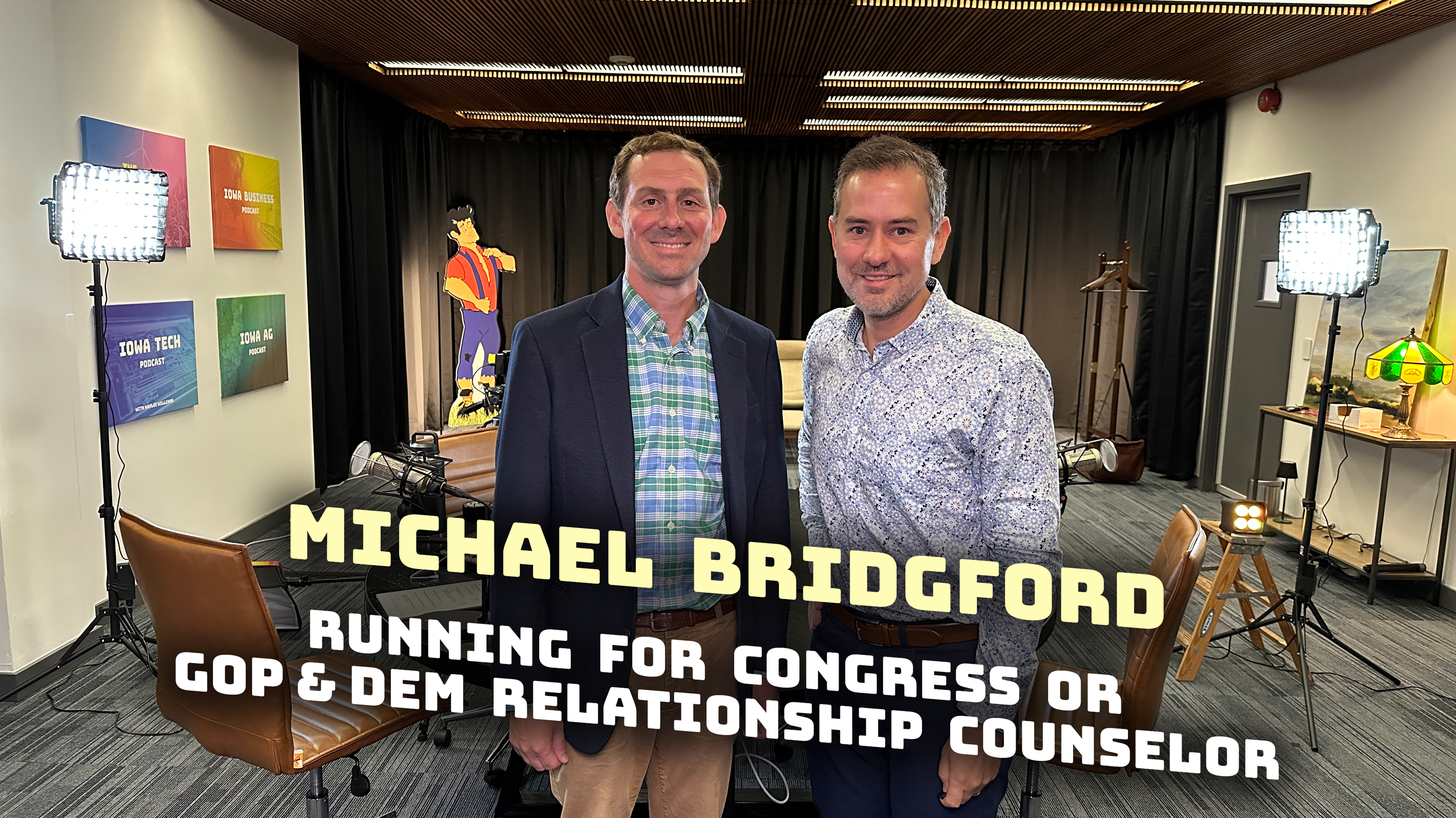



Michael Bridgford is running for Congress as an independent, hoping to gain a seat in the US House of Representatives that acts as a marriage counselor or relationships therapist between Republicans and Democrats. He tells us that his independent voice is an advantage for him and for Iowa.
Most voters write-off independent candidates, but Iowa is a different story he says. 144,161 Iowans are independents. That number is within striking distance of the 166,348 registered Republicans and 153,396 Democrats in Iowa. Bridgford also explains his mission to get big money out of politics and restore the individual’s voice in Congress.

Bridgford is gaining traction in Iowa’s 1st Congressional District, where recent polling places him at 11%. Pointing to major party approval ratings sitting at 25% or less and Gallup data showing 45% of Americans identifying as independent, Bridgford sees an appetite for systemic change. “We’ve reached this point in time where we need people to actually represent the people in the district, not special interests, not having a party boss to answer to,” Bridgford stated.
After gathering nearly 4,000 signatures in 40 days to secure his ballot position, Bridgford aims to utilize the U.S. House’s tight two-vote margin—where 218 votes are required to elect a speaker—to force votes on single-issue bills like term limits and overturning Citizens United.
Hear from Iowans directly. No algorithms.
Don’t let the algorithms choose your news. Enter your email address to hear directly from Iowans leading news in politics, community, agriculture and business. No editing. No clickbait. No rage. No agenda.
Confronting Fiscal Debt and Market Competition
Central to Bridgford’s platform is confronting federal spending. With the U.S. spending $7 trillion against $5 trillion in revenue, the national debt expands by $90,000 every second, creating a burden of $120,000 per citizen. Bridgford highlighted that in July, 42 cents of every income tax dollar went strictly toward paying interest on national debt. To curb this, he proposes zero-based budgeting and a gradual path to a balanced budget by eliminating 25% of the deficit annually over four years. Bridgford also urged immediate action on entitlement funding before Social Security faces a mandatory 25% cut in six years, noting, “There’s just no conversation taking place.”
In addition to fiscal reforms, Bridgford champions antitrust enforcement in healthcare supply chains and advocates for surgical, targeted tariffs over broad trade wars. Positioning himself as a unifying negotiator, Bridgford stressed that fixing complex national issues requires bipartisan collaboration. “We need people in Washington that are willing to work with both sides, ’cause right now both sides are not willing to work with each other.”
Interview Transcript
This transcript was created with help from Ai. Please report errors to us and always refer to the video as your primary source.
Justin Brady: From the Jethro’s BBQ studio, this is the Iowa Podcast. I’m Justin Brady, and independent polling for Iowa 1, Iowa District 1, Congressional District 1, has him at 11%. That’s, that’s realistic striking distance, y’all. And of course, he’s in here today. The who is Michael Bridgford, running for the independent seat for Congress in Iowa 1. Michael, thank you so much for coming on the show.
Michael Bridgford: Justin, I’m so excited to be here. Thanks for having
Justin Brady: excited to have you. Before we get started, everybody, chicken wings. Go to Iowapodcast.com if you want a discount on chicken wings, man. Buy a $100 gift card from Jethro’s BBQ. Just click the link at the top of our page. We couldn’t have made that any easier. You buy a $100 gift card, they’ll send you a $30 gift card. That’s more chicken wings for you, and if you invite me… Just kidding, don’t invite me. Uh, I will come though, if you do. Michael, like I said, uh, thank you so much for coming in here. Um, is it really interesting here. We’ve, we’ve heard some terminology being picked up from the Democrats and the Republicans. You’re an independent. Yep. Um, but we’ve heard terminology from both almost trying to steal your platform, almost trying to steal the independent platform this
Michael Bridgford: me. You’re telling me.
Justin Brady: it’s a little unusual, but we’ve heard it from both major gubernatorial candidates. Um, one calling both parties the Uniparty. Um, the other one saying not redder or bluer. We’re seeing this message on a lot of people’s websites and a lot of people when they’re in here. So it’s a similar message you have. So help people understand, do they vote for the Republican that says they’re against the Uniparty? Do they vote for the Democrat that says they’re a vo- uh, against the Uniparty? Or do they vote for the independent that clearly is against both parties?
Michael Bridgford: I mean, I think the beautiful thing in Iowa is that people really want to evaluate the candidates for what they stand on, what their message is. And you’re right, I mean, what we’re seeing here in the state, um, on both sides, we have candidates that are talking independent talking points, and I think that just shows where the state’s at now. Um, in our district, the largest group of voters are independent. In the state, it’s the second largest group of voters. And, uh, people are really frustrated. The system hasn’t been working. Establishment politics on both sides have led us to where we are now. You know, approval ratings on both sides, 25% or less.
Justin Brady: Yeah.
Michael Bridgford: Um, so this is just a moment for this, and this is where, you know, people are, are resonating with that
Justin Brady: So is this, uh, does this squeeze you out a little bit though, some of the independent talking points coming in? You know, ’cause clearly 11%’s kinda crazy, man. I don’t know historically where that sits, but 11%, um, is… That’s, that’s definitely striking distance, like I said. So
Michael Bridgford: That’s definitely I, I think it, I think it shows how frustrated people are. I, I don’t think it squeezes me out. I think if anything, it’s, it’s highlighting what we’re doing. I think people are looking for an independent voice. I think we’re gonna see… I mean, Iowa’s gonna be the most interesting state in the country this year, uh, based on the governor’s race, the Senate race, the, you know, three competitive House seats. And, you know, Iowans are independent-minded, right? I mean, it goes back to the first in the nation caucus, that history and tradition. They wanna see all the candidates, they wanna hear from them, and that’s where, you know, we’re getting out across the district, meeting with people, doing all types of media to really be in front of people
Justin Brady: Yeah, and obviously we appreciate you being here. Um, Independents are the second biggest party now. Uh, I think Republicans, I think these numbers are right, um, are 166 thou- roughly, roughly. 166,000. Democrats are 100… Oh, sorry. So you’re, you’re like, uh, Democrats are 153,000, and Independents are 144,000. Third biggest party, but that’s huge. So you’re, you’re, uh, you’re gonna hopefully pull from that entire Independent and have a running shot at this.
Michael Bridgford: Right. Well, exactly. And what I like to say with the country now, I mean, according to Gallup, you know, 45% of Americans now identify as independent, so it’s really a two-party country. We have independents, and then we have half are Republican and Democrat. Um, yeah, no, I mean, we have a strong independent base to pull from that are just… They haven’t had an option, right? It’s alway- it’s always a lesser of two evils decision, and that’s just what’s dominated our politics, and I think a lot of independent voters sit out for that. They don’t have someone that they wanna vote for. I, I know that’s how I felt in the past where it’s just this lesser of two evils, and it’s really frustrating. But then also on both sides, people are frustrated, right? If you look at our, you know, our ag base, which is typ- typically more Republican, they’re in a lot of pain right now. Um, I, I think, you know, they’re, they’re definitely open to other op- options. And then on the Democratic side with pulling, pulling away the caucus and just all the other problems within the party, you know, kinda leaning towards socialism, people are frustrated. They need another option
Justin Brady: Hmm.
Justin Brady: So yeah, okay. Yeah, that makes a lot of sense, ’cause i- it used to be, you’ve heard the adage, um, if you vote for the third party, you’re throwing away your vote, and that has worked, uh, for a long time. I know that the Republicans and Democrats both reinforce that. N- neither good nor bad, but that’s one of the strategies they use. It… I mean, just polling numbers alone, votes are different sometimes, it looks like maybe people are finally getting sick of that, so you may have a real shot at this. So let’s talk about, um, the Citizens United thing. Uh, overturning Citizens United, tall order. Yeah. Um, you’re gonna be a, a, a minority if you’re elected into the US House of Representatives as an independent. Um, and what if… I think someone might say, “Okay, Mr. Bridgford, I get it. You don’t… You want overturn- you wanna overturn Citizens United, you wanna get rid of big money out of politics,” but y- I mean, you’re not getting any of that money, so maybe your tune’s gonna change when you get into office. What do you have to say to
Michael Bridgford: No, I mean, uh, look, I’m an independent person. We’ve reached this point in time where we need people to actually represent the people in the district, not special interests, not having a party boss to answer to. And, you know, really kind of the, what, what makes this really inter- interesting right now, you know, the margin in the House is just two votes, right? I mean, Speaker Mike Johnson got elected by two votes. It could even be down to a one-vote margin. It could be 217, 217 and one, and that’s where one person could, could theoretically deny either side the majority to elect a speaker. You need to get 218 votes to elect a speaker. And that’s where if, if that were me, if I were in that position, I would demand a speaker that’s only gonna go for single-issue bills to get a vote on, uh, overturning Citizens United, vote on term limits, all of these issues that really are 80/20 issues that most Americans want. Um, and I don’t– I’m not confident that they will pass, to your point, but all these politicians talk about it. Let’s see them vote on it, right? And let’s, let’s see… So they can show their constituents where they actually stand on those issues
Justin Brady: So the, the selling point for yourself then, um, from what I’m hearing, is normally, you know, sending one independent from Iowa might just be a, like a s- a, a snowball into hell, right? Um, to use the metaphor or the, use the idea. But you’re saying that doesn’t apply this year because this year Iowa’s in a unique position. This year, if we send an independent, that can be the tipping point for certain bills and can actually put Iowa in co- uh, uh, in the spotlight for congressional control
Michael Bridgford: 100%. And it goes back to, so the one big beautiful bill that was passed, that was passed by one vote. So people ask me, “How would you v- how would you vote on the bill?” It’s not how you would vote on it, it’s how you would change it to make it so you would vote on it, right? How you could use that vote for leverage, where right now in the parties, we just see these party line rubber stamp votes. And, you know, uh, I feel bad for the politicians because they’re captured by the system. They’re captured by the money, and they can’t step out of line. If they step out of line, they g- they’re gonna get primaried. Look at what happened with Thomas Massie in Kentucky, right? I mean, there was $30 or $40 million spent against him in the primary. And the other thing I would say, though, what’s different this year is there’s a national movement taking place. People see these numbers where h- you know, half the country feeling this way, these tight margins. So we launched the Independent Leadership Council with Senator Joe Manchin back in July. We’ve got a handful of great candidates around the country in Alaska, California, uh, Montana, Idaho, Illinois, and we’re all committed to this mission of really changing how government functions, right? Having a say in who the speaker and who leadership is gonna be and saying we’re, we’re tired with business as usual
Justin Brady: Yeah. I, I think one of… ‘Cause you were endorsed by Forward Party.
Michael Bridgford: Correct. Yep, forward part as
Justin Brady: one of the concerns, uh, at least I have and others have with something like Forward Party is, uh, Andrew Yang, of course, one of the founders of that, um, independent, not, not left or right or, but Forward, but when push came to shove, he still endorsed Kamala Harris, right? And so I think a lot of people are like, “Mm.” They still have that belief that independents or libertarians at the end of the day are just working for one side or the other, and at the end of the day, the uniparty wins. So I think that is one of the concerns, um, that people have. I wanna ask about what you said, and you can
Michael Bridgford: But one, one, one thing I would say though, so, so, you know, I was, I was– I met Andrew Yang once. Great, very supportive. Um, Kevin Kiley from California, sitting member of the House, was elected as a Republican. Now he’s an independent. He’s also endorsed by the Forward Party. So there you have, you know, someone who was elected as a Republican just the last election, part of our group. So
Justin Brady: You mentioned party bosses, and you’ve said this on your website as well. I don’t think people think about how this works very often. Um, I think about it ’cause when I interviewed Tulsi Gabbard many years ago, she was like, “The first day they took me down the row of…” ‘Cause she was a Democrat at the time. “The first day they took me down the row of Republicans and literally told me, ‘We don’t vote for their bills ever.’” She said, “Well, what if I have a… What if they have a good bill?” She says, “We…” And then whoever was touring her, she wouldn’t say who it was, said, “Then we vote no on it, find some reason it’s bad, and relaunch the same bill in our own name.” ‘Cause, you know, I’m just like, that’s, that’s, that’s how it
Michael Bridgford: That’s why we’re in the mess that we’re in, right? I mean
Justin Brady: the party bosses thing and why if you elect a Republican or a Democrat, in your opinion, um, why they kinda listen to their constituents, but they also have someone else they report to. Can you explain how this works?
Michael Bridgford: Well, I think a lot of it goes back to the money in politics, and just this summer the Supreme Court kind of furthered Citizens United in, in allowing the parties to c- coordinate in an unlimited way with the candidates, with politicians. And so if they step– It goes back to, to the Thomas Massie example, where if you step out of line with what the party boss wants, then they’re gonna come after you in the primary, spend mil- tens of millions of dollars against you, and you’re not gonna stand a chance. And so people, you know, again, they’re, they’re trapped by this, and so they decide, “Well, I want, I wanna keep my position. I wanna stay in Congress, so I’m gonna toe the line.” Um, independents don’t have that issue. Here in Iowa, I don’t have to run in a primary. I got on the ballot via signatures. We got, you know, almost 4,000 signatures in about 40 days. So again, I only answer to Iowans. So I mean, my party is Iowa. I don’t have a party boss, um, that’s gonna direct me or cut me off if I step out of line.
Justin Brady: So what you’re saying is mo’ money, mo’ problems. Yeah. Someone’s rolling their eyes. They’re like, “I can’t believe you just said that.” Um, but basically that, the, the money is helpful, but it also, um, you, you are beholden to those that are paying your checks or writing your checks.
Michael Bridgford: But one thing I’ll add there, I mean, I think people are opening up to this. You know, just in Michigan, the, the, the Democratic candidate that won the Senate primary was outspent almost 15 to 1. In Florida, in the Senate primary, was outspent 36 to 1. So I think people are getting tired of the money dominating. They, they just know that their politicians are working for these special interests and not representing them, and they’re over it. And that’s why I think we’re seeing people talking independent politics, they’re talking independent points, because people are over that Yeah It, it starts with a vote, right? It would take a constitutional amendment, I believe, to overturn that. Again, s- let’s see everyone vote on it so then their constituents back home can say… ‘Cause a lot of these politicians, they talk about, “Oh, we’re
Justin Brady: Oh, so the strategy is forcing a
Michael Bridgford: forcing votes.” Yeah, t- same thing with term limits. I mean, everyone talks about term limits, but let’s actually see a vote on it. And that’s something where, again, for me to, to vote for someone for speaker, I would want a commitment on that
Justin Brady: It goes, it goes to the other question, which is the deficit. You’ve, you’ve talked about the budget and people blowing out spending. This is another thing, though, I will say that the Democrats and the Republicans have both, on the surface, and I’m not saying they don’t believe this, but on the surface have said, “Yeah, we, we need to rein in the debt,” right? But both, and everybody knows this, I don’t think Democrats or Republicans would disagree with this, both when they get office still blow out the debt. So again, this goes back to another one, which is as the independent voice, what can you do?
Michael Bridgford: Again, holding people’s feet to the fire. If they need your vote, they’re gonna listen to you, right? If things are gonna– if anything to pass is gonna need independents’ vote, and right now it could just be a couple, couple people, two or three, you’re gonna have a lot of say versus just electing a party, you know, candidate where they’re just gonna be, again, a rubber stamp vote. It goes back to that on e- really every issue. Um, but yeah, what we’re doing is just not, it’s not working. It’s actually, in my opinion, what’s driving our affordability crisis, and that’s, you know, really the number one issue now. We have to print so much money to fund this debt. We’re adding $2 trillion a year to more than $2 trillion a year. And, um, you know, now we’re seeing interest rates rise. I saw just this morning they’re at like a five or 10-year high. Um, as we have to refinance our debt, it’s gonna cost the government more and more. I think in July, 42 cents of every, you know, of income tax that came in went just to pay interest. It’s not sustainable. It’s adding to our affordability issue, and we’re gonna need an independent voice to be able to address this ’cause, as you said, both parties aren’t, aren’t doing it.
Justin Brady: So you get in there, you’re the indep- pendant voice, and you s- ’cause this is, you know what, what’s gonna happen is when you come in and when there’s a, a new sheriff in town and that sheriff says, “Hey, gotta tighten the belts, gotta cut spending,” the citizens, the people, whatever metaphor you wanna use, dad comes home and says, ” Hey, kids, we gotta cut the credit cards off,” people are gonna throw a fricking fit because everybody has that one thing that they think is really, really important and that those other things they don’t think is important. So what do you come and cut, and who do you piss off in the process?
Michael Bridgford: Well, I mean, I, I, I’m a big believer in gradual change. I don’t think we’re gonna go from over a $2 trillion a year deficit to a balanced budget in a single year. Now, you know, 25 years ago, we had four years in a row of a balanced budget. But I think we need– We’re– You’re gonna have to approach it from both sides, you know. We’re, we’re spending $7 trillion or s- yeah, $7 trillion. We’re bringing in $5 trillion. We’re gonna need to look to raise revenue in some ways. We’re gonna need to look to reduce expenses. Um, but you’re– Uh, I would like to see us try to get there over a three or four-year period, right? Where we, we tackle 25% a year to get to a balanced budget. Because if, if you made that a drastic change in one year, that would have a, you know, a, a bad impact on the economy. We, we need to make changes gradually, but right now we’re going in the wrong direction. We’re adding more and more and more. We need to start turning it around to go in the right direction. And again, it’s gonna take it from both sides. I mean, one example would be with the Pentagon. You know, last September, they had, uh, almost a billion doll- or $100 billion of use it or lose it funds. W- you know, of course, they’re not gonna not spend it, so they went out, they bought Apple products, lobster tails, Steinway pianos. They, they did. I mean, they could look this up. And, and you could spread… It’s not just, just the Pentagon. It could be any department. But we, we need to take a different mindset. We need to have zero, you know, zero-based budgeting. Um, and we’re also gonna have to look at bringing in more revenue
Justin Brady: So you say two keywords there that usually tick off party loyalists on both sides, which is you mentioned bringing in more revenue, which is taxes. Usually the Republicans don’t like that. You mentioned cutting, I think, and usually Democrats… I mean, truthfully b- neither party like taxes or cutting. Like let’s be honest. Sure, sure. So, um-
Michael Bridgford: I don’t like these either, but we have to make change. I mean, what we’re doing’s not working. On, on the revenue, can I give you an example there? I mean, you know, Amazon, uh, prior to the One Big Beautiful Bill, their profit was s- 65 billion. They paid 9 billion in tax. The next year it went to 90 billion in profit, and they only paid 1 billion in tax. I mean, we just– In the long run, that’s just not gonna work, and I think for Amazon to be successful as a company, they need our government to be healthy. They need, you know, things to work, and we’re headed towards a financial crisis if we don’t do something
Justin Brady: So is this a, someone might say, “Hey, I’m hearing tax the rich kinda language coming from you, Mr. Bridgeford.” Um, is that what you’re saying or is there more nuance
Michael Bridgford: There’s more nuance. I think again, it’s, it’s gradual changes to, to get to this over time. There’s not gonna be a change in one year. Um, I, I mean, I, I support the middle class and working class tax cuts that went, you know, that went into effect with the one big beautiful bill. But yeah, I think at the very high end, we’re gonna have to look at stuff. I mean, these big tech companies are the most profitable companies in human history. Um, their b- their profits are growing. We’re gonna have to look to address it. Again, for them to be successful, they need our country to be successful, and if, if we go bankrupt as a country, that’s not gonna be good for them,
Justin Brady: So corporate taxes,
Michael Bridgford: I think corporate, I mean, at the very high end, I think we’re gonna have to look… And that’s where you look at historical tax rates. You know, you know, back in the 1950s, corporate tax I think was 50%. I would n- in no way wanna go that far. But I mean, in our past where we’ve had ver-very successful times, we’ve had a different dynamic, and we’re gonna have to look at making these… I mean, we j- look, no one wants to do this, but we’re, we’re going in debt an extra 2 trillion a year. I mean, it’s $120,000 a person right now, the national debt is. We’re adding $90,000 a second. I mean, we talk about our, our budget deficit here in Iowa. I think it’s around 1.3 billion. We add that every few hours to the national debt. We just can’t. It’s just not sustainable. Um, we’re gonna have to make some hard decisions. We’re gonna… But again, this is where having people in Congress that are willing to work together, sit with both sides, take an idea from here, take an idea from here, atta- attack it from both angles, and do it over time t- in a responsible way, versus right now we go from, you know, one, one party in, in the White House to another, and it’s executive order after executive order. They take it down, put up another one. There’s no consistency and, and it’s leading to, us to this crisis that we’re in right now.
Justin Brady: So I hear, um, looking at corporate taxes. Um, okay, check. What about, um, cuts? Are there any, just to, just to get some, like, clarity on the cuts, are there any budgets, are there any departments, are there any line items that you’re like, “Right off the bat, these three things, or even this thing, we would definitely cut that because it’s out of control”?
Michael Bridgford: I mean, I, I mentioned the Pentagon example, um, and I, I don’t know the last time they passed an audit. I th- I would love to see… I’d love to see every department pass an audit. I think we should expect that out of our tax dollars, right? I think it’s gonna have to be looking at things across the board. I know Rand Paul had a, a six, uh, I think a six-penny, uh, proposal of, of how you could do this over time. We need people coming with ideas. We need to look at it from all angles, and we… A- and again, it, it’s gonna take bipartisan work to get things done. I mean, you gotta pass a filibuster in the Senate, right? 60 votes. So it’s, it’s gonna take people working together. Right now, we have people that just wanna fight with each other and not address these issues. Talk about Social Security. I mean, in six years, there’s gonna be mandatory c- I think a 25% mandatory cut if we don’t address that, and, um, there’s just no conversation taking place. We’ve gotta start talking about these problems. We’ve gotta start addressing them, and we gotta bring some common sense to it, uh, you know, compromise, common sense to actually solve it
Justin Brady: So what’s the strategy then to stay in office to move things and actually get change? Because you know as well as I do, when people start talking cuts or when people start talking taxes, you’re always ticking off people. So do you say upfront, “Look, guys, I’m not gonna have very popular positions. You’re probably gonna tick, be ticked at me. There are gonna be some things you really like and some programs you really like, and I might be cutting those, so give me some leeway or just tell me to get out of office.” Is this kind of the message you’d like i- initially, here’s what’s gonna happen?
Michael Bridgford: look, here’s the deal. We need people to run– I mean, I’m, I’m not running to be a career politician. I’m running to make these changes to, to get our country on a better track. What we’re turning over to the next generation is just not acceptable. I’ve got two daughters. You know, we’ve got, you know, over 20 students involved in this campaign. There’s a lot of frustration. They have a lot of frustration at both parties with what’s going on, and we’ve got, we’ve got to start addressing… It’s, it– I mean, if, if we just keep kicking these cans down the road, w- it’s, we’re gonna end up in… I mean, we’re already somewhat in a crisis. It’s gonna be a, a serious crisis, and we need serious people that are willing to compromise and work with both sides to do things
Justin Brady: Yeah, so one of the things that I know Iowans are struggling with, the whole country, um, and I see both sides to this, which is the tariff thing. Um, and the, um, you wanna expand markets, um, great. Without the trade wars, great. Um, now some people would say that, “Look, the reason this started is because the world hasn’t really been treating us fair to begin with.” I think both sides probably agree on that, they just don’t agree with the solution, of course. Um, so you know, I, I believe the Canadians were tariffing us on some, you know, very, very steep tariffs on some of the things. So some people are like, “Let’s leave it alone and slowly inch this forward.” Other people, uh, are like, “No, let’s, you know, let’s go, um, let’s nuke this situation.” I don’t wanna use nuke ’cause we have other- Well … other, you know, poli- political… But let’s go, um, let’s go crazy on this. Let’s go hardcore and let’s just… So, um, what is the solution here? How do we expand markets? Do you just say, “Yeah, I know we’re getting tariffed unfairly. We need to slow roll this thing. We need to talk with these peop- ” Or do you say, or, um, do you go the side with the, “Yeah, we wanna expand markets, but only those that are gonna tariff us fairly.” Like, we need to both lay down our tariff arms. How do you go about… This is a tough
Michael Bridgford: Yeah, th- this is very complex, right? Do you
Justin Brady: very broad- So what do you do with tariffs and with expanding markets?
Michael Bridgford: I, I think tariffs are a valid economic tool. We’ve used it throughout our history, but it should be used more surgically, right? Right now we’re using them just in these, these blanketed ways where we’re rolling it out across however many countries just in a blanket manner versus there are certain industries we definitely need pr- need to, need to be protecting. Like pharmaceuticals, I would say we don’t wanna have an issue where we’re relying on another country. We just rolled back tariffs on importing beef. I don’t, I don’t think that was a good decision. I think we wanna be supporting American farmers and ranchers and, and finding ways to incentivize to grow our herd so we can bring prices down over time. So tariffs are a valid tool, but yeah, th- this… I think, you know, and I, I get that a lot of this is negotiation. I believe the Canadian tariffs haven’t gone into effect yet, so there still could be a lot more, um, you know, to happen there behind the scenes before they actually would be put in place, ’cause that would be a big impact. They’re, I believe, our second-largest trading partner behind Mexico. They’re even bigger than China. And, um, we just need common sense. We need, we need to, we need to turn the temperature down. I mean, this is across all of politics. Turn the temperature down, be realistic about what we can do, and put, and, and have these gr- a gradual impact to things versus just these… the pendulum swings from one side to the other and they’re, and it just tears apart our economy.
Justin Brady: So it’s not necessarily that tariffs are bad or that econo- the economic trade policy that’s being discussed in DC is bad. You’re more taking issue with the let’s, let’s be a little bit more calculated and let’s not just like, uh, try to tick everybody off and taunt everybody is kind of the approach
Michael Bridgford: Yeah, I don’t… I mean, I think a lot of people, they want government and politics to be boring. You know, they used to be boring. Now it’s like a reality TV show where you have to live and die with every news story, and it’s all about, you know, poking somebody else in the eye and, and clickbait politics on social media. We need to, to take a measured approach. And, and there’s… You brought up really, you know, real issues there, right? I mean, with other countries terri- tariffing us, um, excessively, we need to be addressing that. But the way we’re going about doing it, I just, I, I think it’s more for the performative aspect of it, and it’s, and it’s not good for
Justin Brady: If someone did, um, not calling names, but like Mexico and Canada, they’re just north, you know, they’re over the border. If they were like, “No, nope. Um, Congressman Bridgeford, we’re not gonna change our tariffs. Deal with it.” What would you do in that case? Would you say, “Okay, fine. We’re just gonna match you. You have this tariff, we’ll just do the same exact…” Like how do you approach I think, that’s a reasonable approach, but at the end of the day, we– they wanna be allies with us. I think we wanna be allies with them. They’re, they’re… You know, we sh- like you said, we share a border, we have big economies. There’s, there’s a lot there to, to be able to work together, but we have to do it in common sense ways.
Michael Bridgford: I mean, like you said earlier, um, we lost a lot of jobs, you know, to Mexico, now obviously to China, and we’ve got to address that. Um, and then that’s what the tariffs went in to do. But I think, you know, again, the problem I have is the extremes. I think we– the pendulum is just going too far each side, and we need a little more nuance and common sense in the middle to negotiate and to actually get long-term solutions versus things that change every couple months.
Justin Brady: Now I’m not sure about, I didn’t say anything about lo- we lost jobs to Mexico or China. I don’t actually know those numbers, just in case
Michael Bridgford: Oh, I’m sorry. I thought-
Justin Brady: fine. I just, I just don’t, I don’t know those numbers, so I’m not, I’m not 100% sure on
Michael Bridgford: I thought you were pla- like globalization, the impacts of globalization and yeah. Mm-hmm. Yeah.
Justin Brady: I thought you mentioned them. Mm-hmm. Mm-hmm. Um, healthcare, you’ve talked about price transparency, you’ve talked about PBMs, and you’ve talked about reforming that. Um, if you were in Congress, what do you push for? What are some bills you, uh, try to get through subcommittee as an independent, and you say, “Here, here are some things we can do to reform healthcare. Here are the problems”? And th- I guess the, the next question is, can you communicate that clearly on a podcast
Michael Bridgford: Yeah. Well, and, and I just– There’s just a bill, um, I’m, like, I’m, I’ll, I’ll botch, I’ll botch the name of the bill. I just, I just read about it. There’s so many things you read these days. But, um, I would support it. It’s a bipartisan bill basically going on the exact things I’m talk- I heard Mark Cuban was talking about it. I heard him talk about it on a podcast. But, um, yeah, there’s just so much cost that’s in the middle here, uh, with PBMs, and, and that’s an example where there’s been so much consolidation. Um, to– It’s the same issue we have in our ag, ag industry where there’s been consolid- I’d say it’s the issue we have in our politics. There’s, you know, we only have two options, right? There’s no competition. We need more competition. Um, we, we– That, that’s what’s gonna bring costs down over time when you have these, these industries that are consolidating and, and integrating vertically, whether across the whole supply chain, like in healthcare. It just leads to higher prices, bad outcomes. We need more competition, and I would support anything that’s, that’s supportive of that.
Justin Brady: So more comp- okay, so more competition in healthcare. Um, would this be then a rollback of FDA requirements? Would this be cutting some red tape so that more companies can get into the healthcare market? B- we’ve talked about this before on the show, but for those that have listened to this show know that, uh, healthcare in this country is actually, um, very rigidly regulated. If you’re a startup or you’re a company, even pretty well-funded company, you can’t just propose a healthcare solution, put it into the healthcare market. That’s not how it works. You have to be, you have to go through the FDA, there are regulations, and those regulations, love them or hate them, can be a detriment for new companies. So do you change that?
Michael Bridgford: I mean, I’m always for supporting, uh, cutting red tape. I know you have to balance that with safety, but like you’re saying, the, the, the, the barriers to entry in, in these markets, the amount of money it would take just to get lifted off, it, it’s, it’s not wor- and this is one of the reasons why we have the issues we have. There’s been so much concentration at the top in healthcare and, and I would be fully supportive of getting, you know, helping startups get their products launched, getting into, you know, um, case studies and for approval. I mean, that’s what we need to do. That’s, uh, that’s what’s, that’s what’s made America a great country over time. We’ve had competition, and right now I feel like, um, you know, on one side we’re looking at socialism, on the other side we’re– it’s sort of this crony capitalism where it’s only benefiting the special interests and the people at the top. We need, we need competition, and, and I think healthcare, that would be the number one
Justin Brady: Because I think one of the things that al- always is thrown around when it comes to the FDA and healthcare regulations is safety. That’s the first thing that’s gonna be thrown around. And if it’s a younger startup that’s not as funded, are they truly safe? So people can see how the safety argument can almost be unlimited, like expanded to an unlimited degree. Of course, that safety argument hasn’t saved a quarter million people from dying, uh, from negligent healthcare this year. Um, I think that’s the number. You can fact check me on that. Um, but it’s about a quarter million people that die because of accidental stuff in the hospital. And this does not include like a gunshot victim that came in there that was near death and they couldn’t save. This is like literally people administering the wrong drug or doing s- So the FDA’s not saving those quarter million people. The FDA is also, um, all the drug recalls that we see a lot. FDA hasn’t stopped those. So, you know, it does look like sometimes the safety argument only goes one way. So, um, if you do roll back FDA regulations or allow startups or smaller companies in there, people are gonna come after you and say, “This is making things less safe.” Do you, how do you hold the line on something like that?
Michael Bridgford: and I’ll– So I wanna bring AI into this, and I’m- Sure … I’m a bit AI skeptical. We can get into that. But I think this is a use case where AI could be beneficial, right? I mean, I think it could have really positive impacts to our healthcare in terms of, of testing and, and things that, you know, are beyond even what I can comprehend what AI can do. But I think that’s what– a use case where AI could really help us, and I think that’s where the companies need to lean into more is, is healthcare solutions. I know that we recently had the Moderna, um, there was a cancer vaccine that I think was impacted by that. But we, we need these new technologies to be pushing so we, we can allow startups and smaller companies to compete, right? So we’re, we’re gonna need
Justin Brady: I am glad you brought up AI because we are now seeing some of the bigger companies start to say, Bill Gates I think just had a message two weeks ago, uh, a lot of these people connected to healthcare starting to say, “Hey, AI is really, really scary. We should roll it back. We should have more regulations in place. We should have more guardrails on it.” Are we already seeing some bigger companies start to try to control AI to make sure that it doesn’t disrupt industries? And how would you regulate AI, or would you? ‘Cause you mentioned you’re a little skeptical. So if it’s an enabling technology that can bring costs down, I would guess some larger companies don’t like that too much. How would you balance that with AI regulations or no regulations?
Michael Bridgford: Yeah, I mean, I think AI is gonna be one of the defining issues of this election and, and certainly in 2028. Um, the problem, it goes back to the big money, special interest money, right? And that’s where, to your point, the big companies, th- they have so much money, so much influence to where they can really dictate legislation with the parties because they’re funding the candidates. They have super PACs, you know, the whole story. For me personally, um, I think we really gotta get AI right. I think, you know, we, we, we dropped the ball with social media. I think, uh, that was a s- a case where the special interest money came in. Nothing ever happened. I mean, there was recently a Meta ruling, but that was through the court system, not through legislation. Um, and I think with AI, we, we, we need to look out for society. You know, w- it, it’s tough because there’s a needle thread. We don’t wanna lose to China. Um, but there are real impacts. You know, the, the younger folks, you know, college graduate unemployment’s at an all-time high. Um, they’re, they’re graduating with debt, and they’re not getting, either not getting a job or they’re working in a, a coffee shop. That’s, that’s not gonna work. I mean, we’re gonna have to address this. Um, you know, it’s gonna– it’s, at the end of the day, like, like these hard problems, they’re gonna take bipart- One person isn’t gonna solve these problems, right? An independent candidate’s not gonna solve the problem. But it’s, it’s the, the ability and willingness to get together with both parties and to say, “Hey, guys, we gotta do something here. Here’s an i- idea over here. Here’s an i- idea over here. Let’s get something done. Let’s get it passed through c- the House, the Senate, and signed by the president.” We can’t afford not to in AI, with AI, in my opinion
Justin Brady: Probably last question is the way you talk about your campaign, the way you talk about, um, if you get elected is almo- What I’m hearing isn’t that I’m gonna come in here with this idea and push, or I’m gonna come in here with this idea. I’m almost hearing you wanting to come into Congress like a marriage counselor.
Michael Bridgford: Don’t we need that? I mean, I, I would say we need that
Justin Brady: kind of the campaign pitch then? Is I want to be the marriage counselor. I wanna bring both parties together. I’m an independent, so I can’t push through things on my own, but I’m going to try to get people to unify and actually listen to the… Is this the big final lasting pitch?
Michael Bridgford: I mean, look, to start with, we gotta address these issues. Right now Congress is passing bills about daylight savings time. You know? They, they have, they have limited time. I think they, they just started a session yesterday, and they… The, the last time was July 23rd. I mean, they’re not in session a lot, and the time when they’re in session, they’re, they’re focused on issues that aren’t really issues. We’ve got AI, our fiscal situation, healthcare, Social Security. We could keep… go down the list. So first of all, we gotta bring those issues to the table, and someone to, to point this out so we can address it. And then, yes, from there, the only way we’re gonna solve them is by working together. That’s, that’s it. I mean, the parties are gonna have to work together, and we need people in Washington that are willing to work with both sides, ’cause right now both sides are not willing to work with each other
Justin Brady: Michael Bridgford running for Congress in Iowa’s 1st Congressional District. Um, w- I will say, um, invitations have been extended to all candidates, so if you don’t see them on the show, it’s because they haven’t responded or have declined. Um, what is the website, and how can people reach out to you if they want to learn more?
Michael Bridgford: richfordforiowa.com. Uh, we’ve– We’re on Instagram, Facebook, TikTok. Um, reach… Yeah, we, you know, we’ve got 30 people involved this, in this campaign, a lot of excitement. There’s a national movement taking place. This is the year for it.
Justin Brady: Really appreciate you coming on the show
Michael Bridgford: Justin, thank you