

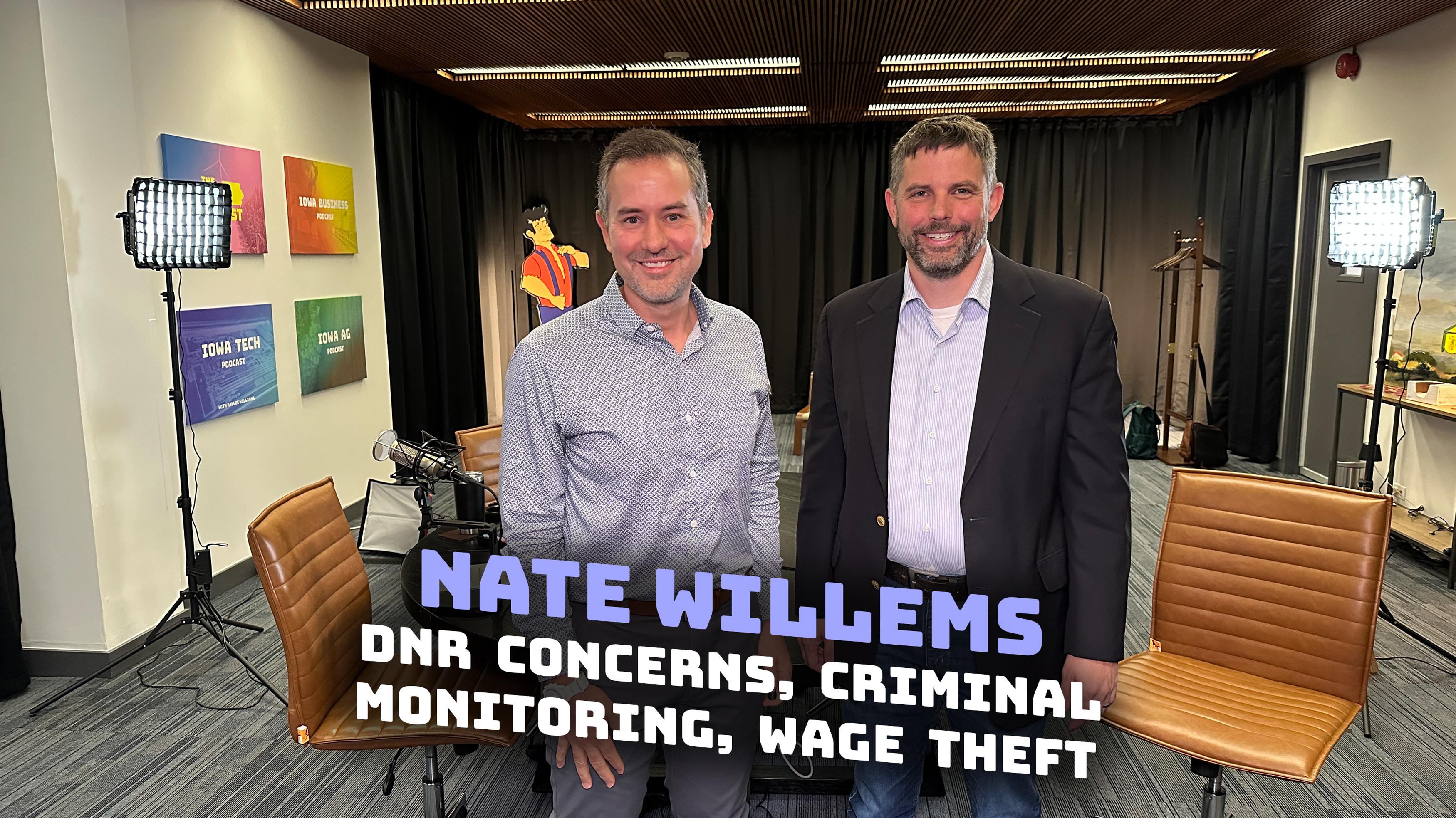



Nate Willems is running for Attorney General and said he’d go further than the DNR on punishing recent polluters. We asked how far in the future. He also explains why he initially voted against a bill that would monitor sex offenders in the state, but voted for the final bill.
Willems also explains how he’d recoup lost wages for Iowa workers and also defends a controversial post on Twitter (now X) that made a comparison between Antifa and US Soldiers “fighting fascism.”

Willems outlined an aggressive enforcement vision on The Iowa Podcast, challenging incumbent AG Brenna Bird’s handling of corporate environmental violations. Criticizing the state’s response to a Shell Rock plant emitting cancer-causing chemicals over a three-year period, Willems noted the facility received only a $10,000 Department of Natural Resources fine alongside roughly $40,000 in back fees. “You need to have polluters understand that it’s gonna be more expensive for them to break the law than to follow the law,” Willems declared, arguing that the AG’s office failed to build a comprehensive factual record to pursue deterrence or substantial remedies.
Cracking Down on Paycheck Theft
Pivoting to labor rights, Willems highlighted paycheck withholding as a pervasive systemic issue affecting workers statewide. Citing state data, he emphasized that unrecovered earnings amount to a $900 million annual loss for Iowa workers. “That $900 million represents 10 times the amount of all other theft in Iowa combined,” Willems stated. To address the problem, he proposed establishing the first dedicated wage enforcement unit within the Attorney General’s office. Highlighting his private practice experience, Willems cited a class-action lawsuit representing 11,000 University of Iowa Hospitals employees that successfully recovered $15 million in liquidated damages for systematically delayed wage payments.
Hear from Iowans directly. No algorithms.
Don’t let the algorithms choose your news. Enter your email address to hear directly from Iowans leading news in politics, community, agriculture and business. No editing. No clickbait. No rage. No agenda.
Statutory Duty and Emerging Tech Challenges
Addressing constitutional rights and criminal justice, Willems stressed that the AG must strictly enforce statutory law regardless of personal stance. Discussing Iowa’s strict constitutional protections for gun owners, he noted, “The job of the attorney general is to enforce Iowa law, even if there are some aspects of it that you may not personally agree with.” Looking ahead, Willems identified rapid advancements in artificial intelligence as an urgent focus, advocating for multi-state collaboration among attorneys general to pool resources and mitigate emerging public risks.
Interview Transcript
This transcript was created with help from Ai. Please report errors to us and always refer to the video as your primary source.
Justin Brady: [00:00:00] From the Jethro’s BBQ studio, I’m Justin Brady, and this is the Iowa Podcast. AG Brenna Bird has some competition, and Representative Nate Willems is that competition. He, of course, joins us today. He’s running for your attorney general here in the state of Iowa, and we appreciate you being here. Thank
Nate Willems: My pleasure. Thank you for having me, Justin
Justin Brady: Before we get started, everybody, you know the drill. If you want chicken wings, like who doesn’t? Come on, Iowapodcast.com, scroll to the top, click that banner for Jethro’s. If you buy a $100 gift card, they will give you a $30 gift card. Our Iowa tech host, by the way, is vegetarian. She goes there, too.
She has, like, a menu she likes. She talks about that, too, so vegetarians are welcome. Um, let’s start right off with the, the thing that is the controversy right now. That’s what’s exciting. It’s the, it’s the Shell Rock plant, of course.
Um, you have been critical of the current AG, saying like, “Guys, you didn’t do enough.”
[00:01:00] Um, yeah, and so there’s this little fight that they’re, they’re like, “No, we did plenty,” and you’re like, “No, you didn’t do enough,” so the DNR assessed a max fine. Uh, but you think real penalties were spared.
What, what would have been those real penalties? If you were AG in Iowa, how would you have gone after this organization?
Nate Willems: Well, I mean, I think the, the twin goals in, in situations like this where there’s been– where the law has been broken and Iowans have been, you know, subjected to, uh, to some harm from an environmental perspective, the twin goals would be, would be to, you know, either clean up a mess or to have a fine to deter, you know, bad future conduct, to prevent future bad acts.
So that is, is, is what you, you, you need– You need to have, uh, polluters understand that it’s gonna be more expensive for them to break the law than to follow the law. Uh, so that’s the, I think the, the principle that you wanna have in mind when, when, uh, you know, these sorts of [00:02:00] sit-situations happen
Justin Brady: Sure, so I can criticize almost any office, any, any- anything really and say, “That didn’t go far enough.” And so what would be far enough? Is, is it a matter of the fines weren’t too high, and if you were in the AG office, you’re like, “These fines are super low. I would’ve gone after them for a million dollars to do X, Y, Z.”
Like, what is the specific
stick that you would’ve used?
Nate Willems: yeah, certainly the fine is too low in this situation, you know. But, you know, I’ve certainly… I’m a person who believes that facts matter and that you have to, you know, develop a factual record in order to put together an appropriate remedy. That never even happened here because Bruner Buhr didn’t build, didn’t take on the case, did not build that factual record.
It was just the $10,000 DNR fine and then nothing more. It was, It
was put to bed.
Justin Brady: top
of it
Nate Willems: there, there were some back fees owed.
Justin Brady: think something like 40,000
Nate Willems: Something like $1,000. Right. Right. Yeah. Well, I mean, yeah, those are fees that were gonna be owed anyway, uh, separate and apart [00:03:00] from the, the, the question of, of a penalty. Uh, so, you know, the… You really have to build out a factual record, uh, to, to assess a s- a particular dollar amount and, you know, know what a court is going to uphold or what, what a court will, uh, uh, reasonably, you know, reasonably put in, in, in a judgment. Uh, so but, you know, that never happened here.
Justin Brady: So would you… I guess the question is there are, and this is not a wrong or right answer by the way, but, um, there are current laws on the books. Um, I’m sure her office would say, it sounds like they’re trying to say that, um, they’re just, the current laws were followed. You know, like they’re, they’re, you know, the fees are here, we outlined this, they, they paid the fees, but you’re saying you’d go above and beyond.
So I think the question is-
Nate Willems: but I don’t think the current law was… I mean, the
reason it, it comes k- I mean, you know, it, it’s, it violates the law to put these cancer-causing chemicals into the air for, you know, any amount of time. I mean, far exceeding the limits any amount of time, but much [00:04:00] less three years, right? Putting that into the, into the air for wherever, to blow wherever, uh, around, you know, the people in that community, the people across Butler County or into Bremer County, that’s the, that’s the problem.
That’s the illegality. That’s what makes this a big deal. Uh, so the… You know, I mean, I mean, things come to the AG’s office when they, you know… The, the role for the AG’s office is when something violates the law, not to be, uh, you know, in, in an ad hoc manner, kind of putting, uh, going after a business because of your policy preference, but when there is a tangible situation where the law has been violated
Justin Brady: So yeah, I think the, the big question most people probably have then is at what point do you, uh, allow like an organization like the DNR to just carry it out? And at what point do you, um, not… I don’t wanna use the word, I wanna use the, I wanna be careful here. Um, at what point do you step in and say, “Hey, I know that you guys [00:05:00] think you took care of this, but I’m going to step in at this point because I don’t think what you did take care of is enough”?
At what point does the AG’s office get involved? Because I think the concern is, um, whether founded or not, I think the concern is do we have an activist AG office that is like just saying, “No, nothing’s good enough. I’m coming after y’all”?
Nate Willems: Well, no. I mean, l- let me offer, uh, I don’t know, an analogy. I don’t know how great it is, but, you know, you watch Law & Order, right? The first half hour of the show where the police officer’s investigating a crime, and then the back half of the show would be the prosecutors. And then, and you see the interplay between the police and the prosecutors, and that really to, to, to a certain degree is how the relationship has existed and should exist between the DNR and the appropriate attorneys within the AG’s office and having a, that conversation.
It’s not as though, you know, the, the DNR would just do all of their work in a silo and then, you know, b- be done with it. I mean, they are typically in [00:06:00] communication with the AG’s office. Now, if it, it, you know, so it’s, it, it’s unlikely that there’d be any surprise, right, for, for the AG’s office, uh, the way the system should work
Justin Brady: Hmm. So let’s talk about wage theft. This is one of the things you’ve been running on.
Nate Willems: I actually don’t use the term wage theft.
Justin Brady: I actually don’t- Got it. Okay. I agree or not. Pre- no,
I appreciate
Nate Willems: I’ve heard- And the reason I don’t is that sometimes if I say the term wage theft, a lot of people will be like, “I don’t know what the heck you’re talking about.”
Mm-hmm. I talk about, you know, employers stealing from workers’ paychecks.
Mm-hmm. Because that, I mean, it’s more self-explanatory
Justin Brady: Yeah, ca- wage theft is a term, and sometimes people don’t know what that means, sure. So let’s talk about stealing from paychecks. Um, obviously currently against the law, and I think you mentioned that you would use enforcement tools that already exist. And so you, there’s, you know, this is one of the things you’re talking about.
You don’t need to pass new bills.
These things already exist. It’s a matter of enforcing them. So I guess my question is, are they not being enforced currently, and why not?
Nate Willems: So here’s the deal. Right now, uh, I mean, it [00:07:00] used to be the Labor Commissioner’s office, then with government reorg, that got put in inside the Department of Inspections and Appeals and Licensing. But there, we’ve always had, you know, a handful, maybe three or four, uh, employees who, who do respond to these situations. Now, the, what the law allows for is if, if somebody’s, if a worker’s had wages stolen out of their paychecks, a l- it allows for to recoup those wages, uh, possibly get, uh, liquidated damages, which is double damages. I mean, there’s no, there are no punitive damages. There’s certainly no emotional distress or anything like that.
But you can get your wages back and maybe an additional, you know, uh, doubling of that with liquidated damages and, and attorney fees. One of the problems is that, you know, currently the, you know, the state depart- the state employees th-that are on res- have responsibility here, they only seek the back wages.
They never go after liquidated damages. They never file suit in court. So right [00:08:00] now, the worst case scenario for an employer is that they obtained an involuntary zero interest loan from their worker’s paycheck
Justin Brady: So what’s, w- do you, I guess, um, double, do you go after the, the pen- additional penalties then in these cases? Yeah, Is this
Nate Willems: that’s, that, that
is, that is, uh, yeah, that is one piece of it. I mean, that, that’s the, you know, the single biggest… You know, the single biggest thing I ever took on, uh, as a, uh, have taken on as an attorney in p- in private practice was against University Hospitals in Iowa City, where, you know, they had, they had paid all the wages, but they had paid them systematically illegally late for decades. So they were taking, uh, uh, an in- basically an involuntary loan out of workers’ paychecks. And so in that situation, because they did eventually get paid all their wages, all we were seeking were what we call liquidated damages. You know, those, those… Uh, w- and [00:09:00] that, those damages are meant to kind of make you whole for the, the loss of use of your own money.
A- a- and that’s, uh… So that, that’s what, what we did, you know, in University Hospitals. I had a class action representing 11,000 workers. We recovered $15 million, and now University Hospitals follows the law
Justin Brady: Hmm. Uh, now in these cases, not University Hospitals specifically, but in, um, a m- majority of the cases you see, or, or a large amount of the cases you see, is it a malice kind of thing, or is it just, like, disorganization
Nate Willems: It’s everything
Justin Brady: it’s… Like, I don’t wanna use the word incompetence, but people are… I will say I’ve worked with a lot of organizations, most aren’t really that organized.
So how do you come after organizations that were trying to follow the law, or is it a, there’s this secret undertone of people trying to abuse it?
Nate Willems: Right. No, it, it, it’s– it, it comes in all shapes and sizes, right? I mean, you know, you have situations where, um, uh, a, a restaurant… I’ve, I’ve had, [00:10:00] you know, clients where the, the restaurant would take it out of your pay, uh, if, if a, a customer walked off and didn’t pay, or if, if, um, uh, uh, a plate shattered or a bottle shattered.
I mean, these sorts of things just cannot be deducted from a worker’s, from a worker’s paycheck, and so there’s intentionality there in- and certainly in those situations. I mean, you know, there are situations where, um, you know, management in terms of how they pay their employees just makes a mistake. Uh, absolutely. But the… You know, but, but there– but it is, it’s, it’s oftentimes part of, you know, their plan, right? I mean, like, we plan to, to pay people in a particular way. Oh, I m- maybe it turns out to be illegal and they, and they didn’t appreciate that. Uh, so y- you’re right. There, there are a wide variety of ways to en- enforce the law, uh, based on, on the particular facts of that situation. You know, what I want [00:11:00] to do is to create the first ever wage enforcement unit within the AG’s office. Uh, and, you know, it’s gonna be a reasonably small unit, but a, a unit that can, you know, work with local, you know, local law enforcement, local prosecutors, that can work with, uh, nonprofits, can work with, uh, in, in private, uh, the private bar and, and, and with the labor movement to, uh, to, to, to be able to, uh, you know, make some progress.
Because the, the problem is $900 million a year. I mean, that’s the, the, the best data that we have, that this is a $900 million a year problem in the state of Iowa. Which, I mean, that $900 million represents 10 times the amount of
all other theft in
Iowa combined
Justin Brady: it is a lot. Um, so I mean, there are a lot of logistical things there, and I, I know this would probably take 45 minutes to cover. But, uh, one of the things I wanna a- I wanna move on to other things, but one of the [00:12:00] things I wanna ask is, would it still rely… This can be a short answer.
Would it still rely then on user-based reporting? Um, I mean, it would probably have to, right? You’re not, like, going through everyone’s books
or
Nate Willems: no, you, not through everyone’s books, but, uh, I mean, we do, I do want the attorney general’s office to, to, to be clear that we want to hear from workers across
the
Justin Brady: making it more accessible for people to report
things and getting them faster
resources is what you’re advocating. Okay, cool. I think that’s fair. Um, there has been an attack ad on you, not framed correctly, I don’t think. I think there is more nuance
to this story, about the, uh, child sex abuse, sex abuser registry, GPS monitoring, this kind of thing.
And they’re i- they’re like, “You, you voted for, uh, a lo- basically not doing the monitoring at all.” Well, there’s nuance here. There was a first version and a second version. So this is when you were in the Iowa
Legislature. Um, there was a first version you voted against, the second version you actually voted for.
And so I guess the question is, though, the initial version, um, [00:13:00] why did you vote f- against the initial version, version?
Nate Willems: you’re referring– There’s a– I mean, KCCI did a pretty good story on this,
uh, uh, recently. Um, I mean, this is the, the Iowa version of the Adam Walsh Act to make our law, which, you know, is still the law of Iowa today, uh, it makes our laws smarter and, and more effective with respect to, to sex offenders.
But there was a, one, what you call a, a strike after amendment, which is, “Hey, forget about that bill. Let’s just replace it with this thing”
that, that, that was introduced. And y- I mean, I think, what, uh, it was defeated on a bipartisan manner. It did not even get 30 votes out of 100 in, in the Iowa House because we s- you know, uh, supported what, um, you know, the legislation that was supported by the county attorneys and the Sheriffs and Deputies Association.
And, and part of that was that, hey, the Department of Corrections, we’re gonna give them the authority to monitor who- uh, any sex offender they think should be monitored. Uh, and we’re gonna have, make them [00:14:00] r-report in, uh, in many instances more frequently with the Department of Corrections. That was the basic framework of, of, of the bill that, that, uh, I supported, and that, that amendment would’ve taken that away.
Justin Brady: So the, what was wrong, just to clarify then, what was wrong with the initial bill specifically that you voted w- and that’s why you voted against it?
Nate Willems: Well, no, I didn’t vote against the bill. Th- there was
Justin Brady: First version. Just the first version.
Nate Willems: after amendment is is what I voted against
Justin Brady: what you voted against because it would not give local c- I, I don’t quite understand, ’cause it would not give local control or it would take local control away?
Nate Willems: it would take control away from the Department of Corrections to, to make a decision based on the risks of that offender
Justin Brady: Mm, okay. Thank you. Yeah, I appreciate the clarity. Um, one of the things I wanna move on to is in the past, confusion around, uh, and you’ve said, “Hey, at the end of the day, I’m gonna s- I’m gonna uphold the law,”
but there is the concealed carry in Iowa, right? Uh, I think there is… Years ago, got rid of the permits, now it’s, it’s [00:15:00] constitutional carry.
Um, are you for or against constitutional carry? Um, what’s your view on concealed carry in the state of Iowa?
Nate Willems: Well, I mean, not only h- has that become the law of Iowa, but, but you’re also, I’m sure, aware of the, the new constitutional amendment that, that voters in Iowa passed, which is, uh, uh, you know, probably goes a little bit further than the Second Amendment to the United States Constitution- Really? … to, to protecting gun owners’ rights.
So, you know, it, it’s a real question mark r- right now as to, you know, what restrictions which may be, have been on the books for, of Iowa law for, for years will, will still be found to be constitutional, uh, uh, under the new Iowa constitutional provisions. But, I mean, to get back kind of to your question, you know, I, I mean, w- well, let me ask you this.
Have you ever s- seen, physically seen the Code of Iowa?
Justin Brady: Have I physically seen the whole?
Which part?
Nate Willems: Well, that’s, [00:16:00] that’s, it’s eight, they’re eight books, right? I mean, it takes up a bookshelf. It’s a big
Justin Brady: I probably, I’ve read chunks a lot for this kind of thing. I don’t know if I’ve read the whole thing
cover to cover
Nate Willems: read the whole thing cover to
cover. Okay. But the, but the, The
the point is, the point is
if you look at this massive set of eight books, you or I or anybody else are gonna find pieces of it that you don’t agree with,
right?
And, and so would I, so would anybody. But the job of the attorney general is to enforce Iowa law, even if there are some aspects of it that you may not personally agree with
Justin Brady: So what are those aspects? Because, um, I think people would wanna know the, the, I don’t know if we call you top cop in this state. Is that even a fair thing?
Nate Willems: that, that’s fair
Justin Brady: people would wanna know, like, what are those things that you’re going to be really wanting to enforce, and what are those things that you maybe will be a little easier on?
Nate Willems: Well, look, the– I mean, public safety is a top priority for any attorney general, and, um, y- you know, working with local law enforcement, work- looking– working with pr- [00:17:00] prosecutors to make sure that they have… That the AG’s office can provide the resources in terms of attorneys to, to help in prosecuting the most violent felonies anywhere in the 99 counties, uh, when, when, when requested, uh, by…
And, and in p-particular in more rural areas, that- that’s a– it’s a top priority of the AG’s office. Um, a-and, you know, working with, you know, list– I think it is important to, to– certainly to, to be, you know, listening to law enforcement as well to hear their concerns of what they’re seeing, uh, you know, as, as, as things change. Uh, but the, you know… So that is the top priority of any attorney general. Certainly, I’m also very passionate and interested about having the AG’s office kind of… Having the attorney general have the mindset of being the people’s lawyer. You know, that, that we’re gonna go to work for Iowa workers, for consumers and senior citizens.
We’re gonna, you know, help out Iowans who’ve been exposed to, you know, uh, to, uh, violations of our air or water, uh, [00:18:00] law, you know, standards w- through pollution like in the situation you
referenced. So but th– just having the, the, the mindset of that office that, you know, every day is an opportunity to go to work for regular Iowans.
That’s what I, you know, certainly want to instill in that office
Justin Brady: And just a final point on the carry issue. This is a sensitive issue, by the way. Like, um… And I understand, uh, uh, people think I’m nuts when I say this, but I can understand the left and right position on this. Uh, I understand why people are concerned on both sides. It’s a very, very hard one. Uh, but just to land the plane on it.
Nate Willems: But I think it’s a settled issue in Iowa
Justin Brady: And okay, got it. So, but I think I wanna push into one thing you said that’s interesting, which you think the new Iowa constitutional amendment
goes further than the national constitution.
And, um, in, in what… You’re the, you’re the lawyer here, not me. So in what way? And then I have other questions too, of course.
Nate Willems: okay, there was a, a recent Iowa Supreme Court decision from earlier this year about, you know, concerning, uh, uh, [00:19:00] an individual who had a, a history of domestic abuse and, and, and, you know, whether they lost their rights to, to, uh, carry a firearm because of that. So I mean, that is an area that I think you’re gonna see.
There, there could be more litigation on that. That’s not fully settled. Uh, I mean, there could be questions of people with, uh, you know, pretty significant mental illness who’ve, who’ve may have lost rights to, to carry a firearm, whether that is going to be revisited. Those are the kind of areas that seem The Iowa Supreme Court simply hasn’t really had a, a, a full opportunity to, to flesh out new law based on the, the new, this new piece of the Iowa Constitution, but that is something that you will see develop over the coming years
Justin Brady: Sounds like, sounds like, so you can say no, that’s not a … But it sounds like kind of talking about there’s probably, there are b- definitely better names for [00:20:00] these, um, ’cause this is a kind of a loaded name, but like red flag laws and gray areas and people with a mental health illness, but it’s not formally diagnosed, so we can’t…
We know they’re a threat, but we don’t have concrete evidence. It’s kind of this gray area that you’re concerned about primarily.
Nate Willems: Well, I, yeah, I, I’m, I, I have tho- I have those concerns. Uh, but, uh, my, the job will be to defend existing state law as it becomes challenged i- i- in the future
Justin Brady: Uh, voter ID.
Um, you’ve been criticized for opposing it. It’s not entirely true either. Um, and so you said, again, you’d enforce the law on this one. So at the end of the day, are you for the current voter ID laws? You think those are a good thing? Or do you think those go too far?
Nate Willems: Well, I think that, uh, you know, uh, uh, certainly we want everybody who’s an eligible voter to be able to vote, to be able to vote w- you know, without harassment, just i- in a, you know, feeling free to exercise their rights. Uh, you know, certainly the, the, the [00:21:00] laws have changed quite a bit. Uh, you know, they’ve shortened what early voting from 40 days to 20 days.
There’s, there’s the voter ID requirement, and, you know, that’s the, a decision that the legislature has made and, and certainly we will enforce. But, uh, I, I mean, I know that, you know, years ago wh- when these, when I was in the legislature, I mean, my, my mindset simply pr- probably, I’m sure my mindset then was, well, voting is a fundamental right, period.
And, you know, getting in the way of it i- is not something that I care to do
Justin Brady: Yeah. And so, um, is the concern with the voter ID law the fa- what, what is the primary concern with that, um, with the current voter ID law in your mind? Is it just the fact that it’s a right and we don’t show IDs for rights, or is it something else?
Nate Willems: No, that, that’s, that’s, that’s a good way to say it. But, but again, you know, that is something that, you know, the legislature’s wa- has made its changes, and we live under the statutory scheme that we have. And, you know, wanting to make sure under [00:22:00] Iowa law as written that Iowans who have the right to vote are able to, to do that, uh, as easily as possible
Justin Brady: There was a post, conservative-leaning organization to be very clear, I try to be as, uh, transparent about this stuff as humanly possible, that i- um, brought up that you retweeted some Antifa, uh, World War II comparison photos. And, um, I, I don’t think you’ve addressed this yet. It doesn’t mean you haven’t wanted to, um, but is this something that you didn’t understand you were retweeting, you regret retweeting it?
There was something… Uh, can you explain what that was and why these photos were retweeted on X, or Twitter at the time?
Nate Willems: I don’t, um, don’t have a great recollection of that. Um, uh, I, I mean, certainly Uh, do you know what year that was? I’m try- struggling to remember
when that
Justin Brady: know the year. Um, I don’t know the year, but it was basically, um, uh, photos of World War [00:23:00] II, it looks like D-Day
people. And it was s- something about, um, comparing them to Antifa. Antifa’s going to fight fascists,
Nate Willems: Yeah. Well, I mean, I, I would hope w- that we’re all against fascists, right? Just like the, the troops in D-Day were fighting fascism, fighting against Hitler’s Germany. I would hope that we all support those basic goals
Justin Brady: So, um, are you, um, against, ’cause I, I think the president has designated, again, it’s the president,
Republican Party or Democrat Party, you don’t have to agree with him, the president has de- designated Antifa as a terrorist organization. Would you agree with that framing?
Nate Willems: I have no idea. I’ve, I’ve never met an Antifa group or, I mean, I- do they exist in Iowa?
Do, do you know? I,
I,
Justin Brady: would assume some smaller groups or smaller individuals do. I don’t know where they hang out.
I didn’t, I
haven’t been
in
Nate Willems: never, I, I’ve never been to a community event where there was a, a table of, of, of, of these folks like passing out literature or anything. Maybe you have, but I [00:24:00] haven’t
Justin Brady: I, I don’t– I couldn’t tell you where the local Antifa bar
Nate Willems: Yeah, neither could I
Justin Brady: So, um, then it’s basically you don’t agree or disagree with the president’s framing on that?
Nate Willems: I, I have no idea what goes, what would’ve gone into the administration’s calculation in designating them a- as a terrorist organization. Uh, you know, the, I mean, I think they may have also designated the Southern Poverty Law Center as, uh, uh… I’m not sure if they, they designated them as something. I’m not sure if they designated them as a, uh, but, uh, anyway, there is, there should be a, a thorough process that goes into, uh, to de- before the Department of Justice would designate somebody, uh, with, with that, and I, and hope that they did
Justin Brady: Uh, AG’s office currently, or not currently ’cause it’s kind of concluding now, went after TikTok and Fa- and Meta,
Face- Facebook and Instagram, Meta, um, on several things, harmful safety, harmful content, compulsive use. They argue that, [00:25:00] um, these companies were being deceptive, uh, in, like, what they were targeting, the age limit should’ve been higher, a lot of stuff like this.
Um, that’s kind of that generation’s issue with social media corrupting the minds of children. Some people are like, “Bro, be a parent.” And some people are like, “No, the parents are being parents. The social media’s being deceptive.” That’s kind of the hot issue today. I would imagine if you’re AG, the hot issue will be AI, right?
So in your administration, what would be your approach to tech companies on AI? Is it allow the free capitalist society to work, or is it, “Mm, I already see things that these companies are being predatory,” or they’re doing X, Y, and Z, or they’re, or they’re already crossing a line. What would you do, uh, as attorney general, um, uh, against or for these AI companies and the
Nate Willems: It’s s- it is such a dynamic space. I mean, just the
very nature of AI is, is changing so rapidly, so quickly, [00:26:00] and I think it is, uh, been a real challenge for other lawmakers in Congress or, or a legislature or for law enforcement people to, to keep up. Uh, so that’s a
real challenge. But I– Yes, I have, I have con- r-real concerns about, uh, you know, just like anybody else does for, for, for the, the potential, I mean, of AI.
I mean, certainly we’ve, you know, we’ve seen how it can make life more convenient in, in different ways, but I’ve ab-absolutely have real concerns for how it could be misutilized, misused going forward. So that’s– it’s something that I think, yeah, any attorney general should be keeping an eye on, and that is, you know, likely… You know, I– Look, I, I’ve said any number of times that I want the– this office focused on Iowa law and helping regular Iowans, and, and I do. That– This is an area where it does seem kind of more appropriate to be u- working in a multi-state manner [00:27:00] with other attorneys general across the country, uh, i-t to, uh, you know, to protect regular people in all of our states from, from, from, from, uh, you know…
A-again, if, if laws are being violated and, and, and people are being put at, at– people are being harmed or put at risk, it, it’s just– it’s, it’s certainly something that is top of, top of mind for a lot of people and, and myself included.
Justin Brady: Are, and this is not a trick question because I don’t know , are there laws being broken right now? This is not a…
You’re, you’re not saying
there are, there are. You’re not saying that, for sure, to be very, very clear. But I’m curious if, you mentioned you had real concerns, and then you said, “If laws are being broken, this is some…”
So I just wanna know from, what are some of the concerns you have, and you’re like, “These things I see right now
could very well harm Iowans, and these are very concerning to me.” What would be your shortlist?
Nate Willems: I mean, th- this is m- again, maybe not a great, uh, analogy, but it– there is a p- [00:28:00] you know, there’s a public health risk.
Uh, I mean, the, that, that if, if… You, you’ve probably read, you know, these stories about how, you know, the, the, these, uh, operations that these, you know, the, the AI have been able to kind of, uh, break out of their cages- Mm-hmm
you know, for, for lack of a better way of saying it. And so in those situations, what, what could happen? What risks are, uh, you know, are posed to, to, to Iowans, b- to, to regular people? Uh, you know, because I think that, you know, I mean, you know, AI will, uh, you know, pursue things for however it’s gonna pursue it, but not gonna be pursuing things necessarily for, with the, the health and welfare of regular human beings, uh, you know, in mind.
So, you know, it’s, uh- I, I, there could, you know, I don’t know if it’s so m- To go back to your question, I don’t know if it’s so much of a matter of [00:29:00] identifying a specific statute which is being violated, but I think it’s more of a, a, a place of where can we spot a potential real danger to people, uh, that, that, you know, where you would think about seeking injunctive relief
Justin Brady: Yeah. I mean, this is a hard one. Again, this is another hard issue because like you pointed out, um, there are a lot of incredible potential use cases that are developing, um, from this technology, which stands to bring down a lot of costs, lower the cost of healthcare, make breakthrough innovations in cancer research, diseases, that kind of thing.
And so this is one of those things, and again, this would be the more the legislature side, but
this would be one of those things that they would ha- they’re gonna have to be really, really careful, uh, how they regulate this stuff. And it’s gonna be hard if you’re in the AG’s office, and you can respond to this if you want, um, ’cause we’re basically out of time, but it’ll be really, really difficult in the AG’s office to know at what point do we step in and go after these people, and at what point do we not?
It’ll [00:30:00] be a d- difficult balance. You can answer that if you want to, or we can call it,
Nate Willems: again, it, I think it’s, you know, you’re, you’re limited, you’re, you’re limited in any single attorney general’s office to, to have the expertise in, in, in such a, in a field that is s- dynamic and changing so
quickly. You’re… It’s a real challenge for any attorney general’s office to have the in-house expertise to, to, to be able to put together, uh, uh, the, the right legal theory even if they wanted to, which is, is why this is a probably a situation where it does make sense for A- AG offices to, across the country, to collaborate, uh, to, to, to try to envision potential threats or, or risks and, a- and act, you know, pool their resources to act in a manner, uh, to, you know, pr- protect the people of, of our, of the State of Iowa and, and, and elsewhere.
Justin Brady: Nate Willems is running for, uh, the state attorney general here in Iowa. Obviously, we really appreciate you being on the show. What [00:31:00] is the website if people wanna reach out and wanna learn more about your campaign?
Nate Willems: Sure. It’s natewillems.com. I’ll spell that because nobody’s ever s- really spelled my last name correctly. That’s N-A-T-E-W-I-L-L-E-M-S.com
Justin Brady: Uh, we really appreciate you being on the show. Thanks so much for coming on the Iowa
Podcast
Nate Willems: Uh, my pleasure