

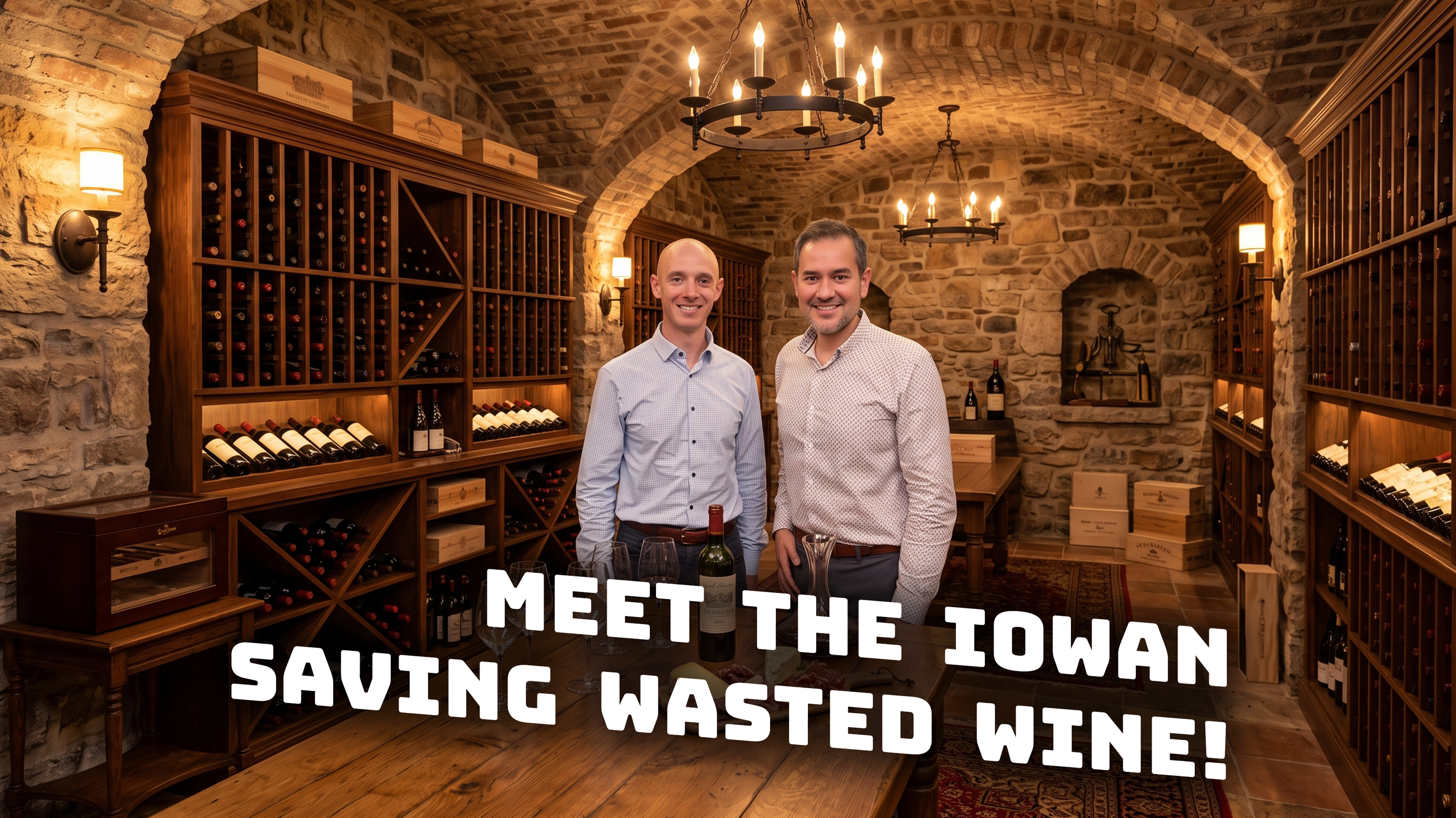



You’d think Tom Lutz, founder of Repour Wine Saver would be shaking in his boots with restaurant traffic down and the NA movement driving down the consumption of alcohol, but you’d be wrong. In a counterintuitive local-Iowa victory story, lower alcohol sales are big business.
Lutz’s technological breakthrough “eats” oxygen from the bottle keeping it fresh for longer. As consumers purchase less wine, they’re becoming more selective, turning to more expensive bottles. And because they drink less per sitting, they’re choosing to save that nice bottle and stretch it. The same story rings true for restaurants, and that’s where Repour has found big business.

To combat the revenue lost when opened bottles spoil, Iowa entrepreneur and PhD chemist Lutz created RePour Wine Saver, a specialized stopper that actively absorbs oxygen. “I like to call oxygen the frenemy of wine,” Lutz explained, noting that while oxygen initially opens up flavor, it eventually enables bacteria to convert ethanol into vinegar. Unlike traditional vacuum pumps that leave residual air, RePour utilizes tailored oxygen-scavenging chemistry to eliminate 100% of the bottle’s oxygen. This solves a major pain point for hospitality venues, where studies show 96% of patrons will not complain about a bad glass, choosing instead not to return.
Hear from Iowans directly. No algorithms.
Don’t let the algorithms choose your news. Enter your email address to hear directly from Iowans leading news in politics, community, agriculture and business. No editing. No clickbait. No rage. No agenda.
Manufacturing and Scaling Distribution Out of Iowa
Transitioning from a garage concept to full production required tapping into Iowa’s entrepreneurial network and custom engineering. Lutz’s team built an automated production line in Cedar Rapids using 3D-printed components. “We spit out a stopper about every two seconds,” Lutz said regarding the manufacturing capability, which supports single-use stoppers designed to preserve wine bottle-by-bottle.
Backed by private investment and State of Iowa support, RePour pivoted its distribution strategy following early COVID-19 disruptions. After validating the product through 600 sample deployments to Wine Spectator recognized restaurants, the company landed national accounts including Landry’s Restaurant Group (Morton’s Steakhouse and Saltgrass) and roughly half of Total Wine retail locations nationwide. With consumer trends shifting toward lower-volume, higher-quality wine consumption, RePour provides an essential waste-reduction tool for both restaurants and home drinkers. Reflecting on his journey from scientist to manufacturer, Lutz offered key advice for founders: “Try to know your strengths, but probably more importantly, know your weaknesses, and try to find people to help you with those weaknesses.”
Interview Transcript
This transcript was created with help from Ai. Please report errors to us and always refer to the video as your primary source.
Justin Brady: From the Jethro’s BBQ studio, it is the Iowa Business Podcast. I’m, of course, Justin Brady And we all like wine. Well, not all of us, but there’s that problem with wine. It’s a cool Iowa business story today, of course, like we always do. There’s that problem with wine where you open it and it gets gross, and you have to drink it or dump it down the drain. I’ve actually… I don’t know how many bottles of wine I’ve dumped down the drain ’cause it just tasted gross, and apparently you have the solution for that. Tom Lutz, the, uh, co-founder of RePour Wine Saver joins us today. Thanks so much for coming on the Iowa Business Podcast.
Tom Lutz: on the- Yeah. great great to be here, Justin. Thanks for having me.
Justin Brady: many- w- how many… We- we’ll get into this here. We have a, like, a sponsor thing. But really quickly. How many bottles of wine have you thrown down the drain in your life before making this?
Tom Lutz: Well, since we started this, not too many, but, uh, before that enough. Too many
Justin Brady: out enough. Yeah. Yeah yeah. Uh, it’s, it’s, like, uh, cringey. It’s, like, heart- heartbreaking every time you do it. Uh, before we get started, everybody, Dentons Davis Brown is a beautiful sponsor here. We love them. They don’t just sponsor the show. They actually bring… They throw experts in here. For 15 minutes, we break down really difficult legal things. Uh, Joellen Whitney was just in here talking about AI and how to manage that from a legal standpoint. Are you collecting too much data from your employees? Yeah, that’s a thing. Kinda gives you a bigger legal haystack and actually makes you liable for more stuff you don’t really wanna be liable for. Fascinating. Fascinating stuff. If you wanna see that interview and all The others with all their other experts, go to… All their lawyer experts. Go to iowapodcast.com/business. We have them all up there. We love those people. Tom, like I said, thank you for saving all the wine. Can I, Uh, just… just to set some context here. There’s a… I wanna know about building in Iowa, growth, distribution, how you manufactured this, all, all these, all these things that Iowa entrepreneurs, Iowa executives wanna know. But first, what does it do? Because it’s, it looks like a cork for wine, But it magically eats oxygen. Or ex-
Tom Lutz: Yeah, you got it. Yeah
Justin Brady: how this RePour wine thing here in Iowa that you’ve made works.
Tom Lutz: Yeah, so, uh, I like to call oxygen the frenemy of wine. If you’re a wine drinker, you open up that bottle of wine, you know that wine opens up, it starts to taste great. Um, that’s where it says friend, right? Uh, it becomes the enemy as soon as you wanna save that bottle of wine for another day. So it literally is oxygen… There’s a bacteria inside of the wine that turns, uh, the ethanol, the, the alcohol in the wine into vinegar. So that, the reason it tastes gross, the reason you’re throwing it out after a couple days, is truly you’re turning, uh, the ethanol into vinegar. So any wine preservation product is really trying to manage oxygen. So no oxygen, the, the wine will stay fresh. So you might have tried a vacuum pump before or, you know, other… There’s all sorts of things out there that, you know, f- quite frankly, just don’t work very well, um, because they don’t remove 100% of the oxygen. So my aha moment was a half bottle of wine 11 years ago. We had a newborn son, he was two weeks old. Um, my wife was resting and I was kind of staying up, keeping an eye on him in the middle of the night and, uh, thinking about that w- bottle of wine we just threw away. Half bottle of wine as she was starting to have a glass of wine again. And I thought, so I’m a sci- I’m a scientist, I’m a chemist by training, and I thought, “You know, there’s gotta be a way of getting oxygen out of that bottle other than a vacuum pump or just trying to push air out of the way.” So I thought about it, started putting my chemistry brain to work a little bit, and oxygen scavenging, oxygen absorption is something that’s actually used in the food industry around us. Uh, if you open up a bag of beef jerky, the little packet inside of there-
Justin Brady: desiccant
Tom Lutz: Desiccant. Uh, uh, that’s what everyone always says. First thing is a s- yep. So, so desiccant is silica gel, that absorbs moisture. Um, moisture, if it was beef jerky, would get chewy and really hard to eat, right? So they want it to stay moist, um, but they have to get rid of all the oxygen so it’ll stay fresh. So I tailored that chemistry to work really well in a wine environment. So it removes 100% of the oxygen ’cause it’s a active process. So that whole looking like a stopper thing is kind of a blessing and a curse for us because people have tried so many wine gimmicks that, you know, fun- fundamentally just don’t work. They look at our stopper and like, “Oh, how can that little plastic stopper possibly keep my wine fresh?” But in reality, there’s a material inside of that. There’s a little foil tab on the bottom of the stopper. Uh, you remove that from the wine saver, put it in the bottle. That report, that wine preservation technology is inside each report.
Justin Brady: Mm-hmm. Uh, that just gets and it slowly starts eating at the oxygen basically. Yeah. That’s– So did you have, um… You said you’re a scientist by trade. Have you worked on this stuff before, like, uh, oxygen eating? Did you do this in school or anything? Did you- Yeah. Where does all this come
Tom Lutz: yeah, no, I, I have a PhD in chemistry, so my whole professional life has kind of been where science meets real world problems. Uh, and that was just the real world problem that hit me that night. Um, and we enjoyed wine. Uh, definitely not, uh, you know, a sommelier expert level wine. I’ve learned a lot over the last 10, 11 years, of course. Uh, and I would say my wine knowledge has increased, but, uh, it was really more just a personal problem that, um, I thought I could come up with a good solution to
Justin Brady: I’m assuming it doesn’t work in just wine. I’m assuming we could put it on a bottle of bourbon and other things like that ’cause they have the same problems. Maybe they don’t have the same problems. I don’t
Tom Lutz: they’re not as fast, right? so- um, I have been told, um, bourbon will, will stay fresher with it. Um, vermouth, things like that, olive oil, things that– anything that will deteriorate with oxygen, um, The Rapport technology could work on and keep it
Justin Brady: You say a key word there, which is could. So are these future product lines, like, uh, olive oil toppers and bourbon toppers? Is it, is
Tom Lutz: Yeah, those, I mean, those are all things that are on our mind, but, you know, right now wine is our core, uh, focal point. We’re still building a brand, building a business, so, um, staying true to that wine industry, which is massive and has a huge need. Um, so that’s really where the focus is, but those are all ideas that, you know, could come down the pipeline at some point.
Justin Brady: It’s kind of like, um, we see those ideas, but we’re just trying to keep up with wine right now. Uh, what I like about this, correct me if I’m wrong, is if there’s a foil tab we remove off the bottom, and if this thing is eating oxygen, that would suggest that eventually the thing gets full of oxygen. So from a business model standpoint, can you sell like crates of these to restaurants and just keep reselling them when they, when the current ones are expired or used?
Tom Lutz: Yeah, so one stopper is good for one bottle of
Justin Brady: Dude, that’s awesome.
Tom Lutz: it, I mean, it, it really is like a tank of gas. I t- I tell people, you know, so o- when it’s empty, it’s …it’s done. It’ll, it’ll work as a stopper, but it won’t keep your wine fresh anymore
Justin Brady: Got it. So when the cork comes off, when you wanna save the wine, that’s for that bottle, and when that bottle’s expired, the cork is
Tom Lutz: Yes, exactly. So
Justin Brady: this is good reoccurring revenue for the company then, because if you’re selling this stuff, uh, it’s a, it’s, it really is a win-win, ’cause it’s win-win f- it’s a, it’s a win for you ’cause it’s recurring revenue, duh. It’s a win for the restaurant because especially if they’re putting this on their nice bottles of wine, they’re not dumping 15, 20, $30 down the drain every time. This is the win-win, right? Am I missing
Tom Lutz: no, you, you, got it, and, and it’s, it’s ease of use. So restaurants, it’s all about speed of service. Yeah. Um, you know, on a busy night, you don’t wanna take time dealing with anything, really. You wanna get a drink out to your customers, have them enjoy it, come back for another drink. Um, so we really work as a close-of-night procedure. So at the end of the night, when you’ve opened a bottle of wine that you wanna keep fresh, that’s when you remove the Foil Tab and stop the bottle. And same thing at home, actually, as well. So if you happen to finish that great bottle of wine, you don’t have to waste a s- a report on it. But, you know, if you have leftover, it’ll keep it fresh until the last glass is served from that bottle
Justin Brady: Yeah, that’s… ‘Cause this is a huge pro- I mean, I’m assuming you sell a lot to restaurants. You sell to consumer, I think, on Amazon, websites, stuff like that. Yeah, yeah. But, um, I know it’s a huge problem for restaurants ’cause they really are dumping thousands of dollars down the drain all the time.
Tom Lutz: They do. A- And, and it’s guest experience too, right? So a three-day-old
Justin Brady: I’ve had bad, I’ve had bottles when I order by the glass sometimes, I know what comes with that, which is sometimes it’s a flat bottle, right? Like I know with that, and, and it’s happened more times than not when I’m– And I feel bad ’cause I don’t send it back or anything ’cause I’m like, “Well, I did order by the glass. It’s kind of on me.” You know what I mean?
Tom Lutz: know, you you hit exactly on it. So most people don’t complain. Right. There, there’s some statistics that 96% of people won’t complain about a gla- a bad glass
Justin Brady: Ooh. wow, 96? Yeah, so- So they
Tom Lutz: we’re not confident. Yeah, yeah, yeah. And if you layer that with other pieces of your business that maybe weren’t a perfect experience, then they d- just don’t come back is the problem. And it’s not just ’cause of wine, but the whole experience, right?
Justin Brady: Not just- And that means the business owner might lose that revenue ’cause they don’t come back, and no one ever talks about it. Yeah, that’s cool. I know this may be for people who aren’t wine drinkers or, you know, they’re like, “This sounds like a stupid problem.” It’s definitely a problem. It costs, uh, restaurant owners thousands of dollars, especially now with the NA movement and, like, drinking is kind of on the decrease, so those margins are getting thinner. Yep So you’re kind of at the center of this. Um, I wanna talk about, uh, the invention part of it the manufacturing part of it. Um, you’re a chemist, scientist, not a manufacturer. I mean, you weren’t. Uh,
Tom Lutz: we are now.
Justin Brady: Yeah, you are now. How’d you figure this stuff out? Because this is a part chemistry and science, but also part manufacturing, so it wasn’t just go 3D print it, ’cause it was a little bit more complicated than that. So you’re an outsider. How did you start to say, “I know in my head how this works, but how do I manufacture and make this in Iowa?” How did you figure this out?
Tom Lutz: Yeah, so I would say my personal strengths is, have always been more on that problem-solving side of things. So we do make it, make it here in Iowa, make it in Cedar Rapids area, uh, have our, our own production line. It’s a home-built line, so it’s built… You, you made a comment about 3D parts, but half of our production line is built from 3D parts. So, um, we are, we, we spit out a, a stopper about every two minutes or two seconds, sorry, two seconds. So, uh, an operator loads it up with parts, and it comes out the back end, but it’s all a home-built machine. Um, so there’s a lot of trial and error with that. There was a lot of, uh, learning through the, the process. Uh, started out in my garage. I mean, that’s where the, the, the original line was being built and, um, made, and it’s slowly been built onto and added onto. And, uh, you know, part of that is the, the massively supportive, um, entrepreneurial network here in, in Iowa that’s been so helpful. So what I’ve loved is when we have a problem and we don’t know, quite know how to fix it, there’s somebody that’s willing to offer some advice, some suggestions, some guidance. And as a, as a startup here, starting really probably eight years ago, seven, eight years ago is when we really started the process, it was that supportive network that filled in the gaps, right? We can find some of the solutions, but we don’t have all the answers.
Justin Brady: Right. So you didn’t know how to start with any of this stuff, and so you just straight up started asking the entrepreneurial network here in Iowa, ” How do I do this? Or, “How do I set up this machine?” Or how… This is, this is l- literally how this started here in
Tom Lutz: Yeah, exactly. yep. What networks did you plug into?
Justin Brady: ‘Cause that’s- Yeah … like, I kinda, I’m in the, plugged into the entrepreneurial network- Yeah so I kinda, know some of the names, but people who aren’t, they, they’re like, “I don’t even know what the network is. I don’t know where the door is. I don’t know who to go meet.” So how did you find this magical entrepreneurial network? I think it’s two things. I mean, there is a pretty robust true entrepreneurial network here, right? So when I s- like I said, I was good with the science, but not necessarily the branding and marketing. So if you jump ahead a little bit, I walked into the EDC, an Entrepreneurial Development Center in Cedar Rapids, and said, “I don’t know much about marketing,” or I’m n- I feel like that’s a weakness that I really need help with, right?
Tom Lutz: So once we knew the s- the science and the technology worked really well, it’s like now we gotta build out the brand. We gotta build out the messaging and all of that. Walked in there and got support there. When it came to building the production line, it really just came from the network of friends, family, and people that I ran into. It’s, it, you know, the other big thing I’ve learned about Iowa is people in Iowa are just awesome. I mean, you, you ask for help, you ask for guidance, people raise their hand and wanna help you. So one of my business partners, good friend now, is, uh, was just t- we had kids in school together. They had moved here, um, from out of state, um, from here, from Iowa originally. Um, and, you know, he, he said one day, “What do you do?” And I said, “Well, I, I make, you know, I’m, this is my product and I’m working on it.” And he’s like, “You know, I’d love to learn more about that. That’d be fascinating.” It turns out he’s Kaizen trained in, in operational efficiency, spent much of his professional career in big warehouses and production and engineering-based stuff, and he and I effectively built this line together. Um, found a, a, another gentleman that was, uh, an engineer at Rockwell that loved just tinkering and doing things, and he filled in some of the gaps of programming that we didn’t necessarily have to run the line. So kind of a non-traditional entrepreneurial network, if you will. They weren’t necessarily starting their own businesses, but, um, willing to help, willing to support people, um, from the, from the production line anyway.
Justin Brady: I think a lot of people in Iowa, entrepreneurs, people wanting to start a business, they don’t understand how accessible that is. Um, obviously it’s hard work. There, there have been, I’m sure, sleepless nights, times you wanted to throw up ’cause you’re like, “Oh my gosh, is this ever gonna work?” Like, we hear those stories. Uh, we, we should do more basically on the anxiety founders go through, but… You may need more than 30 minutes for that one. Yeah. That, that that could be a rough show. There’d be tissue Boxes um, crying, um, gnashing of teeth. Um, but I think a lot of founders, entrepreneur w- and prospective founders don’t understand that you can. You said you just went into the EDC in Cedar Rapids, Entrepreneur- Entrepreneurial Development Center- Yep. and said “I don’t know how to do this stuff. Who helps?” And they’re like, “Yeah, here’s who…” This is Literally how it works in Iowa. Some people think that’s crazy. Yeah. But you can go to Gravitate Downtown. You can go to the Partnership. You can go to these places and, um, they’ll say, “Yeah, here are the people you need to talk to.” Like, I can’t tell you how many times someone said, “Hey, Justin, someone’s working on this. Can I just loop them into you?” And they’re like… And then I talk to them and they’re like, “You… Did someone just loop me into you? And you just took the me- What, what is this?” I was like, “Bro, this is Iowa. This is literally how it works. You can Call and schedule a meeting with you. It’s nuts.”
Tom Lutz: Well, and, And, that’s really how a lot of the other supportive things have happened. It’s been bus- other business owners that are like, “Hey, I, I’ve got an issue.” You… Cedar Crest is a pen, um, uh, printer. They do all the custom logos of pens, and we wanted to do some, some logoing of our stoppers for brands, right? They helped us out for a few years j- getting that set up. So just a business that has a, a skill set and a, a strength and was willing to help us do some things.
Justin Brady: Uh, the distribution thing’s hard for people. Like, they’re like, “Cool, I made it. How do I sell it?” So did you just… Um, walk us through that. Did you just straight up list it on Amazon? Did you make a Shopify store? Did you do a little of both? Did you try one or the other? What worked? What didn’t? How’d you figure that out?
Tom Lutz: Yeah, our story’s a little interesting. So, uh, shortly before we were ready to start selling it, I did a Kickstarter campaign, and I… And it was more for feedback on the product and the technology than a actual boost to get us started, right? And we got some great feedback on things with the brand and things to do differently, but that brought a lot of customers to us that I wasn’t ever expecting. So- The Kickstarter did. The, the Kickstarter did. So Brookstone found us back then, right? So- Through Kickstarter? Through Kickstarter, right. ‘Cause it, you know, Brookstone, before they went through bankruptcy, that was kind of the… You know, they would keep an eye on Kickstarter for cool brands, cool ideas, things they could bring in, right? So Our first real shipment was to, to Brookstone. Really? Non-wine focused, non… You know, So we had a bunch of kind of random customers that were non-Iowa based customers when we started out. We also knew that because wine preservation, there’s so many gimmicks on there, we had a, we have an element of education- Ooh before trust, right? So for us, we really took the first couple years saying, “We’re selling, yes. We’re on Amazon, we’ve listed, but we really need to get the validation from wine people before we really try to push hard.” So we went to a couple sommelier focused, sommeliers are the wine experts, right? Um, uh, industry events. So r- really for two or three years, that was the focus more than selling. Um, and it was really re- restaurant focused ’cause I figured, you know, to try to educate every consumer’s so much harder than if you get some real credible, uh, people that, that everyone looks to, right, for, for, for success, um, or for validation. So it was really January of 2020 when we crossed that threshold and said, “Okay, we’re ready to start selling.” Um, so we sent out 600 samples to Wine Spectator restaurants. At- Really? At that point, 90-
Justin Brady: being the magazine or- Yeah, so- Isn’t it Like, a magazine? or a rankings? I So there, there’s a Wine Spectator list.
Tom Lutz: So y- Oh, like that. Right? So re- restaurants that are listed in that. Some of them are, uh, I believe may be paid to get there, some of them. But they, they care about their wine list, they care about having a really quality wine program. Lot of great interest, follow, you know, feedback right away. Um, and at that point be, by design, probably 90% of our customers were restaurants. So you, you remember what happened in January and February 2020.
Justin Brady: Oh, no the, all those samples out, ready to really transition from validation into selling, um, and COVID hit, obviously. So we
Tom Lutz: kind of just said, “Let’s stick our head in the sand and make sure we see if we have a business after COVID.” Um, and we’ve got some… We had some Amazon sales, we had some direct to consumer sales, but the restaurant was really the focus. Um, so I would say as, as, even though we’ve been around for eight to 10 years, it’s really been the last two or three when we’ve really said, “Okay, we have a business. Let’s start selling. Let’s start marketing.” Recently take, took on some investment. Again, all Iowa people supporting, you know, Iowa businesses. Um, and now we’re really transitioning into more in that selling and that placement mode.
Justin Brady: Yeah. I like what you said there. I wanna push in on it. We don’t need to spend more than 30 seconds on it, but I just wanna highlight it, which is, um, you said that just making the cool product wasn’t good enough because in your industry, in the wine industry, people all have seen the gimmicks before, and they generally have a default state of, “Nah, I don’t believe it.” And so I see this a lot with founders. For those that don’t know, my full-time st- job is PR comms, and every single founder, many of them have made these amazing, uh, technologies and amazing solutions, and they think it’s as easy as just let the world know, do a couple Facebook ads, and you’ll sell a bunch. But I tell them, the world is at default state of not believing you. And so the way what you did, which was key, is you reached out to the people who control that trust in your industry to win them over first, knowing that you needed that validation. That’s a huge thing, and I would say it’s a huge thing that some founders don’t learn after decades. So for people listening, like, that’s a, that’s a big deal. No one believes you. Um, you mentioned the investment Uh, I think it’s, you’re talking about the IEDA 250,000? Is
Tom Lutz: we had two, two investments. We actually took on some private investment, so- And private investment too. Yep. A- as well as the-
Justin Brady: what that’s gonna be? used for.
Tom Lutz: gonna be? Uh, it’s really a brand awareness sa- sales and marketing, right? So you know, the, the, theory, to, to your point, that we make a great product, people are gonna find us and love us and share it and to other people, it’s worked a little bit, but it’s slow, right? So, um, for me, one of the things I was really looking for was that marquee industry person to start using Rapport. So- Oh … um, thinking that would add more credibility, validation, widespread usage, right? So, um, one of the big names in the restaurant business from a, a massive chain is the Landry’s Restaurant Group. Um, so Morton’s Steakhouse started using us about a year ago. Um, Sal- Saltgrass is one of them. They’re kinda like an Outback. There’s about 100 of those locations. So in the last year or two, kinda since I said once we kinda came out of the, the hangover of COVID, is when we’ve really started to get more traction with some of those national accounts. Um, and with that, you know, you can only bootstrap and do word of mouth so much. And the wine industry, the alcohol industry, is also in a lot of flux. So a lot of wine programs right now, they have two ways they can go with their wine programs. They can cut them down because they’re not quite sure which wine’s gonna sell when, and, you know, now we’ve got a massive waste problem, so let’s reduce our by-the-glass list from 18 wines to eight, right? So they can do that, or they can find a solution to the waste issue, and we’re finding that a lot of restaurants are looking for that solution right now. So to get our name out there more, that awareness factor, really needing funding to support that, be it more trade shows. Up until recently, we’ve only been to… We’d– Before last summer, we had not been to an industry event other than a couple sommelier conferences.
Justin Brady: is growth, It’s marketing, it’s awareness it’s Sales it’s that kind of stuff
Tom Lutz: Sales and marketing is en- entirely what we’re using it for right now
Justin Brady: This is interesting because, like we talked about m- like 10 minutes ago, um, there’s this big NA movement. Um, people are drinking less. You have people like Huberman talking about, “Hey, one, maybe two drinks a week,” and that’s it, right? You hear this a lot. You see Gen Z is going to be one of the driest generations in decades. Think some people would say, ” Well, uh, Tom, this is quite a crappy time to be in this industry,” but you’re saying the opposite may be true, which is because people are drinking less, when they go out, they’re probably going to be drinking nicer things. It’s kind of almost… what we saw in cigars, really. Like, Um, I’m not sure if you’re aware of this, but in the last I think it’s five years, people have started smoking less cigars. But when they do smoke cigars, it’s nicer ones. So cigar places are sto- not carrying the cheaper stuff as much, and they’re starting to stock the nicer stuff. So that might play to your advantage, where people are actually wanting to save wine and stretch these bottles longer. So is this, is this what I’m seeing? Is this
Tom Lutz: What I’m saying is this- Hun- 100%. I, bo- both, both at home consumption and in restaurants,
Justin Brady: point, cause people aren’t gonna slam a whole bottle at at night because they’re trying to drink less, so they’re gonna wanna stretch that bottle.
Tom Lutz: they don’t want a hangover, so they’re gonna stretch that bottle. Yep, if I’m gonna go buy a bottle of wine, whatever’s a nice bottle for me, whether it’s a $10 bottle of wine, a $100 bottle of wine, you know, before I might save that for a very special occasion. I might have a cheaper bottle of wine or something that is not considered nice for me, right? Um, now it’s, might be a Tuesday night, I would like a glass of wine, but I have no idea when I’m gonna come back to that bottle. It might be tomorrow, it might be two weeks from now. So there’s a massive need, um, for people that want to enjoy a nice glass of wine. I’m getting a lot of feedback from restaurants that they’re succeeding with the better wines. Um, it’s actually, they’re exactly to what your point. Yeah. Their people are trading up. I might only have one glass tonight instead of two. Um, if I’m gonna have that glass, I might as well get something I enjoy.
Justin Brady: That makes so much sense. Um, yeah, the NA movement. What are some o- some of the other, like, scale challenges? You mentioned marketing challenges. You mentioned, you mentioned, um, putting the word out there and then COVID, um, kinda hitting you. What have been some of the other challenges? Like, is there any challenge in, you know, making it in the USA? Like, is this a some… For some industries, making things in the USA is difficult because of X, Y, and Z, or talent or materials. How about for you? Has been- making it in Iowa and in the USA been a challenge, or has it been, uh, Helpful
Tom Lutz: You know, uh, uh, so being associated with some other businesses in the past, I, I thought overseas, um, you know, cash flow conversions, um, inventory tied up in cash, timelines of management of things. You can’t respond to demand shifts and things like that. All of that and bringing, and having manufacturing here has been awesome, and the only challenge that we actually ran, have run into so far is, um, kind of in that halo of COVID. Um, our, our, our stopper has that rubber black-looking piece on it. Um, and it’s, it’s a thermoplastic, and I never even thought about it being tied to the oil industry coming out of the Gulf of Mexico, and it turned out that was the timeframe where there was a hurricane and a big freeze and a bunch of oil refineries went offline, and we act- I- never was on my radar that that was a potential cause or concern for problem. So we got a little tight on inventory, almost ran out at that point, but other than that one window, it’s been… Actually, I, I actually think it’s a blessing that we’re making it here and not dealing with, um, well, now with tariffs and everything else as well. So for us it’s been a great, um, opportunity. Um, the way we actually build our product, we have consumer packs, we have restaurant style packs. We actually keep most of our inventory in WIP, um, as just, as just, sorry, um, work in process inventory. Okay. So more just the raw stoppers, not the packed out finished goods stopper in the packaging. So we can adjust very quickly if we have a big si- spike from a certain restaurant versus a consumer. Total Wine, for e- for example, right now has recently brought us in, and we’re in, uh, about half of their locations.
Justin Brady: this happen?
Tom Lutz: Uh, in the last six weeks. Uh, early July. Early Ju- July, yeah
Justin Brady: Iowa company Repour and Total Wine? We don’t, I don’t think we have any Total
Tom Lutz: Not yet. I, uh, yeah, I was out at their corporate offices. I’m like, “Well, I would love to, love to see you here, too,” but yeah
Justin Brady: they’re a big operation.
Tom Lutz: They are, yeah That’s crazy
Justin Brady: If you’re in Total Wine, that’s a big, for those that don’t know, my gosh, that’s a big
Tom Lutz: Yeah, that’s, uh, we’re very excited about that opportunity, yeah. Yeah, when
Justin Brady: when, uh, hypothetically, when we visit other states, sometimes we may buy things from there, and I think there was that one, like, there’s some weird law. You’re not supposed to bring stuff over. Nobody does that. What are we talking about? No, let’s not talk about that. Um, but no, it’s a huge operation, Total Wine. They move a lot. They get great prices, too. So yeah, that’s, that’s a big win. Um, the, I wanna talk about the, like the, the… Well, you mentioned the supply chain being really, really close to home and how that’s been an advantage with economic moves and, um, the… Do you see any other, what am I trying to ask here? You mentioned having everything really local has been an economic advantage. Is that because this– Is I wanted to ask a question. Is that because market changes, tariffs, things change, and you just have it All local This makes things easier. You can, with ebb and flow and market changes. It’s The crappiest way to ask this question- but I think you know what I’m trying to ask.
Tom Lutz: I, you know, I think that’s part of it. I think part of it is that Midwest supporting Midwest, Iowa supporting Iowa, right? Oh, sure. So you know, COVID was t- tough on businesses. You know, ba- local bank was much more supportive in helping us through challenging times than, you know, some national bank that might not care, right? So, you know, or with Cedar Rapids Bank and Trust, they’ve been a great local supporting business for us, you know, supporting local businesses, for example. Our manufacturer has, you know, if cash got a little tight at some point, they were willing to extend terms or just change out the due date on an invoice a little bit instead of just hammer on the door, “Where’s our invo-” You know? And, and you know, that, that was all kinda halo of COVID of course, but that’s the kind of relationships that being here and building this business in Iowa has really been helpful with.
Justin Brady: What are some of the tech things you’re using? ‘Cause I like to ask this question now because AI and manufacturing and things are getting, like, things are changing very quickly, so I’m starting to ask founders what are the tech solutions you’re using, AI or not, or, you know, or what are you Looking at in the very near future that you’re excited about that’ll, like, uh, make things more efficient?
Tom Lutz: Yeah, I mean the, the biggest thing for us is, you know, is, is, um, CRM tools. So we use HubSpot as our management of, of people, um, or of customers. Um, that and, you know, AI to simplify processes or organize things quicker, um, has been massive for us.
Justin Brady: mm-hmm
Tom Lutz: Um, as we’re, you know, looking and talking with new customers, just using those as tools to understand their needs better and faster instead of we don’t have every restaurant group here in Iowa, right? So how do I learn about a restaurant that’s not physically here in the state? And there’s some tools now that can help us do that, which helps.
Justin Brady: Yeah. Uh, la- probably, um, two questions before we go, which is, are there plans in the future, I kinda hinted at this earlier, are there plans in the future to expand to other use cases? Not just liquor or wine, but does this technology apply in other industries that you’ve looked into?
Tom Lutz: It absolutely does. Um, the, the wine industry is so massive that, you know, from a small business, um, staying focused is really critical. Even within the wine industry, it’s hard to stay focused because we have a consumer, we have wineries, we have restaurants, we have international, um, different types of wine we can focus on a little differently. So it’s certainly in a longer term vision and plan, um, but in the near to mid time fr- time, uh, timeframe, I guess, um, it would really be focusing on wine in the US specifically.
Justin Brady: Sure, ’cause I’m just thinking things that seal, that eat oxygen, there’ve gotta be tons of use cases for that in food and beverage, but medical and aerospace, there’s gotta be a ton of, ton of use Yeah, no, the technology can certainly be applied, uh, to a lot of, lot of different areas. to BD, TBD I guess is what I’m hearing. Uh, last question would be if someone has a widget or a gadget or a piece of hardware in their head in Iowa and they wanna start it, it… ‘Cause where’s the starting point? Um, how do they, how do they get started? How do they get validation quickly and know if it’s worth pursuing or whether they should just back off?
Tom Lutz: Yeah, I’d do, do some peer reviews, even if it’s just your neighbor or whatever, right? Like find people that can give you feedback and try to be honest with listening to the feedback. It’s, it’s easy to just, to, to discount what everyone says and say, “My idea is the way.” You know, for, for me, I think the most successful piece of advice I can give is try to know your strengths, but probably more importantly, know your weaknesses, and try to find people to help you with those weaknesses.
Justin Brady: That’s good advice. Tom Lutz, the co-founder of Rapport Wine Saver. What’s the website in case people wanna learn more and save a couple
Tom Lutz: Yeah, just, just repour.com, R-E-P-O-U-R.com
Justin Brady: Awesome. Tom, thanks for coming on the Iowa Business Podcast
Tom Lutz: being here. Thank you