


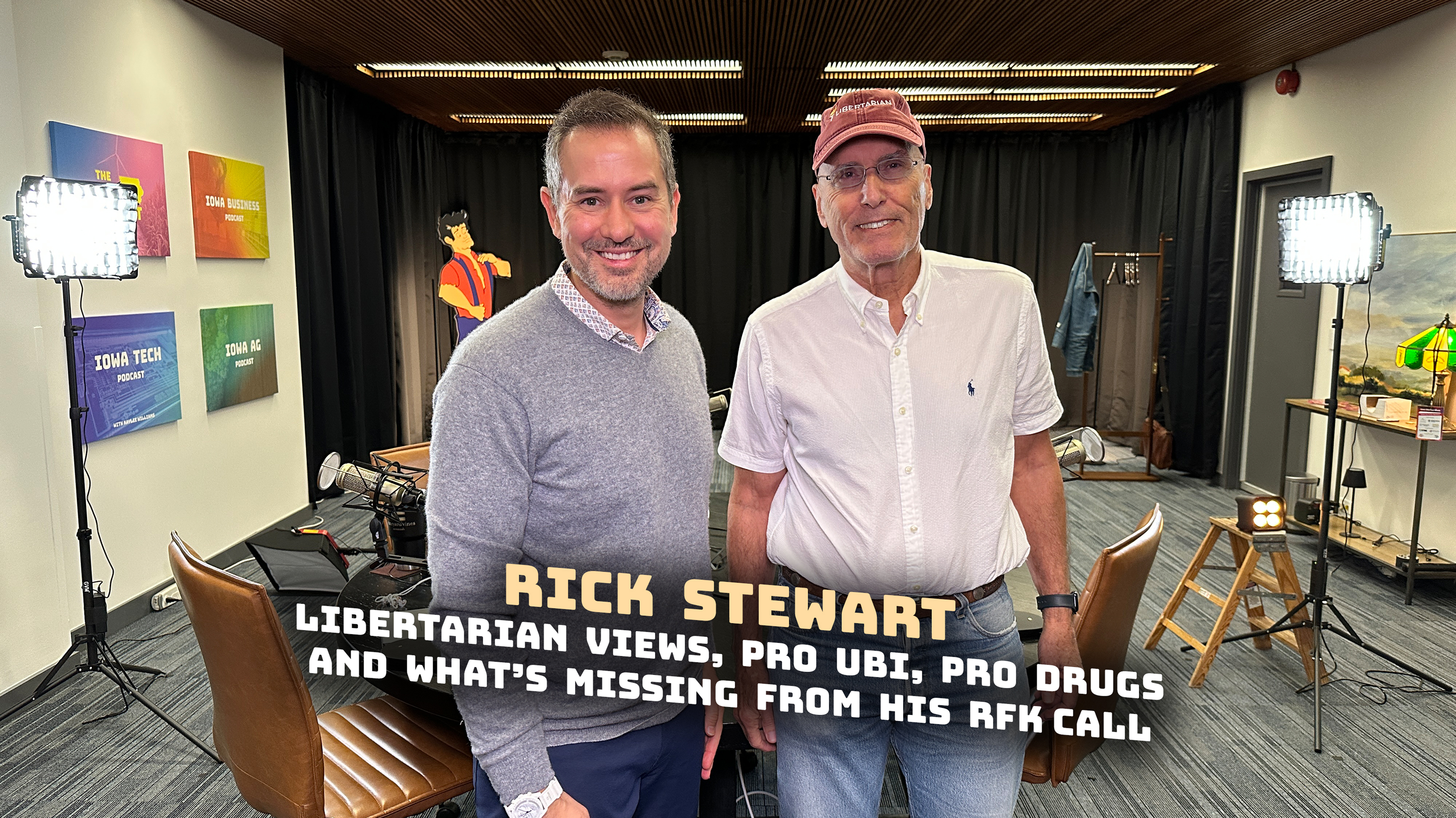

Update, Nov. 4, 2026: Rick Stewart (L) lost the 2026 race for Iowa’s 2nd Congressional District to Lindsay James (D).


Libertarian candidate for US Congress, Rick Stewart defends Universal Basic Income from a Libertarian viewpoint, abolishing income tax, legalization of drugs, erased portions of his call with HHS Secretary Bobby Kennedy, and in a bonus wrap-up chat, how he never collected signatures to get on the ballot.
Stewart has run for U.S. Senate, Secretary of Agriculture, Governor, and now the US House of Representatives. He addresses the Libertarian Party losing popularity, despite more voters claiming to be independent, explains how the party was hijacked, why he believes they’ve finally righted the ship.
Mounting his sixth bid for public office, Stewart is challenging Iowa’s political status quo in the race for the 2nd Congressional District. In an interview centered on systemic policy overhauls, Stewart detailed plans to eliminate illicit drug markets, challenge entrenched two-party control, and replace conventional welfare programs with a streamlined safety net
Hear from Iowans directly. No algorithms.
Don’t let the algorithms choose your news. Enter your email address to hear directly from Iowans leading news in politics, community, agriculture and business. No editing. No clickbait. No rage. No agenda.
Ending the Drug War and Partisan Duopoly
Stewart condemned current federal drug policy, pointing out that annual overdose fatalities surged twentyfold from 5,000 to over 100,000 following fentanyl’s entry into illicit channels. Stewart contended that prohibition itself fosters contamination and lethal usage. “The drug war is probably the first or second worst idea America’s ever had,” Stewart argued, advocating for pharmaceutical-grade regulation distributed through licensed pharmacies with clear dosing guidelines to curb addiction.
Beyond criminal justice, Stewart addressed structural hurdles confronting third-party candidates following shifts from Gary Johnson’s 3.3% presidential showing to Chase Oliver’s 0.42%. Pointing to partisan stagnation, Stewart insisted that structural reform is vital to representative democracy: “There has to be a minimum of three people on the ballot for every single position that’s federal and most of the state positions”.
Replacing Income Taxes with Land Value and UBI
Stewart targeted the nation’s 140,000-page income tax code, proposing to abolish it entirely in favor of an unavoidable, single-page land value assessment. With government spending representing roughly 38% of the economy across local, state, and federal levels, Stewart proposed consolidating all existing entitlement programs—including Social Security, Medicare, and Medicaid—into direct monthly cash dividends. “All I’m proposing is to replace every welfare system that we currently have with a universal basic income,” Stewart stated, arguing that direct, equal payments coupled with transparent flat funding would expose actual fiscal costs to voters and curtail bureaucratic bloat.
Interview Transcript
This transcript was created with help from Ai. Please report errors to us and always refer to the video as your primary source.
Justin Brady: From the Jethro’s Barbecue Studio, it is the Iowa Podcast, and a familiar name who’s running for House. He’s run for a couple offices in here, in the state of Iowa. Hasn’t got them yet. Maybe this time it’s gonna be different. Rick Stewart joins us today. He’s running for the Iowa US… Excuse me, the US House of Representatives in District 2, and he joins us today. Rick, thank you so much for coming on the show. Really appreciate it.
Rick Stewart: I just came for the barbecue
Justin Brady: You just came for the barbecue? Yeah. Where is the barbecue?
Rick Stewart: What’s he saying? Justin, I, I, no,
Justin Brady: it.
Rick Stewart: I, I really, I really appreciate the
Justin Brady: We’re hap- we’re happy to, have you
Rick Stewart: the people that, uh, that, uh, appreciate you, and, uh, we’re gonna have a good
Justin Brady: We are gonna have a good talk. I’m glad you’re here. Like I said, Rick, uh, thank you so much for joining us. Candidate for Congress. This is not your first rodeo. But I wanna start out with the RFK call that you published. Um, the Gazette, I think, published a little bit of the audio. I wanna talk about that first to get into this, and there are a few hard cuts in that audio. Uh, what, was, was the whole call 10 minutes or was it longer with, uh, Secretary Kennedy?
Rick Stewart: Uh, first of all, uh, I wanna just make it clear that I did not record that call. I did not publish that call. I’ve never heard that call. But I was there, uh, and there was a person that did record that call, uh, sitting, uh, close to me when I made… when, when I received the call. Okay. Uh, for me, that’s just politics as usual. It’s nothing special. Uh, I didn’t know RFK beforehand. I’m sure he’s not gonna call me back, but he did call me.
Justin Brady: Probably not
Rick Stewart: Uh, yeah, you know, uh, it’s, it’s just politics, okay? And, and I’ve… It is my sixth time around, so I’m slowly figuring out, oh, that’s just the way that politics works, right? Uh, there, there… I think that there was a break in it, uh, because, uh, the, uh, phone that was recording it or the recording… I, I think it was just somebody’s phone. Uh, it malfunctioned just a little bit. Uh, I- if I listened to it, I couldn’t remember what might be missing. It was just a casual conversation with Bobby. Um, and, uh, you know, the, the… I, I assume that everything that’s important is in that call
Justin Brady: Now, okay, so you were aware it was being recorded, I’m
Rick Stewart: Oh yeah, for sure. I- Yeah, okay. Yeah, yeah, yeah. Y- and I was, one person has to be aware. Yeah. I, I’m sure Bobby wasn’t, okay? But I was, and that made it legal.
Justin Brady: Right. Uh, so I don’t know about the laws there at all. I’m not gonna get into that. I’m that’s what the- I’m I’m not accusing you of anything at all. I don’t know enough. Um, I just wanted to ask ’cause, uh, who recorded it, by the way? Was it someone on staff? Was it someone nearby?
Rick Stewart: was a friend of mine that’s- Okay. Yeah
Justin Brady: And they were the ones who went and, uh, sent it to The Gazette or published it online? I
Rick Stewart: gotta be honest, I have no idea. It’s, it’s way out there. I don’t know w- exactly what they did. Uh, you know, it’s like, it, it was the, it was their recording. I, I’m just the guy that, uh, was on the phone. Yeah.
Justin Brady: so that’s what I wanted to ask you about, ’cause you were the guy on the phone, and so I, I wanted to ask you, there were two moment… ‘Cause we, I do audio, right? I’ve done audio for 10 years. I know what a cut looks like. I know, um, what, what it sounds like. And one of the, the things, we treat the room in here, we make it really, really quiet. That way when we cut things, if we need to, you can’t hear it. Now, we don’t edit things. We post full versions of everything so people can see. Um, but when you’re doing, like, a commercial or you want something to sound nice, you cut it in a certain way to make it sound smooth. But I did hear a few cuts, and the few cuts I wanted to ask you about since you were actually there, were, happened when you were kind of implying that… And I, I’m gonna be careful here, but you were implying that maybe you’d be interested in a cabinet level position. And then after you implied that or asked about it, that’s when a cut happened, and it happened twice. It happened at the 1 minute 104 mark and at the 6:43 mark on the full version that, uh, Laura Bellan has posted. So I wanted to ask, when you implied that or when you kind of discussed that, what was the response that Secretary Kennedy gave you?
Rick Stewart: Uh, I don’t remember exactly, uh, what, how he responded, but he… I, I can say this, he certainly never offered me directly anything at all. Because I asked him, I said, “Well, what could I, what kind of job could I expect in Washington?” Uh, uh, and he said, “Well, you know, I can’t say that.” Well, he’s not… He’s, you know, he’s smart, he’s a politician. Uh, that’s all I really remember. Um, you know, if they offered me a cabinet position, what I forgot to say probably, you know, I, I do a lot of these and I can’t remember exactly what I did every- everywhere I did something, but the cabinet position I would like actually would be the one that, uh, controls the, the DEA, ’cause what I really want is I wanna be the drug czar. Mm. And that’s not a cabinet position.
Justin Brady: Or the un-drug czar, right? ‘Cause
Rick Stewart: if I was the
Justin Brady: pro, legalization of
Rick Stewart: was the drug czar, I’d be different than every one we’ve had before
Justin Brady: If you were the drug czar, would you basically be like, “It’s all good. Go about your business”?
Rick Stewart: Uh, well, there’s an intelligent way to do all that, and I would do the-
Justin Brady: that
Rick Stewart: No, I would
Justin Brady: classic libertarian position is drugs for everybody, we don’t care. Um- It’s, it’s more nuanced than
Rick Stewart: Yeah, no, that’s, that’s, it’s, I don’t think it’s unfair to say that. Uh, but we have half an hour, so we can get a little bit deeper into the woods.
Justin Brady: Well, we’ll touch on drugs briefly ’cause we have a lot of other
Rick Stewart: Talk about them. Okay. So, um, yeah, no, uh, the drug war is probably the first or second worst idea America’s ever had. The only competition would be the Civil War, uh, because that’s the only th- thing that’s killed more Americans than the drug war. Drugs don’t kill Americans, the drug war does, okay? People don’t unders- They, they don’t have the slightest idea, uh, that, uh, drugs are, for the most part, extremely safe. Uh, heroin, fentanyl, those are very safe drugs if you, you you know what you have. In other words, if you have a pharmaceutical grade heroin or pharmaceutical grade fentanyl that comes with good instructions and you follow them, it’s okay. You’re not gon- you’re not gonna die. Uh, the only time that people die from drugs, there’s, there’s basically three reasons. The number one reason, this is the fentanyl crisis in a nutshell, uh, is that they didn’t get what they wanted when they bought it because they had to buy it on the black market. The black market for drugs is deadly. We had over 100,000 deaths a couple of years ago, uh, up from 5,000, so 20 times as many deaths, uh, after, uh, fentanyl entered the market. That’s black market. That’s the drug war. Now, some people don’t follow the directions. So even though they might know the directions, they don’t, and they mix, uh, drugs. Uh, and that’s, that’s a bad idea. You know, mix and match for all drugs is a bad idea. Uh, uh, even, uh, ones that you get from your doctor, you shou- you have to be really careful. Follow the directions. And some people that are using drugs for recreational purposes, they don’t follow the directions. Uh, and then the other one, which is the same thing, but, you know, you can’t drink and do drugs at the same time. It’s a bad idea to drink, uh, if you’re taking any drugs. Uh, you know, just leave the alcohol aside. So that’s what really kills people, uh, the black market, which is just the drug war, right? Uh, and then, uh, not following the directions and forgetting that you can’t mix and match.
Justin Brady: What is the, um, you, you probably know more about this than I do, but, uh, this used to be a position that people thought was insane. Like when you say that, I would say 20 years ago, people would’ve said, “Rick, you’re, you’re a crazy person.” Lately that conversation has been changing. Uh, first with marijuana, which we now have legalized in the state of Iowa for medical purposes. Uh, I’m sure you would be, you know, across the board recreational’s fine. Um, but now I’ve been hearing about serious scientific studies into psilocybin. I’ve been hearing, um, serious studies into, uh, meth, I think. Like I don’t know what the, I don’t know what the technical term is for meth. I don’t…
Rick Stewart: Mert kis is methamphetamine
Justin Brady: version of it that they ta- I don’t remember what that
Rick Stewart: Yeah, that, that, you’re, you’re thinking of MDMA. Uh, the street name is got a lot of them. Ecstasy would be the one that a lot of people know
Justin Brady: And people are like, I’ve heard, um, some of these previously illegal or taboo drugs now being experimented. And I hear, uh, Dr. Andrew Huberman talking about some of this on his show, and how they’re running tests on this stuff. So what you’re saying is, is, is that things should be legalized, but we should also, um, we should legalize them and then have a structure in which they are safe. Is this kind of the argument?
Rick Stewart: Well, yeah, they- The
Justin Brady: market is the issue-
Rick Stewart: Yeah, it’s the black market that’s the issue. That’s the
Justin Brady: there, so we should have these, we should have a capitalist, um, system wrapped around these in, in your view, because that would make them safer, that would expose everything. We’d be able to see that they’re safe. Um, people would publish studies on our mushrooms are, are safer than th- I mean, is this kind of the argument?
Rick Stewart: Yeah, I don’t think I would actually go that far, uh, because, uh, the, the, the free market sometimes does, uh, have excesses. Uh, so, uh, w- with, for instance, let’s just grab one that everybody’s heard of is heroin. Um, yeah, it should be available at the pharmacy, uh, without a prescription, uh, pharmaceutical grade, so you actually know what you’re getting. Uh, and it should come with the clear instructions, which are fairly simple. Uh, don’t use it more than five times a week, right? Like, so use it five times, take two days off. If you follow that regimen, uh, you’re not gonna get addicted, and also you’re not gonna develop tolerance. Those are the two negatives that you don’t want. If you don’t follow those directions, you’re gonna get both. You’re gonna get addiction, and you’re gonna get tolerance. Okay. Tolerance just means you’re gonna have to take twice as much and then four times as much
Justin Brady: I think another class example is like cocaine. I think per- in the ’30s it was completely legal, and then it got illegalized. And so I don’t… I will say to everybody as a disclaimer, I’m not a doctor. I don’t know the research. I don’t know the science. So this is, uh, a political discussion only. I’m not recommending, and I don’t think Rick’s recommending you take or do anything. But, um, so I wanna put that in there. This is just a political discussion. Um, I want to go back, or not go back, but I want to talk about, um, the Libertarian platform. I have often wondered, is this more of a serious party? Uh, I think it used to be. Um, but these days, is it a serious party, or is it more of a advocacy group that is framed like a party? Um, and the reason I ask is because, like, even your candidacy right now, um, when I went to your Facebook page, it says you’re a candidate for the second district. Your X page says you’re a candidate for Senate, but the website still says you’re running for governor. So I’m just like– And based on the call with, um, Bobby Kennedy, you mentioned that I’m– I’ll probably never get in office. And so at this point, I have to ask myself, what is the modern-day Libertarian Party? Is, is it kind of a advocacy group, or is it a party? Do you guys actually wanna get office?
Rick Stewart: Well, let’s separate it into three things, okay? So there’s me, there’s the Iowa Libertarian Party, there’s the national Libertarian Party. Uh, and I attend the national convention, the state convention, and of course, I’m me. Um, so we’ve h- the, the national party has had a, a real problem, uh, uh, for about six years. They were actually, uh, literally taken over by a group of non-libertarians for the purposes of destroying it. It’s, uh, well-documented that, uh, uh, some, uh, Republicans put as much as a million dollars into an, uh, uh, a drive to, uh, take over the Libertarian Party, and they were successful. I was at the convention, and I watched it happen. Uh, it’s… We’re, we’re, we’re back on our feet now. Uh, th- there’s been two conventions since then. Uh, we’re, we’re doing what we used to do. We have a very, very serious platform, uh, but that doesn’t mean that we’re going to be strong in any of the elections. We were really lucky when we got Gary Johnson, the ex-governor of New Mexico, to run for president, uh, as a Libertarian, uh, two times in a row.
Justin Brady: his VP candidate.
Rick Stewart: Weld, the ex-governor of Massachusetts, was his VP the second time around. Uh, and, uh, and we did really well during that time. But since then, we’ve had candidates who ha- had no, um, widespread, uh, um, uh… They, they weren’t, they weren’t well-known. You know, they hadn’t been in big public office. They weren’t, uh, uh, entertainers like Arnold Schwarzenegger or anything, you know. So, uh, because nobody had heard of them and we had a lackluster effort, uh, at trying to promote them, uh, we didn’t do very well. We are a serious party, but w- because there aren’t, there aren’t enough registered Libertarians who want to play politics, uh, we have a hard time getting traction. Uh, someday we will, and, you know, I hate to say this, but the Democrats and Republicans are clearly destroying, um, themselves in Congress. Uh, they’re the… Like, that’s really- we’re in a really bad situation right now. It s- it isn’t something that just happened yesterday. Uh, George Washington warned us against this. Guess what? George was right 250 years ago. Uh, factions are really bad for politics, and now we’re stuck where we only have the Republicans and the Democrats. We don’t really have, like, Republican senators and Democratic representatives. They’re all just working for the party. They have to, ‘ cause if they don’t, the party’s gonna kick them out. You know, that’s, that’s the way it works. We have to break that. Uh, there, there has to be a minimum of three people, uh, on the ballot for every single position, uh, that’s federal and, and most of the state positions. That way people get to pick between three different candidates. Uh, it’s tough to do, but, uh, realistically, the Libertarian Party is the only one that we get our candidates on the ballot for president
Justin Brady: Is, yeah, so I wanna ask about that because this obviously, this always confuses voters when they hear a question asked to either someone on their party or someone on the opposite, opposite side, the other party, and it seems like a very simple question, and then no one answers it, and they dodge it, and they don’t talk about it directly. They don’t wanna answer it, and everyone’s like, “That was a really simple question. What are you doing?” Is that because they have their own opinion, but the party has an opinion, and those opinions aren’t shared, so they can’t answer it? Is this essentially what’s going on? ‘Cause I think people forget that to a point, the party is going to determine what talking points you can pick, right?
Rick Stewart: No, that’s absolutely true. They, you don’t get to say what you’d like to say. You don’t get to do what you’d like to do. You don’t get to act the way you’d like to act. Uh, you have to march the, the party tune, okay? So we’ve seen it over and over and over again, even in Iowa, that you, you just don’t get to choose, uh, the right way or your own way or something that makes sense because if you deviate from the path, it’s goodbye, sayonara. Nice to know you. You’re out of here
Justin Brady: mentioned, uh, Gary Johnson. He got 3.3% of the national vote, which was a record, I believe, for any third-party candidate, I think. Well, Ross Perot may have-
Rick Stewart: yeah, Ross is the big one,
Justin Brady: Ross Perot. Yeah, but, um, r- that was a, definitely a record for the Libertarian Party at 3.3%. But, and you already said this yourself, after that, Jo Jorgensen, 1.2%, and then Chase Oliver, .42%. So people can kind of see the trend line, right? And you mentioned that was because the GOP kind of hijacked the Libertarian Party from the inside, but you’ve righted that ship now.
Rick Stewart: Correct
Justin Brady: Yeah. Um, so tell me about the classic Libertarian Party platform, because most people assume that is the taxation is theft party, like legalized drugs and taxation is theft, right? Is this kind of the classic Libertarian platform?
Rick Stewart: Well, I think that’s the, just something that, uh, the media finds easy to talk about, so that’s what they do talk about. But I, I have, uh, some advice for anybody that’s even mildly curious or would just like to educate themselves a- and, and not be the dummy in the room about libertarians. Uh, go to the, the website, uh, which is, I believe it’s lp.org, uh, and the platform is there, and it’s been developed over the course of 50 years. And you can read it. It, it’s just English. It’s not like a Democratic or a Republican platform. Oh, I’m sorry, they don’t have platforms anymore. Uh, yeah, it’s very easy to read, and, uh, you will, you will … I think, honestly, that you will have a hard time disagreeing with any of it. You’ll certainly have a hard time, excuse me, disagreeing with all of it because it just makes rational sense. Uh, some concepts are, are hard for people to get their arms around. But when you just dive in a little bit, you realize, “Oh, I get it.” So I’ll just throw one out, uh, that’s, that’s really hard for people to, to, to, to understand, but that’s open borders. Open borders mean that I can go anywhere I want. I don’t need a permit. I don’t need a piece of paper. I don’t need a visa. I don’t need a passport. I can just go where I want. That’s like what we have already in the United States. I don’t need a passport to go to Illinois. I just go over, and nobody checks my driver’s license on the way back, okay? We have, uh, open borders inside the United States, and that’s o- one of the reasons, a big reason, a huge reason why we’re the richest country in the world. Uh, open borders actually make us rich. And if we open them up even more to the whole world, seriously if we had open borders in the whole world for the last 100 years, the poorest country in the world would, would be like no worse off than Mississippi, which is our poorest state. Uh, closed borders make, uh, make people poor. Uh, and, uh, open borders make us rich. Uh, and you know, we don’t … Nobody says, “Oh, we can’t let the people from Nebraska in here. They’re all criminals.” I mean, that’s just nonsense. They’re just like us except, you know, they have bad football. Um, the, uh,
Justin Brady: uh,
Rick Stewart: you know, the open borders are wonderful, and
Justin Brady: they make practically look like though? Because people would say, “Well, we can’t, like, we can’t just have totally… We have to have some kind of at least checkpoints where a border guard says, ‘Why are you here? How long are you gonna be…’” We have to have something, right? Now, now is, like, total open borders mean absolutely no defense, no borders, no checking at the border at all? Or does it mean it should be open borders, it should be easy to get back and forth, but we should have checkpoints, we should at least log who’s coming in and going out?
Rick Stewart: If it makes logical to have a checkpoint between the United States and Canada, then it makes exactly the same logical argument that we should have a checkpoint between Iowa and Missouri. And I don’t think you’ve… You, that probably sounds bizarre to you. It is. We, and fortunately we don’t have one. It doesn’t make any sense that the people from England or the people from Botswana can’t just come into the United States
Justin Brady: mean, even over in, uh, many European countries that have open borders, there’s still checkpoints though, right? So are you advocating for zero checkpoints at all, nothing? Or like true open borders? Or are you just saying that we shouldn’t be denying everybody having this exhaustive long visa process?
Rick Stewart: Well, what I’m arguing is that open borders make the most sense. I’m not arguing that we should open our borders today. Open borders in Europe, they do have completely open borders in the entire European Union. You- there’s no checkpoint. You just drive from France to Spain, from Spain to Italy. No- European Union, and that’s a huge area, right? It’s exactly like the United States. We don’t have a checkpoint between us and Minnesota, although sometimes I think we should, you know, ’cause, I mean-
Justin Brady: the spam out?
Rick Stewart: out. Those people… Yeah, those people in Minnesota, what, what are they doing down here? No, the, the, the logic is the same. It doesn’t make any difference. You could just reduce it down. I mean, should you get checkpointed before you get up to Ankeny?
Justin Brady: Yes. For sure.
Rick Stewart: Yeah. I’m, my no, open borders do make sense. My particular proposal is not open borders. My proposal is we, uh, redesign the worst immigration system in the world. You know, the United States has a couple of things that we’re the worst at. It’s like we’re the worst at healthcare. It costs twice as much, and it isn’t any better. We’re the worst at op- at immigration. We have the worst immigration system in the entire world. We should get a really good one, and then we’re also the worst… Our income tax system is the worst income tax system in the entire world. 140,000 pages. So, uh, let’s setting those
Justin Brady: about that cause, uh, that’s one of the classic things that libertarians run on is taxation is theft and just a general, it’s a general, it’s a sweeping statement, general, is like we should have less taxes. But some of the platforms you’re talking about seem, seem to be, seem to be very pro-taxation and we’ll talk about, uh, UBI is, is something that came up recently. We’ll talk about that. But first, just to talk about what you brought up, uh, about abolishing. You wanna abolish income tax, but you wanna replace it with a land value tax based on just the pure market value of the land. Tell me about that.
Rick Stewart: Well, the income tax is the least efficient and the least effective tax that we have. It’s the devil’s playground, and you know who loves to play in the devil’s playground is the politician. So they have just over and over and over again, they’ve put in, uh, things that help somebody and hurt everybody else. They made it incredibly complicated. I don’t know anybody except myself, uh, who actually, uh, fills out their income tax return by hand, and I don’t use a computer. Uh, but I do that to make sure I understand, uh, exactly what we’re, w- what’s going on with the tax. It’s horrible. It’s absolutely disgusting. It’s one of the biggest problems America has. Yes, it needs to be replaced with a land value tax, dollar for dollar. Uh, and people say, “Well, you know, I don’t wanna pay property tax.” You say, “Well, okay, number one, property tax is not land value. Property tax is land value plus the building value.” Right. Okay, I’m not talking about building value, I’m talking about land value. Land value is the most effective, most efficient, and the fairest kind of tax, uh, of all, right? Because you can’t avoid it. W- you can’t not pay your, your land
Justin Brady: footage, it’s not debatable
Rick Stewart: Yeah, yeah, you can’t, you can’t hide it, you know? You can’t trade it. Or I guess you can sell it, but, you know, it’s, that’s… It’s a great, it’s a fab- fabulous tax. Uh, and so I, w- I’m trying to just divorce the fact that, yes, we should spend less money from how do we get the money that we’re gonna spend? And that’s why I say dollar for dollar. It’s a fantastic way to do it. Think about how much time you spent paying your property taxes last year and who you- Oh, yeah how m- who’d you pay to have it done for you?
Justin Brady: Taxation, property taxes, the whole thing takes forever. It takes a couple meetings, it takes documentation, it takes forever
Rick Stewart: rid of the whole thing and it’ll be free. Just you get a one-page bill in the mail every year and then you pay it
Justin Brady: And so every– ’cause everybody has to live somewhere, right? So this is the argument. Everybody has to live on somewhere. They’re either renting a property unit, in which case the, you know, they’re renting an apartment, in which case the property manager’s going to pay on that land. Yep. Um, and so they’ll have to divvy it up and say, “Look, this apartment was built on, uh, a quarter acre, and this is my taxation. And so I have a lower tax bill than most people, um, ’cause that’s shared between all these tenants.” Yep. “So th- we’re incentivizing people to be efficient in property use,” et cetera, et cetera. This is the general argument. Yep. So one of the things that, that makes sense, and this seems to be aligned with the classic libertarian platform. But here’s one thing that struck me that wasn’t, or maybe isn’t. Maybe you disagree with me. Um, it, you l- lately have, I think at the soapbox, you talked about universal basic income and how we should have universal basic income for anybody over the age of 18. Uh, Andrew Yang was probably the first person that major- like, started suggesting this and really campaigning on this, uh, throughout the country. And at the time, it was called so- a socialist viewpoint. I think some people would probably still think it’s a socialist viewpoint. So is the libertari- is this a Libertarian Party idea? Is it just your idea? And how is it not socialist? Or is it socialist? Is it not? Is it libertarian? Explain that to me.
Rick Stewart: Well, l- uh, socialist of course is a, a bad word now, so, uh, I just prefer to-
Justin Brady: even knows what it means
Rick Stewart: means … Right. I pr- I prefer to, uh, think about it a slightly different way. Let me just explain that first. You know, the, the real question is how much of the economy does the government control? Uh, the range is zero to 100. Uh, zero doesn’t exist. That would be a libertarian paradise. 100 is just pure communism, okay? Uh, so if it’s only 90, uh, well, that’s not pure communism. That’s a little short. If it’s 50, well, that’s sort of like France, okay? The, the lower the percentage of the economy that the government controls, the less communist and the more capitalist you are. That’s, so r- rather than putting a, a name on it, why don’t we just put a number on it, you know? If you’re at 50 and I’m at 45, I’m more f- free market than you are, and you’re more communist or socialist, whatever, than I am. That’s
Justin Brady: You’re putting it on a spectrum
Rick Stewart: just give me the number, and that way I can compare, you know? Uh, and it’ll be a lot less confusing for everybody to understand their own country and other countries. Uh, I don’t believe that we can go to a 0%, uh, realistically, uh, quickly.
Justin Brady: taxation
Rick Stewart: Yeah. We’re, we’re already, uh, too high. You know, w- let’s just say for the sake of argument that we’re at 38%. Uh, that would be, uh, local, state, and federal, total. Um, so, uh, a lot of that, uh, uh, the, the great majority of that is, is welfare, okay? That’s what we spend the most amount of money on. Well, right now we’re spending more money on interest, but let’s set that aside. Right. W- w- you know, the big problems in America, uh, that we’re spending enormous amounts of money on are Social Security, Medicare, and Medicaid, and those are all welfare programs, okay? I’m a welfare recipient myself. I’m gonna get a welfare check, uh, next week again, and, uh, I’ve heard that they’re gonna increase my welfare check by 3.6%
Justin Brady: No, you’re talking about Social Security, I it. That’s Social Security,
Rick Stewart: Yep, that’s it. Yeah. That’s welfare, okay? That’s Social Security. It’s welfare. It’s, it’s, it’s an income transfer from young people to old people, okay? Uh, it’s theft. I don’t think that the Libertarian Party in its official platform uses the word theft, but what else is it if, if I make all the young people in America write me a check every year even though I don’t need it? That’s-
Justin Brady: do you donate it then?
Rick Stewart: No, I don’t donate it. That would be silly, wouldn’t it? It’s, I mean, they gave it to me
Justin Brady: Well, if it was theft, why wouldn’t you donate it
Rick Stewart: Because the, the majority, okay, they, they stole it from the minority. That’s, that’s theft. Uh, when, uh, you vote and 50% say take money from young people and 49.9 say no, but well, you lost, we won. That’s theft. Uh, i- conceptually, there’s no difference, okay? They didn’t wanna give it to me, I took it. That’s theft, okay? If it’s not voluntary, it’s theft. That’s okay, all right? I’m not… I’m just saying, like, we should be clear, and I don’t think we can go down to zero, uh, but we have a lot of welfare right now, and all I’m proposing is to replace every welfare system that we currently have with a universal basic income. So, uh, it’s gonna be… All the welfare is gonna be equally distributed to all of us, ’cause we’re all gonna get a check every month, and it’s not gonna be different whether you’re Bill Gates or Rick Stewart or, uh, an 18-year-old. Now, that has to be funded, but it’s already being funded, and it’s being funded with taxes, okay? I can’t just snap my fingers and give everybody a, a UBI. Uh, so what I’m saying is we’re gonna, we’re gonna actually fund that with an income tax. I know I’m gonna… I argue against income tax, but this is a little bit different and slightly better. It’ll be a flat tax on everybody, okay? So whether you’re an 18-year-old, uh, that’s working for a minimum wage or whether you’re Bill Gates who’s not working for b- uh, minimum wage, everybody’s paying the same percentage
Justin Brady: would probably come out of the land tax that we discussed earlier, right? The,
Rick Stewart: A lot of it, a lot of it could, but, uh, when I’m thinking about, of it, our, uh, you take our current budget that the government spends money on, okay? Uh, I’m gonna replace all of the income tax with the land tax. The government does spend a lot of money on welfare programs, and so the land tax is gonna pay for, uh, a lot of the, uh, the new welfare program, which is a UBI. We will have to balance the budget. The government can’t spend more money than it takes in in the long run. That just destroys the economy. But since we are where we are, we’re gonna cr- we’re gonna, we’re gonna change a little bit gradually, right? We’re not gonna just, like, turn ourselves upside down. In, in a 10-year period, we’re gonna be able to where we wanna be. It’s gonna be a great world
Justin Brady: is the idea here that you mentioned a lot of these things, payroll taxes, welfare, Social Security, Medicare, school, school lunches, farm subsidies, all these things are some form of government welfare is kinda what you’re calling it. And so is the idea here that if we just roll it up into one program, UBI, give it to everybody, it can no longer be wielded as a voting tool, it makes things simple, it keeps the budget in check. Overall, does it actually lower taxes if we… Or does it increase taxes if we roll all this up into one program, there’s no documentation anymore, there’s no divvying it up, there’s no, like, dozen different programs that are handing money out. Does this actually lower the overall tax bill or does it raise it?
Rick Stewart: Well, we don’t know, uh, but what it does do is it makes it extremely transparent because you will know exactly what your tax rate is. Everybody in the country will because it’ll be the same number, and you’ll know exactly what your, uh, welfare payment is. I, I, for this, for, for the purposes of this, I wanna use a slightly different word. It’s just an, it’s just an income and a wealth transfer, okay? And the income and/or wealth transfer is, is a desire to make the world a juster place. Well, if you always have the people that are relatively better off transferring money to the people who are relatively not so well off, then that’s a just transfer if you believe that we should help the people at the bottom be not quite so low, okay? When you take money from people at the bottom and you give it to people at the top, yeah, yeah, let’s just call that a farm subsidy. That’s not just, okay? Because the people who are getting those farm subsidies are much wealthier than the people who are working for minimum wage and are 18 years old. If you believe in income transfers, then you want it to go from the people that are relatively wealthy to the people that are not so wealthy, and a UBI does exactly that because it taxes everybody the same, and it gives everybody the same. So your choice as a voter is, do I wanna increase the tax, which will give me a bigger, uh, UBI, or do I wanna decrease the tax, which will give me a lower UBI? And if you, if you draw a graph and look at it, you go, “Oh, I know which side I’m on because I pay, let’s just say, $2,000 a, a, a month in, uh, taxes, and I’m getting 1,000. Well, I’m losing 1,000,” right?
Justin Brady: trying… Okay, got it. So you’re doing long game math here, which is if we are able to link these two programs very directly, if everyone’s paying the same taxes and everyone’s getting the same back out of the government, eventually what’s going to happen is everyone’s going to stop, um, wanting more government programs ’cause they’re going to see the connection out of their own paycheck. This is the libertarian long game is kind of borrowing the Andrew Yang idea and using it as a way to lower the overall taxes throughout the country. Is that a fair way to summarize
Rick Stewart: I think that if people knew what they were spending and knew what they were getting, they would lower taxes. But that’s speculative. I’m willing to live in a world where it’s the opposite. If we’re a really super generous society and we’re like, “No, we wanna bring, like, 80% of the people up to that el- that level,” right? And, and we’ll all chip in, but mostly the people of the 20% are gonna be footing the bill, obviously.
Justin Brady: Yeah. So in, in a way, even the, uh, the person making $5 a year and the person making $5 million a year are both going to be paying into the tax system in this way if you’re doing- Right … and then they all, all also see, “Oh, that came out of my paycheck too,” so this is the long game. Rick Stewart, candidate for US Congress, of course the second congressional district. If people like what they’re hearing and they wanna reach out to you, how do they do that?
Rick Stewart: Oh, the best way is to call me on my cellphone. I’m gonna give you that number. You’re
Justin Brady: gonna give that to the listeners? Absolutely. All right, go for
Rick Stewart: Yep, 319-333-4449. And the second best method is to email me. I’m gonna give you that, too, and it’s super simple. If you know who I am, you know my email because it’s rick@rickstewart.com. Me at me. Email me
Justin Brady: Rick Stewart, candidate for Congress in the Second Congressional District. Thank you so much for coming on the Iowa Podcast.
Rick Stewart: Well, thanks for the invitation. It’s, it’s… Had a lovely conversation
Justin Brady: I agree. Happy to have you here.
— Rick Stewart Bonus Video Re: Ballots —
Justin Brady: [00:00:00] Rick Stewart, of course, was running for, uh, congress, 2nd, uh, district here in Iowa, 2nd Congressional District.
Just got with- done with the interview, but after the post-interview, you were telling me something, and I was like, “Can we record this?” Or get a little- … closer to me here. Uh, I was like, “Can we record this and talk about it?” You mentioned the, your, the, the y- in order to get on the ballot, you have to get a bunch of signatures to get on the ballot, and you said, you said what?
Rick Stewart: I didn’t get any signatures this year.
Justin Brady: And I was like, “How, how’d you get on the ballot then?” And you’re like, you
Rick Stewart: People that wanted me on the ballot got signatures.
Justin Brady: And you don’t know who these people are. You said these, these signatures were just placed on your door- doorstep. Someone called you and gave you a warning this was gonna happen, and you have no idea who these people are.
Rick Stewart: Uh, no, not specifically. Absolutely not. I mean, I, I doubt that… Uh, maybe somebody that I know signed one of the signatures. I don’t know. I have no idea. I didn’t do that myself. Yeah. I, in fact, uh, earlier this year, way earlier, I saw… I, I can’t name the date. It was sort of an insignificant thing- Uh … at first.
I didn’t care. Uh, so I got a random phone [00:01:00] call from somebody that y- maybe he gave me his name. I don’t know. Uh, and, uh, y- you know, he said, “Well, would you be interested in running in- Yeah … 2nd District Congress?” You know? I said, “No.” I mean, if I’d have been interested, I would’ve started four years ago, right?
I decided after five times it was enough. So, uh, you know, and, and he was pleasant, and he, he argued, and he maybe gave me his name. I don’t know. I do remember this. I said, “Oh, are you a Democrat or a Republican?” He goes, “No, we’re, we’re s- we’re libertarians. We’re supporting the Libertarian Party.” And I said, “Well, you know, okay, whatever.
You can sit, tell me what, whatever.” Right?
Justin Brady: Mm-hmm.
Rick Stewart: Mm-hmm. And, um, uh, but I said, “No. No. No.” Uh, but then, uh, somebody, and I don’t even know if it’s the same-
Justin Brady: Mm-hmm … ‘
Rick Stewart: cause I don’t know who did the first part. I don’t know who did the second part. Somebody, uh, did collect signatures, and that’s a lot. That’s 3,000 signatures.
Uh, and they had them in the right way, so like they had 11 counties that had the right number and all [00:02:00] that. Uh, uh, and on the Saturday before the signatures were due at the secretary of state’s office I, I was in Iowa City. I live in Cedar Rapids. I was in Iowa City, uh, uh, when I got back, and it was like noon or something.
Justin Brady: Mm-hmm.
Rick Stewart: There was a banker’s box on the, on my porch. And, um, I’m like, “Oh, God.” Uh, and I open it up and there’s petitions inside.
Justin Brady: Signatures inside the banker’s box.
Rick Stewart: Yeah, they were all organized by like- And you don’t- … by county, right?
Justin Brady: And by county. And you
Rick Stewart: don’t have a- I, I wasn’t even home when they dropped
Justin Brady: it off
and you didn’t have any idea who this was. You didn’t get any Ring camera footage or no? No, no, no,
Rick Stewart: no.
Justin Brady: So if you s- if you signed a petition to get Rick Stewart on the ballot- Yeah, yeah … please let us know who got the signatures or who asked you, because we’d love to know. Yeah. Rick, thank you so much. Yeah.
Interview is up on Iowapodcast.com, our interview with Rick Stewart. Uh, do you know, by the way, if anybody else had ballots stuck on their bu- on their doorsteps?
Rick Stewart: No, not for sure. I don’t know.
Justin Brady: Yeah, okay. No. Well, there you go. The mystery continues. We’ll, we’ll [00:03:00] keep digging. So, thanks. Appreciate it.