

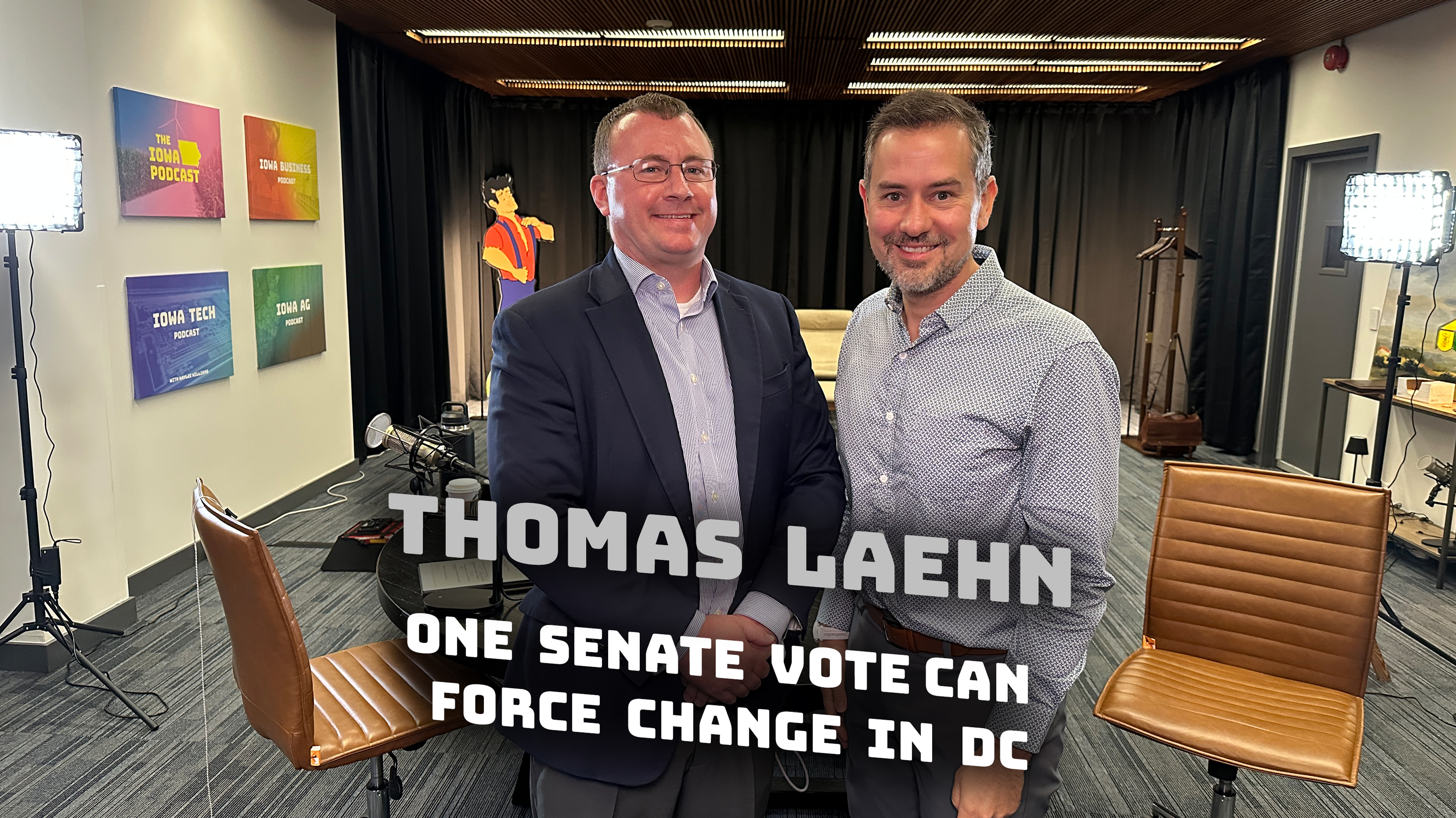


Senate Candidate Thomas Laehn is an Libertarian running for Iowa’s open senate seat. While most people question what one Libertarian voice can do in an ocean of blue and red, he sees it as a strategic advantage: that one vote can force a quorum and force DC Senators to actually have a dialogue.
It’s an often overlooked fact but because there are only 100 Senators and control is often on razor thin margins, if Iowa sends an Libertarian voice, the state actually punches slightly above its weight class in the Senate. Laehn’s plan is to force a quorum and force both parties to work with each other for Iowans and the American people.

Laehn, the Greene County Attorney and the first Libertarian elected to a partisan office in Iowa history, is challenging major-party candidates for the U.S. Senate by targeting eminent domain abuse and corporate influence. Laehn criticized the Summit Carbon Solutions hazardous liquid pipeline, detailing how IRS Sections 45Q and 45Z grant $85 per metric ton of captured carbon dioxide in federal tax credits. He noted that despite 78% of Iowans supporting his drafted legislation to prohibit eminent domain for hazardous liquid pipelines on agricultural land, Governor Kim Reynolds vetoed the bill after receiving $172,000 in campaign contributions from pipeline investor Bruce Rastetter. Rejecting claims that the private project serves a legitimate public use, Laehn noted, “Our state government has vested a private company, a hazardous liquid pipeline company, with eminent domain so that, um, Summit Carbon Solutions, this private company, can take people’s property along the pipeline’s proposed route, for the construction of a pipeline that will make the company’s investors billionaires with federal taxpayer money.”
Hear from Iowans directly. No algorithms.
Don’t let the algorithms choose your news. Enter your email address to hear directly from Iowans leading news in politics, community, agriculture and business. No editing. No clickbait. No rage. No agenda.
Reforming Capitol Hill and Campaign Finance Pledging to serve a single six-year term to remain unbossed by special interests, Laehn contrasted his roughly $50,000 in individual campaign contributions with opponent Ashley Hinson’s support from a D.C. super PAC pledging $29 million. To end empty-chamber speeches, Laehn plans to enforce parliamentary rules on the Senate floor, asserting, “There should be no business on the floor of the Senate unless we have a quorum.” Pointing to a Gallup poll indicating 63% of Americans favor third-party candidates, Laehn argued that disaffected voters represent the true majority. Encouraging voters to reject uniparty dominance, he declared, “We, the disaffected, are the majority, and we just have to reject this false narrative that if you vote your conscience, you’re gonna vote for the losing candidate.”
Fiscal Policy and Constitutional Scope Laehn advocates for a constitutional balanced budget to address the national debt, which has surpassed $40 trillion, accumulates at $2 trillion annually, and consumes roughly 40% of federal income taxes in interest alone. On abortion, he maintains a strict constitutionalist position, contending that while he is morally pro-life, federal officials lack jurisdiction to regulate the issue because that authority is reserved exclusively for the states under the U.S. Constitution.
Interview Transcript
This transcript was created with help from Ai. Please report errors to us and always refer to the video as your primary source.
Justin Brady: [00:00:00] From the Jethro’s BBQ studio, this is the Iowa Podcast. I’m Justin Brady, And the first Libertarian to steal, and I think it’s history. I think there’s some little Iowa history here, but the first Libertarian to steal a Republican or Democrat seat is running for Senate. He joins us today. His name is Thomas Lang, Greene County attorney and Libertarian for Senate. Thanks for coming in here. Yeah. good morning, Justin. Thank you for having Did I get that right, by the way? Yes, Shoot a little Iowa history.
Thomas Laehn: I have history? It is. First Libertarian elected to a partisan elected office in the state.
Justin Brady: Congratulations. That’s, That’s pretty cool. It’s a good feather in the hat. Before we get started, everybody, we of course love Jethro’s BBQ. If you want a $30 gift card for free, yeah, free, go to Iowapodcast.com, scroll to the top, click that banner, buy a $100 gift card, and they’ll throw in a $30 gift card. I think that’s pretty cool. Uh, so Thomas Lane, course Green County attorney, Libertarian for Senate. Uh, a lot of people, Like, what is the kind- Let’s start about the eminent domain, and, and everyone’s like, “Ugh, can we Stop [00:01:00] talking about eminent domain?” But you have a view that sounds similar, but maybe is not similar to the Republican and Democrat people on the ticket, which is, you know, tough on eminent domain, blah, blah. But help us understand the nuance with the Libertarian view here, because from your website, you have a lot more stronger opinion on the pipeline, on eminent domain, than maybe the Democrats and Republicans do
Thomas Laehn: Yeah, they’re not actually serious about stopping eminent domain abuse, uh, in our state. Now, the Constitution, uh, the F- 14th Amendment, Section 5, gives Congress the power, the authority, uh, to enact legislation protecting our constitutional rights. That’s the whole point of Section 5 of the 14th Amendment. One of those rights, uh, is, uh, the, uh, right to property, and the Fifth Amendment [00:02:00] prohibits the government from taking your property unless it’s for a public use. Uh, this pipeline, and I’m happy to go into detail about the, the project itself, but it’s the biggest boondoggle in the history of our state. Our state government has vested a private company, a hazardous liquid pipeline company, uh, with eminent domain so that, um, Summit Carbon Solutions, this private company, uh, can take people’s property along the pipeline’s proposed route, uh, for the construction of a pipeline that will make the company’s investors billionaires with federal taxpayer money. Uh, but the project itself doesn’t do any good other than to enrich the donors to the Republican Party. Now, uh, Congress, as I said, has the authority to stop, uh, this type of, of abuse, of, of eminent domain abuse, uh, but they don’t. Uh, neither, uh, Ashley Hinson, the Republican, nor Josh Turek, the Democrat, is proposing legislation at the federal level to stop eminent domain abuse. They’re [00:03:00] too beholden, uh, to the corporate interests that benefit from these types of projects
Justin Brady: So when they’re in the studio, uh, Mr. Turk has been invited. We would love to have him in here. We have not heard back from the campaign yet. Uh, Congresswoman Hinson was in here. And now this isn’t just them, but the Republicans and Democrats in general will all t- say what sounds to me tough language on the eminent domain abuse, and we should never have that. And so people are probably saying, “Yeah, I I mean, I hear what Turk and Hinson are saying. I hear what you’re saying. It kind of sounds the same to me.” So where… What’s that delineation? What’s that definition? Um, it kind of sounds like there is a line for you where we can use eminent domain and then we cannot. What is that clear line that you’re like, “Guys, if I was in Congress, if I was in Senate, I would, I would draw a hard line right here”?
Thomas Laehn: That line’s been drawn for us by our Founding Fathers in the Constitution. Uh, the Fifth Amendment clearly states that, uh, eminent [00:04:00] domain cannot be used unless it’s for a public use. All right? So a, a public road, a school, a public school, you know, uh, uh, spaces where members of the public can actually go and use the space, and it’s open to the
Thomas Laehn: [00:05:00] [00:06:00] This is a private, uh, pipeline company that will be, uh, transporting liquefied carbon dioxide from privately owned ethanol plants. It is not a, a public use. It is, it’s actually, uh, somewhat laughable, it’s ridiculous that they would claim this is a public use, and they can’t really define how it’s a public use. The initial justification, uh, was that it would, uh, reduce, uh, carbon dioxide emissions and slow global warming, right? So this was… But that- they’ve… Then now that’s what they call a public purpose or a public benefit. It’s not a public use. It’s not like you and I are going to be walking on the pipeline and it’s like a public sidewalk. Uh, and, and the problem with that rationale for the project, uh, is that, uh, the environmentalist groups are opposed to it because it will actually do more harm to the environment building the pipeline than It will do good, uh, reducing carbon dioxide emissions. You know, we had a representative from Carbon, [00:07:00] uh, Summit Carbon Solutions come to Greene County, uh, and I asked him, “Have, has your company calculated how much carbon dioxide will be emitted, uh, by the heavy machinery you’ll be using to build the pipeline?” Oh. And he said, “No.” Oh. Right? So, so we don’t even know at what point the carbon dioxide they’ll be capturing will offset the carbon dioxide emitted in the construction of the pipeline itself. It’s an absolute boondoggle.
Justin Brady: When you say Boondoggle who’s to blame for this? Because it’s really interesting to me that this issue, we’ve been talking about it on this show now for over a year, and for a while there, I, I really didn’t understand if it was a Republican-led or a Democrat-led issue. At, at first, at first, I had people avoiding wanting to talk about it, wanting to kick the can. We saw, we see the state legislature here in Iowa, of course, also kick the can. And so is this one of those, I guess Some people would call it uniparty issues, [00:08:00] or do both sides have a particular thing to gain out of this? What am I missing? I’m asking you this because you’re not really beholden to the Democrats or Republicans, so I’m asking for your opinion on
Thomas Laehn: Yeah, no, it’s a uni-party thing. Uh, so the tax credits, uh, to really understand this project, we have to go to something that happened in Congress under, under the Biden administration, which is that, uh, the tax credits for carbon dioxide capture projects were expanded, Sections 45Q and 45Z of the IRS tax code. And this was an, an initiative by the Biden administration, so by a, a Democrat. But it was endorsed and advanced by our Republican, uh, congressmen, including Ashley Hinson. Uh, and what this expanded tax credit provides is that if you capture carbon dioxide that would otherwise be released into the atmosphere, our federal government will pay you $85 per metric ton of carbon dioxide. Uh, and th- so this is, this is a, a tax credit [00:09:00] supported by both Democrats and Republicans. I think probably it initiated on the Democratic side because they thought it would help reduce global warming and protect the environment, but I think our Republican congressmen saw that it would make their donors richer, and they got behind it. Uh, we could kill this project by eliminating those tax credits, right? That’d be the simplest way to kill this project. Uh, but n- none of our congressmen, neither our senators nor our, our representatives in the House, are proposing legislation to eliminate those tax credits. And here’s why, Justin. You know, the principal actor, uh, proponent of this pipeline project is a man named Bruce Rastetter, uh, who stands to make billions of dollars in federal taxpayer tax credits. This money will be directly deposited into the accounts of Summit Carbon Solutions. Uh, and Bruce Rastetter and his investors will literally make billions of dollars. If you take the amount of carbon dioxide that will be captured, uh, multiply it [00:10:00] by $85 per metric ton, billions, p- potentially tens of billions of dollars. Uh, Bruce Rastetter is also one of the largest donors, what they call a mega-donor, to the Republican Party. Uh, you may know, Justin, I drafted the bill two years ago, uh, that would’ve prohibited the use of eminent domain for hazardous liquid pipelines on agricultural land. Uh, I drafted that bill. It passes the House. Uh, they added a, a s- number of provisions, but the core language is what I wrote. Passed the Senate, went to the governor’s desk. We know that 78% of Iowans, the overwhelming majority of Iowans, are opposed to the use of eminent domain for, uh, hazardous liquid pipelines on agricultural land. 78% of Iowans supported my bill, and Governor Reynolds vetoed it
Justin Brady: Mm-hmm.
Thomas Laehn: Why? I don’t think it’s a coincidence that Bruce Rastetter has contributed $172,000 to her election campaigns.
Justin Brady: Okay
Thomas Laehn: so the [00:11:00] only good this project does is to make the donors, uh, to the Republican Party wealthier. That’s all it
Justin Brady: So you’ve said some things in the campaign that kinda tick off both sides, but then randomly also align with both sides. So what’s interesting on, like, X, if I’m, uh, I- X is a, a wealth of… information. Um, some people are like “Dude, wh- why didn’t you just run on the GOP side?” Or, Why didn’t you just run on the Democrat side?” The third part- This is the common thing. The third party always has a tough time. Don’t wanna throw away my vote. Of course, that’s all BS. vote for who you want to, duh. Um, but you’ve said a s- you’ve said something… which is, “I would, but I don’t wanna sacrifice my principles.” What principles would you be sacrificing by running on the GOP or Democratic ticket?
Thomas Laehn: Yeah, you know, a number of people, people I love and trust, my own father has really encouraged me to run, uh, with a major party. Uh, but my ability to, [00:12:00] say, secure the Republican or Democratic nomination, just, just practically speaking, is, is slim to none. I, I have a better chance of winning as a third-party candidate than I have, uh, of receiving the Republican or Democratic nomination because the two parties are controlled by corporate interests, right? The only way you can secure the Republican nomination or the Democratic nomination is if you are working for the corporate interests that are backing those two parties. And if you refuse, you cannot get the nomination
Justin Brady: Mm. Mm-hmm. So what, what you’re saying is, um, um, whether good or bad. um, you Might think it’s bad, but whether good or good or bad if you’re going to run on the Republican ticket or the Democrat ticket, you are gonna get paid from them. Not paid, but they’re gonna help you, they’re gonna support you, their, their team’s gonna support you. Uh, there’s gonna be funding coming your way, and you have to agree to their terms, is what you’re saying.
Thomas Laehn: Exactly right.
Justin Brady: this is something you’ve talked about, how you haven’t accepted PAC money. I think you’re sitting on maybe, uh, as of the last FEC filing, 50 [00:13:00] grand, something like that, from individual donors. Um, someone might say, “Okay, Mr. Lane, we understand you’re against PAC money, probably because you don’t have any.” So how would people know, okay, if you get in Senate and donor money starts coming your way, or PAC money starts coming your way, or lobbyists start talking to you, how do we know your position won’t change?
Thomas Laehn: Uh, two answers, the first of which is I’m not gonna seek re-election. So I am committed to serving one One and done. and done. And that way, the people of Iowa know that every decision I make as a senator, I’m making because I believe it’s right for the people of Iowa, and I’m not beholden to any corporations or PACs or super PACs. Uh, I’m not making decisions because it’s in the interest of my own re-election. I’m making the decision because it’s in the interest of the people of the state of
Justin Brady: Interesting Secondly, I
Thomas Laehn: I would also propose legislation to overturn Citizens [00:14:00] United and, and, uh, the legislation would prohibit corporate spending in elections, period. Full stop. No corporate spending in elections. Congress absolutely has the authority to do that, uh, but, uh, neither party is ever going to propose such legislation, uh, because it’s not in their interest to do so. Uh, m- we will not have meaningful change in Washington, D.C. until we overturn our two-party system, because the members of Congress today have a vested interest in the preservation of the system as it exists
Justin Brady: Do you find it interesting that both c- uh, at least gubernatorial candidates, um, I, uh, this is all I’m familiar with, I’m sure some other candidates have maybe said this, have talked about, uh, the uniparty, redder and bluer, um, they’ve both talked about that. They both p- talked about the two-party system being bad, but are both running within the two-party system.
Thomas Laehn: Yeah, I think they’re, they’re recognizing the reality that there are [00:15:00] more independents in Iowa than there are Democrats, right? So they have to appeal to the independents. And I th- I actually think those who are disgusted with the two-party system are actually the clear majority of Iowans, right? So we know there’s this phenomenon called negative partisanship, that people who vote Republican don’t actually like the Republican Party. Now, there’s some small fringe of, uh, you know, MAGA hat-wearing Republicans who drank the Kool-Aid. Uh, they’re the minority, and there’s a small fringe in the Democratic Party that have- are card-carrying Democrats and are actually passionate in their support for the Democratic Party. They’re distinct minorities. Most Republicans vote Republican because they want to stop the Democrats, and most Democrats vote Democrat because they want to stop the Republicans.
Justin Brady: But neither is that motivated for their own side . Yeah. No, and I think the people of Iowa are ready to vote for-
Thomas Laehn: Yeah. No, and I think the people of Iowa are ready to vote for someone rather than against someone. But, but you know, our, our gubernatorial candidates, uh, [00:16:00] I think they, they, they know the numbers, and they know the only way you can actually win, uh, the governor’s office in Iowa is if you appeal to independent, third party, and moderate voters, ’cause they’re actually the majority in the state
Justin Brady: And This is where- you think you can win because you think you can say, “Look, hey, independents,” which are a large part, percentage of this state, um, y- you don’t, you don’t have to go to the right or the left that you’re disgusted of. You actually have an option. This is where you think you have an advantage here in Iowa. Yes
Thomas Laehn: we just have to explode this myth, you know, debunk the n- debunk the narrative that you only have two choices on, on Election Day, right? Uh, if we go into the voting booth on November 3rd and Iowans vote their conscience, I would win.
Justin Brady: Hmm, interesting. That’s a big statement
Thomas Laehn: That’s a big Now, I, uh, we know from a Gallup poll, 63% of Americans would prefer to vote for a third-party candidate. Wow.
Justin Brady: Wow. So you have a– Yeah, go ahead. Yeah.
Thomas Laehn: we have a- Yeah, so the politically disaffected are the majority. [00:17:00] We, the disaffected, are the majority, and we just have to reject this false narrative that if you vote your conscience, you’re gonna vote for the losing candidate. In reality, if we all voted our conscience, we would vote for the winning candidate.
Justin Brady: Which would probably make changes in how elections are done and the way parties think about issues. We’d probably see less divisiveness perhaps, i- is, uh, what I would assume. You, you mentioned Citizens United. I’m glad you brought it up because this is one thing, um, and viewers know there, there are no two-stage questions here. There are no trick questions. This is just something I wanna know about. How on earth would we ever enforce something like that? If you overturn Citizens United, you say, “Great, we got the money out of politics,” the money’s not gonna leave politics. You and I both know that. It just changes how it’s distributed. You still have third parties and independent groups that are doing PR campaigns to invi- in- influence the way votes happen. So doesn’t Citizens U- how does s- overturning Citizens United [00:18:00] actually help anything?
Thomas Laehn: Yeah, you know, I, I think, I believe that legislation could be enacted that would prohibit corporate spending, period, on political campaigns, right? It’s not, not just, you know, a corporation giving money to a candidate, but a corporation running political ads during an election, uh, season. Uh, the Congress can prohibit
Justin Brady: Yeah. I mean, can’t they funnel it through a PAC or a third party and pay the third party and the third party does the ads?
Thomas Laehn: I would prohibit all of that
Justin Brady: just all across the board? All across the
Thomas Laehn: All across the board.
Justin Brady: where, like is there any spending, campaign spending at all in, in like… There, there’s going to be some, right? How do we control where the money actually comes from?
Thomas Laehn: I mean, individual donors. So I have to, uh, you mentioned my FEC report. I have to report- Right … where my money comes from, and individual donors would be at liberty to support whomever they please and, and write a check to whatever candidate they please. But, uh, I think it should be, uh, under federal law that any corporation cannot spend, uh, [00:19:00] on political campaigns.
Justin Brady: Got it Okay, okay. So individuals then could technically get a bonus from their corporation. They could funnel it through their own thing, but at least we’d have individual names and we’d have numbers rather than corporations. So there very well could be a workaround, but it’d be, may make it a little harder
Thomas Laehn: It would. And, and you, you would know every individual, and, you know, individual donations are capped at $3,500. Great point. Right? So we would know every individual in America who gave money to Thomas Lane or Ashley Hinson or Josh Turek. Uh, and, you know, it, there, of course, like I could gift my father $3,500 and then he could donate it, right? There would be workarounds. But what, but what we have right now are corporations and PACs and super PACs literally spending millions of dollars. You know, uh, Ashley Hinson, uh, is, uh, receiving support from a super PAC in Washington, DC that has pledged, uh, to spend $29 million on her [00:20:00] behalf, and that money’s coming from corporations, not individual donors, or at least the, the majority of it is coming from corporations
Justin Brady: it. Uh, and of course, we’ll reach out to the Hinson campaign, as we always do on this show to give people a voice in the notes as well. Um, you w- you talk about restoring ac- This is interesting, actually. Restoring active debate in Congress. And I was reading that and I’m like, “Oh, do… We really don’t do that, do we?” Like, Why is this so important to you? You wanna restore active debate in Congress. I guess I should say, one, how do we do it? And, and l- Well, actually, let me back up a little bit. I was just in DC, just doing some tourism stuff. I had a meeting there as well, not a political meeting. And I was in, I wanna say the Senate. I, I was Watching some subcommittee hearing. And what I noticed was that there was someone giving a speech convincing, uh, this subcommittee of something, And literally no one’s listening to them. W- the person, uh, sitting in the speaker’s [00:21:00] chair was on his phone the entire time. Now, I don’t know who these individuals were, I don’t know what the meeting was, um, but I’m just like, No, o- This guy’s, like came prepared and no one’s listening to him.” A court report- There’s someone reporting, taking notes, but no one really cared. So I was kinda like, ” Well, that’s interesting. Is anybody even listening to each other when they talk in Congress at all?” And so then I see this on your website and I wanted to ask you about it. So you are running for Senate and you want to restore active debate to Congress. Is that not happening right now, and why is that important to you?
Thomas Laehn: Yeah, it’s not happening at all. So, you know, 22 years ago, I interned in the United States Senate. Uh, on my first day, I was taken to the Senate floor. I was given a tour of the Capitol Building, and there was one senator on the Senate floor talking to the camera, and otherwise the chamber was empty.
Justin Brady: Mm-hmm. Asked
Thomas Laehn: very naively, you know, I was still young and idealistic, you know, “Where are all the other senators?” And the guy giving me this tour, his name was Corey, uh, Corey [00:22:00] said, uh, “Well, you don’t understand how it works.” He said, “They’re never here. They just take turns talking to the camera. Uh, they don’t actually engage in any debate or deliberation on the Senate floor anymore. They’re off meeting with donors and interest groups and lobbyists.” And I realized then that both parties, in fact, every single member of Congress is complicit in defrauding us, that this is just a Hollywood production. C-SPAN has agreed not to pan out and show you that the chamber’s empty
Justin Brady: This is, they’ve actually agreed to this?
Thomas Laehn: Well, they must have ’cause you turn on C-SPAN, you never, you never see the
Justin Brady: got it. Right. So we don’t know they’ve agreed, but you’ve noticed that they don’t ever show the whole chamber. They only show Zoomed-in
Thomas Laehn: Exactly. Yeah. You never see more than a few seats at a time, uh, unless it’s time to vote, ’cause then all of the members of Congress scurry over, you know, from their meetings with donors and lobbyists. They scurry over to vote, and then they disperse. Uh, and [00:23:00] this should be deeply alarming to the people of Iowa, the people of our country, and it’s indicative of what’s really happened in Washington, DC, that the members of Congress aren’t working for us. They’re not going to Washington, DC to do what we elected them to do, to make laws, to deliberate and legislate. They go to Washington, DC to meet with lobbyists and donors
Justin Brady: And so the pitch is, um, if they’re all complicit, right? The Republicans and Democrats are all complicit in this process. They don’t wanna do active debate. Your pitch would be, “Hey, there are only 100 senators, so if you send me to the Senate, uh, I really have some weight to shake some stuff up and make something like this happen.” Is this k- is this the pitch? Exactly
Thomas Laehn: right. Because I can call a quorum. I can go to the Senate floor and say, “Point of order, there are not 51 senators here. There should be no business on the floor of the Senate unless we have a quorum.” And this, Is, this a law? The Robert’s Rules of Order, yes. Got it. Okay. It’s S- Senate, the Senate cannot do [00:24:00] business unless there’s 51 senators present, and yet there’s never 51 senators present.
Justin Brady: they’re doing business.
Thomas Laehn: doing business. Well, they’re just taking turns talking to the camera. Right. Like in your committee meeting. They’re not talking to one another, they’re talking to a camera to hope they get a clip on C-SPAN that they can then, you know, market to their constituents- Right for, uh, campaign donations or to show that they’re doing their job when they’re
Justin Brady: in, in a, in a se- like you’d essentially be, I don’t know what the right word here is, there’s probably a better word for this, but you’d you’d kind of hold the Senate hostage is what you’re saying you’d do. You would force a quorum so that people have to debate and discuss these issues, and then maybe also get C-SPAN to go wide angle.
Thomas Laehn: Yeah, to, just to go to the Senate floor and say to the American people, “There’s no one here. The people you elected to sit in these seats and debate and deliberate and make laws, they are not here. And Madam Speaker, Mr. Speaker, I demand a quorum.” You know, I’m the county attorney in Greene County. We have a board of supervisors with five members. Some counties have five, some have [00:25:00] three. We have five. Uh, and I am their attorney, and I go to their board meetings. And if I ever had one or two supervisors show up and try to call a meeting, I would not let them. It is illegal. You don’t have a quorum, you can’t do business. And yet the members of Congress, again, every single one, all 535 members of Congress are complicit in this Hollywood production, right? Not one of them is absolved of blame
Justin Brady: So this is interesting because I think when people are thinking of voting for a third party, they’re often in the mindset of, “Okay, cool. Even if you win, what the heck are you gonna do? You’re one person.” And you’re saying actually quite a bit. This is the pitch, is that you actually can do and force their hand to do quite a bit as a senator. Maybe not as much as, uh, a member of the US House. Um, but as a senator, there’s, there’s quite a bit you can do as a Libertarian, which is an interesting pitch for sure. It’s, uh, it’s, it’s a Good one. Um, Another one, that you w- might wanna… Uh, another [00:26:00] one of those pitches that you wanna, or that you’ve been telling your constituents as a Libertarian for Senate would al- also be forcing them to do a constitutional balanced budget. Yeah. Um, again, now I will say I’ve heard this. I think, uh, running for Congress, Chris McGowan has said this. There have been some others that have said this in this studio as well. Actually, I just think it’s him this turn. I’ve heard this before from, um, other candidates. And so how is this something you could force through as a senator or at least hold, uh, Congress’ feet to the fire?
Thomas Laehn: Yeah. I would be one vote in the Senate. I would support a constitutional amendment to balance the budget. A- and the American people, I think, need to be alerted to the enormity of the, uh, kind of debt crisis we’re facing. You know, we have now for the first time surpassed $40 trillion in debt. It took 192 years for our country to accumulate the first trillion [00:27:00] dollars in debt. Right. Now we’re accumulating debt at $2 trillion a year, right? When you pay income taxes, approximately 40% of your federal income tax is being used simply to pay the interest- Right … on our national debt. If we balanced the budget and eliminated our national debt, our income taxes could be reduced by 40%, right? Uh, Congress has a spending problem. Now, I would only be one vote. I can initiate legislation. I can introduce legislation. I can introduce a constitutional amendment.
Justin Brady: You can force a quorum
Thomas Laehn: I can force a quorum, right? Exactly right. But part of this is just we need a third party who’s willing to… whose members are willing to stand on the floor of the House and the Senate and to raise issues that neither of the two major parties have an interest in raising, right? Because this debt is because of reckless spending that’s benefiting corporate America, not benefiting you and me as everyday Americans.
Justin Brady: Yeah, but as you point out, a lot of that [00:28:00] reckless spending comes from both sides, right? That have certain constituents they need to make happy, according to you. And so you probably realize you’re going to have quite a fight on your hands, ’cause you’re gonna be fighting against, what would that be? 99 other senators, right? Uh, wait, I think there are… No, no, no, I’m, I, I can’t remember the current Senate count right now, but, um, uh, yeah. The, one of the other issues I wanted to talk about is this, some may consider it a nuanced view on the pro-life, pro-choice abortion debate. It’s been raging since before Roe versus Wade. It continues. Iowa has a heartbeat ban in place. Uh, so this is an issue that is very polarizing. Some people are, have called you more of the Democrat side, ‘ cause you’re pro-choice. Other people have said, “But wait a minute, you’ve got pro-life views.” Let me read this off. You, you say you’re radically pro-life, But as a state legislator you would ban it. But as a senator, [00:29:00] you say Senate doesn’t have constitutional authority. Explain that nuanced view, and then I have a little bit, you know, I have some questions on that. But explain how you can, for some sounds like you’re trying to play both sides here.
Thomas Laehn: Yeah, no, I’m not trying to play both sides. My only side is the Constitution, right? So at the end of the day, I’m not a libertarian, I’m not a conservative, I’m not a liberal, I’m not pro-life, I’m not pro-choice. I, uh, swore an oath when I was elected county attorney to defend the Constitution. I believe in the Constitution and the rule of law, right? And, and both parties, Republican and Democrat, have been willing to sacrifice the Constitution and the rule of law for the sake of getting elected, for the sake of advancing their own short-term interests. Now, our Constitution very clearly divides authority between the national government and the state governments, and that’s meant to protect our liberty, right? Because the greatest threat to liberty is concentrated power, because concentrated power is arbitrary [00:30:00] power, and arbitrary power is the greatest threat to liberty. So we divide power. We gave some power to the national government, and we reserved most power to the states. And so things like education policy belong in the states. The s- the federal government has zero jurisdiction, uh, to enact le- uh, education policy. The same is true for abortion. Uh, under our Constitution as it’s written, uh, decisions about abortion are regulated at the state level, not the national level. Uh, I, uh, personally, morally, uh, because of my moral beliefs, I am o- opposed to abortion, and I support legislation in Iowa or in any state to restrict abortion. This is the true test of my commitment to the Constitution, because it’s a- an issue that I feel very passionately about, uh, and maybe the greatest moral issue of our time. [00:31:00] And yet if I am in federal office in Washington, D.C., I have zero authority under our Constitution to regulate abortion
Justin Brady: But you kinda do, right? Because there have been some, um… And I’m not going to call it, ’cause on this show we main- main- maintain neutrality. Um, but there have been things in the past that have been morally abhorrent or things that have been awful that we got Right. Now, we did it the legal way, We wrote constitutional amendments, right? So would you be in f- if you are radically pro-life, I would assume you would view, please, please push back on me if this is incorrect, I’m just for the sake of time. Um, I would assume you would think that I think abortion is murder at whatever stage, you know, there’s some stage you may, may believe that. So push back on that if that’s not right. But if you believe that, and i- you know, wouldn’t it be your job as US senator to say, Guys, we’ve got this wrong. The Constitution from a federal level needs to consider six weeks, two m- Whatever it is three months, [00:32:00] whatever it is, as murder. These individuals are citizens of the country at this stage, and they are all federally protected.” You could do something like that, right?
Thomas Laehn: I could. The problem is the constitutional amendment process, which I believe in. In fact, we could go down a, a, a, a different path on this ’cause I think the f- the Article V amendment process, uh, is so important. It’s a distinctly American contribution to the history of Western constitutionalism. Uh, it requires a national consensus. You can’t enact, uh, uh, an amendment to the Constitution, uh, unless you get approval in three-fourths of the states. Mm. That’s the threshold
Justin Brady: And so just to, ’cause again, if you wanna ask more, I, I’m never gonna cut anybody off on this show, but we do have time anyway. Uh, so but Basically what you’re saying is open to it, but it’s gonna take three-fourths and we’re not even
Thomas Laehn: No, we need to have kind of a moral, uh, reformation in society first. I mean, th- this is a battle that has to be fought, [00:33:00] uh, to, to, to win the hearts and minds of individuals and, and, and, uh, you know, kind of change the public understanding o- of, of abortion. You know, show people what a horrific, uh, uh, thing it is. Uh, but I’m not gonna spend my time … You know, if I’m only there for six years, which is my commitment, to be in the Senate for six years … When we have a national consensus that there should be term limits, right? 88% of Americans support term limits. We have a national consensus that Citizens United should be overturned. You know, 77% of Am- Americans wanna reduce or eliminate the role of corporate spending in federal elections, right? So we have a national consensus. We c- If we could just get through Congress, Con- Here is the great problem, Justin. We elect people to Congress to implement the public will, but members of Congress today are actively obstructing the public will.
Justin Brady: So what you’re saying is, um, abortion and many other issues, you’re gonna do [00:34:00] your job, which is to represent, is what you’re saying. So changing the who and cha- changing the way citizens think so that you can represent them in the US Senate. Thomas Lane, Greene County attorney, of course running for the Libertarian, uh, role as US senator from Iowa. If people like what they hear or they wanna reach out to you and learn more, how do they do
Thomas Laehn: Yeah, they can find me online. I have a website, uh, Laen4Iowa. Laen is spelled L-A-E-H-N, the number four, Iowa, I-O-W-A.org. Uh, there’s an E in my name. Uh, I’m the Laen who lives in Iowa, not Kansas. Uh,
Justin Brady: not gonna live fact check on this show either
Thomas Laehn: Laen. L-A-E-H-N, the number four, Iowa, uh, .org. Uh, I also though have, um, social media accounts, uh, X, uh, Facebook, Instagram. Uh, you can find me there as well
Justin Brady: Mr. Lane, thank you so much for coming on the Iowa Podcast
Thomas Laehn: Yeah, no, thank you for having me [00:35:00] [00:36:00]