


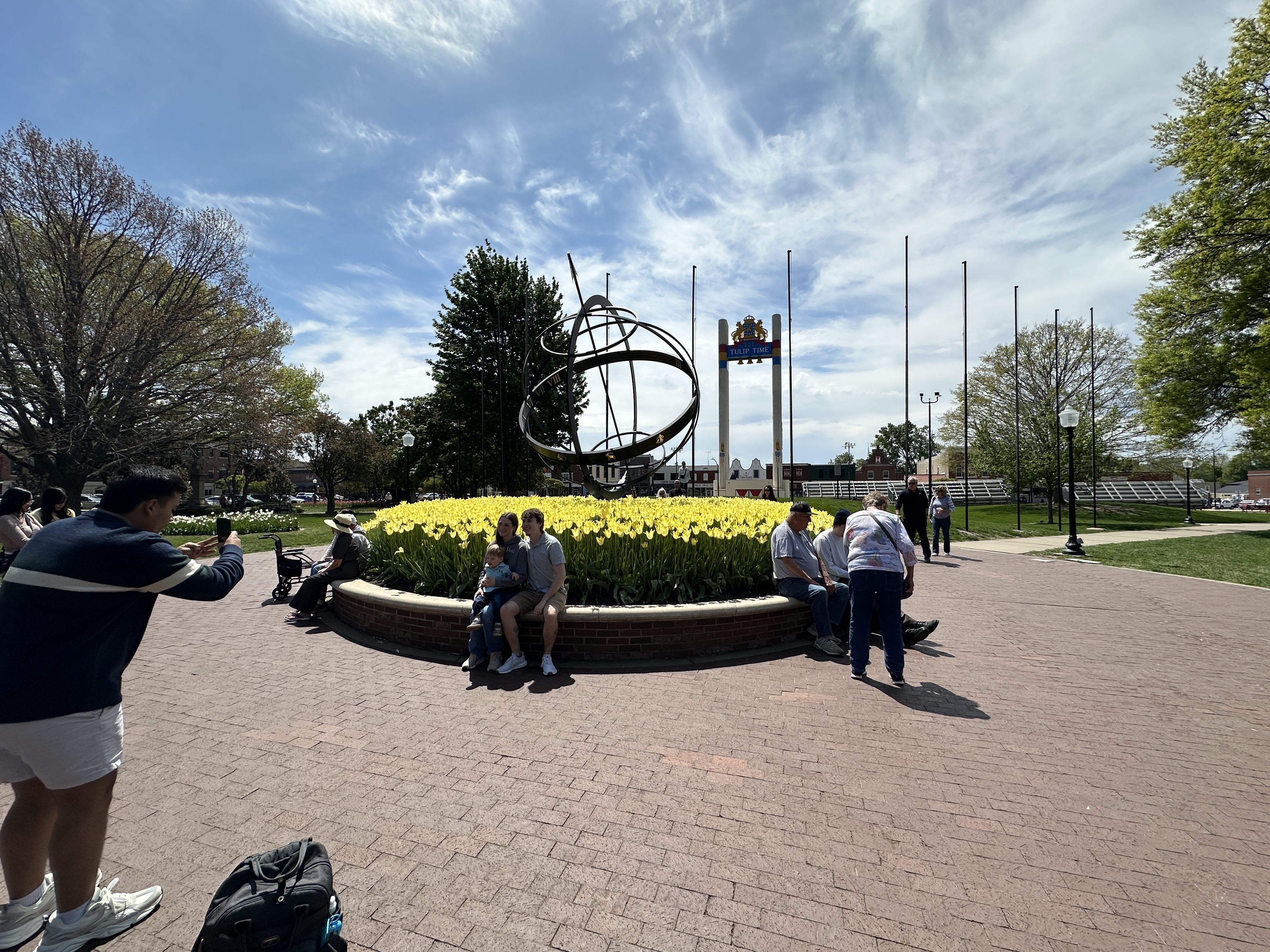


It’s Tulip Time in Iowa! Iowan’s are aware of the annual Tulip Time Festival in Pella, running May 7-9th this year, BUT did you know it’s a honeypot of high-brow visitors? Royalty and even musical celebrities are known to make an appearance, all for the love of Dutch heritage and culture. Jessi Galligan, Executive Director of Pella Historical Museums & Tulip Time joins us.
Tulip Time Festival Logistics
Galligan explains how many tulips are planted, how the city of 10,000 plans for, and accommodates nearly 200,000 people, the logistics that go into the festival, and the incredible economic impact it has on the town. She also discusses Tulip Time parking and FAQs like “where are the tulips?”
Pella Tulip Time Festival Parking and Arrival

When should I arrive: Aim to arrive before 9am to get ideal parking. If you arrive after 9am, plan on parking in the designated parking areas near the interstate exists into Pella.
Where do I park: There are large designated parking areas near the interstate exists. There’s a shuttle that will take you into downtown. The shuttle accepts cash or Venmo.
- Delta Lot on west side of town, Exit 40 from Hwy 163 – follow signage at Exit 40 (1417 Washington St – Google Pin 📍)
- Pella Christian High School on the southeast side of town, Exit 44 from Hwy 163 – follow signage at Exit 44 (300 Eagle Lane – Google Pin 📍)
Do I need tickets: You don’t need tickets to check out the tulips! You will need tickets for Vermeer Windmill & Historical Village, Scholte House Museum, Afternoon Grandstand Show, and City Wagon Tours. You can get those tickets here.
How do the tulips look in Pella for the Tulip Time Festival?
While there are many tulips that have lost their blooms due to animals, there are also plenty of tulips to see in Pella! We’ve taken photos below for you to get the very best out of your Tulip Time Festival experience. The hot spot appear to be the Sunken Gardens, Pella Historical Village & Vermeer Windmill, and Downtown area.
Where can I find Tulips in Pella?
Where are the tulips: The tulips are everywhere! Pella plants 300,000 tulips between the city, staff, and private businesses. The tulip hot spots are the Downtown area, Sunken garden, and Pella Historical Village & Vermeer Windmill.


2-min Tulip Time Tour
(Taken May 3rd, 2026)
Interview Transcript
This transcript was created with help from Ai. Please report errors to us and always refer to the video as your primary source.
Justin Brady: From the Jeff Rose Barbecue Studio, this is the Iowa Podcast and it’s tulip time in Iowa. And we have the person, Jessi Galligan joins us, the Executive Director of the Pella Historical Museum. Of course, we’re talking Tulip Time Festival. Thanks so much for coming in the studio.
Jessi Galligan: you so much for having me. I’m really excited to be
Justin Brady: We’re gonna Talk about, all 30 trillion tulips. No, just kidding. we’re actually gonna. find out the real number here in a second. I’m gonna ask you about that. Uh, before we do everybody jet rows, of course, we love jet rows. And if you want a giant plate of chicken wings, go to Iowa podcast.com. Scroll to the top. Click that banner and you can get $30. If you buy a hundred dollars gift card, it’s more chicken wings for You tell ’em I sent you. Um, okay. First Tulip time Festival. When was this? How long has the, like, Iowans are kind of like, um, we’re used to Tulip time. We know what tulip time is. How long though? Ha? Has anybody asked you this? How long has this thing been going?
Jessi Galligan: Yeah, well, last year was a big celebration. Last year was our 90th anniversary, so we got to say that number a lot Last year, uh, 2025, our 90th celebration. This is our 91st year of tulip time, which is really exciting. It’s kind of amazing that our festivals had this sort of longevity, so really grateful for the, the support and continued crowds that we get.
Justin Brady: Yeah. for sure. Now this, I think a lot of people assume it’s just the city apella that does all this and all the city resources and all that goes into this. That’s actually not true. Right? To, I’m, I’m sure the city Apella supports you. They’re like, they’re happy you’re here, but it’s, you’re totally different. Yeah.
Jessi Galligan: yeah, yeah. You’re exactly right. I certainly, the city of Pella is just a wonderful partner for us. Yeah. They do plant, you know, over a hundred thousand tulips and they do help with sanitation, um, safety. I mean, if we didn’t have our police force at tulip time, I mean, that’s really important for us. But it is,
Justin Brady: tulip people are
Jessi Galligan: Crazy. You don’t want to be cutting a tulip,
Justin Brady: Pella Riot. Police have to be
Jessi Galligan: Truly. Yeah, no, for sure. Um, but yeah, it’s our little nonprofit, Pella Historical Museums, uh, that has been hosting the festival since the second 1, 19 36. Uh, that was the second Tulip Festival, and it’s the first one that Pella historical sponsored. We’ve been doing it ever since. So certainly incredible partnerships from the city, from the Chamber, from the visitors bureau, and just from all the people who live in the community, of course. Um, but Aspel Historical, who sponsors it, who organizes it, we’re. You know, paying the marketing dollars, we’re paying for the porta-potties, we’re paying for a hundred thousand tulips planted in the city. So, um, it, it’s a team effort, but at the end of the day, uh, Pella Historical is the one who makes it happen. Yeah,
Justin Brady: And you’d think it would be like Pella Visitors Bureau or Pella, you know, come to Pella. You’d think it’d be Something like, that. It’s not though. it’s Pella historical. yeah. So have you. do you guys ever think to yourselves, why are we doing this?
Jessi Galligan: It’s a good question. You know, I, and I’ll first say our visitors bureau in town is incredible. They’re wonderful partners for us. We do, um, they do do a lot of marketing for us, so really grateful for that, that team over there. Um, but yeah, I, I think it’s because at the end of the day, tulip Time, yeah, tulip is the namesake. It’s not really about the tulips, it’s about the Dutch culture. The Dutch heritage. It’s about Pella’s history and heritage, and that’s, that’s why we celebrate tulip time. That’s why we keep doing it. It’s, it’s not just about that flower, it’s about everything that comes with a, with it. So Pella historical, it, it goes hand in hand. It makes
Justin Brady: So you guys see this as a way to preserve Pella history in the Dutch heritage? Yeah.
Jessi Galligan: A hundred percent. Yeah. I, if you come to tulip time, I mean, you’re gonna be seeing hundreds if not thousands of people wearing traditional Dutch dress and doing traditional Dutch dance and singing, um, floats in the parade that have to do with pella’s heritage. And then of course our, our museum, our windmill, that’s all about Pella’s history and heritage. So yeah, truly tulip time is a, a heritage festival. And exactly like you said, it’s preserving. Our community’s history and and hoping that we can continue to teach generation after generation about it.
Justin Brady: I imagine it’s a challenge because. The outside of, I want to ask you about like the volunteers, and this is a lot of money. This is a lot of money, a lot of volunteer labor goes into this. I’m gonna ask about that. But there, there’s almost, this does Pella historical, do I call you Pella Historical Museum or Society?
Jessi Galligan: We’re called a lot of different things. We started as Pella Historical. Yeah. We started as Pella Historical Society. Uh, we were that for a long time. We were like, wait, we have museums too. We don’t want to confuse people. So we’re
Justin Brady: where the museums
Jessi Galligan: exactly. But we’re called lots of
Justin Brady: So this is, this is the, there’s like this balancing act because the entire city is basically on display for tulip time, right? All of Pella. And so. do you kind of apply pressure or maybe encouragement to private property owners and everybody in the city to maintain things a certain way or designed a certain way, like some of the windmill, some of the, uh, architecture around there? You can’t. control that, that’s private. So are there grant programs, are there incentive programs or do you just have a reputation in Pella for disappearing people if they don’t
Jessi Galligan: Yeah, that’s exactly right. No, um, no, that’s a, that’s a really great question, and I think one thing that’s important to note, first of all is that tulip time is three days, right? And that’s what Pella historical controls and organizes. But really Pella is a pinnacle of Dutch heritage and Dutch culture 365 days a year. Um, and outside of those three days of Tulip time, that has, uh, you know, a little to do with us, I, I think, but a lot to do with just the character and nature of the city. And, um, yeah, you’re right. Pella Historical does not control that. The city does though. Um, we have, uh, you know, uh, different committees, um, on the city level that are in charge of. Um, giving a seal of approval to different designs, and there are design guidelines for what businesses in the central business district have to look like. Um, and the city approves all of those things. So, like, for example, Pella Historical acquired a new property a few years ago. We’re going through a redesign process and it’s pretty strenuous as we figure out, okay, how does this match the, the design guidelines the city has in place? So certainly there are, um, incentives for, for private homeowners with our, um, we do have a pate preservation trust, which is more architectural history. But at the end of the day, yeah, the city decides, yes, that meets our guidelines, or no, you gotta go back to the drawing board.
Justin Brady: So it’s, it’s kind of a joint venture between all of you.
Jessi Galligan: It really is. You know, people move to Pella and they’re confused. They’re like, well, I thought the city did that, or I thought the Chamber did that. And it’s like, there’s like 47 nonprofits that are all working to just make better. Well, I threw out that number. That’s a random number, but No, no, there’s like, there’s
Justin Brady: we’re running that quote in the headline. Exactly.
Jessi Galligan: Yeah. 47, no, there’s, there’s us. There’s the Pella Preservation Trust, there’s the Visitors Bureau, there’s the chamber, there’s the Spirit of Pella. There’s, I mean, there’s so many. Yeah. And then we all just care really, really deeply about the community and making it a wonderful place to work. Live, visit.
Justin Brady: How many volunteers then? ’cause I told you I was gonna ask this. How, how many volunteers are there to the three day thing? Um, of course, you know, and not including the p swat team
Jessi Galligan: Right.
Justin Brady: and the, the riot team or whatever. Uh, for all those crazy tulip lookers, how many people are volunteering to like, organizations, people? What are the numbers on this to make sure this thing goes. Goes to plan, because I’m also gonna ask how many tulips that you plant. Everybody wants to know
Jessi Galligan: yeah, yeah. It’s, you know, I don’t have a number for you on volunteers and there’s a reason for that. Um, it’s because so many people make things happen that. I don’t even know about. Right. So true Tulip time is organized, um, by, primarily by a group called the Tulip Time Steering Committee. It’s eight volunteers, um, that work alongside myself and my staff. Um, they are eight individuals who each serve five years on the committee rotating through a series of things. Um, and they’re in charge of one element of the festival. And they have, you know, 10 volunteers under them who each have 10 volunteers under them. It’s like the MLM of committees. Um, but they, they, that’s funny.
Justin Brady: really
Jessi Galligan: Yeah. They, so, I don’t know. And sometimes things happen and it’s like. Oh, shoot. That that didn’t happen. What in the world? Well, it’s like, oh yeah, Jenny moved away and we’re like, we didn’t even know Jenny was doing that for the last 50 years. So it’s, it’s really amazing. Um, but I mean, hundreds if not thousands, especially if you’re counting people who are walking in our parades easily. Thousands of people volunteering.
Justin Brady: Yeah. Goodness. Okay, so how many tulips.
Jessi Galligan: There are imp Pella around 300,000 tulips that bloom every spring. So, um, just under a third of those are planted by my staff and my gardeners. A little over a third of those are planted by the city of Pella, um, paid for by our tax dollars. Mm-hmm. And then another third are just private residents and businesses that
Justin Brady: just kind of chip
Jessi Galligan: Yeah, they wanna beautify their, their own spaces, you know, the bed in front of their house or, or whatever it may be. Sure. So. Yeah, it’s, um, it’s a big number and I think people think, if they’ve never been to the festival, they think that there’s gonna be, they go to one spot and there’s just like a field of tulips, and that’s not how it is. It’s, it’s really all over the community. So, you know, there are, along the road, as you drive into town, and then there’s four different parks where there’s spread out and you can find them, um, you’ll find ’em at, at businesses. If you wanna venture over to Pella Corp or Vermeer, you’ll, you’ll see ’em planted. So, um, 300,000 goes a long way when they’re spread out over town like that.
Justin Brady: yeah. And you mentioned you and your team plant a third of those. that’s crazy. How big is your team? It’s not like hundreds of people.
Jessi Galligan: I, I have a staff, it’s myself and three other full-time people, and then there’s probably 10 front desk people and 10 gardeners, uh, maintenance people that just, they, they make it happen. They, they work really hard for a few weeks in the fall to get all those bulbs in the ground. So
Justin Brady: Are there, are there like any crazy stories of people that, like celebrity sightings that come to this thing. or people that keep coming back for crazy reasons? Uh, are there any stories like that?
Jessi Galligan: I can think of a couple off the top of my head. Um, first of all, we have had like Dutch royalty come and visit. What, um, we’ve, we had a, a princess come and visit in the 1990s, I believe it was 97. Um, and a, a different Dutch princess visit, um, I believe in the 1940s or fifties, but I’ll have to fact check that. Um, but yeah, so a couple members of Dutch royalty Last year we had the Dutch Ambassador as part of the festival this year we actually have the cons General of the Netherlands visiting. So we do have this friendship in this partnership with the Netherlands and, and their leadership, which is really cool. Um, as for like other celebrities, I mean. I’ve
Justin Brady: pretty good. list as it is. What?
Jessi Galligan: We’ve, we’ve had like, um, Dave Kooning of the Killers Uhhuh. He, he grew up in Pella, so I’ve, I’ve never met him, but people have run into him at Tulip time and I didn’t know that. Yeah. Yeah. He’s one of, uh, the Pella, the Pella fame, you know, the Corver family and Dave Kooning. Those are our two claims to fame, so
Justin Brady: that’s super. funny. So royalty. That’s, that’s super fun.
Jessi Galligan: Yeah.
Justin Brady: run that on the, the Pella advertising or?
Jessi Galligan: like we’ve, we’ve had a Dutch princess in our towns.
Justin Brady: cool. How do, okay, so planning all these tulips, 300,000, there’s gotta be some kind of coordination, right? Because there’s like patterns and stuff and like, you know, so do I, don’t I? Maybe, maybe gardeners are like, Justin, this is the dumbest frigging question you could. Are they marked? Like How do you know what the colors are? How do you, How do. you plan? Okay, I know how we know what the colors are like we have people that do that. But how do you plan this out? Do you have like some grid, do you use satellite positioning? Like do you measure with a measure? How do you do this geometrically designed tulip stuff? How do you do this?
Jessi Galligan: yeah, it’s a good question. I, I won’t speak for the city. I’m sure that they have their own methods. They’re really talented people over there too. As for my staff, um, my head gardener, her name is Julie. She’s incredible. Um, as soon as tulip time is done, she just starts planning out what she, what colors and varieties she wants in every single bed, and she knows how many need to be in each bed. So, okay, I need to order X amount of van Ike, and I need to order X amount of, uh, the ice cream tulip, or whatever it may be. I mean, there’s hundreds and hundreds of varieties of tulips. Um, and then, yeah, she, she just knows what she needs. She places the order usually in. June or July, they shipped to us in the fall. And then, um, she just, yeah, she instructs her gardeners, all right, this is what needs to be here. This is what needs to be there. And she’s, uh, very creative. And, and then the people that plant them are very hard workers. They’re, they’re planting through all sorts of weather conditions. So yeah, it’s a, it’s a brain that I don’t have, but I’m grateful that other people do.
Justin Brady: This is a thing, like this is kind of her specialty, is spacing them out correctly
Jessi Galligan: Yeah, exactly.
Justin Brady: are tulips fairly temperamental? Like is it hard to keep ’em all alive because when you know it’s, it’s showtime Yeah, basically. Or tulip time and. You know, no one wants to come and see a bunch of dead
Jessi Galligan: right. Yeah.
Justin Brady: So is there, like, do you have, does the city go around or do you go around like waters them and protects them? Yeah. Or do You have like. security on them so people aren’t like coming and like running a tractor over
Jessi Galligan: Yeah. You know, as for security, we really act on goodwill. We’ve never had any problems with humans taking tulips and mass quantities. We do have problems with deer and squirrels. Um,
Justin Brady: oh gosh,
Jessi Galligan: The deer like to eat them once they’re already up a little bit. The squirrels love to just mess with the bulbs underground, um, before they even come up. So yeah, we had a few, the squirrels were bad this year. We had a few beds that just did not come up the way we wanted to. Um, I will say before tulips are bloomed, um, like when it, there’s still just leaves and stem. They are a very hardy flo flower. The cold just does not really hurt them really, once they’re open. If, if it gets below 32, you know, then we might have a little bit of issues. But even then, you know, a slight frost isn’t gonna, isn’t gonna kill ’em. Honestly, they’re more susceptible to heat and sun. So. This year we’re facing, we faced a little bit of a shorter bloom, um, because we had some pretty warm days, sunny days, you know, 80 degree days. And when the tulips get that sun, they open up and then they’re, yeah, they keel over and die faster. So we do still have a lot of beautiful tulips in Pella right now, but, um, you will find some empty beds if you come right now because they just, they soaked up the sun too early and, uh, they bloomed really early.
Justin Brady: a challenge every year
Jessi Galligan: every year as, and you’re planting them in the fall. It’s not like you can, you know, we have people say, well, why don’t you just quick plant more? Or, well, you plant them. Why can’t you just plant them a little later? And I’m like, that’s not how that works at all. But I.
Justin Brady: there are weather and seasons.
Jessi Galligan: I can appreciate that. People I, I didn’t understand before I worked here either, so I have to be generous. But, um, yeah, it’s just, it doesn’t work the way people think it does, I don’t think. And then people say, oh, well the tulips are blooming early. Why don’t you just move tulip time a week early? Well, maybe we can start thinking about that for like 2030, but you know, when it’s march, we can’t just decide to move the festival a week earlier ’cause of all of the work that has gone into it.
Justin Brady: All the logistics and the planning. It’s, it’s absolute madness because your, your population in Pella is 10,000 people. It’s over. But how many people, I guess, in that three day period, it’s not 10,000. Is it like Doubling in size or more than
Jessi Galligan: Oh, way more than that. We, I mean, it’s hard to guess for sure, but based on, you know, like cell phone data and that kind of thing, we think we get between 150 and 200,000 people. Yeah. Over the, over the three days, so that’s great.
Justin Brady: crazy. It
Jessi Galligan: It is crazy and you know, again, people are like, why can’t you do it a second weekend? It’s like every single person in the town has given it their all for those three days, and now we have to go sleep for a week. So
Justin Brady: That’s, that is, crazy. Yeah. How do you do that? Like, I mean, you don’t just pop up like 80 hotels around the area overnight. So are mostly, is this mostly Iowans and they just drive in, or are people like doing campers or is it a little bit of both? How do people, where are people just opening up their houses and crashing on living room floors? What’s going on?
Jessi Galligan: So in some, first of all, in some ways it’s like a homecoming. A lot of people who grew up in Pella or have, you know, parents and grandparents in Pella, they come back home. So then yes, they’re staying at, at relative’s homes. I have like an aunt and uncle that live a few hours away and they come and stay at my parents’ house, things like that. Sure. Um, but yeah, we also, all of our hotels fill up so quickly. Um, if you wanna stay in Pella over Tulip time, you better be booking and like. August of the year before, ’cause things fill up. Um, and then Pella actually has a lot of Airbnbs too. Pella has like 200 Airbnbs, which is a huge number. Um, I’m guessing every single one of those fills up for tulip time as well. Um, and then if you looked at the surrounding communities, I mean, we, we start sending people to Oscaloosa, Knoxville. People are staying in Des Moines even. Um, and, and commuting the
Justin Brady: Yeah, that makes sense actually. You, you think about that, the, the Des Moines um, trip. Ella, I remember when I was a kid, that was way longer. And now, with that new divided highway, that four lane, whatever, I don’t even know what we call these. Yeah. One sixty three. That’s a fast trip. It’s like, um, I remember I was doing Business Horizons when it was at Central College there for a little while, and I would just commute from home to go every morning That was
Jessi Galligan: Yeah. To East Des Moines or Des Moines Prep. It’s like 45, 50 minutes. So yeah, it’s a breeze to just hop on there and,
Justin Brady: And it’s a little faster if the state patrol aren’t on that street.
Jessi Galligan: Exactly. That’s what we don’t tell people. It’s a but joke. It’s
Justin Brady: a joke. Um, the, uh, the, yeah, that’s that. I mean, I just don’t understand. So does this like impact businesses significantly then? Like are they all kind of extend their time open to, you know, even you think of small things like local pizza delivery and stuff for people getting extra food at night when it’s not like, do all the businesses kind of increase their workload and stock
Jessi Galligan: I think about the poor postal workers during tulip time. I just, I’m like, I wish that you guys could take those three days off. ’cause that’s impossible. But yeah, the downtown businesses, oh my gosh, they do so well at tulip time, um, I. They’re amazing and they’re part of what draws people, right. So it’s again, a community effort. We’re all working together to get people to town. Um, but yeah, you’re exactly right. Businesses stay open longer. They’re hiring, you know, part-time help to just get them through that week. Um, even and, and like I said, with tulips being a little bit early this year or other years, you know, they start getting busy in early April already, and, and it’s, it’s people swarming to town to see
Justin Brady: Like people are come, oh,
Jessi Galligan: yeah. Yeah.
Justin Brady: kind of tulip time, which is three days And then there’s unofficial tulip time, which is before and after. So this is not a three day economic boom. This is what, like a couple months, a
Jessi Galligan: be a month. Yeah. I mean, if we get a long bloom season and we have tulips blooming for three, four weeks, I mean, that’s, that’s when we’re getting people. So yeah, I, there was a study done before, before my time, um, but in 2017, so about 10 years ago, uh, there was a study done that said that the three days alone, the three days of tulip time, brought in a $3.1 million economic boost to Pella and the surrounding 30 miles. Well, that was 10 years ago. I’m guessing that number has only. I mean, gone exponentially up. Um, so I mean, that just goes to show you the impact that our little community, uh, nonprofit has on, on our surrounding friends and neighbors and, and everybody else. So, yeah.
Justin Brady: Goodness gracious. That’s like a, yeah, that’s, that’s such a massive undertaking. And you know, like you said, Pella’s a quiet, small town, but It’s kind of, your Super Bowl. Like you,
Jessi Galligan: it really is. Yeah.
Justin Brady: yeah. It’s not like anybody’s surprised. It’s, do you kinda, you kinda walk through town and like, uh. Like little old ladies are kind of rolling up their sleeves. They’re like, all right, it’s about ready to go. It’s about ready for tulip time. We’re gonna crush it this
Jessi Galligan: Oh yeah. Oh yeah, totally. I, I mean, truly everybody, you know, you have your small group of people who hate it, hate that they can’t
Justin Brady: What station,
Jessi Galligan: gas station easily,
Justin Brady: wait a
Jessi Galligan: whatever. I
Justin Brady: Wait a minute.
Jessi Galligan: So they get out of dodge for three weeks, maybe like 5% of the community or less. They’re the party poopers, whatever, but like 95% of the town. Loves it gets really excited. You know, you have people like me who have like four or five Dutch costumes and wanna show ’em all off. I was walking around today getting ready to come here, and I, I saw like four different people walking through town with their Dutch costume on, and I already, yeah, already. And I, I stopped one ’cause I, I, you know, I knew her. I was like, oh, Kristy, you look so beautiful. She’s like, oh yeah, I got a new costume this year. I’m just testing it out before next weekend. I’m like, nice. I love that you’re just Yeah. Welcoming the people that are here and making sure all the things are nipped and tucked and ready to go. So
Justin Brady: funny. Yeah. Test. So, uh, is this like a thing people like test and try out, not try out, but they’re like te stress testing Pella and costumes and things before tulip time,
Jessi Galligan: I think some people are, I think some people just like to give visitors that experience. You know, we have the information windmill on the square, which is staffed by our visitors bureau. And, um, a lot of those folks who are volunteers in that windmill for, you know, the weeks before Tulip Time wear their Dutch costume. Just ’cause it’s a fun photo op for people. Um, like for my husband and I, we tried them on a few weeks ago to make sure they still fit from last year. I, I’m a strong proponent that your clothes should fit you, you don’t have to fit your clothes. Except for wedding dresses and Dutch costumes, then you do have to fit your clothes. So, yeah,
Justin Brady: I. well, okay, so I have got to, I’ve got to the dissenters. There are actual dissenters in Pella that are just not a fan. God bless you, whoever you are, but they’re just not a fan of the whole thing. They actually leave.
Jessi Galligan: And you know, I don’t, if you’re a strong introvert and you don’t like crowds uhhuh, I guess I can’t blame you. Um, or, or maybe you just don’t care about the community’s Dutch heritage, or maybe you hate a parade. I don’t know. I won’t judge. Um, but yeah, there’s, there’s a small contingency of people, an unorganized contingency who I think would rather just leave. And that’s okay. That’s okay. They can, they can do that, but they’re missing out on really good food and, and a lot of fun. So,
Justin Brady: Have the, yeah, ’cause it, it’s super funny how you talk about like, like, um, well they just, they can’t get to the gas station, the grocery store ’cause it’s too busy. And I’m like, go talk to someone in Iowa City Right. During game or, or uh, or the Jack Trice area, although that’s A. little bit more spread out. But go Talk to them and see how they like
Jessi Galligan: see You’re a hundred percent
Justin Brady: pandemonium.
Jessi Galligan: Yes.
Justin Brady: A lot of people don’t. really re like think about this, but Kinnick, um, ’cause I think it’s Kinnick’s larger than Jack Trice. I, I don’t, I don’t, I’m, I, I, couldn’t either. I’m not a super sporty person, but a lot of people forget that Kinnick is like way bigger than some NFL
Jessi Galligan: sure. Okay. They forget.
Justin Brady: you know, And so, Iowa, yeah. Okay. Small tone, oil, blah, blah, blah. But my gosh, you, you like, we know how to handle, uh, sports at a pro level. Yeah. Because. The Iowa, Iowa City area has to support a massive, massive crowd that some major cities don’t even have to face. You know what I mean? Um, so it, it is funny to me though that, that There are, dissenters in Pella that are not, Do they ever, try to sabotage to the time
Jessi Galligan: I have
Justin Brady: or like steal a mascot or something? I never
Jessi Galligan: have never witnessed anything that serious. No.
Justin Brady: We need Some drama on this.
Jessi Galligan: No. Please, no. Please don’t bring your drama to Tulip Time.
Justin Brady: Um, are there any pop-up businesses or coffee carts that people set up during tulip time? Because there’s just such an influx of people then?
Jessi Galligan: Yeah. So, um, one of the things that we do, um, so obviously with Tulip time and us being a nonprofit is we get a special events permit for this thing. Um, it’s probably the largest special events permit that the city has to approve all year. Um, but part of that is that we do have food vendors, drinks vendors and merchandise vendors. So over at West Market Park, which is about a block or two from the downtown area, there are. Gosh, two or 300 merchandise booths, like 10 foot by 10 foot booths set up that is usually filled up by February. Um, yeah, it, it’s amazing. And just everything you could even. Everything, and I haven’t been over there in many years because I’m too busy to get over there. But you just never know what you’re gonna find at the Dutch market. Um, and then we do have about three dozen food vendors set up as well. Um, and that’s partially how Pella Historical gets funding back from the festival because along with obviously charging people to get into our museums, um, into the grandstands, and we have city tours that um, we do as well. Uh, the food vendors pay. Tell historical a small percentage of their. Revenue for the weekend, and then that’s what, um, helps us pay for
Justin Brady: Because you’re bringing it all in, so, yeah. Yeah, that makes sense.
Jessi Galligan: So, yeah, and, and what’s cool too is those three dozen food vendors, the majority of them represent other nonprofits. So you have like the FFA club and you have, um, church groups and just all, you know, Kiwanis and Rotary that are doing these things. And, and so it’s a huge fundraiser for them. So, um. I, you know, I know how much Pella Historical gets in from that 10%. And by doing the math, I can tell you that those 35 ish food vendors bring over around a million, bring in over a million dollars, um, in food
Justin Brady: Collectively. yeah.
Jessi Galligan: Between all 35 of them or whatever. So just pop up food vendors are bringing in a million dollars for, again, mostly nonprofits, um, which is just really cool that it then goes on to support the community throughout the rest of the
Justin Brady: Now, is it all like on theme or the food vendors, do they have some flexibility where they can do whatever
Jessi Galligan: Yeah, there’s definitely flexibility. I mean, you have your, your old festival favorites like funnel cake, corn dog, lemon shakeups, things like that. But then we do have some really specialized Dutch foods as well. So throat waffles and vet ballin and fruits and crottin and, and all these Dutch street foods. Um, we don’t really. Uh, monitor what they sell in their booth, where, you know, whatever they sell is great. Uh, but we do have some rules on what their booth has to look like. Ooh. Uh, so they do have to have sort of a Dutch front look to them, which is, uh, you know, just adds to the ambiance of the festival
Justin Brady: is. it kinda like, for those who haven’t seen it, kinda like almost a, a European Christmas market vibe, but in the summer in tulips and not, and then, you know, Netherlands
Jessi Galligan: Yeah, kind of except that we also do have a European Christmas market in December,
Justin Brady: oh, that’s, Oh, Yeah, Totally forgot about
Jessi Galligan: Yeah, we have our Caremark that, and that is put on by our visitors bureau, so, um, and they’re, they do a fabulous job at that. I’m on that committee as well, so, um, yeah, it’s, yeah, kind of, but warm and ified and,
Justin Brady: Warm and too ified. It’s a new word. We just invented it.
Jessi Galligan: Yes.
Justin Brady: um, I gotta what, what are the big, ’cause you’re present during the festival and you kinda lead the thing. And so what are the big questions you get, like all the time that you can get ahead of, because we have a lot of people listen to this show. So what are some of the questions, you know, you’re gonna get over and over and over again and we can just answer them now and Save you. Maybe. a little time. What are those Big questions you always
Jessi Galligan: Where’s the bathroom?
Justin Brady: Okay. where’s the bathroom? So where is it?
Jessi Galligan: Well, there’s a, there’s a, porta-potty in every direction. Um, I think the movie theater is gonna be open and sharing their bathrooms with the public this year, which is, which is exciting. The police station, the library, um, the big windmill where, where my office is, the Vermeer windmill. Uh, we do have public restrooms as long as we’re open for the day. I think those are your, your best bets.
Justin Brady: All right.
Jessi Galligan: Where do I find tulips
Justin Brady: do I find. two lips?
Jessi Galligan: question. Um, and I think it’s gonna be an interesting one to answer this year because I, I do think we will have limited tulips left for our festival. Um, but that’s okay. As I said, tulip time is about way more than just tulips. So, so the answer to that is this upcoming, you know, the day before the festival, I will go around and take a picture of every tulip I can find and post it. So look on our Facebook
Justin Brady: On your Facebook
Jessi Galligan: for, where we have, for where tulips are still
Justin Brady: We’ll post it on our page. too.
Jessi Galligan: Yeah. Would love that.
Justin Brady: we’ll get the word
Jessi Galligan: Yeah, those are by far the two biggest. We also get a lot of questions about our costumes, so I, like I mentioned, I have I think three or four different costumes and, um, the, the Netherlands is a small country. It’s a third, the size of Iowa. There are 12 provinces within it, and then within the provinces, obviously there’s all these different villages, and each village or province has their own style of dress. So if you come to Tulip time, you will see so many different styles of Dutch costumes that look nothing alike. Um, but they all came from the Netherlands, just different parts of the Netherlands. Some of them have little like curly cues on the hats. Um, and they all have different meanings. So like some of them, if, if the woman has her hat tied as opposed to the strings just hanging down, it means she’s married or not. Um, some of ’em
Justin Brady: Oh, I didn’t know.
Jessi Galligan: there’s. Yes, there’s another costume that has like, they kinda look like little alien like, but if they’re facing one way, it means they’re Catholic. And if they’re facing the other way, it means they’re Protestant. So there’s all these just really weird. They
Justin Brady: They had the dating scene figured out.
Jessi Galligan: they really did. Yeah. Wow. Different colors meant you were in mourning or not. Um, so lots of questions just about, about our costumes and do ask if you’re, if you’re visiting Pella and you see a, a costume that you like, chances are, uh, the folk, the folks wearing it, the person wearing it
Justin Brady: I’ll tell, you’ll
Jessi Galligan: you, will tell you. And is excited to tell you too. So it’s
Justin Brady: like they’re, uh, really, really superpower mood ring and slash marital status.
Jessi Galligan: Yes. It’s like a mood wedding ring in a costume. Yeah.
Justin Brady: Oh, that’s cool. Uh, and the last question, ’cause I, I didn’t figure this out until we had a studio. We have a studio now you, you, in the studio That has free, parking. We didn’t always, we used to be in the East Village and parking was always a concern. So I have to ask on behalf of Iowans, who Always. like this is, the relationship with parking is they hate it. So where’s the parking at Tulip time? Where’s the best, where’s the easiest way for me to find a spot?
Jessi Galligan: So if you get to Pella before like 9:30 AM you’ll probably find some decently close street parking if you’re good to walk a couple blocks. We like to send people on Friday and Saturday to one of our two big lots that are located on the edge of town. So you just get off the highway and you’re pretty much there. And then we have shuttles that will take you into the downtown. So it’s a, there’s a feed, a park, a free shuttle to then come in. It’s a great way to do it. We also have several, again, nonprofits, churches, and schools in town who open up their parking lots for a fee too. Um, usually that are within walking distance. So all of that information is on our website, um, if you need to do a refresh. But if you’re coming to town like later than 10:00 AM I would not even try to get into the downtown area. I
Justin Brady: the exterior thing and take the shuttle. Is there, a cashier card for the parking in the exterior in the shuttle? Like how does that
Jessi Galligan: Yep. Good question. It’s cash or Venmo in the parking
Justin Brady: Cash or Venmo?
Jessi Galligan: Yeah. Venmo’s, just thank you. We were with, we’re with the times, even though we’re a history museum,
Justin Brady: I’m just asking the questions. I know. all of you listening are going to ask. So some of you are Like why are we asking about parking? I’m like, because some people wanna
Jessi Galligan: you need to know it’s, and no, before you go, so you don’t get
Justin Brady: before you
Jessi Galligan: in the traffic. Jesse
Justin Brady: Galligan, the new executive director, we didn’t even talk about that. The fact that this is a brand new gig for you.
Jessi Galligan: Well, a little bit. I’ve
Justin Brady: been working there for a while? but this isn’t, you’re the leader now. You
Jessi Galligan: am, but this is my third tulip time as director. So I, I do feel like I, I’ve gotten my feet under me a little bit and, and yeah. Have been with the organization since 2019. So, um, yeah, it’s every year brings something new though.
Justin Brady: since you took the executive director
Jessi Galligan: I did, my first tulip time was Yeah. I started in August of 23,
Justin Brady: Oh my gosh. Holy cow. Well, Congrats. I guess late con late. Congratulations. And maybe next time. I’ll do better research on that one. Um, Jesse Galligan, the executive director of the Pella Historical Museum, and Of course. tulip Time Festival. Thank you so much for coming on the Iowa
Jessi Galligan: Thank you. I so appreciate the opportunity. It’s been fun.