

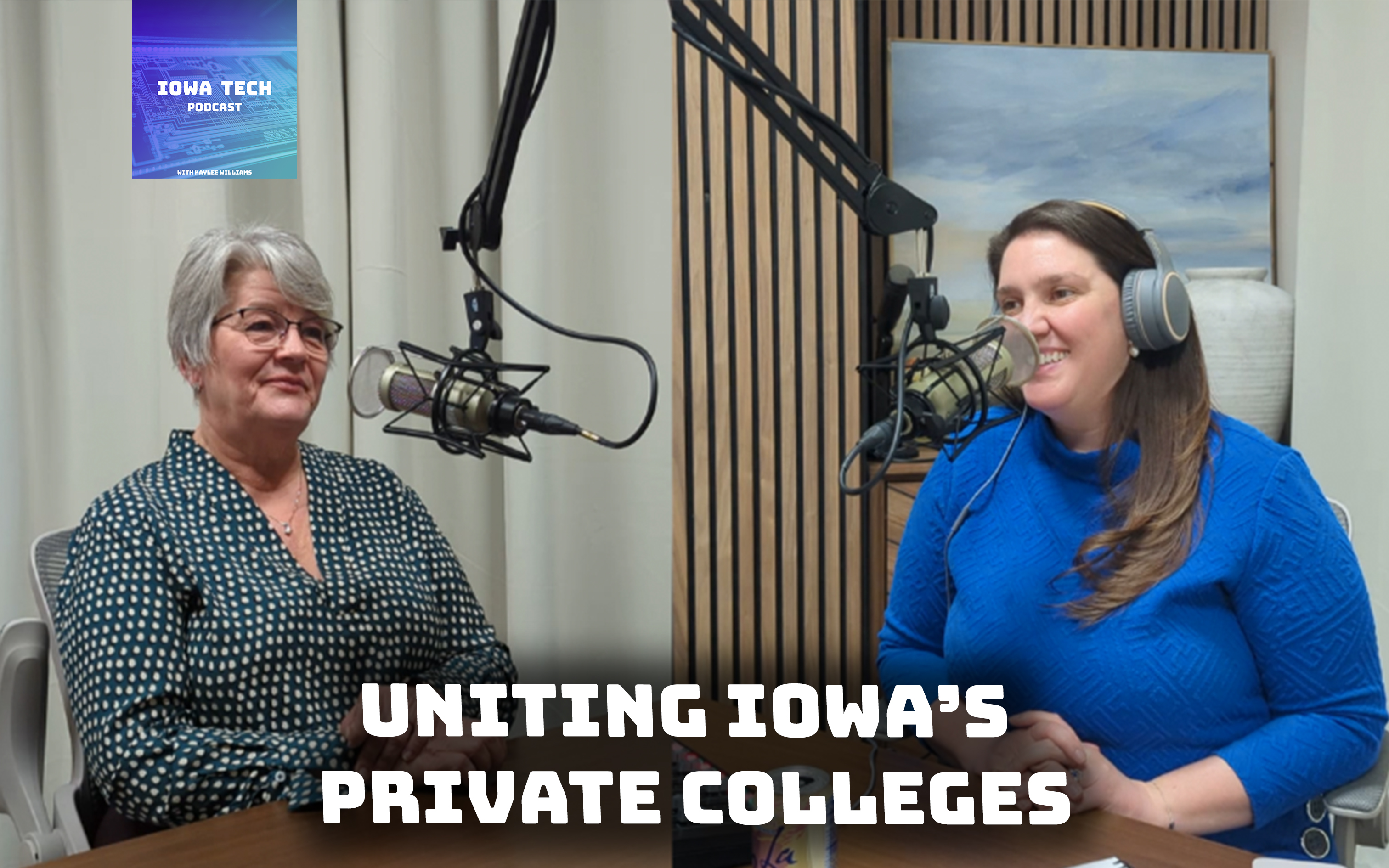


On this episode of the Iowa Tech Podcast, host Kaylee sits down with Dr. Paula Kueter, professor at Morningside University and director of the Joan and Larry Arnold Entrepreneurship Center. Paula shares her journey across Iowa’s private colleges and her mission to elevate entrepreneurship beyond the state’s flagship institutions, spotlighting smart, creative students who often fly under the radar. She details how Morningside is scaling its MBA, integrating AI across the business curriculum, and partnering closely with Sioux City, SIMPCO, and neighboring schools like Dordt, Buena Vista, Northwestern, and Briar Cliff to build a stronger Northwest Iowa ecosystem. The conversation explores redefining innovation around practical scaling, process improvement, and buying-and-improving existing businesses—plus the importance of data literacy, critical thinking, and ethical AI use for the next generation of founders.
Hear from Iowans directly. No algorithms.
Don’t let the algorithms choose your news. Enter your email address to hear directly from Iowans leading news in politics, community, agriculture and business. No editing. No clickbait. No rage. No agenda.
Paula also previews a growing collaboration among Iowa’s private colleges, including a new consortium pursuing 501(c)(3) status to pool resources for pitch competitions, shared courses, and donor support—“entrepreneurship as Switzerland,” where all ships rise together. She and Kaylee discuss post-COVID student dynamics, the power of belonging and small class sizes, and why private campuses function like innovation extension offices for local businesses. From Manufacturing 4.0 opportunities to unsung ecosystem champions like NIACC’s Candy Carstens and longtime connector Judy Iles, Paula makes a passionate call to action: if you’re a business with a problem, tap into your nearby private college—students are capable, eager, and ready to build. To connect with Paula and Morningside, email kueterp@morningside.edu.
Interview Transcript
This transcript was created with help from Ai. Please report errors to us and always refer to the video as your primary source.
Kaylee Williams: Hi everyone. Welcome. back to the Iowa Tech Podcast. It’s your host, Kaylee. I’m here in the Jethro’s Barbecue Stu Studio, which invariably makes me hungry every time I come in here and I see the giant Jethro and I think about burnt ends and it’s like cornbread. Please. Yes, thank you. But not right now. Right now we’re focused on the podcast and I have with me. Dr. Paula Keter, Who’s a professor at Morningside, um, but also the director of the Joan and.
Dr. Paula Kueter: Larry
Kaylee Williams: Larry Arnold? entrepreneurship Center and Economic Development. Yeah. Did I get it?
Dr. Paula Kueter: close.
Kaylee Williams: It’s a mouthful. And it’s not even her full title. She does more than that, Um, but Paula, I will let you talk a little bit about your role at Morningside just to kick things off.
Dr. Paula Kueter: off. Okay. All right. So, um, I have been at Morningside exactly a year. Today is my first year.
Kaylee Williams: it already been a year? It’s
Dr. Paula Kueter: been a year. Um, and I was originally hired to teach the MBA, so they, uh, launched their MBA program last
Kaylee Williams: So Mm-hmm.
Dr. Paula Kueter: And, um, as all things change, I ended up with a number of undergrad classes through the year. So I’ve had a wonderful opportunity to scale up their MBA program. But also really to take, uh, the endowment that, uh, Mr. And Mrs. Arnold gave about a year ago, October, and really bring their vision to life. Yeah. They came and stopped by, on their way down to Arizona and, uh, this fall, and we had a chance to talk with them. I had a chance to meet with them, and they’re super excited about where we’re gonna be taking the center mm-hmm. What it can do for Northwest Iowa, um, in particular. Um, and so, uh.
Kaylee Williams: that
Dr. Paula Kueter: Plus I help with retention. Um, so data is my thing and so I’m kind of the, a utility player I’m turning in to be a utility player at Morningside,
Kaylee Williams: I love it. Now, I met you when you were at Drake And you’ve you’ve worked at a few of the private colleges across Iowa, including, Laura’s, the University of Dubuque. Um, you really know the ecosystem, you know the players. You are known in the ecosystem, and I was just. Talking to you about this before we hit record here, but you’re such a champion for these students. Tell me, tell me, why, like, what is your ethos behind this work and, and why are you? So passionate and why do you have so much conviction, um, about these young people? in entrepreneurship in Iowa?
Dr. Paula Kueter: Yeah.
Kaylee Williams: So,
Dr. Paula Kueter: um, I have, uh, I’m an Iowa State grad three times over, And when Iowa State first started talking about their entrepreneurship program in the College of Ag, I had the first setup before Kevin Kimmel. Right? So this is when, uh, Mr. Papa John had just given the money. Judy Isles literally was in a cubicle.
Kaylee Williams: Early days.
Dr. Paula Kueter: Early early
Kaylee Williams: days,
Dr. Paula Kueter: And you know, just seeing all the interesting ideas. The Iowa State, specifically the College of Ag students had. Right. So I grew up on a farm, which is entrepreneurial by nature. Um, I took the road less traveled, um, through my program, so that’s entrepreneurial. Um, when I had a chance to go over to Laura, um, after I had, um, finished up a couple really big grants for Iowa State, I noticed that that same the same mindset was sitting over in the private colleges. Hmm. Hmm. And I thought that was really interesting. I was like, Hmm. So I had a very, I’ll be honest, I had a very skewed idea of what the students were like at the private institutions in Iowa. Yeah.
Kaylee Williams: be fun. Yeah. Right.
Dr. Paula Kueter: And so as time’s gone on, you know, going from lo I did some things at UD at Platteville. I taught entrepreneurship at UW Platt, um, had a chance to go down to Arizona and work in the Center for Innovation and Brain Science, which is a $40 million research facility, and start that up and kind of see what entrepreneurship looked like down there. And so when I got back, um, to Iowa. I had a wonderful opportunity to really go to Drake and be the Papa John director. Right. So, uh, there’s some things that you check box, right? Yeah. And so I, I had a chance to do that, but then I really got into the ecosystem. But I think it’s even more that once every, once in a while we look at the private colleges and we, everybody talks about Iowa State and Iowa and UNI and, and the community colleges, which are great,
Kaylee Williams: Yeah. Yep, yep.
Dr. Paula Kueter: but Iowa has such a phenomenal. Unrecognized system of Iowa private institutions mm-hmm. That have very, very smart students, very creative, very innovative, and they’re kind of like Iowa’s best kept secret in a way. You know, at Drake, I was just stunned by the number of businesses students had and the sa I’m seeing the same thing at Morningside. I’m just stunned. And we don’t enjoy Kaylee, the estate funding line. Right. We’re a private school. Yeah. Just like everybody else. Um, we don’t get Papa John money. Right. So we don’t have, uh, a go-to.
Kaylee Williams: Yeah.
Dr. Paula Kueter: So everything we do is, by nature, very entrepreneurial. Mm-hmm. You know, it’s working with the donors. You know, working with donors takes a while. You have to build relationships, and that’s really kind of what entrepreneurship’s
Kaylee Williams: Mm-hmm.
Dr. Paula Kueter: is building relationships and listening and working with your city. I work very closely with Renee Billings at the city of Sioux
Kaylee Williams: Mm-hmm.
Dr. Paula Kueter: and Michelle Boto at Simco, so we can jumpstart entrepreneurship in. Northwest Iowa, the very northwest corner of Iowa. We work really close with Dort University. Yeah. Um, we work closely with Bu Vista University. Mm-hmm. Um, and we’re working closely with Briar Cliff, and so we know that we have a really strong ecosystem and so we’re starting to have, uh, pitch challenges mm-hmm. And getting our students in the mind frame that they can do this. Yeah,
Kaylee Williams: that’s right. Right.
Dr. Paula Kueter: And, and that’s the thing. They, they don’t recognize that they can do it.
Kaylee Williams: Yeah.
Dr. Paula Kueter: And so this has really started, um, when I was a student at Iowa State, I commuted, I was the, um, total opposite of what an Iowa State student looked like, you know? And so I’ve always had, um, a deep appreciation for students who kind of take the road less traveled. Yeah. Right. And so, you know. W. Hopefully as time goes on and our ecosystem in Iowa starts to
Kaylee Williams: mm-hmm.
Dr. Paula Kueter: We don’t look at it as this is a, you know, Morningside student, this is a Drake student, it’s all the private college system students. Mm-hmm. And let’s get ’em together and let them network.
Kaylee Williams: You’ve been an advocate for collaboration amongst private colleges in Iowa for a long time. Tell me a little bit about that. How’s it going? Um, and And in what ways are these colleges collaborating with one another?
Dr. Paula Kueter: So, um, because we are self-supporting,
Kaylee Williams: right? Mm-hmm.
Dr. Paula Kueter: A student walks by and there’s a dollar amount. We, we recognize that, right? And so there is some competition. So, but what I’ve always said is that entrepreneurship is like Switzerland.
Kaylee Williams: that
Dr. Paula Kueter: Nobody’s gonna necessarily go to one of us for entrepreneurship only. They’re going to go for business or they’re going to go for chemistry or for ag in the case of Morningside or nursing or education. Yeah,
Kaylee Williams: Yeah.
Dr. Paula Kueter: entrepreneurship. Like the frosting on the cake. Mm-hmm. Right. So that’s just an enhancement. Yeah. And so we have actually been able to start working pretty well together. So we have the consortium. Okay. And that, um, we will be, um, getting our paperwork for the 5 0 1 C3 back from Drake Law. So that’s a partner and they help draw all that. So we’ll be able to file here probably the middle of February. Okay. And that’s going to allow for donors or, you know, entities to give us money. So it’s not necessarily just going to Morningside, it’s going to a pot. It’s going to a pot. Right. and then that will help support entrepreneurial activity. So pitch contests the same thing. Let’s say I’ll pick on Iowa State, the same thing that the Iowa State students get to enjoy the whole year. You know, each college there’s different pitch competitions, things like that. Yeah.
Kaylee Williams: Yeah. Yeah.
Dr. Paula Kueter: Our students will be able to do that through the consortium because there will be some prize money. Yeah. Right. And so, plus we can also do some sharing of courses. Mm-hmm. Um, because some of the schools don’t have Apollo.
Kaylee Williams: right? Mm-hmm.
Dr. Paula Kueter: Mm-hmm. Um, some of ’em, they’re using entrepreneurs in the community, and this way we can, I’m hoping we can get to the point where we can have some shared resources, but we’ve all kind of put, have to put down our competition Yeah. Around this. Yeah. And, and I truly understand. Mm-hmm. I, I, I was the associate dean at Simpson. I truly understand the enrollment situation. I understand, but it’s about the students.
Kaylee Williams: You
Dr. Paula Kueter: know, if we look at this more holistically as being for the students mm-hmm. That’s gonna help drive students to the private colleges.
Kaylee Williams: and keeping students at the center, I would imagine drives better programming As well. I was, and I think we talked about this, but I was so impressed with the quality of pitches that we saw when I went to, it was like a, um, business showcase event. mm-hmm. And it was all kids from private. Schools all over the state. and they were presenting their startup ideas and, And they had uh, these incredibly well baked business plans with a competitive analysis And, you know, what’s their niche and their differentiator and go to market strategy. And I was just, I was so impressed. Um, you said something earlier,
Dr. Paula Kueter: That I,
Kaylee Williams: I thought was, uh, wonderful. It was something to the effect of like, these kids are so smart. they’re like
Dr. Paula Kueter: so smart
Kaylee Williams: Di like you wouldn’t, know it necessarily. They, they don’t have as many opportunities. to be platformed. Mm-hmm. Um, but the schools are are trying to come together and platform them.
Dr. Paula Kueter: mm-hmm.
Kaylee Williams: Tell me about your vision for innovation in Iowa, maybe your mid to long range outlook.
Dr. Paula Kueter: So I’ll kind of speak to northwest Iowa. Yes,
Kaylee Williams: please do. because Western Iowa gets lost. doesn’t it?
Dr. Paula Kueter: Yes. There is life, past fork dodge, um, uh, and I think people forget that. Yeah. Right. And, um, in, in northwest Iowa. You manufacturing is a component. Mm-hmm. And we, and we realize that, but as you starting to talk with a lot of industry leaders up in northwest Iowa, they understand innovation has to be the under girth of it.
Kaylee Williams: Mm-hmm.
Dr. Paula Kueter: And it’s really getting students to think differently instead of say, I’m gonna start a business. what kind of innovation can I do to change this system? To change this process? Yeah. Right. Because I said there’s a lot of op I was telling a student the other day, there’s a lot of opportunities to buy an existing business now and then improve the system in the process. And that’s how you scale. Yeah. Right. And so instead of kind of doing the bones that we’ve been doing for many, many years, I’m taking the approach that we’re going to, um, focus more on how would we scale. And so we would start at the beginning right. But also include how do you scale? And Candy Carsten’s at Nyac is doing a little bit of that right now. Right. And um, one of the things we work really close with K in Nyac and she’s just wonderful, um, very, very open for sharing and just an outstanding trooper for entrepreneurship. But for innovation, it’s changing people’s mindsets. Yeah.
Kaylee Williams: Yeah.
Dr. Paula Kueter: Because I think they think they have to come up with the greatest next big idea. Mm-hmm. And then it becomes overwhelming.
Kaylee Williams: Yeah, Absolutely.
Dr. Paula Kueter: like cramming for an exam. Yeah. If you don’t know it by six o’clock the night before, it’s not going to happen.
Kaylee Williams: ain’t Gonna learn it.
Dr. Paula Kueter: Not gonna happen over coffee all night. Right? Yeah. And so making it into manageable chunks, but also, um, I was just talking, um, with someone last week. I said, let’s put the carrot out in front of them. Right? So here’s what it could be if you scale, because what we’re seeing in this, um, different set of students now, they’re different than they were 10 years ago. Right. And entrepreneurship needs to adjust to that. Yeah. They’re coming in much savvier. Mm-hmm. Um, AI is becoming a definite thing. So at Morningside we have integrated, especially in the school of business, we are integrating AI left and right, um, and using it ethically not to cheat. Right. Yeah. Leading into it, really using it as a tool. Yeah. And we had a class where they were creating, um, agents this fall. Yeah. Um, we have a very progressive, um, interim president, Chad Benson. Mm-hmm. Um, who is an AI guy. Mm-hmm.
Kaylee Williams: mm-hmm. And
Dr. Paula Kueter: A tech guy. And so, you know, that brings a lot of excitement to Morningside definitely. But definitely to Northwest Iowa. Yeah. You know, because it’s a different mindset
Kaylee Williams: and the applications for technology in manufacturing are numerous and very exciting.
Dr. Paula Kueter: And even if you look at it, it’s scaling, Right. So if you have a, let’s say a mid-size business and you have, you know, multiple customer relation issues you have to do.
Kaylee Williams: mm-hmm.
Dr. Paula Kueter: Here’s some kids who literally can build you an agent probably in two days,
Kaylee Williams: I mean, absolutely. I was just emailing with, um, Brad Dwyer and Joseph Nelson at Robo Flow Today, Because IEDA, which by the way, Next Monday um, the applications go live for the manufacturing. 4.0 loan program, which provides $75,000 up to $75,000 for innovations to help integrate 4.0 equipment Into the man manufacturing processor on the floor, And so computer vision is certainly a, a 4.0 technology. That can be adopted. And you think about. The radical transformation that can happen on a manufacturing floor if computers can see and robots can do.
Dr. Paula Kueter: Yeah. And it’s not taking away jobs, you know, I
Kaylee Williams: oh, that’s
Dr. Paula Kueter: the one thing that people are scared of ai. So one of the set of classes that I teach is AI in the MBA. Okay.
Kaylee Williams: Okay. Right? So you know this stuff.
Dr. Paula Kueter: I know this stuff, right?
Kaylee Williams: need me woman explaining you.
Dr. Paula Kueter: my secret. now. Um, And One of the things that we were able to do is hire an individual that has a little bit of an AI background, um, in the training and development world. So we’ve really been able to ramp really quick at Morningside. Wow. And we have, um, a computer science professor that is very, um, into that as well. So you put everything together and you can see the possibility. Students can see the possibilities. Their eyes light up because they never even dreamed when they came to Morningside. This was a possibility.
Kaylee Williams: wanna take, that class. I
Dr. Paula Kueter: I wanna take that class. Right. But one of the things that we really need, and this is what I tell students, is you can scale, a business. Mm-hmm. But if you don’t know how to lead your business and you don’t understand organizational culture
Kaylee Williams: Yeah.
Dr. Paula Kueter: That’s where learning critical thinking comes in. Yeah. Um,
Kaylee Williams: that’s the MBA, you know, the holistic nature. of an MBA is, is More than just how do you. make more money.
Dr. Paula Kueter: And we teach that in the, in their strategy course, our undergrad capstone. Right. And one of the things that was interesting, so I started with integrating AI right away in there. So they’re looking at different companies and at the end of the strategy course and the reflections, they said, if I had not learned this in class, I would’ve not recognized that AI had this. They would’ve accepted it, point blank. And so I think that’s one of the things entrepreneurs really need to be kind of on mm-hmm.
Kaylee Williams: alert for. Mm-hmm.
Dr. Paula Kueter: Mm-hmm. Because it’s, it looks real,
Kaylee Williams: and it sounds
Dr. Paula Kueter: it sounds great and, but it, something’s not right.
Kaylee Williams: You gotta diligence the AI a little bit. Exactly You do.
Dr. Paula Kueter: Yeah. And so, you know, that’s one of the things is really focusing on building those critical thinking skills
Kaylee Williams: mm-hmm.
Dr. Paula Kueter: That entrepreneurs need now, because it’s different than it was 10 years ago, Kaylee. Yeah. Think about, you know, all the different types of data we deal with. Do you know if it’s wrong or right? You know, and even how you do data analysis mm-hmm. And all the different software programs, you know, to figure out how, where’s my, where’s my edge? Yeah. Where’s my edge? And you go to any of the private institutions and they’re probably gonna have professors, I know they will, that do data analytics. Mm-hmm. Mm-hmm. And there’s students who need projects, they will do a project for you. Right. And so that’s one way that the private colleges and the institutions now can really help. The small business is make sense out of their data. They’re right there. They’re in your community. Mm-hmm. They know the community better than anybody. Mm-hmm. And there’s smart kids there. They’re gonna take their idea, they’re gonna help you with your problem and find the solution. And then there’s a very good chance that solution’s then gonna become something.
Kaylee Williams: Yeah.
Dr. Paula Kueter: So I think we need to look at it a little bit differently. ’cause you know, for so many years we’ve talked about innovation being the big idea. Mm-hmm.
Kaylee Williams: Mm-hmm.
Dr. Paula Kueter: And there’s all these other little ideas that kind of get, I think sometimes swept to the side.
Kaylee Williams: Hmm. Yeah. And I I, I know from experience that successful startup companies, they’re not. always super sexy. Like it Could be just a small automation or a small problem that you’ve identified that you can fix. Love the idea of just scaling, learning a, approaching entrepreneurship from just this. idea of scaling. Someone said to me recently, it’s never been easier to just start. A software company, it’s never been easier to just fail at starting a software company. And These are good. things, by the way. And, and so he almost made the point that it’s really not the ability to write code or build the software that is your special sauce. What is your special sauce? Is the way you think, the way that you build, The way that you the expertise that you bring to the table. Maybe you have some domain expertise or you’re really passionate About a particular topic. I mean, it’s. innovation The definition of innovation I think has changed.
Dr. Paula Kueter: has, you know, and if you look back when you know, John first gave the money, innovation was very, I would say, raw. at that time. Mm-hmm. Right. It’s now become a very manicured idea. yeah.
Kaylee Williams: yeah.
Dr. Paula Kueter: That has different subsets. Yeah. Right. Um, you know, one of the things that just made my heart pitter-patter and not many things do except for my grandchildren. Um, but one of the things that really sparked my interest is when, um, president Benson, um, assumed, uh, office in. Like August. Mm-hmm. And about a month and a half ago he told me our focuses are gonna be innovation, entrepreneurship, and leadership, which is my domain, my three domains. And having him come out of corporate.
Kaylee Williams: Mm-hmm.
Dr. Paula Kueter: And having two AI companies, it’s amazing. The transformation. Yeah. Our students know it without us even telling them. They can sense it. Mm-hmm. Right. And that gives them a lot of hope. And that’s across, I’m sure, across all the private institutions. Yeah. In Iowa
Kaylee Williams: it’s how you stay relevant.
Dr. Paula Kueter: You have to Right. You can’t put your head in the sand anymore and be an ostrich and hope everything’s okay when it comes out.
Kaylee Williams: Yeah. Yeah. gotta change,
Dr. Paula Kueter: gotta change. And you know, really looking at the private colleges and what they can do for you.
Kaylee Williams: Yeah.
Dr. Paula Kueter: It it, and I think that’s one of the things, there’s students there who can help with any problem you have
Kaylee Williams: Yeah.
Dr. Paula Kueter: treat ’em like almost an extension office. Yeah. There is somebody on staff there that can get students lined up with you because they need projects.
Kaylee Williams: And very enthusiastic. my experience of working with students on projects, even for a startup that I was involved in. they do a good job. Mm-hmm. Now it might, it might just be a first draft, like you’re gonna have to put some hands on it. and, you know, Get it to where it needs to be. But They’re very capable, very competent.
Dr. Paula Kueter: very competent. And you know, I’m not trying to say that the region schools are not the same way, but the private colleges are just a very unique atmosphere. mm-hmm. It’s a very family atmosphere. Yeah. And that’s why students go there. Right?
Kaylee Williams: absolutely, It caters to a, different type Of student And I actually, this is good ’cause I wanted to touch on this with you, but what are some of the benefits that students who maybe. right now are just graduating from high school? Why should they consider a private college?
Dr. Paula Kueter: You know, one of the things we get, we’re having some of our highest visitation numbers. We had the largest incoming class, um, this year, the
Kaylee Williams: Congratulations. Thank you. That’s
Dr. Paula Kueter: We’re on track to hit it again.
Kaylee Williams: Okay.
Dr. Paula Kueter: Um, and one of the things I noticed from doing visitations, um, meetings with students Yes, is they’re looking for where they belong. And I haven’t heard that for many, many years. I’m looking for where I belong. you know, what does belonging mean? And so for everybody, it’s a little bit different. Mm-hmm. But I have had a number of students say, you know, I really wasn’t considering Morningside until I walked the campus.
Kaylee Williams: Yeah.
Dr. Paula Kueter: Right. And one of the things that the private college is, regardless of who it is, is you have smaller class sizes. I know much to the chagrin of maybe some of my students, I know their names. I know if you know, we have a very high athletic population. Right? Yeah. I know what sport they play. Mm-hmm. They know to look for me in the stands. Like our football team did extremely well this year. And I had about 12, um, football players in my organizational behavior class, which was an interesting ’cause they were like half of the class.
Kaylee Williams: And
Dr. Paula Kueter: the running backs when they were warming up, stopped and looked at the stands and waved at me. That’s, and my husband saw it. He goes, yeah, Jaylen’s waving at you. You know? And so that’s why they come. Because we come to their events. Mm-hmm. They can see us. We ask them, how was your day? If you know, um, about a year ago at, at Drake, I had a student, his mom died,
Kaylee Williams: Oh
Dr. Paula Kueter: right. Yeah. And that’s really tough. Um,
Kaylee Williams: young.
Dr. Paula Kueter: So young. And then when I got up to Morningside, it happened again, except this student was an international student. Mm-hmm.
Kaylee Williams: Ugh.
Dr. Paula Kueter: Right. And so those are the things that really I think, make the private institution shine in
Kaylee Williams: Mm-hmm.
Dr. Paula Kueter: Is that we care a lot about our students
Kaylee Williams: the sense of community, it’s almost inevitable. Mm-hmm. Because you’re, you’re close knit. It’s a smaller class size. You can actually know your teachers, I mean, I’m not. gonna lie to you, there were plenty of lectures at the University of Iowa where I was the kid slinking in the back, you know, just Not really, not wanting to be seen, you know? But I, But I think that The cool thing about what we know now about how people learn is that there are different styles of learning and there are different, contexts of learning that are more conducive for different people. Every
Dr. Paula Kueter: and that moves over to entrepreneurship.
Kaylee Williams: yes.
Dr. Paula Kueter: It’s not one size fits all anymore. Like it was maybe 15, 20 years ago. Right.
Kaylee Williams: Right.
Dr. Paula Kueter: You know, you have to look at your population and see how they’re learning. Mm-hmm. You know, and it was, you know, we were kind of laughing this week as we had, you know, today’s first day of classes at Morningside and on Monday we were kind of chuckling like, this class is so radically different than last year’s first year class. Mm-hmm. And the first year class before then. We never saw that many rotations of change in the past. You know, you would have like groups of five years and now with each group coming in, they’re different. We can tell these students are not
Kaylee Williams: COVID Oh, kids really?
Dr. Paula Kueter: Right. So they would not have been in high school. Five. Yeah. they would not have been in high school. Yeah. And they are much more engaged. They’re happier.
Kaylee Williams: Oh,
Dr. Paula Kueter: It is just like a totally different,
Kaylee Williams: it breaks your heart. doesn’t it? A little
Dr. Paula Kueter: and, and you know, I think that kind of hurt us a little bit in the innovation market too, in terms of students.
Kaylee Williams: Oh yeah.
Dr. Paula Kueter: Because the trauma, and I think that’s a fair statement to call it trauma. Mm-hmm. That occurred for the last four years for these groups that have been going through when they were freshmen in high
Kaylee Williams: Mm-hmm.
Dr. Paula Kueter: They couldn’t really dream. It was kind of survival when you think about it, you know, for the seniors that when COVID hit, their senior year was destroyed.
Kaylee Williams: Oh gosh. Can you imagine?
Dr. Paula Kueter: You know, so, oh my gosh. Thinking about starting a business or an idea, you know, they’re just trying to get through. Yeah. Right. We’re starting, at least I am, and maybe some of my counterparts at the other institutions are, you’re starting to see a different. Um, tenor.
Kaylee Williams: it.
Dr. Paula Kueter: Mm. Um, you have students that are coming up, I have an idea and it has to do with AI and it has to do this. Can you teach me how to do this in Excel? Yeah.
Kaylee Williams: Right.
Dr. Paula Kueter: And so the, they’re becoming inquisitive again. Mm-hmm. And that’s something I don’t think we’ve really seen, um, in the last four or five years. Mm-hmm. Now Now it’s hard to compare that maybe with the region schools, ’cause the classes are so big with us, we notice it. Yeah.
Kaylee Williams: Yeah. You can kinda wrap your mind around a cohort, a
Dr. Paula Kueter: Yeah. We, we see kind of that fluctuation. Yeah. Where the bigger, when you get into the, the bigger schools, you’re not necessarily gonna pick up on that fluctuation. Oh yeah. As much as you would at the smaller ones. 30,000
Kaylee Williams: people. I think at, at Iowa. I’m not sure about Iowa State. Iowa State’s.
Dr. Paula Kueter: Iowa State’s a shade bigger I think. Yeah. But you know, one of the nice things that I look ahead, right? So I’ve got a few gray hairs,
Kaylee Williams: right. Um.
Dr. Paula Kueter: What I wanna do is to get, you know, ’cause my sons ask me, mom, when are you gonna retire? When are you gonna retire? Right. And as long as I’m having fun, I’m not gonna retire. I
Kaylee Williams: love, that,
Dr. Paula Kueter: but I’m also smart enough to know I need somebody coming in behind me,
Kaylee Williams: Yeah. Yeah. you gotta lift people up.
Dr. Paula Kueter: Yeah. Because when you have, when you’re building programs, so many people don’t do that. And then you retire, somebody leaves and the program collapses and it’s.
Kaylee Williams: it’s like they have to start all over again and build that
Dr. Paula Kueter: Exactly. And so, you know, that’s why I work super close with the city of Sioux City. Mm-hmm. And with Simco and they have been wonderful partners. And Breyer Cliff, you know, we’re starting to do, and that, you know, it’s a little dicey. It’s kinda like Dubuque. Dubuque’s got Ud Laura and Clark, we’ve got Breyer. And so you know, you’re all fighting for the same student.
Kaylee Williams: Yeah.
Dr. Paula Kueter: But we also recognize that we have to be there for our students as a whole.
Kaylee Williams: Mm-hmm.
Dr. Paula Kueter: You know, and the, the, uh, pitch competition you judged was the first time that the private colleges were competing to go to the Papa John contest for the private colleges. Ah.
Kaylee Williams: Ah, that’s what it was.
Dr. Paula Kueter: what it was. That’s so cool. And Candy had it last year. This year we’re doing kind of a modified one. Okay. We’re gonna be running a pitch challenge on February 19th, I think is a Thursday. It’s inter, it’s a national entrepreneurship week. Oh.
Kaylee Williams: nice. That makes
Dr. Paula Kueter: Blake Anderson, who owns uh, I think Petland Foods and Ankeny is a Morningside grad and he is gonna be our keynote speaker. And so we’re gonna make a thing out of it. And we’ve invited Dort Uni, Vista, Northwestern, bring them in. Bring them in, and I think we’re gonna have a fun time. Right. And so the benefit to that is not matter who wins what prize.
Kaylee Williams: Yeah.
Dr. Paula Kueter: But let them network together.
Kaylee Williams: Yeah.
Dr. Paula Kueter: Because you know, one time I. earlier this fall, I asked my class, how many of you talked to any of the other schools? I was just kind of curious. Yeah. And they all looked at me like I had eight heads and 16 eyes. And I’m like, so you never, and they’re like, no, not really. And I thought, that is really sad. They see each other on the field or the court or whatever. Mm-hmm. And they, you know, chitchat.
Kaylee Williams: Yeah.
Dr. Paula Kueter: And I said, you know, they’re like, no. And I’m like, this is what’s wrong. with the state. The state of Iowa.
Kaylee Williams: Yeah. I,
Dr. Paula Kueter: Our students aren’t talking to each other. Hmm. They’re not networking.
Kaylee Williams: Yeah.
Dr. Paula Kueter: Think how powerful this would be if we get all students who have even a little idea, a button of an idea. Mm-hmm. Together, because you don’t know five years from now be like, Hmm, that kid from Briar Cliff, or that kid from Dort. I wonder if, if they’re doing this. Yeah.
Kaylee Williams: You
Dr. Paula Kueter: as we look at the state of Iowa and we have all these wonderful, you know, new bocos doing really cool things, but we have such a fragmented ecosystem mm-hmm. In a lot of ways in the state of
Kaylee Williams: Mm-hmm. Mm-hmm.
Dr. Paula Kueter: and maybe it’s because I’m on the west side, so I’m kind of looking back in, right?
Kaylee Williams: Mm-hmm.
Dr. Paula Kueter: But wouldn’t it be cool if we built the ecosystem around our students that would get them to stay in the state of Iowa? Right.
Kaylee Williams: Right?
Dr. Paula Kueter: That would, they could grow their businesses or they become intrapreneurs and stay within the state of Iowa. Mm-hmm.
Kaylee Williams: I, what I’m Hearing is, while these private colleges are competitive by nature because they have to be, um, when they come together. They develop programming with a shared North star in mind about entrepreneurship, innovation, the mindset of solving a problem and scaling that all the ships rise with the tide, And they’re all able to better and more effectively deliver that Kind of education To their students. Exactly. By partnering and I hadn’t even considered. The second and third and fourth order impacts Of helping those students. to build more of a statewide network. themselves. Mm-hmm.
Dr. Paula Kueter: Yeah. It really is. And so now I probably just gave away my idea for the EIA grant, but. I’ll have to call Debbie and say,
Kaylee Williams: I won’t tell anyone, but I, will publish
Dr. Paula Kueter: on Kaylee’s podcast. Um, but you know, we really need to make it a concerted effort. Yeah. Um,
Kaylee Williams: yeah. And there need to be, there need to be champions. who are going to reach across and link arms.
Dr. Paula Kueter: And that’s not to neglect anything that, like, you know, what Alex is doing at New Boco and all these things complimentary. It’s very complimentary. But we need to get together and have a conversation. About how can we help each other?
Kaylee Williams: Yeah.
Dr. Paula Kueter: How can we, as looking at the state of Iowa, Right. Because you know, like a lot of our students, we get some from Nebraska, well quite a few from Nebraska. We’re getting quite a few now from Iowa. Mm-hmm. We see some from South Dakota ’cause we’re in kind of in a unique position.
Kaylee Williams: Yeah, that’s true.
Dr. Paula Kueter: You know, we’re at the, the crux of all three Yeah. And I’m hearing more students say they wanna go back home when they graduate. I’m like, well, what are you gonna do? Well, I’m not quite sure yet. I said, well, what kind of ideas do you have? And they hadn’t even thought of it. I said, what kind of problems exist in your community?
Kaylee Williams: There you go.
Dr. Paula Kueter: And I said, go solve them. Yeah, but see, it’s taking that next step, Kaylee, and saying, well go solve them. Mm-hmm. Because one of the things we’ve kind of noticed a little bit with this group, they have to be told, go solve it. Yeah. And they’re like, oh, okay. And off they go.
Kaylee Williams: Just need a little nudge.
Dr. Paula Kueter: you know, one of the things,
Kaylee Williams: it
Dr. Paula Kueter: it would be nice if the state of Iowa, and I know this may or may not happen, but it would be nice if the state of Iowa had an entrepreneurial pot, not IEDA,
Kaylee Williams: Mm-hmm.
Dr. Paula Kueter: Mm-hmm. Mm-hmm. that focuses only on the students because,
Kaylee Williams: because,
Dr. Paula Kueter: and it could be shared mm-hmm. Among all the institutions in some way, shape, or form. Mm-hmm. That it’s not just going to Iowa State or Iowa. Mm-hmm. You know, because in a little bit of the way you and I is in the same boat. Yeah.
Kaylee Williams: right. Yeah. Yeah.
Dr. Paula Kueter: In a little bit of the way niac, if you’re looking at that. Right. One of the things, and like I said earlier that I appreciate about Candy Carsten’s,
Kaylee Williams: is
Dr. Paula Kueter: that she is so open to sharing, Yeah,
Kaylee Williams: Yeah,
Dr. Paula Kueter: and it doesn’t matter if it’s another community college, if it’s a private school. She wants to, I, uh, she wants to move entrepreneurship all over through the state of Iowa. She’s kind of, I would say Iowa’s unsung hero. Yeah. To be honest.
Kaylee Williams: candy,
Dr. Paula Kueter: You know, she’s so sweet and, and she knows what she’s doing. But there is another example of somebody that’s at a smaller community college, Right. Right. Same kind of situations. Um. I think that’s why Nyac works so well in terms of entrepreneurship mm-hmm. With the private colleges that are doing some things. Yeah. You know, lo I just got done kind of helping lo do a jumpstart. They’re gonna be having an entrepreneurial initiative over there. Okay. And so that’s really cool for lo I, I have lots of deep, deep feelings for Laura.
Kaylee Williams: It’s your first one, right? First,
Dr. Paula Kueter: Yeah. You know, all this kind of thing. Um, but also, you know, we wanna do some shared
Kaylee Williams: Yeah. And
Dr. Paula Kueter: We’re gonna be, you know, hopefully trying that within the next year. So how can we share? Yeah. Um, you know, and that brings Candy into the conversation too. You know, candy is a wealth of information. So is Judy Isles, you know, Judy has been wonderful. I have called and said, Hey Judy, I need this. Can you help me? Same way with Lynn Lenor at Iowa. Yeah, right. Very, very, um, open. But I think that’s because the Papa John door opened. Yeah. Right. And um, that makes a big difference. It
Kaylee Williams: It does. And I, I think it’s kind of our superpower in this state is the, connectedness and the willingness that We all have to help one another and talk to one another and it’s not like that everywhere. No, it’s, And we really like we should recognize, it. We should lean into it and, and find and create opportunities to work together and collaborate. and that’s why I wanted. to bring you on today, Paula, because This has been something you’ve been banging the drum about for, uh, as long as I’ve known you. Oh.
Dr. Paula Kueter: Probably 10 years. Yeah. Yeah.
Kaylee Williams: Thank you so much for coming on today. Welcome. Are there any closing thoughts you’d like to leave for our listeners?
Dr. Paula Kueter: thoughts? Yeah, I, what I would say is, you know, if you’re a, uh, business owner or, um, regardless of size and you have problems, reach out to your private institutions. We’re uniquely located throughout Iowa. If you look at the map, that’s true. It’s extremely true. And there, you know, there is somebody on that campus that can help you with your problem and tap into the very entrepreneurial and innovative minds that are sitting there. And I’m not necessarily talking about faculty, I’m talking about the 18 to 26 year olds.
Kaylee Williams: your workforce.
Dr. Paula Kueter: That’s your workforce. And open the door for them, Right now, I think sometimes I think the door’s closed.
Kaylee Williams: Yeah.
Dr. Paula Kueter: And so it, it takes, you know, uh, collaboration on both sides. But if you have a problem, reach out and see what, you know, these kids can come up with. Because you might be shocked with what they come up
Kaylee Williams: You might be
Dr. Paula Kueter: and go, oh, I hadn’t thought of that. Mm-hmm. Right. And so, you know, it is why I tell entrepreneurs all the time, you never should stop doing customer discovery.
Kaylee Williams: Yeah.
Dr. Paula Kueter: And in this case, this is customer discovery saying, can you help me with my problem? Yep.
Kaylee Williams: And if they want to contact you and Morningside? Yeah. How do they get in touch?
Dr. Paula Kueter: Um, the best way is email, and so Kaylee can probably put it somewhere, but it’s K-U-E-T-E-R p@morningside.edu. Okay,
Kaylee Williams: Okay, perfect. Well, this has been a wonderful discussion with Dr. Paula Keter. of Morningside University. Thank you again. Thank
Dr. Paula Kueter: you.