

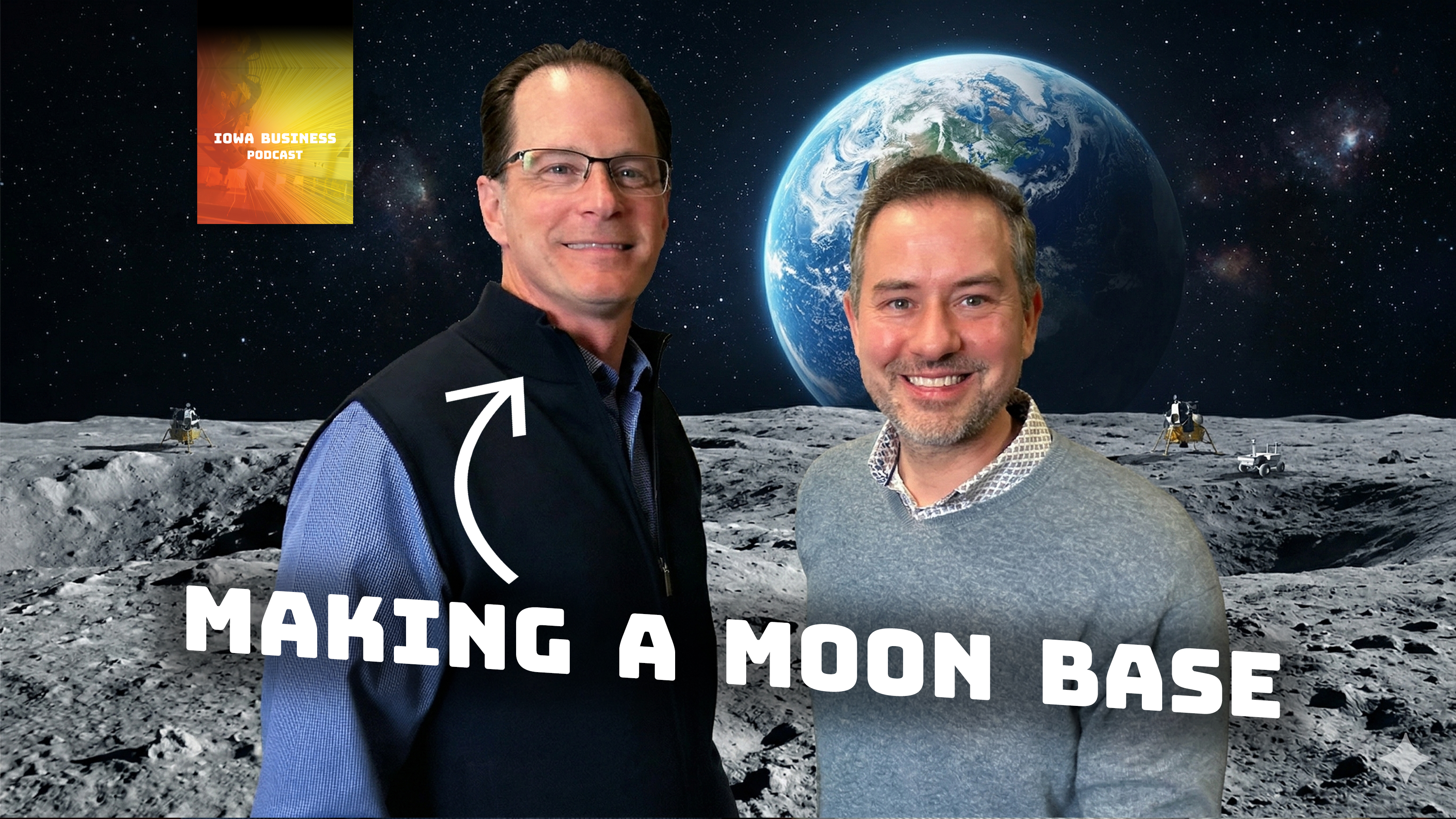


As we watch NASA’s Artemis II mission, one Iowa company is looking forward to incredible breakthrough potential. The moon has plentiful Helium3, an element not found on earth, and Vermeer’s technology can harvest it. CEO Jason Andringa explains how they’re unlocking new potential in quantum computing, fusion energy, and leading a Bondurant manufacturing boom!
Andringa has a space background. He has a degree from MIT in Aeronautics and Astronautics and worked for NASA’s Jet Propulsion lab—yes, a real life rocket scientist. Andringa discusses their massive one hundred million dollar expansion into Bondurant, and confirms he’s been communicating with SpaceX on future technology and missions. Will Vermeer be planting a flag on the moon or Mars soon?
Jason Andringa, CEO of Vermeer

Jason Andringa, CEO of the 78-year-old Iowa brand Vermeer, is steering the manufacturing giant through a period of explosive growth that spans from the soil of the Des Moines metro to the regolith of the moon. He detailed the company’s massive $100 million investment in Bondurant, Iowa.
The new 300,000-square-foot facility, dubbed Vermeer Des Moines, sits on a 186-acre plot—less than a quarter of which is being developed initially. The expansion aims to double the current regional workforce of 100 to roughly 300 team members by the summer of 2027.
Bondurant manufacturing and domestic labor growth.
While Vermeer maintains its global headquarters in Pella, pulling nearly 3,000 workers daily, Andringa noted they have hit a ceiling for local recruitment. The move to Bondurant allows the company to tap into the larger Des Moines talent pool and nearby educational institutions like Iowa State University. Despite the global trend of offshoring, Vermeer remains committed to a domestic strategy, with 96% to 98% of its steel sourced within the U.S. “We have really always built all of the products that we sell within the United States, we’ve built it within the United States, and not only have we built it within the United States, our supply chain has been US based,” Andringa said.
Hear from Iowans directly. No algorithms.
Don’t let the algorithms choose your news. Enter your email address to hear directly from Iowans leading news in politics, community, agriculture and business. No editing. No clickbait. No rage. No agenda.
From Underground Infrastructure to Lunar Excavation
Vermeer is transitioning its “fast-moving” smaller product lines, such as tree care and landscape equipment, to Bondurant to free up space in Pella for “big iron” machinery. However, the most futuristic growth lies in aerospace. Leveraging Andringa’s background at NASA’s Jet Propulsion Laboratory, Vermeer is partnering with Interlune to develop lunar excavators. These machines will harvest Helium-3, a rare gas valued at $25 million per kilogram, essential for nuclear fusion and quantum computing.
Andringa is bullish on the necessity of this technology, noting that “Vermeer can be kind of a fast follower or even kind of a moderate follower in those type of technologies.” While the CEO has traded his childhood astronaut dreams for executive leadership, his vision for the company remains celestial. “I’m incredibly passionate about using the things that Vermeer is world class at to help be part of the solution on the moon and Mars,” Andringa concluded. He also confirmed he’s spoken to people at SpaceX on future projects.
Will we be planting a Iowa and Vermeer flags on The Moon or Mars in the near future?
Interview Transcript
This transcript was created with help from Ai. Please report errors to us and always refer to the video as your primary source.
Justin Brady: [00:00:00] From the jetro Barbecue Studio. This is the Iowa Business Podcast Tale of two Cities. We’ve heard that quite a bit from our previous business guests. There’s a tale of two cities in Iowa. Some people are growing like a freaking weed, and then other people are just kind of pausing. and One of those Iowa loved brands that is growing like crazy. Joins us today, Jason anda the CEO of Vermeer. Thank you for coming in the Studio
Jason Andringa: great to be here.
Justin Brady: We’re gonna talk about the Bonderant expansion, why you guys are growing like a freaking weed, and, uh, generally world domination. But before we talk about that, thank you so much to Dentons Davis Brown for sponsoring the show. We just had Kaylee and Beth in here talking about two really core issues, immigration and how that affects H one B visas, the a hundred thousand dollars fee, how immigration affects you. We also talking about talent acquisition and [00:01:00] talent retention with Beth. Both of those are on Iowa podcast.com/business. Absolutely fascinating discussions. They both spent. 20 minutes in here, breaking down these issues for you. Jason. Jason, like I said, thank you so much for coming on the show. Uh, the Bonderant project is kind of massive as an understatement. It’s like a, what’s the investment here? A hundred, a hundred million. Is that right?
Jason Andringa: It is, it’s, it’s a big deal for Vermeer. We have been a proud resident of Iowa for 78 years now, ever since my grandfather started Vermeer. Um, and we have been growing, like you said, um, growing robustly. And so even though Pella has always been and will always be the center of the universe for Vermeer, we really believe that we are bringing about as many people to Pella every day as what we can. So if we’re gonna grow, we need to have facilities other than Pella. And, uh, we, [00:02:00] we have a, a substantial second facility in, um, Greenville, South Carolina, but the. Investment in Bonderant is really for a third substantial facility. Um, and honestly, between Greenville and and Bonderant, um, we have incredible capacity to grow in those two facilities. So the investment in, uh, Bonderant, which we’re gonna call Vermeer Des Mo. Is we purchased 186 acres, so we, we bought a huge piece of land and we’re gonna build a 300,000 square foot manufacturing facility on 40 of those acres. So we literally are building out less than a quarter of the land that we have. Um, in Bond Durant, uh, we, we have a team of, uh, more than a hundred people working in a leased facility in Northeast Des Moines. And that team is awesome. They’re doing tremendous work for Vermeer. So we look forward to moving all those people to the new [00:03:00] facility in the summer of, uh, 2027. And then, um, more than doubling the size of our, um, workforce
Justin Brady: we’re gonna, We’re gonna, talk about all the stuff you’re doing, uh, ’cause it’s not limited to our earth either. You’re doing some stuff, kind of, might be doing some stuff on the moon
Jason Andringa: We hope to be.
Justin Brady: Yeah, we’ll, we’ll, so, we’ll, we’ll break that down. But the most important thing is if you’re in Greenville, this’ll probably be a topic you spend 10 seconds on. If you’re in Greenville. Do you guys work with Mr. Beast on any stuff? That’s what all the kids wanna know these
Jason Andringa: no, uh, green Greenville is, um, super vibrant growing community. Um, and you know, our footprint in Greenville, South Carolina is because of an acquisition we made. 10 to 12 years ago. Um, and we purchased a small facility. We purchased a company that was in a small facility and then, you know, bought a piece of land and built a new facility. So that’s, that’s why we’re in Greenville. Um, but yeah, we’re, we’re really proud of our footprint there. Growing vibrant community. A lot of world-class, um, manufacturing companies are based in Greenville, but, [00:04:00] uh, but no, Mr. Beast is not part of the
Justin Brady: We need to make that happen. That would be cool. You can work on Beast Games three and work on Beast City or something. You may Not even have any clue. what I’m talking about. You can be like, dude, I don’t know who this case is. We need to make that happen. The um, a lot of the pe a lot of people, Vermeer’s one of those companies that’s l. I don’t know if I can, I can probably use the word literally everywhere and doing almost everything and involved in everything. If there’s any major construction, street, reduce cabling, anything like that, Vermeer’s probably involved. Most people are, you’re one of those brands that most people may not know, like at least General Iowans probably don’t know exactly what you’re doing in there, but they see your stuff probably daily. And one of those things that I think they see all the time is like the directional drill stuff. Basically the machines when they’re laying a bunch of cables and doing new fiber optics or electrical stuff, that’s almost always your stuff. Right. And briefly touch on that and then we’ll talk about Bond Ranch and all the projects you’re doing. Absolutely.
Jason Andringa: [00:05:00] So even though Vermeer can trace the heritage of all of our products back to the farm. More than 80% of the Vermeer business today is what we call the industrial side of the business. And by far the biggest part of that is, um, what we call infrastructure. So primarily the installation of underground infrastructure. And literally that goes all the way back to the 1950s when my grandfather was building, uh, PTO driven tiling, trenchers for low-lying farm fields. And all the work that we do today, um, can trace its heritage back to that. So, you know, primarily installing, uh, fiber optic, um, installing water, sewer, um, natural gas, et cetera. Um, anytime. Underground infrastructure is, is installed. Uh, Vermeer equipment is more than likely the product that’s putting it in. So, um, ditch Witch is our number one competitor in that regard. And in the US we’re pretty much the, the two
Justin Brady: Mm-hmm. Yeah.
Jason Andringa: do that work.
Justin Brady: Yep. And so I think I saw [00:06:00] your directional drill. When they were installing fiber in my neighborhood. And And when They were laying cable on my street, I saw your logo right outside my, my front door here in Iowa, which is really cool. So I want to talk about the Bonderant project here. It’s, you know, as we discussed, a hundred million, 300 jobs total there. I think 180 are new. yes. But the key word you have used, and you kind of indicated this now with the, with the plot of land that you have, and then there was a press release on your website that had, that had the word initially. Tell me about initially, what, what, what’s the long-term plan here? because in 2023 you moved a facility into Des Moines and it’s 2026. Jason, you already outgrew that,
Jason Andringa: we did, we did.
Justin Brady: me more about initially. in Bonderant. Yeah.
Jason Andringa: Um, so. In 2023, I considered it kind of an experiment to lease half of a facility in Des Moines. Uh, we were leasing a building from Efco in, in Northeast Des Moines, and we first leased half the building [00:07:00] and it took us a year and a half-ish to fill out that half of the building. And then, um, a few months ago, we leased out the, the rest of the building. So we, we have that entire a hundred thousand square foot facility and as you indicate we’re, we’ve outgrown that. Um, and, and so the initial footprint that we’re gonna have at this, um, piece of land in Bonderant, which is right on I 80 in between the Altoona and Mitchellville exits, is we’re building on 40 acres out of 186. So the word initial is very appropriate. Um, you know, we. Definitely consider this 300,000 square foot facility and these 300 team members that will initially work there to be the beginning. And, um, as of now, we see robust growth for the products that we build, particularly on the industrial side of the business, so that 80 plus percent of the business. So I, I would anticipate over the next decade plus [00:08:00] that we will grow substantially
Justin Brady: What, what do you like? I know, I know the fu no one knows the future, right? But is substantially, are we thinking 10%? Are we thinking doubling? What are we
Jason Andringa: I think more than
Justin Brady: More than, doubling?
Jason Andringa: So in Pella we have about 2 million square feet of manufacturing and office space. And so starting in in Bonderant with 300,000, I mean, I could easily see that being a million square feet in 10 to 15 years
Justin Brady: with that kind of, with that kind of growth. Then talk about the guts because I, I wanna know, everybody wants to know a few things, which is, what are you making in there? I think it’s forestry, it’s more the landscape and that, those kind of products, I think. But then. So talk about what you’re building, but then explain is there some new tech and AI and automation stuff going on in here? ’cause you’re kind of a tech guy, MIT background. nasa. We’ll talk maybe about that. So I would imagine there’s some sophisticated tech and processes on your line in there. So.
Jason Andringa: So the first, the major product that we’re [00:09:00] first moving, and that was actually the first product we had in our leased facility in Des Moines as well, is what we call cutting edge. So those are the wear parts on trenchers, horizontal directional drills, those are the wear, um, screens and um, cutting. Drums of grinders and chippers, and we used to build those Impella and we just weren’t able to put appropriate focus on them. So the team in Des Moines, you know, that was their initial number one priority, and they are doing a. Much better job of focusing on those products and being very responsive to the market than what we could be in Pella. So that will be an initial product line that will move to the new facility in Bonderant. And then we’re also looking at a number of different products that we currently build in Pella that we build. Um. In fairly robust quantities. And, and the reason for that is, is we want that, that team in Bonderant to be able to get up to speed pretty [00:10:00] quickly on these new products. So, so products that, um, we build several of per week, you know, enough volumes that, that people are really gonna be able to get accustomed to what they’re building. So, um, most likely that will be products that come from the tree care rental, um, landscape, part of our portfolio. And the space that we fill up in Pella will be able to grow product lines in Pella that frankly, we are not able at the moment to build to the demand that’s out there. So, you know, those are the, the big wood grinders, you know, thousand horsepower, uh, thousand horsepower wood grinders. Um, large drills, you know, really big drills. The type of drills that you see on, um, like a big. Natural gas pipeline type, um, job site surface mining machines. So the big iron is, is what we’re going, we’re trying to expand Impella. So if we move some of these faster moving smaller products out of Pella to the facility in Bonderant, then that frees [00:11:00] up space Impella to build more of the, uh, the big iron.
Justin Brady: Yeah, because it’s, it’s the weirdest thing that I’ve come to understand in manufacturing is when you have a facility, you almost need to focus on your hits out of certain facilities. When you’re trying to do too many things in one spot, it gets confusing. And I don’t, I, I don’t know if it’s a leadership thing. I don’t know what that is, but it seems like people who, you guys do lean manufacturing, uh, and people who are focused on lean, they tend to try to focus facilities on very specific. I don’t even understand why that is, but that’s what it seems like you’re doing, is you have this massive demand. You can’t meet the demand and the bond Durant Des Moines metro facility is going to just play the hits.
Jason Andringa: So we actually have six facilities in the United States. Um, you know, once we build bond rent, we’ll have three substantial facilities and then three smaller facilities. But every one of ’em is important to Vermeer. And one thing that’s important to me is that every one of them has something that they can point to, that say, we are the best in all of Rammi are doing
Justin Brady: We do this
Jason Andringa: [00:12:00] We do this thing and we do it better than anybody else does. And, and so I, I think that is a big part of it. And, and that’s why Yeah. You know, we, we, we want Des Moines to be able to, to say we’re the best in Oliver Mirror at cutting edge. We’re the best in all Vermeer at building, you know, these products. Um, so yeah, it’s, it’s kind of like each facility, um, each of the six facilities that we have domestically, and then we have two international facilities. Um, each of them has kind of a calling card for, you know, what they’re the best in the Vermeer universe at,
Justin Brady: Yeah. You have one in the Netherlands and then there’s a, couple others I think.
Jason Andringa: the Netherlands and then China.
Justin Brady: Yeah. because you have a ton of demand in China, and the facility in China is basically meeting local demand,
Jason Andringa: So it’s, it’s actually not so much Chinese demand anymore. Um, the Chinese market is incredibly competitive and, and our Chinese competitors are subsidized by the Chinese government, which is very challenging. But we,
Justin Brady: of people don’t know that the CCP is involved in a lot of these industries. They think that these industries are just growing on their own, [00:13:00] and that is absolutely not true. Yeah. The CCP provides the funding. The C CCP runs a lot of interference. The C CCP does a lot of PR and marketing for these organizations is not organic. That’s
Jason Andringa: correct. So actually the products that we’re building in China are primarily for, say, the Southeast Asian, middle Eastern, African, Latin American market. Um, so yeah, it’s, it’s kind of that entire developing world that we’re building. Um, we’re designing and building products in China
Justin Brady: It’s starting to be this movement of localized manufacturing, which you’re doing. Um, people trying to get out of central facilities and doing like meeting regional needs with regional facilities essentially is where we’re getting to. Yeah. Not to mention it cuts down on emissions. ’cause if you’re sending things back and forth on ships and planes all the time, uh, it’s a logistical nightmare. It’s a cost nightmare. It’s an emissions nightmare. Um, I want to talk about the new tech in the new space. Are we going to see some state-of-the-art robots? Are we going to see one of those facilities that like, part of it is just like lights out, robots working all the time. What are we what are we seeing [00:14:00] in
Jason Andringa: there will for for sure be some interesting tech. Um, at the same time for Vermeer to be lights out is unlikely for a while. So, yeah, and, and that the reason for that is Vermeer is a high mix, low volume manufacturer when it comes to sort of big macro manufacturing. So, for instance, Ford, um. Caterpillar, John Deere, you know, they, they make tens of thousands, if not hundreds of thousands of units, of the models that they build. Vermeer Ver yeah. Vermeer actually builds 300 different products. We don’t build more than like 1500 of any product, and in a lot of cases we build just a handful or a few dozen of a product in a year. So definitely, um, you know, Vermeer is not a manufacturer that. Just has, you know, one product at the other coming down the assembly line. You know, our, our quickest tack times, which is the amount of time to do one station worth of work is an [00:15:00] hour, whereas in the auto industry, it can be a fraction of a minute. Um, and so, so yeah, I mean, honestly, you know, we, we are, we definitely have a number of robotic welders. We have a number of cobots. Um, we’re starting to experiment with robotic painting, but. Frankly, the human being is still by far the most flexible, um, and capable opportunity to build high mix, low volume machines, like what we do at Vermeer. So, you know, we’ll, we’ll continue to bring in, um, you know, robotic technology to augment our human team. But as far as I can see into the future, um. Our, our human team members are gonna be the center of, of what we do when we build machines.
Justin Brady: Yeah. And that, that checks out because the more you talk to advanced manufacturers, the more you talk. I just, I was interviewing Christopher Mims, he’s one of the. Uh, tech top tech journalist of the Wall Street Journal for another project, [00:16:00] and he’s like, the more you really push into ai, AI and automation, he writes about supply chains. He writes about manufacturing and he’s like, the more you push into this stuff, the more you realize AI is going to be a helper. It’s a tool and it’s not going to just take jobs. He’s like, it’s just, I don’t see that happening. And we talk to a bunch of CEOs here in Iowa and they’re like. We think AI is gonna really help being more productive, but we don’t really see the whole taking jobs away thing.
Jason Andringa: I agree with that. Careful
Justin Brady: Everybody has to be super careful messaging this because they want to. A lot of people like yourself are certainly looking at. AI and leveraging robotics and, but they also don’t wanna message it in a way that scares people off. Because it’s the, the message of look, when we put this stuff in, like we’ll actually add more jobs because we’re going to be able to serve more market. But it’s like a, such a, it’s such a hard thing to message. And so, um, one of the, one of the cool things I guess I’m proud of on this show is that we’re probably able to message that and we’ve been kind of teaching people that AI is a good thing, guys. It’s going to really help Iowa [00:17:00] businesses. Um, will we see any optimist bots in there? Or, or like humanoid type robots at Vermeer,
Jason Andringa: Probably not imminently, you know, once, once again, I would anticipate, you know, the, the auto manufacturers will be the first ones. I mean, honestly, since, uh, you know, Elon Musk is building them, I think, you know, it’ll be a Tesla that we first see them and then, you know, we’ll, we’ll see them, we’ll see them in, in. Other industries where they build tens of thousands of units, if not hundreds of thousands of units per year. Um, I, I like to think that Vermeer can be kind of a fast follower or even, even kind of a moderate follower in those type of technologies. You know, we can let the auto industry, we can le we can let you know, big row crop ag, uh, be kind of the leaders and we can see what works well and what doesn’t work well, and then we can adopt it when it fits us.
Justin Brady: So you talk about Musk and of course, um, you guys are in that space. Race kind of in this space. Not the really the race, but you’re in the space industry.[00:18:00] ’cause you have, and this isn’t news, but you have this uh, partnership with I think Inter lo, correct? me if I’m wrong. Yeah. And you’re, it’s, It’s excavation equipment for the crust of the moon. Correct. Like, whoa, that’s so I gotta, I gotta ask, I gotta ask ’cause you’re in the space. Yeah. Uh, you’re in the space space. The moon is cool and all, but are you guys already secretly working on tech for Mars,
Jason Andringa: Well, honestly, what we would build for the moon would be very applicable on Mars as well. So, you know, honestly, um, my connections to aerospace go back to 20 years ago when I worked in aerospace. I worked for the Jet Propulsion Laboratory for four years, and I’ve maintained my.
Justin Brady: nasa?
Jason Andringa: Yeah.
Justin Brady: Yeah. Yeah.
Jason Andringa: Nasa, jet Propulsion Laboratory. It’s one of their, one of NASA’s various centers. I co-opted Johnson Space Center in Houston and then worked for JPL in, uh, Pasadena. And I’ve, I’ve maintained connections in that industry ever since. So, um, I know people within SpaceX, I know people within Blue Origin. [00:19:00] I know people within nasa, and so I’ve, I’ve always just kind of maintained these contacts that when NASA or SpaceX or Blue Origin or whoever get to the point of needing to do infrastructure work, needing to do excavation, needing to do surface mining on the moon or Mars, um, Vermeers your partner and, um, the former CEO of Blue Origin is now the CEO of inter loon. Because of my contacts within aerospace, um, two and a half years ago, he reached out to me and what they want to do is harvest Helium three, which is, which is valued at $25 million per kilogram, which is a mind blowing amount of money. And it’s because it’s, you know, it’s, it’s available in at like parts per billion type quantities within the lunar regolith, but essentially does not exist on earth,
Justin Brady: Really? Yep. Whoa, whoa. whoa. Helium three is, is what we’re, and that doesn’t really exist on earth. Or if It does. it’s extremely like microscopic parts of it, or
Jason Andringa: it’s, so there’s, there’s no natural way that [00:20:00] Helium three is created on earth. Um, because the, the, um, the solar wind blocks it, the, the, the, the solar wind is blocked on earth because of our atmosphere, whereas on the moon there is no at atmosphere. So the helium three is coming out on the solar wind at all times. And so, you know, over billions of years it has accumulated to kind of a parts per billion level on the moon. So what they need to do is they need to use a Vermeer. Lunar excavator to, to excavate massive quantities of lunar regolith. And then inter lun will develop the technology to separate the gases from the solids. And then they have to sell, sell, um, separate the helium three from the other gases, and then they have to contain the helium three, and then they have to get it back to earth. Um, but Helium three is expected to have a really substantial, um, role to play in both nuclear fusion and also in the cryogenics of quantum computing. So a couple, a couple big time future [00:21:00] industries, um, are gonna be really dependent on this kind of obscure gas. Um, helium
Justin Brady: And fusion and quantum computing are kind of two things. The scientific, uh, and well the scientific industry are kind of stuck on, like they keep toiling at this. Yeah. It’s, it’s stuck in pretty much everyone’s r and d pipeline. And so it sounds like if we can just crack open the moon a little bit, Get some of that. E three. Yep. So, um, what what I, I, I really want to go into like the sciencey side. I’m not a scientist, but I really wanna get into the nerdy side and say what does Helium three actually do? Why is it actually used? And I think that’s probably, uh, more time, it’s probably a little too in the weeds, but generally. Is there a way to simplify what Helium three does and why it’s so important here? Because I’m sure there are some things out in space that are not here on Earth, but are completely useless to us. So why this? What does it actually do? Is there a way to simplify that
Jason Andringa: I, I don’t understand. [00:22:00] Yeah. And honestly, you know, I, I’m not an expert in it either. I’ve, I’ve learned a lot about it just because of my affiliation with Interlune. Um, you know, I, I don’t know what it is about Helium three that makes it, um, so useful from a cryogenic perspective when it comes to quantum computing. But I do know, uh, when it comes to nuclear fusion, it’s the perfect fuel for nuclear fusion because it, um, there’s no radio radioactive, um. Waste whatsoever. So, yeah, so nuclear fusion is a almost essentially clean form of nuclear energy as opposed to nuclear fission, which is the form we’ve had for decades up till now. But of the different opportunities that you could have to fuse two, um, molecules and nuclear fusion helium three is by far the best fuel. So, so yeah. And, and there’s, there’s already kind of, um. Various uses of Helium three, but at a really low level. So, so, and right now, the only way to get Helium three on Earth [00:23:00] is as a byproduct of, um, other nuclear processes.
Justin Brady: high energy
Jason Andringa: Uh, I don’t know that it’s, it’s, it’s just super difficult to get it on earth. I mean, there’s no natural way that,
Justin Brady: it’s a better way to say it. That’s the scientific way to say it, Jason. Thank you. Um, the, okay, so then, is it fair to say then that Iowa through Vermeer could play a core part then? Of one of the greatest energy and quantum computing advancements in history, then if, if Vermeer gets that
Jason Andringa: Yeah, maybe.
Justin Brady: So I gotta ask then, have there been discussions with the SpaceX team on this stuff?
Jason Andringa: There have been, and honestly, um, you know, SpaceX is not focused on Helium three at all. You know, SpaceX is focused on building, frankly, the stuff, you know, building the, the, the, the massive launch vehicle, um, Starship to, to get to. The moon and, you know, bring stuff back. So, and, and honestly, NASA has now just pivoted back to the moon and, um, the new administrator of [00:24:00] nasa, Isaac man, as, as, um, pointed to the moon as NASA’s next big, um, focus. And Artemis is going to launch probably as soon as Wednesday and fly around the back of the moon. So the moon is a, is a big priority once again. And honestly, the, the majority of the work that needs to be done there is literally. Building stuff. Um, so, you know, building rudimentary roads and, you know, building shelters and putting infrastructure underground and Vermeer can help with all that. Weird. Yeah.
Justin Brady: Yeah. Well I’ll be darned. Yeah. Maybe Maybe they should all be calling you and clones some contracts Pretty soon
Jason Andringa: there we there have been discussions. There have been discussions for sure. Is
Justin Brady: Is there. any chance that you go up there and plant a Vermeer flag on the
Jason Andringa: You know, it’s funny that you say that because when I was younger, I, I strongly wanted to be an astronaut. I was really driven by wanting to be an astronaut for years. And, um, I was talking about these different opportunities with Vermeer’s board [00:25:00] and one of the board members kind of paused and just like, Jason, you’re hoping this is your opportunity to go to the moon. And, and honestly, I, I kind of, I was kind of taken aback and I was like, no, I, I don’t want to go to the moon anymore. Um, you know. That, that is for younger people, frankly. I mean, not, not that I’m ancient, uh, not that I’m ancient, but you know, honestly just sort of the risk and, and, um, the training and everything that would be involved with going to the moon. Um. I, it’s no longer all that appealing to me anymore personally, but yet I’m, I’m incredibly passionate about, you know, using the things that Vermeer is world class at to help, um, be part of the solution on the moon and Mars.
Justin Brady: Yeah, they can, because the infrastructure just not even, uh, harvesting. Harvesting, getting, Yeah. Helium three. Is that the word
Jason Andringa: Good way of saying it.
Justin Brady: Um, it’s not just that, it’s the infrastructure As well. that Vermeer Makes equipment for. Because of the space background that you [00:26:00] have. You understand that, um, this isn’t like the earth surface. It’s a little different. It’s
Jason Andringa: is very
Justin Brady: You mentioned that the lack of atmosphere in the moon is what allows the depo helium three to be deposited there. yeah. so I’m a it, it sounds like this might be, correct me if I’m wrong. A renewable kind of thing that just keeps redeposit on the moon over time or is it a slower thing or,
Jason Andringa: Yeah. I mean. There’s so much of it on the moon that it’s impossible to imagine that we would eventually use it all, but in all honesty, if we did thousands of years from now, use all the helium three that’s kind of easily available on the moon. There’s enormous quantities in the atmospheres of the gas giants, so a Ju Jupiter, Saturn, Neptune, Uranus, there’s. Many, many times magnitudes more of it in the atmospheres of, of those gas giants. So who knows? Um. A hundred generations from now, uh, people may be thinking, well, maybe it’s not a hundred generations, but 20 [00:27:00] generations from now, people may start thinking about how to harvest that from the atmospheres, the gas giants. But, uh, for sure us and our kids and our grandkids and our great grandkids, um, don’t have to worry about it. There’s more than enough in the re of the moon for the foreseeable future.
Justin Brady: Well, when you have official, when things, it sounds like you’re having conversations with the SpaceX people about this stuff, about building stuff on the moon, probably Mars. When you have something official to talk about, you have to let us know ’cause that is really, freaking cool. It’s.
Jason Andringa: it is cool. It is cool. Maybe
Justin Brady: maybe you can get your friends over at, uh, SpaceX Tesla. Uh, it’s eventually X ai. I think it’s all gonna be combined maybe in the next, 10 years. Who knows? Maybe they can make a hyperloop from Pella to Des Moines to connect your campuses. um. one last question before I let you go. Obviously, fascinating stuff you guys are doing, and I know most Iowans don’t probably think about it that often, but, um, why you are making a facility in Des Moines? Uh, you made another one outgrew that. Here’s another one. [00:28:00] And were there ever conversations about, you know, it’s expensive to manufacture stuff in the United States. It’s expensive. Maybe we should look at, uh, Mexico. Have you had those conversations? And why didn’t you do that?
Jason Andringa: Yeah. You know, it’s, it’s great. It’s a great question and, you know, a lot of companies have made different choices than Vermeer. Um, I, I just think we’ve always felt as though manufacturing in the US was the best place for us. Um, and I think maybe part of it is, is, you know, once again, because we’re such a high mix, low volume, that we wanted to make sure that, you know, that we had. The engineering close by and, and et cetera. Um, but you know, it, it’s interesting in this, in this era of tariffs and et cetera, that, uh, Vermeer essentially our entire supply chain is domestic. Some of our higher, yeah. Yeah. So some, some of our suppliers, suppliers come from outside the United States, [00:29:00] but literally. Upper 90% of ver of Vermeer supply chain is domestic. Yeah. Like literally like 96 to 98% of our steel. Now of course, domestic steel has now gone up as well because of, because of the tariffs on steel. But yes, like I think something like 96 to 98% of our steal is domestic. So, you know, we’re, we’re honestly, um. Very well positioned for the current tariff environment, to be honest. Um, there are effects on us, you know, primarily the cost of steel. Um, but, but yeah, as far as needing to scramble to find domestic sources for various components, um, you know, we, we really don’t have to worry about that. You know, some of our suppliers are having to scramble, but, but we, but we are not. Um, and so yeah, we, we have really always built. All of the products that we sell within the United States, we’ve built it within the United States, and not only have we built it within the United States, our supply chain [00:30:00] has been US based. So, so yeah, we’re, we’re holding up a lot better. Not, not that we’re not affected. We are to a certain extent, but we’re holding a up a lot better than most American manufacturers because of that.
Justin Brady: Is it more expensive though to build in Iowa?
Jason Andringa: You know, we, we honestly think all things considered no. Um, you know, we, we think just, you know, if, if we did have a plant someplace else, just, you know, use Mexico as a, as an example, you know, you’d still have your engineering in the US and so yeah, we, we just believe that the benefits of, you know, honestly, if, if you look at Vermeer’s cost structure, um, the materials that we buy are, are the most expensive part of what we do. Um, and you know, you know, labor’s. Less expensive or a smaller component of our cost than what materials are. Yeah. And so we, we just think that the benefits of, you know, our engineering being co-located with our [00:31:00] manufacturing, um, you know, as we design a new product, you know, being able to get all the different people who are gonna be involved in building it, involved in it. We believe that that provides efficiencies for us. So, you know, we’ve, we’ve looked at it and, you know, frankly, in the current environment, I’m, I’m glad that, that we, that we have remained 100%. And, you know, in the current, in the current environment, you know, we, we certainly, um, believe our strategy is the right one for the foreseeable future.
Justin Brady: like labor? costs? Sure. Labor costs
Jason Andringa: Yeah. A little bit. A little,
Justin Brady: holistically though, it’s not
Jason Andringa: That’s correct.
Justin Brady: Um, just a i i is the, I know I told you half an hour, so I’m gonna keep it hard here. We’re gonna get out real quick. Is the metro move also helpful in just population density? Because you’re growing so fast, PE is, you know, not the biggest city and there are more people here. So did you just need to tap into more people and more talents?
Jason Andringa: a hundred percent correct. So, so, you know, like I said, you know, we’ve got 2 million square feet of manufacturing and office space, imp Pella, and, you know, we’re, [00:32:00] we’re pulling just under 3000 people to Pella every day. Um, and we just don’t think in the long run we can, we can bring more than about that number of people to Pella every day. So by, by. You know, buying this land in Bonderant, which we’re gonna call, uh, Vermeer Des Moines, um, you know, we, we just have a much bigger pool of workforce and, you know, we can pull from the entire Des Moines metro, um, you know, the community colleges, um, you know, we tap into another whole set of community colleges with regards to, you know, training workforce and et cetera. Closer to Iowa State, which is a really close partner of Vermeer. So yeah, we just, we just really, um, are able to tap into a, a broader pool of workforce and, and educational institutions, et cetera.
Justin Brady: Jason anda the CEO of Vermeer. Thank you so much for giving us an update on Bonderant and of course, all your space stuff. I could have probably talked about that another half an hour. Thank you so much for coming on the Iowa Business Podcast. Appreciate
Jason Andringa: It’s a pleasure to be [00:33:00] here.
Thank you to our collaborator Dentons Davis Brown
⚖️ Get guidance from Dentons Davis Brown: https://www.dentons.com/en/dentons-davis-brown