

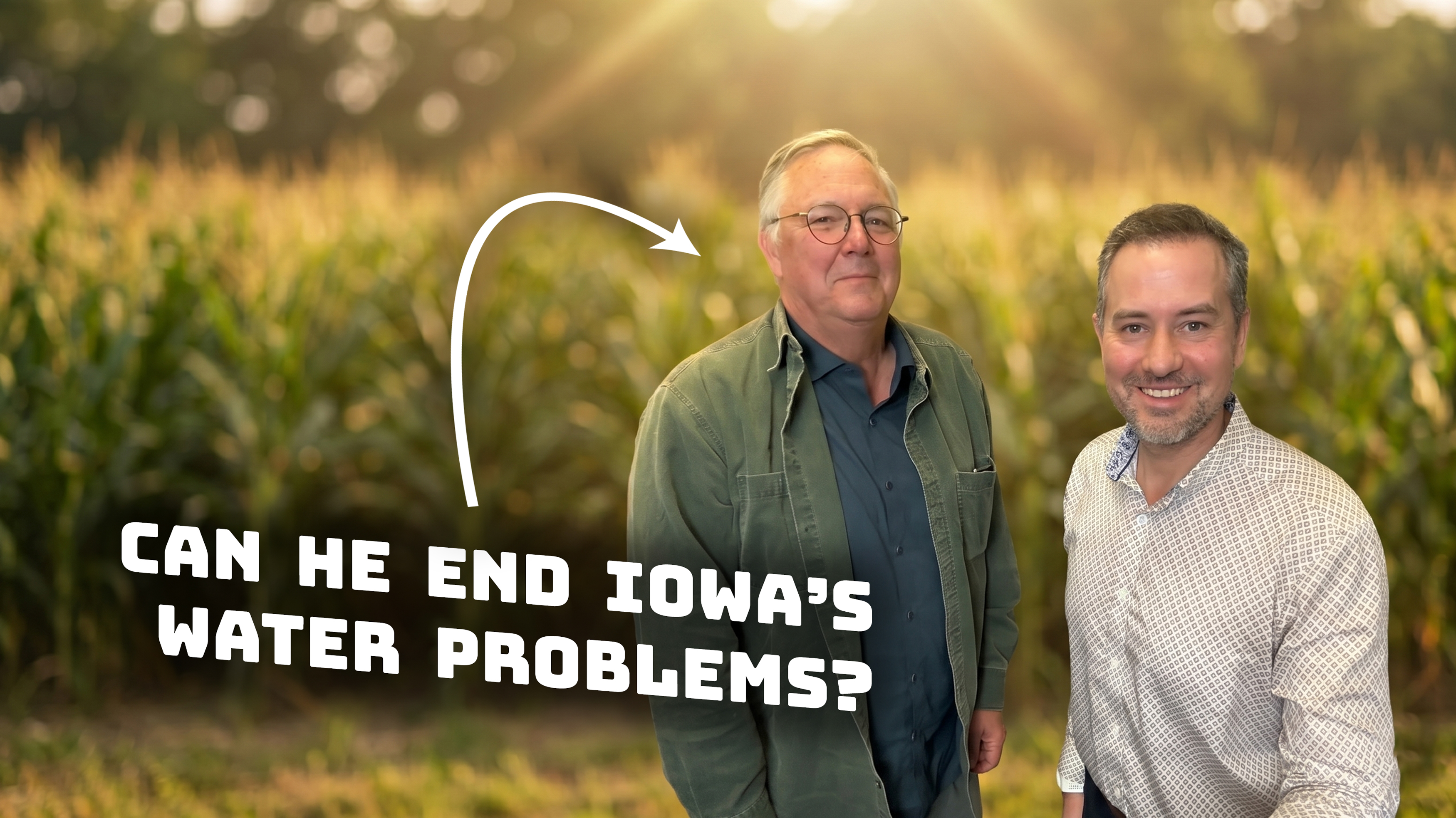


Jones says the runoff and nitrate issues are entirely preventable if we change regulations around farming. He also suggests new state funding to help farmers re-design their fields but also suggests farmers may have to contribute new tax revenue to get our water problems under control.
In the past, the Secretary of Agriculture position wasn’t a race that demanded a lot of attention. As most Iowans become increasingly concerned with Iowa soil health and water quality however, the race has taken more attention and Chris Jones hopes his solutions for Iowa water quality will land him the job. Jones discusses how he proposes to fix the “upstream” problems and what regulations may be necessary.

Iowa stories for your inbox
Justin, David, & Kaylee cover Iowa news, agriculture, business and tech. No clickbait. No rage. No agenda. Support our vision and subscribe!
Mandating Conservation and Reducing Pollution
Jones argues that Iowa’s current corn-soybean agricultural system has become “untenable” due to its impact on water quality, specifically citing high nitrate levels that affect over 60 communities. To address this, he proposes specific mandates such as banning fall tillage and questions the application of fall anhydrous ammonia. Jones also advocates for a mandatory 50-foot buffer between row crops and perennial streams to protect riparian areas.
Reforming Crop Insurance and Subsidies
Jones highlights how the federal farm bill currently prioritizes four main crops, creating a “perversity” where farmers grow corn and soy in unsuitable environments simply because revenue is guaranteed. He suggests that the state and federal government should expand subsidies to include more sustainable crops like oats or provide “off-ramps” for farmers to transition to different systems. Jones believes taxpayer money is better spent helping farmers diversify than on temporary fixes for existing pollution.
Opposing Liability Shields for Pesticide Manufacturers
In response to discussions about legal protections for chemical companies, Jones took a firm stance against liability shields for those producing pesticides and herbicides. He argues that companies must remain responsible for the long-term health outcomes of their products, especially since it can take decades to understand their true environmental and human impact. Jones expressed concern over the “gutting” of federal oversight agencies, which he believes makes local accountability even more critical. “These companies need to be held responsible for the outcomes of their products because, look, some of this stuff, as I said, we’re not gonna know for a long time,” Jones explained.
Transitioning to Pasture-Raised Livestock and Local Processing
Jones advocates for moving marginal land out of row-crop production and back into pasture for grazing cattle, which he claims produces superior environmental and water quality outcomes. He suggests that the state should support the infrastructure needed for this transition, such as fencing and specialized equipment. Additionally, he supports reducing regulatory burdens to allow farmers to sell meat directly to consumers, which would require increasing local meat processing capacity. “If we want small-scale livestock production, we need local meat processing capacity,” Jones noted while discussing the need for a system focused on human nutrition rather than just commerce.