

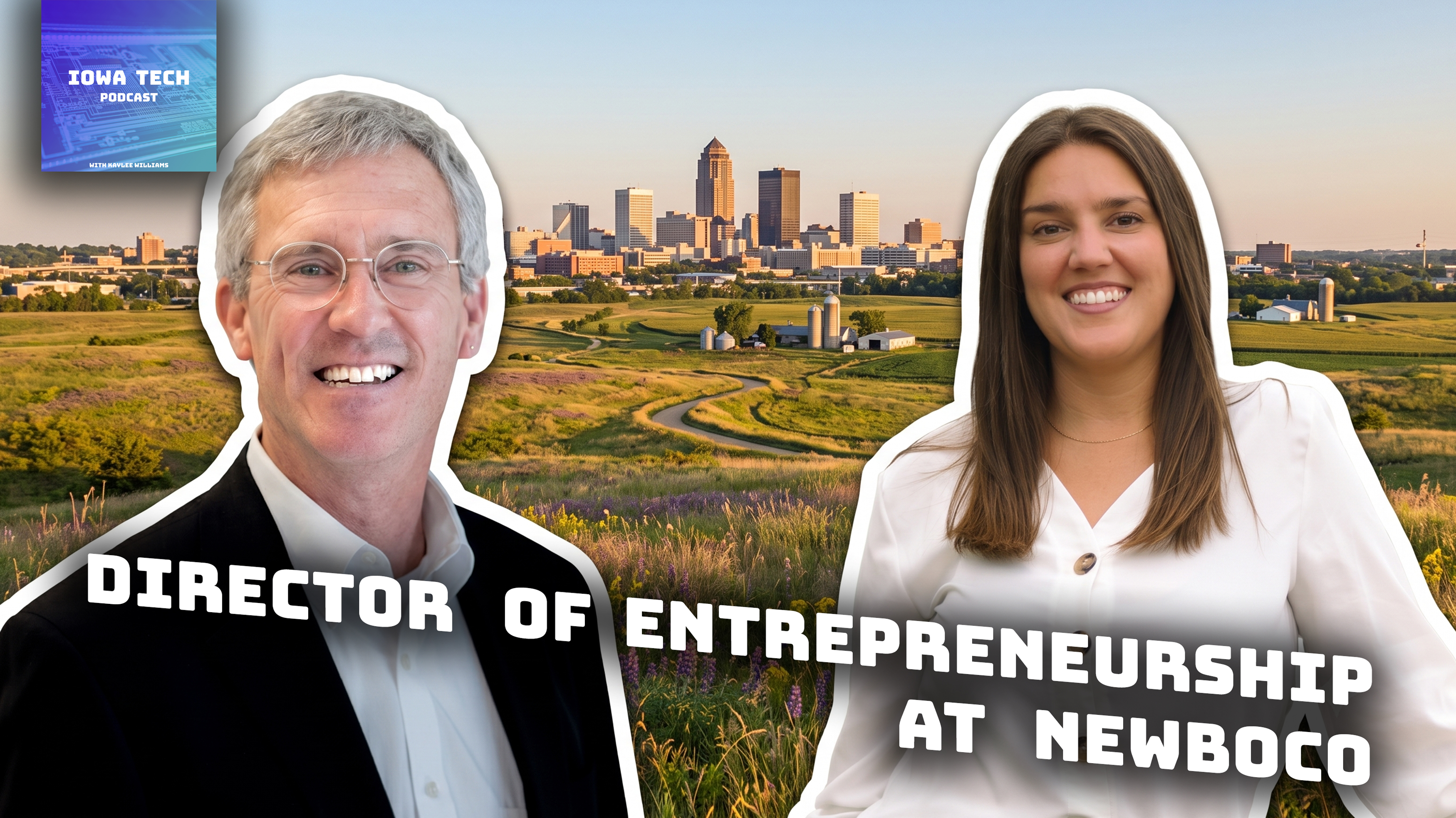


In this episode of the Iowa Tech Podcast, host Kaylee Williams sits down with Alex Taylor, Director of Entrepreneurship at NewBoCo, to explore what it takes to build and grow a successful business in Iowa. Drawing on decades of experience as an entrepreneur, educator, consultant, nonprofit leader, and small business owner, Alex shares practical insights for founders navigating the challenges of launching a company.
Hear from Iowans directly. No algorithms.
Don’t let the algorithms choose your news. Enter your email address to hear directly from Iowans leading news in politics, community, agriculture and business. No editing. No clickbait. No rage. No agenda.
The conversation covers the foundational elements every entrepreneur should prioritize, including customer discovery, financial discipline, and surrounding themselves with the right advisors. Alex emphasizes that many founders become consumed by their product while overlooking the operational fundamentals that ultimately determine long-term success. He also discusses the importance of finding complementary co-founders, developing a clear growth strategy, and remaining focused instead of chasing every new opportunity.

Kaylee and Alex also dive into what makes Iowa’s entrepreneurial ecosystem unique. They highlight the collaborative culture among organizations like NewBoCo, JPEC, universities, economic development groups, and investors, arguing that Iowa’s greatest competitive advantage is its willingness to connect founders with the people and resources they need to succeed. Alex explains how NewBoCo supports entrepreneurs through programs like Startup Sprint, its accelerator, Kiva microloans, community mentorship, and Entrepreneur-in-Residence initiatives across the state.
The episode also explores the growing role of artificial intelligence as a productivity tool for entrepreneurs, while stressing the importance of pairing AI with human judgment and expertise. Finally, Alex reflects on the challenges still facing Iowa’s startup ecosystem, particularly the need for more early-stage capital and greater awareness of the many resources already available to founders.
Whether you’re launching your first startup, growing a small business, or simply curious about Iowa’s innovation economy, this episode offers practical advice, honest encouragement, and a behind-the-scenes look at the people working every day to help entrepreneurs succeed.
Interview Transcript
This transcript was created with help from Ai. Please report errors to us and always refer to the video as your primary source.
Kaylee Williams: Hey everyone, welcome back. It’s the Iowa Tech Podcast, and your host, Kaylee Williams. We are here in the Jethro’s Barbecue podcast studio with Alex Taylor, probably a familiar face for many of our listeners. Alex is the director of entrepreneurship at NewBoCo. He is a teacher, professor at Tippie College of Business, and if you can believe it, he’s got another full-time gig. He is the co-owner of Woofables, which is a small business/startup that he bought back in… When was that, that you
Alex Taylor: 2010. And, and I’m a co-owner. My wife actually runs it,
Kaylee Williams: runs it Ah, okay
Alex Taylor: uh, y- on a day-to-day basis. I consult on a strategic basis, so that would not be a full-time thing for me. It’s a full-time thing for her at Plus, and, um, I try to stay out of the way’cause we wanna stay married.
Kaylee Williams: Sure. Okay. That makes- sense. That’s probably a whole other story we could
Alex Taylor: It is a whole other story
Kaylee Williams: um… Well, let’s just start, let’s actually start with you, Alex. So tell me a little bit about your background, and how did you end up having a passion for entrepreneurship?
Alex Taylor: Um, well, I’m an English major from the University of Iowa, so when you graduate with an English degree, you’ve gotta kind of find your way. And, uh, that in and of itself was pretty, uh, innovative. But I was also a student leader at the University of Iowa, and I went back. I did some consulting and started a couple of nonprofits, um, and then went back to the University of Iowa, got my master’s in higher ed administration. And it took 22 years before I actually got into a higher ed job. Um, but along the way, I got a chance to work for Bob Parsons at Parsons Technology, and he went on to found GoDaddy. At the time, it was the largest– Well, his software company was the largest direct mail software company in the world. Um, he competed against Intuit. And Intuit came in and purchased us, and there were two directors of corporate communication, one here and one in California. It was pretty clear who was gonna win that rock, paper, scissors. It wasn’t gonna be me.
Kaylee Williams: Oh, geez.
Alex Taylor: So I started a distance learning company with, uh, Bruce Lehrman and Jeff Quint, and Bruce went on to found Involta, and Jeff Quint went on to found, uh, Cedar Ridge, uh, Winery. And then worked for Michael Dell for a while and handled his global employee communication. So I was surrounded by entrepreneurs throughout this entire journey. Um, did some work for a corporate– a manufacturing firm and did some consulting, um, and then went to a large print industry when they were breaking into email marketing, and they handed me 21 brands that were doing email marketing, spam. They wanted to get it organized, and so I helped them grow that from $800,000 to $3 million ARR. That was a pretty challenging task, but I figured it out. And, and then finally, I– Well, I was hired by the City of Cedar Rapids to help with the flood recovery efforts. So as you can see, I’ve sort of migrated around, but you figure things out and learn to decipher things. University of Iowa brought me on, and I, um, helped start the executive MBA program here in Des Moines and, um, helped run that. And again, everything kinda has a little startup flavor to it, and I guess that’s where I cut my teeth. Started a couple of nonprofits along the way, I think five or six nonprofits. I started three for-profit businesses. Mm, couple of them successful, one of them not so successful, but I’m glad I did it. Uh, so I’ve got some scars. And, um, I’ve been on 17 different boards of directors over the years. Most of them are all nonprofits. Um, when Eric Engelmann offered me an opportunity to come help run this accelerator, it’s like, well, sounds great. It’s exciting and something I’m, I’m willing to figure out. So that sort of brought me here. We bought Woofabulls back in 2010 and scaled that to a national manufacturing distribution company. And we’re certainly looking for a buyer, so if anybody’s interested in a dog biscuit company, come talk to me.
Kaylee Williams: That is, uh, first of all, very funny and, and very, um… I didn’t– I don’t know if I knew your background, all the things that you had your hands in, including the University of Iowa campus here in Des Moines, the MBA program.
Alex Taylor: the executive MBA. In fact, I was just over there doing a little bit of, uh, uh, catching up with some emails, and I ran into some staff members that I knew back in the day, so it was great. Spent a lot of time in this building
Kaylee Williams: a long time in this business. Yeah. Well, you’re definitely a builder, Alex, and you understand the entrepreneurial journey and the grit of it and the struggle of it at times. The highs are high and the lows are really low Um, tell me a little bit about how you leveraged that empathy alongside that know-how as the director of the Startup Accelerator Program
Alex Taylor: Well, I think it’s, at the end of the day, um, I consider myself more of an instructor and, and perhaps a, a connector, as you know. Um, but really these are people who are subject matter experts in whatever business they wanna grow, and that’s great. But as you well know, running a business is, is, um, a little bit like looking into a cockpit of an airplane and all those knobs and buttons and toggles and dials. And to run a business, you have to understand at least what those things are. You don’t necessarily have to be an expert in those things, but you have to know sort of what they are. And I don’t know about you, but when I look at that cock- cockpit, it’s very overwhelming. It’s like, oh my gosh. That’s how entrepreneurs are when they are starting their business and we start to work with them and explain to them, “Well, you’ve gotta think about your marketing or your finance, and what do you think about co-founders?” Uh, uh, not even to mention raising venture capital, which is a whole other ball of wax. And they get stars, you know, cross-eyed and deer in the headlights and say, “Well, it’s, it’s okay. It’s, you’re, it’s okay to be scared. It’s okay to suffer the imposter syndrome. Let’s talk through all of the things that you can do, all of the things you need to do, and let’s prioritize and just very slowly and methodically work through these things one at a time.” And I get it, having started some businesses with other people over the years and seen organizations go from, you know, cradle in some cases to grave. But, uh, I get it and I understand, and I know it’s, it’s, it’s terribly overwhelming and frightening. So that’s where the empathy comes in. And then it’s just building off of all the experiences I’ve had, is helping put the pieces together for them and telling them it’s not so bad. And I know I can’t solve all those problems, and I know they can’t solve all those problems, and that’s where the connectivity comes in. So having done the work with the executive MBA program here, I had a chance to see a total of 17 cohorts go through the MBA and, uh, EMBA program over the years. Well, these are all executives of companies. They’re subject matter experts who can help. And having graduated from the ABI Leadership Iowa program, again, further expanded my network of contacts around the state. So my ability to connect people who have startup needs with people who are subject matter experts, whether it’s building a prototype or a website, try to make those connections. So I would never claim to be the business expert, but I certainly know somebody who can help. So that’s kinda how that works.
Kaylee Williams: you are definitely a connector and connected. Uh, for those who are listening who are maybe entrepreneurs that are looking into that cockpit right now and trying to figure out, “Okay, what button, what knobby do I push? There are a lot of blinking lights,” what would you tell them are the three first levers they should pull? Where should they focus their time early, early stage of a business?
Alex Taylor: You know, that’s great. I, I have a couple of go-to, you know, sort of slam dunk items. But, uh, first, I don’t think there’s a single answer. Uh, startups are like children. They’re all different, and they come in at different stages and with different levels of experience and expertise. But the first thing I would say, customer discovery. Be absolutely sure you have product market fit. People think they have created the greatest thing in the world, and yet you ask all the people who would buy it, and they, their family, their friends, they say, “Oh, that’s a great idea, great idea.” And then you turn around and try to sell it, mm, you know, it falls flat. And I think customer discovery should be ongoing, because even after you incubate, even after you get venture capital, you constantly need to be aware of what the customer needs are, because that shifts and changes. I mean, who would have ever thought that Sears would close or Kmart would close? Look at the legacy of businesses that have folded, and I would argue that they didn’t stay relevant’cause the customer needs change. The second, make sure your financial house is, is put together. Some people are intuitively good at finances. Uh, and know your numbers inside and out, upside and down. Um, those are two of the probably the most important things. Can you speak to your product and, and the need, and can you speak to your numbers? How are you gonna make money and stay profitable? What’s your cash flow look like? And then third, um, I advise them to find the right set of advisors. Um, I, I think it’s just… It, it’s helpful to surround yourself with others who are experts in those fields, and primarily that would be an accountant, so a CPA who can help with tax implications, a banker to help with all the financing considerations, how you string these things out over a period of time and pay off those loans and finance your startup, a lawyer for all of those legal contracts and, uh, employment law, et cetera. And last but not least, and I would never wanna dis- dismiss its importance, but insurance. Um, s- risk management. Now, I would argue that not all businesses need a degree of risk management. But if you’re a chiropractor, you better have some risk management. But if you’re just building a website in your basement, maybe not so much. So, uh, but definitely the accountant, banker, and lawyer for sure. Get those ad- advisory team in place. So as I said, cust- customer discovery, financial, you know, financial hygiene, and then a, a good team of advisors. And from there, you should have enough horsepower to build something. Now, whether it’s successful or not, that’s, you know, that’s to be TBD, right?
Kaylee Williams: That’s a great answer. And now, Alex, most of your career has been here in Iowa, right? What do you think sets Iowa apart? What makes this a place that’s uniquely fertile for early business owners to build?
Alex Taylor: This is, this is probably my favorite question, and people ask me this all the
Kaylee Williams: I’m sure they do
Alex Taylor: It’s, it’s the ecosystem. It is the ecosystem. We as a culture are hardworking. We as a culture in the upper Midwest have that Germanic can-do attitude. Um, farmers are perhaps the most entrepreneurial industry in, in the world’cause they’re always figuring stuff out and bootstrapping stuff together. And as it all sort of compiles over time, we’re here to help each other. We’re not a competitive environment. We have, what, 3.2 million people in the state of Iowa. We don’t have enough of critical mass to be competitive, or we shouldn’t be competitive. Um, regretfully, there are a couple of folks, as there are in any large populations, that are gonna be competitive. But generally speaking, the people who work in our space of entrepreneurs are very, very helpful. SBDC, JPEC, all the economic development officers, chambers of commerce, um, y- the universities, the colleges, the s- gosh, the community college system is phenomenal. Uh, NewBoCo. Yeah. Thank you. Um, EDC is another one that comes to mind. So there are tons of res– The Iowa Center. I could go on and on and on. And it– And, and, you know, Director Durham has done a great job with the Iowa Department of Economic Development, which, you know, they’ve got some limited funds or, or I would say targeted funds. I wouldn’t say limited, but targeted funds that are really very helpful, and we’re a cooperative, collaborative environment. And when I get startups from out of the state, like California or New York or Florida, they come and ask for help, and they get put in here, whether you forward them along or s- uh, JPEC forwards them along. They go through Venture School or the Accelerator or Global Insurance Accelerator,
Kaylee Williams: Yeah
Alex Taylor: and we all connect them. Say, “Oh, you need to meet Kaylee,” or, “You need to meet Scott,” or, “You need to meet Diana.” And w-we forward them on, and they just come back and say, “I can’t believe how helpful everybody is.” That is a very long way to say it’s what makes Iowa, uh, successful. That’s our secret sauce.
Kaylee Williams: I was just talking to, uh, Tyler Weingarten from TAI this morning, and he said, “Kaela, you know that magic trick where you call a CEO and they answer your, your phone call like that you know you need to talk to them about something?” He’s like, “That happens because of Iowa.” That’s unique to our ecosystem- Yeah
Alex Taylor: Except for the attorneys. Yeah.
Kaylee Williams: Yeah. It’s over the attorney.
Alex Taylor: everyone I know, and I tell them that, just say, “How come you never return a call or an email?” They all laugh and say, “Well, you’re right. We don’t.” Aside from that, they’re helpful when you can get them.
Kaylee Williams: get them.” Yeah. Right.
Alex Taylor: and that kind of… You can get them when You
Kaylee Williams: can get them when you really need
Alex Taylor: Yeah, absolutely. And they’re there.
Kaylee Williams: Yeah. That’s right. So, and you mentioned this, um, legal and financial and having a banking, you know, advisor, and these things are– They’re like the less sexy, less glamorous parts of, of building a business, but they’re foundational, and they’re important. Yeah.
Alex Taylor: absolutely
Kaylee Williams: And founders tend to get very excited about the problem that they solve, and they should be excited about that. But that’s where these resources are here to help surround you and-
Alex Taylor: Right. And I think the two things, traits I see, um, that are, I won’t say frustrating, but I would encourage entrepreneurs to get their, you know, open their minds and eyes. One is I can just the, the, like I don’t need any help. I can do this by myself, this sort of stubborn, I can do this by myself. It’s like, yeah, but it’s gonna be a lot of work and it’s gonna be a long mountain to climb. Um, that’s one thing. And the other one I get, which is always fun but challenging in, in a different way, is shiny object, shiny object, shiny object, and I’m gonna do this, and then I’m gonna start working on this, I’m gonna start working on this. And they’ve got five or six or seven or eight different things, and it’s like, okay, that’s really good, Kaylee, but we really need you to focus on this and get this right, and then we can add… And I love the excitement and energy that those entrepreneurs bring to the table. Mm. But corralling them to stay focused on the things that will help make them move faster, that’s, that’s sort of a, a different challenge.
Kaylee Williams: definitely. Can you talk about AI and how you’ve seen AI help or hinder small business owners and entrepreneurs around the state?
Alex Taylor: That’s a really interesting question. I’m not sure I’m the best person to answer that question, but what I, I encourage people to use that for some of their customer discovery, uh, use that to get answers, take advantage of the internet. AI is just internet on steroids, right? Um, and it’s all– I mean, it, it… The internet is one thing, and it’s– Now that we’ve got AI in our back pocket, it’s just slow. Uh, uh, net- or the, the internet’s slow. AI just speeds up that process. Take advantage of that. Get the menu of research that you need to do. Get the menu of solutions. But make sure that you back those things up with expertise advice. Um, at Tippie I teach a business communication class, and I refuse to ignore AI. It’s part of, it’s part of the, you know, culture now, and it’s a tool. And I don’t care if they use AI. I am more concerned that the end result is a piece of writing or speaking or engagement that will be effective, that is not plagiarizing, that is original, that gets the job done. Um, I’ve used AI actually to write a website, which I was– I wanted to try it. I had a client that needed a website, and I said, “Well, let me just see if I can get this done.” And I typed in the commands, and I’ll be… It was the ugliest website I’ve ever made and needed some, needed some TLC. But I was able to actually build the website and, um, I would need to go probably another hour or so with Q&A to fully. But it’s, it’s an amazing technology, and it’s evolving. We, we have a lot to learn from that.
Kaylee Williams: Definitely. Definitely we do. Um, so, you know, I’m, I’m interested in from your perspective, you know, you’ve talked to small business owners, you’ve talked to startup founders. Uh, what’s your take on, um, the ratio of companies that you’re seeing here in Iowa that are in this lane of high growth, you know, s- J curve, like we’re gonna grow and we’re gonna grow fast, versus maybe more of the small business mindset where they can still grow and they can be very successful, but they’re probably not looking at like an IPO or some type of large acquisition. Where do you think– Uh, what’s the ratio that you see?
Alex Taylor: your guess is as good as mine. I, you know, the ebb and flow of what I feel and see kind of follows the academic year, because we have Venture School that takes place in the spring and in the fall at the JPAC Centers. We run the accelerator in the spring and the fall. And because of the seasonal nature of that influx of academics and coaching and mentoring, usually at the end of those semesters, we see businesses go or no-go and start to take off and generate revenue and build the prototype. And sometimes during the summer, it’s sort of summer, it’s a little bit slow, but these are when founders are doing the prototyping or doing their customer discovery. So I think there’s sort of a seasonal flow to that. Um, for the startup accelerator, which originally began in 2000 and, um, 2014, um, it was originally intended for just tech. And w- as we have reimagined the accelerator to be a seven-week sales, branding, marketing, prospecting type of program, um, in the evenings, modeled very similarly after Venture School, we have had three, maybe four investable companies that could be VC-backed that have gone out for funding or are in the process going out for funding. The rest of them are service businesses. One’s sort of an athletic coach, and the other’s doing books for people, legacy books. So I, I just think, I don’t know if there’s a real way to say that it’s, uh… I, I, if I had to guess, I would say 10% to 15% are scalable, potentially VC-backed. Now, there’s a challenge, too, because there’s sort of an iron curtain with the universities, right? And I’m not… There, there’s a lot of cool stuff going on at Iowa State and Iowa and UNI and, um, but they’re working inside those ivory towers, and, and sometimes we don’t see about those or hear about those because they’re funded and in such a different way.
Kaylee Williams: Yeah. Yeah. That’s true. Tons of IP that could be groundbreaking- Yeah transformational. Um, and you know, they, when they commercialize and they go through their tech transfers
Alex Taylor: then we hear about it, it’s like, “Wow, how come we never heard about this before?” You know, not to mention some of the, the medical properties with, uh, you know, the biomed stuff is just absolutely fa- And I guess there’s some ag tech stuff that’s going on too
Kaylee Williams: Yeah, for sure. Um, so, uh, I– Well, now you’ve got me thinking about something else, and I might bring it up here. Um, did you hear about the, uh, rural engines announcement that came out that, um, Iowa State in collaboration with the University of Lincoln, Nebraska- yes And we are now like a rural engine for
Alex Taylor: I know. It’s very exciting. And-
Kaylee Williams: it’s a grant through the National Science Foundation
Alex Taylor: Yeah. I, I think, uh, when I first jumped on board with the accelerator in 2020, um, we had a couple of, um, bioengineering companies that were out there, ag engineering. So t- trying to get the algae mass into energy, et cetera. Very, very cool. That’s very exciting. Congratulations Iowa State and the University of Lincoln, Nebraska. Or Ne- Nebraska Omaha.
Kaylee Williams: Yeah.
Alex Taylor: gotta make sure I get that right. Um, no, that’s really exciting. Um, I’m heading up to Iowa State here in a couple of weeks, uh, for their SciStarters, uh, demo day, and I’m excited to hear, to, to hear a little bit more about this
Kaylee Williams: Yeah, I’m sure they’ll be talking about it. I’ve, I’ve seen a lot of, uh, press around like social media and, um, and I think there was a really good v- video that I think Peter Dorhout did where he talked about what the grant actually is and what it, what it funds, and so, um, that’s very exciting work. What are you working on right now, Alex? What are you excited about?
Alex Taylor: Well, um, so I do three things. A lot of folks don’t understand what is NewBo To Go. We’re a nonprofit dedicated to economic development, and we have, um, most of our, uh, the bulk of our people do tech education, computer science education, STEM education, professional development for teachers who teach these skills. And the goal is to develop and retain our technology workforce. And we have a great… Samantha Dalby does a great job with that. And then we have entrepreneurship and aside from EntreFest, and we provide Kiva loans, which is micro-lending, zero interest up to three years. Um, great program, great, great, great funding mechanism for early stage startups. But then we have some of the work that I do. Well, we’ve got a version of… We’ve got a startup sprint, uh, which is a weekend where we help businesses incubate ideas into potential startups that would then get into Venture School or perhaps the Drake program. Um, I’m working on an accelerator. We have the, the fall and spring accelerator, and that’s geared on branding, prospecting, marketing, and sales, and it’s a seven-week, mostly evening over Zoom, so we can reach startups coast to coast from the Missouri to Mississippi. So it’s not geographic centric. So anybody, if you’re got early revenue, early traction, but wanna give it a boost and give it an acceleration in the accelerator. Um, I do ma- you know, I coach and mentor through the venture programs around the state and, um, people will send me startups all the time. “You gotta talk to Alex. He’ll help you, or he’ll send you in the right direction.” And then I work with communities around the state. So I spend a, I would say about a third of my time traveling to various communities around the s- state. I just ended a con- NewBo just ended a contract with Fairfield, where I was the entrepreneur in residence once a week, and I would coach and mentor there, and they have something. It’s a version, their version of 1 Million Cups called Traction Thursday. And so it’s the same sort of format except they do their Thursdays at lunch. I’ve been… NewBo’s been contracted by Clinton, Grow Clinton, so I’m working in, uh, Clinton twice a, twice a month. I’m the entrepreneur in residence and working with the startups in that community, augmenting their economic development efforts, working with local subject matter experts, accountants, lawyers, bankers, marketers, programmers, and connecting those folks and helping them understand that they don’t have to s- strictly work with existing businesses, but they can help startups, which is very rewarding. It’s hard, but it’s rewarding. Um, and so I’m working with communities, individually, individual coaching and mentoring, and the accelerator. And, um, I’ve started doing a little bit of writing, trying to publicize, uh, the work that we do across the state and talk about trying to encourage people to start businesses and give it a shot. And it’s okay if you fail, you know? I mean, h- when we all try to learn how to ride a bike, we probably all fell a few times. That’s not failure. That’s learning. Learning the hard way, but you’re learning. And what happens? If you wanna ride the bike, you just get back on and ride again. So if you wanna start a business and don’t wanna have success that first time,
Kaylee Williams: Mm-hmm.
Alex Taylor: just get back up, brush yourself off, and get back on the horse and find something else to start
Kaylee Williams: Mm-hmm. Yeah. We are much more the product of our failures than the product of our successes. I’ve always believed that. It’s how we fail,
Alex Taylor: Yeah, that’s true.
Kaylee Williams: and then we get back up.
Alex Taylor: That’s right
Kaylee Williams: Um, what advice would you give to an early stage or, like, a mid-stage founder, small business owner?
Alex Taylor: Um, find good strategic partners. Uh, co-founder or a strategic partner. And again, this gets back to that advisory board. But, um, i-i– I, you know, I, I can’t speak for venture capitalists, but technically speaking, when I do talk to venture capital or see people raise venture capital or, or even going to a bank, they’re gonna s- they’re gonna wanna see you have a co-founder. They, you know, putting all the eggs in one basket, um, is not confidence inducing unless you can really tell a good story. And there are some great entrepreneurs that can tell a good story. But boy, when you say, “Ah, you know, I’m really good at computer software development,” but, uh, the next question is, “Well, who’s gonna run your business? Who understands the numbers?” Or in some cases, “Who’s gonna do business development or sales?” Um, when I look at Woofables, I, I love my wife dearly. She runs a really good business. She’s pretty good at sales. But, um, if she could have me do business development for her, um, I think I would do a better job with that. I’m probably not the person that she wants to be doing all the numbers. Let her deal with that. And so that’s an example of where having a partner to complement the strengths, that they help each other and scale. Um, that to me is what mid-stage companies should be thinking about. I also think they need y- to have a plan. Um, it’s one thing to get launched. You just wanna stand up and get going. But once you get going, where are you going? What does that… Not just say your exit, but what are your 18-month, two-year, five-year, 10-year plans? And then maybe what does that exit look like? And then you, um, reverse engineer that. How many employees are you gonna need to do this? How much machinery are you gonna need? What’s your staff look like? What’s your income look like? What’s your financial, what’s your cash flow look like? And work yourself back, and then work that model forward and work it back a few times on paper over the course of a month or two. And hopefully you start to see a little bit more clarity on what you’re doing, where you’re doing it, how you’re doing it, and who’s gonna help you do it.
Kaylee Williams: I think the, um, there’s a program that I think does a really good job of this for those maybe more mid-stage small business owners, the 10,000 Small Businesses program. And there’s like a revenue minimum that you have to have in order to even be eligible to
Alex Taylor: 70, $75,000, and you need to have, uh, at least another employee. Yeah, uh, Carrie Yost and Jackie Bolt. It’s a great program. In fact, Laura just went through that for Woofables and went… Yeah, I, I wish she had done that. She wishes she had done it about six or seven years ago because, um, not only the networking with other businesses, but getting out of the day-to-day business and working on the business with others around you and hearing how others think. And I think, and maybe you know this, the cohort size is 30, or is it 30
Kaylee Williams: Ooh, I don’t know. That sounds right. though.
Alex Taylor: it’s about 30
Kaylee Williams: Anecdotally from what I’ve seen when I’ve visited
Alex Taylor: And it’s a really close-knit, um, group. Uh, and I, I’m– can’t remember how many. It’s like 10 or 11 sessions.
Kaylee Williams: Pretty intense.
Alex Taylor: Pretty intense. It’s very
Kaylee Williams: It’s like, a bouillon cube
Alex Taylor: Yeah. She was glad to be done’cause there is, uh, there’s homework involved. Quite a bit. But, um, yeah, so, so you get through the incubation, you get through the early stage venture school, the accelerator, you’re seeing traction, you’re generating 75,000 plus. Um, some of the companies that come in, you know, are a million plus, which is okay. But they teach the dashboard. It– Yeah, Goldman Sachs is one. Another one that’s, uh, really good is Techstars, and that’s really good for the technical companies. And I know occasionally we have that program here in, in Iowa as well. Um, those are two of the more natural next steps.
Kaylee Williams: really good call-out. Um, Techstars Anywhere is the remote one that anybody can apply for, even if you don’t have a Techstars in your state. And I don’t think we currently have one here, but we did for a long time. Um, but yeah, Techstars Anywhere is their remote version. Great program. And these, these are battle-tested programs that every– And, uh, around the 10,000 Goldman Sachs program, every small business owner, entrepreneur that I’ve heard go through that has had glowing reviews of the curriculum and, and what they, you know, they wish they would’ve done it sooner, and all that they learned, and now what their goals are, and how dramatically that can change over the course of the program, so
Alex Taylor: I’ll also, um, put another plug in, uh, for Goldman Sachs, is it’s, it’s free. it’s it’s in your budget. But, uh, if you consider that time is money, it’s not free because it does take time and it does take dedication. And that’s, you know, that’s the hard work of running your own business. And if you really want to be successful, you put in that homework and that dedication to make that happen. Um, but yes, I completely concur. It’s a great program
Kaylee Williams: a great program. And if you wanna learn more about it, I’ve got an interview with Jackie Bolt somewhere in the archives. We can link to it in the show notes, but you can check it out. So Alex, we’ve talked about what makes Iowa special and good. Are there areas that you think our ecosystem could improve?
Alex Taylor: Yeah. Uh, I’m gonna beat the drum that we are all beating. It would be great to have, um, greater accessibility to funds for the earlier stage. I think when you get to sort of the mid-stage, even for some of the state funding, POCR and, and all of that, uh, there’s some matching funds involved, and these startups just don’t have two sticks to rub together to get to that matching funds. Um, and that’s just sort of a challenge. Uh, it would be great to have better funding for that– those earlier stage. Um, thankfully, uh, we do have some good programs at the universities. Uh, and I just met with Chase over at Drake. They’ve got an incubation-type program. They might have small stipend for the students who are enrolled, and they can put them in a room and give them some coaching and mentoring. It’s not a lot of money, but it, it’s, it is some. Um, and there’s the KIVA loan, which again, up to $15,000, zero interest for three years.
Kaylee Williams: It’s incredible
Alex Taylor: a great program. Again, 15,000 isn’t big money, but boy, that sometimes that’s just enough to, to get the ball rolling. Um, but early stage funding’s probably the biggest gap. And then the other challenge is for all of us, and this is everybody I mentioned so far and several I probably forgot, bankers included, we need to be shouting from the rooftops. Iowa is just– We’re Iowa humble, um, but we need to let people know we’re here, and we need to let people know that it’s okay to fail. But reach out and reach out to your economic development people, your SBD folks locally, your colleges, your universities. Um, th-there’s a great support network, and, uh, uh, every week I run into somebody say, “Boy, I had no idea this existed.” And that tells me we need to do a better job communicating.
Kaylee Williams: Yeah. I would agree with all those points. I think our ecosystem is such that, you know, we’re always working on it. We’re always trying to make it a vibrant place to be and to work and to grow, and I think founders are often, like, heads down on their business, but when they look up and they come up for air, we should be here to meet them, ready to meet them with whatever they need, whether it’s financial support or capital infusion or if it’s, uh, you know, business consulting or sales support, whatever it may be, you
Alex Taylor: Yeah. One of my favorite activities to do, uh, as I network around the state and meet with economic development folks, hoping that they will, um, support NewBoCo and hire, hire us to come in and help them. But I’ll host, um, entrepreneurial roundtables. So in August, I know I’m gonna be in Sioux City for a luncheon where I work with their economic development person and the person, uh, is it Paula from, uh, Morningside? Yeah. Yep. So we’ll get together, and Anastasiia, and we’re hosting a lunch for startups in that area, and it’s really just a roundtable for them to meet each other. And, uh, and, uh, forgive me for repeating myself’cause I say it almost every day, but misery loves company. Yeah. And these, these startups love to, to hear other startups’cause then they don’t feel so bad. It’s like: “Oh gosh, I’m not the only one that’s struggling with…” Or they’re also willing to help. It’s like: “Oh, Kaylee, you’re struggling with that? Oh, no problem. Here, I know somebody you can call.” And they end up helping each other. So hosting these roundtable lunches in, well, Sioux City, and then it’ll be Council Bluffs, so we do one in Fairfield. Got a great little group in, um, Manchester, Iowa, in Delaware County. Donna Bos has got a great group over there with Sarah Hermanson. And, um, they’ve got some cute little startups, a quilt, two ladies who do quilting. There’s, uh, ladies doing home care. Two kids who just graduated from the local community college are starting an ice cream store. And just really very fun to hear their stories, but they… the, the imposter syndrome sort of w-withers away when they’re in the room with other people, and meeting and hearing these stories and getting them plugged into the system. Uh, it’s still hard work, but they don’t feel quite as lonely.
Kaylee Williams: Yeah. Yeah. Entrepreneurship can be very lonely, even when you have a, a whole staff of people. In a way, it’s more lonely.
Alex Taylor: Yeah, You’re absolutely right. Well-
Kaylee Williams: Alex, we’re, we’re lucky to have you in this ecosystem doing the important work that you’re doing through New Bo Co., um, through your teaching initiatives, and as a small business owner. So, uh, thank you for joining me on the podcast today
Alex Taylor: thank you for having me. It’s, it’s a pleasure. I enjoy what I do
Kaylee Williams: This has been another episode of the Iowa Tech Podcast. Tune in next week