

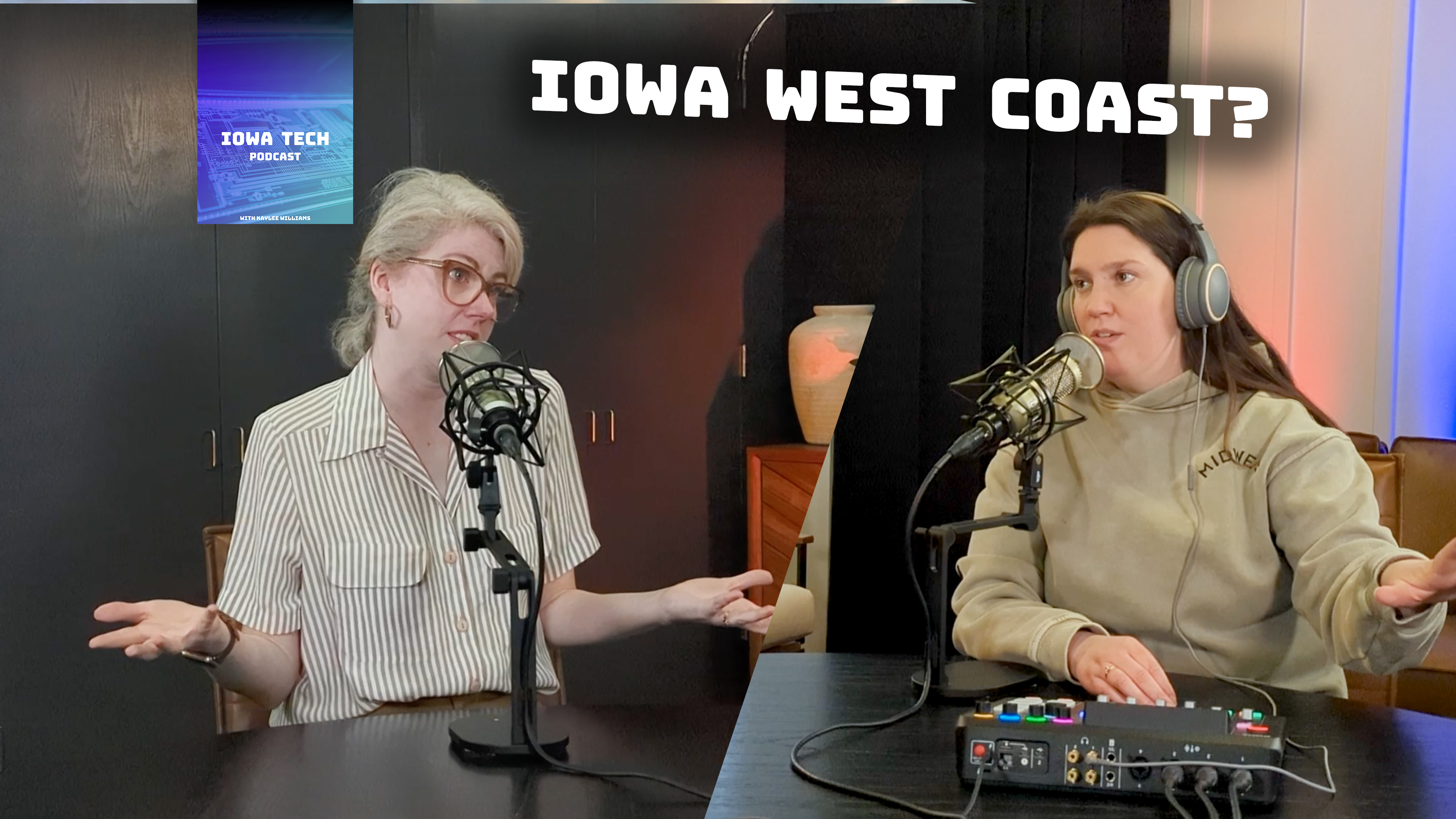


Host Kaylee interviews Anastasia Williams, the entrepreneurial community navigator for Iowa’s West Coast Initiative, a nonprofit serving Monona, Plymouth, and Woodbury counties from Sioux City. The initiative connects entrepreneurs and small business owners to resources and people, with a growing focus on building a grassroots entrepreneurial ecosystem so founders don’t feel they must leave to grow.
Prompted by an impressive Morningside University pitch competition, they discuss how strong student ventures (aided by AI) reveal untapped West Coast talent. Anastasia notes the region has historically received less attention than eastern Iowa, so she’s convening founders through word-of-mouth, setting the “table” and letting entrepreneurs co-lead. What began as a proposed monthly meetup quickly became weekly, including a “value surfacing” session to define norms and culture for future members.
Hear from Iowans directly. No algorithms.
Don’t let the algorithms choose your news. Enter your email address to hear directly from Iowans leading news in politics, community, agriculture and business. No editing. No clickbait. No rage. No agenda.
Rural challenges include community size, insularity, and preexisting relationships that require trust-building from an outsider. The goal isn’t to copy Des Moines but to lean into each place’s strengths. While her role hasn’t formally partnered with colleges, Anastasia wants students integrated into the broader community to learn, contribute, and possibly stay. Brain drain remains real; she cites her shrinking Sioux City Jewish community as an example of lost vibrancy when opportunities feel scarce.
Anastasia’s “why”: humans need each other. She sees the ecosystem as holistic—schools, wages, amenities, and belonging matter as much as capital. She admires Norfolk, Nebraska’s comprehensive youth-retention approach (wages, first jobs, amenities, childcare/education).
Drawing on her own entrepreneurial path (dog bakery, tutoring company, yarn brand turned relationship marketing/consultancy), she emphasizes collective success and practical advice: don’t be your own labor. Make your first hire revenue-generating, consider partnerships, and use barter/value exchange across founders’ prior skill sets to offload work without premature cash burn. Getting out of the “basement” and into community can transform a business.Learn more or get involved via the Iowa’s West Coast Initiative website: iawestcoast.com
Interview Transcript
This transcript was created with help from Ai. Please report errors to us and always refer to the video as your primary source.
Kaylee Williams: Hey everybody. Welcome back to the Iowa Tech podcast. It’s Kaylee, your host. Um, and we are here in the Jetro Barbecue Studio in Des Moines, Iowa, on a lovely, somewhat colder Saturday. Um, and I actually have in the studio with me, Anastasia Williams. Hi Anastasia.
Anastasia Williams: Hi
Kaylee Williams: now. for our audience members who may be wondering, we are not related if you couldn’t tell by the eye and hair color. Um, but we do both have the last name Williams, so totally unrelated. Um, Anastasia is the entrepreneurial community navigator at Iowa’s West Coast Initiative. So let’s unpack that a little bit. Anastasia, What does that mean? So,
Anastasia Williams: uh, essentially. The Iowa’s West Coast Initiative, we’ll start there. That’s probably a little bit easier. Okay. So we are a nonprofit organization based out of Sioux City, Iowa, and we focus on three specific counties on the west coast of Iowa, so Manona, Plymouth, and Woodbury. And our role, really, my role is to connect entrepreneurs and small business owners with resources and community members that can help them move their businesses forward.
Kaylee Williams: Cool. Seems simple enough.
Anastasia Williams: Seems it.
Kaylee Williams: And you are as the navigator, you’re almost like a concierge. So you are meeting with entrepreneurs? and you are, you are meant to be the one who’s the vector who can say, here’s the buffet of resources available to you. Let me help you choose which one is the best one.
Anastasia Williams: Yeah, that’s, that’s essentially it.
Kaylee Williams: Okay. So what are the goals of Iowa’s West Coast Initiative? Why does it exist?
Anastasia Williams: Well, it was initially started. When there was a need seen to increase the amount of resources available to small business owners on the west side of Iowa, it was seen that the east side kind of gets a lot of attention. There’s a lot more entrepreneurial activity over there, but if we could somehow pull some of those resources over to the West coast, then maybe we could drive some of that. More economic development on the west side. And what it has really evolved into as I’ve stepped into my role, ’cause I’m, I like to joke that I’m a baby in this role. It’s only been about four months for me. But what I am starting to realize is that we need to really focus on building out the buzz wordy entrepreneurial ecosystem in the region so that we can foster and retain that. Those small businesses in the zone and without them feeling like they need to go elsewhere to build a business. Yeah.
Kaylee Williams: Okay. Um, and it’s interesting you say that about Iowa’s West Coast. I, before I started in my role, didn’t really know much about any initiatives that were happening on the west coast or entrepreneurs. And then, um, just, was it two weeks ago or was it even last week? We were both at the morning side pitch competition, and those student pitches were incredible.
Anastasia Williams: were really impressive
Kaylee Williams: I mean, and I, some of the credit here has, to go probably to AI because they had fully baked products that they were actually, not only able to demo, but they had, uh, beta users actively
Anastasia Williams: yeah, yeah.
Kaylee Williams: In the
Anastasia Williams: the wild. Yeah. That
Kaylee Williams: mean, I was just, I’ve never. seen pitches that were, that were refined from that age group, from that demographic, yeah.
Anastasia Williams: I don’t know if I’ve even seen them that refined from people who are kind of at that level of just getting started. I mean, I did a pitch competition. I judged the following week, and it was so different from, I keep saying those kids, they’re adults, but those young people,
Kaylee Williams: young now. surely we did not look that young when we were in college. Surely.
Anastasia Williams: Not, not a bit.
Kaylee Williams: Um, yeah. I, I think it’s fascinating and it really opened my eyes. I, I was just like, oh my gosh. There, there is so much cool entrepreneurial activity happening On the West Coast. And uh, you know, I think AI has been a part of this, but it’s always been the case that great entrepreneurs are everywhere. Yeah. that they’re not just in the cities that you can, um, you can build a billion dollar business from your basement in Sioux City.
Anastasia Williams: Yeah. And maybe that’s why we can’t find them. Maybe it’s because they are in the basements.
Kaylee Williams: Well talk a little bit about that because as far as I hear You are actually bringing? the ecosystem together for some pretty interesting events.
Anastasia Williams: Yeah.
Kaylee Williams: that look like?
Anastasia Williams: it’s, it’s varying at the moment, but what I’ve been trying to do is, is really bring this down to almost a grassroots level. Because if there isn’t a place where these people are already congregating. Which there isn’t. Then how do we find them? So it’s been a matter of essentially word of mouth. I find a person, I say, who do you know that’s a business owner? And then they say, oh, I think I know so and so. Or I know a guy who knows a guy, or I know a guy who knows a gal. And. Essentially kind of just grabbing all of that information and all of those people and reaching out to them to say, Hey, do you wanna be a part of this? We wanna build more of an entrepreneurial community, a group of entrepreneurs that kind of supports and helps each other. Uh, and it’s had really great responses. Even after our first meeting, I was getting texts from people who had heard that we had done that and saying, can I join? I’d really love to join. Um, so they really are coming out of the woodwork
Kaylee Williams: and what. is that event? Uh, can you talk a little bit about, um, how you structured it mm-hmm. And what it looked like. for the founder?
Anastasia Williams: Yeah, so it’s interesting because at, at the moment. W we’re really kind of circling exactly what it will be because it’s one thing to come from an m uh, excuse me, an economic development perspective, which is who’s really been trying to drive a lot of the small business development in the area, is really kind of the economic development side of kind of the Siouxland region. And realizing that, that that power has to really be put in the hands of the entrepreneurs themselves and the small business owners themselves, because they’re the ones who have the most at stake. So my role in starting this group specifically was really just to have a table. And set that table and get them to come to it to engage with each other. So during the first session, it really was just a very loose conversation of what are you seeing in the area? What are some of the roadblocks? What do you wish we had? And then. How do we wanna use this time? How do you wanna use this time? I’m just here. I’m here as an extra set of hands as bandwidth that you guys don’t have to go get things organized. If you need a workshop, I can go do that. I just need to know what you need and how you want this to look. And when I initially proposed it, they, I had suggested monthly business owners are busy. I didn’t think they would wanna meet more often than that. And they came back with, can we do it weekly? Wow. Yes, absolutely. We can do it every week. So now we’ve met a few times and it’s still, they’re still kind of discussing, you know, how we wanna format it, what it’s gonna look like, what’s gonna be the most beneficial. We just did value surfacing this last time. I gave them a list of values and I said, I’m so sorry. I’m gonna make you guys talk about your feelings. And, and it was great though because. You know, it got even the most sarcastic of them, myself included. I’m extremely sarcastic to really start to be a little bit more earnest and sincere about, alright, this means something to us and we really want it to go somewhere. So what’s important to us, so that in the future if people wanna join, they know exactly what kind of environment they’re stepping into and they can choose to either opt in or out of that. Cool.
Kaylee Williams: Now you are working with business owners and ecosystem builders across a pretty large region. I mean, you identified three counties, but we know in rural Iowa, those counties are bigger and they tend, your footprint. is is large. Can you talk about some of the challenges that you’re seeing that are unique to the communities in your region of service?
Anastasia Williams: Yeah, and it, it varies depending on the county, of course, and that’s, that’s why the challenges are different everywhere I go, but. It. There’s a lot of differentiation depending on the size of the community. So the smaller they are, the more insular it tends to be and more interpersonal conflicts to, to say like it bluntly, but learning how to kind of step into an environment that already exists, relationships that already exist, and then. As an outsider, be one who can provide support and bring them all together. Yeah. That’s really challenging. Yeah. Um, and then really kind of letting them see their community as its own special ecosystem in and of itself. Mm-hmm. Right. And learning to draw on the strengths and the weaknesses of that, I shouldn’t say weaknesses, but strengths and maybe challenges and really leaning into what’s working and what could work better for their area. Versus them trying to just shoot for the moon and be, you know, as productive as Des Moines or something else that’s a little bit
Kaylee Williams: and It’s, it’s not. a carbon copy. Everything that I’ve learned from our conversations together is that these communities do have sort of unique advantages in their own respect, And by leaning into that, identifying it first. Then leaning into that they can build their own entrepreneurial ecosystems that are just as vibrant. Yeah. But like, special, you know, unique to their unique area and their, the people that are there. Mm-hmm.
Anastasia Williams: Definitely.
Kaylee Williams: Do you work very much with the private colleges? I know we mentioned Morningside and you were at a, a different pitch competition maybe a week later. Um, so I know you’re involved, you know, you float around and you go to the events, but do you work in any formal capacity with the private colleges on the West coast?
Anastasia Williams: I think in, in the past, and again, baby in the role, so right, right now from what I can tell is that this role hasn’t worked super closely with the colleges other than. Partnered events.
Kaylee Williams: Right. Yeah.
Anastasia Williams: Uh, but after that competition that we were at at Morningside, it became very clear to me that that probably needs to change in some capacity, right? Whether that is, it doesn’t necessarily mean that I have to get into the college space and really kind of get in their environment, but really allowing them to be part of the community because some of them, and, well, I think a lot of them actually. Don’t automatically think, oh, I’m gonna go join this local group, which is full of people who actually live here, because maybe I’m planning on just going home. You know, I’m gonna go home after college. But I think it’s really important to get them integrated into the community, whether that’s to keep them there. I mean, it would be great if they wanted to stay, but if they don’t want to stay, there’s still things to be learned and experiences to be had outside of just the community within the college that they can take home. You know, to wherever they wanna lay down their
Kaylee Williams: Mm-hmm. Do you see folks boomerang back to the West Coast? Like even those individuals who leave? I know you’ve only been in the role for a little while, So it’s okay. if, if the answer is I don’t know yet. We’ll see. Yeah. But What’s your take? your general impression on that.
Anastasia Williams: My general impression is, no, they don’t. Um, it, it does happen occasionally and we will see that a lot of the business owners. Who have made a name for themselves in the community and are some of the quote unquote, bigger fish. Um, they have been boomerangs, you know, they’ve gone away to school. They’ve come back, and then they’ve really done something in the community. But for the most part, it does seem like the, there are others who try to start something in the area, get discouraged because of lack of support or resources or whatever that is. And then. They leave. So whether they go and they create something better somewhere else, uh, that I’m not entirely sure of, but that just seems to be the, the trend. That I’m seeing and it’s, it’s very typical with a lot of Midwest communities. You have the thing that everybody calls brain drain, right? You get kids, they grow up, they leave college. I’m part of the Jewish community in Sioux City and you know, we had seven synagogues in Sioux City at one point. It was an enormous booming. Vibrant Jewish community and now there are, there’s one synagogue and there are literally 80 of us, not 80 families, 80 of us. So it’s really condensed and it’s, and it’s sad to see that I now am one of the only congregants who has a kid that comes to, I have a 6-year-old who comes with me to services and he’s the only child, and he doesn’t love that and I don’t love that. But if there’s nothing better for these young families in the area, then. I’m, you know, who’s to blame them for going somewhere else where they find those opportunities.
Kaylee Williams: So can we talk a little bit about the woman behind the program? Anastasia? Is this, is this part of your, why do you want to see this community become the kind of place that young people don’t wanna leave, but they wanna stay and they wanna build and grow?
Anastasia Williams: It is. So I am definitely, and I’ve done a lot of why surfacing over the years working with businesses. It’s one of those things that really push on them. Like, what’s your why? What’s your why? What’s your why? Even in my own business efforts that I’ve done in the past, I’ve directed that question right back at myself. What’s my why? My why is I believe that humans need each other. I believe that people need each other, and to say otherwise is just turning a blind eye to the. To the obvious. Um, I think that community building is one of the most important things that we can do, um, as people. Mm-hmm. So whether that’s just within your neighborhood, which I try to work on building that within my own specific like. Neighborhood where I live, where my kid lives, where my neighbors are. But then outside of that, I see that in a larger perspective also, you know, when I’m talking about like the Jewish community or we’re talking about the Siouxland region and working with business owners and entrepreneurs is something I’ve done for quite a while now, but in a different capacity. I’ve done it in like the knitting and crochet supply chain. Um, but really. I think that it’s important and it all connects together when you really think about it, when they say ecosystem, a lot of times we think, oh, you have your entrepreneurs, your lenders, your universities, your investors, and those are the ecosystem. But no, the ecosystem is more systemic than that. It’s about why does an entrepreneur wanna live here? What opportunities do they have? Are the schools good so they can continue to raise their families? Uh, you know, um. Is minimum wage enough that they wanna stay here after college and find something while they’re working on building a business? Uh, you know, are there things, fun things to do on the weekends? Uh, is there a place that they can take friends when they come and visit? All of those things are really important for somebody to want to live in a community, but also build a business in a community. You have to kind of have that whole support structure built into it so that it’s really its own incubator.
Kaylee Williams: That’s a, a big bite for one person to take on,
Anastasia Williams: might be. It might be,
Kaylee Williams: but it’s great. And look, you are a consummate community builder. You’re a relationship builder. I think that’s part of the reason that you’re in this? role. Big part of it. You know, you talked, about going into these rural communities and you have to earn their trust before you can even begin to encroach. You know, this topic of. Let me help you. Help yourselves. yeah. Like They have to trust you. They have to know you. And so, you know, you’re, I think one of your superpowers is your ability to, to create relationships and people like you are the ones who come together and collaborate in ways That address this problem holistically. This brain drain problem? with Many of the, the different touch points that you just outlined. Are there. any programs that you ha, you look to in the region that are aspirational for you, that have started down this path and seem to be doing something right?
Anastasia Williams: The one that I’ve looked at the most recently, and there are, there are several that I have, I have designs to get my hands into a little bit deeper, but time is very limited.
Kaylee Williams: Right.
Anastasia Williams: But the one that I’ve come across recently that I really am, um, that I admire is over in Norfolk, Nebraska. So spelled Norfolk, but apparently it was misspelled and now they. Just say Norfolk instead of, I don’t know. Anyway, you
Kaylee Williams: is a fun fact. I would never have known that.
Anastasia Williams: Yes, it’s just something you have to know, but they are not connected to any major interstate systems or highway systems, and so getting and keeping people in their community is a really big challenge for them. So what I stumbled across was a basically an initiative, a really broad initiative to try to. Retain their young people and the plan that I unearthed was so comprehensive and talking about things like, oh, we’re gonna increase minimum wage. Uh, we’re gonna give them opportunities for right when they walk out of college right here in this community. We’re gonna make sure that there are the types of restaurants they want to have and, you know, other opportunities for. Young families to have access to really good education for their kids. We want them to say no. This is the right place to keep our roots. And, uh, you know, growing up I grew up in a small town. Well, I grew up on a farm, so really I didn’t grow up like inside of a town at all. Um, I grew up on a farm right out of side of Ames, Iowa. I was on the county line, so I spent a lot of time, I went to school in Boone, um, after I did farm kid school out at United Community. Um, but.
Kaylee Williams: but.
Anastasia Williams: One of the things that I’ve always, I had prided myself in was I left. I left because there wasn’t much opportunity there. And as I’ve gotten older, and now I live in another really small community, even smaller than Boone, Iowa, uh, up in Elk Point, South Dakota, which is very close to Sioux City, um, I’ve realized that it’s really not the right way of thinking about it is that, oh, I’m so excited to get out, but really. Just maybe what opportunity did I even look for? Opportunity, right? Did I even look at how can I have a life here that I enjoy that is fulfilling, that makes me wanna stay so I am close to my family, et cetera. You know, I, we live three hours from family, which has, its, you know, is, is is good and positive in this place, right? But, um, I think it’s, I think it’s important too. I, I don’t even know if it’s education, but to just build these spaces so that people don’t automatically glorify the exit. Yeah.
Kaylee Williams: Yeah. And I, what you’re saying is making me think a little bit more about intentionality behind making things just kind of obvious, like present In front of you, you know? you, the question you posed was, did I even look? I think the counter to that is should you have to,
Anastasia Williams: Yeah, no, you know,
Kaylee Williams: should, like, is the role of community builders like yourself and like the work that I do here in Des Moines, is it really like. We we’re here, we’re building the community. It’s here when you need it. Yeah, and um, it’s very present. It’s, it’s like right. in front of you. And I think what I love about some of the programming that you’ve developed in Sioux City and, and more broadly, the area around it is you’re creating these, these, uh, events and, and different initiatives that are like, they’re there, they’re there, they’re right in front of you. You kind of can’t miss it if you’re a business owner. And, um, and so it gets me thinking that, that, that. might be a part of a small piece of the bigger picture around how you retain great talent in communities, like Sioux City.
Anastasia Williams: I think so. Gives me a lot to think about that. So much to think about.
Kaylee Williams: Well, I, and I, I know, I know you and you have an entrepreneurial brain, and I wanna talk about that because, um, so I’m, I can just like hear your inner monologue as you’re like, wait a minute. Okay. So you have been a business owner. Mm-hmm. And I, I wanna touch on that ’cause I think it’s important. It’s a part of what really qualifies you for this role. You know what it’s like. You’ve been in the business owner seat before. Can you talk a little bit about what that experience has been like for you? Yeah.
Anastasia Williams: Yeah. And I mean, I’ve done it, I’ve done it in a sense where I’ve done, you know, B2C business to consumer sort of thing. When I, when I lived in Des Moines, I had, uh. Had a little tiny dog bakery for a little bit
Kaylee Williams: That’s so fun.
Anastasia Williams: yeah, yeah, yeah. It was a, it was a thing. Um, and I had, when I moved up to South Dakota, I had a tutoring company and I had tutors like going out into and teaching other kids. And, um, I, I mean, I’ve had a, like a plethora of things. And then I started kind of in down the knitting lane where. I had a yarn business. I dyed plant dyed yarn. And then that evolved quickly into way too many hobbies and interests and things. And when I got out of it, realizing that I wasn’t so much interested in the actual making of it, I got really interested in the business part of it. That was the part that I really enjoyed was marketing, specifically like marketing was. My jam and not so much social media and that type of my marketing, but I’m really into relationship marketing. I think that is super, super important. Um. So over time it really changed into almost like a consultancy business. So it’s not only that I’ve been a business owner and that I understand what it’s like to be a business owner ’cause I think that’s one thing. But where my skills come into play here is that I have been in a role that has helped other business owners. So I’ve had to really critically look at as a group what our, ’cause I had a, a membership program of about. 130 business owners and looking at as a group, what does the collective need here and how do we build something together with this idea of collective success? So not so much. When we each succeed, we all succeed, but the opposite, when we all succeed, we each succeed. And kind of coming at it from that perspective and really seeing. In chunks of, okay, we know these people don’t have time. We know these people don’t have money. We can’t help them with either of those things. What can we help them with? And you know, kind of looking at the, the overarching picture of that in that particular industry. But a lot of that applies to any other industry, right? It’s just part of having a business. So again, like I think I’m uniquely qualified for this just because I’ve. I’ve been there, I’ve done it in a virtual setting. I’m really just trying to take that environment and copy paste it into in person, across multiple industries. Yeah,
Kaylee Williams: it’s a new challenge for you, but, but one, One that I think you’re, you’re up to the task to do and I know you’re still very early, so I mean, Four months into, a gig is nothing. I would say you’re maybe still in the onboarding phase. and, and. like understanding the lay of the land phase. Do you know what I mean? Yes. Like, Execution. comes a little bit later. You’re, you’re already like doing above and beyond in my opinion. ’cause you’re already producing programmatic events and, and thinking creatively about how to actually, um, drive towards outcomes, which is really cool. Um. I wonder if you have any advice that you could share for entrepreneurs who are building in Iowa, um, particularly those in maybe more rural parts of the state. Mm-hmm.
Anastasia Williams: Mm-hmm. I think, and I, I would say this, wherever I go, is that the, the one thing that really trips most business owners up, whether they’re rural or not, but I do think it, it happens, it’s a lot more challenging in rural areas, is when entrepreneurs try to be their own labor. I, I really, I see that as the biggest downfall, the inability to, um. Try to figure out how to delegate or make room for hiring in whatever capacity that you can, or even partnering, right? Because sometimes it doesn’t necessarily need to be an employee relationship. It could be a partnership, but trying to do it all yourself is the quickest way to burnout and. Fail, I guess. Um, not that failure is always bad. Sometimes it’s actually a really great step in the process, but you’re never gonna be able to unchain yourself from that business if you are the only person driving the boat and it ends up being just. It’s too overwhelming. Nobody wants to quit their job, that they feel like they’re working too hard at, at over 40 hours a week to go work for themselves for 80 hours a week. Right? Like
Kaylee Williams: especially with all the uncertainty around it,
Anastasia Williams: right? Ev like, no one wants to do that, but so many people do that thinking that that’s gonna work out or that isn’t gonna happen. But if you are, if you are the labor, if you are the marketing, if you are the manager, if you are press, if you are everything else for yourself. You’re not outsourcing any of it or getting help with any of it. Ugh. It’s just, you’ll just bury yourself
Kaylee Williams: I’m hearing you say this, and all I’m thinking of entrepreneurs that come to mind that have stumbled into this very same roadblock again and again and again. It’s dressed a little differently. each time, but it’s the same thing, um, including myself. You know, it’s like, it’s really scary to think about bringing someone on because more often than not, you’re gonna have to pay them. A partnership is awesome if you can do like an equity kind of buy-in, but you know you’re probably gonna pay that person. And even if they’re a 10 99 contractor. It’s like as a business owner, you’re like, oh, money out the door. Do I have money to do this? How long can I keep them on? Do I even wanna bring them on knowing that I only have a three month runway to continue paying them? And that’s that risk threshold that I think. entrepreneurs have to lean into and be like, no, I’m, I’m not gonna be too risk averse here. I am gonna, I’m gonna make the leap. Because the thesis is that the hypothesis really is if you bring on someone to help you. That frees you up to then work on the more strategic side of the business and you can, you know, ostensibly find ways to increase your top line revenue And keep that person employed for a longer period of time, and maybe even hire another and a third and a fourth. But it’s scary. That juncture. is really scary. And letting go of your Legos is really scary because what if you bring them on and they’re not as good as you?
Anastasia Williams: Yeah. And I, I think that there’s, there’s something, there’s something to that in, in the sense that, you know, when you’re hiring, the first hire you should make, should be a money making hire, right? So whoever you hire should be helping you earn revenue. Uh, I’ve done it in the past where I have hired individuals who have not. Helped me earn revenue. And those are important hires too, but I, it was too early in the process for me to do that. And that ended up being a big, a big, uh, challenge for me. But I also think too, that there are other ways in which business owners can get really creative that I don’t think that they think about. And when I had my membership program, one of the things that we realized was that. Every entrepreneur who comes to the table, or most every entrepreneur that comes to the table has a past life. So they were in a different role. Maybe they were an accountant, maybe they were, uh, in marketing, maybe they were in sales, and a lot of them have other skill sets that they’re bringing to the table. And they may not be actively using them in their business. But we figured out that there is, uh, an opportunity for value exchange. There. So whereas maybe an entrepreneur, I can’t afford an accountant, great, but you are an accountant and can I trade you something? Can I do you know, your social media in exchange for you looking at my books, you know, doing some things like that where you get some of the stuff off of your plate, you are still leaning into only your strengths. It doesn’t always free up your time. Mm-hmm. If you can exchange product for things, sometimes it does free up your time, but it’s an opportunity to start leveraging other people in your business without a direct hire.
Kaylee Williams: That is so cool. It’s like a barter economy.
Anastasia Williams: is. It is
Kaylee Williams: and founders. Yeah. And, and now we’re full circle to why is the ecosystem important? Yeah. why is building that, network important? And why are people like. you who bring the entrepreneurs together when they themselves maybe don’t even have the bandwidth to come up with a meeting time in place and a budget to cover coffees for everybody, you know? Why is that important? Yeah. These are the kinds of, um, collaborations that can come out of that.
Anastasia Williams: Yeah, it’s, it’s amazing. And I, I even, you know, recently spoke with somebody in our area who had been a software developer working out of his, his basement, his writing software, and he said, I finally made the decision to come out of the basement. And start interacting with the community that wants to support me. And he goes, it’s, it’s so far, it’s only been for like a couple months, but it’s. He already says it’s transformed his business in ways that he didn’t think was possible. So there is something to that. We can all pretend that we hate people and we can make those jokes like I’m an introvert, I hate people, I never wanna talk to anyone. And I really thought that that’s who I was before I stepped into this role. But in the end, we are still extremely relational Humans, like the beings, we need people. And if we keep ourselves closed off from that, I think that’s a bigger detriment. To our businesses and our personal lives.
Kaylee Williams: Amazing. I, I could not agree more. Thank you so much for, for being on the podcast today. I, I love the work that you’re doing. I think it’s very important. I wonder if, um. For the listeners, for, for people who are tuning in, maybe even from your part of the state, um, how can they get ahold of you if they wanna support you, if they wanna get involved with any of the events that might be coming down the pike here, um, or if they want to learn more about the work that you’re doing, um, what’s the best way to reach you? Anastasia, uh,
Anastasia Williams: Well, I mean, we have our website, which is IA west coast.org. IA west coast.com, dot com,
Kaylee Williams: and.
Anastasia Williams: I think that’s probably the, the easiest and the quickest way. Everything else filters in from there. Yeah. Um. I mean, obviously we have Facebook and all those fun things, but the website really is the, is the ticket.
Kaylee Williams: Yeah. Or, or come catch her at an upcoming event
Anastasia Williams: Or catch me at
Kaylee Williams: You’ll, you’ll find her. she’s around.
Anastasia Williams: I’m
Kaylee Williams: Thank you so much for being on the podcast today. Thank
Anastasia Williams: for having
Kaylee Williams: All right. And we’ll bring you back. soon. I’d love to check in after maybe the one year mark. Okay. In your role. Okay. Thanks for tuning in. Everyone. Catch us next time.