

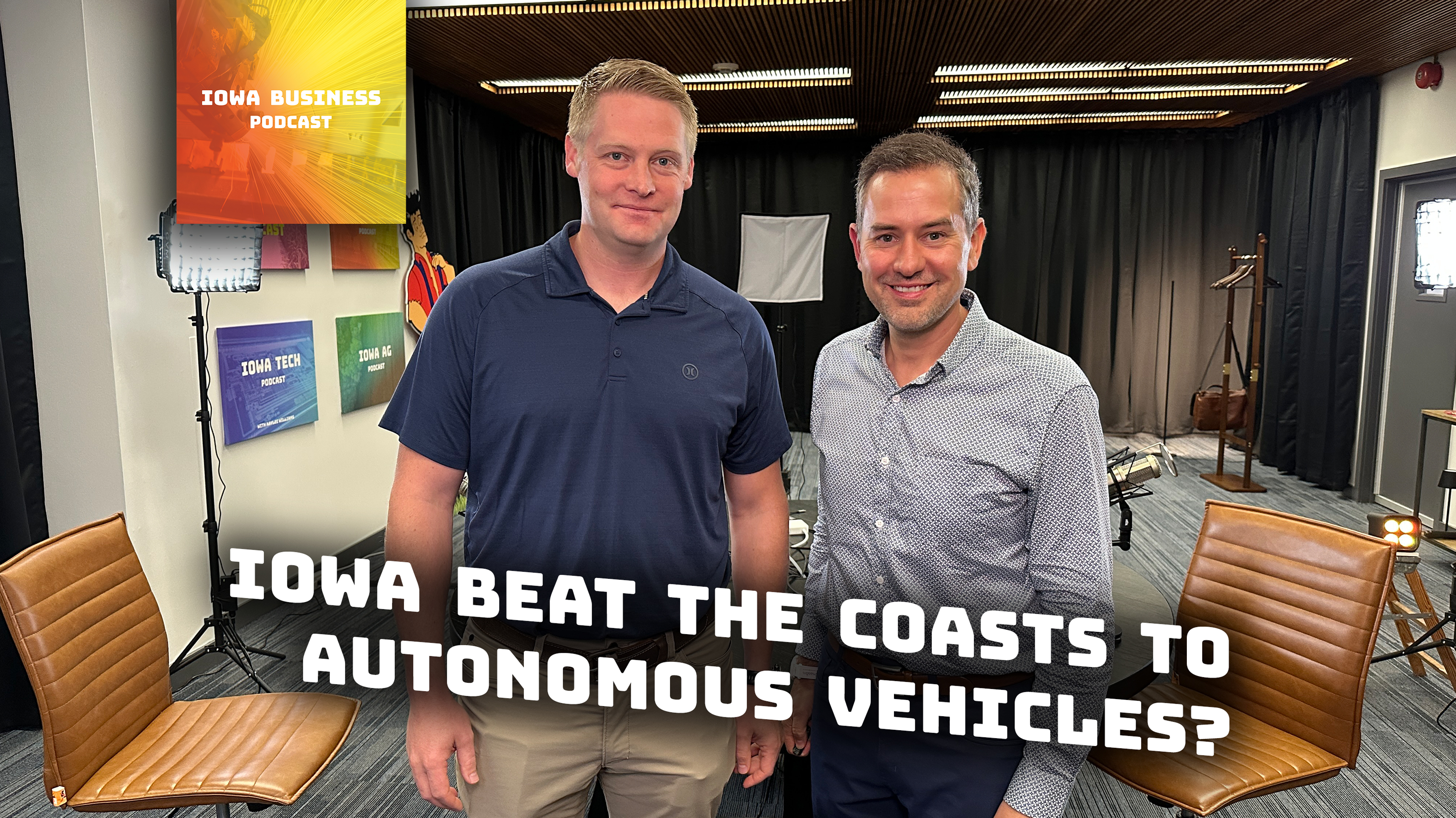


The coasts may get the headlines, but the midwest holds the crown for real-world autonomous vehicles. In fact, Ai-driven vehicles have been operating in Iowa for 10 years already. Colin Hurd, CEO of MACH recounts past Iowa successes, and why future of “off road autonomy” is thousands of different robots for niche uses cases.
Hurd details real-world examples in not just Ai applications, but other industries as well. He explains how removing the human operator, actually opens up unlimited possibilities, solving problems like soil compaction, bulk, and weight barriers. Will Iowa fields, and manufacturing have hundreds of various robot shapes and sizes soon? It looks that way.

While coastal technology hubs dominate headlines, Midwest innovation is quietly driving the future of autonomous vehicles. Hurd, has spent a decade advancing off-road autonomy for applications ranging from agriculture to battlefield defense. Unlike highway self-driving ventures, Mach focuses strictly on machinery operating off public roads. “Public highways are a totally different can of worms, and so what we focus on is essentially any machine that’s gonna move off-road,” Hurd explained.
Rather than selling aftermarket retrofit kits, Mach supplies original equipment manufacturers (OEMs) with factory-integrated hardware and software. Internal autonomy programs often require at least five years of time and heavy R&D investment for a single vehicle platform, creating a major barrier for OEMs managing up to 30 different machine models. Mach dramatically compresses this timeline, once getting an OEM machine running autonomous missions in less than four hours. A prime example is orchard spraying startup GUSS, which used Mach’s tech stack starting in 2016 to commercialize by 2018, scaling to over 100 autonomous units—allowing one operator to run four to eight sprayers simultaneously—before John Deere acquired the company in 2023.
Hear from Iowans directly. No algorithms.
Don’t let the algorithms choose your news. Enter your email address to hear directly from Iowans leading news in politics, community, agriculture and business. No editing. No clickbait. No rage. No agenda.
Disrupting Machinery Design with an Independent Model
Following widespread consolidation where major OEMs acquired independent technology providers, Mach operates as a neutral tech partner. “We wanted to be Switzerland when it comes to technology,” Hurd noted regarding Mach’s open supplier model. This neutral positioning allows mid-tier manufacturers to access advanced technology—such as RADX, a phased array radar sensor built to see through dust during tillage operations—without purchasing from direct competitors.
Why the Midwest Leads Practical Robotics
Autonomy also enables lighter, software-defined machinery that prevents soil compaction. Hurd credits the Midwest’s grounded environment for prioritizing real-world results over tech hype. “In the Midwest, you just don’t get very far unless you have real product market fit,” Hurd said, highlighting how practical problem-solving anchors the region’s edge in robotics.
Interview Transcript
This transcript was created with help from Ai. Please report errors to us and always refer to the video as your primary source.
Justin Brady: From the Jethro’s Barbecue Studio, it is the Iowa Business Podcast. Did you know the future of autonomy, like autonomous machines, you see them driving on the roads now, didn’t come from the coasts? Mm-mm, it actually came from the Midwest, which sounds weird.\ We’re gonna get into that, but this technology\ is still kinda… I, I have a full self-driving car. It’s super cool, But the technology has already been in Iowa agriculture, Iowa fields, Midwest fields, for years, for before this, and we’re gonna talk to one of the people behind it. Karlin Hurd, the founder and CEO of Mach, joins us today. Karlin, thanks for coming on the show. Yeah.
Colin Hurd: Yeah, thanks for having me, Justin
Justin Brady: Before we get started, thank you so much to Dentons Davis Brown for collaborating with us on this show and putting the oomph behind this to get it going. We’ve had a lot… I, I used to name names. I can’t do it anymore,’cause there’s so many of them, but they don’t just throw money behind the show to make… to bring it to you. They actually send their attorneys. They break down legislative stuff, HR law, immigration law, M&A deals, and it’s basically all this really, really rich, deep dive content for you, the business leaders, entrepreneurs, and executives in this state. It’s all for free. So if you want free law advice, and… Or I gue- I guess I probably shouldn’t say free law advice, but if you want, like, law oversight and information, duh, go check that out, iowapodcast.com/business. Iowapodcast.com/business. You’d be an idiot not to go check that stuff out. Karlin, thank you for coming in here. Um, I think it’s probably wise, you know, obviously CEO of Mach, you guys are an AI company. It’s probably wise to zoom out,’cause you have a classification. I assume there’s a lot of, um, depth or there… This is a big definition, but you call it off-road autonomy. It’s basically autonomous machines. What is that, and why have you, specifically you, been doing this for, is it a decade at this point?
Colin Hurd: a decade. I’m dating myself now, but I, I’m like one of the… It’s weird because when I started this, um, I thought I was way behind. You know, uh, in 2016, I started my first autonomy company and, uh, that same year Case IH rolled out their concept autonomous tractor at Farm Progress Show in Boone, and I was like, “We missed the boat.” The– I was like, “What am I even doing? This, this is our already solved problem.” Um, turns out I was actually super early. But, um, so you brought up off-road, the difference. Um, I guess it’s a, it’s a incredibly important distinction for our business. Um, public highways are a totally different can of worms, and so what we focus on is essentially any machine that’s gonna move off-road. So that can be everything from a lawnmower to a tank, uh, deployed in Ukraine or on any battlefield, right? So that’s kind of the scope of everything that we’re doing.
Justin Brady: And your claim to fame, um, by the way, I’m gonna move, have, have that microphone, bring that a little closer to your mouth there. Sure. Like super close. I didn’t tell him in advance. Normally I do this in advance. Your claim to fame isn’t necessarily AI autonomous vehicles. Your claim to fame is that you can almost retrofit, this probably might not be the right name, so you can correct me. You can almost retrofit or make any vehicle autonomous that isn’t supposed to be. I mean, I’m sure there are certain limitations there, and within the off-road
Colin Hurd: Within the off-road space, yeah. So, um, that’s another good distinction. So there is a difference between retrofitting autonomy on a tractor or vehicle, what- whatever it is, versus factory integrating it. And so, um, I’m assuming the self-driving car you’re talking about is your Tesla, right? And so Tesla is a factory integrated autonomous
Justin Brady: Vertically integrated the whole thing. Yeah.
Colin Hurd: you buy it as an autonomous ready or… And you, you pay the subscription and you get it, right? Whereas a retrofit system, which is the first company that I started in 2016,
Justin Brady: It’d be smart ag
Colin Hurd: yeah, Smart Ag, um, you could, you could go buy a normal John Deere tractor, and then our company would go put everything on it to convert it to be autonomous. And so it was an aftermarket solution. And th- there’s a lot of precedence for that in ag and other markets, right? You can go buy aftermarket technology, put it on your machine, and get it to do some new functionality. Um, the distinction though for, for Mach is that we are focused on factory integrated autonomy. So our customer base is manufacturers of machines. And so what we do is we basically take hardware and software, supply it to them, and then they can put that on the vehicle for whatever the use case is. You know, it can be, like I said, mowing or defense.
Justin Brady: You work With the- OEMs.
Colin Hurd: Directly with the manufacturers,
Justin Brady: Yeah. and so for most our audience knows this stuff, but basically you’re one of the component makers for all these companies
Colin Hurd: Yeah, not for all of them. Um, but
Justin Brady: You’d, you’d like it to? be
Colin Hurd: Yeah, sure. Uh, we’d love to sign them all up. But I think, um, that’s the difference in, in this business model in particular, is we’re providing a pathway for a manufacturer who says, “Look, we understand autonomy is important, and we wanna do it the right way, and we want to offer our vehicle as an autonomous vehicle from the factory. So that means our dealers are gonna support it. This technology has been vetted through our normal manufacturing design processes and functional safety processes.” And so that gives them a way to bring a, um, a completed solution to the market, and that’s not sort of– There’s not all these liability questions either that tend to come up when you start making vehicles drive themselves. Um, and so they can say, “Look, we’ve, we’ve done our due diligence on this. We’ve tested it. We know what it does. We know what it doesn’t do, and we can bring forward an offering to the, to the marketplace.” Y- So yeah, I, I, I think that’s kinda the important distinction between, you know, retrofit versus what we do at Mach.
Justin Brady: Yeah, so most of the end users probably aren’t gonna know who you are or see your name on stuff. yeah Unless they’re pulling back layers of stuff. Yeah. Uh, and this is, the distinction here, or, or I should say why this is important, is because as we’ve seen from… And I don’t wanna, um, announce the, you know, uh, rumors of my death were greatly exaggerated. You know, I don’t wanna have one of those moments. But as Ford and as GM have found out recently, creating your own self-driving systems ain’t so easy. You know, I think GM shut down Cruise. Um, uh, Ford has been having a lot of trouble with their, their hands-free systems. I, I don’t even… But, you know, There’s been this dis- this, um… It’s not so… They’ve thrown tons of money at it, but it’s Not such an easy thing to crack. It’s a very delicate engineering process, which you guys have cracked, which is why companies with, um, oodles and oodles of money way beyond what you have are coming to you to do this,’cause it’s a very, very, it’s an engineering, a very difficult engineering problem, not something you can just throw money at. Is that, is that a fair
Colin Hurd: Yeah. No, no, it’s a very good assessment. And, um, what, what we like to say is y- order of magnitude, and it really depends on the machine and the use case that you’re t- that you’re talking to is, but it’s at least five years of time invested as well. It’s not just money, right? There’s a ton of money that you need to invest in it. You gotta, you gotta have competency in software engineering and also the hardware, but then you actually have to have the time to develop it, test it, um, and refine it, and that can be five years for a single vehicle platform, right? And some of these OEMs will have 30 different models of machines that they’re making. So for them to, um, just expect that, “Hey, we’re gonna start a program internally, fund it, and have a solution at the time the market needs it,” um, great, maybe they can do that for one platform, but to have that for their fleet, um, they just can’t keep up with the market, right? So having an off-the-shelf solution, um, working with a company like us as a partner tends to make a lot of sense.
Justin Brady: Yeah, and not to mention the willingness to just completely burn millions of dollars in R&D, right?’Cause some of these larger companies, they will not cross that path because they have shareholders to answer to. But startups are like, “We have no choice. We have to cross that path. We have to burn the R&D money, otherwise we don’t survive.”
Colin Hurd: We don’t have a product at the end of
Justin Brady: Exactly, and so l- some of these larger companies are just not willing to do that. They’re not willing to… I think Chamath Palihap- Palih- Palihapitiya, one of the “All-In” guys, is like the glass-eating process is what he calls it. A lot of large corporations will not do that. Um, one… unless you had something to add to that. No, I,
Colin Hurd: No, I, it’s a good observation. Yeah, yeah, 100%.
Justin Brady: one of the things you talk about is the open supplier model. Um, how is that different? from, like the, I would assume the closed supplier model is, um, uh, companies that, I don’t know, you have their one thing and they, you know, right to repair, you can’t get… What what is, what is the open supplier model and how does Mach enable that? Do you enable that?
Colin Hurd: Yeah, and maybe the, maybe the better term would be the independent supplier model, right? And so it’s really– Uh, this is kind of, um, one of the thesises that led me to starting Mach was we’d seen a tremendous amount of M&A in our industry. So what–
Justin Brady: I mean, including your own acquisition of Smart Egg
Colin Hurd: Yeah, it got rolled up into CNH, right? And so, um, what happens is these independent technology companies that can provide, um, a solution to any manufacturer, if a manufacturer buys them, they are no longer independent. They’re beholden to whoever they just got bought by, right? And so then all of a sudden, it, you know, this was a really acute problem in COVID with all the supply chain issues. But if you were still a customer of, let’s say, a Raven, and you needed parts, but Raven’s owned by CNH, who’s gonna get the parts, right? I mean, not that anybody had a policy like that. It’s just like, “Hey, this is our company. We made a good bet. We need the, we need the supply.” And so I think what happened very quickly in the course of three or four years is most of the independent technology companies in ag and other spaces were acquired by OEMs because they recognized, “Hey, I don’t have this competency in-house. I need it. I need to protect my supply chain.
Justin Brady: Uh
Colin Hurd: Electronics are a bigger part of my business model.” And so, you know, it’s a classic make versus buy, and a lot of them have bought. Um, and that worked for some of the major OEMs, or maybe it– we’re gonna find out if it works or not when the, the… Um, we’ll see. Um, however, there’s a whole layer of OEMs underneath that class, right? So beyond the, the major manufacturers, there’s mid, mid-tier OEMs, large companies in most regards, that, um, don’t wanna buy from their competitor, right? They don’t wanna buy technology that, um, their competitive manufacturer owns, and so they’re looking for independent, um, technology suppliers. And so that was one of the th- the principles behind Mach was we were gonna be independent. We were gonna be neutral, right? We, we wanted to be Switzerland when it comes to technology. So whether you’re a small OEM, a large OEM, whether you compete or not, that’s not our problem. We’re gonna give you the best solution we can at the best price and in, in the best quality.
Justin Brady: And how, so it’s like a, and this is a dumb example, but this is the one I have in my, in my mushy brain right now, which is k- it’s kind of like Michelin tires to cars. like Michelin can put tires on any cars. They’re not making cars that I know of so other car manufacturers are like, “That’s fine. We’ll, we’ll put Michelins on. That’s fine.” I don’t know if that’s a dumb
Colin Hurd: No, it’s, I think it’s a pretty good example actually,
Justin Brady: I got. um, does this So basically you have brand, uh, brand autonomy. You’ll work with Deere, you’ll work with Case IH, you’ll work with a small startup that nobody knows about. You’ll work with tiny companies, you’ll work with big companies, doesn’t matter. Does this help, um, like how does this help the end user, farmers? Like it just basically prevents all the technology from getting in one person’s pocket, then they can inflate prices and lock everybody in. Is that kinda what it does?
Colin Hurd: Sure, there’s that element, right? I mean, I think it helps, um, it helps end users probably more from the standpoint of, um, the, the playing field is maybe more even across the board in terms of functionality. So we, we can provide an autonomy solution that is in many cases better than the biggest OEM solution. Um, and with certain technology that we have that’s taken us years to develop and tons of learning and tons of time, that, that competitive product can be just as good as, you know, the, the mainstream. The other, the other thing that it does is I think, and, and this is probably the biggest advantage for end users, is it just gets the technology to market faster because you are bypassing that painful R&D glass-eating phase of bringing this technology out to your customers. Um, and so just like you could go to Michelin or Firestone and buy a tire, you can go to a company like Mach and get an autonomy solution. Now, it’s a gross simpli- simplification. There’s a lot that we have to do, um, in terms of integrating that well and safely on a machine platform. But the timeline to do it is, I mean, it- we, we’ve gotten a machine in our facility and had it running autonomous missions in less than four hours. Right? You know, and there’s prep that goes into that to make that successful, but it can be that easy when, um, we’re working with an OEM who understands some of the requirements, and we have a proven stack that we can put on it and make it work, so
Justin Brady: like, for those– I’m gonna ask you about the vision here,’cause most people when they hear of autonomy, they just think of current machines and just making them autonomous. But when you make things autonomous, it actually changes the way machines can be made, so I wanna talk about that. Before I do, though, does this kind of, um, allow smaller companies to get to market way faster with lighter hardware builds and compete with some of the bigger companies, like, by what you’re doing? Does this kind of level the playing field so that the end users get quality products and it’s not necessarily about walled gardens and large suppliers controlling everything? Does this kind of enable that?
Colin Hurd: it absolute- absolutely, yeah. I mean, wish you saw that. So like our flagship customer that we always can r- w- reference’cause it’s a, um, very public, is a company called Gus. Gus, um, was a small startup based in California. They built an orchard spraying machine that was autonomous. They used our, our tech stack on that machine. So they went from being, uh, not even a manufacturer to becoming the, one of the leading manufacturers of orchard sprayers. Um, and it was fully autonomous to the point where, um, they were– Nobody was even close to them. Deere didn’t have anything, Kubota didn’t have anything. Nobody in that space had a solution that could even touch what Gus was doing, and they did that in a matter of, um… I think the first, uh, machine we worked on them with started– We, we started working on them in 2016. Uh, they commercialized in 2018, and then Deere bought them in 2023.
Justin Brady: Jeez, that is a fast timeline
Colin Hurd: Yeah. But they were selling– I mean, we did o- well over 100 vehicles in that timeline. Um, and for that market, that’s a substantial
Justin Brady: What’s im- what’s impressive is that when Deere bought them, they bought the customer base, they bought the equipment, but they didn’t buy the AI technology. Right. Which is– So AI– So no matter how large the company is, they can’t really acquire that angle, and now you can have another smaller startup does, does the same thing. So it does allow, like, one to two people teams to, like, compete in ag or autonomy, uh, in two years, right? That, that’s insane. That’s like, unheard of.
Colin Hurd: insane. Right. That’s like a So
Justin Brady: um, one of the things, uh, that AI does is it obviously removes the operator, and it obvi- it removes a lot of cost, too, over the long term.
Colin Hurd: Mm-hmm. Mm-hmm.
Justin Brady: Do you see customers changing the form factor and dramatically changing how these machines operate? Um,’cause, uh, one of the things you mentioned, I think in an email we had, was how this weird connection, you can connect the dots, I’m not gonna connect them for the audience, this weird connection with autonomy and soil compaction. Like, autonomy enables a lot of stuff that most people probably can’t envision yet. Can you paint that picture?
Colin Hurd: Yeah. So th- there’s a couple themes you’re pulling on there. Um, the first is like the vehicle form factor. So, um, you know, I got into this, in, uh, this autonomy space actually through soil compaction, and it’s kind of a roundabout way, right? So my, my very first company prior to SmartAg, um, we built a entirely mechanical tillage device. You could put it on a planter to get rid of compaction during planting. So there’s a problem called pinch row compaction. The weight of the tractor and the planter puts a lot of w- um, compaction, and it stunts the yield in the rows next to the tires, right? So this is a simple solution called Track Till. You could put it behind your planter and work up the pinch row compaction as you were operating. Um, and so y- you’re probably still wondering like how does that connect to autonomy, right? Well, um, despite our best efforts, and it was an effective solution, you could only still get back about 80% of the yield you were losing from compaction. So you’re still, you’re still behind the ball in terms of y- you should, shouldn’t create the p- compaction at all. That’s the best case scenario is don’t compact the ground. Um, and so, you know, you start asking, you just start peeling back the onion and trying to go to the first principles of the problem and say, “Well, how could you n- how could you avoid creating that compaction?” Right. And the only practical answer is use smaller, lighter equipment that doesn’t cause the compaction. Um, but obviously that’s not a practical answer for a farmer who has 10 days to plant all of his fields. Right. And sh- he’s short on labor, right? So then all of a sudden, compaction is now becoming a labor issue, not a, not anything else. It’s not… It, it’s just a fact of, of labor scarcity. And so the, the ag industry has answered labor scarcity by creating larger, more efficient machinery, and there’s side effects to that, right? And so do you have to have a, you know, 120-foot planter, which, uh, we put a lot of our systems on back in the day, or could you have a bunch of smaller planters, 12, 10-foot planters? If they were autonomous, one person could still operate that capacity. Right. And so that’s kind of what got my wheels turning in terms of, yes, you can change the form factor, and it does allow you to do things that you couldn’t do otherwise. Um, the GUSS vehicle that we mentioned earlier is actually an example of that. That thing doesn’t even have a cab. It’s just a tank on wheels, um, a spray tank on wheels and, um, a fan. And so you can’t even drive it if you want to, but it allowed one person to run basically four to eight sprayers at the same time. Yeah. So drastically more efficient
Justin Brady: Yeah, it’s incredible to me that most people don’t th- I don’t, I honestly don’t think of that, of this all the time, but when you start to remove the operator, you start to remove the things the operator needs, and that’s surprisingly a bulk of stuff being put in this. And so what you’re saying is with autonomy, with AI, machines go from these big, giant, massive machines to these super, ultra-small, ultra-light, super cheap, possibly, uh, likely, super cheap machines that people can buy. So rather than buying one large machine for a half million dollars, theoretically they could buy 15 tall, small light machines for $10,000 or $50,000. Is, is this kinda where you’re seeing not just ag tech, but autonomous off-road, um, st- uh, off-road autonomy going?
Colin Hurd: Y- in some cases. It, it’s not a blanket rule, um, because there is still– I, I mean, there’s still fields out there when you’re speaking of ag that are, you know, they can be, uh, two miles long from end to end. And, you know, so even a– There, there’s a diminishing return, and it’s probably very dependent on the use case that you’re focused on, um, in terms of does it always make sense to buy a bunch of smaller machines versus a large machine? It’s probably gonna depend on the farm, the operation, and the use case, right? Um, there is definitely situations where that is gonna make sense. I think the interesting thing is less about maybe does it have to be smaller, does it have to be bigger, what, what’s the size of the machine, but more so, like, how can the machine design change to support an autonomous future? And I think within every use case, um, you’ll see software-defined machines being built,
Justin Brady: Ooh,
Colin Hurd: that you’ll start with the concept of what will the software enable this machine to do, and then what do I need to support that mechanically? And it cha- it’s gonna change a lot of how we just think about machine design in the future. Um, and that’s, that’s the exciting piece. And, um, it does create challenges for us in our business model because, uh, we’ll start working with the manufacturer, and they realize, “Hey, um, we need to change how this machine is built.” And so now all of a sudden going from a, “Hey, let’s put it on your existing machine and roll it out in, in 12 months after we’ve tested everything,” it goes from, “Hey, we’re gonna redesign a whole machine from the ground up, and it’s gonna take us three years.” But, um, that’s a different, that’s a different challenge in our business model.
Justin Brady: Yeah. So what you’re saying is just to, you know, the Iowa connection,’cause obviously you work in a bunch of different industries, but just the Iowa connection, there may be a future. I would argue there is. I mean, from what I’ve done on this show and my other work, I’m like, “This seems obvious to me.” But there would be a future when we drive through Iowa fields and we don’t just see the same three combines all the time or the same three pieces of equipment. We see hundreds of different variations depending on soil type, depending on the location, depending on if they’re close to rivers, depending on certain crop yields or, or whatever crops people are growing. We’re going to see thousands of different micro use cases for robots rather than the same machines being used for everything.
Colin Hurd: Yeah, and I think, I think the general utility of i- in the concept that we have of a tractor that can do a lot of different things will remain. I– Just because
Justin Brady: of course
Colin Hurd: a, it’s it’s, a pretty well-proven concept, there’s a lot of value to that. So, um, the part that’s actually super interesting to me is what goes on behind that tractor. Because a tractor, um, is essentially just supplying horsepower and putting power to the ground to do a job. And now that job can be a whole bunch of different things from planting to cultivating to, to, uh, seeding or spraying, whatever it is, right? And so I think there’s gonna be an incredible amount of innovation that happens behind the hitch, um, which is really exciting too. So actually, in our business, um, we, we focus on both those categories. And one of the, one of the technologies that we just released and, and, um, the team won some awards for, uh, in Germany was a sensor called a RADX, which is a phased array radar sensor. The reason we developed that initially, um, was to see through dust in tillage ap- applications. Because
Justin Brady: Makes sense,
Colin Hurd: great to have an autonomous tillage tractor, but if you don’t know what’s happening behind the hitch, um, it’s kind of hard to do that operation, right? You just need something to tell you that the quality of work is meeting certain thresholds. Um, and so that was one of our first, uh, innovations in the behind the hitch space. Um, now that sensor itself has a whole bunch of other applications, which is really exciting. But, um, that, you know, I think you’ll see, especially too because when you look at the implement manufacturing side of things, um, and there’s a lot of great implement manufacturing companies in Iowa, um, they’re, they’re a lot of times smaller, right? So they can move a little bit more quickly, they can, they can innovate faster, and they need to innovate, right? Fundamentally, they have to innovate to be competitive long term. Um, so I think there’s a l- there’s some really exciting stuff you’ll see just in how machines take form over the next, uh, call it 10 years.
Justin Brady: Um, I mean, I’m already seeing bits of this. I was in San Francisco for a founders event, uh, Canopy, and it was a bunch of young founders demoing really early versions of stuff. And what kind of struck me is they had… There were a lot of robots. And at first I’m like, “Okay, everybody’s trying to solve the same problem.” Then I realized everybody’s solving very different problems. Like, one guy had developed a security robot that was super… It almost looked like a Roomba with a pole and a little claw. And I’m like, “What is the point of this?” He’s like, “Well,’cause we, in our use case, a lot of security people, it’s just a recording thing only. They just want someone there to record and take notes, then Also adjust a few things.” Like, a door was left open that doesn’t, you know, they want that closed for fire code. And, uh, you know, a seat was in the middle of a fire escape area, and they wanted that moved. Because, because a lot of the, uh, the, the security officers they hired, which he said, by the way, this job they all hate,
Colin Hurd: Mm-hmm. Mm-hmm
Justin Brady: it’s just minor things. They don’t need someone ready to tackle someone. They call the police for
Colin Hurd: Yeah, yep
Justin Brady: so I was like, I was, I was like, “Well, can’t a humanoid do that?” And he’s like, “Well, of course, but a humanoid’s not this cost.” It’s like 500 bucks
Colin Hurd: Yeah. Holy cow. Yeah,
Justin Brady: like that, you know? And a humanoid would, you know, 30,000. And I’m like, “Oh my gosh, there are going to be so many.” We all think it’s, uh, gonna be a bunch of humanoids. It’s probably not. It’s probably going to be hundreds of millions of different platforms for different use cases. So this is the beauty of what you’re building over… Or, like, why I’m excited. I’m not a sponsor, I just think it’s cool. Um what, what is it about… You, you kind of hinted at this earlier. What is it about Midwest robotics? Because the coasts get the headlines from Wired and TechCrunch and The New York Times and The Wall Street Journal, Washington Post. Great publications. I’ve written for a few of them. But the coasts get the headlines, but it’s almost like the more I learn about it, the Midwest, Ames is a hotspot, is kind of leading the actual practical robotics side of this discussion, which no one really focuses on. But why is that, and why are people ignoring the Midwest?
Colin Hurd: Yeah, I mean, we’re a flyover state, so, um, y- you know, we get that a lot. And I, and I think the difference, um…’Cause I’m, you know, I’m tied into a lot of innovation happening out west, and there’s some, there’s some really cool ag tech stuff, right? Um, most of the West Coast ag tech has no, um, application in broad acre crops- Right right? So when it comes to corn and soybeans, which we’re surrounded by here, you just don’t see any of those machines making their way into this environment. There’s a lot of reasons for that. Probably the biggest is, like, you get a really smart tech founder that, you know, came out of Stanford or whatever and wants to go into robotics, and they’re looking for a use case. You know, s- classic technology, searching for a problem. Right. And they go see somebody that’s… They, you know, they go drive, um, from San Francisco to LA, and they see a bunch of people out in a lettuce field picking lettuce, and they’re like, “Oh, my gosh, we gotta automate
Justin Brady: We got it, Yeah. Yep
Colin Hurd: know, it’s like, okay, well, that’s a market. It’s… Is it the m- most impactful market for this technology? Probably not, like, overall, right? When you look at agriculture as a whole. Um, and so I think you see some technology make the jump. A great example of that is, um, Jorge’s company that he founded called Blue River Technologies, right? Well-known, um, early pioneer in ag tech and robotics. They started with lettuce thinning. Um, John Deere ended up acquiring that company, but only after they proved that that lettuce thinning, uh, machine vision technology could be transferred into row crops, right?’Cause that was the critical piece to make it work for John Deere. And now that technology is doing seed and spray for John Deere. So it made the jump, and it c- I think is creating a tremendous amount of value, not only for farmers, but for, um, but for, for Deere. And I, I think the difference is, is in, in Iowa especially, and in the Midwest, the founders that we see and the technology that we see, and I’m saying this from the perspective of another hat I wear, which is at AgStartup Engine in Ames. And so it’s a, it’s a venture fund that starts with really early stage ideas focused on ag tech
Justin Brady: We are having Michaela Mooney on the show here in the future as well, so Yeah, yeah
Colin Hurd: she’d be, she’d be great. She’ll tell you a lot more about it. But the really cool thing in the Midwest ecosystem is it’s typically, um, starts with the problem and then the tech- we walk into the technology, and so it’s a lot more intentional often. And you just don’t– You get rid of some of the hype cycle that exists in the Bay Area where everybody’s, um, raising rounds upon rounds of money and maybe not proving any real traction that matters to the whole market. In the Ag West– or in the Midwest, you just don’t get very far unless you have real, uh, product market fit. And it, it’s hard enough to raise money here, um, but you definitely won’t raise money unless you have a product and you’re solving a real problem that farmers care about. And, you know, we’re, we’re Iowa nice, but we are also practical, and we’ll tell you what we think, you know? And so there’s a level of honesty that I h- I think refines a lot of great founders, um, out of the Midwest
Justin Brady: And it’s one of people solve problems they’re surrounded by. And so, you know, when you have a, a crap ton of money, crap ton of connections in certain areas, and then in th- it’s proximity. And then in those areas, people are saying, “I see this problem.” The investors and the money are like, “I see that problem, too. Here’s a billion dollars.” In Iowa, it’s like “I see this problem.” And around people are like, “I see that problem, too. Here’s 100
Colin Hurd: bucks Yeah.
Justin Brady: Yeah. You know? And so, you know, there’s, whether you love it or hate it, there’s not as much money here. there’s, there is a ton of money, in San Francisco. They’ve had momentum. for years. And so, you know, they had some of the big names, the, the Apples of the world that have been there for decades. So they’ve got momentum. And we don’t have that momentum here from a funding and tech standpoint. Um, the… Colin Hurt, the founder and CEO of Mach, obviously really appreciate you coming on the show. What is the website if people are like, wanna learn more about this stuff?
Colin Hurd: Yeah, it’s just, it’s simple. It’s mach.io, so M-A-C-H.io. And, uh, you can go there, look us up, find us on social media, whatever you wanna do. We’re always, um, showing as much as we can about some of the cool projects and work that, uh, we’re involved in
Justin Brady: Well, thank you very much for coming back on the Iowa Bu- well, Back on the, back on Iowapodcast.com but first time on the Iowa Business
Colin Hurd: Perfect. Yeah. Yeah.
Justin Brady: for coming back on the
Colin Hurd: thanks for coming back on the show. Absolutely. Thanks for having me