

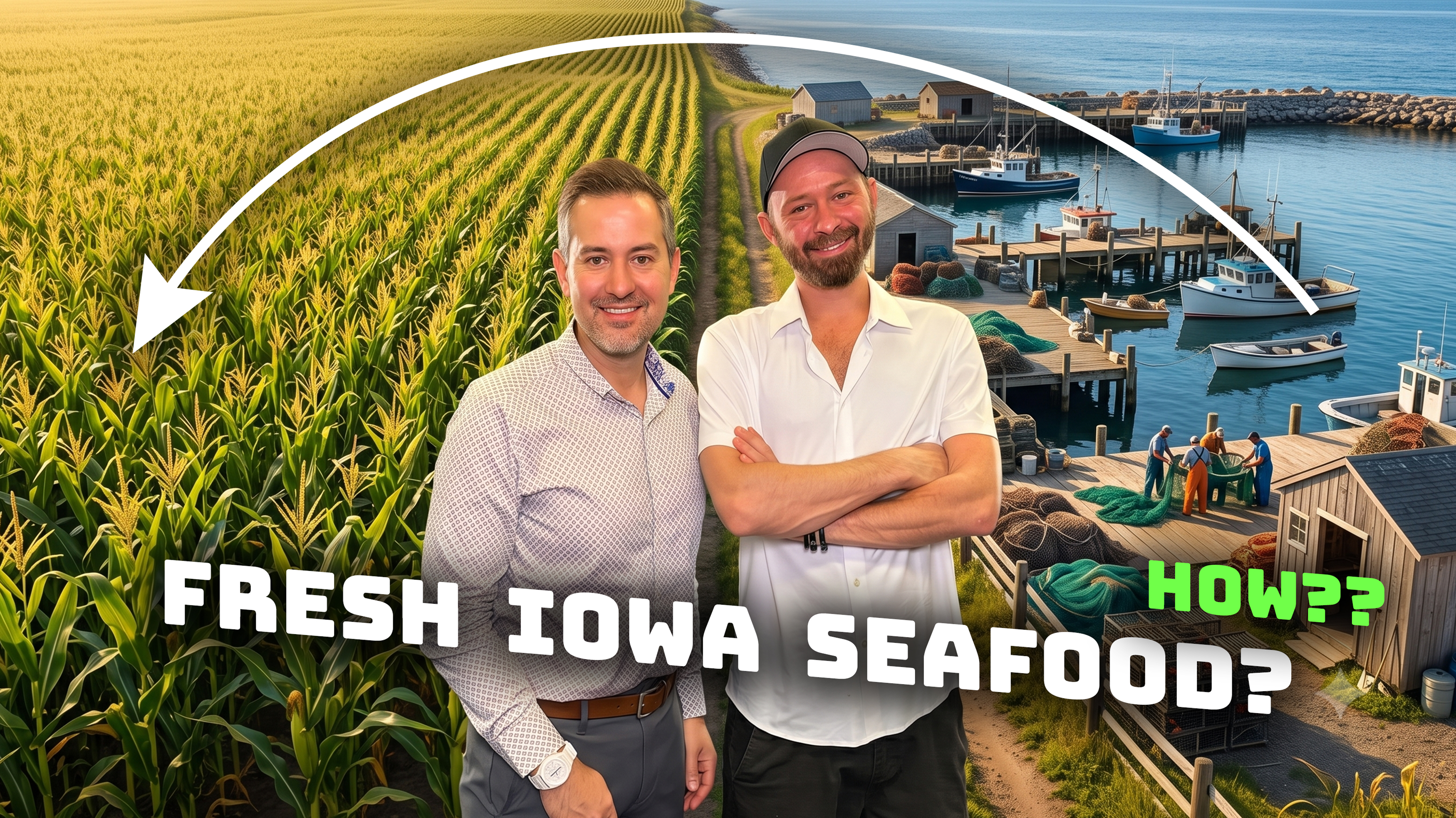


Fresh seafood in Des Moines, Iowa? How is that possible? We asked Executive Chef Ryan Baber of Splash Seafood if it’s just a bunch of marketing jargon or if it’s a legit claim. He told us about the logistics process that requires him being on the phone with fisherman across the country, planning menus based on what’s coming off the boat, receiving jet fresh fish every day.
Baber goes into detail on how he’s crafting seasonal menus for Splash Seafood not just prioritizing fresh seafood in Des Moines, but also fresh local produce and beef from Iowa farms. It turns out there’s a complicated logistics process behind that fresh seafood on your plate.

Delivering ocean-fresh seafood to downtown Des Moines requires a tightly choreographed supply chain.Baber spends his mornings managing a complex network of five to six purveyors spanning from Hawaii and the Pacific Northwest to Prince Edward Island, Canada, and the Florida Keys. Baber spends the first 40 to 45 minutes of every shift confirming daily shipments flown directly into the local airport or trucked from Midwest hubs like Minneapolis and Chicago. “The logistics of it is definitely a very well-meshed together net, so to speak,” Baber explained, emphasizing that strong vendor relationships keep prices competitive and secure emergency deliveries within 24 hours.
Hear from Iowans directly. No algorithms.
Don’t let the algorithms choose your news. Enter your email address to hear directly from Iowans leading news in politics, community, agriculture and business. No editing. No clickbait. No rage. No agenda.
Sourcing Coast-to-Coast and Right at Home
Beyond coastal catches, the 18-year Splash veteran balances regional seafood with fresh Iowa produce and meat. His kitchen sources beef from Iowa Premium Beef in Tama and receives weekly produce deliveries of fresh tomatoes, sweet corn, and lettuces from Reinhart’s Family Farms in Boone. This constant influx of seasonal ingredients drives a spontaneous culinary process. “You pick the one thing that strikes your interest, and then you build all of those components around it,” Baber said regarding his menu creation, noting he has designed entire dishes around local green strawberries or fresh radicchio.
Constant Innovation on the Plate
To keep the dining experience dynamic, Baber rotates a six- to seven-course featured menu every two to three weeks featuring two appetizers, three entrees, and dessert options. This rotation allows the kitchen to test seasonal items, such as scallop and shrimp ceviche, which often transition onto the permanent core menu if popular. Combining local sourcing with daily flights remains essential to the restaurant’s approach. “Everything possible we try to do as close to home as we can,” Baber noted. His next project includes a special three-week featured menu running six days a week in early September to coordinate with the musical Wicked at the nearby Civic Center.
Interview Transcript
This transcript was created with help from Ai. Please report errors to us and always refer to the video as your primary source.
Justin Brady: [00:00:00] From Iowapodcast.com, I’m Justin Brady. And how do the logistics of, like, getting food, fresh food, here in Iowa… We know how to get agriculture, pork, beef, we know how to do that stuff, but how, how on earth do companies and restaurants that advertise fresh fish, fresh seafood, get, actually get it here to call it fresh?
That’s what we’re talking about today with Ryan Baber, the executive chef at Splash Seafood, of course, located right in the middle of Iowa in downtown Des Moines. And of course, we love Splash and Jethro’s, big time collaborator. We love doing stuff with you guys. But, uh, I appreciate you coming down to kinda talk about how this actually works.
Ryan Baber: It takes time, but it’s not too hard, I will say that. Uh, it– The logistics of it is definitely a very well-meshed together net, so to speak. Um, we deal with multiple purveyors from coast to coast, even from Hawaii to [00:01:00] Northwest Coast to all the way up to PEI of Canada, down to the Keys.
Uh, and I talk to them literally daily, um, via email, text, phone call. I– My phone just went off right there, and I bet you I know exactly who that was, and it was my boy from Honolulu. Uh, he called me earlier this morning, and he said he was gonna get back to me because I’m looking at doing a new feature menu next weekend.
So, um, I give them the heads-up, and they look at what’s available and sustainable, and then we fly it in. Uh, it lands at the airport, and once it lands, it’s trucked straight to us. Um, our closer relatives from, uh, Peoria and Chicago area and also the Minneapolis area, we get those trucked in. But I would say on average, we deal with about five or six different people, um, dealing with seafood, and we fly it in as fresh as possible pretty much on the daily
Justin Brady: so break this down for us. Why, and again, this is a, I don’t, I don’t understand how this works, but why would [00:02:00] you have to be in touch with so many different areas? Like, what is the, what are the Keys giving that Prince Edward Island in Canada, you mentioned PEI,
Ryan Baber: Yep, absolutely
Justin Brady: are you s- are there different fish types that s- that are in different waters?
And how do you keep track and manage all that?
Ryan Baber: So not only does it come down to seasonal varieties of fishes, uh, it comes down to, you know, the oysters, you know, uh, where we can get them, who has them available. Um, you know, a while back we had an issue with West Coast oysters being unavailable because of, you know, the waters weren’t stable and this and that.
So, you know, it depends on who can get what and from where, and also competition drives value. So the more, the more you can pin your purveyors against each other, the better value you can get. And that being said, we are a landlocked state. We’re in the middle of the country, literally in the middle of the country.
So getting in fresh seafood daily, you gotta have that bang for your buck, so to speak. Um, [00:03:00] and trying to get the best price available, that’s kinda why we deal with as many people as we do,
Justin Brady: Oh, sure.
Ryan Baber: drive, you know, you tell them, “Hey, this guy has it for this price, but why can’t I get it for that?” And they’re like, “Okay, we’ll knock off five bucks or two bucks or whatever,” you know.
So that definitely does help, and we have had an amazing relationship with every one of the men, ev- I should say every one of the individuals, pardon me, uh, that we deal with, and outstanding relationships. I’ve been at Splash for over 18 years now doing what I do, and well, started as line cook, but we’ll get into that later.
Um, built a great rapport, great relationship, and they’re more than willing to help me with not only pricing, but availability and, you know, they’ve– I’ve had guys bend over backwards and make a trip up to Minneapolis just to bring me a case of oysters because it got shorted on the truck.
Justin Brady: Jeez
Ryan Baber: It’s all about relationships, man.
You always gotta build those relationships with those individuals because
Justin Brady: most people think you pull up a [00:04:00] order form and just click what you want, and you’re sitting here building relationships, you’re
handling these… This is a logistical nightmare in, in my opinion. You’re actually shopping in season in different regions, and you can get away with that because you’re getting this stuff, it sounds like you’re getting this stuff within 24 hours on a daily basis
Ryan Baber: Every morning it’s at least my– Once I walk in those doors of that kitchen, it’s at least the first 40 to 45 minutes it’s on the phone double-checking with everybody, making sure orders are filled, making sure that, you know… And if, the, the crazy part comes when you’re building a feature menu because that’s when you’re getting different products in.
Uh-huh. You know, that, that first 40 minutes is just making sure that our standard product is coming in. Um, with the feature product, then that’s the whole debate, that’s the back and forth, that’s the conversational piece that you have to be on the phone and talk with them. So I mean, that could take up, you know, the first hour and a half of my day just making sure that we have the product allocated and confirmed shipping to be delivered.
[00:05:00] So if I roll a feature menu out on Friday, I wanna make sure that it’s going to be there Thursday so it can be prepped and
Justin Brady: Oh, sure. You’re creating menus here at Splash Seafood based on what’s in season at Prince Edward Island, and what’s in season on the West Coast, and what’s in season out of the Keys in Florida, and I’m sure there are other things too, like Maine for lobster or whatever.
Ryan Baber: off the coast of Hawaii as
Justin Brady: you’re sh- off the coast of Hawaii. So as an executive chef, you’re shop- You’re, you’re picking fresh seafood based on seasonality within these regions all across the country all the time, and this determines the menu you serve here in Des Moines
Ryan Baber: That is correct. Yes. Uh, and, you know, I’m– Well, hopefully I hear back from my guys because like I said, this weekend I’m trying to– I’m, well, I’m going to, uh, flip the whole menu. Um, and, uh, yeah, and I told them to get to work. And that’s the thing is, you know, I, [00:06:00] I understand, you know, we have this great relationship, but at the end of the day, I’m paying you.
Like, I’m gonna buy from you. If you can help me, I’ll help you. So we’ll see what they come up with, and then that’s where the selection process begins. And that’s the fun part about it is when you have five different… We’ll just s- we’ll go on a random number. We’ll say five different. So you have Northeast, Northwest, Southeast, Southwest, and Hawaii.
We’ll just say way out west. Um, so you have five different directions to go- Yeah … as far as a product. Um, once you lock in on said product, be like, “Mm, that one sounds fun,” that’s where the creative side kicks in. Like once you decide– And it doesn’t even have to be a protein. I’ve developed dishes around a vegetable,
Justin Brady: Ühüm
Ryan Baber: dial it in, ’cause we deal with local farmers as well, [00:07:00] so
Justin Brady: Oh, so you’re dealing with seasonality here in Iowa and the coast at the same time
Ryan Baber: all of our beef is from Iowa Premium Beef, and that’s right outside of Tama, Iowa. So all of our beef comes from them. Um, and the majority, shout out to Reinhart’s Family Farms, ’cause the majority of our produce comes from them.
Um, they deliver it once a week, if not twice a week. Um, I’ve even ran out to their farm to pick it up before. Uh, but yeah, um, all of our fresh tomatoes, corn, lettuces, uh, zucchinis, squashes, stuff like that, we get straight right out of Boone, Iowa. Um, and if, you know, I get a call from Miss Polly, love her to death.
Uh, if I get a call from her and she’s like, “Hey, I’ve got, you know, five pounds of these green strawberries left, and I was just wondering if you’d like them.” Who the hell knows what to do with green strawberries? Mm-hmm. They’re underripe, they’re bitter, but they still taste like a strawberry. Instead of sweet, they’re bitter, [00:08:00] they’re tart.
Yeah, I’ll take them. And then that’s where you build your dish around, you know? So- Oh … so you pick the one thing that strikes your interest, and then you build that, all of those components around it. And that’s where you– It could be a protein. Like, “Hey, I’ve, I’ve got some local, uh, skirt steaks,” whatever it may be.
Yeah. I’m like, “All right, I’ll, I’ll, I’ll give it a go.” And then you build your dish around the skirt steak. You build your dish around these lettuces. You build your dish around like, “Oh, I got local radicchio. What can I do with this radicchio? I got this, that, the other,” you know? Um- That, that’s where the creative side comes in, and I, I absolutely love that part because I’ve, I’ve looked at lists a mile long of certain components.
Like, ah, yeah, yeah. Oh, bam, there it is. And then you develop around that[00:09:00]
Justin Brady: it reminds me of a design thinking author and what he said, like, “Creativity thrives under intelligent constraint.” And so it
Ryan Baber: That’s a good way to put
Justin Brady: Yeah, it’s a great quote, and it sounds like that’s basically what you’re doing is, um, the creative juices are kinda coming from shopping within season. And when I say within season, various season, you know,
Ryan Baber: Correct. All year
Justin Brady: combined with what’s available as far as vegetables locally, beef, and pork.
Dynamically creating these menus to accommodate all these fresh ingredients. How often are you creating these menus?
Ryan Baber: Every two to three weeks. Um, we do a, uh, we do a featured menu, um, for the Homestead building, um, Splash. Uh, and it consists of two apps, three entrees, and a dessert option. Sometimes, depending if we can get different product, it’ll be two dessert options. So it’s anywhere between a six to seven course, uh, tasting menu, so to speak.
Um, but I mean, you, you can come in and just order the entree off that [00:10:00] menu. Yeah. You can order just the appetizer, just the dessert. So it, it’s a lot of fun. I will say it is a lot of fun, and that is what has sparked me to continue this path, I should say. Uh, it wasn’t the avenue that I originally had decided to go down, but, uh, I just couldn’t get away.
I got addicted to it. I couldn’t get away from it. It’s just so much fun, and the way it makes your brain move, the way it makes your brain think, you’re always on your toes, you’re always on point all the time, and it’s ex- ex- it’s exciting, to say the
Justin Brady: When we see restaurants that just repeat the same menu indefinitely for years, are… I- it sounds like, uh, local restaurants such as Splash, sounds like you guys are getting away from that kind of stuff because it’s not as fresh. Is this, is this a fair assessment?
Ryan Baber: our core menu and we have our feature menu. The feature menu is the one that we, you know, play with a lot. That’s, that’s where I get to have my fun is [00:11:00] on the core menu. Um, when I do have, uh, the time, which we’ve changed a few things on the core menu, um, seeing as how that one has to be kind of concrete and solidified, that one takes a little more time.
We have changed a few things on it- Uh-huh … but that one takes a little more time to make sure that it’s, it’s the right adjustment. Um, and with the featured menu, like that’s the one you get to play with. Yeah. So you can throw out whatever you want. You get to have fun with it. Like right now, it’s summer, it’s hot.
I was like, “I’m gonna do a ceviche.” So- Sure … scallop and shrimp ceviche, and selling like crazy.
Justin Brady: Yeah, that
Makes
Ryan Baber: Makes sense. And when doing something like that is when you can kind of get a grasp of play with this menu, see what works. If this works, that dish might transition to the core menu. It might replace
Justin Brady: Oh, Interesting.
Ryan Baber: if I do a featured risotto during the winter, like a [00:12:00] butternut squash risotto or something like that, and if that transitions well, then, you know, on core menu, we could just put seasonal risotto or something like that, where you can– Every season it’s a different dish, but it just says seasonal risotto.
So it’s kind of whatever’s available locally, ’cause we do local asparagus, um, even the microgreens that we use to garnish. Uh, we have a guy that is at, honestly, not that far away from here. Um, he grows his own microgreens that we buy from. Um, so everything possible we try to do as close to home as we can.
So I mean, it, it really does come down to playing with this side before you solidify it on this side.
Justin Brady: It’s, it’s like a Rubik’s Cube of food
Ryan Baber: really, it really is
Justin Brady: before we let you go here, you got Wicked’s coming back to Des Moines, and I know you’re doing,
Ryan Baber: Oh, yeah
Justin Brady: menu just to coordinate with this for fun. Can you talk about that before we wrap this?
Ryan Baber: [00:13:00] Uh, there, there’s gonna be… So I’ve been working on it for a couple weeks, um, when I have time to sit down. Uh, and there’s gonna be some fun things. Um, a lot of fun riffs on, you know, the Wicked Witch. There’s definitely gonna be some squid ink involved one way or the other. Uh, there’s definitely gonna be, um…
I’m, I’m going to do something… I don’t wanna give too much away because I want the audience to be excited about it and I want them to come to see it for themselves, but there’s gonna be a yellow brick road theme.
Justin Brady: right. Yep
Ryan Baber: There’s definitely going to be the, uh, I can’t remember her name, but the Witch of the East or North?
Of
Justin Brady: of the characters’ names, so I can’t help you.
Ryan Baber: whomever, whomever the pink one was.
Justin Brady: So basically there’s gonna be this surprise menu that coordinates with Wicked, and if you wanna
Ryan Baber: 100%.
Justin Brady: to come. Is it available then? I think it’s [00:14:00] September
when
Ryan Baber: Beginning of September for three weeks straight, and we will be open six days a week. So Tuesday through Sunday, um, we’ll be open every single day
Justin Brady: It’s like the perfect package because y- Civic Center’s right there and you’re literally caddy corner or kitty corner, as some people say. So like right after the show or right before, you can walk right over and get the special curated menu. Ryan Baber, executive chef at Splash Seafood. I know my wife and I cook at home a lot every day.
Ryan Baber: Keep
Justin Brady: think that’s hard, but this sounds freaking insane. So if you don’t wanna go through the logistical nightmare of, of sourcing all this stuff, you should probably go to Splash Seafood. Like I said, Ryan, we appreciate our partnership with you, Splash, and Jethro’s. Thanks for coming on the
Ryan Baber: 100%. I appreciate you very much
🫶
This show is a collaboration. IowaPodcast.com collaborates with loved Iowa brands to bring value to listeners. Brands compensate our hosts directly for their time. Learn more