

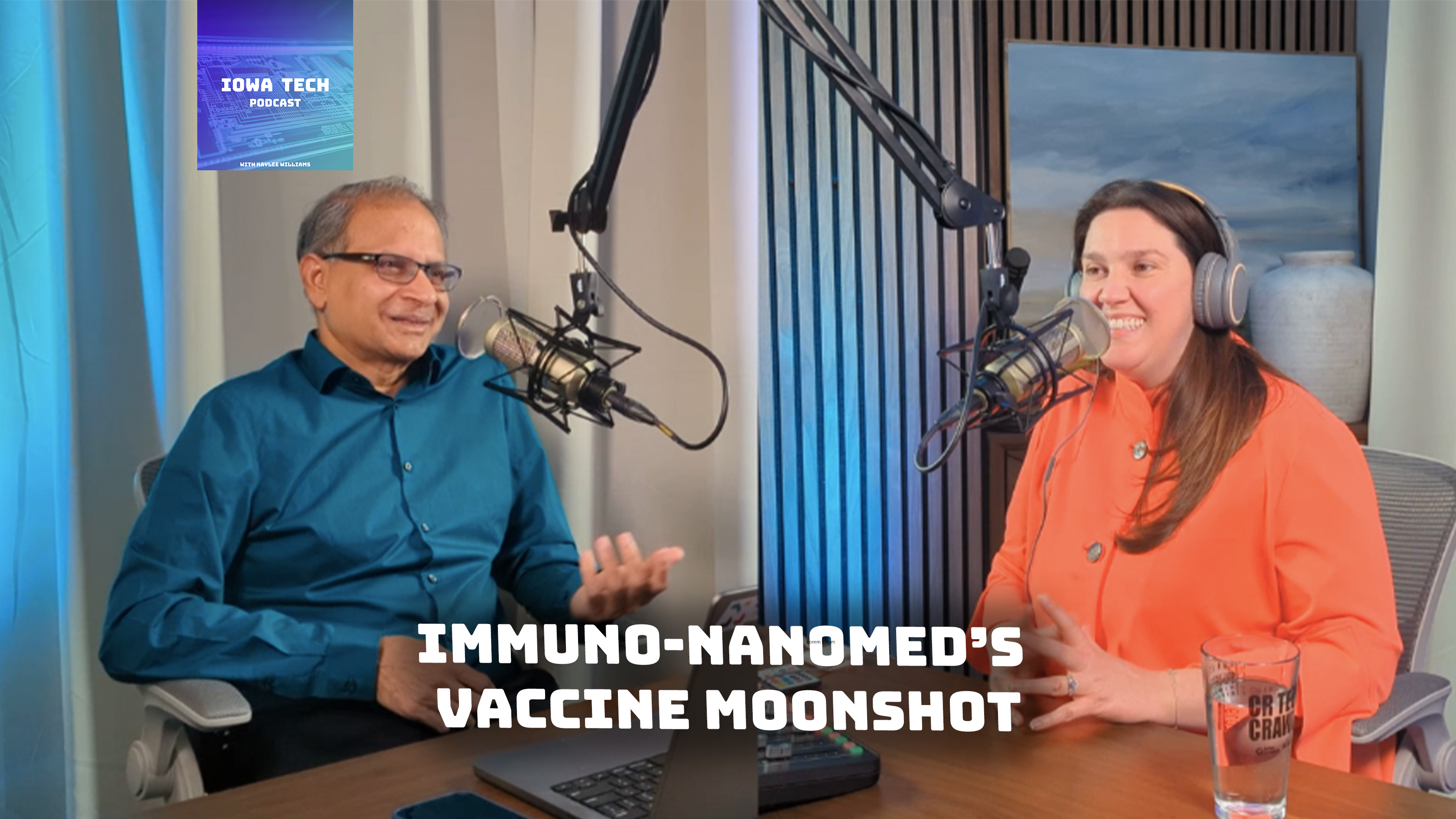


On this episode of the Iowa Tech Podcast, host Kaylee sits down with Dr. Balaji Narasimhan, CEO and founder of ImmunoNanoMed, to explore a moonshot innovation: a dry-powder, needle-free vaccine platform called “powder wax” that’s inhaled through the nose. Balaji explains how their particle-based technology could deliver stronger, faster mucosal immunity right where respiratory pathogens take hold, improve protection against variants, and eliminate the cold chain—potentially slashing costs and enabling at-home, self-administered vaccination. He also shares how the platform could multiplex vaccines (think flu, RSV, COVID, pneumonia) and extend to companion animals and even livestock and poultry via mass-vaccination approaches, with an eye toward DIVA compatibility and safeguarding human health supply chains.
Hear from Iowans directly. No algorithms.
Don’t let the algorithms choose your news. Enter your email address to hear directly from Iowans leading news in politics, community, agriculture and business. No editing. No clickbait. No rage. No agenda.

Balaji traces the technology’s origins to a Seahawk collaboration between Iowa State University and the University of Iowa, then details ImmunoNanoMed’s path from lab success to commercialization: building a cross-functional team, partnering with CROs to get FDA-ready, pursuing scalable, high-quality manufacturing, and engaging potential big-pharma partners—all targeted over the next 6–18 months. He reflects on Iowa’s innovation ecosystem (Startup Factory, I-Corps, IEDA, InnoVenture) and why he’s committed to proving world-class health tech can emerge from the Midwest. The episode closes with personal notes on mentors, teamwork, and family, plus a call for collaborators. Learn more or get in touch at immunonanomed.com.
Interview Transcript
This transcript was created with help from Ai. Please report errors to us and always refer to the video as your primary source.
Kaylee Williams: Hey everyone. Welcome back to the Iowa Tech Podcast. It’s your host, Kaylee. We’re here in the Jethro’s Barbecue Studio, and I have with me Dr. Balaji Naman, the CEO, and founder. of Immuno Ed. Hey, doc, how you doing?
Dr. Balaji Narasimhan: Very good, Kelly, and please call me Balaji.
Kaylee Williams: Of course. Thank to be Glad to have you. Um, Now, for those of you who were at. the Inno Venture Challenge in 2023, you might recommend, or you might, uh, recognize, um, Balaji from the big stage who was one of our top three presenters. Um, tell us a little bit about the company. and the core innovation that you’ve developed at immuno ed. Let’s just dive right in.
Dr. Balaji Narasimhan: Super. Well, thank you Kelly. Again, it was a lot of fun, um, doing the inter venture challenge, and I want take a second to applaud you and your team, um, in creating that opportunity for startups, uh, in, in Iowa. Uh, we learned a lot going through that process and, uh, uh, I’d certainly love to see you guys do that again.
Kaylee Williams: thank you. Um,
Dr. Balaji Narasimhan: So Immuno Ed’s focus is, um, is on developing next generation vaccines that can be effective against, uh, infectious diseases. So towards that end, we’ve developed a technology called, um, powder Wax, which is a dry powder vaccine delivery platform. And this platform is based on. Particles. So these are powders that are dry. And so our technology would, would take vaccines which are shot in the arm today, and then replace them with these dry powders that would be inhaled through one’s nose. And this technology would have advantages in the following ways. It would provide, um, immunity or it would improve the immunity against infectious diseases, especially against variants, for example. You may know that we’re going through a very, very tough flu season this year. Um, a lot of people are, are getting sick with the flu, including children, which is really, really very disturbing and, and very unfortunate. Um, but there’s a need for us to develop vaccines that can, um, help us prepare against not just what’s happening today, but also be prepared for future pandemics, future variants. So our technology is, is really future proofing these vaccines in a way. That current vaccines simply are, are not able to do. Um, there are also some other limitations of current vaccines, including the fact that they need a needle to, to deliver them. And so you need to set up an appointment and, and get a professional to do that. So they cannot be what is called self-administered. Mm-hmm. Um, they also don’t have the ability to be stored at room temperature. So all the vaccines that have been approved so far by the FDA. Need cold storage. And what is also important to understand is that this cold storage is not just right before the vaccine is delivered. It’s throughout the time that the vaccine is manufactured. Most of that process needs to be done under cold conditions, Even
Kaylee Williams: Even in transit.
Dr. Balaji Narasimhan: Even in transit, especially in transit. And so, um, our vaccine, uh, our data has indicated that our particle based vaccine or our VAC technology has the ability to be stored at room temperature for long periods of time. So just imagine that, that, that, that kind of a, a game changing advantage right now. You can, you can ship vaccines to people’s homes. People can go out to their mailbox and pick up a box in which the vaccine that is going to give them. Improved immunity against, let’s say flu right is is gonna be at the door. So this is a, what I call a reverse field of dreams approach, where you know the vaccine will come to you instead of you going to the, you know, clinic and getting a vaccine. Yeah, and best of all, you get to give it to yourself. And not just that, you can give this to yourself for flu, for RSV, for COVID, for pneumonia, all in one shot. You can package or co or, or multiplex these different vaccines by just mixing multiple powders and that gives you the ability to protect yourself against not just flu, but three or four, uh, additional diseases. And why not, right? You can take the same approach and vaccinate your cat or your dog. So our cats hate going to the vet. And so if you can develop products for animals, especially companion animals like cats and dogs mm-hmm. You can now vaccinate your cats and dogs without needles, right. And, and, and hopefully vaccinate them in your home.
Kaylee Williams: Wow.
Dr. Balaji Narasimhan: So these are the reasons why we’re super excited about, uh, about immuno inmate’s ability to advance such a technology forward.
Kaylee Williams: Yeah. And I’m, I’m remembering from your pitch at the Inno Venture Challenge, and frankly from the application itself when we first read through it, this feeling of, oh my God, this is an incredible innovation for this to come out of Iowa would be. Phenomenal. Uh, I mean, industry changing, it would be disruptive in a huge way and it would. improve the accessibility of these medicines for people who simply can’t travel to a clinic. Um, you know, and it, it would certainly lower the cost. I would have to imagine if you can get rid of the cold chain
Dr. Balaji Narasimhan: A hundred percent in the needle. Yeah. So 80%, uh, up to 80% of the cost of a vaccine goes into keeping it cold. And so, um, for our vaccine, that cost is zero. because there is no cold chain or, or no reason for a cold chain because the vaccine has thermal stability. And so from a cost perspective, we think it could be, it could be highly, highly cost effective compared to traditional vaccines that are in the market. And then the point you made about, um, accessibility, uh, a lot of the current vaccines, especially if you think about respiratory infections, where do those pathogens go? They go into your lungs. So they reside in your lungs, right? And that’s where they start. Um, so why are we not vaccinating in the lungs? Why are we not hitting the pathogens where they reside rather than, you know, vaccinating in a muscle. So the room we’re sitting in right now, let’s say that’s your lung, and let’s say we’re trying to protect it, right? Would you put sentinels at the door here or would you put sentinels on Grand Avenue? You’d wanna put sentence at the door, right? Sure. Because that’s where you would get the best protection. Yeah. Yes, you can. You put Sentinel at Grand Avenue, but by the time they come and try to help you out or to help us out in this room, it may take time. And that’s exactly what the shot based vaccines are doing, is they’re eventually gonna give you immunity. Mm-hmm. But not where it is desired. And not when it is desired. And so that’s the, that’s the key part of our technology, is giving the immunity where it is desired and when it is desired.
Kaylee Williams: Is it possible that these vaccines could be more effective than what’s on the market today? That
Dr. Balaji Narasimhan: That is exactly our, our technology’s promise is that, um, the ability to provide immunity where you need it mm-hmm. Is a strength and is a differentiator. Um, and, and, and we think that kind of immunity where you need it, um, is, is, is the superior part of the, is gives us the potential for the superior performance compared to, let’s say, a shot in the arm kind of vaccine.
Kaylee Williams: Yeah. Wow. Let’s back up for a minute. Tell me how you got here And why? are you uniquely qualified to lead this company?
Dr. Balaji Narasimhan: So, um. My day job is, uh, and includes, um, uh, running a laboratory at Iowa State University. And, um, about couple of decades ago, um, I started collaborating with, um, um, individuals at the University of Iowa in their medical school. And so we started a, a hawk collaboration, if you will. And as you know, Shaw collaborations are very powerful because. You know, they bring two important strengths to the, to the table and in this
Kaylee Williams: to see it.
Dr. Balaji Narasimhan: absolutely. So do we. Um, except on two days of the, of the year or something.
Kaylee Williams: um,
Dr. Balaji Narasimhan: anyway, so the Hawk collaboration that, that we started really integrated expertise in sort of the particle based technologies that were coming out of Iowa State and a lot of the human health and immunology expertise, particularly for respiratory infections that came out of University of Iowa. So as we started working together, we, we started seeing the potential of this platform to, um. To really change the game on, on, on how vaccines can be delivered, how they can be administered, and what kind of impact they can have. And all this is way before the 2000, you know, 20, uh, coronavirus pandemic. And so a lot of the advantages that we were seeing for our technology, um. We’re very, would be very evident, um, during, for example, a pandemic, and then guess what happens as we have a pandemic. Um, so that in some ways accelerated our, our approach towards commercializing this. Um, what was sort of an academic, uh, collaboration and a, and a successful laboratory experiment really started to then take on the position of, uh. Well, can we really, really commercialize this? And that took us into a whole new world. Um, as academic researchers, we were, we were grounded in the fundamentals of what we were doing and really understood, understood things at a basic science level. But then to move this into a product, to move this into the clinic requires a, a whole different set of expertise, a whole different set of proof of concept, commercial relevance, economic viability. Uh, regulatory approval. All of these are, are very, very important things that we think about, but, but not in the way we need it to, uh, if we, we need to really, really commercialize the vaccine. So when we started our startup, um, which was right around when the pandemic started, um, we started realizing that we needed, uh, additional expertise in the team that would help us, um, get the kind of, uh, uh, uh, knowledge and as well as the kind of resources that we would need to move this forward. Um. So, so in addition to the scientific expertise that the team has, we started building a team that would really, really get us. Moving forward on, on raising resources, business development, um, regulatory as well as consultants, and most importantly, partnerships. So these partnerships are, are something we realized were, were, were, were critical for us because everything is not something that a small startup would have. And so that’s where the innovation ecosystem that is present in, in both ISU and, and University of Iowa, uh, through, for example, programs like the ICORP program. The startup factory that is present at ISU, the Papa John’s centers. Um, those were important, uh, early ground opportunities that, um, we took advantage of and we were fortunate to be in ecosystems where we could learn, um, from those types of things. And then we started, um, um, learning more about opportunities like in a venture, opportunities like what IEDA has. And so. Um, broadening our, our team and, and becoming more competitive for those types of, uh, opportunities made us begin to realize how, you know, how, how we needed to proceed in, in going through this. And each startup’s pathway is their own pathway, right? There’s no sort of well-trodden pathway that everybody takes. Everybody’s experience is, is somewhat unique to, to what they’re doing. So, so we’re trying to carve our own pathway here in, in, in some ways. Um, we’re, we’re about to, you know, move forward to, to towards, uh, you know. Showing proof of concept for a human and an animal vaccine, um, coming out of Iowa. Mm-hmm. Right. Middle of the country. Um, you know, known for some things. Uh, but we do have, uh, the opportunity here, which I think is very cool. To, to pool resources from advances in research that have happened at two of our, our, our, our universities, and move that in a way that I think would be, would be transformative. Um, and so it’s been a learning curve for me, um, in terms of, uh, how to, how to assemble all the resources and the partnerships. But I feel very, very good being in the ecosystem that we’re in. Um, people are trying to help, people are trying to. To be honest and tell us, uh, you know what to do. And, and, and we’re, we’re very fortunate to have partners that are, um, that are helping us move this forward.
Kaylee Williams: Yeah. And you, you’ve got me thinking too about different applications for this technology. So you mentioned, um, companion animals. Is there a broader application here for potentially livestock or poultry or, um, I have to imagine that that could be a huge, um, use case for this if there, if it was feasible to do it.
Dr. Balaji Narasimhan: Totally. Um, glad you asked the question about, about livestock, um, and, and poultry as an example. So, a couple of things are, are important when, when we think about, um, you know, countermeasures like vaccines in those environments. The first one is cost. Um, the cost of, uh, of vaccinating poultry, for example, is. Is is very different from the cost of vaccinating a companion animal. Yeah. So we have to make sense from a cost of goods, uh, perspective. Mm-hmm. The second is mass vaccination. Um, if you’re thinking about vaccinating poultry, for example, you cannot do this one bird at a time. That is not something that is obviously feasible, right? So vaccination approaches need to be, uh, field deployable or mass vaccination compatible. And then the third aspect is, um, in, in, in the USDA and and animal health vaccine, um, area. You need vaccines to be what is called DIVA compatible. And DIVA stands for, uh, differentiating infected and vaccinated animals. And so, um, somebody who’s, who’s, uh, examining an animal needs to have the ability to know whether what they’re seeing in that animal is because of an infection or because the animal is vaccinated. And so all of these are important, um, aspects that one needs to. Incorporate in, you know, the cost of goods, uh, the mass vaccination and then the diva compatibility are all, are all important factors. And so, um, 100% there’s an opportunity to take a technology like ours and make it feel deployable. For example, one could imagine. You know, spraying a vaccine like this, um, into a large, uh, containment fee, uh, area with, with animals and have the animals inhale or birds. Um, inhale These, uh, these vaccines which would reduce operator error, improve operator safety, and, and hopefully mass vaccinate. These animals in a way that would protect them mm-hmm. From being vulnerable to the kinds of disease environments that they’re in right now. And since you mentioned poultry, just to give you an example, um, avian influenza is something that could be devastating to human health. And the reason for that is a lot of human health vaccines, for example, the flu vaccine. Mm-hmm. Uses eggs. And so the current flu shot that every one of us is getting now, um, is basically virus that’s grown in chicken eggs. So if Avian influenza wipes out our, our, our poultry, that is going to have an impact on our human health, uh, supply chain as well. And so having technologies like ours, which are needle free. Um, that can be delivered, um, uh, uh, in a mass vaccination compatible manner to, to livestock animals would have the opportunity, um, to, to be potentially, uh, game changing from, from those perspectives as well. But we have a wide ways to go to prove that. And, um, we’re part of, uh, uh, A-U-S-D-A team, uh, that, uh, that, sorry, a team at Iowa State and University of Wisconsin. Um, that received an award from the USDA to exactly evaluate that. Um, is the, is the viability of an approach based on these particle based vaccines to, uh, to have an impact in a livestock environment,
Kaylee Williams: Excellent. And so talk a little bit, because this to me feels like the definition of a moonshot technology. How, how realistic is it that this could actually get to market? Tell us about what the pathway looks like from here going forward. What? needs to go right for this product to become available to people here in Iowa?
Dr. Balaji Narasimhan: So the, the moonshot analogy is, is, is very appropriate. Um, if the technology, um, you know, is able to deliver on the promise that we’ve seen so far, um, there is absolutely no better word, um, to describe this than, than a moonshot, which was one of the things that, um, I really liked in the, in a venture challenge, uh, competition is, is you guys use that term and. That sang a lot to me, um, just because of, of the way I was thinking about sort of what we were doing. Um, so, so where we’re at right now is, um, you know, we have, um, um, we have partners in place that are helping us with, uh, so these are CROs, uh, contract research organizations, uh, that are helping us with, uh, checking, uh, the boxes, dotting the ice, and crossing the t’s. On manufacturing readiness, on qa, qc, so analytical development, um, partnerships, all of these things that are important for us to do, the preclinical studies that the FDA would, would, would like to see. So we’re essentially getting FDA ready, if you will. mm-hmm. With the, uh, CRO partners, um, as, as well as some other preclinical partners that we have. Um, we’re also in conversations with, um, with a couple of, uh, what, what I would call big pharma partners mm-hmm. Who are also, um, uh, uh, interested in the, in the potential of this technology. So in terms of next steps, we would, um, show the, these, uh, the, uh, show preclinical data. Um, that would be FDA ready. So this would have to be done under conditions that would make sense to the FDA, both from a scale perspective as well as from a quality perspective. And so those would be the two next big steps for us, um, is to show that we can do this at scale. Yeah. And we can do this with a high quality that the FDA would expect to see in a product that would go inside a, inside a human. So, so that’s kind of that big. Uh, activities for us over the next, uh, I’d say, you know, six to 18 months is for us to generate resources and get partners on board that’ll help us, um, get the product to be FDA Ready so that when we do get in front of the FDA, uh, we can show them that we have a, a scalable process and we have, uh, a process that would, um, that would have the quality. Uh, and most importantly, of course, we need to have customers. We need to have. You know, uh, uh, one or more customers that would be interested in taking this technology as a partner with us into the clinic. And so that’s really the, the next six to 18 months for us is to, you know, nail down those customers and, um, multiple, hopefully, and, um, uh, and, and really get the data that, that the FDA would really wanna see in order to start giving us the green light to move towards human clinical trials
Kaylee Williams: Wow. Okay. I, um, I wanna talk a little bit about the ecosystem. You, you know, Immuno. ed is a, a bit the darling I think, of Iowa and the Iowa ecosystem. because you have been through the startup factory, you know, you’ve worked with the University of Iowa. You, the people at the JP know you. Um, you went through the Inter venture challenge, you pitched on the big stage. W we both know you could be in Boston, Balaji, you could be building this, you know, on the, on either coast. Really. Why is it that you stay here in Iowa? Why is that important to you,
Dr. Balaji Narasimhan: First, thank you for your, for your kind words. Um, about, about our company, Kelly. Um, you know, I’ve developed this technology here as during my time as a faculty member at the University of Iowa. So everything as at, at Iowa State. Um, so everything that I’ve learned, um. Through, through the ecosystem that, um, that is present here. Uh, I attribute back to, um, to, to where I’ve, you know, where I’ve worked on this technology. Um, I happen to believe that it is very, very possible for us to show the world that technology like this, that has an transformative impact on human health and on animal health can come from the middle of the country, can come from a part of the country where. Um, you know, we’re, we, we have a lot of significant advantages that are not as well known, um, as, as some of the traditional advantages that are present on both, uh, both coasts. Um, so the question that you asked me, I have, I have been asked before, uh, but I feel like we can, we can prove to the world with this opportunity, um, that with the ecosystem we have, that the partners we have and, and the wonderful work that, um, that people like yourself are doing with Inno Venture and, and the work that IEDA is doing. It’s a great breeding ground. Um, I’m also a big baseball fan and I think, you know, a successful baseball team is not just developed based on trades and, and bringing in, you know, um, uh, free agents. I think there’s a, a lot to say about the farm system and, you know, it’s, it’s not coincidental that, uh, the Chicago Cubs, you know, AAA team is, is based right here in Iowa. Right. So, so I think there’s op there’s an opportunity for us to, to take the. The farm system, uh, a bit more, um, forward, if you will, and, and start looking at technologies that have come right out of research that have happened, um, uh, at, at our, at, at our universities, for example, which is, which is where we are at. So I see no reason why we couldn’t do what we’re doing, uh, staying right here, uh, where we are. And, and, and, and it’s also fun, like, because it’s, it’s like a challenge to show that, you know, you know, you would probably not attribute a big human health, uh, vaccine company to come from the middle of Iowa. Well, why not, right? When some people ask why, I sometimes feel like asking. Why not? Yeah,
Kaylee Williams: why not? And, and frankly, I agree with you. There are a lot of resources here that, um, exist to support moonshot companies like yours, and it would be an incredible win for, for Iowa and for the Midwest as a region for this technology to, to come out of here
Dr. Balaji Narasimhan: Very much. And, and, and there are advantages of course, that the coast would have both in terms of resources, but also in terms of expertise and getting a human health product, especially one that’s going into one’s body, has a lot of regulatory, uh, you know, has a bit of a regulatory climb. And, and there are resources and partnerships that we may have still reach out to that, that, that might, you know, come from outside of Iowa. Mm-hmm. But I think developing the core technology here and showing that, um, a company coming right out of, right out of the state and right out of, you know, the, the collaboration between, um, the university and the state, um, I think, I think makes this very, very special.
Kaylee Williams: A couple of fun questions before I let you go. What or who inspires you
Dr. Balaji Narasimhan: Wow. Wow. Um, so I’ve been, um, um. Very inspired by my mentors. Um, um, my, both, my mentors both for graduate work and postdoctoral work, um, have, have really sort of, um, paved the way for, for people like myself, um, to, to think big, um, and to, and to work on problems that matter to to, to our world. And, um, and the road was much harder when, when they were at the stage of their careers, when they started. Um, and, and their, you know, their climb has, um, you know, is very inspirational to me. Um, and what I’ve learned from, from being in their ecosystems, being in their laboratories, uh, is something that I cherish. And, uh, and, and it makes, uh, it, it, it inspires me to, to. To, to, to aim big and to try to solve problems that are, that are important to people like us, to our ecosystems and to the world. Um, so that’s something that, um, that, that really, really, really drives me. Um, so that’s something that I’m, I’m very inspired by. Uh, and, and again, I’ve also come to believe from what I’ve learned from my mentors is that. One person or one technology cannot solve everything. Um, you need a team around you. You need partners. Uh, this is the, these are very, very complex and, and large and global problems. And so it excites me to put together teams that can help us address these large global, complex problems and move the ball forward in a way that’ll make this world a better place for next generations to come.
Kaylee Williams: Now you have two college aged children, Twins and they’re both starting right? Freshman year. One at MIT and one at, uh, Johns Hopkins. I have to ask, are they getting into the medical field or do they have an idea yet over what they wanna do and where they wanna land
Dr. Balaji Narasimhan: Um, right now, um, their, their majors are both aligned with medicine. Okay. Um, but, uh, but also with engineering, uh, which is my, my background and my wife’s background. So my wife and I are both chemical engineers and, um, and so, yeah, so, um, at least as of now, it looks like the apple hasn’t fallen too far from the tree. Uh, time will tell.
Kaylee Williams: I, I think that’s so great and I, I just love that the twins went to different schools. I think That’s fun
Dr. Balaji Narasimhan: some days. Uh, we appreciate that less than other days, but
Kaylee Williams: well, uh, congratulations to you and, and, to both of them for flying the roost and getting out into the, into the world. And, um, thank you for building what you’re building. It’s so exciting to see this technology coming to fruition and going through. It’s gonna be a slog. It’s gonna be a regulatory, um, pathway to, to get there. But man, is it exciting to think about where this. Could go in the application. So, um, we will have you back I would love to bring you back in maybe four, six months to check in and see how things are going. if anyone who’s listening to the podcast would like to contact you or learn more about the technology, um, or the company immuno ed, how can they do that?
Dr. Balaji Narasimhan: Yep. They can go to immuno.com and, uh, and there’s, uh, contact information to reach out to us, uh, right on our website. So, so yeah, please do look us up and, uh, uh, reach out to us. We’re always, uh, looking for partners. We’re very happy to answer questions that people have. And, uh, again, I want to thank you for having me here and for, uh, supporting our efforts with the kind of very positive and, and growth mindset driven ecosystem that you provided. Thank you.
Kaylee Williams: you so much. Take care. Thank.
Dr. Balaji Narasimhan: Thanks.