

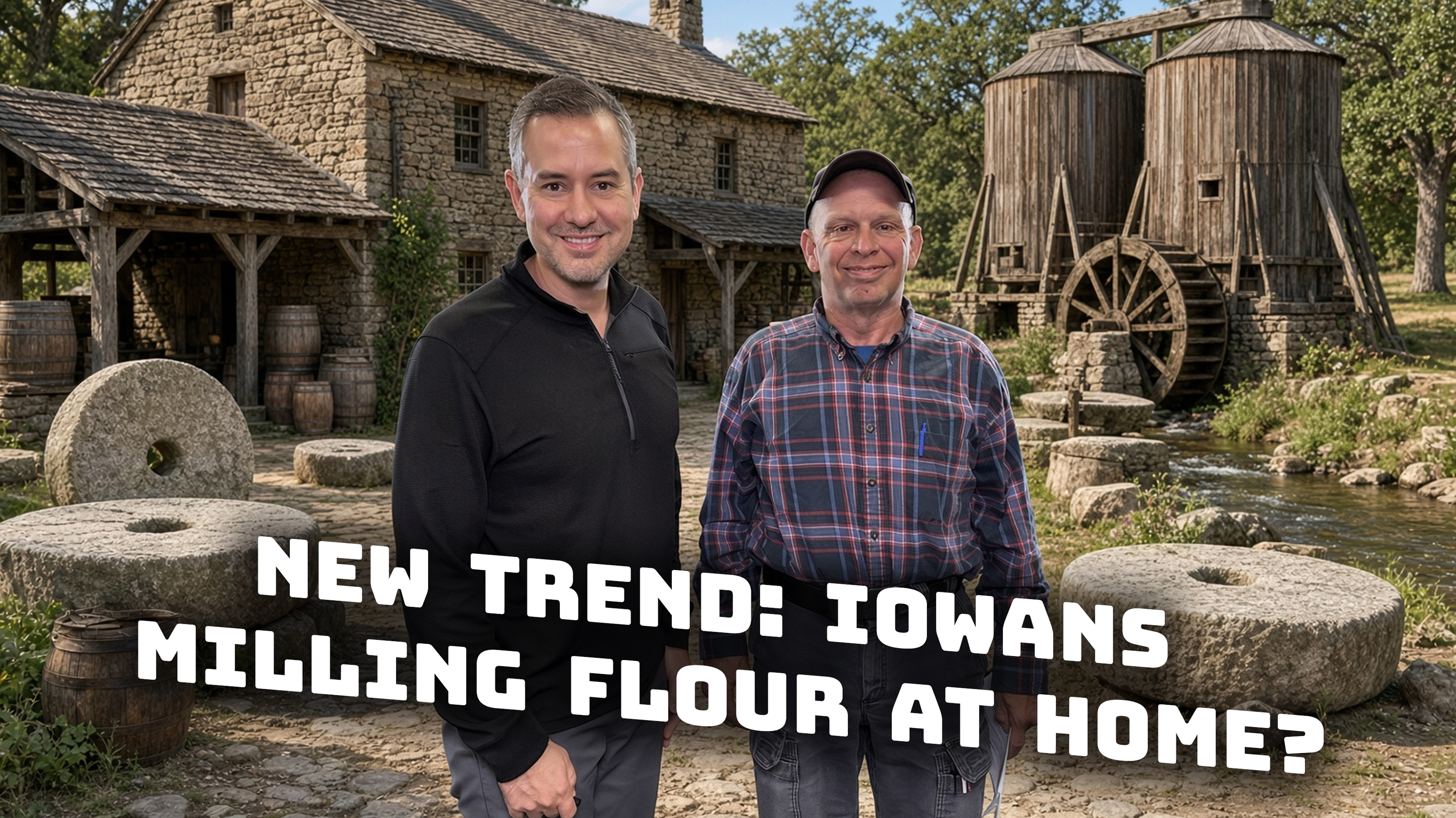



Organic Iowa wheat farmer, Jeff Hafner was a bit confused earlier this year when Iowans started grinding their own flour at home using their own countertop flour mills. The stories all started sounding familiar, people who thought they were gluten sensitive, were eating their own homemade bread just fine.
Hafner says he’s no scientist. He’s a farmer. But his customers stories have surprised him. He discusses the tough work of making organic wheat in Iowa, their stone-ground process, and why many farmers are struggling with USDA Organic paperwork.

Despite skepticism from conventional agriculture executives that regenerative practices are merely a fleeting fad, Early Morning Harvest founder Hafner has spent nearly 25 years proving otherwise. Transitioning ground requires a rigorous two- to three-year timeline, aided today by community networks like Practical Farmers of Iowa and cost-share assistance through the NRCS and FSA. Maintaining certified status is equally demanding, requiring an annual six- to eight-hour inspection covering both Hafner’s farm and on-site processing facilities. “What I have seen through all those years is a steady growth of industry changing and adapting, and the organic market slowly growing,” Hafner observed.
The Agronomics of “Ugly” Fields
Hafner noted that shifting to organics requires producers to trade aesthetic perfection for stronger margins. While a conventional grower might achieve 70 bushels of soybeans per acre at $10 per bushel for a $700 gross return, organic yields often sit lower at 50 bushels. However, contracting those organic beans at $22 per bushel generates over $1,000 per acre, comfortably offsetting the yield reduction. “The caveat and why I said pride,” Hafner explained, “is my beans look really ugly.” Without synthetic herbicides, late summer rains invite heavy foxtail pressure, but the resulting balance sheet rewards the extra labor.
Hear from Iowans directly. No algorithms.
Don’t let the algorithms choose your news. Enter your email address to hear directly from Iowans leading news in politics, community, agriculture and business. No editing. No clickbait. No rage. No agenda.
Artisan Milling and Shifting Consumer Habits
Operating two stone mills, Early Morning Harvest processes unbleached artisan flour that retains the natural germ and bran. Hafner distributes across the Midwest through Amazon, roughly 100 Hy-Vee Health Markets, and 98 percent of regional Fareway locations. Alongside packaged flour, customer demand has catalyzed a sharp rise in direct grain purchases, as consumers embrace home tabletop mills. “I wondered there must have been a lot of mills given for Christmas because in January, my goodness, we did load a lot of wheat berries,” Hafner said.
Interview Transcript
This transcript was created with help from Ai. Please report errors to us and always refer to the video as your primary source.
Justin Brady: From the Jethro’s BBQ studio, it is the Iowa Business Podcast. Last week, a seed executive, um, at an event kinda made a comment that this organic regenerative grain thing might just be a fad. There’s not real market demand for it. Is, is that true, though? That’s what we’re gonna be talking about today on the Iowa Business Podcast, of course, in the Jethro’s BBQ studio. And joining me today is Jeff Haffner, the founder of Early Morning Harvest here in Iowa. Jeff, thank you so much for coming on the show.
Jeff Hafner: pleasure
Justin Brady: Before we get started, everybody, we obviously appreciate Dentons Davis Brown being a collaborator here on the show. They don’t just fund the show, they actually bring people into the studio and bring great advice with them. They’ve been talking about AI, they’ve been talking about visas, they’ve been talking about immigration, they’ve been talking about, um, tons of stuff. So if you want to see those episodes and get… Uh, they were just talked on AI cybersecurity and privacy policies, and how almost all of you are probably kind of in a troubled spot, and you don’t even know it. You need to go check that stuff out at iowapodcast.com/business. Uh, Jeff, like I said, thank you so much for coming in here. Um, there were… It was just a conference. There were some comments made by a, a, a seed executive about… He was kinda like, “I just think regenerative and organic, there’s no market demand for it. It’s kind of a passing fad.” Is it a passing fad?
Jeff Hafner: fad? Well, there, there’s a lot of fads out there. Uh, s- so I will say that, um, we’ve been organic for almost 25 years. Mm. And, um, there’s a… L- l- let me go down one word on, on organic. So we are certified organic. Um, there are a lot of people out there that follow organic practices, but they don’t go through the, uh, documentation to, uh, officially put the label on their product, and that’s fine. Um, but we went to organic, uh, becau- many years ago, uh, the neighbor wanted to go organic, and we were the only neighbor willing to farm their ground organic and learn. And back that many years ago, uh, there wasn’t all the help. that there is now. You got Practical Farmers of Iowa, uh, you, you have YouTube, you have many venues to help you learn the practices. Uh, now there’s even financial incentives, uh, through NRCS and, uh, your FSA offices. Uh, that didn’t happen back then. What I have seen through all those years is a steady growth of industry changing and adapting, and the m- organic market slowly growing. And I’ll also add into that the non-GMO, um,
Justin Brady: True. Good point
Jeff Hafner: uh, non-GMO market, which is slightly different, yet the same. So whether it is coming a fad, what I’ve seen over the last 25 years is a slow, steady growth
Justin Brady: Yeah, and th- this is interesting because you, you said 20 years, 25 years? What
Jeff Hafner: Yeah, close to 25 years. First year Surfrider gang was 2000, maybe 1999, um
Justin Brady: That’s a long… So yeah, like you said, you’re kinda the, one of the originals. Um, do- well, not the original, but you were really early on this trend when there was zero help at all. You mentioned that there’s more help now. Practical Farmers of Iowa, never heard of that, NRCS, and SRA- uh, so there’s, like, federal and state money available to go organic, and then there’s also all these resources. Um, can you tell me about what Practical Farmers of Iowa are? What’s your, what’s your, m- what do you mean when you say there’s tons of YouTube help? What is this? Ex- explain this
Jeff Hafner: So Practical Farmers of Iowa, they are an organization based out of Ames that, um, they’re based on community, uh, and helping other farmers, whether that’s regenerative, alternative, conventional, uh, new farmers. Uh, there’s a lot of people that maybe got away from the farm. Uh, now when they retire, they wanna get back into it. Um, so they are a very good resource, uh, with listservs and research. A- and you can get on any of their listservs and just ask a question, and you will get, um, opinions a- and help that way. Uh, very… Growing outside of Iowa even, you know. Very, very good resource
Justin Brady: And you mentioned NRCS and SRA. Um, what… These are funding sources? Where are
Jeff Hafner: Correct. So right now… So it costs money to be certified organic. There are certification fees, inspection fees, um, probably three or four other fees. Isn’t there a fee on everything?
Justin Brady: a fee on everything
Jeff Hafner: there’s cost share money available for that now, and there’s also cost share money available through NRCS for tran- helping you transition, uh, to organics. A- and the two… Uh, so two to three years transitioning to organic is, i- is the rough time, and I say two to three years, it depends on how you count it, so
Justin Brady: Right, and we’ve, uh, heard this before when we had gubernatorial candidates in here and this topic came up, is the, the two to three-year period is a little scary for a lot of farmers. But there are federal… Is it just federal or just state or both off-ramps designed to get people- Both. Okay, so there’s both federal and state off-ramps designed in the form of funding to help farmers transition to organic and regenerative? Both or just one or the other?
Jeff Hafner: right now I just know of organic. Okay. Um, you know, the regenerative, sustainable, alternative, uh, those are terms being thrown around there,
Justin Brady: mm-hmm
Jeff Hafner: but there’s no real official definition yet. A- a- and I say that cautiously because just like organic rules, there is a national organic program rule that if you’re gonna be certified organic you have to follow that. And there’s… We are at the beginning stages of the regenerative and sustainable. So right now it is an individual’s personal opinion, in my opinion, on how you wanna define
Justin Brady: Yeah, and I appreciate you going into detail earlier that there are organic farmers who follow to the T organic practices but have not paid for the USDA certification. And for those that don’t know, that little stamp, that USDA certified organic stamp doesn’t necessarily, um, well, it, it does mean it’s organic, but it basically means that they paid for that seal, and there could be another product on the shelf that is organic as well, but they just didn’t pay for the seal, correct?
Jeff Hafner: Correct. A- and some of it boils down to a farmer’s opinion of what organic should be.
Justin Brady: wait, there are opinions in
Jeff Hafner: Yeah. Oh, there’s opinions. Everybody has an opinion. Well, I’m, I’m gonna give you an example. A- a- and this example is from 10, 15 years ago, so the rules may have changed, okay? So we certified organic, our cattle organic, you know, 10, 15 years ago. Uh, at that time, you could give them all their preventative shots, black leg, um, I can’t think of any of the others, um, that you were allowed to do that, and that was okay. However, if you had a sick calf and you gave that calf a shot of penicillin, that calf was no longer organic- Mm-hmm … because penicillin was not considered an organic substance. My opinion is penicillin’s one of the most safest drugs out there. But if you’re gonna be certified organic, you follow, had to follow the rules. So we tracked that calf separately. And th- now that said, that was 10, 15 years ago. The rules may have changed. sure Another example, you, um, when, uh, we first talked, we talked about aquaponics and hydroponics, and, and I do have those greenhouses. You know, when I first built those greenhouses, you were not allowed to certify aquaponics and hydroponics organically. What? B-
Justin Brady: isn’t it? Isn’t that weird?
Jeff Hafner: That’s crazy. Because- Because the N- National Organic Program rule at that time was vegetable farming had to have soil building practices. There is no soil in a lot of aquaponics a- and hydroponics, no matter what other herbicides, pesticides, or lack thereof that you used. I believe that has changed now. I’ve decided that to still not certify my greenhouse as organic. I don’t want the paperwork.
Justin Brady: That’s interesting. So, ’cause you have aquaponics, you have greenhouses. Uh, are those the only two ways you grow your produce?
Jeff Hafner: Uh, we, we do some outside gardening. Um, we followed organic practices, but I didn’t certify the vegetables. So, um, we’ve been actually downsizing that and, um, just I, I, I can’t make money at it. You know, kudos to those vegetable producers out there. Uh, Bridgewater Farms is one of them that do a very good job raising vegetables organically.
Justin Brady: So this does push into the demand thing, because if the demand is really off the charts, why can’t you make money at the organic farm? Is it just a fact of you’re, you wanna scale down, it’s a lot of work? Is it a fact, is it the fact that the demand’s not there? Is it a little bit of both?
Jeff Hafner: it’s a little bit of both. Y- you know, and that kind of goes to, uh, one of the conversations we had before. Uh, one of the things that hold a lot of people back from organics is it is a lot of work
Justin Brady: You’re talking the farming
Jeff Hafner: The farming side and/or the livestock side and/or the, the vegetable side, it takes more documentation, more paperwork, and more time
Justin Brady: Hmm. Is it just the more time or is it the paperwork? Which one’s harder or is it both?
Jeff Hafner: Uh, both. Yeah. My organic inspection for the mill and the farm takes, uh, six to eight hours. Yes. When the, when that inspector walks in the door- Yeah uh, it will take six to eight hours
Justin Brady: I think that is the, like, one of the… I’m not a farmer myself, but I think that is one of the central, um, concerns or debates or talking points on this issue is that organic farming is harder. Um, and, um, n- I don’t wanna call it a m- m- I don’t know what we call the other farming. Conventional
Jeff Hafner: conventional is the word I use
Justin Brady: So convention f- conventional farming and GMOs and these modern practices are easier because that’s literally the way they were designed. They were designed to be easier and to extract more a- to extract more bushels per acre, yada, yada, yada. But the central concern is, okay, yes, they can produce more food, but the food is of lower quality, an organic farmer may say, or someone in the regenerative camp may say. So they’re like, “Yeah, you’re getting more, but there’s a nutrient trade-off,” right? Is this kinda where you sit?
Jeff Hafner: That is a huge debate, okay? Yeah, I, I, I, I, c- I can go down that road. So, a- a- and I will give my opinions a- and what I’ve heard. and seen, okay? Yeah, Um, so you talk about, uh… I do, I do wheat, okay? One of the few farmers, conventional or organic, that does wheat. Yeah And I mill it into flour. We sell organic flour across the Midwest. So what do you say to one of my customers that buys my flour, and comes up to me and says, “You know, I’m a little… I have trouble eating breads and pies and stuff. I don’t feel good a- and I think I might be a little gluten insensitive”? He… Then they follow up and say, “Well, I made this trip to Italy, and, uh, I could eat whatever I wanted.”
Justin Brady: We’ve heard this before.
Jeff Hafner: heard this before. We’ve heard this before. But then they come to me and they say, “And if I use your flour, I don’t have a problem.” Yeah.
Justin Brady: Yeah
Jeff Hafner: So I, I actually did some research in the last week because I, I have heard this so many times, I got curious.
Justin Brady: Mm-hmm
Jeff Hafner: Yeah. So Europeans don’t necessarily fortify their flour.
Justin Brady: Mhm. Ja
Jeff Hafner: that’s changing. B- uh… So if you fortify flour, it’s a lot of times because when you process flour, you remove the bran, you remove the germ. So the bran and germ have a lot of your vitamins and nutrients. In order for it to follow FDA regulations, you gotta put it back in. That is normally done chemically
Justin Brady: Right. And that’s where fortified comes from
Jeff Hafner: Correct. So every body is different, uh, just like every soil type’s different. Everybody’s body may react differently to that fortification. I’m not saying that’s the answer. Yeah. It could possibly be the answer. Right. Uh, European Union has more strict use and, uh, policies on chemical use. Yeah. Um, that could also be part of the reasons. Um, the, so the, the, the other reason is, uh, in America we use more hard wheats. Uh, over there they use more soft and durum type wheats. Another possible answer. So there, there’s several reasons, um, but that goes down the road to any of the crops we raise
Justin Brady: sure. And so what you’re say- you are, um… Are you one of the few or the only wheat farmer in Iowa then?
Jeff Hafner: Oh, I’m not the only wheat farmer.
Justin Brady: only one, ’cause there… I know I, I didn’t even know before prepping for this, I didn’t even know we had any wheat farmers in Iowa. But this is interesting because this has been a topic I’ve been really diving down the rabbit hole lately, which is our flour in this country. And we have a lot of people that say, “I can’t eat…” Like, like your customers. We have a ton of people that say, ” I can’t eat bread. I’m gluten intolerant.” One of my friends is like, “I’m pretty sure I’m gluten intolerant. I might be celiac. I don’t know.” And then he started eating some, uh, French, um, bread from France, the- their flour from France, and all of a sudden he was like, he c- “I could eat a sandwich now,” and I didn’t feel s- my, my stomach wasn’t upset. Like, what, what is that? And so this is something that you are kind of tapping into.
Jeff Hafner: Uh, Well, by accident. b- just because you listen to your customers, right? A- and so French and Italy That didn’t sound right. France F- France and Italy. France and Italians. Uh- France and Italians
Justin Brady: Italian. French and Italian flour, yeah.
Jeff Hafner: I, you know, I, I’m still American and Midwestern. I don’t get around the world much. So, um, so when they grade flour-
Justin Brady: Yeah
Jeff Hafner: they do it by ash content, and ash content is when they take a, a weighed amount of flour and they burn it. Whatever’s left over is the ash. Wow. So what doesn’t burn is usually the minerals- Mm … which is usually in the bran. So the more you sift or refine that flour, the less bran. So that ties into, and you’re getting into that gray area again. That goes back into how much bran did you take out? E-
Justin Brady: And so to push into this, that, uh, uh, ’cause I wanna, I wanna emphasize this. A, a lot of the way flour, um, from, from wheat obviously, a lot of the, a lot of the way flour is processed in these, in the United States, is that the bran and the germ are removed, and then they are sold as byproducts or other products. And then chemically, um, nutri- nutrients are added back in, and that’s what the term enriched comes from. Right. And so you, when you’re processing your flour, you mill it, you process your flour, you mill it on site, and you just mill everything together. You don’t remove anything. It’s just all the, the, the, the flour, you grind it up, it all goes in the flour
Jeff Hafner: Yeah, it, we have, uh, we have two stone mills, so,
Justin Brady: Oh, you have stone mills
Jeff Hafner: mills? Yeah, yep. it. is- it is an artisan flour. Yeah. It is stone milled, and then we sift it for consistency. Um, so we have several different grades of flour you might wanna call it, depending on how much we sift it. Um, so I am not smart enough to remove the bran or the germ. Uh, You know, it sounds other… Uh, uh, that sounds like a lot- of machinery and- and
Justin Brady: A lot of science.
Jeff Hafner: science that, that, w- where I can take our grain and run it between two stones, and that sounds pretty simple. Um, but it also gives you an artisan flour that, um, i- i- is we don’t add or take anything away from
Justin Brady: So this is interesting. I, I wanna ask you about this because I’ve heard that wheat is kind of, and I’m sure the, the farmer in you or a scientist out there is like, “That’s not technically correct,” but I’m gonna do my best, everybody. I’ve heard that wheat shares properties or is, has some similarities to, like, let’s say an avocado, which is as soon as you break it open or as soon as you cut it, it begins to oxidize or it begins to change, and so the longer it sits on a shelf, the further it has to travel, the less nutrients it has. So is this something that you… Obviously, these are claims. I’m not a scientist, but is this something that you think you have an advantage of because you grow organic wheat, you stone mill it yourself, and then you give it right to locals in the Midwest. Is this supposedly more nutritious?
Jeff Hafner: So you’re correct. So there is a huge trend, um, that kinda took us by surprise for people buying tabletop mills and buying just the wheat berries.
Justin Brady: Really? This is a trend
Jeff Hafner: Th- th- this is, this is a trend. A- and, uh, I would… I don’t have the numbers, but significant increase in people coming to our place to buy just wheat berries. So you’re right, I don’t know anything about avocados. I’ll be, I’ll be perfectly honest.
Justin Brady: I know ’cause when you cut an avocado it turns brown. You know what I mean? That’s the only thing I know
Jeff Hafner: so it’s interesting you say that because you’re right. It, it d- especially since we still have the germ in our flour, so it will start to go rancid or whatever. So our retail size bags, we, um, are resealable, so you can throw it in the freezer. We d- our shelf life is based on 70, 72 degrees, a room temperature. So if you th- happen to throw it in the refrigerator or refriger- freezer, you will slow that process down. I have had complaints from a baker, uh, that, “Hey, you know, went ba- your flour went bad very fast.” And as we talked to the baker, they were ta- they were storing it next to the hot stoves. Sure A- and you know, that, that’s just an education thing. Right Um, but along that same way, um, you talk about shelf life. So the other thing they do to flour is bleach it. So I don’t bleach it.
Justin Brady: you’re talking about, like, more industrialized processes, yeah
Jeff Hafner: not every big company bleaches their flour. That said, uh, it can be sped up and done chemically, which that goes back to our previous conversation of what does that do to your body, um, or not do to your body. It can d- be done, it happens naturally over time. If you would take my flour that I milled a year ago and hold it up to my flour that I milled yesterday, the year ago flour would be more white. It would be lighter in color, and that’s the process you just talked about
Justin Brady: Yeah, so this is interest- obviously, um, people forget that wheat is a crop. It grows, and anything that grows spoils, and for some reason we have this idea that wheat shouldn’t, like our flour should never spoil. It should just be this dry thing that stays forever, and that’s not true, apparently. Yep.
Jeff Hafner: that’s true. Yeah, you’re, You’re correct.
Justin Brady: this is an- I wanna talk about this trend because you distribute, uh, wheat and c- wheat berries apparently, to just Iowa, the Midwest? How far out do you go?
Jeff Hafner: Uh, so we are on Amazon and eBay.
Justin Brady: And… Oh, really? Wow, okay.
Jeff Hafner: Uh, that, that was- an interesting education during the pandemic. We’ll, we’ll just leave it at that. Um, but we are in the, the health market at the Hy-Vees, most of the Hy-Vees with a health market, not in the flower aisle. Uh, we’re in several Fairways. Um, most of the Fairways, you know, Wheatfield names, you know, New Pioneers, a lot of mom-and-pop grocery stores, uh, bakers, restaurants throughout the Midwest. Uh, if, if you kind of did Lincoln, Quad Cities, Minneapolis to Kansas City, that’s kind of our circle
Justin Brady: Do we have a… Is there like a, a list on your website we can find out what restaurants, what bakers, what grocery stores carry it?
Jeff Hafner: Um, a l- I wouldn’t say it’s complete, but there’s something there
Justin Brady: they’re customers too, so you can’t exactly disclose everybody without their permission to. Um, you mentioned Hy-Vee and Fareway, uh, of course, two local Iowa grocers. Thanks, guys. Um, is that full distribution or is it select stores for your
Jeff Hafner: So Hy-Vee, it’s in the health market, so it’s mainly your, uh, 100 biggest stores that have the biggest, um, the health markets. Um, and then Fareway, it’s probably 98% of the stores. 98% Yeah. roughly thereabouts.
Justin Brady: So they have it at almost every store at this point. Do they also have it in the wheat aisle or is it a separate spot
Jeff Hafner: I think it’s in the flower aisle,
Justin Brady: it’s in the flour aisle. Okay. Oh yeah, the flour aisle. The wheat… Did I just call it the wheat aisle?
Jeff Hafner: That’s okay. You were correct. It is the weed aisle
Justin Brady: So this is, uh, this is maybe a side tangent, but why the decision to put the, your flour in the health market and not next to the flour? Do you know why in Hy-Vee stores?
Jeff Hafner: most of the customers looking for healthy organic flour will be, they would be going to the health market, yes
Justin Brady: That’s fascinating. You’d think there’d at least be a duplicate listing, like you’d be in both places or something. But who, who am I? Who am I to… Um, so have you heard of customers, again, um, anecdotal’s fine. This is, you’re on- you’re boots on the ground. Um, but have… So it, it sounds like you have a trend of Iowans coming into your store and milling their own grain. Are- they’re buying the wheat berries from you, and then they’re grinding them at home right before they bake something? This is what’s going on here in Iowa?
Jeff Hafner: Correct.
Justin Brady: And wh- when did this start? When did this trend start?
Jeff Hafner: I, so I made a joke back in January of this year as we were loading trucks early in the morning that I wondered there must have been a lot of mills, uh, given for Christmas because in, ’cause in January, I h- you know, you’re not supposed to swear on the air, but my goodness, we did, we load a lot of wheat berries in January of this year. That’s, that’s when I really noticed it
Justin Brady: Fascinating. Yeah, and I have… So anecdotally then, are you hearing from customers with gluten problems or bread problems and saying, “Hey, after I started using this stuff, all those things disappeared”?
Jeff Hafner: I, I’ve heard it. So we do a lot of trade shows throughout the Midwest. Um, Iowa Eats up in Waterloo a- and different ones. A- and yeah, we, we’ve, we’ve heard that comment a lot
Justin Brady: That’s crazy. Yeah, and obviously, you know, this is just your experience and I, I’m really, um… But, uh, when you hear a lot of experiences like this, sometimes it can be indicative of a trend. Um, before we kind of wrap, what, what are the economic factors that are kind of, uh, I think some of the MAHA stuff, whatever your political thing is, we’re not gonna talk about politics on this show, but, um, the MAHA stuff is probably, I would guess, pushing, um, new customers your way. But what other economic factors? Um, I think i- is overseas competition challenging you? Are any laws and regulations locally helping or hurting?
Jeff Hafner: S- so I’ll, I’ll gear that question back towards the agronomy side. Um, one of the things out there, and again, I don’t kn- know the current policies, is competition from overseas. Um, th- they may put the organic sticker on it, but we really don’t know what happened their end. A- And that is my understanding and I know USDA is working on it, and it might be a lot better, but… So competition from overseas is, um, uh, is a concern. Um, the, The other thing as far as, uh, economics, um, I’m gonna throw pride into this a little bit. Everybody wants that perfect looking field. You know, they can’t stand the one water hemp that escaped the sprayer b- just because of the nozzle hiccups that one time. So I, I will do basic math for you. Um, you’re not supposed to do math in public, but a- anyway, I’ll, I’ll try and keep it- No, do it … you know. So let, let, let’s say, let’s say you, do? do, um, 70 bushel beans. Mm-hmm. A- and I don’t know conventional markets right now, so let, let, let’s, uh, let’s keep the math simple. So let’s say you locked them in for, um, for, um, $10 a bushel. That’s probably low right now, but that’s $700 gross dollars, okay? I’m only gonna get 50 bushel soybeans. A- and, and there’s probably some farmers with, uh, poor soil that go, “Wow, I would love to have those 70 and 50 bushel beans.” Let’s say I only get 50 bushel beans. I locked mine in for 22.
Justin Brady: Mm.
Jeff Hafner: So, you know, 20 times 50 is 1,000. The caveat and why I said pride is y- my beans look really ugly. I, I could tell you that right now. You know, the, the… everybody l- everybody got tired of rain this August. No, we’re good. But, but but normally when we get an inch of rain in August, everybody jumps for joy For me and everybody else, I don’t have the chemicals and the foxtail comes like you wouldn’t believe. A- and so my fields look really ugly. I lost 20 bushel and maybe I have to wait for a frost, but gross dollars, um, that’s the financial side of it
Justin Brady: Yeah. Um, it’s absolutely a fascinating story, and it’s interesting that there is a massive trend of people buying their own mills and getting wheat berries from you instead of the flour. Would you say that the… This is the last quick question here. Would you say you’re selling equal amounts of your flour and your wheat berries,
Jeff Hafner: Oh, no.
Justin Brady: more flour?
Jeff Hafner: still more flour? Okay, But, they’re
Justin Brady: is a trend starting where people are buying the wheat berries and grinding their own wheat at home with those little desk- They look like coffee grinders is kinda what they look like.
Jeff Hafner: there, there’s several models out there, so
Justin Brady: come in bottles out there, so. Yeah. That’s so the, the… ‘Cause I have heard that that is a trend in certain pockets, but apparently that trend is, has made it to Iowa, which is absolutely fascinating. Jeff Haffner, the founder of Early Morning Harvest here in Iowa. If, if people want some wheat berries for their desktop mills, what’s the website?
Jeff Hafner: Uh, earlymorningharvest.com is the website. Uh, and if you have questions, you know, send us an email. Um, we are always learning. Uh, you know, most of us aren’t really bakers, but we will try and help you put you in contact with somebody learning to bake their own bread. Um, email at info, I-N-F-O, @earlymorningharvest.com. And yeah, we’re out there. Just, just come and ask questions
Justin Brady: Jeff, thank you so much for coming on the Iowa Business Podcast.
Jeff Hafner: Yeah, that was fun