

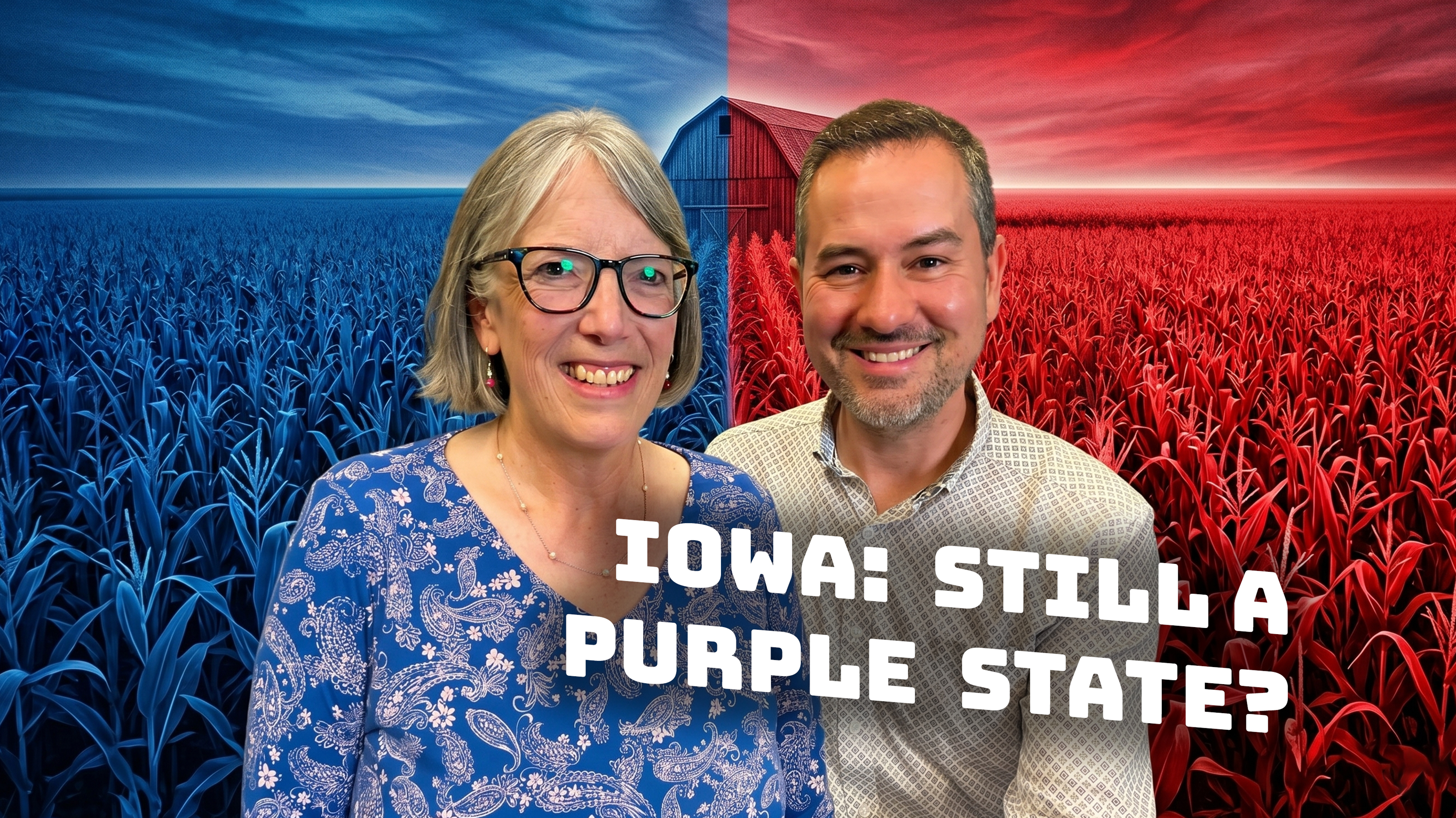


Iowa is experiencing a remarkably unpredictable election cycle, marked by unprecedented vacancies in its top offices. Kathie Obradovich, editor-in-chief of the Iowa Capital Dispatch, breaks down the bizarre election cycle, the Iowa GOP Gubernatorial flip, what’s happening in the Senate and Congressional races, and are The Democrats coming back to The Iowa Caucuses?
Obradovich says it’s been 20 years since the governor’s race was truly open, and 58 years since both the gubernatorial and U.S. Senate races were simultaneously wide open. This rare alignment introduces a unique level of instability and excitement for both major parties during a midterm cycle.
Hear from Iowans directly. No algorithms.
Don’t let the algorithms choose your news. Enter your email address to hear directly from Iowans leading news in politics, community, agriculture and business. No editing. No clickbait. No rage. No agenda.
The Republican gubernatorial primary frontrunner was thought to be Randy Feenstra, though low polling data and a surge in fundraising by challenger Zach Lahn have introduced unexpected softness into his support. This has pushed Lahn odd’s on betting markets like Kalshi and Polymarket from 5-7% to over 30%.
Obradovich highlights that a candidate must secure 35% of the vote to win the primary cleanly, or the decision goes to a highly unpredictable convention.
Lahn has successfully shifted the Governor race talking points toward water quality, soil health, and cancer rates. Reflecting on the dynamic, Obradovich observed, “I think that that has elevated water quality as a talking point”. Meanwhile, State Auditor Rob Sand runs unopposed on the Democratic ticket, presenting a strong general election challenge.
Congressional Toss-Ups and Iowa Caucuses
The U.S. Senate race to replace Joni Ernst is a complete toss-up between Democrats Zach Wahls and Josh Turek, who both boast strong fundraising and national endorsements, while Republican Ashley Hinson maintains a significant financial and structural advantage. Obradovich notes that Iowa’s congressional districts remain highly competitive, with incumbents Zach Nunn and Mariannette Miller-Meeks facing genuine vulnerability in a state that currently leans heavily Republican.
The conversation also centered on the national implications of Iowa losing its first-in-the-nation Democratic caucus status. Obradovich strongly criticized the national party’s decision to move away from the state. Expressing her concern for the future of grassroots campaigning, Obradovich stated, “Letting the caucuses go I think was a huge, huge mistake”. She believes the grueling Iowa retail politics process ultimately builds stronger national contenders. Emphasizing the value of local voter engagement, Obradovich added, “I don’t know if we would’ve had the Joe Biden, Kamala Harris debacle that we had if that campaign had started in Iowa”.
Interview Transcript
This transcript was created with help from Ai. Please report errors to us and always refer to the video as your primary source.
Justin Brady: [00:00:00] From the Jethro’s Barbecue
Studio, this is the Iowa Podcast, and I’m Justin Brady. It’s
election season, and what’s coming down, or I should say, what’s coming around the corner? We’re gonna get the crystal ball out today and have a discussion with Kathy Obradovich, of course. Uh,
everybody… I knew you from the Register.
It was really funny.
I acci- accidentally sent the invite to this thing to your Register email address, but of course, you’re the editor-in-chief of the Iowa Capital Dispatch now. Of course, you, um, have… I guess it’s… Is it safe to say you really have your finger on the pulse of Iowa politics? Well,
Kathie Obradovich: let’s just say it’s, I’ve had my finger
somewhere near the pulse
for a long, long time. I mean, it’s been close… I, I hate to age myself this way, but next year will be 40 years of professional reporting in
Iowa. Yeah, and a-
so for most of that I’ve covered Iowa government and politics,
Justin Brady: Yeah.
Now I remember growing up, um, watching [00:01:00] all your c- coverage, and so, like, it’s… This is weird for me ’cause you’re, you’re, like, a
political
reporter,
analysis,
analyst icon in Iowa. So I obviously appreciate you being in the
studio today.
Kathie Obradovich: That, that makes me feel really old.
Justin Brady: I, I hesi-
Kathie Obradovich: I
Justin Brady: I
hesitated to say
Kathie Obradovich: it
Justin Brady: that way.
Whatever.
Kathie Obradovich: no offense Oh my gosh. Um, before we get started, everybody, appreciate Jethro sponsoring the show. Of course, uh, go to iowapodcast.com, scroll to the top, click that banner. If you buy a $100 gift card, they will send you a $30 gift card for free. Of course, really appreciate that. And yes, Jethro’s still in the studio.
Justin Brady: I, I want to obv- obviously a lot of election stuff. Very unique year. I know people say it every year, “This is the most critical…” But it is a really, really weird… I can’t even talk. See, I’m that nervous apparently. Uh, it is a really odd year. We’re gonna talk about governor. We’re gonna talk about Senate.
We’re gonna talk about Congress. We’re gonna talk about is Iowa a red state? I don’t, I don’t think it is. But also maybe touch on some caucus [00:02:00] rumors? We’re gonna touch on that at the end, so stay for that. But first, the governor race. I don’t know if you have… Uh, I’m, I’m… I even hesitate to ask you a bunch of specific questions ’cause I don’t wanna, like, you know, push out your analysis.
So what I’ll f- I guess I’ll start is what are the general observations on the governor race so
Kathie Obradovich: Yeah. Well, you mentioned it’s a really odd year, and in fact, um, it’s been 20 years since the governor’s race was actually really open,
Justin Brady: right?
Mm-hmm
Kathie Obradovich: Um, and that’s, that’s more than some people, you know, before anybody… Some people have even voted before,
right? Uh- Oh,
before their voting lives.
Justin Brady: great point
Kathie Obradovich: And it’s been 58 years since both the governor and US Senate race were wide open. So that
is really longer than most people have been voting. I, I,
spoke to a, I spoke to a group, oh, a couple of weeks ago, and I asked them, “How many of you were old enough to vote, um, in [00:03:00] 1960…” I can’t even remember which year. 1968, I guess it was. Um, and one person raised their hand. Only
one per- per- It wasn’t a huge group, but only one person.
And it, it wasn’t a, a skewed older group. Only one was actually old enough to vote the last time there was an open governor’s race and open, uh, US Senate race. And certainly it was before m- Despite how ancient I am it
was certainly
Before my
professional life. Uh, I was, like, four years old. So, you know, it’s, uh, truly a unique year in Iowa politics.
Um, uh, we… And, you know, normally when we have this kind of, uh, potential for turnover, um, it would be a redistricting year and n- you know, never in a midterm.
Um, so I think it’s even more unique because of that. So, uh, we’ve got instability, um, uh, I think in both parties, and, uh, so it’s very exciting, uh, to not know exactly what’s gonna happen in every single
[00:04:00] race.
Justin Brady: [00:05:00] It came out today as of recording this that the Democrat Party is really running low on cash. And of course, on the Republican Party side, we have almost two parties. We have the Republican Party, the traditional GOP, then we have the Trump party, the MAGA [00:06:00] party. Of course, Thomas Massie just lost his seat.
So both parties, it’s kinda hard to even understand what’s gonna come of this. And, and here’s, here’s an example, right? We have Randy Feenstra, who everybody kinda considers the front runner, um, just polling data, Kalshi, Polymarket stuff.
But
now
Zach Lahn
out-fundraises him, and he sees a big pop. Um, is there any chance we see Feenstra lose to Lahn?
Is this considered a toss-up? You’re kinda like, “Eh,
probably not.”
Kathie Obradovich: I, I mean, it’s- the thing about a primary is that somebody has to get 35% to win a primary cleanly in Iowa, otherwise it goes to convention. And if it goes to convention, then anything goes. They could even nominate somebody who’s not running right now.
So anything goes if it goes to convention. Now, uh, we haven’t seen enough polling, um, to really know, um, where Randy Feenstra is. The, the, the most recent stuff I saw suggested he was hovering around [00:07:00] 40%, which would be enough for him to win, uh, a primary. But, um, he, you know, the people who are primary voters are ones that maybe are more likely to look at somebody other than Randy Feenstra.
So r- you know, Feen- Feenstra’s advantages are, you know, his name recognition, which frankly I think people overestimate.
You know, uh, pe- people certainly know him in Western Iowa, um, and that’s of course where the GOP stronghold is. Uh, but he was criticized, I think fairly, for not getting out enough around the state, um, especially in, you know, the s- the first and second districts, um, where I think he probably is a lot less well-known.
So I, I do think, uh, there’s some softness there in his support. Um, I mean, he’s not only gotta get people to say in a poll that they like him a- ’cause they maybe recognize his name, but they gotta get him, you know, somebody to go out and vote in a primary for him. So, so I do think that, that, that there’s [00:08:00] softness.
I also think it’s gonna take more than money, um, you know, to beat him. Zach Lahn has been up on TV. Um, he’s got a unique approach, you know, different than his… He, I think he stands out, um, different among his, uh, you know, co-candidates, um, mainly because of his views on water quality.
Mm-hmm.
Um, and um, so, you know, it’s possible that he could rise to the top, but s- there’s not much time left, right?
Right. So I mean, if I were have to… If I would have to put money down, you know, on it, I would say, uh, the smart money’s still on Randy
Justin Brady: Really? Okay
Kathie Obradovich: But, But, I think it’s, you know, uh, certainly, uh, I would g- I would not go so far as to predict that he would be the winner.
Justin Brady: It, it does seem like if, you know, if Zach Lahn doesn’t get the nomination, it does seem like at least he was successful in changing the talking points. Because before he announced, it, I, this is… [00:09:00] I didn’t hear, um, a lot of talk on water quality and soil quality. I didn’t really see people caring that much.
I didn’t see much on cancer rates. And I, I see my data, and when we covered water quality and cancer rates on this show, no one cared. No one clicked those stories. And then Zach Lahn starts talking about it, and those now people seem to care. So even if he doesn’t get the governorship, I- do you think that he has succeeded in changing the talking points?
Kathie Obradovich: I think the talking points have changed. I, I would hesitate to credit it entirely to Zach Lahn. Um,
uh, you know, you, you noticed at the very end of the legislative session, Republicans rushed through a package of funding aimed at water quality
programs, and I think that had more to do with what, uh, the candidates who were running were hearing from people, um, as they were out in the state campaigning, and in p- particular what, um, the Secretary of Agriculture, Mike Naig, was hearing.
Um, his, his candidate, his, um… N- there’s no primary in that, in that [00:10:00] race, but his Democratic challenger, Chris Jones, has really hit, uh, water quality really hard.
And, and I
Justin Brady: He’s
been on this show talking
Kathie Obradovich: yeah
that’s the central, you know, point of his campaign really. And so I, I think that that has elevated water quality as a talking point. Uh, all of those th- factors coming together, and Zach Lahn is part of that.
Justin Brady: Yeah.
No, absolutely. Um, one of the
weird things here, I mean, I’m assuming, I don’t wanna skip over Sand. I think it’s probably a given that Sand’s gonna win the pri- the
Kathie Obradovich: he’s unopposed, so sure.
Justin Brady: I mean, well, we
do have some names, right?
Like
Jule-
Kathie Obradovich: No, Julie.
dropped out.
Justin Brady: Oh, she already dropped out.
Oh, she already dropped out. Okay. And then Paul
Doll, but-
Kathie Obradovich: Yeah, you know, he’s, he’s, he’s the nominee.
Justin Brady: Right.
Yeah.
And
so
um,
obviously
at this point it’s a given. I don’t wanna skip past it ’cause people are gonna be like,
Hey.
hey Brady, Sand’s also running.” W- yeah, we know. We we know.
Um, so I do…
You do think
that…
Well, I guess I should ask this in the form of a question, Kathy, is did the Feenstra strategy of, of avoiding the [00:11:00] spotlight, if we’re honest, that’s kind of what part of the strategy has been, it looks like.
I don’t know why. Um, obvi- he’s the only candidate that hasn’t come on this show, which is
fine.
It’s, if that’s the strategy they run, that’s fine. Y- do you think this strategy hurt him or did it help him?
Kathie Obradovich: Well, it remains to be seen.
Sure.
You know, uh, if he wins the primary going away, maybe the, uh, you know, the reaction will be, “Well, it was genius-
Sure.
for him to-
Yeah
ignore, you know, ignore his, uh, Republican challengers and just, uh, you know, go straight for running, uh, in the general election. And it– that strategy, um, has not been exclusive to him.
Um, I think he’s, uh, taken it further. Um, but I mean, when, uh, Governor Reynolds ran in her last… Of course, she wasn’t challenged in a primary particularly, I don’t think. But she, uh, she really didn’t, um, meet with editorial boards. She didn’t do a lot of, of interviews, didn’t really [00:12:00] announce an agenda. I mean, there were a couple things that she’d been talking about, but she really didn’t announce an agenda before her, um, her last election. So I think that that’s becoming a little bit more of a trend more, certainly more with Republicans than Democrats. Um, Republicans have, uh, stopped meeting, for example, with the Des Moines Register, uh, editorial board. Only, um, Feenstra was the only one who didn’t meet with, with them this cycle, and they didn’t endorse anybody.
They, they declined to endorse a candidate, so I thought that was interesting. Um-
Justin Brady: Was that
part of the… I know the Seltzer poll, for lack of a better term, didn’t go well, uh, for The Register, and I… Didn’t they announce at that point? They’re like, “We’re gonna stop endorsing people.” I, I may be wrong on that.
Kathie Obradovich: no, they’re still endorsing, but they
just, they, they’re not, they just chose not to endorse in the, um, in the governor’s race, uh, in the primary. So I’m sure that they’ll still endorse in the general election. But the polling, polling never really, having been, um, opinion editor at the, at the Register, polling really wasn’t a factor [00:13:00] in deciding who to endorse.
Um, it was really based on, um, where the candidates stood on issues that the, that the Register editorial board had staked out as being important. So, um, and you know, they, uh, their editorial about not endorsing in the Republican race went through candidate by candidate what, what was sort of the fatal flaw for, for each one of them. And, um, you know, with Feenstra, his lack of engagement was one of the things that they, they
said. He debates
Yes, he skipped all the debates. And to me, you know, debates are not necessarily always pivotal in helping people make up their minds, but sometimes in a, in a big field like this, in a big field of people who aren’t household names, I think they are helpful. And secondly, I think debates help us hold the eventual winner accountable for what it, you know, what they say they’re gonna do versus what they actually do. I mean- Right … the Republicans like to say, “Promises made, promises kept.” Well, what promises do you think [00:14:00] that Randy Feenstra has made at this point?
Right.
Yeah. Uh, not very many, um, because he, he just hasn’t been, um, asked,
Justin Brady: Yeah. No, absolutely. Uh, observations on the Senate race, because that’s a, also a huge, enormous seat
opening up. Joni Ernst is not gonna run for that. So Ashley Hinson and obviously Zach Wahls and Josh Turk, do we still call them a toss-up at this point?
Kathie Obradovich: I would still call it a toss-up. I would call it a toss-up, um, for a couple of r- things. One, um, very competitive in fundraising. Mm-hmm. Um, and then secondly, um, I mean, I think that both candidates have, um, you support, you know, from national figures. You’ve got, uh, Elizabeth Warren, uh, endorsing, uh, Zach Walz. You’ve got Pete Buttigieg and Tom Harkin endorsing, uh, Josh Turek.
Uh, you know, you’ve got, you’ve got these, um, uh, y- first of all, national interest in this race, which I think is in, you know, [00:15:00] um, uh, correct. The n- you know, the national parties should be interested in this race. Um, but you’ve got, um, you know, two candidates with similar backgrounds, both in the state legislature, et cetera, um, and similar positions on most issues, although, uh, they’ve, you’ve, you know, there have been efforts to sort of, uh, highlight a couple of things, couple votes that Turek’s made, et cetera. Um, so it’s really more about which candidate is most electable, and, you know, people have different views on what that looks like. So, so that, that is one where I think it’s a complete toss-up. I ha- you know, I’ll be as interested as anybody in seeing how that turns out on election night.
Justin Brady: Yeah, and of course, depending on who wins and depending on what issues come out, depends on does Ashley Hinson have a shot at opposing Zach Wahls or Josh Tuрок, who’s the favored candidate? It’s, it’s kinda hard, uh, for me at least, it’s kinda hard to know that right now
Kathie Obradovich: Yeah, it is. I mean, Hinson is in a good spot. I mean, [00:16:00] Iowa, if you look at voter registration, it still leans pretty heavily Republican. You mentioned, you said, you know, “Is Iowa still a red state?” At the moment, I would say yeah, Iowa is still a red state. So I think she starts off with an advantage. Um, she is not coming out of a potentially bruising primary, although she does have a primary opponent, Jim Carlin, who is a former state senator.
He actually announced, um, before Joni Ernst said she wasn’t running, so he was actually prepared to run against an incumbent senator, um, which is a little bit surprising. But he is way back in fundraising. Uh, y- he’s, he’s not really running a competitive primary at all against Ashley Hinson. So really, she’s been justified in focusing on the general election.
Interestingly, she’s more focused on Walz. She, you know, when she mentions, you know, her potential Democratic opponent, she has, she has mostly talked about Walz and, you know, there’s speculation about whether that’s who she wants to run against or who, you know, who she thinks she’s gonna be running against.
Don’t [00:17:00] know, uh, that. But, um, but I do think that it’s, um, you know, an opportunity, um, for her to… I mean, she’s, she’s way ahead of either of the Democrats in terms of fundraising. She’s not having to spend money right now, so she’s, she starts with a significant advantage.
Justin Brady: Yeah, she, and she does also have the name recognition as well. How much that matters, we’ll see.
Kathie Obradovich: Yeah. And again, you know
uh, it– she’s been a second district congressperson and, um, you know, does that make her a household name outside of the second district? Not necessarily. Not necessarily. But, but she’s certainly, I would say, better known than either Walz or Turek
Justin Brady: The o- the, I ask about the red state, purple state, blue state thing because traditionally you’re used to Iowa being kind of a purple state
for a
long, for a
Kathie Obradovich: Yeah. Oh, yeah
Justin Brady: Um, part of that is caucuses, which we’ll get into hopefully later. But, um, I remember in the last couple cycles, uh, or the last couple elections, people on the Democrat [00:18:00] side just not being excited about the candidates.
Like, they’re just kinda like, “Ah, I don’t know. I don’t even know if I’m gonna vote.” Like the, you know, Democrat friends that I’ve talked to. This is anecdotal, but some of the polling data, some of the news coverage just is kinda like, what’s the advantage of these past candidates? Like, I don’t, well, I don’t know.
They have a, they, I don’t know. Like, it just, I feel like the Democrat party in Iowa did not do a good job connecting with voters. This time I see Republicans really excited about their candidates, like genuinely excited. They know the issues these individuals stand for. I see the same thing on the Democrat side.
They are, like, super pumped about Sand running for governor, and I see this kinda up and
down the ticket. People are really excited about Josh Durech, Zach Wahls, Ashley Hinson. And I feel like the, both parties in Iowa this time did a really, really good job connecting with the voter base and with their base.
So this is why I ask, was Iowa a purple state that just, like the, they
didn’t put up the…
I, I don’t wanna sound mean, but they didn’t maybe put up the best [00:19:00] candidates for the state, and so they didn’t
resonate, but
the
Democrat base was still
really strong and willing. They’re just like, “Guys, you didn’t put up candidates that are gonna…”
So was it a sleeper, are we a sleeper purple state, or are we really a red state? I don’t,
I, I
Kathie Obradovich: we’re gonna find out. I mean, this will, this will be the year we find out. Um, we’ve got, uh, really, um, all four congressional races in play in terms of, uh, you know, the two with incumbents, uh, Zach Nunn and Mariannette Miller-Meeks, um, are considered to be, um, e- essentially vulnerable. Um, especially, um… You know, I… And I, I think that that, uh, really says something, um, in this era in Iowa. And then you’ve got the two, two open seats. Well, you know, the fourth district, I, you know, if you ask me about predictions, you know, I, I’m pretty sure that Chris McGowan’s gonna be our next fourth district congressman just because the fourth district is so
overwhelmingly Republican.
He’s [00:20:00] running a, he’s running a, um, he’s running unopposed in the primary.
Um, and the three Democrats who are running against him, none of them are really sta- you know, standing out in terms of being able to raise a ton of money, et cetera. I think, uh, Democrats, um, you know, they try not to write off the fourth district because it, it does help, um, get Dem- it, it helps to get Democrats out to vote, um, in those state ri- wide races.
Um, but the, that congressional seat is pretty deep red. I don’t see that changing. Um, but, you know, then you’ve got, um, you know, these other seats then that have the potential to flip, and that’s… That– I think that that is, you know, probably the, one of the best indications if, uh, Iowa is still a purple state. You know, at least one, maybe two of those seats could flip. Um, will we, will Democrats win the governor’s race? Um, I think that’s, you know, they certainly have the [00:21:00] potential there. Um, Rob Sand is a strong candidate. Uh, it looks like the Republicans are in disarray. Um, and, and we’ll see. Um, but y- you know, you mentioned something important. Democrats have to decide, um, that e- even if their candidate, their preferred candidate, is not on the ballot, um, that they have to get out and vote,
and Republicans generally do that. Um, they go out and vote because they, you know, they’re gonna, they’re gonna vote regardless. Um, Democrats are like, “Well, I don’t know if I’m gonna vote for that person,” um, you know, “Even though they’re, they’re a Democrat, they’re not my choice,” you know.
“I’m not excited about them.” Um, and that is a handicap, and especially in a year like this. Uh, it’ll be a big challenge for whoever the nominees are in some of these really competitive races that we’re talking about to really get out and unify the party and excite the base behind them, and that is a, that is not always an easy task, and I think it’s harder for Democrats
Justin Brady: [00:22:00] Yeah, you mentioned the Zach Nunn and Sarah Trone Garriott race. Uh, and you mentioned people might be like, “What? Zach Nunn’s vulnerable? Like, what, really?” Y- I mean, the vice president
came to stump for him,
Kathie Obradovich: Yes. Yeah that does
Justin Brady: tell you a lot. What’s,
what is up with, uh, Trone Garriott’s momentum there? Where does that come
Kathie Obradovich: Yeah. I, I mean, I think that part of it is that the third district has always been a swing district.
Um, you know, even, um, even as the state has been progressively getting redder and redder, that third district, because of Polk County being, you know, the biggest, bluest
spot in Iowa, um, it’s always been a strategy where you have to, if you’re the Democrat, you have to run up the score in Polk County, ’cause you’re not getting anything in the rural, in the rural counties, and the Republicans have to do the same.
They have to get as many people out to vote as possible in those rural counties, um, because they’re probably not gonna win Po- But they have to eat into the [00:23:00] Democrats’ Polk County numbers. Um, Republicans, uh, g- sort of… I, I’m not gonna say the word rigged, but, you know, in redistricting, they restructured the districts so that Council Bluffs now is in, um, the third district into the…
instead of the fourth district. Or no, I’m sorry, they went the other way. Council Bluffs is now in the fourth district instead of the third district. So they got rid of some urban voters, um, you know, maybe a, a light blue spot or uh, you know, a light pink spot, a swing spot. And so they got rid of that, which made the district harder for Democrats to win.
So, uh, so Zach being an incumbent and also the way the district is structured, I would say he has an advantage,
but they’re gonna… The Republicans have to spend money and resources and sending out people like JD Vance to help him win
Justin Brady: Do you think… Yeah, I wanna push into that a little bit. You think there was a little sneakiness going on in the redistricting?
Kathie Obradovich: No, I don’t think it, I don’t think they were sneaky. Redistricting, you know, is a pretty open process. I think everybody knew what, [00:24:00] exactly what they were doing. But they, you know, once you vote down the first map, um, y- you can, you can sort of shop for, uh, maps that are slightly more, um, advantageous,
and, uh, that’s, that is fair under the
Justin Brady: it is always such a contentious issue every time. There are, like people get really mad on both sides every ti-
every time. There’s
also,
of course, Iowa 2, um, and you, you already touched on Iowa 1 and 3, but, um, any- anything to note in Iowa District 2?
Kathie Obradovich: Yeah, Iowa too. Um, so again, um, so that’s Cedar Rapids and Dubuque basically. Um, Lindsey James from Dubuque, a state representative, uh, is slightly better funded than her challengers. Um, probably be- certainly better known.
Um, you know, I, I would say she would have an advantage there. Um, and then, uh, it looks to me like, uh, Joe Mitchell [00:25:00] is kind of blowing out his challenger on the Republican side in terms– especially in terms of fundraising.
But, um, you know, when Democrat- when Republicans talk about that race, um, they, they sort of i- it’s with the assumption that Joe Mitchell is gonna be the, the nominee there
Justin Brady: Yeah. What I wanna ask you about this, ’cause one of the trends I’ve seen and in the, in, in, in the past, well, several years of politics, is how stinking aggressive things have gotten.
Um, it used to be we would campaign on issues, and the, the dirt we would dig up is mostly political dirt. And of course, there are some personal things that have happened in the past, but it’s gotten to a point where things are so aggressive and dirty and just downright vile.
But I feel like, correct me if I’m wrong, I feel like this year, unless I’m missing someone, across the board, all Iowa candidates have been more respectful and more balanced and more atta- They, you know, [00:26:00] still attacking each other, but they’re very much keeping it issues-based and not personally based. Now, there are voters that are, of course, getting stupid and nasty.
There are individuals, um, but the candidates themselves do feel like they’re, they’re running a more balanced, respectful campaign this year. First of all, I don’t know if you
agree with that or not, but then second of all, is what happens in Iowa going to shape national politics?
Kathie Obradovich: So second question first, yes, I think so. I mean, if, if Democrats are able to flip, um, you know, the governor’s race, if, uh, they’re able to flip, you know, f- uh, the, the US Senate race, that absolutely makes a difference. And as tight as the race for the majority in the US House is, what happens in Iowa absolutely matters, and it’s…
it is part… And, you know, uh, politics in Iowa have become more nationalized, so, uh, I mean, if you look at, um, you know, some candidates are out there just branding [00:27:00] themselves as Trump candidates, et cetera.
Um, you know, so I think that you are gonna be able to make some conclusions, I guess, about, for example, how strong Donald Trump and his agenda are based on what happens in Iowa. You can’t always do that, um, and I think it’s dangerous to do it. You know, media do- like love to do that, and I think that, um, sometimes it happens too often. But, but yes, um, so I think that the, um, you know, what, what happens in Iowa does matter nationally, and now, now I’m gonna have to make you repeat your first question.
Justin Brady: question
was, um, do you think, do you see a softening of the rhetoric?
Oh, yes. Like, do you see people being more issue-based and less personal-based?
Kathie Obradovich: Well, first of all, let’s see what it looks like in the general. Um, because, because, you
know- because- ‘Cause right
Justin Brady: now they’re combating within the
Kathie Obradovich: And, but sometimes sometimes the, the, the, um, the family feuds, as they, as they call them, sometimes the primary battles are, are actually the [00:28:00] most vicious sometimes. Um, and, you know, we certainly have seen elbows being thrown. Um, uh, we’ve seen it in the, in the governor’s race, um, you know, most interestingly against Zach Lahn. Um, so I mean, the, the Registers reported about his, uh, you know, part of his family lives in Kansas, and he’s
flying his pLahn. Yeah, flying his pLahn there. Um, you know, I’m, I’m guessing that that came, um… I I have no idea how that story came
Justin Brady: Yeah, we got some flack for that a little bit because people are like, “Why didn’t you ask about the place in Ca-” I’m like, well, he, he’s kinda talked about living there. I don’t know, I don’t know what the news is there un- unless I’m still missing something
Kathie Obradovich: Yeah, and then, you know, ev- you start seeing, uh, so yeah, there’s been, um, elbows thrown in the Republican race, not just against Randy Feenstra for being absent, but, you
Justin Brady: Runnin’
Randy, I think,
Kathie Obradovich: Yeah.
Justin Brady: him. I was like, ” Okay.”
Kathie Obradovich: Yeah,
in other, in other ways. So you’ve got that going on, and then, um, you know, Walz and [00:29:00] Turk, uh, especially Walz, I have to say, uh, you know, have, have been really aggressive, like in the debates, um, you know, trying to create some distance in some issues, uh, between the two camps.
But you’re right, it has been issue-based. That has not– I haven’t seen any personal attacks in that particular race,
Justin Brady: ‘Cause like nationally, I guess what I’m referring to is accusations against each other of like being a Nazi or
being like an evil communist and they wanna like ki- you know, kidnap and kill all your kids, and just like insane rhetoric that I’m like, “What reasonable person does this work on?”
Kathie Obradovich: Yeah, you do hear that
Justin Brady: seen any of that
here
Kathie Obradovich: I mean, you do hear that, um, sort of not directed toward any person, but sort of generalized against the opposite party. Yeah. Right? So-
Justin Brady: from random people.
Kathie Obradovich: So that’s where I think we have to wait and see what the general election looks like and just how civil it is or isn’t.
Um, but you know, I think that most of the candidates who are running, you know, realize, okay, they want to, um, show differences with the, the [00:30:00] primary ’cause they need to win the primary. But this, but whatever they bring up, you know, is, you know, open game then for the opposite party to bring up, uh, during the general election.
You, you don’t wanna wound your potential nominee.
Justin Brady: Yeah. Uh, I’ll make
a prediction in here.
Um, the– Now I have not had Feenstra in here, uh, but I don’t have any reason to believe this doesn’t apply to him as well. I kind of feel like after the election is said and done, I’ve had a lot of candidates in here, and I kind of feel like after this, uh… And, and here’s what’s interesting for those that don’t know, is when these are cameras and boards are off, sometimes c- conversations change, but they have not changed in this case.
I have seen
people saying, “Oh, my opponent believes this. I respectfully disagree with that.” Like, and I’m like, “What is going…”
My prediction
is national politics looks at Iowa and they say, “Huh, maybe old school politics works. Maybe sticking to issues works. Maybe not acting like a psychopath works.” And I wonder if federally people start to tone down the rhetoric led
by our
state of Iowa.
I hope to see that. [00:31:00] Uh,
Kathie Obradovich: I do too.
Yeah,
Yeah, I, don’t-
Justin Brady: we can do it. Yeah. We
Kathie Obradovich: I’m cynical a little bit
about, about whether that happens,
But, um, but
Yeah. I-
mean- Yeah. Yeah. I mean, I’ve, I’ve, I’ve, pushed for years, for example, for other states to join Iowa in nonpartisan redistricting ’cause it’s just good government. But, um, you know, we’re going completely the opposite direction, so that just shows how much influence I have.
Justin Brady: And then, uh, last question. Um, I
have
heard… So two things. We had Steve Karlin in here last year talking about politics, and he says, “I honestly think, uh, Democrats leaving Iowa h- disconnected them from the just the normal country, the normal USA public. And now they’re disconnected, and they’re kind of, like, not sure what voters like because they disconnected from Iowa.
Iowa kind of represents the average American voter, and they’ve lost that access.” This is, uh, I may be misquoting Steve a little
Kathie Obradovich: So you’re
talking about caucuses now?
Yes.
Yeah. Yeah. Yeah, [00:32:00] moving on to caucuses.
Justin Brady: And so my question is, um,
also
I had a source in here that’s, uh, um, um, very well-connected. We’ll leave it at that. I don’t want people to guess who it is.
And they said there is a big movement happening right now to get the caucuses back to Iowa for the Democrat side. Is this a…
Could this happen?
Kathie Obradovich: Well, it’s, it’s gonna be really tough. Uh, letting the caucuses go I think was a huge, huge mistake-
Uh-huh … um, not only for Iowa Democrats, but also national
Justin Brady: I agree
Kathie Obradovich: And, and the reason why, and I, you know, I’ve written this, but, um… And exactly what you said, you know, being able to connect to voters in the middle of the country I think is, uh, it’s a huge thing. Secondly, what Iowa represented was the ability for, uh, the party’s strongest challenger to the establishment candidate to come out. And, um, you know, I thought that, you know, regardless of who wins the caucuses or who en- ends up being the party nominee, that campaigning in [00:33:00] Iowa makes them a better candidate.
Yeah.
They have to do grassroots,
Justin Brady: true
Kathie Obradovich: you know, they have to engage with voters. Um, it’s a pl- it’s a low-stakes place, mostly low stakes, but the national media is all, all here. But, you know, the place to test their messages and their messaging. Um, and starting in New Hampshire does not give Democrats that. Um, so I, so I do think it was a big mistake not only for, um, not only for Iowa Democrats to lose that because i- it’s just…
The caucuses, you know, they say it’s not about raising money, but it is really helpful to raise money for the party, and it’s also about political influence going forward. You know, Barack Obama never forgot that he won first in Iowa. He never forgot it. And so I think that that having, you know, i- i- there’s a big advantage to having, uh, the White House full of people who had to campaign in your state and spend a lot of time here, stay in people’s basements, [00:34:00] get to know people.
And so, uh, losing that was, was huge for Iowa Democrats. But yeah, um, I do think that, uh, you know, I would… I don’t know if we would’ve had the Joe Biden, Kamala Harris debacle that we had if that campaign had started in Iowa
Justin Brady: I agree. Yeah, totally. And it put, like you said, Barack Obama, it put him on the map. I think up until that point he was kind of a no-name, just, just one of the candidates, and Iowa made his career. And then we look at, like, Pete Buttigieg, who, uh, also total no-name.
And then there’s just that moment on the soapbox when someone’s like, “Would you ride the slide with my son or my kid?”
And he’s like, “
Yeah, why not?”
Like, he was so…
Democrat or Republican,
I think you have to agree, uh, Pete Buttigieg was really, really good in public.
And so Iowa, like they say Iowa picks the president, not true. They, you know, we, the number one winner here does not always go. But Iowa does put everybody through a very equal wringer,
and we get to see how everyone [00:35:00] acts under pressure when just normal everyday Iowans and everyday Americans get a say, “
Hey, here’s the thing I care about.”
And
candidates are, like,
thrown off because that wasn’t in my
op research, that wasn’t in our data, and this random person that, you know, no one’s ever heard of and will never hear of again, ’cause they’re just an average everyday American go about their life, reshapes an entire national campaign. Iowans are really good at
that. Um-
Kathie Obradovich: And, and Republicans still have that, and it’s still important, you know? And I th- I think that you… That is a big advantage. Um, and, and again, it, it’s the same on their side. Um, th- Iowa doesn’t always… The, the strongest, the establishment candidate doesn’t always win, and sometimes what, what comes out of it is who is the best alternative to the, you know, the anointed candidate
Justin Brady: Yeah, Kathie Obradovich, we gotta have you back in here when we’re in, like, actual, not actual, but the actual
election.
Uh, I, um, words,
words. General. Words.
Kathie Obradovich: [00:36:00] General.
Justin Brady: thank you.
Also bailing me out
with, uh,
general. Kathie Obradovich,
editor-in-chief for The Iowa Capital Dispatch.
What’s the website for The Iowa Capital Dispatch
so people can go and read your work?
Kathie Obradovich: iowacapitaldispatch.com, and it’s capital with an A-L.
Right.
Justin Brady: Good, ‘
cause it’s
the capital city.
The O is the building, the A is the city.
Kathy, thank you, thank you so much for coming on the
Kathie Obradovich: Oh, thanks for having me. It’s been a blast.
[00:37:00]