

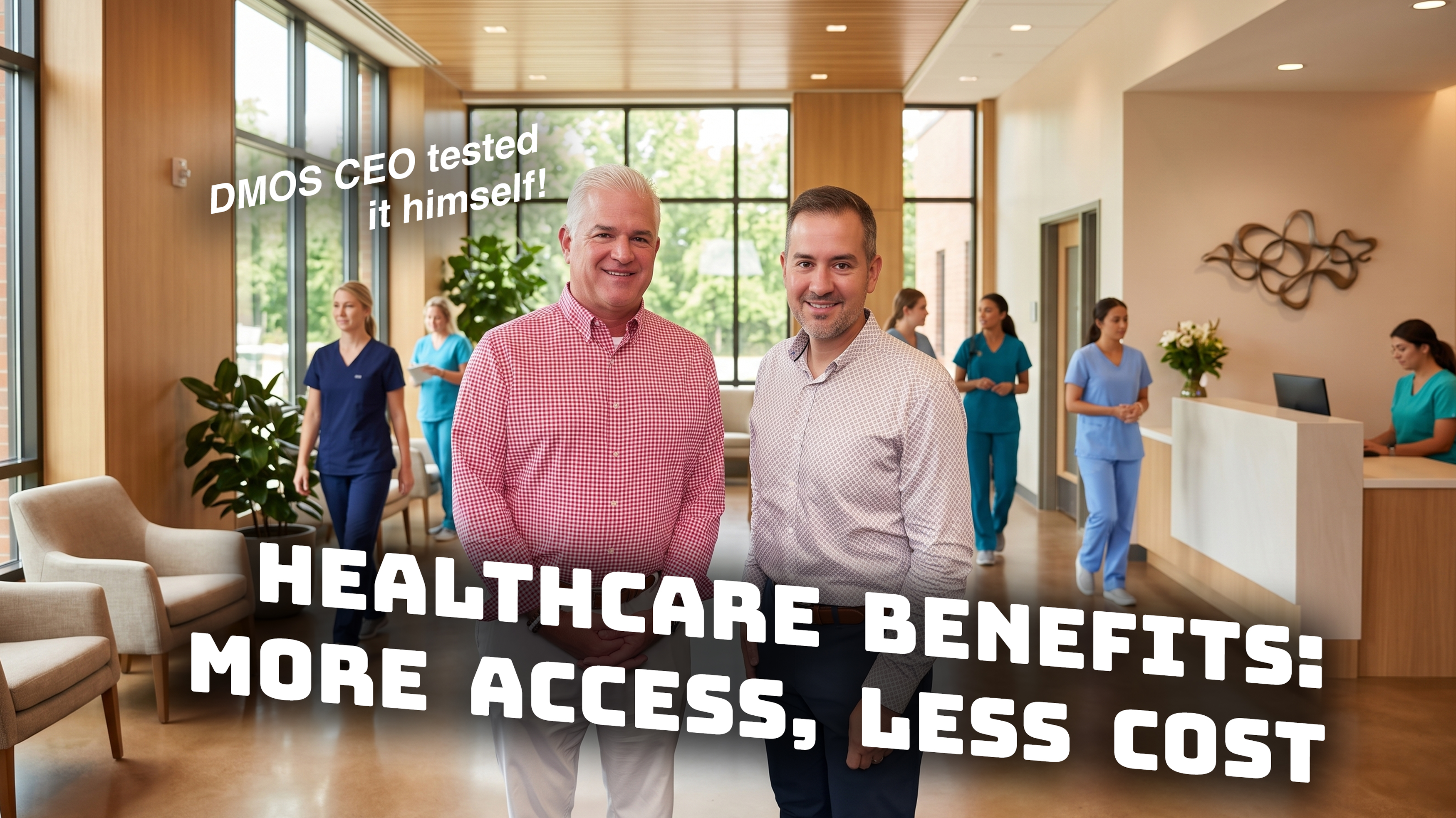


Employee healthcare costs are going up and Richard Green, CEO of DMOS Orthopaedic Centers isn’t insulated from the problem. His team is addressing the rise by adding healthcare benefits, vs removing them. He details his partnership with Hy-Vee Health Exemplar Care, how they’re utilizing the Direct Primary Care (DPC) model, and how it’s already saving them money.
As the CEO of healthcare company, Green understands the healthcare system better than most. He shares a mini case study on their decision to offer an unlimited DPC healthcare plan to his employees, and explains why adding this benefit reduced healthcare costs and increased access for employees. He breaks down the numbers and shares the hard data.

Green experiences healthcare from both sides of the spectrum: as a provider operating six locations and as an employer managing benefits for a growing workforce. Facing potential annual premium hikes between 15% and 25% under traditional fully insured plans, DMOS transitioned to Hy-Vee Health Exemplar Care’s Direct Primary Care (DPC) model to curb expenses.
“If we took what we would’ve gotten in a fully insured plan and been 15 to 25% increase, in a company like that, that’s a seven-figure number,” Green stated. By switching strategies, DMOS held its annual plan increase to just 3%, significantly beating the national 9% average reported by Aon studies.
Testing and Scaling the Direct Primary Care Model
Before offering DPC to staff, Green, Board President Nick Honkamp, and plan architect Renee Pyle tested the membership personally. Green noted the stark contrast in care during an extended consultation with Dr. John Vanderveer, emphasizing that DPC limits panel sizes to 700–900 patients compared to 1,200 in traditional systems.
“Being able to sit down with your physician and spend time, form a relationship, have the access to get, go back and forth and communicate with them was really a powerful moment,” Green noted. Employee adoption rapidly expanded from 18% in the first year to 42% in year two as positive word-of-mouth spread.
ER Diversion and Long-Term Savings
A key driver of financial performance was 24/7 care access, which redirected employees away from emergency rooms. DMOS logged 212 after-hours visits between 7:00 PM and 7:00 AM last year. Avoiding hospital ER visits—which cost $5,000 to $6,000 on average—protected the plan’s underwriting profile.
“We save a ton of money with this after-hours care, plus at the same time you’re providing great access for people,” Green emphasized. DMOS also captured $400,000 in savings by managing its own pharmacy benefit manager (PBM), proving DPC’s value within a broader strategy.
Interview Transcript
This transcript was created with help from Ai. Please report errors to us and always refer to the video as your primary source.
Justin Brady: [00:00:00] From Iowapodcast.com, I’m Justin Brady. One of the things we’ve talked a lot about is one of our beautiful collaborators here, Hy-Vee Health Exemplar Care. You’ve heard the ads, you’ve heard me talking about it. You’ve heard their staff on here giving you incredible health advice. You’ve also heard a couple, one thing in particular that some of you have asked about, which is employee benefits. Like, I don’t… Okay, the direct primary care model, cool. How does that work? I, I hear this throwing around in the shows, which is like, how does this work for, uh, as an employee benefit? Is it a thing? Yes, it is a thing, and instead of asking them about it, they sent us one of their customers. So we can Ask them questions They’re not even here to defend themselves. No, I’m just kidding. Uh, Joining us today of course is Rich Green, DMOF CEO. What does DMOF stand for and why are you in here?
Richard Green: Uh, we are, uh, Des Moines Orthopedic Surgeons. We’ve been around since 1955. We’re the largest orthopedic group, uh, pretty close to the largest orthopedic group in the state. [00:01:00] Uh, we, uh, provide multi-specialty orthopedics at five, six now locations. Norwalk opens this week, so we’re, um, heavily, thank you, heavily advancing. And, um, the unique side that we have for this conversation is that we are both a provider of the care, and we’re also an employer of those that provide the care. So we see both sides of the fence, and that’s where this has got so fascinating with working with direct primary care as an option, because it is so non-traditional,
Justin Brady: Yeah
Richard Green: something that people just don’t understand. They, they’re a little hesitant when they hear about it, like, “How does that work?” But then once you use it and get into it, it’s absolutely amazing
Justin Brady: you see a very different perspective of the healthcare industry that the DPC model sees. You’re, you know, you’re surgeons, you’re actually in the trenches, but you’re also using the DPC model or Hy-Vee Health Exemplar care for a benefit kind of thing. So w- ex- explain to me the challenges you were running into with your own employees accessing care, [00:02:00] because sometimes there has to be a little pain for you to go looking for a better solution. So what were the things from a CEO standpoint you were running into over and over again where you’re like, “This is just not the way”?
Richard Green: The, the… Great question, and I think that a lot of employers are running into this right now. The access to a lot of these major programs is there. I mean, you look at the big players in our market, they have big networks. You can walk in with your cards, you can do your thing. The, the challenge on that was the cost of what that kept escalating at per year. And when we look at needing to invest in technology and invest in more people to provide the care and do things like that, it was really difficult to be able to take 10, 12, 15% increases every year. Uh, we tried to revamp and go to a captive model. We tried to revamp and do a couple other things, and the only levers that really the, you have in a fully insured model is increase the deductible, increase the copay. So as stated before, where we have the hat of [00:03:00] the employer and the hat of the provider, on the provider side, we’re having patients come in with 5,000, $10,000 deductibles and either not having surgery ’cause they can’t afford it, or they have it not understanding that they don’t have insurance really. And now we’re put in a terrible spot of having to try to get money back from them. A, a good example would be, and we love Hy-Vee, they work well with us, obviously Hy-Vee Exemplar Care is one of our partners with things. But it’d be like walking into a Hy-Vee, getting all your groceries, and then paying for them later. It just doesn’t work that way. So we looked and said, “We’ve got to blow this model up and figure out a way to do it.”
Justin Brady: you’ve been using the direct primary care model, you’ve been using Hy-Vee Health Exemplar Care now as an employee benefit to your employees. So I guess the big question is, did this realistically affect the P&L? Did this realistically affect the balance
Richard Green: It did. It did. Um, our, our in- our increase last year was 3%. Now that’s about CPI. So you talk to companies out there, you read the [00:04:00] latest Aon, uh, studies, 9%’s the average. Um, we got that down to 3%. So yes, it did affect the P&L, and the, the, um, the result of that was being able to give our employees raises, was being able to continue all the benefits we can do to hire more people to be able to provide better access to expand clinics and things like that. Because on the flip side, if we took what we would’ve gotten in a fully insured plan and been 15 to 25% increase, um, in a company like that, that’s a seven-figure number. Then you have to make some really serious decisions on do you, do you expand? Can we give out the… Can we provide the compensation packages that are attractive to attract the best talent? Um, and, and going down that path just wasn’t there. We had to do something different, and we did. Were we scared about it? Absolutely. Absolutely, ’cause you’re changing that access point. You’re changing the human behavior of I walk into a, into a clinic, I hand them a card, I get my care, I give them my 20 bucks or 50 bucks or whatever, and it’s done. [00:05:00] Now we have to make sure employees know where to go for their care, when to get their care, and things like that
Justin Brady: We’ve talked about how Hy-Vee Health Exemplar Care has these in- insanely low r- monthly rates, unlimited visits, so I’m assuming that’s attractive. Your CFO probably liked that. Was there also an element, and I don’t know the answer to this, but was there also an element of the preventative nature where if people have easy access, they can go in whenever they want unlimited, they tend to prevent some of the things that would’ve made your rates go up? Is this also an element?
Richard Green: That’s a, that’s a fantastic question because that’s, right now in the, in the, uh, public realm, that’s what everybody’s pushing is we need, we need to provide health, not healthcare. We need to be more preventative. We need these, those things. And you look at where we are as a society, and that’s just a personal choice, and it’s really hard to mandate a personal choice. Eat your vegetables, make sure you walk, do things like that. We tried biometric screening for years. Yeah. It didn’t
Justin Brady: Yeah, the Fitbits. You get a
Richard Green: All that stuff. Get a free bi- yeah. And, but [00:06:00] none of those things work. But what works is this. So when we talked about going down this DPC path, we needed to try it before we gave it to our employees. So our board president, Nick Honkamp, myself, and Renee Pyle, who gets all the credit ’cause she’s the one that was like the architect of this program- That’s right … we all three of these went in and became members and went to- Wow … direct primary care. Um, so I go to Dr. Vanderveer for my first appointment to see what it’s like. Check-in was easy. Okay, great. I’m imagine it might’ve been coached a little bit, “Hey, Rich is coming in,” kind of thing, but that was fine. Um, sat down with him and about 10
Justin Brady: gets the Rolls-Royce. No, just kidding. Just ki-
Richard Green: About, about 10 minutes into this appointment with, with John, um, I’m like, “Okay.” And I get up, and he goes, “Where are you going?” I said, “Well, we’re done, right?” He goes, “We’re not even close, no.” And he spends the next 25 minutes really diving into my healthcare, and more importantly, forming a relationship with me as a patient, and that’s something that unfortunately, it’s not the primary care industry’s fault, it’s just the model they have to have. When you look at, [00:07:00] uh, Exemplar Care, and DPC models like this are the same all over the country, where they limit their panels to 900 patients or 700 patients. And then you go into a system, uh, in, in any system, Unity Point, Mercy, whatever, and those primary gu- care guys have a model of 1,200 patients, they just quite frankly can’t spend that time with them. So being able to sit down with your physician and spend time, form a relationship, have the access to get, go back and forth and communicate with them was re- meaning, you know, email, a portal, and get answers very, very quickly. That was really a powerful m- moment of, we may be able to get to this health thing. So now you’re more motivated to go in and get your screens done and do your preventative tests and things like that because you have this connection. And once we got, once the three of us went through and did it, said, “This is fantastic,” then we, we put it in play on that, on your one.
Justin Brady: you at Des Moines Orthopedic Surgeons probably know better than most that, um, relationships in healthcare from [00:08:00] a functional standpoint, from a healing standpoint, actually matter quite a bit because you can’t get… As you know, the human body is quite complex, this is literally your job, and you don’t get enough information in two minutes. Right. It’s very nuanced. There could be two symptoms that look exactly the same on the surface, but the underlying issues are completely different, and this is why that time matters a lot, the relationship si- uh, side matters. I wanna go into kind of the concerns. Like, you made a change- Mm-hmm … and you’re surgeons. Were there any things that you, that concerned you about moving over to Hy-Vee Health Exemplar Care and the direct primary care model from an employee benefits standpoint, but also from a healthcare
Richard Green: Well, I think from a, um, from an employer standpoint, what you don’t wanna do is disrupt your employees, and we knew this was gonna d- be disruptive. Uh, so our strategy was we’re gonna, we’re gonna level fund, meaning we’re gonna provide this as a [00:09:00] benefit for everyone, whether they use it or not for the first year or so, and that was a risk, and our board was, was for– had enough foresight to say, “We understand.” Because the alternative was we stay where we were, and that just wasn’t a, that wasn’t an option. So we had both points of access to that. Then it was convincing our employees that you can go here for free. That’s the message. we’re we’re paying for it, but it doesn’t cost you anything. There’s no copay, there’s no deductible. You can get all your labs, your tests, you can get a, a, a large majority of your medication, and you leave that day. You go to the appointment, you wait, you get a bag of medicine, and you walk out, and there’s no stopping at wherever afterwards to, to get their meds. Um, and we were concerned that the people– that was gonna resonate with our folks, and it didn’t at first. The first year I think we had 18% of our employees that, that used the DPC model. This year, this past year was 42%.
Justin Brady: Oh, so it’s going
Richard Green: Word of mouth and water cooler. So when these people went and they came back and they sat in their cubicles or they were in [00:10:00] clinic or the doctor went and they’re like, “Man, that was, that was pretty cool. That was really what you said it was.” Now, where the real kicker hits is this after-hours 24/7. So if you have a young child or yourself or whatever and, and you know you never get ill at the perfect time. They never have ear infections at noon.
Justin Brady: never convenient, is
Richard Green: They have ear infections at midnight, and they’re screaming, and they got a big temperature- Yep and their only place to go would be the emergency room. The ER, Right? So now with this 24/7, they can call and make an appointment, get in whenever they want to, be seen generally within an hour or so, if not less, have their medicine and go home instead of I gotta, you know, gotta take him home, put him to sleep. You have to run to the pharmacy to all… You just get everything in one fell swoop. So from a service and access point, that was a game changer for us. It was phenomenal. Last year we had 212 people, 212 visits, it might have been somebody twice, that went between 7:00 PM and 7:00 AM. If you take that 212 [00:11:00] number and multiply it by five, $6,000, which is what it’s gonna cost you to go to the ER, tho- those were dollars that would hit our plan that the next year when the underwriters look at it say, “Well, you guys use a lot of healthcare.” Now that, that didn’t hit, right? So we save a ton of money with this after-hours care, plus at the same time you’re providing great access for people.
Justin Brady: Interesting. Yeah, and no shade at ER doctors, but ER, ER is They don’t want an ear infection at- Right … at midnight. Yeah. They’re sitting in the ED. So save lives. lives in critical, uh, you know, they’re not set up to do this long-term primary care. So you go to the ER, you’re not gonna get a 20-minute visit to diag- this is not gonna happen. So this is clearly better for the patients. Truthfully better for the ERs too, ‘ cause they don’t want this stuff in the ER. No, no. And ERs are
Richard Green: no, and the ERs are overrun. Absolutely
Justin Brady: are, they are totally overrun. what was the process for onboarding? Like you do the DPC model, you’re offering Hy-Vee Health Exemplar care to employees as a benefit. What was the onboarding process [00:12:00] like? How did that work, that transition period, that gray area?
Richard Green: guess the, the best advice to any employer is you have to know this is a five-year sliding scale of things. Mm-hmm. The easier things to do, and perhaps in a smaller organization where you have maybe 50 or 75 people, is called a narrow network. So you only see a certain number of people or a certain number of providers. The networks aren’t as expensive. You control the cost. You’re providing healthcare, but you’re also taking away access, and that’s one thing that is the number one hindrance, other than cost, for a lot of HR folks when they look at changing plans is, “Oh, well, I have that blue card. That’s so easy. We can’t get away from that.” So what we did was looked at, okay, let’s look at this in phases. We’re gonna have DPC as our number one, as our, as our, our, our go-to, but we also have to have this network. And then let’s look at the number of people that actually have a primary care physician within their… like they de- they declare. And we have a relatively younger workforce, and a lot of younger people don’t have d- primary care [00:13:00] physicians anymore. They just don’t, right? And that’s one of the hesitations. “I can’t see my doctor any longer.” Well, a lot of people didn’t have a doctor to see. Yes. And that’s what we discovered as, as a couple years went on. Um, the third part to this equation with, uh, having a network, having DPC, was the PBM, was controlling our own pharmacy. Once we got those three things put into place, uh, we saw some significant savings. Our first year, we, we lost money on the, on how the plan worked, but we also gained about $400,000 in controlling our own PBM. So it was a wash. Yeah, so-
Justin Brady: so have a long term.
Richard Green: Have a long-term plan
Justin Brady: thing. I mean, like anything in life, you’re not gonna have over-the-night savings on anything. It’s always gonna be a long-term thing. Uh, Richard Green, the CEO of Des Moines Orthopedic Surgeon. Of course, we’re talking about Hy-Vee Health Exemplar Care. Thank you so much for coming in here. What is your guys’ website? You can shout that out, and we’re also… Yeah
Richard Green: [00:14:00] Dmos.com and go there for all your needs. We’ve got virtual care where you can talk to somebody right now. You can schedule an appointment 24/7. You can learn about any of our providers or our locations. Our Norwalk clinic opens up, uh, this… Well, it’s been open, soft opening. Our grand opening is this Thursday, so we’re just super excited about being able to provide care down at Norwalk. And, um, we, we really push the access point. Right time, right place care. We have urgent injury clinics, now four of them, walk-in clinics that you can get any of your orthopedic needs met. We partner really well with DPC and the rest of those guys on being able to provide that access
Justin Brady: And if you’re a CEO, CFO, and you want, uh, the direct primary care model as an employee benefit, go to exemplar.care. We really appreciate that partnership with them, and like I’ve said before, we are obsessed with this. So thanks so much for coming in here, Richard. Really Appreciate
Richard Green: Happy to help
🫶
This show is a collaboration. IowaPodcast.com collaborates with loved Iowa brands to bring value to listeners. Brands compensate our hosts directly for their time. Learn more