

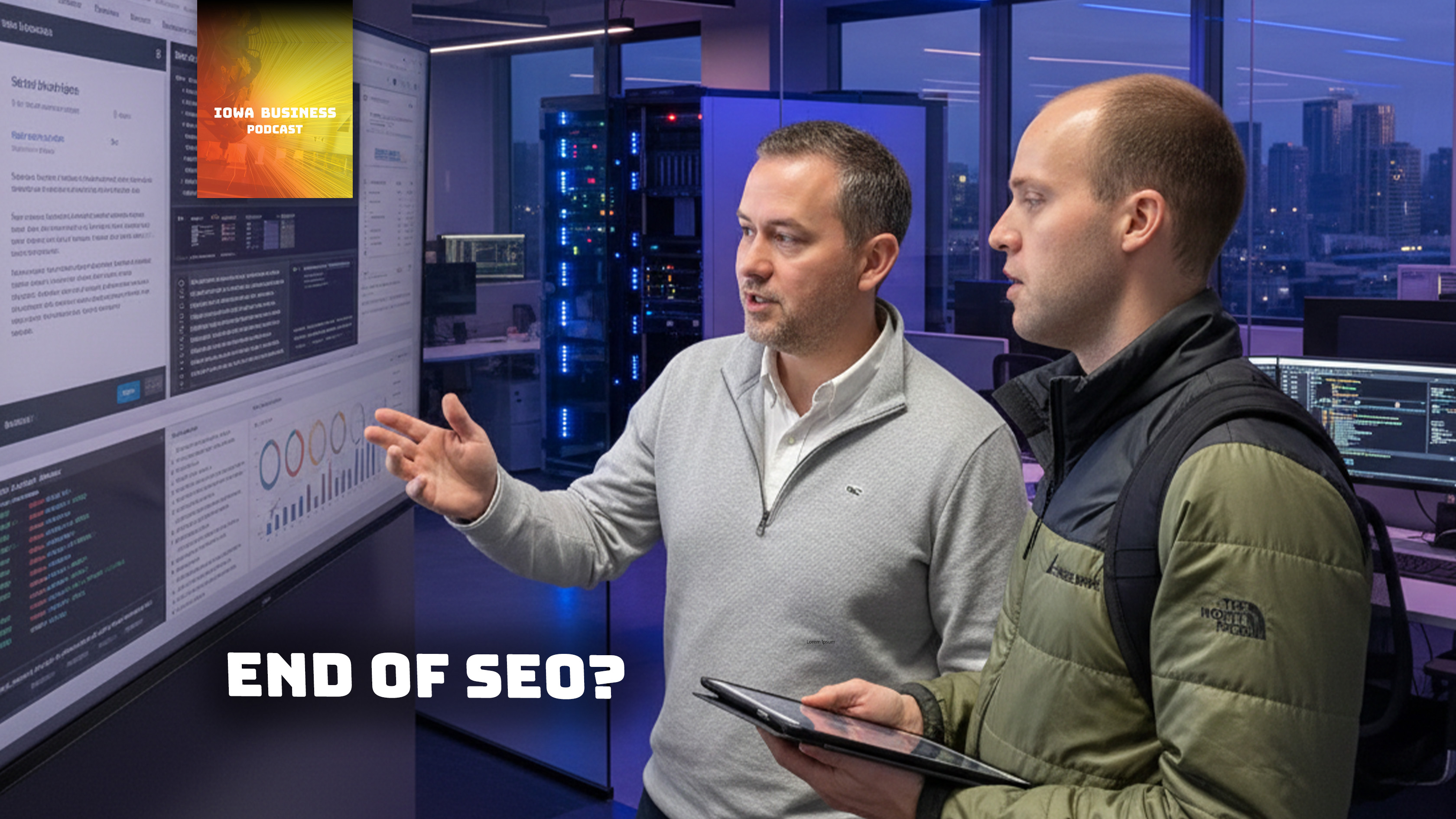


Follower numbers and web traffic aren’t meaningful numbers anymore. Iowa CMO and Comms leads need to switch focus to AI search and control mind share, not worry about vanity metrics. Iowa-based AI and search pro Ryan Doser explains why trust signals need to lead your marcom strategy.
Doser details why audio-only podcasts are dead and what Iowa brands need to do as web traffic drops off. Is written content valuable in an era where people Gemini, Grok, ChatGPT, and Perplexity questions and never visit our websites? Does web content matter, and how do we own our audience distribution as AI takes over? Doser gets into the weeds.
Hear from Iowans directly. No algorithms.
Don’t let the algorithms choose your news. Enter your email address to hear directly from Iowans leading news in politics, community, agriculture and business. No editing. No clickbait. No rage. No agenda.
Thanks to Dentons Davis Brown for collaborating with The Iowa Business Podcast to bring incredible value to our listeners! Collaborators compensate our hosts directly for their time and effort crafting exclusive content.

Interview Transcript
This transcript was created with help from Ai. Please report errors to us and always refer to the video as your primary source.
Justin Brady: I’m Justin Brady and the Iowa Manufacturing Podcast is now the Iowa Business Podcast, of course, proudly recorded in the Jethro’s Barbecue Studio. Get your CMOs and comms people because SEO has changed. I don’t even know if we call it SEO anymore. There’s actually a new term and AI is leading the whole charge. Crazy town and to talk about that. Impressions overall are kind of growing, but web traffic might be plateauing or in some cases even decreasing. Is that good? Is that bad? Do we care? Do we write written content anymore? Are we all just gonna become cyborgs To discuss that as Ryan Dozer, who works in ai, SEO. This, I’ve actually, full disclosure, I actually hired Ryan for some stuff on this very show to work on because I was like, dude, I don’t understand how this is working. So Ryan, thank you for helping me break all this down for all the CMOs and comms people out there.
Ryan Doser: Justin, appreciate you having me on. Uh, honored to be here and you know, we call it A-E-O-G-E-O-L-L-M-O. Insert new acronym of the week, it seems.
Justin Brady: Yeah. Yeah. We’ll, and we’ll break all that down too. There were some real ones in there and some fake funny ones. Uh, before we do that, thank you to Dentons Davis Brown for being one of the big collaborators on the Iowa Business Podcast. We had Beth Koonin in here, and you can check out that show on Iowa podcast.com/business. And Beth was talking about talent acquisition and retention here in Iowa, and strategies to do that that. Are actually what I would say, not very lawyer ish. She broke down a lot of the problems she’s seen about losing critical talent and ’cause she’s always in that spot where she’s like trying to get people to like make up or, you know, separate. So she told us some of the trends she sees way, way out there so you can avoid those. So make sure to go check out that show, Iowa podcast.com/business SEO. Ai, SEO El ao. Mayo, That’s, I really like that you came prepared. So with AI now making on page recommendations, people have seen, you go in, you Google a term, and a lot of companies rely on inbound traffic. They built content for years, and now they’re freaking out. And this isn’t a, I’m not being extreme here. They really are freaking out because Google. Is taking that beautiful, rich content they work so hard on and just presenting it on page and they never get any traffic at all. So do we still write anything anymore?
Ryan Doser: Yeah. And you said companies, I think we need to make a very big distinction, here, Justin, because in my opinion, right? If you’re a small to medium sized business, I actually think AI search is very overrated, and shouldn’t be prioritized. But if you’re a big brand, I actually think it’s very important because you’re trying to spin a narrative in an industry, right? It’s all about citations now, like. you mentioned, Web traffic is decreasing. So when someone searches, like, let’s say you’re Verizon or US Cellular, and you search what is the best cell phone provider? Well, you want to spin that narrative into your favor and say that Verizon is the best provider. But if you’re a local to medium sized business, if you’re losing web traffic, it’s not that important. In my opinion, you should be spending more priorities on paid traffic, email marketing, personal branded, social content, you know, word of mouth, other marketing tactics that actually produce ROI. I think it’s a Very shiny object, for small to medium sized business owners chasing these citations that don’t actually lead to ROI, but for big brands it’s very important.
Justin Brady: Got it. Okay. So this is interesting because you now, I don’t know if you are saying this, but it sounds like maybe you’re saying that inbound traffic was a vanity metric
Ryan Doser: A lot of times. Yeah.
Justin Brady: Just CMOs present this information to their CEO and they’re like, look at how much traffic we’re getting. And if you’re smart these days, the CEO should say, why do I care?
Ryan Doser: And a lot of nuance to this, right? Well, I used to work at, Meredith, Meredith, I think it’s People Inc. Now, actually, they rebranded a million times. But for like publishers for instance, it’s not a vanity metric. because they’re relying on that traffic to get ad revenue impressions, right, But if you’re a SaaS business or if you’re some other company that you know, maybe you’re latest conversions you, you’re selling a product, yes. It could be a vanity metric in that regard.
Justin Brady: And so when you say do things that have ROI, it’s. it’s You’re saying very simply do stuff that sells stuff. Like if it’s just a visitor number, if it’s just a follower number, if it’s just an impression number, those days are gone. Maybe I, I would argue they’ve never really been here. Right? We, we would judge those numbers ’cause we didn’t do a good job capturing ROI. But you’re saying look at how many customers you close. Look at where the revenue’s coming from. Focus on those areas. It’s really time to stop looking at subscriber numbers, traffic numbers. Does email list numbers factor into that, or is that different?
Ryan Doser: I think email is super important. I mean, it’s a little different. Obviously, email it’s a more trust factor. If someone gives you their email, they’re probably more inclined to trust you and purchase stuff. from you. So, And this goes back to a more broader conversation of owned versus rented distribution, right? So technically SEO or social media or YouTube or whatever. That is all rented distribution. At the end of the day, Justin, just from a marketing perspective. you Always want to own your distribution. Emails being a big part of that, phone numbers being a big part of that, and any sort of internal data where you own the distribution. That’s really the, the name of the game in marketing and business in general.
Justin Brady: a lot of marketing now is, and we’ll talk a lot about it, but YouTube and video and how that plays into search, but a lot of marketing is like Instagram and reels and shorts and TikTok. And that to many marketers is like, cool, I wanna get the eyeballs there. Now obviously if you’re in manufacturing or if you’re in like finance, tiktoks probably not the best place. This is what you talked about earlier, focus on results. Like not just go to the new hot thing, but if my audience is on social channels or on YouTube, you’re saying we should, you should still focus on getting people to subscribe on email newsletters. Like that’s still a thing.
Ryan Doser: Yeah, email news, again, it goes back to own distribution. if you can. If you can own your distribution, You can pretty much do anything you want because when you’re not owning your distribution, you’re at the mercy of social media. Algorithms changing. Like YouTube, they could shut your channel down at any point. A competitor could hire malicious actors to take your channel down. Sounds crazy, but trust me, I’ve seen this play out. I’ve seen it. Yeah. So you always want to own your distribution. That is going to be the main focus. of just. Everything marketing related. It’s Only gonna get more important too, as AI comes more into the mix.
Justin Brady: And for those that don’t believe you, I actually had an initial show years ago that was taken down by a lawyer. ’cause they said My name, my name, my name matched someone else’s name. And I was copyright infringing. And I’m like, you can’t copy. It’s my fricking name. So anyway, my lawyer sent a nice letter to their lawyer and said. Go right ahead. Make my day. They backed off. But what happened is, um, they, it is a long story. Uh, we reached out to Apple. We said, Hey, is this legitimate? They actually told us, no, this looks like it’s Phish. Don’t respond to it. It was legitimate. And so they actually took the show down when they put it back up and apologized. They didn’t put back the subscribers, they just put the show up in a new feed. And so to your point, like owning that email, I’m glad to hear you say owning the email distribution is still very much important. You mentioned numbers too, so collecting
Ryan Doser: email addresses. Yeah. Any owned form of. distribution is very
Justin Brady: So focus on owning. So any content, any marketing should be focused on two things. Then one ROI, duh, selling stuff. But two, you’re saying if you are building numbers in the form of email lists and text lists, that’s okay too.
Ryan Doser: Yeah. And my buddy, uh, who owns Fresh Fit Meals, they’re actually moving towards that model of more owned distribution versus rented. They, you know, invested thousands of dollars in a. system where they’re prioritizing phone numbers They’re doing more SMS blasts, they’re doing more email blasts, and they’re using that internal data more to their advantage versus previously they were, spending more of their advertising dollars on meta with Instagram and Facebook and other platforms where you don’t own that distribution.
Justin Brady: Yeah. And is it possible? ’cause I, I do notice that when people do push content and they, and they, they, the algorithms are favorable to them. It does seem like over time when you start growing, they start to pull back how favorable they are because they’re kind of, are they trying to do a bait and switch? And now they want, they’re like, we know you got kind of hooked on the algorithm and on those numbers coming in. Now we’re banking on the fact that you’re gonna pay for it
Ryan Doser: it depends on the niche, but I think, a, a bigger lesson here. Justin in general, is that they Reward personal accounts more than they do business accounts. Sure. Because They’re gonna cap you on a business account ’cause they wanna push you towards the ads. Yeah. That’s, That’s the play there. But people, you know, if you’re a personal account, they’re gonna give you more reach They’re Not to mention. people connect more with personal accounts too. So there’s more engagement on personal accounts. When your engagement’s. Higher the algorithm’s gonna reward you that way. But the whole play of social media is to get businesses to pay for ads So they’re always gonna cap you.
Justin Brady: So do you recommend smart, smart people are thinking, wait a minute. Do you recommend then a good company strategy is push the brand through personal accounts.
Ryan Doser: I think personal brand is the ultimate leverage going. forward. We’re, we’re in a trust recession. Justin, in the age of 2026 and AI, destroying trust by the day. people, trust people. Now, easier said than done. If you’re at a huge company, you don’t want to put all your eggs in one basket on someone and then they could get quit or find a new job, and now you gotta start from scratch. So you have to be very strategic about how you’re doing this. But in general, it’s personal brands. are going to be the best thing You can do. moving
Justin Brady: Not to mention strategic and careful from a disclosure standpoint because, um, that even though there’s, it’s not a, so in radio, it’s still in, in pa, in, in like AirWave stuff, it’s still regulated by the FCC, um, even though they break these rules anyway. I know from personal experience, I’ve seen people break those rules. Those rules don’t necessarily apply to digitally yet, but they do apply within the terms of use within those, or you know, so like YouTube has a check this box if there’s any promotion in there. If you saw this, you will see the box check because of that plug I did at the beginning.
Ryan Doser: Most people aren’t checking that box.
Justin Brady: Yeah. And so will this, I know and but I seek things that are clearly promoted and people aren’t checking the box. Is there an algorithmic reason for that?
Ryan Doser: Yeah, they probably think that if someone’s viewing it. and they see that Promotion thing on top. Well, someone. instantly, gonna think, oh, this is a promotion, why would I watch this, but YouTube’s algorithm is so smart where if you promote something, they’re gonna know that looking at the transcript and analyzing that transcript. So they might cap you on an algorithm perspective with views that way. So, so
Justin Brady: honest is what
Ryan Doser: Essentially Be honest. That’s the best. strategy for anything.
Justin Brady: Like you said though, the most frustrating aspect of that is even on this show, when I have a guest in like yourself included, you’re not paying to be here. I’m not paying you to be here. There’s no money exchanged here. But they’re gonna put that little thing at the beginning and so people are gonna be listening to this saying, is Ryan paying to be on this show? ’cause they don’t know what that actually applies to. Right. Because I do a good job disclosing, ’cause that’s my training, but. How is a normal consumer supposed to know? So anyway, um, this is a matter then of, there are two schools of thought here, which is inbound versus mind share. And so mind share being, um, like we don’t care about AI ripping off our content and presenting it. We don’t care because we just want AI to tell things the way we want them told. Right. And so are there two, two schools of thought here, which is inbound? ROI. Then mind share, which is harder to track, but we don’t care. ’cause it’s shaping public opinion.
Ryan Doser: Right. You’re saying controlling the narrative and how Google and all these LLMs are controlling the narrative. Well, on that topic, Justin, this is actually very interesting. Uh, You know, hres, the company hres, big SEO tool, They ran a study, I think it was December maybe, of AI misinformation. So they spun up a fake brand. You know, you can leave the. link in the show notes. People Are interested. do that the LLMs, they had all these trust signals, faked podcasts, faked articles, fake models Yep. Fake guest posts. They essentially manipulated a fake brand to see how LLMs would receive it. And they actually, the, the results were the LLMs promoted this fake brand I can’t remember the exact terms, or whatever industry they were in. so that tells me it’s actually easier to manipulate LLMs versus traditional Google search results. Because here’s the kicker, Justin, we’re in an age now. where AI agents are actually performing more traffic. AI agents are determining the traffic versus previously on a traditional Google result, there were a lot of human centric metrics, right? So if you search for something on Google, you click a website, you’re there for five seconds, you bounce, you go back to the first page of Google, that’s a signal to Google. A human went to that site, they didn’t like it. We should probably deprioritize that in the Search results. Where now it’s AI agents doing all the work, right? So if you search for something on Gemini or chat, GPT, They’re gonna have AI agents searching for that traffic and now we don’t know. You know, are there human metrics? Is it more agent metrics? There’s just more manipulation involved with LLMs than there was previously with Google search. I think it’s a very concerning reality.
Justin Brady: Yeah, it is very concerning. ’cause some of the stuff I’m getting fed up, um, by. Gemini, grok and Chad, GPT, uh, may at rest in peace. I don’t even know if it’s gonna make it. Um, that’s a whole nother topic probably, but some of it is like, I’m like, I don’t, I know this topic ’cause I, I will test AI with my own opinions and things I know a lot about and I’ll test
Ryan Doser: it. There’s a lot of confirmation. bias too in these
Justin Brady: my gosh. And, and it will present information that is way off. And then I’ll push on it and I’ll say, are you sure about that? That doesn’t sound right. And it’s like, oh my gosh, uh, yeah, you’re right. I’m wrong. Here’s the actual thing. And so, yeah, it’s, it, it is a kind of obfuscating making the source material a little bit more obscure where it’s like, trust me, bro. I’m gonna present information. That’s correct. But on the opposite side of that, what I’m hearing you say is. And obviously there’s an unethical way to do this that will get you screwed. Like you will be de-listed, you’ll be de ranked if you try to do this, you know, unethically. But there is an ethical side that you’re saying, Hey brands, if you’re writing content and doing the right strategy, you can influence how AI talks about your industry and brand.
Ryan Doser: and that’s called trust signals. And so, and trust signals have always been important. as SEO, as traditional SEO, with back links and guest posts and getting featured on podcasts and press releases, trust signals haven’t gone away. I just think they’re more important now. in the age of AI search, you’re Talking about things like published books, right? Massive trust signal for an LLM Speaking at a conference, massive trust signal. getting on this podcast, massive trust signal, right? because for instance, you post this on YouTube, Gemini, owned by Google. Yep. YouTube, same company. They can look at all these transcripts and Video, they can analyze, video and verify is this a real person? What were they talking about? Was it relevant to whatever his brand stands? for? And so that is where we’re going with all of this, Justin. it’s These types of trust signals. to prove that You’re a real person. you’re a real brand, and that’s how you’re gonna stand out in these LLM results.
Justin Brady: Yeah. And so list off, by the way, I didn’t know trust signals was now a term that’s a term now?
Ryan Doser: I, It might be. I don’t know. I’ve been using trust signals for a long
Justin Brady: Okay. Because, um, yeah, I, I’ve just, that’s awesome. Um. The It it, What are some trust signals then? Because this is what people are asking. Yeah,
Ryan Doser: Yeah, What we’re doing right. now.
Justin Brady: yeah, I like the trust signal thing. So, but what we’re doing right now, I think for most CMOs and comms folks maybe is a bit obscure. They’re like, get on Iowa podcasts. Like what, what? So what are, what’s a list of, here are the trust signals you should prioritize so that AI prioritizes your brand.
Ryan Doser: Yeah. So backlinks are still important. Really? I, Yeah. Yeah. I would actually argue that The relevance of backlinks is more important than just the pure quantity of backlinks though? So for instance, me getting a backlink on Forbes or some industry niche site is gonna be a lot more important than just getting a hundred random backlinks. ’cause before that was the, the school of thought. where You just get as many high Dr. Backlinks as possible, regardless of relevance. Being domain. rating. Yep. It’s a metric coined by, I think, HRES or SEM, rush domain authority and domain rating. Um, I always give these little acronyms without even realizing who the audience is sometimes. Yeah. Um, but now, like I said, it’s more, uh, quality and relevance of backlinks. But that’s one. I would say podcasting is another one too, right? So for instance, if you’re a company, you want to be a guest on as many high quality podcasts or popular podcasts in your niche as possible. I’m not saying just go broad and try to get on every single podcast possible. You wanna get on industry. Specific podcasts and be a guest. The more you can show up, give your thoughts, right? Podcasts are posted to Spotify, apple, YouTube, Amazon, all of these big time sites. And so when LLMs are taking these transcripts from podcasts, that’s very important, right? You want them to take what you’re saying on all these podcasts, and that way you can help get results in LLMs that way. Speaking at conferences, is also very big, right? a lot of times conferences are posted online, so they’re gonna know that you spoke at this conference. Being a published author is a really big trust signal. I would argue that’s even more important now than it was previously because AI knows, Hey, if Justin Brady wrote this book, it’s a bestseller in the New York Times, or it’s on Amazon, well, that’s really gonna upstart you in a certain niche if you’re a published author. Um, I would say, you know, maybe some other trust signals are consistent content creation. So if you’re Showing up consistently across all social platforms, if you’re writing a. consistent blog, uh, LinkedIn, Twitter, or X uh, Facebook, et cetera. Consistent content. That’s relevant content too, not just garbage AI lop content. That’s another trust signal. There’s probably many more I’m not thinking of, but those are just some of the top ones I can think
Justin Brady: Yeah, and I would venture or I would volunteer PR stuff
Ryan Doser: Yeah, digital PR Media, Yep.
Justin Brady: which is a big one because, uh, these, uh, chat apps, Gemini, LLMs, rock, all the, all these ones. Are going to look at published media. Yeah. Because they’re going to say, and I understand this is polarizing topic. I understand there’s left and right media. Yeah, I get it. But they’re going to say, well, if something came through the filter that is this Wall Street Journal reporter, there is less likely a chance that message is being manipulated because it went through this guy whose job is to get it right and who will get fired if he or she does not get it right. So I would say. Now, I hate the word. I hate the word now more than ever. I hate that. Oh, I hate it. But it’s very important to loop your PR comms people in there and have a offline, as you’re saying, PR comms strategy to win the online AI game. Is that a fair assessment?
Ryan Doser: I think, uh, digital pr and comms in general especially from a bigger company perspective, is more important than ever. Mm-hmm. And There’s something interesting to think about. Justin, I just thought of this. So If you ever notice, and this is more in the niche, I I follow AI pretty closely, as you know, big, big, big AI companies like Open ai, anthropic, et cetera. They’re starting to partner with big media companies, right? So. We had New York Times, right? We have the Atlantic, we have dot Dash Meredith, where OpenAI, for instance, is paying all of these big media companies to essentially take their data, scrape it, and train their AI models. Well, They’re just. avoiding a future lawsuit. That’s all that. is. And so what’s gonna happen, Justin? Where are they gonna prioritize their partners sources versus just some generic media source? That’s something else to look into. And now we have Google, you know, owning a big stake in Reddit, which was a couple years ago or a year, they bought a big stake in Reddit
Justin Brady: I didn’t. Mm-hmm. So
Ryan Doser: they’re gonna prioritize Reddit obviously, more than some other platforms, so, look, but,
Justin Brady: unfortunate.
Ryan Doser: which is unfortunate. It is unfortunate, but you have to peel back the curtain here And see who did they pay to scrape content from. So those sources, in my opinion, I’m not, you know, some futuristic person here, but they’re probably gonna prioritize those partners versus just some other generic publisher out there. Yeah. Yeah.
Justin Brady: seeing that Reddit punches way above its weight class in some searches. And it’s like some of the, I would argue much of Reddit content is absolutely junk
Ryan Doser: and it’s AI generated, now
Justin Brady: yeah. It’s just the worst fricking thing. If that company would go away tomorrow, I’d be a happy camper. Do we need to prioritize then video first content over written form content? Because I’m hearing that, um, basically the, the companies working on AI search and AI suggestions are prioritizing real and. and it’s very very hard. I mean, it’s certainly possible, but it’s very, very hard to fake this. Yes. Right. Because could people fake two people talking? Sure. But those people have to be real. They have to have a digital footprint somewhere. It actually is gonna get kind of hard. So do brands prioritize big and small? Prioritize like video real content than overwritten content?
Ryan Doser: A hundred percent. Because you can also use AI to. remix and repurpose that long form. video content by taking the transcript and creating emails from it, from blog posts, social media, But this is exactly what I do. Right. My foundation, my content foundation starts with long form video and then use AI to remix and repurpose the rest into short form because there’s a lot of context there. I’m not going to chat GBT and saying, write me a blog post. Write me a social media post, I’m giving it my actual long, form content with my transcript, and other training and context behind it so it produces high quality outputs that. actually sound like me. Not to mention Justin, you know, this too long form video is a massive massive trust signal to an audience. If someone’s gonna sit here and watch this 30 ish minute podcasts that we’re doing. They trust us, essentially, right? They bought into what we’re saying. And so if you’re ever trying to sell anything, video is a much easier solution to that than written text when the average person probably looks at written text these days. and asks, was that AI generated. Did someone actually write? that? No one knows the answer anymore.
Justin Brady: So when you say video content, people are like, got it. Video content, flood the waves, get it everywhere. Good. High quality content. Of course. You know, one of the things I talk about is audience, audience, audience. So we talk about all our hosts here on Iowa podcast.com. It’s not about you. Focus on the audience, give them what they want. That being said, people put their tactic hat on and they’re like, cool. In order to get the vibes though, in order to get the, can we use that in order to get the effect? The ROI, is it as simple as just push it everywhere or do we need to make sure that YouTube, when I’m pushing content there, I embed that on my webpage so that it’s making that brand association, is there a right way to do the video content and is there a wrong way?
Ryan Doser: There’s just so much nuance to this, right? The answer is it depends to everything. Mm-hmm. You know, I think if you’re a business, you should always start. I would recommend you had to be consistent. So I would always recommend doing a. One long form video per week. minimum. upload that to YouTube, of course, right? ’cause then you can use that to remix and repurpose for other areas. But topic is also very important. Justin, you know, we talked about this in our consulting session where packaging is everything. right? You have to have topic, title, thumbnail, hook. So if you don’t have that and, and Topic being the very first one, if you’re not creating content. Over topics that your target audience cares about or actually searching for. Using keyword research Data to find this. no one cares at the end of the day, so you have to start there before you just start pushing out random content to the masses and then hoping that someone sticks. You always have to have that packaging research and strategy element in mind first before we just hit record and create. content.
Justin Brady: Yeah. And when I, this is interesting because when I hired you, I hired you for the Iowa podcast.com project and all our shows, and one of the things I said, don’t be nice, don’t like, be
Ryan Doser: which is good advice.
Justin Brady: advice. Yeah. Don’t be nice, be aggressive. We’re here to win. We’re here to reach as many Iowans as possible. So if you’re advice is within that line, let’s, let’s go for it. Like, don’t worry about bruising. My ego, one of the most hilarious things is you went over that with me. You’re like, the headlines are a little vague. The images you’re putting up are a little vague. The description’s a little vague. What’s super funny about this, Ryan, is I was like trained by when I was writing for the Washington Post, I was trained to do this stuff. And then forgot. I’m like, what is wrong with me? And so it’s like, do you find that people just tend to stray for and, and they tend to forget the obvious stuff, which is people are scrolling on a fricking app and if the thumbnail doesn’t look good, the description doesn’t look good, people just assume that, well, because you’ve subscribed or because you’re on our email list, you’re just gonna click and listen to everything. People don’t do that. Right. You, you need to almost get them to subscribe as a first wave and then constantly remind them and, and that their content’s good and get that additional click and visit.
Ryan Doser: And you mentioned that you learned that at the Washington. Post. Very interesting because they already have massive distribution. If You’re a company that doesn’t have massive distribution, like the Washington Post. You can’t get away with that. So you have to focus on packaging and build that distribution up versus someone like that already has the distribution. It’s a Completely different ball game.
Justin Brady: There are brands in Iowa that are regionally focused. There are brands that are nationally focused. There are global brands, um, but then there are local brands. They’re like, I’m, I’m Cedar Rapids, I’m Burlington, I’m Des Moines. I don’t care about the state. I just care. Does the strategy change if someone is focusing geographically or, or if someone’s fo focusing nationally or globally?
Ryan Doser: It all depends. Yeah, where your target audience is. You just always want to keep in mind, you want to create content and package it. correctly for the target audience in mind. So You always say this too, and I appreciate, do people care or will people care? You always have to have that mindset before you just create content. Because me, you might care. I could talk about LLMs and all this AI rabbit holes for days, but the average person that’s not in my target audience, they don’t care. You know? That’s just the reality.
Justin Brady: Yeah. Does geo geography matter though? Like, do we need to somehow signal to Google and YouTube, um, that we are local? Like, do we need to update our pins on Google Maps and Apple maps? Do we need to put addresses into thi Like do we need to give Google and all this search stuff signals that we are local? Does that matter? And does that help us on like local search?
Ryan Doser: Yeah. If you’re a local business. obviously Geography is everything. And so, you know, think, keep in mind too, if someone’s searching on YouTube or Google, even if they’re signed in or not, Google’s gonna have their IP address, right? So they’ll know that someone’s in Des Moines, Iowa searching for something. So, yes, you know, if, if your local audience is in Des Moines, you wanna maybe throw in Des Moines in the transcript and say Des Moines, or maybe throw Des Moines in the title, just to give it some sort of signal there. And the transcript and the algorithm knows you’re in Des Moines ’cause like people are searching, they know their IP address. So like my results in Des Moines, Iowa are. gonna be Different than someone else’s results. in, you know, St. Petersburg, Florida, for instance, for the exact, same search.
Justin Brady: so that means if you’re like a local shoe co company and you sell shoes, or you sell locally made widgets or something when you’re creating video content and hopefully creating it, as Ryan has said, weekly, and then remixing that and shoving it everywhere. Ideally, you are using about as much local terminology that you can, you’re mentioning your city name, maybe you’re mentioning local fixtures, local things. Local events. Is Google and all these chat bots and search stuff. Is this all smart enough yet to prioritize local stuff to local searches then? If
Ryan Doser: If you go to chat, GPT. Or Gemini or Google AI overviews and you do a local intent search. The citation is gonna be a local intent response. if that makes sense. So it’s ev It even could be something as easy as if you’re making, you know, a piece of content or video, you could have something in the intro, Hey, I’m Justin Shoe Shop, in Des Moines, Iowa. Okay, well, now the algorithm knows you’re in Des Moines, Iowa, and then that will probably help. you for local intent searches.
Justin Brady: So the, the message here is you’re all, you’re all probably not giving AI enough credit. Is is kind of what you’re saying, like we’re even SEO people who were used to like content written form content, like that was like how I would rule the internet, right? I would be write content. I knew what Google liked. My stuff would always rank really, really well. That strategy has changed because now it’s video. But what you’re saying is even on video, if you’re saying. Things in a video and you’re, you need to be very conscious that if you’re locally focused, regionally focused, or nationally focused, you are mentioning that stuff in the podcasts, in the video content like that, that matters
Ryan Doser: Yes, and it also applies to all mediums. So I didn’t even mention this. Justin, but SEO stands for search engine. Optimization. I actually rebranded this myself. I did a, podcast interview with Nathan Tch, big time, SEO guy, and he gave me this, you know, terminology called Search Everywhere. Optimization, and it Really stuck with me. Right? It’s not just Google. We’re talking about here, we’re talking about YouTube, Instagram, TikTok, Pinterest. So search applies to all of those mediums. So same thing to be on set on Instagram. If you upload a video to Instagram, you wanna make sure that that’s local intent. If your audience is local, same With YouTube, same with TikTok, et cetera. Search applies to any single platform that has a search capability associated with it, if I’m making
Justin Brady: Yeah, absolutely. And uh, just final point probably is our audio pla audio only or audio focused platforms, kind of the OG podcasters. I’m thinking Apple and Spotify, uh, especially, let’s focus on Apple. Is it kind of dead
Ryan Doser: if you’re starting from scratch? Yeah.
Justin Brady: Yeah. because, um, all across, I, I have lots of access to tons of client projects and Apple and Spotify. It, it is just, it’s either plateaued, uh, or not growing at all. And so is, is there a point in time in the near future where podcasters are basically like, nah, not worth our time to publish on Apple and Spotify
Ryan Doser: if you’re starting from scratch? Yeah. But you know, look at the big shows on Spotify and Apple. They already have distribution elsewhere, right? So if You already have big distribution on YouTube or an email list or other platforms well you can just shift your audience, over to Spotify and Apple and start growing on that platform, those platforms. But if you’re starting from scratch, Justin. Yeah. One of the worst things you can do is just do an audio only podcast, for Spotify and Apple dismiss YouTube and dismiss other
Justin Brady: Yeah, I, that would be a death sentence. Honestly, I, I don’t know how people would do it. Looking at the numbers, like when we started publishing, I, I was audio only. For, I mean, for years. Yeah. And
Ryan Doser: so was a lot of other people.
Justin Brady: I mean, I’ve been doing this for a decade, people, and I finally made the jump to video and I was like, I, I hate this. I don’t, I don’t want to do this, but I did, and I was blown away by how much traffic video platforms just sent, kept sending to me. I’m like, why? Got like a 50 subscribers and some of these reels and some of these YouTube shorts are getting like thousands of views. It’s like, where are you people coming from? But. Apple over the same period, like apple’s exceptionally bad. It’s almost like that platform’s already dead and it’s right. It’s for those that don’t know, it’s, it’s really like easy to manipulate that. I actually did an experiment, this is a whole nother thing, I think you’re aware
Ryan Doser: I think I saw that. Yeah.
Justin Brady: did an experiment where I got a, a fake show, fake name ranked in the top 200 in two weeks.
Ryan Doser: you pay for it? Yeah.
Justin Brady: Oh yeah. I hired a scammer out of a, I think it was Bangladesh. And like he used a click farm with, uh, probably stolen apple IDs, like, and I, and I didn’t tie my name to it ’cause I didn’t want people saying like, oh, you just did this to direct traffic to yourself. No, I did that, shut it down. And then wrote an independent article about it just to show how easy it was and
Ryan Doser: Well, you’re exposing a lot of fake gurus right now, Justin.
Justin Brady: I have names and the only reason I, seriously, I have names of people in the, that are sitting in the top 20 right now that I could expose, but the only reason I don’t is because I know how these scams work, which is, some of the podcasters don’t even know this is a thing. They just think they’re hiring legit marketing person. So I don’t wanna like smear someone who was trying to do what was right. Right. You know, uh, last question for real this time I guess, is that people are saying, okay, Ryan, cool. We’re, we’re gonna do video, but. You are saying record a video. That means lighting and sound. Then you’re saying write a summary. Then you’re saying post the clips to reels. Then you’re saying post ‘EM to LinkedIn, post ‘EM to YouTube, post ‘EM to X backlink, all this stuff. We have left the time of one person being able to do this. It. This sounds like a 3, 4, 5 person team kind of thing. So is that what you’re saying, that we need to have these big content teams now? Are the local people screwed or is there a process that the local people can compete with? The national people that have the
Ryan Doser: Well, Justin, good thing we have this thing. called AI and automations now. So That’s exactly what I do. Right. And I’m a micro example, so I use OBS studio free piece of recording software. I have no lighting, no expertise on. video Production, scripting, anything. I understand the SEO side of it. So that’s what kind of helped me grow on YouTube. But someone who’s a good friend of mine now, I would consider her name’s Sabrina Romanoff, She’s a solopreneur, grew to five plus million social followers in one year. just From using her own content, she records one time a week for long form YouTube, and I think two or three organic TikTok for short form uses AI and automations to repurpose the rest across various other platforms. Created her own AI tool to help her distribute on those other platforms. Vibe coded it herself, so it’s very possible. Now, Justin, if you understand the basics of AI and automations and how you can automatically repurpose a long form YouTube video into other forms of content and distribute that with an automation, which is what I do, the opportunities are. endless here.
Justin Brady: Mm. I will say just like my rant is, because I’ve done a lot of this and been in the weeds, automation tools have saved me. Like I, I am probably running just by myself, what four people used to require, like four full-time people. I will say the one hangup I. Is scheduling and posting the stuff on the platforms? Yes, because everybody, they like, if you try to use buffer, that doesn’t work. You can’t tag people, you can’t add collaborators. Uh, for those that don’t know, tagging people and adding collaborators to a project increases your reach. Make sure to do that. But everybody wants you to do it on their platform and their platforms. X is pretty much the easiest. They’re just like, yeah, sure. Upload whatever. Post it. We don’t care. But YouTube is like, no, we want it tagged this way. We want it done this way, then we’re gonna run a copyright check. That will be wrong and you’ll need to dispute it even though you bought the license to that. And then like Meta has their business suite, right, which is junk. It never works. And it’ll usually kick out the reels that you’re trying to post on Instagram saying they’re the wrong format, even though you built ’em to spec. So. Are we gonna see AI agents be able to, like Google’s starting to use Gemini within browser? Are we gonna start to use, see AI agents be able to actually navigate all that stuff? Or is that gonna like violate terms of use? ’cause people want you on
Ryan Doser: potentially. And there, you know there’s, the big debate is if you post via APIs, which is what all these scheduling platforms do, you’re gonna take a hit reach. That’s always been the the argument, right?
Justin Brady: platform. Yeah. Which
Ryan Doser: I kind of agree with that. But again, I would always upload natively to. YouTube, I would not let an automation or AI handled the YouTube part. I would always start with YouTube. Yeah. you know, obviously it’s nuanced depending on your target audience, et cetera. YouTube’s My number one driver, so I start with YouTube and it’s a lot of other people’s number one driver, and then from YouTube use AI and automations for the other platforms. Yes, you might take a hit reach, but I would rather be present on those platforms chopped up from my organic long form content than spend the time or not do it at all. if I’m making sense. there. And then focus On other higher priority, tasks in my
Justin Brady: Ryan Dozer, SEO AI content guru. I hate the name
Ryan Doser: I do too.
Justin Brady: too. Sorry, everybody, but you’re good at it. Let’s just, what is the website if brands are listening to this and wanna reach out to you?
Ryan Doser: Yeah, ryan dozer.com and then Ryan, dozer on YouTube.
Justin Brady: Awesome. Ryan, thank you so much for coming on the Iowa Business
Ryan Doser: Appreciate you. having me, Justin.