

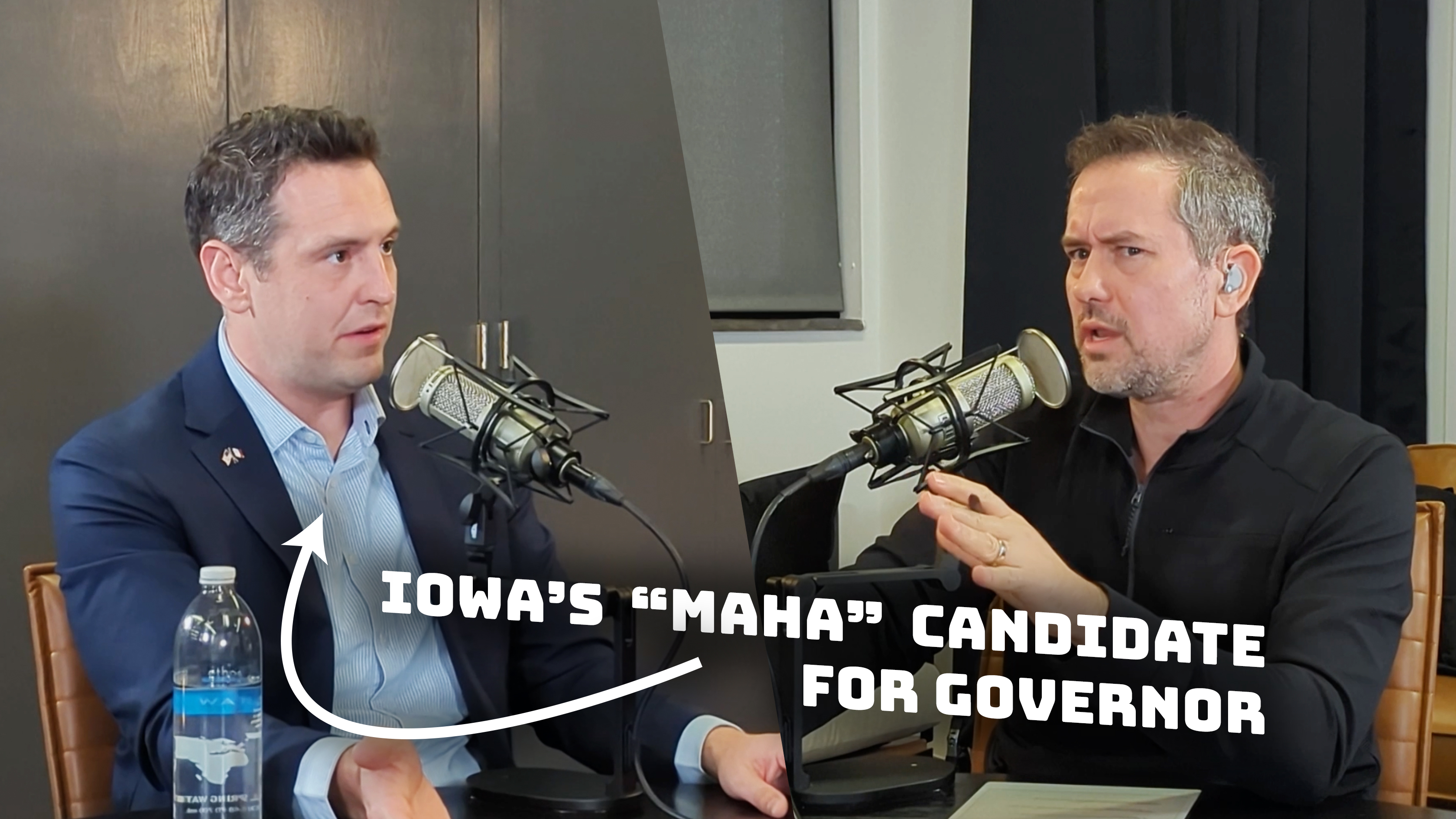


Zach Lahn is running for Governor in Iowa and is the first candidate to be endorsed by RFK JR’s MAHA Action organization. If elected, he intends to stop subsidies and veto incentives for big ag, actions that could anger likely campign contributors. Can he win without party backing if it comes to that?
Lahn discusses President Trump’s executive order protecting Glyphosate. Is a new rift forming between MAHA, MAGA, and the GOP? Are new battle lines being formed in Iowa? And can he convince Iowa farmers to lead the country in regenerative agriculture? With rising cancer rates and our kids fleeing the state, we can’t wait any longer.
Who is Zach Lahn?
Zach Lahn is an Iowa businessman and regenerative farmer. His campaign focuses on systemic issues including the state’s high cancer rates, the loss of 10,000 family farms over two decades, and the rapid out-migration of young residents. He argues that captured government agencies have prioritized multinational corporations over the health and economic stability of everyday Iowans.
Challenging Corporate Immunity and Agricultural Monopolies

Lahn takes a firm stance against “shield laws” that protect pesticide manufacturers from legal liability, promising to veto any legislation that grants immunity to companies like Bayer. He argues that such protections subvert the free market by denying citizens recourse for harm. A view two likely competitors, Adam Steen and Rob Sand didn’t share on earlier interviews.
Lahn goes as far to advocate for federal antitrust action to break up the “Big Three” agricultural giants—Bayer, Corteva, and Syngenta—which he claims have consolidated the market and exploit farmers. “No product should have immunity from liability, period,” Lahn stated during the interview. “Part of the free market is to give people the ability to have recourse if they’re harmed from a product.”
IEDA is currently advocating for incentives to get Corteva’s need seed headquarters in central Iowa—a move Lahn opposes.
Economic Incentives and Bringing Iowans Home
Critiquing the state’s current economic development strategy, Lahn pointed out that Iowa often provides “welfare” to profitable, publicly traded companies while homegrown businesses struggle to compete. He highlighted a massive data center project receiving over 500 million dollars in tax abatements for only 30 promised jobs as a prime example of “backwards” incentives. Lahn proposes diverting these funds to help Iowa graduates return to the state through down-payment assistance or bonuses. “Governors don’t grow economies; people grow economies,” Lahn noted. “How can we have our economy grow if we’re exporting our most valuable resource we have?”
Lahn went as far to suggest money currently given to large ag companies should be given to students to incentivize them to return. He didn’t give specifics on this plan however.
Hear from Iowans directly. No algorithms.
Don’t let the algorithms choose your news. Enter your email address to hear directly from Iowans leading news in politics, community, agriculture and business. No editing. No clickbait. No rage. No agenda.
Lahn, who operates his own regenerative farm, also advocated for “food freedom” laws to allow small farmers to process and sell meat locally without federal interference. He believes shifting toward regenerative and organic practices is a path to financial independence for the next generation. “My goal is to help Iowa’s farmers make more money,” Lahn emphasized, “so they don’t have to have an off-farm income job, and that they can pass their farm onto the next generation.”
Interview Transcript
This transcript was created with help from Ai. Please report errors to us and always refer to the video as your primary source.
Justin Brady: [00:00:00] Real Iowa’s real talk. No drama from the Jetro Barbecue Studio. This is the Iowa Podcast. Let me read you a quote to start this one out. I don’t care how low our taxes are, kids are leaving, people are dying of cancer. We’re not in successful territory. That’s of course a governor candidate referring to the state of Iowa, and that governor candidate is here today. That’s Zach Lane, the Maha candidate for governor. Can I call you the Maha candidate for governor? Yeah. Thank you so much for coming on this show today. It’s gonna be a great
Zach Lahn: Thanks for having me, Justin,
Justin Brady: Before we get started, everybody, if you like barbecue like I do, go to Iowa podcast.com. Scroll to the top of the page, click that banner, and if you buy a hundred dollars gift card from Jethro’s, they will send you a $30 gift card for barbecue. You should do that. Uh. Zach, obviously, thank you so much for coming in here. Really appreciate it. Um, first to kick it off, the, you were kind of considered, or I don’t even know if I think you self call yourself the [00:01:00] Maha candidate for governor or Maha endorsed, or what does, what does one need to do to become the official Maha person? But I also wanna ask, is there a rift that is developing between MAHA and maga?
Zach Lahn: You know, first I’d say that, um, I am the first candidate that’s ever been endorsed by the Maha Action Organization ever in the country. Yeah. And so, and I think there’s a lot of reasons for that, that I talk about on the campaign trail. I’m sure we’ll talk about here. But, you know, I think that, uh, as far as the rift goes, I don’t see that that much. I really see that, you know, I had a, a town hall meeting last night in Templeton, Iowa. Out of just over 300 people. We had 80 people show up to this town hall meeting. And one of the things that I got maybe the, the most, uh, accolades for was when I mentioned this endorsement by the Maha organization. And we are in, you know, uh, you know, MAGA territory there. So I think people are looking at this and both ways saying that it’s common sense to want our kids to be healthy, to have clean water, to have healthy food, and to [00:02:00] help our people stop getting cancer.
Justin Brady: Yeah, absolutely. But I think a lot of people think maybe there is a rift developing because with the executive order, Trump signed up on the glyphosate thing, and there’s a lot of nuance here that you’ve gone into in the past. You’ve been on Tucker Carlson’s show, you’ve been on Shawn Ryan’s show, you’ve been on some big shows and there’s, there’s nuance here about, there’s Glypho, glyphosate, and then there’s a blend of glyphosate we use. These are different. But was that kind of, uh, shot across the bow in a little bit of distancing from the GOP in Maha or MAGA In MAHA?
Justin Brady: I kind of wonder if there is a rift. Like what, what did, what did that signal to you, that EO executive order that essentially protected the manufacturer of glyphosate in the
Zach Lahn: Yeah. well look, I think that that. it’s very clear this is how big agriculture, wages war. It really is. I mean, we look at the, uh, attempts for immunity at the state level, and the legislatures, I think 22 states, they’re pushing for it. We see the farm bill provisions that they’re putting in for immunity. We see the executive order that’s out there and now the Darnell case where they’re pushing heavily. To, uh, petition the Supreme Court to throw these cases out. And you know, I, This is a common sense thing. Look, we can have the debate all day long about glyphosate and glyphosate based herbicides. I have talked extensively about that, and I’d be happy to talk about it here. But a very basic point is that. No product should have. immunity from liability, period. That is the lowest hanging fruit in this entire discussion, that if you make a product that harms other people, part of the free market is that [00:05:00] the people that are harmed should have Recourse. Right? That’s just a period. like very simple statement. We have to be able to say that whether it’s vaccine immunity or whether it’s uh, in the pesticide immunity or whatever product it is. Part of the free market is to give people the ability to, to have recourse if they’re harmed from a product. So when I look at this. I look at captured agencies across our government. You know, the EPA has been captured for a very long time, and there’s in-depth discussions that I’ve had about this, about how they’re captured, how they use mostly industry studies from the companies that are gonna be regulated to determine. whether or not they’re gonna allow a, a pesticide to be registered. And I think that we have to start to look at what people just expect. They expect the governing bodies, regulating bodies to be working on behalf of the people. Not on behalf of companies or corporations or multinational giants. They’re here. They were started and instantiated to protect the people. And that’s just what people are expecting. And I think, you know, in this campaign we’re [00:06:00] talking about a lot of very common sense things. Agriculture’s one of them. I run our family farm today. I love our farmers. They’re my family and neighbors. I am not wanting to make life harder for farmers. I’m wanting. our farmers to be told the truth and also to be able to know that. When it Does come out. in a major way that they’ve been harmed by these products, that they have the ability to seek recourse. And I think That’s just a common sense thing that people know that they should have. But, you know, our, our campaign has really been about four key systemic issues, and the number one of those is that our kids are leaving the state at a rate faster than 46 other states that that study came out last summer. Number two is that we’ve lost 10,000 family farms in the past 20 years. Our education system is now in the bottom half, and we have the fastest rate of new cancer of anywhere in the history of the world, Right. These are. systemic issues that are not right or left. These are just issues that affect the everyday lives of Iowans, and that’s what we’re running [00:07:00] on
Justin Brady: So the EO kind of resembles the SHIELD law we were talking about last year Trump’s executive order protecting glyphosate, and you’re probably aware of the shield law, but there was a shield law here in Iowa for those that need to be brought up to speed that would give pesticide companies and glyphosate manufacturers immunity from future cancer cases. So, I, I’m assuming, I guess I don’t know, but I’m assuming the same people are behind, both of them are the same entities.
Zach Lahn: oh, I, I,
Justin Brady: oh, I, I, don’t, I don’t know that for a fact, but I’m assuming so, yes.
Zach Lahn: yes, we, we know the entities that are pushing this, and we also understand the lobbying firms that are pushing this in Washington, DC and even pushing it in the White House. You know, there’s a group out there that was fo founded specifically for this purpose. It says it on their website called the Modern Ag Alliance. right? And they have, their, a
Justin Brady: a lot of ads locally
Zach Lahn: A hundred percent. And, And they’re not just doing it here they’re doing it all over the
Justin Brady: Mm mm-hmm.
Zach Lahn: On their website. it, it says they were started by Bayer. And when you look at the ads and what they’re pushing for it’s immunity from lawsuit. You know, I think there’s something important to understand. The [00:08:00] executive order was specifically about glyphosate. It did specifically mention immunity as well. There’s a lot of people that have said, you know, this is not, uh, immunity from liability. It’s immunity from supply chain disruptions and things like that that could happen from the Defense Production Act. That’s not true.
Justin Brady: That’s not true.
Zach Lahn: and It’s not true. because there isn’t anything that specifically excludes product liability. And a hundred percent we know that when these cases come up in the future After this point, meaning for production and harm that’s caused after this point. The defendants in the case will be entering that into evidence to say that we were told to maintain full supply for national security purposes. We Complied with this. We were, we’re protected under the Defense Production Act. I think it’s 7 0 7.
Justin Brady: Sure. So it, it is fair to say then that it some shield law, your governor of Iowa, fast forward and some shield law is proposed. Again, it’s safe to say you’d veto anything like that.
Zach Lahn: A hundred percent, yeah. It, it Wouldn’t, it wouldn’t even be a [00:09:00] consideration And, and look I am not calling for a ban on glyphosate. That’s not what I’m doing. I, I, there are products I do think need to be banned. I think it’s pretty collectively known that a product like Paraquat just needs to
Justin Brady: mm mm-hmm.
Zach Lahn: increases your likelihood of Parkinson’s. There’s been people who have sprayed it and got too much on their skin and literally died days later. It’s been used in poisonings around the world. It is a very harmful and toxic product, and it’s used on hundreds of thousands of acres in Iowa today. I just talked to a farmer the other day who’s told me his neighbor uses it on 20,000 acres every year. To desiccate it, to desiccate his crops at the end of the growing season. That’s not only a terrible product, but that’s the worst way to use it. So there are products like that. Glyphosate is the most ubiquitously used herbicide in the history of the world. It’s used everywhere. And one of the. issues that comes up with this product is not so much on the agriculture side. Our farmers in large part understand some of the risks that come with using products, especially, uh, you know, farmers today that have, you know, listened to a lot of the [00:10:00] evidence. But, uh, glyphosate Roundup and I, if you want me to talk about the differences there, about glyphosate based herbicides and, and glyphosate, I’m happy to do that. But, uh,
Justin Brady: I think people can research. Yeah, research that. But, but like, and you’ve talked about this, I would encourage anybody to go look at your previous interviews where you very, I mean, you get really in the weeds on glyphosate, why it’s different than Roundup and Paraquat. Um, but then Iowans want to know, ’cause you, you kind of hinted at this and you, you’re like, well, I don’t wanna do an outright ban. Yeah. And so. Some people in the Maha camp would be like, yeah, but that’s what we want. So what’s the solution as governor? Do you push for an outright ban to toxins and chemicals and pesticides and things that you think research is indicating are bad? Or do you simply remove incentives and say, look, we’re not going to incentivize this. We’re not gonna ban it either. We’re gonna let the free market decide.
Zach Lahn: Well, I think that. there’s, there’s two pieces there. One. The shield laws take away that incentive to be able to, to stop this. [00:11:00] So that’s the first reason why we have to make sure those don’t get passed. And then two, I wouldn’t, uh uh, you know, I would more say that one of the answers is to provide incentives for alternative paths. Look, one of the issues here we have in the state of Iowa is that our young people are not able to get onto farms, and by and large young people are looking at these products and farming in a different way. If we want to solve this in long term, and as Bobby Kennedy said, this is a long term issue that we need to solve. If we want to solve it, one of the things we’re gonna be looking at first is how do we get more young people onto farms? How do we promote regenerative practices in farming? Which there are plenty of practices and plenty of evidences things we do on our, we do on our farm today that we can be promoting the state. And he, and I think if you talk to, uh, family farms. One thing you’ll find is that so many of the incentives right now are geared towards the biggest producers. It should be the opposite way. We should be saying, how do we help start up as many family farms and keep as many family farms in the game as we possibly can? Mm-hmm. And. then [00:12:00] provide off ramps to different types of farming. Look, you know, this is a very interesting discussion that we’re having because, you know, often my discussions tend towards agriculture, and part of it is because. Iowa’s in agriculture state. My family’s been involved in agriculture for
Justin Brady: The entire economy revolves around agriculture here. Yeah.
Zach Lahn: But, what I often talk to people about is that. You know, we have two issues here that are coming up for our farmers that involve these same companies. The first issue that farmers will talk to you about every day is that these same companies that are, that are, uh, producing these products that we’re talking about are also overcharging our farmers on inputs. Mm-hmm. and they have been. for decades, they’ve been consolidating every part of the industry to the point where there’s now about three companies that control 85% of the input market. Where when I was growing up, when you were growing up, there’s three to 400 companies that were operating in the state, and we could all name different products that we can remember from funk seed, even Pioneer, who’s got bottom now. And so farmers understand they’re being exploited financially by these [00:13:00] large, large agricultural companies. What I’m trying to say is that we’re also being lied to about the safety of the products, and so That’s where we have to go. with this and provide off ramps to other types of farming because, and to finish this point here. Regenerative type of farming, organic. type of farming. Like these things also allow farmers a way out from under the thumb of these companies because you don’t have to use as many products or any of the products Our farm uses none of them today.
Justin Brady: And that’s something I, I definitely wanna go into detail with on how we make that transition. Like, you know, but, uh, real quick, there isn’t, like, I think Debbie Durham at, uh, IEDA, the State’s Economic Development Office is really pushing hard to get Corteva here. This is one of the companies that I think has come up in your interviews before. And so, and of course, uh. Neither right nor wrong, but they are pushing for state incentives to get it here. So is is it more. Is this one of the reason that some of these [00:14:00] big food companies, big ag companies, we talk about, is this what you’re referring to when you’re like, no, the free market is really not at play here because it’s, you’ve talked about this in the past, it’s incentives. So again, if you were governor, would you be like, Hmm, no, we’re pulling the rug out from that deal. We are not gonna provide any incentives to seed companies or big food or anybody where, where’s that line drawn?
Zach Lahn: Yeah, I think, I think, um, we have to start looking. this from an Iowa first perspective, and I’m gonna talk about what that means to me, but. This, This issue you’re bringing up is one that I hear about all the time on the campaign trail, and Corteva is one of the three big companies, Bayer, Corteva, and Syngenta. And we can get into that in a moment, but I think what we have to understand here is that We already have the right incentive to bring a company here, especially an agricultural company. And that is we produce some of the best graduates to go work for these companies that they could find in the country Any of the time, you’re an Iowa, uh, if you’re an Iowa kid and you’re going out to Denver or Nashville or Austin, [00:15:00] and, uh, an employer finds out you’re from Iowa, what do they say? We love hiring Iowans. They have great work ethic. They, they take responsibility. They’re not, they’re not afraid to work late and work hard. We already have the resource here. that they want. And so when I look at what’s happening with our Iowa Economic economic development dollars, I think some of this is backwards. And here, here’s what I mean by that. I mentioned on a previous podcast that Syngenta, Chinese owned company has gotten, you know, about seven and a half million dollars in refundable tax credits from the state of Iowa. John Deere has got a hundred million over the past 20 years. They’re sitting on, I believe, around 40 million that they haven’t even, haven’t even used yet. All the while we have homegrown companies that have been here for generations that are having to compete against these companies and those homegrown companies. we don’t have to convince to be here. Mm-hmm. They just want. to be here. Matter of fact, they would do everything they can to stay and be profitable and employ as many islands as possible. So
Justin Brady: So we’re funding their competition
Zach Lahn: right. And here’s what I say when it comes to me as governor. I [00:16:00] understand the reason that we’re looking at this, but I think we’re looking at two, in two short term of a fashion, meaning, yeah, it sounds great to write a press release that we’re gonna be opening up this new place for this multinational, you know, publicly traded company. But if we look at this from an Iowa first perspective, we have to say, how do we invest in an Iowa company first? How do we invest in Iowa companies to, to compete with these companies? Because by the way, they are trying constantly to put these guys outta business. Mm-hmm. and we’re funding them. And so I, I just heard from a seedsman the other day that, um, he, he got a letter, and there’s an article written about this now, where these companies, these big three companies are telling them that they’re gonna have to start providing their client lists, their customer lists to them. Oh, if they want to continue. to do business, what company would ever provide a competitor? Their client list, it wouldn’t happen. They’re monopolistic practices. So when I look at those big three companies, I think they need to be broke apart with antitrust suits. Really? Oh, a hundred percent antitrust. Okay. Yes.
Justin Brady: you don’t think it’s, um, um, just a matter of [00:17:00] removing incentives, you actually think it’s breaking them apart with antitrust from a federal level,
Zach Lahn: they’ve already consolidated past the point of monopoly or duopoly. They already have. You know, I talk about this, you know, Teddy Roosevelt’s, one of my favorite presidents. He broke apart JP Morgan and Standard Oil. He did the right thing. even in the face of industry. I think if you go back in Iowa’s history, and you look at our, our proud history of the pioneers that were here, you know, we had. A big effort on, again, from against settlers and speculators of land. And then, you know, the Settlers were coming in here improving the land, building it up, pulling the rocks, cutting the trees, doing all this work, and then the speculator come in with an attorney and they would say, no, we actually have a claim to this land. And they would tie them up in court. They couldn’t win, and they’d take the improved land away from our, our ancestors. And so what happened from that? You had people like James Harlan that cropped up and, uh, other US senators or or politicians from Iowa that ran for office. With the purpose of defending the people, that is the history of our, of our state, is that [00:18:00] people rose up to defend the citizens. We now see politicians time and time again rising up to defend the companies, and I’m, here to defend Iowans. And I’m not saying. that as a cliche statement. That’s why I would say we need to break apart these companies because it’s just like what Teddy Roosevelt did. He did it for the betterment of the economy and the people.
Justin Brady: is it also safe to say then, just to go back to the original question that you would not support and you would again, veto any bills, any economic development incentives for larger companies like this?
Zach Lahn: I think we. have to look at, uh uh Yes, and I, you know, it’s hard to put a blanket statement there, but I think that
Justin Brady: there is nuance, right? Law is not a statement you can make in a podcast, but you know, generally what I’m hearing is that there may be laws in your term as governor that favor that, say, Iowa companies go first, and then if it’s something we need, yada, yada, yada, fine print, then we can look at national
Zach Lahn: Yes. And by the way, I think a lot of Iowans just think that’s what’s happening, meaning like that’s what they expect. to happen from our politicians is to say, we have a third [00:19:00] generation seed company that’s having to com compete against these giant conglomerates. We need to be on their side because they have a faithful presence in our state. When things go tough, go bad and get tough in the economy. They’re gonna do. everything they possibly can to keep Iowans employed. To remain a profitable business in the state of Iowa. Meanwhile, we see some of these large companies in the meat packing some of these large companies and, and, uh, and implement manufacturing that when things are tough, they’re just cutting jobs because it’s just a, a cell and a spread, uh, an Excel spreadsheet. Mm-hmm. That’s what it is. But when you look at these other companies that have a faithful presence in Iowa who have employed Iowans for generations who, whose family have history here, they are going to take a hit themselves to try to keep as many Iowans going as possible.
Justin Brady: you mentioned young people getting onto farms. I wanna talk about you, you obviously are a regenerative farmer yourself. Mm-hmm. Um, we can, I would probably encourage people to Google what a regenerative farmer is. We don’t, ’cause that’s probably a 15 minute show by itself. But, um, I’ve had, we’ve had on this [00:20:00] network, uh, at to your point, a lot of younger people are really getting into organic and regenerative farming and. You are suggesting that that is a actually a challenge here due to the fact that a lot of young people are being locked out of farmland. So that’s a whole issue on, in and of itself. But right now, ’cause again, we’ve had organic farmers in here and right now, Iowa organic farmers. We’ve had them in the studio, and I think it’s something about 70 to 80% of Iowa land, I think it’s a little higher, are being sprayed with synthetic fertilizers and pesticides and herbicides. And I don’t know this, but I have been told that telling a farmer who’s using conventional, I don’t even know if we can call it conventional, but um, like spray stuff for fertilize, you know. It’s like a two year period where they just kind of have to leave the land alone. I don’t know if that number’s exactly right. You may have a better number. It’s three year. Oh my gosh. It’s three years.
Zach Lahn: The third year you can sell your product?
Justin Brady: How do you convince farmers who are already razor thin [00:21:00] margins? And many of them say, yeah, I mean. Okay, Zach, I get it. I, this is something I want to do, but dude, I can’t, I can’t just blow three years of revenue. So how do we convince the state of Iowa that could lead a regenerative farming, um, like frontal assault? How do we Yeah. Revolution. How do we convince them? Thank you. You can, do you wanna interview me now? How do we convince Iowa farmers to make the regenerative jump when it’s like a three year downtime?
Zach Lahn: Yeah, well, gosh, this could be a 40 minute podcast in of itself. It could. I love talking about these issues because, you know, I think the more people understand about where I’m coming from this, it’s not a radical thought, and I’m not saying everybody has to farm like me. My goal is to help Iowa’s farmers make more money, and I want them to be able to make more money so they don’t have to have an off farm income job, and that they can pass their farm onto the next generation with, and also support two incomes, you know. We had a heritage in our state for a very long time where grandpa would be farming, he’d [00:22:00] retire, move into town. Often this would happen to my family, and then son would live in the farmhouse and farm. And both fam, both parts of the family would be supported by the farm. Income. That doesn’t exist anymore. It just doesn’t, unless you’re a very large producer. Doesn’t exist. We’ve seen farm bankruptcies in the Midwest increase by 70% in the last year that this is a cliff we’re approaching and there’s many things we can talk about with this, but. When I talk about these things, I go back to how do we make more money, live healthier lives from our state and and prioritize the long term of Iowa? Because losing 10,000 family farms in 20 years is the wrong way, and my entire life, every politician said We have to support farmers, we have to support farmers. Everything has gotten worse for the actual producer. So when I’m looking at these off-ramps, I’m specifically looking at ways that we can help our farmers make more money. Going into regenerative organic is one of those ways, and I’ll, I’ll, I’ll talk. It’s not the only way, but I’ll talk about this a second. So, yes, it is a three year process. A third [00:23:00] year, you can sell what you’re growing as organic. And for the longest time it was the case that yes, you have to farm, uh, uh, you know, without chemicals and, uh, and so you’re, you’re gonna have a lower yield, you’re gonna have higher weed pressure, you’re gonna have increased cost, and you’re gonna have a, a, a lower take when you’re going to sell your grain. There are programs now out there that will actually help pay for this entire transition through the USD and the NRCS. Wow. Yes. There’s actually a program called, the 8 23 program that will help pay, and it actually pays a decent amount to cover that transition period because when you get into the actual organic growing and you know, I often don’t talk about that I even grow crops organically and not for any reason other than that, it’s a personal choice of mine. This is some, this is the Way I would like to farm and I’m not here to mandate how people farm, But I will tell you. I was actually just looking at our, our, um, report that we got back from, uh, from where we sold our grain [00:24:00] this year, uh, or last year in 2025. And, you know, our yield on corn is less, you know, you might get 2 20, 2 30 bushels an acre. You can get higher than that if you’re in a good year unconventional. And we’re 180 somewhere in there. But we’re also selling some of our gr, some of us sold for $10 a, a bushel last year, where conventional might have been three to four. And on our soybeans, you know, we, we grow organic corn, oats, soybeans, and alfalfa. That’s where we grow. Right now, we’re actually moving to more animal input and having more cattle on the ground. But we’re first, you know, transitioning the ground, all the ground. And then also putting in Native Prairie is one thing we’re doing. But on our organic soybeans, you know, we had, uh, an average of 65 bushels an acre last year. And on that we, uh, when we end up selling, we’re at $22 a bushel where the conventional price was around 10, and they’re also getting around 60 to 65 bushels an acre. So I think that there’s been an effort, and I think it’s been by these big agricultural companies to make it sound like anybody that’s doing it in this way. It just doesn’t work and [00:25:00] it’s a path to, you know, insolvency or something like that. And There are examples of people. who haven’t done this the proper way, who think, oh, they see the higher price and say, you know what? We’re gonna go to this. It’s gonna solve all our problems. And we are, but we’re already running a, a farm that’s not running well. We’re not, we’re not doing good business. We. You can’t, organic isn’t gonna fix bad business practices. You have to be a good business person. But so we see this and it’s one, it’s one way, but there’s also, like you said, there are a lot of people that are wanting to get into this, to sell locally. And one thing I will mention is I wanna push for food freedom laws in the state of Iowa. You know, when my was raising hogs in the barn on our farm, he would raise hogs, butcher them on site, package it, and go sell it to a local market. That’s illegal today. Completely illegal, even for small farmers. And so we have to start to deregulate on this side to say, we’re gonna, this is a part of our history and heritage as a state that we can grow in, in, in small farms and sell to our neighbors and not be criminals.
Justin Brady: is that state [00:26:00] or federal?
Zach Lahn: Well, it’s You, it’s, there’s, there’s a nuance in there. Both the federal has regulations on packing plants, and then the state has their own regulations on packing plants. And, and we as a state can decide if we’re gonna sell only within the state what those regulations can be.
Justin Brady: So we can kind of shield local citizens from federal law and say, if you’re gonna sell locally, go for,
Zach Lahn: Yes. And there’s other states. that are leading on this, and Iowa should be the number one food freedom state in, in the country.
Justin Brady: Fascinating. Yeah. The, um, I, I think a lot of people don’t understand the under workings of the fact that if you are a local farmer and you do want to sell, like I, I bought from a local farmer years ago and he, he straight up said, now you can’t say I’m selling this to you. I’m giving this to you as a buddy, you know, and you’re, you’re basically just comping me for my time and. Okay. I don’t, you know, I don’t understand what we’re talking about here. Um, so I, I wanna jump to probably last few questions here is if you are either vetoing laws, and, and again, there’s nuance here. I’m not gonna, you [00:27:00] know, listen to the whole interview here, if this gets clipped, listen to the whole interview. But if you’re vetoing,
Zach Lahn: ing, that will get clipped out. yeah, it’s gone. Um,
Justin Brady: if you’re vetoing. Hypothetically, if you’re vetoing like glyphosate laws and Stu Shield laws and these kind of things, and you’re getting rid of incentives for Cartiva or Bayer putting more plants in Iowa, something like that. Mm-hmm. There are some entities that aren’t too happy about that. Which would be, which would be basically everybody’s donors. And so let me give you a few examples. And I don’t know if these, if these candidates have these people as donors, but I ask. Uh, Adam Stein and Rob Sand, two very high quality individuals. Uh, I respect them both highly, but I did ask them both about the Glyphosate Shield law and I was like, is this something that you’d say, no, we’re not doing shield laws. Both of them didn’t want to answer that. Mm-hmm. And so this goes back to I was like, wait a minute. I’ve had a lot of people in here and I’ve had a lot of on both sides, and [00:28:00] some Democrats are like. And like almost pro Maha, but then other Democrats are anti Maha. They wouldn’t call it this. Same as on the Republican side. Some are pro Maha, some are anti Maha. So I feel like battle lines are being drawn here in in the country over health. And I’m not sure which party falls on which side. So I do wonder if a candidate like yourself that prioritizes these things has a high likelihood of being hung out to dry by both parties. So if you aren’t taking money from these organizations, and if you aren’t supporting these organizations and you win the GOP primary, are they gonna fund you at all or are they gonna hang you out to dry?
Zach Lahn: You know, that’s actually not something I’m really concerned with. I really believe that there’s enough people in our state and enough people in our country that would like to see the things that I’m, I’m, I’m advocating for. And I will tell you, you know, I think that politically speaking and like, like when I hear that, you know, those two candidates won’t [00:29:00] take a stance on this. It’s kind of like for me, politically speaking, it’s like, well, That’s a benefit to. me because I talk to the people on the ground and I know that this is something they don’t want to have happen. It’s actually, like I said, the lowest hanging fruit. The shield laws are wrong and it’s, you can talk about it from a health standpoint. You can talk about a freedom standpoint, the free market standpoint. The courts are a key function of the free market. Civil liability is a key function of the free market. Our citizens deserve to have protection, and so when I look at this, I’m looking at for the sense of this isn’t right or left. To me, this is common sense. You know, I’ve had so many people come up to me in town hall meetings. I’m an independent, I’m a Democrat. You’re the first repre. A guy last night said to me, uh, you’re the first Republican I’m ever gonna vote for. And this was in a small town, small community where I touched on some very hard subjects. Other people won’t, won’t talk about including things like water quality, uh, like farming practices, glyphosate, all these things. People are wanting to be told the truth. They’re [00:30:00] tired of politicians saying they’re gonna punt on answers, uh, because it’s because of what you say. It’s because they’re wanting to get this donor money and industry money. I’ll just tell you this as governor, I’m gonna be very pro business, but we also have to be smart and I’m gonna, I’ll, I’ll maybe end with this type of story on this question. Is that South of Cedar Rapids right now, 1400 acres of Iowa farmland had the top soil ripped off of it, and when you drive by it, it looks as if a military installation is going in. I’ve never seen anything built so fast. ever. There’s more heavy machinery there than I’ve, than I’ve ever seen in one place. It has to come from all over the country. I would assume Google and QTS are putting in two giant data center installations. QTS alone was given $529 million in property tax abatements for that, and they’re contractually obligated to create 30. jobs. You know, I could probably punt on something like [00:31:00] this and then go to one of these companies and say, Hey, I, you know, I, I, I need campaign money, but it’s wrong. It’s the wrong way to do this. It’s not putting Iowa first. It’s saying that those companies are wanting something from us and we have something to offer. This is all a negotiation. How do we make it more competitive for Iowa kids to stay here? How do we compete against other states? What Are we doing to. promote the state of Iowa? And so when I look at something like that, it’s like, why do they want to come to Iowa? Because we have the climate that helps them have the lowest cost, uh, lowest cost in their business. That means we are in the bargaining table here. So I would say instead of reducing their property taxes, I’d raise their property taxes. I’m not saying you, you can’t come here, but if you’re gonna come here, we’re gonna use those funds to lower property taxes for the people in the communities
Justin Brady: For locals.
Zach Lahn: Yes. And we just have to start thinking in a smart way about how we negotiate from a business standpoint. You know, I talk about our Iowa’s kids leaving all the time, and I’ve said I’d love to find a way to give [00:32:00] bonuses to Iowa graduates of Iowa high schools that have moved away to come back home. And so when I say that people like, look at me as if I, you know, I, they haven’t heard something like that before. I say from a business standpoint, every time one of those kids leaves four and a half million dollars of lifetime earnings and $400,000 of tax revenue leaves our state. If you’re a remote job, I want you to come back home first. If you have been trained in the trades, I want you back home. We need those people.
Justin Brady: But do you talk, I mean that’s kind of, some might say that’s anti-free market though, incentivizing individuals to come back. So is the incentive just making a better state environment or is the, uh, interim incentive incentivizing individuals to come back with like scholarship programs or something like that?
Zach Lahn: There’s many ways we can look at it, but I’ll tell you this. That’s an interesting way to look at this, but I’ll say we are currently giving welfare to publicly traded companies.
Justin Brady: So divert it,
Zach Lahn: We, we we’re, we’re, giving, we’re giving funds to very large multinational conglomerates that are making hundreds of billions of dollars in profit. And then what I’m just saying is, Hey, [00:33:00] what if we help an Iowa and come back home and maybe have a down payment assistance on a home for being here over a long period of time to make life more affordable, to be around grandparents and go to, you know, uh, Friday night football games and things like that.
Justin Brady: yeah,
Zach Lahn: I want to advocate on behalf of the people of Iowa, and by the way, that makes business sense. As soon as they leave, we lose all that tax revenue. When we get them back, we gain it. So if you have 50,000 or a hundred thousand dollars, we’re still 350,000 or uh, uh, $300,000 in in the black. We’re still doing great and we’re building our culture. We’re, we’re bringing Iowa’s kids home because I’m asked this question, how, how are you as governor gonna grow the economy? And the very simple answer is, governors don’t grow economies. Often politicians and governors get in the way of growing economies. People grow economies. And how can we have our economy grow if we’re exporting our most valuable resource we have? The last thing I’ll say in this is, I saw today a stat that said Iowa has the 10th highest property taxes in the country. And the first [00:34:00] thing I look at on that, especially in rural areas, is how are they calculating that? Because in our rural areas, what’s happening is we are trying to provide the same amount of services with fewer and fewer people. So the burden per capita is going up. We have to grow, we have to bring people back to these communities, and that’s what I’m focused on, is bringing Iowans home and making Iowa the most family friendly Iowa business friendly state we can make it.
Justin Brady: So last question, I said 30 minutes. We’re just a hair over that. But last question would be, does the MAHA agenda also apply to processed foods, water quality? Are there any things you would immediately put in place if you become governor in those areas?
Zach Lahn: Well, I think. it, you know, the interesting thing about the Maha agenda is that, um, you asked a question earlier that didn’t answer, not on purpose, but it’s how, how do we, we’ve just been talking a lot how, like, How. does one become that candidate? And this is just the way we live our life. You know, we, we try to eat healthy food. We try to make sure our water’s clean. We try to make sure we’re, we’re cleaning up after ourself and, and helping [00:35:00] the environment. We’re doing projects on our farm right now to restore creeks. ’cause they’ve been washed out and we’re trying to, you know, install things that will help improve our own water quality on my own land. And so when I look at this, I think it’s, you know, Maha’s a term that came out recently. But this is just people who understand that we are being called to steward creation. Whether it’s the land, the people, the animals, the environment. That’s what we’re called to do. And I feel that’s my call. And so yes, it applies to. Uh, whether it’s water quality, like I’m, I think we need more water quality testing stations, more like our citizens deserve to know what is in the water they’re drinking so they can take the necessary precautions to protect themselves if something’s bad, and but also so that they can hold people and politicians accountable if they’re not doing the right things to make sure they have clean drinking water. It’s just a basic foundational thing. Iowans deserve to be able to count on.
Justin Brady: Zach Lane, candidate for governor here in Iowa. Zach, obviously appreciate you being here. What is the [00:36:00] website if people wanna follow along?
Zach Lahn: it’s zach lane.com. Z-A-C-H-L-A-H n.com.
Justin Brady: Zach Lane, thank you so much for coming on the Iowa
Zach Lahn: thank you. It was great.