

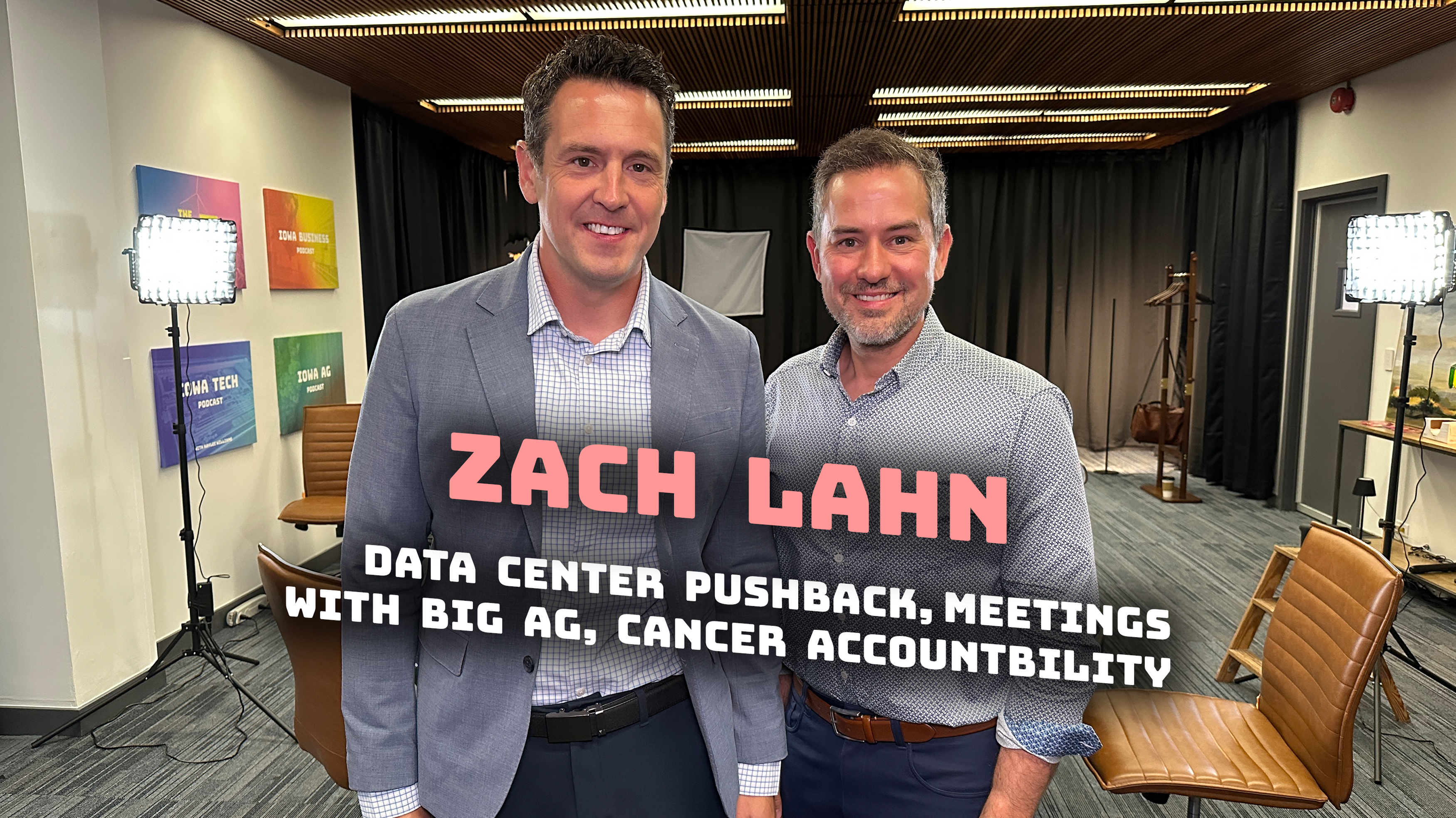
Sand and Lahn debated Oct 14 on KTIV in Sioux City. Watch the debate replay on KTIV. Next up: Oct 27 on KCRG. The Iowa PBS debate has been cancelled. “On Oct. 23, the Lahn campaign published a statement saying Lahn had accepted an offer by Iowa PBS to reschedule its debate to Oct. 29, and he also planned to attend the KCRG debate Oct. 27,” reports The Des Moines Register’s Brianne Pfannensteil. “Shortly after, the Sand campaign said it had not agreed to both debates.” Here’s the full interview.


Businessman Zach Lahn surprised the state of Iowa getting the GOP nomination for Governor but before Iowans can vote for him, they have questions about the permanency of his data center “moratorium,” what was discussed in his meetings with big ag he mentioned on Iowa Press and if he will take a hard stance against them if elected.
Lahn is also asked about if he aligns more with the Democrat running for Secretary of Agriculture, and is asked if the Environmental Protection Agency (EPA) is a captured entity, as he has claimed, will he make an Iowa-focused version of the EPA with individual labeling requirements like California?
Zach Lahn on specific issues
- Supports a statewide pause/moratorium on new data centers until proper rules, local negotiations, water protections, power-rate safeguards, and fair-share payments are in place.
- Will bring antitrust suits to break up consolidated Big Ag companies (inputs, nitrogen, meatpacking).
- Will encourage direct state resources and stackable incentives (via IEDA and related programs) so farmers can profit by adopting practices that cut nitrate runoff into waterways.
- Makes the case for, and supports a ban on paraquat.
- Will require/expand independent Iowa state research and testing of agricultural product safety (beyond relying on EPA/company data). Essentially an “Iowa EPA.”
- Pushes for legalization of on-farm butchering and direct-to-neighbor meat sales.
- Wants to create a new “investment ag land” property class with higher tax rates on out-of-state/investor-owned farmland, while preserving exemptions for resident Iowa farmers.
- Will redirect economic incentives to prioritize Iowa-headquartered, multi-generation companies over branches of out-of-state firms (and condition incentives on moving HQs to Iowa).
- Work toward a goal of at least 80% of public-school food being grown in Iowa.
Lahn on Iowa Data Centers and a “moratorium”

Iowa data centers and a general fear of Ai technology have dominated the news cycle as of late and Lahn has commented the state must consider a “moratorium” on data centers. We asked what exactly that means and his long term vision.
“ In my view, a moratorium’s a pause. And, and the reason why, and I’ve said this, uh, from the beginning, is that the rules of the game haven’t been set properly,” Lahn said. “ If you look on the ground in local communities and counties and county elected officials, you’ll realize that. Some of these counties don’t have comprehensive plans in place about where they want to put a data center.”
Lahn is pressing for local pauses on data center developments to protect taxpayers and infrastructure. Citing a Brookings Institution study where a Virginia data center drove up consumer power rates by 32 percent, Lahn warned against rushing into unscrutinized deals. He highlighted a project south of Cedar Rapids that secured $529 million in property tax abatements while requiring just 30 long-term jobs. Lahn insists counties need comprehensive zoning plans before approving facilities. “It is incumbent upon us to negotiate properly, but we have to make sure we’re protecting water quality, we’re not having increase in power rates, that, uh, we understand the proper land usage,” Lahn stated. But how involved would a Lahn administration become in this debate if a data center didn’t want tax incentives or special treatment?
Lahn was asked if his position would change if tax incentives were removed entirely, but his response indicated it still might not get immediate approval. “ It’s not just tax incentives, it is the environmental concerns, and there are real environmental concerns,” he said. “We have a water quality crisis in this state, and when you’re not using a closed loop system, you are running water through to cool your, cool your operations,” he said emphasizing the need for clarity up front before any state permit approval.
Tackling Water Quality and Agribusiness
Lahn linked Iowa’s elevated colorectal cancer rates to high nitrate levels in waterways, calling for targeted state incentives to help farmers reduce agricultural runoff. Pointing out health risks from chemicals like paraquat—which Syngenta is phasing out globally following thousands of Parkinson’s-related lawsuits—Lahn reaffirmed his support for state-backed safety research and antitrust suits against consolidated agribusiness conglomerates. “We have to clean up our water. We just have to,” Lahn emphasized. To diversify farm income, he advocated for ag-tech innovation, expanding direct-to-consumer meat sales, and mandating that 80 percent of food served in public schools be grown locally.
Hear from Iowans directly. No algorithms.
Don’t let the algorithms choose your news. Enter your email address to hear directly from Iowans leading news in politics, community, agriculture and business. No editing. No clickbait. No rage. No agenda.
Reforming Property Taxes and Food Systems
With roughly a quarter of Iowa farmland owned by out-of-state investors, Lahn proposed establishing an “investment ag land” property class to levy higher tax rates on out-of-state funds while protecting local farm families through targeted exemptions. He argued that decentralizing food production offers far greater community safety and market accountability than relying on multinational corporations. “The solution to a lot of these problems that they’re talking about is decentralization, is local control, is local food systems and food sovereignty within local communities,” Lahn said.
Interview Transcript
This transcript was created with help from Ai. Please report errors to us and always refer to the video as your primary source.
Justin Brady: [00:00:00] From the Jethro’s BBQ Studio, it is the Iowa Podcast. And surprise, Zach Lahn is the GOP gubernatorial nominee here in Iowa, and he joins us today to talk about the run. Last time you were in here, Zach, it was, you were facing off against quite a few GOP, uh, contenders, and now you’re the nominee. And so we’re gonna talk to you all d- all today about stuff maybe we didn’t get to last time, but also some new things that have come up in the campaign.
So thank you for coming back on the show.
Zack Lahn: Thanks for having me on
Justin Brady: Absolutely. Quick reminder, everybody, go to Iowapodcast.com, scroll to the top, click that banner, and if you buy a $100 gift card to Jethro’s, you’ll get a $30 gift card. It’s pretty cool. Um, like I said, we– I don’t think two hours is probably enough, but we have to limit it ’cause people have attention spans these days.
So, um, let’s start off with something that kinda came up a little bit stronger after the interview, which is– And h- [00:01:00] honestly, as a tech guy myself, I’m surprised this is news. I’m surprised people care, but I like that they care. Data centers. I never thought I’d be talking about data centers , but here we are.
You have said multiple times, “We need to have a moratorium on data centers.” People have taken that two ways. People have taken it as moratorium, pause. People have also said, “This is one of those bans that looks like not a ban.” So is it a ban? And what are we banning, and why?
Zack Lahn: Well, in my view, a moratorium’s a pause. And, and the reason why, and I’ve said this, uh, from the beginning, is that the rules of the game haven’t been set properly. And I think if you look on the ground in local communities and counties and county elected officials, you’ll realize that. Some of these counties don’t have comprehensive plans in place about where they want to put a data center.
And so my, my view on it is very simple, which the good news is I see some of these larger companies now, I’ve actually had conversations with some of the, some of them, saying, “We get it. We wanna pay our fair share.” And I’m saying, “That’s a great start. Let’s do that.” Now, what can we [00:02:00] do if we’re going to allow something?
If a local county wants to allow this, what can you do to sweeten the deal to benefit the community? And I think there’s ways that they can do, do those things, but we have to think about it this way. It’s not very often that some of the largest companies in the world are knocking on our door wanting something from us.
It is incumbent upon us to negotiate properly, but we have to make sure we’re protecting water quality, we’re not having increase in power rates, that, uh, we understand the proper land usage. Where should these go? They shouldn’t go on the most valuable farmland, that’s for sure. And we also need to make sure they’re paying for their power, so it’s not increasing utility rates.
You know, Brookings Institute did a study, I think in Virginia early on, that one of these, uh, large centers increased, uh, consumer rates by 32%. And that, rightfully so, set off a lot of red flags. And so now there are conversations, ’cause I’ve been in them, about, uh, these companies and local elected officials saying, “How do we negotiate properly?”
The companies saying, “How do we pay our fair share and make sure we’re a welcome member of the community?”
Justin Brady: So how much of a role does government play in that though? [00:03:00] Because, and, and here’s the big question is just looking through past interviews, there seems to be a distinction, maybe there’s not, you can correct me if I’m wrong, that’s why you’re here. There seems to be a distinction on these data centers in Iowa about tax subsidized data centers and just free market data centers.
So if a large company, uh, I’m not gonna name any large companies, but if a large company wants to come into Iowa and build a bunch of data centers, and you’re governor and they say, “Hey, uh, Governor Lahn, we don’t, we don’t need anything from you. We’re just gonna build a data center. We already bought the land.
We’re all good.” Are you saying, “That’s totally fine. My concern as a possible governor in Iowa is when tax subsidies are going to them”?
Zack Lahn: Well, I think there’s both. I think number one, on the local level, the counties have say over this, over zoning and permitting and all, all of these things. The state also has some permitting, uh, authority as well too, and that local control should be there. And so right now I think there’s maybe nine, uh, counties that have put in place moratoriums, temporary pauses.
Linn County put one in for 18 months, and I think that’s, uh, one of [00:04:00] the… One of the items I read was that they’re looking at upwards of 30 new buildings that are being proposed for data centers. And so when you see something like that, and they’re happening at a breakneck, neck speed, you understand why the local citizens are saying, “Hold on a second.
What’s even happening here? Do we want this in the community? If so, what’s the deal that we’re making with them?” And I fully support the counties to make the deal that’s best for the community. But right now we’re not doing that. I mean, the one near me, south of Cedar Rapids, they received 529 million, over half a billion dollars in property tax abatements, and contractually the trigger to get that money, uh, is 30 long-term jobs created.
Zack Lahn: [00:05:00] [00:06:00] And so- Right. Yeah … now, now when you see these companies coming to the table voluntarily because they see the narrative shifting because of not just our message, but the people on the ground that are so passionate about this, they’re saying, “We get it. We don’t want any more incentives. We wanna pay our fair
share.”
Justin Brady: yeah, and I– which is great, but just to a-a-add a point onto this, uh, if tax incentives are off the table, are you okay with data centers?
Zack Lahn: Yeah, we– I think there’s a
pro- As long as they’re not being
Justin Brady: long as they’re not polluting and stuff, you know, the obvious stuff
Zack Lahn: It’s not just tax incentives, it is the environmental concerns, and there are real environmental concerns. What I would love to see happen with a data center if they were gonna come to Iowa, look, we have a water quality crisis in this state, and when you’re not using a closed loop system, you are running [00:07:00] water through to cool your, cool your operations.
I would love to see as a part of what these data centers are doing is offering to, uh, put in place, uh, water purification to denitrify the water in the communities that they’re in, and then have, uh, what’s going to the municipalities already have those, those nitrates removed. And I think that if we can find a way to, uh, incorporate solutions like that where it’s a major benefit to the community, then the communities absolutely should have the right to choose what they’re doing.
This is, in my view, uh, this is a county level decision that needs to be made. I do support counties that want to put a pause on these projects, and I fully understand it. I would want to in, in m- our county already has one, but I would want to if I was one of them as well
Justin Brady: Yeah, you mentioned that you’ve had conversations with some of these tech companies. I’m not gonna ask you about those. But, um, what has changed since you were running, or I guess you’re still running, what has changed since you got the nomination is it sounds like you’re now having conversations with, uh, larger companies and people who are interested in working in Iowa.
One of those, I think it was Iowa Press, you mentioned, uh, that [00:08:00] you’ve had some great conversat- great meetings with these groups when talking about big ag. So we have gone from, not gone from, but earlier when you were in here, you were talking about antitrust, like breaking them up antitrust, and, uh, Corteva, Bayer, and Syngent- Gentner, three names that we discussed, I’m pretty sure.
We’ve m- moved from, and this isn’t bad, but we’ve moved from breaking these companies up with antitrust to having great meetings with these groups. What are these meetings about? And were they adversarial? Were they conciliatory? What was
Zack Lahn: let me be very clear. We still need to bring antitrust suits. None of that’s changing. I mean, we have seen consolidation in the agriculture industry, uh, maybe far more than any other industry, outside of some of the financial, uh, finance, uh, consolidation. But when we’re talking about the large input providers, the nitrogen providers, when we’re talking about meat, uh, you know, meat packing facilities.
But there’s… Like, we still need to bring antitrust suits. That’s not changing. But the question is, you know, as I’m going out to share our message, it’s a very different type of message [00:09:00] when it comes to agriculture. But I think what, what has happened is there’s been some thoughts that, um, that maybe some of the positions would be changing away from some of the, uh, uh, ways that we, uh, are, are doing agriculture.
And some of that is true, but it’s not exclusive of ways that we are currently farming. I fully understand. We have a biofuels industry, and that’s provided a tremendous amount of, uh, jobs and, uh, growth to the state. But at the same time, what I’m trying to do is very simple, is say, there are people who wanna have regenerative farming options.
There are people that wanna start, uh, you know, rotationally grazing beef. There are companies that would like to come into the state of Iowa, and they’re… You know, I was just on the phone with a company on the way here today, and they, uh, have regenerative, uh, corn chips. Their company is booming, and they’re talking about building plants.
And I’m just saying, “Guys, this is the best place to do it. Let’s bring you in.” And those are the things we’re talking about. And so I think understanding that, um, that we have an agriculture industry right now, but at the same time, we’ve watched as for [00:10:00] decades things have not gotten better for the actual producers.
I’m trying to provide other diversification options to actually add farm income to these producers. And 100%, the farmers need more competition. These companies need to be broken up. They’ve, uh, consolidated far too much. I’m not getting off that
ever.
Justin Brady: So, it sounds like-
these were probably not fundraising calls.
Zack Lahn: no. No, it’s more… Hey,
look-
Justin Brady: Figured I’d
Zack Lahn: Figured I’d ask
people are asking what my stances are, and, and, you know, as I get into some of these groups, they’re wanting to know, “Okay, well, what do you believe on, on these subjects?” Like, look, it’s an Iowa first message. That’s what I’ve been bringing since the beginning. If you want the tax incentives from the state, move your headquarters to Iowa.
You know? And there are some of these companies, many of them that are represented by associations I’ve been meeting with, who have companies just like that. They have their headquartered in Iowa. They’re three, four generations in the state of Iowa. My whole point is those are the companies that we need to be investing in
Justin Brady: One of the things you said on an interview, I wish I could credit the journalist, I’m very sorry, we’ll put it in the show notes, is that, um, we were, this is a quote, “We were lied [00:11:00] to by big ag about the safety of their products. I don’t even think that’s a question anymore. Now it’s about holding accountable.”
I think it was Iowa Five. And then they followed up on, “Okay, do we put funding to it? Do we do more research?” And you’re like, “We, we know what’s going on.” And so that sounds very certain to Iowans. So a lot of Iowans that see cancer rates and water quality issues are like, “Okay, with that kind of certainty that we know what’s going on, here’s what we need to do.
What’s the day one, week one, month one EO that is signed out of your office to end the cancer and water crisis?”
Zack Lahn: I think that, uh, well, number one, we’ve spent a lot of time getting here, and it is going to be a, a longer term process to get to the solution. That being said, we do understand, for instance, that high nitrate load in water is one of the top causes of colorectal cancer. We understand that. It’s a very fast-killing cancer.
So wh- when we’re talking about what do we do, it’s about aiming the resources and the levers that we have to pull towards the crisis. So what that means is, you know, we’re looking at primarily solutions that we can do to stop [00:12:00] these products from getting into our waterways and streams. And so we need a heat map of where…
wh- which we know, up the, up and, uh, down the Raccoon and Des Moines River, of where a lot of this is coming from, and then we need to target incentives, real stackable incentives, so not only are farmers not losing money to adopt these practices, but they could actually be making more money by helping to clean up the water and reduce the load.
So this is something that the Iowa Economic Development Authority can also participate in. And, you know, it’s good to recruit business through that organization, but also we have to remember that businesses and people aren’t gonna wanna move to the state if we have the fastest rate of new cancer of anywhere in the world.
And so, you know, when you look at our campaign, we’ve been about, you know, uh, keeping Iowa’s kids in Iowa, saving family farms, making education number one in the nation again, and stopping the cancer crisis. Well, if you stop the cancer crisis, it’s gonna make the other three way easier. Mm. And i- if you’re measuring how many kids are staying or going from Iowa, these other three, if they’re doing well, more kids are gonna be staying.
If we reduce our cancer load, you’re gonna have more kids wanna stay in the state. If [00:13:00] we have better family farms, same thing. If we have good public education, same thing. So there are… I’ve talked extensively about things that we can do to solve this, but the difference is it can’t just be a little bit of funding here or there, and, or a pilot here or there.
We have to clean up our water. We just have to. And so what does that look like? It means aiming the resources that we have to bear as a state and a government towards making real incentive solutions to this to stop these products from getting in our streams in the first place.
Justin Brady: I mean, you’ve made pretty definitive statements about like paraquat, for example. So, uh, final pointed question on this one, would we see a paraquat ban day one?
Zack Lahn: Uh, you know, I, I would tell you, I have had many farmers say we need to ban paraquat.
Justin Brady: So is that a
Zack Lahn: Is that a yes? If there, if there was a product that I think shouldn’t be sold in the state of Iowa, it’d be paraquat. Right. And here… But here’s the good news. Syngenta has already ceased, announced they’re ceasing global production on it.
Justin Brady: Wow. Do you think that’s in relation to all the attention being put
Zack Lahn: That’s all the attention- 100%. Thousands and thousands of lawsuits are coming from it. It is, [00:14:00] you know, it is known to directly cause Parkinson’s disease. I was actually in Lee County, uh, just what, three days ago, four days ago, at a, at an event when I had, uh, a man and his wife come up to me and thank me for talking about the cancer crisis.
And they said, “But here’s the thing. Don’t forget about Parkinson’s.” And he, his hand was trembling as he said this to me. Mm-hmm. And, and I went into this exact discussion around paraquat, and he, his eyes just kinda got wide and he said, “Thank you for knowing about this.” Yeah. “Thank you.” And so, you know, there are…
Look, throughout the history of the country, throughout the history of agriculture, there have been products that we have known that have been very harmful, and we’ve put bans in place for them. Yeah. If one has reached that level, paraquat is likely it. Yeah. And so I think that there is a- I understand … is a case to be made.
Justin Brady: Is there a yes, though? Because I’m seeing… Okay, got it. All right.
Zack Lahn: Yeah, that- All right, thank you. Yes. Well, now look-
Justin Brady: ‘Cause I know what’s gonna happen. People are gonna get in the comments and say, “He didn’t really answer him right.”
Zack Lahn: so- Well, I know that, but here, but here’s the thing. It’s not like that’s solely up to
me.
Justin Brady: Right,
Zack Lahn: when you’re saying this, look, there’s a whole [00:15:00] legislative process.
Sure. There’s a body there. And what I’m trying to say is there is an absolute case to be made that I think even the people that are on the ground that are, are in agriculture are saying to me, “This is a nasty
product.” so it’s not nuanced. It’s actually a legislative process, which you can’t just wave a magic I think, Justin, if you read through some of the things I talk about or go through podcasts, I try to be very precise
in
Justin Brady: You do. Mm-hmm
Zack Lahn: And so when you ask me that, um, you know, it’s similar to, to my opponent saying he’s gonna legalize marijuana. Well, he doesn’t have the power to do that. Like, or, or that, you know, some of the, the social media stuff. Well, he doesn’t have the power to do that. You have to work with the legislature on these, on these items.
So would I be the one making the case that we need to protect our citizens from Parkinson’s disease by stopping this chemical from being sprayed on, uh, on, uh, tens or hundreds of thousands of acres? And I… Yes. I’m not like, you know… Look, I also understand many of these other products. I’ve never called for glyphosate to be banned or other- these other products.
We need to have off-ramps to provide better solutions, and I think the farm community, ag community understands this
Justin Brady: One of [00:16:00] the things that struck me the last time you were in here about, uh, the, I think you mean buffer zones, setbacks. You’ve been talking a lot about specific ideas on how to limit runoff, how to limit the nitrates getting into water systems. One of the interesting themes I picked up on, and I actually got listener comments on this one, very precise listener comments, which were…
‘Cause we’ve had Mike Naig in here, we’ve had Chris Jones in here, both running for ag secretary. One of the comments I got was saying it’s ki- Zach and Chris sound more aligned than Zach and Mike sound aligned. Is there a Chris Jo- like, is there a Chris Jones endorsement, or who do you align with more?
Zack Lahn: Uh, I align with, uh, me on these subjects because I’m a– I, I have very nuanced views on these things. But I will say, you know, like, I think one of the good things that’s coming out of the Secretary of Agriculture race is we are focusing in on water quality conservation practices. And, and look, I’ve, I’ve talked to both of these candidates.
You know, uh, briefly talked to Chris Jones at a speaking event. I’ve heard some of his, uh, uh, some of his priorities. I’ve talked to Mike Naig. You know, when I [00:17:00] talked to Mike Naig and he laid out some of the priorities, I was very, uh, very pleasantly, uh, you know, uh… I, I saw these things coming out, I was like, “Wow, this is– these are great things.”
Mm-hmm. And, you know, talking about how do we increase family farms? How do we reduce nitrate load? How do we, uh, increase cover crop acreage? These are things he’s been focused on. And so, you know, when I look at this, the big thing I would say that differentiates me on, on these discussions is that I think that when people see the crisis that we are in with cancer and with water quality, what can easily come to mind first is that we need to tax and regulate.
And what I tell people is that you have to also an- understand that there are other antagonists in my story on this. Mm-hmm. And what that would– what those are is farm consolidation. You increase taxes regulation, you’re gonna have more farm consolidation. You increase taxes and regulation, you get more farm bankruptcies.
We are going to continue to hollow out our rural communities, have farms get larger and larger, have out-of-state investors buy more of our land. That’s why I’m saying we can provide [00:18:00] incentives that are real and stackable that’ll actually help farmers make more money by doing it, because they do want to do these practices.
Look, does everybody wanna do ’em? Probably not. But I do think that we are all in this together. We’re all drinking the water. We all have kids and grandkids here that we wanna see healthy.
Justin Brady: So it’s like, uh, yeah, there’s overlap with both candidates. Is, is, is, I mean, this may be not a fair assessment, but it’s kinda like, yeah, I see the overlap too. There’s overlap with both candidates, by the way
Zack Lahn: Yeah, and I think that part of what is happening, which is the partisan nature of politics, is people are just putting jerseys on.
What team do you play for? And I think what’s been very interesting for me is that what my opponent has tried to do in my race is just put a jersey on me to say, “You’re exactly this, this, and this.”
Where anybody who’s watched my campaign from the beginning knows how nuanced that is. Where people were telling me in the primary, “You cannot win a Republican primary talking about these things. You can’t win talking about big agriculture. You can’t…” And we did. And, and so now, uh, what the attempt is is to say, you know, “He’s, you know, just like this or that person.
You know, [00:19:00] it’s all Republicans’ fault.” Well, by the way, that’s not a unifying message. If you can’t find something good that the Republican Party has done, uh, a- a- as, as a Democrat, if you can’t find something good the Republican Party has done, probably the issue’s in the mirror
Justin Brady: So one of the last thing on the Jones-Naag thing, just because of the issue, one of the things Naag said, and again, I’m not the… Y- you, you probably way know way more about the nuance, uh, of the, this stuff than I do. But one of the interesting things that came up was Naag said, uh, Secretary Naag said that we need to wait on EPA guidance for the labeling of these things.
‘Cause I was, uh, bringing up glyphosate and paraquat and saying, “Do we need to act on these?” And he says, “No, no, no, we gotta wait for EPA guidance, that’s their job.” But I’ve heard you say in, uh, previous interviews the EPA is a captured industry, so… Or an entity. Agency. Yeah, agency. Thank you. So do we ignore the EPA’s guidance against what Mike is suggesting, Secretary Naag, and go our own way?
Or do we need to put [00:20:00] federal pressure to change the EPA and how they operate?
Zack Lahn: I think, again, going back to the, the partisan nature of this, unity doesn’t have to mean uniformity. I’ve said that. You know, we have differences, a difference in views in the Republican Party, and it’s good to have different views in the Republican Party. I have been running on this exact subject since I first got in the race.
I understand how the labeling process works with the EPA, sometimes far too much because I’m so interested in it. But the company is the one that proposes a label to the EPA, not the other way around. The company also provides most of the research on the safety of the products to the EPA, not the other way around.
And so when, when we’re talking about what needs to happen, number one, yes, there is captured agencies. There’s far too much in- influence. You can see that through the Monsanto Papers. There’s a revolving door that’s been in many of these agencies for a very long time. I believe most Iowans that are paying attention understand that, and I’m not just talking about the EPA.
It’s so many different agencies in government, and this revolving door causes special deals for [00:21:00] large companies who can pay to navigate the bureaucracy. And now many of these regulations have been set up so only the big guys can navigate them. But when it comes to labeling specifically, it’s very simple.
The company proposes a label to the EPA, and the EPA relies a lot on the science that the company’s proposing. If that’s the case, then the EPA has to be a, a body that is heavily scrutinizing, or as I’ve called for, they need to be doing their own research into the safety of these products. And I also th- believe the state of Iowa needs to be doing our own research.
And again, this isn’t about banning products. This is about making sure we have the proper research in place so people know what the harms are and that, uh, what the risks are to using a product. And then on the state side, my whole goal is to provide other opportunities and off-ramps and, uh, alternatives to these.
So like for instance, um, with the Iowa Economic Development Authority, I’ve talked to you about how often they’re using incentives to recruit maybe a branch of a large company to come to Iowa, and I’m wanting to invest in
Iowa’s
Justin Brady: Corteva was one of the more recent ones, I
Zack Lahn: I think they’re– [00:22:00] Uh, they got, uh, 13 million incentives to go.
I think Johnson maybe. I
think
Justin Brady: I don’t know
Zack Lahn: But so when I’m looking at this, I’m trying to look at what the industry of the future is gonna be in agriculture, and I see all of these companies, many that have re- reached out to me about– that are providing alternatives to pesticides and herbicides, which would lower input costs for farmers, something we all want.
And so when you look at some of these alternatives that are using UV light, they’re using electricity, AI to kill weeds, well, when these companies are in their smaller stages, this is when I would like to start to recruit them to move their headquarters to Ames, Iowa, to be in the innovation park, to have engineering students from I- from the univer- uh, from Iowa State…
Sorry. Uh, from, uh, Iowa State to be in the innovation park, um, so we can have co- uh, students from Iowa State working there and then maybe create the next multi-billion dollar company right here
Justin Brady: Yeah, and that’s something we’ve talked about on the business show is the tech community kind of wanting to be Silicon Valley. And we’ve talked about why. Like, we’re the leader in ag, let’s just focus on ag tech. And so [00:23:00] this is something I know we’ve talked about. You, you mentioned the EPA. Um, it almost sounds like we would have, uh, or you would strengthen rather, our own Iowa version of the EPA to fill the gaps or act as a defense mechanism to the captured EPA
Zack Lahn: We, uh, abs- we should. Like look, what’s the role of the state government at the state level? I mean, look, the federal government is actually operating outside of its bounds in many ways, in many industries, in many areas. The state level is where we are here to make sure that we’re, uh, putting in place the proper laws, regulations to care for our citizens, to promote our way of life, to promote the economy, to make sure we don’t have undue influence in a, in a, in an industry, and also make sure the free market can work.
Um, but I’ve said, you know, very clearly that, you know, uh, even back to our founders, uh, after they get done writing the Constitution, they went back to their own states and put in place law- laws and regulations to promote their way of life within the state. That’s what we do here. And so, yes, I, you know, I [00:24:00] looked at…
I look at Governor DeSantis. He’s been doing these things in Florida by doing independent testing of products to make sure that families have good insight over, uh, into what they’re eating and putting in their body. The state has a distinct role to make sure we’re doing these things. And I would say we especially have that distinct role, especially when we’re facing something like, uh, you know, the fastest rate of new cancer in the world.
Yeah. So when that happens, that’s when the state has to start looking and saying, “Look, we have to put far more attention into protecting the life and the, and the, um, the longevity of our citizens.”
Justin Brady: I mean, it sounds like in the future, and this is this is probably just a comment, but it sounds like in the future maybe on boxes instead of, “This product is known to cause cancer by the state of California,” it’s gonna say, “This product is known to cause cancer by the state of California, Florida, and Iowa.”
Zack Lahn: Well, Florida’s been doing a lot o- on this. You know, um, w- we have to make
Justin Brady: there’s a lot of- The labels are gonna get bigger
Zack Lahn: you know, there’s the… I think Florida’s proposed some labeling changes as well. I c- I can’t remember exactly what they are. But w- you have to balance this. You can’t put undue, [00:25:00] uh, onerous regulations on business that are gonna, like, stifle innovation, stop products from coming into places, which California has went way overboard on many things, and it’s actually affected m- much of the country.
Um, in Iowa, what we wanna make sure we’re doing is just we need to be doing, uh, what needs to be done to protect our citizens and make sure they know the safety of a product, the safety of food. And this goes back to, you know, uh, believing that, you know, we have a role to play in, you know, growing food, healthy food for our kids.
And I’ve talked about having at least 80% of this food served in public schools grown in the state of Iowa, and I would love to see that happen because if we do, we know where our food’s coming from. We’re creating new markets for, uh, for Iowa farmers. We’re getting people off the sideline that may want to start growing a cattle herd or may wanna start growing, you know, certain, uh, vegetables or, or produce in the state of Iowa, but they don’t have a market for it.
If we can help create something like that, we can start to revive farms, give more diversity
Justin Brady: And you’re talking a little bit about direct sale there. I also want about, [00:26:00] ask about foreign entities buying Iowa land, but, um, hopefully we can fit it all in. But one of the things you’re talking about there is direct sale, so allowing Iowa farmers to butcher their own meat and sell it directly to their neighbor.
You’ve talked about this before. And I have, since you talked about that, and since other farmers have talked to me about this, I have asked, uh, local legislators and local lawmakers, ” Why can’t we do this?” And the same thing comes up every time, from Republicans and Democrats both, by the way, is like, “Well, we need to be safe.”
And so are… Like, I don’t, I, I don’t understand enough about the issue, but is direct sale not safe? Is, do we have to go through meat lockers ’cause they’re safer? Um, if you reverse something like that and allow or advocate for the sale of direct meat to people, are we gonna all be getting diseases? Is it gonna be less safe?
Zack Lahn: think if you look at the news that we just had over the past couple weeks, we’re getting diseases by these large conglomerates
that– And here, here’s the problem when you do that, is that when you have a lettuce issue [00:27:00] that has some sort of bacteria on it, it’s not just in one community, it’s in 20 states, and it’s national news.
That’s an indication that it’s gotten too big. And so the more decentralized we can get, the safer it will actually get. And here’s the thing, with technology now… Look, they said the same thing about, well, you’d never wanna rent a, rent a house from a stranger. You never wanna take a ride with a stranger in a car.
Now Airbnb and Uber are booming, of course. And so w- the, the technological ability that we have to, uh, vet products, to provide reviews for products, to ha- make sure that if something happens that is unsafe from a product, that other consumers know about it. And by the way, if you’re selling something into your community, you’re accountable to your community.
If you’re a large multinational conglomerate that’s selling something to 40 states, people have no idea how to actually hold you accountable. And, and what- what’s happening then is you have to rely on these governmental bodies, which, by the way, these companies are donating to all of the politicians and have their own [00:28:00] people in the agencies.
The solution to a lot of these problems that they’re talking about is decentralization, is local control, is local food systems and food sovereignty within local communities. And we know this because we did it for a very long period of time without the technology. We did it r- rather safely. Imagine how much more safe and effective we can be at providing food to local communities using technology
Justin Brady: Yeah, so the people are often a harsher judge than the legal system, which can tend to be a little slower. The, um… If you wanna answer that, that’s fine, but I have another
question if, if I’m selling something to my neighbor and my neighbor gets sick, then my s- neighbor’s coming to my house the next day to tell me, “Hey,
Zack Lahn: by the way.” He’s mad. Yeah. Very upset. Uh, you know, and so I just think that we know this from a governmental standpoint. We know that, uh, agencies and, and even businesses, as, you know, Jordan Peterson said in 2008, he said that there’s this idea that companies were too big to fail, where the idea was they’re actually so big they had to fail- Mm
because they couldn’t answer to the needs [00:29:00] of their consumers. They were getting too disconnected from the consumer base
Justin Brady: You’ve said several times that you would… I don’t want to… Tax, I think that’s the correct word we’ve used. Push back if I’m wrong, because I saw a face there like. The companies moving into Iowa, um, that aren’t Iowan. You mentioned something about maybe they should pay higher property taxes, and we should give priority to certain projects to Iowans.
So I guess the question is, it starts to get a little convoluted if there’s not a, just a flax pro- a flat property tax rate. So in Iowa, if outside entities are paying more and inside entities are paying less, does that create some problems? And how do you define who is an Iowan in that case?
Zack Lahn: Well, first two things. One, there is a differentiation there, which I’ll explain. Please, yeah. But, but two, you talked about creating problems. We have problems right now, and the biggest problem we have is that we don’t know who owns our farmland, we don’t know who our neighbors are, that maybe a quarter of our state is now owned by people who don’t live in the state, [00:30:00] out-of-state investors and funds.
And when we’re talking about these things, there’s a bit of a, what you mentioned, a bit of a non-purposeful conflation of two different areas. One is ag land. And so what I’ve called for ag land is to, uh, have, uh, a new class of property that’s investment ag land, and then exemptions, which are– we have full pr- precedent for.
We have homestead exemption, we have many exemptions in, in property, uh, for Iowans that are living and farming the land in Iowa. And that would a- allow, uh, a higher rate for those out-of-state funds and investors, which is really what we are– what, what we’re looking to get under control. But on the other side, uh, you were talking about businesses moving to Iowa, and that really is looking at where do we allocate scarce resources.
So right now, uh, as I mentioned, we’re giving large incentives to, uh, companies that are moving a branch here or something like that. Oftentimes, it’s a branch of a company that’s competing with an Iowa company. Mm. And so my whole goal is to say, “We’re gonna invest in Iowa’s companies first.” And so if you look at, uh, you know, ag implements, we have [00:31:00] implement dealers that are Iowa-based, been here for two or three generations employing their communities.
And the benefit of investing in a company like that is that they have a long-term faithful presence in our state. When the economy gets bad, which I have learned these stories firsthand from many, especially in the agricultural industry, of companies who have faced hard times, and when they did, they didn’t lay off one person.
And the reason was they’re in the community with these people. Mm-hmm. They’re going to church together. They see them at the grocery store. They’re shopping on Main Street. Their kids are playing soccer together. That’s how you build a culture. And if you’ve paid attention to any part of my campaign, you’ll understand that my priority is how do we build the culture of the state of Iowa, which I think we have been very, very large beneficiaries from what our ancestors have built, safe communities, good schools, you know, um, a lot of these things that we should be able to count on.
But we can see there’s some deterioration, and we need to step up and, you know, make sure we’re building these things for the long term.
Justin Brady: Zach Lahn, gubernatorial candidate on the repu- Republican side for Iowa [00:32:00] governor. I really appreciate you coming back in the studio. What is the website? What’s the easiest way to reach out to you? And I will say, your X account is extremely active. A lot, some of my prep material came from replies and posts, so that would probably one thing people can check out.
But how do people contact
Zack Lahn: X is great, um, @ZachLahn I think it is. But my website is Zach, Z-A-C-H-L-A-H-N.com
Justin Brady: Zach, thank you so much for coming back on the Iowa
Zack Lahn: Thank you. This was great
[00:33:00]