

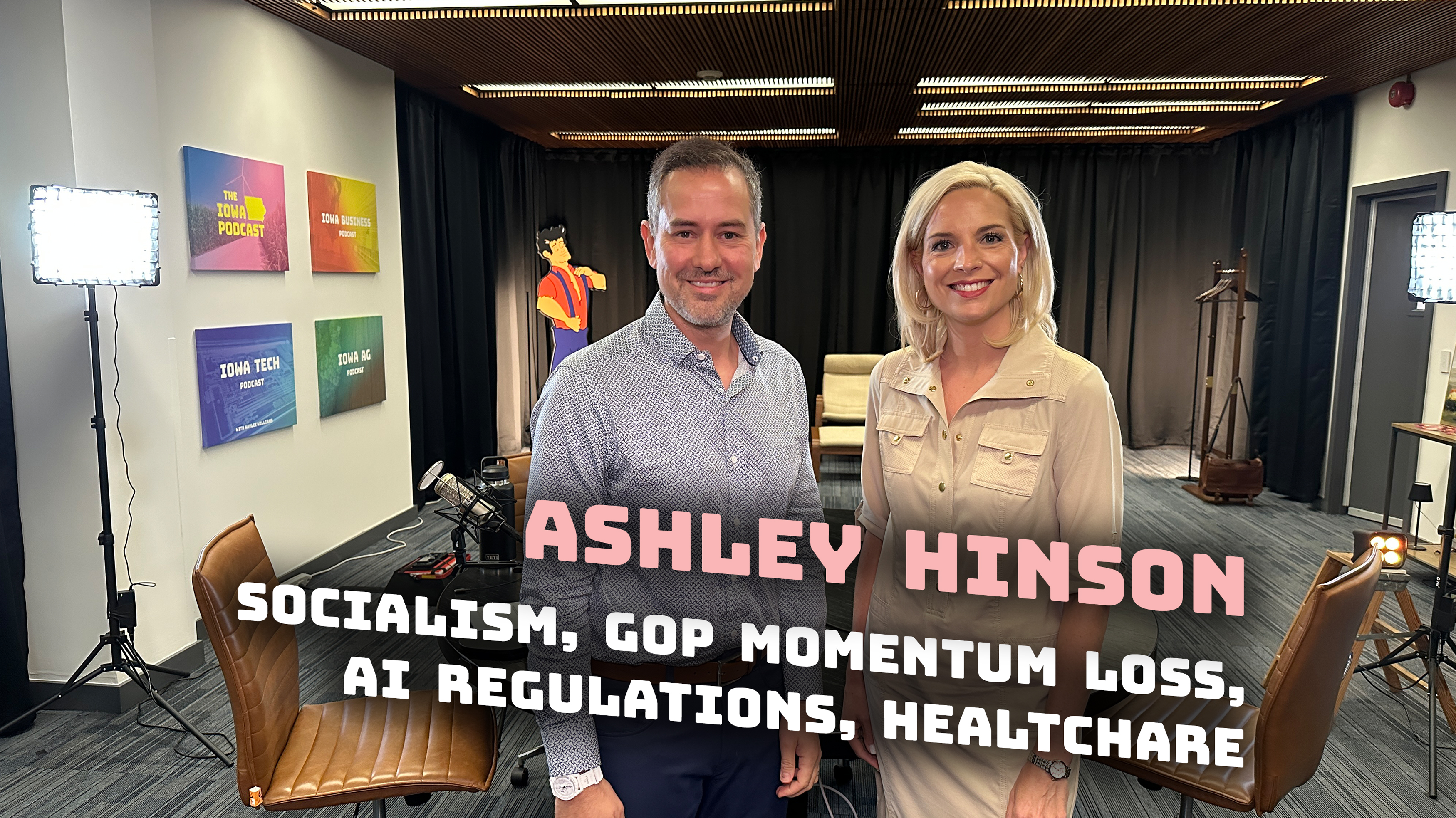
Hinson and Turek debated Oct 7 on Iowa PBS and Oct 13 on WHO 13 (final scheduled debate). Here’s the full interview.


Congresswoman Ashley Hinson is running for Senate in Iowa. She explains her position on the root cause of healthcare problems, if regulations for our “safety” are actually keeping things more expensive, and her thoughts on proper regulations around Ai.
Hinson has served in US Congress since 2021 and is looking to be elected into one of Iowa’s 2 senate seats, soon vacated by Joni Ernst who is not seeking reelection. She also gives her stance on eminent domain, bio fuels, data centers, and flock camera surveillance.

Hinson detailed her legislative platform and campaign vision for Iowa’s U.S. Senate seat, prioritizing global security, middle-class relief, and energy independence.
Addressing voter weariness regarding foreign entanglements and escalating threats from Iran, Hinson emphasized the necessity of preventing nuclear capability while working toward a swift end to regional conflicts. “I want to make sure we get this done quickly, but the end goal for me in any deal or any negotiated deal, end to this war, is we need to make sure Iran doesn’t get a nuclear weapon, and we need to make sure our allies in the region are protected,” Hinson stated.
Middle-Class Economics and Healthcare Reform
Pushing back against left-wing economic sentiment, Hinson argued that voters gravitate toward alternative political ideologies primarily when they feel unheard by government institutions. To address middle-class strain, she highlighted her support for the 21st Century Road to Housing bill to cut construction regulations, expanded child tax credits, and targeted district investments in childcare facilities. “Communism doesn’t work. Socialism doesn’t sell. It’s not right for our country, and we believe in freedom and capitalism,” Hinson said. On healthcare, she advocated for system-wide price transparency to curb administrative costs and predatory pharmacy benefit manager (PBM) practices, alongside legislation targeting excessive insurance pre-authorization delays.
Hear from Iowans directly. No algorithms.
Don’t let the algorithms choose your news. Enter your email address to hear directly from Iowans leading news in politics, community, agriculture and business. No editing. No clickbait. No rage. No agenda.
Energy Grid, Infrastructure, and Tech Safety
Regarding state development, Hinson endorsed local control for data center projects, pointing to Cedar Rapids’ closed-loop water system and five-year utility rate locks as successful municipal models. She urged faster regulatory approvals for domestic power generation, including nuclear initiatives like reopening the Duane Arnold Energy Center. “My approach to energy is all of the above and all of the below,” Hinson noted. Warning that lagging in energy or artificial intelligence compute power risks ceding global dominance to China, she called for targeted AI guardrails centered on child protection, data privacy, and oversight on surveillance technology.
Interview Transcript
This transcript was created with help from Ai. Please report errors to us and always refer to the video as your primary source.
Justin Brady: [00:00:00] From the Jethro’s BBQ studio, it is the Iowa Podcast. GOP has maintained control of the last election of the White House and all of Congress, complete domination, but things are changing quickly. And the Senate, Polymarket has that as a 50/50 toss-up. Why is that?
Representative Ashley Hinson
who is a candidate for US
Senate, joins us today to…
Maybe you can, maybe you can sway it the other way. I don’t know. What do you
Ashley hinson: I think we’re gonna win, so I’m glad to be here and, uh, glad, glad to have the opportunity to represent Iowans in Congress and look forward to being Iowa’s next US senator.
Justin Brady: you so much for coming in here on the show, really appreciate
Ashley hinson: Thanks for including me in your conversation. Love talking with people
Justin Brady: It’s gonna be a good discussion. As a reminder, everybody, go to Iowapodcast.com, scroll to the top, you’ll see a little Jethro’s logo.
If you click that and you buy a $100 gift card, you’ll get a $30 gift card for free. It’s pretty cool. Uh, like I said, Representative Hinson, thank you so much for coming in here. Y’all had [00:01:00] control, right? You
Still do, but it– Polymarket… Now, some people are like, “Eh, Polymarket.” I think the,
sometimes the betting markets do pretty well because, you know, people are putting their own money on the line, so
Take it with a grain of salt, but it seems like we got the, the Republicans got Congress, they got The White House, some argue Supreme Court, um, based on this America First
messaging. So, Feenstra kind of had the Trump endorsement. We kind of had the America First thing. That was really, really exciting. But then everything changed, it looks like, when we started going to war in Iran, and when we started this, this Strait of Hormuz stuff, and it seems like Americans are kind of like, “Ah, gosh.
I don’t know. I signed up for this America First stuff. I don’t know what this stuff is.”
So what is the message
going into your
Senate election? Are we still… America First, or are we focused elsewhere?
Ashley hinson: I think putting America first is you can [00:02:00] focus on a number of priorities, and I think we certainly did that as soon as we came into office. You talk about the trifecta that we had, uh, Republican House, Republican Senate, and Republican in the White House. We got to work right away fixing a lot of the problems of the previous four years under Joe Biden.
Uh, we didn’t have any new trade deals. We had new hot wars, uh, erupting around the world, um, weakness on the global stage, um, but we had a wide-open southern border. We fixed all of that in the first six months, right? In terms of, uh, the border and closing that down, returning taxpayer dollars back to them after, uh, I voted against $6 trillion in new spending under, uh, President Biden, um, in my first term.
Um, so I, I think that we were trying to right out the gate say, “Yep, we heard you. The most important election issues of 2024, we are gonna deliver on those right away.” And when it comes to Iran, you know, uh, I don’t want an endless war in Iran. Um, I, I think it is important to make sure Iran cannot have a nuclear weapon, and it is thousands of miles away.
It’s out of sight, out of mind for so many Americans. But at the top issue of why I ran for [00:03:00] Congress and now why, why I’m running for the U.S. Senate, we need to protect taxpayers. We need to make sure rural America has a seat at the table, and we have to have a safe and secure country, and that starts by eliminating threats not only at our southern border, but abroad as well.
And Iran has been, um, massively increasing its stockpiles, not just of, um, nuclear materials, but of, uh, of missiles, of drones, um, that could have been not only a threat to our allies in the Middle East, but us here in the homeland as well. And so, uh, I want to make sure we get this done quickly, but the end goal for me in any deal or any negotiated deal, end to this war, is we need to make sure Iran doesn’t get a nuclear weapon, and we need to make sure our allies in the region are protected.
Justin Brady: [00:04:00] [00:05:00] I think people do question the endless aspect of it though, because
it does seem endless. Like we’ve, um, past presidents, we’re still in this same position. We’ve been told Iran can’t have a nuclear weapon. We’re gonna do this and that, and then we keep doing this and that, and they still keep getting nuclear weapons, supposedly.
So at this point, people… are like, “Is This about… nuclear weapon?” And I don’t have any background information. here. I don’t have any special information, no security clearance on this side.
But
people are maybe
getting I think the favorability shows that people are getting a little agitated at this point, thinking, “I don’t think this is about nukes anymore.
I think this may be about something else, and the American people are being [00:06:00] kept in the dark.” So
how do don’t agree with that at all. Let me first just interject here. I’m gonna push back on you because I, I actually went with a bipartisan group of legislators to meet with the vice chairman of the Joint Chiefs of Staff just a few weeks ago before we left, uh, to, to not only talk about this threat landscape, but everything around the world right now.
Ashley hinson: And so I think it’s really important that Iran… that we took that action when we did. Um, and we need to, we need to wrap it up. I 100% agree with that. I wanna see it end. I also… Just let me put my mom hat on here, because I have two teenage boys. Uh, so I think about conflicts around the world and how that plays in, how it could potentially affect my family.
I have sat down with so many families of military kids who are… Their kids are over fighting right now. I was just with, uh, April Conway, uh, who, you know, leads the, the, uh, Blue Star Moms right now. You know, their kids are deployed right now. Uh, I don’t wanna see these wars that put our, our young men and women at risk.
Um, and that’s, that’s why we need to finish this conflict, I believe, as soon as possible, as quickly as possible. That’s my message to the White House, too, because that’s what I’m hearing from Iowans. They want it wrapped up. But I also think about future conflicts and deterring those and why it’s so important.
I [00:07:00] don’t want my boys fighting in a conflict either
Justin Brady: Yeah. Do we have, and I understand that we can’t give away the whole strategy, but is there, if you wanna talk about it, that would
be amazing, but
Ashley hinson: I can’t talk… And I honestly, I, I think that the, the Joint Chiefs and Chair- Chairman Ca- you know, General Caine, um, you know, leading our war fighters in, in making sure we’re, we’re tackling these threats, they, their clearance is above mine, right? I have a clearance, but theirs is way above mine.
So, uh, I trust that they are making the right decisions to not only keep our troops safe in this conver- conversation, but also the American
Justin Brady: So do we have a, to your knowledge, a definition of when we hit these metrics, we’re done? Do we have
that?
Ashley hinson: I, that, I, that’s the
Justin Brady: Don’t
Ashley hinson: That’s not Congress’s role. Congress’s role is to make sure that our war fighters are equipped, that the, the Department of War has what it needs, uh, that the, uh, the VA has what it needs to take care of people when they come home after they serve. That’s Congress’s role here.
Justin Brady: Got it. All right. Um, one of the things that, I don’t know if you saw this, Bill Maher just went on this rant, I wanna say it was a week ago, two weeks ago, about [00:08:00] socialism in the Democrat
party. He told the vice president, “My vote’s up. My
vote, it might be available if my party keeps going down this roll,” or this, this, uh, this road. 8% of the United States now identify as socialist. I’m bringing this up because you’ve been talking a lot about capitalism on X and posting these things.
Um, A third of the Democrat party is, uh, identifying as socialist now. Two-thirds have a favorable view, and if you think
That’s a red/blue thing, it Looks like…
maybe not, because it, in
Some data sets, 14% of the GOP ha- it
Doesn’t identify as socialist, but has a, oh, maybe a favorable view. W- where did we get wrong, and what did we get wrong? And how do we get, when you’re running for Senate, how do you get some of those Bill
Maher voices
to maybe
vote for- Republicans?
Ashley hinson: I think it starts by… Well, I’m a former reporter and anchor, and how I’ve always run my campaigns is by, by getting out there and listening to people, and then turning that story into action. Um, I- that’s how I will [00:09:00] operate as a US senator. That’s how I’ve operated as a congresswoman.
I think we are missing an element of that, that listening, and I think people are switching to those party ideals because they don’t feel heard. Um, they don’t feel like their government is working for them. Life is, uh, tough for a lot of people. Uh, so we need to be focused on, laser focused on policies and delivering on those policies that help, uh, address what people are concerned about.
So whether it’s affordability and housing, right? Uh, that’s one of the number one things that I’ve continued to hear. It’s, it’s hard to be able to afford to buy a home. The average age for a new home buyer is over 40 years old now. Um, so you talk about the American dream and that being unachievable, that’s a, a warning signal to me loud and clear.
So what are we doing about it? We just passed, uh, the 21st Century Road to Housing bill that’s gonna help drive down the cost of new housing, get rid of government regulations, make sure it’s easier to build, um, so that more people can get into affordable housing. Uh, we, again, we stopped the influx of illegal immigrants at the southern border.
Uh, the, the studies had shown that that many people competing for [00:10:00] housing, uh, that were not Americans, were driving up the cost of rent and the cost of housing here in the United States, so we’re, we’re turning that back around. Uh, so housing being one part, childcare being another part. Uh, you talk about the workforce behind the workforce, and making sure people can not only afford childcare, but find it in their communities.
I have brought back money to make key investments in childcare facilities, uh, and their people in my congressional district because I understand having a child is expensive. We worked to make sure the child tax credit was, uh, increased in the working family’s tax cut. So these are all places where we are trying to say, “Hey, we hear you loud and clear.
We are delivering for you. We’re delivering that relief right to the middle class,” so that we can get those people, uh, over to our side and show, yeah, we’re gonna fix these problems that are facing our country, um, so that the American dream is still achievable. I think the DSA and what they’re proposing, not only is it crazy, um, but I don’t think it will sell in Iowa.
I am a little concerned about it… You know, you look at, uh, in Colorado, for example, and in New York, where some of these [00:11:00] people have won their primaries. Just last night in Florida, uh, the, the Democrat socialist candidate won the, the, the primary for US Senate. Uh, so I, I worry about those voices increasing in, in, um, volume, but I, I do think that there are gonna be people who are gonna push back and say, “Communism doesn’t work.
Socialism doesn’t sell. It’s not right for our country, and we believe in freedom and, uh, capitalism.”
Justin Brady: I feel like the messaging is awful, and I feel like the mess- the pro-capitalist messaging should be quite simple. But when I notice people getting in the weeds on the capitalism versus socialism thing, well, generally they don’t know either, what either one is.
But whenever I see the complaints, uh, against capitalism, often what people are pointing out is actually kinda socialist stuff. They’re talking about regulatory capture. They’re talking about, uh, a few big companies at the top controlling things. That’s not, that’s not
actually capitalism. So
do you point, do you push back and deregulate some things? L- like, let’s focus on healthcare, for example. This is a good one. This is a good example. Uh, you’re probably aware of [00:12:00] this, but one of the discussions always revolves around insurance. It’s the wrong discussion, of course, The right discussion, at least in my opinion, is healthcare costs, because we would
Never say
if we’re getting in tons of wrecks, like, “Well, the
insurance cost on
this is, we need to control that because people are getting in wrecks.”
We’d say, “People are getting in wrecks a lot
Ashley hinson: Why are people getting in wrecks?
Yeah Yeah. Why
Justin Brady: why is there so much damage to cars? Like what the heck is going on? So one of those
issues that most people don’t know is a lot of very big medical companies control most of the healthcare costs in this country.
Neither Good nor bad, but that’s just
a reality.
So
one of
my, uh, clients that I used to do in PR comms said, “Hey, we’d like to get this new device on market, this more effective device, but Justin, I don’t have two and a half million dollars to refile through the FDA.” This is a local startup here in Iowa,
Medical
company,
and is it maybe
time to roll
back tons of red tape, tons of regulatory capture, and break up all these large corporations’ grip hold on [00:13:00] healthcare?
Ashley hinson: Well, I think that’s certainly an antitrust conversation needs to be had over, uh, who’s controlling what in the healthcare space, and, uh, you talk about the cost drivers of healthcare. It is… If you look at the charts of the last, let’s say, 20 years, uh, 20, 30 years, uh, you’ve seen the increase in administration cost with healthcare, so that- Wow
that is all of these other people outside who have their hands in, in the pot, so to speak. But the actual number of providers is pretty stagnant. Um, and that to me is the, the big warning sign i- when it comes to healthcare, is we, we need to make sure it returns to how are providers actually able to provide better patient care, and then that’s the, that’s the place where you start.
Um, and then you start looking at where do all these little costs start adding to, uh, the, the end price tag that, you know, you or I are gonna pay when we go to take our kid to the doctor, right? Um, and so that’s what I’m trying to do, is look at what are the key cost drivers. Um, so it is administration cost.
It is, uh, I have a lot of questions about the big health insurance companies and what they are doing as a part of their business model to, uh, to try [00:14:00] to make money off of people. And, and because it is such a dark, black hole, a lot of this is not transparent. What I am focused on is trying to put transparency in these key places, because I think that will help fix a lot of things here.
Um, whether it comes to PBMs, um, and some of their shady practices, because we don’t know what happens in the middle. Pharmacists are getting squeezed, and then they’re trying to stay open in a rural community to, to be able to fill these prescriptions that their patients need. Um, but, but they’re getting squeezed on, on both sides, right?
By the big pharma companies and by the PBMs, uh, who now, by the way, speaking of antitrust issues, many of the big pharmaceutical companies also own the
Justin Brady: Open the same company,
Ashley hinson: So of course they’re making money, and then the consumer ends up just having to pay for it, uh, at the point of sale. And so, so those are some places where we’re looking to drive down costs, and then specifically with the big health insurance companies, uh, I just introduced a piece of legislation.
It was based on, you know, as I’m out campaigning in the state, I’ve been to all 99 counties, many of them more than once. I, I met with a small hospital system in Northwest Iowa and they were like, “This is [00:15:00] obscene how much time we have to spend with chasing these denied claims.” Um, people are looking for pre-auth so they can get these procedures done.
It’s taking forever. Doctors are having to jump on… I, I talked to a, a spinal surgery doctor who works mostly on kids at the University of Iowa Hospitals and Clinics. He’s having to jump on these calls with people who have no idea what they’re talking about at the insurance companies. Two hours of his time, uh, to try to explain and justify.
That’s not a good use of that doctor’s time. He should be treating kids. So these are the places where I’m trying to be laser focused on driving down the cost of care, using transparency, using these pressure points, because at the end of the day, better transparency means better account- Oops, sorry.
Better accountability. I’m a hand talker, if
Justin Brady: Mhm, ist fein
Ashley hinson: Um, better accountability in the healthcare space, and better accountability means better patient care
Justin Brady: I remember years ago, uh, we were talking about, about this before we recorded, I had John Delaney in the studio at WHO Radio when I used to be there. And this, so this is interestingly one thing Democrats and Republicans at least seem to align on, at least over however long that was. [00:16:00] Um, one of the things he said, or one of the things I asked him was, “Do we roll back FDA red tape and allow more startups to get into healthcare?”
‘Cause right now it’s not possible. And as you and I both mo- as I know, uh, working with a lot of startups, they tend to disrupt industries. They tend to come in here and say, “Hey, they, this organization does this thing for $10,000, I can do it for 10.” And I think Jeff Bezos w- used to say, like or has said, “Your margin is my opportunity.”
That’s how startups think. But we can’t apply that thinking to healthcare. So do we see, um, antitrust is, is fine, maybe that’s the solution, but do we see programs for medical startups that say, “Look, if you have medical devices, we’re gonna get you into market way faster.” Is that something maybe you would push if you were in
Ashley hinson: I, I think absolutely we need to– Well, we need to reduce red tape across the board. Um, we need to be innovating in the healthcare space. I think you talk about the next cures, these next medical devices that are gonna be, you know, really providing patients with relief in key places and [00:17:00] cures in other places, right?
We, we should be innovating, and we should be busting the model. Um, that’s happening in the defense space. You’re seeing that with some of the defense startups already. Um, what I care about most when it comes to, um, FDA involvement here, and I actually, I sit on the, the appropriations committee right now that funds FDA, um, and certainly there are a lot of process improvements that need to happen there.
Uh, but what I care most about is safety. At the end of the day, as long as things are safe for people, um, to, to, uh, to… Whether it’s a pill you’re taking or a device you’re using, that’s what I care about, is making sure that we have the right procedures in place. If you can do that in fewer steps and get things to market faster, we should be doing that
Justin Brady: I think the concern with people is that safety is that mystery word that is often used as a club to crush innovation.
So the challenge there is how do you define safety in… ‘Cause there is no end to how
I can define safety, right?
I could just keep going with that to keep my competitors out. So how do you define that in a way that still allows innovation to
happen?
Ashley hinson: I think a lot of the… [00:18:00] Well, let me get back to the root problem of a lot of this, liability. Um, and you talk about, uh, that driving a lot of the concern of what doctor- even doctors, right? They’re using… They have to do CYA, you call ’em CYA things to, to make sure that they don’t get sued all the time, right?
So I think that’s a larger part of the conversation that needs to be had around implementing a lot of these new cures, procedures, whatever it may be. People are afraid to try them because they’re afraid they’re gonna get sued and go out of business. Um, that dri- speaking of driving up healthcare costs, that is a huge part of it, too, right?
So if these doctors have huge malpractice lawsuits against them all the time, and they didn’t really do much wrong, but we’ve got an overly litigious society, that’s a problem.
Justin Brady: So tort reform,
legal protect- like what, what, what do we on that at the state legislature. I hope we could do something to complement a lot of the other things you’re talking about with FDA.
Ashley hinson: I don’t know if there’s an appetite for that in Washington, D.C., but I certainly think it needs to be a part of the conversation because, uh, y- that, that cost, every one of these little costs gets baked into what people have to pay. Um, and that just drives up cost for everyone Yeah. [00:19:00] Uh, one of, one of my clients a while ago, there were two plastics, and I said, “What’s the difference between these plastics? They have a similar name.” And they’re like, “Oh, it’s the same plastic.” I was like, “Why is this one double
Justin Brady: the
cost?” And they’re like, “Well, the company that sells this to us has to pad the price because they’re gonna get sued.”
I’m like, “What do you mean they’re gonna get
Ashley hinson: and that’s so wrong
Justin Brady: People just sue down the line. They sue everybody whether they’re liable or not.” So
that’s and trust me, I wanna make sure people, if, if you have a product that’s causing problems, I wanna make sure you’re held accountable for that.
Of course. it’s a tough balance …
Ashley hinson: and that’s one of the things, that’s one of the conversations we had around, um, medical malpractice reform here in Iowa.
If you saw off the wrong leg, you should be held accountable for that. Um, but also we just got to a point where, um, things were, well, out of control, and again, that, that drives up the cost for everybody, and it’s about good patient care. You want doctors to be able to provide that without fear of cons- constantly having to order more tests to, to drive up the cost of healthcare for everyone just because they’re worried about getting sued.
I don’t think that’s
Justin Brady: One of the most promising, at least in my opinion, and I know in the opinion of a lot of tech people, AI is, shows a lot of promise for bringing a lot [00:20:00] of costs down in many different industries. Of course, we’ve seen some larger companies that aren’t so keen on it because of that potential threat. So i- just in my opinion, AI in healthcare alone could dramatically decrease costs. So if you’re in Senate, what does it look like from a AI regulatory standpoint if you’re in the Senate? Is it we need to slow it down? Is it, no, if we slow it down, China and India are gonna get ahead, other countries are
gonna get ahead, and we’re gonna get behind. Let’s not regulate it right now. What’s the approach you take?
Ashley hinson: Well, I think we need to have some bare minimum, probably guardrails on our, on our process. I do agree with you that we cannot allow China to win the AI race, because if they do, then they’re controlling our data, they’re controlling every… I mean, look at what they were able to do with the– even with TikTok.
We had this fight over TikTok just a few years ago. So it’s– That’s the algorithm, right, that they’re fighting over. That’s all AI-driven, uh, and what it does is it, it, uh, it pulls the data of the American people, and then they’re using that. D-data is power, [00:21:00] right? And that’s how they, they understand that, and they saw that very clearly.
And that’s why we were pushing back so, so, uh, uh, you know, aggressively against the TikTok owned by the Chinese and forcing that divestiture here in the United States. Uh, when it comes to AI, I’ve really been, I guess, pushing specifically around kids’ protection right now. That’s the area where I’ve been most passionate.
I mean, healthcare, I agree. I think there are a lot of uses for AI to, to simplify processes. What I don’t wanna get to a point in healthcare, and then I’ll get to kids in a second, is, uh, that you’re, you’re thinking you’re actually talking to a doctor and you’re actually talking to a chatbot.
Justin Brady: Ooh, sure.
Ashley hinson: that, to me is, uh, you know, it worries me on who’s giving the medical advice and who’s actually accountable if something like that happens, uh, and you get bad advice, and then you go out and you take something, and then you get sick, right?
So speaking again of the liability, like who’s in charge? Who are you actually talking to? We need some very clear guardrails there about, uh, about that process. Uh, when it comes to kids, um, we’re having a lot of conversations about kids’ online safety because, I, I mean, my kids use AI on their phones.
They’re talking to things. You know, you’ve got [00:22:00] chat, AI, chat on AI, all these different… ChatGPT, all these different apps. Um, and kids may be thinking they’re talking to a real human, and they’re not, right? So there’s a lot of things around AI chatbots that I’m very passionate about, making sure that consumers have more clarity, uh, on, on what they’re actually accessing.
But, uh, I will say this, that if we don’t do the compute, if we don’t do the, uh, the innovation in this space, then we will lose that power to China, and they will not use it for good
Justin Brady: You mentioned guardrails in AI. Have you given any thought as to what those guardrails would look like? You
mentioned one, you kinda hinted at, like, you know, kids, making sure there’s transparency, people need to know
that they’re talking to an AI, not a person. But, uh, this is a huge issue, so have you given thought to what those guardrails look
Ashley hinson: Yeah, I think specifically on AI, I, I think that just I would go back to my argument on transparency. People need to know what they’re engaging with, um, because most of the forward-facing parts of AI, uh, on the consumer space, that’s what I’m really, really concerned about. Obviously, I wanna make sure that these [00:23:00] AI chatbots are not nefarious and, um, are giving bad advice to people.
Um, so I think those are the key places where I would like to start, uh, with some guardrails, um, and then again, have the serious conversations about how they affect kids.
Justin Brady: I mean, bad advice is a hard one though too, because who
Ashley hinson: Yeah, who, yeah, I guess you’re right. Yeah. But I, I would say that, and it’s tough for probably Congress to define that certainly, but I think we can all agree, uh, I, I think, well, Congress getting any Congress to agree on anything with 218 votes is a challenge, right?
And that’s, that’s why we are where we are and we haven’t passed anything yet. But, um, I think these, uh, bare minimum, these protections for kids, protections in healthcare, um, I, I think we should make sure that companies can use it for innovative purposes. But again, if you’re using it to, uh, funnel, uh, information to other countries for our demise, for example, or you’re, you-
Justin Brady: Probably Not good.
Ashley hinson: But I think there are some places where we could be very, very clear about, uh, our guardrails there, and so that would be what I would focus on.
Justin Brady: Okay. Um, uh, you know, as a tech person myself, I’m glad that tech is in, like, the foc- in the lens now, which is kinda cool.
But [00:24:00] another
thing that came up this year that I would’ve never imagined would’ve come up is data centers. This is, like, a thing now.
Big ugly boxes
that no one used to care about, people suddenly care about.
So two schools of thought. One is ban them all. We don’t need them. They’re, you know, eating
down our water. The Other school
of thought is, bro, it’s technology. We kinda need these things to grow technology. As a senator, where do
you sit? Do we see, uh … I know Zach Lane has called for a moratorium. He has not called for a ban.
Some people have called for a ban. Some people have said this is stupid. If people buy the land and they’re being good n- who cares? Where do you sit on data centers, and what would you do as a senator?
Ashley hinson: Well, I think, uh, there’s a right way and a wrong way to do these kinds of projects. And- What about those? Yeah. So I, I– Cedar Rapids has two data centers going in right now, and what I hear from people as I’ve traveled through the state, and people are worried about them, and I, I wanna acknowledge that. I mean, this is a very big concern for a lot of people here in Iowa and around the country, uh, because, uh, you wanna know when you turn on your, your, uh, kitchen spigot that there’s gonna be safe water coming out [00:25:00] of that, safe water to drink.
Uh, but you also wanna know that when you flip your light switch on, your power’s not gonna be more expensive because of a data center. Um, and I think that is at the heart of the right way and the wrong way to do this. Uh, so in Cedar Rapids, for example, one of the data centers is doing a closed loop system, so they have one draw on the water, um, and they’re being very, uh…
I guess that’s the most environmentally friendly way to do it. You’re, you’re drawing water once. Um, and then on the power side, they’ve locked in rates for rate payers for five years with the local utility. I think– And that was all driven by local control. Mm-hmm. And I think that’s the way to do these projects.
These decisions are best decided closer to the people because it’s in their b- it’s literally in their backyard, right? And I think that’s, that’s the way to do it. I think Congress’s role here is specifically on the energy side because, um, you know, there is a lot of conversation around power. Um, I, uh, let me rewind too.
In, in the past four years under Biden, before this administration, they were taking coal power plants offline left and right. Um, and so energy generation is a problem in this country, and you wonder won– why, uh, [00:26:00] energy rates and utility rates were going up. It’s because we were taking power offline. Um, so we need to get power back online more quickly.
So you talked about the FDA regulations and fixing that process. The same thing needs to happen around power. Um, whether it’s natural gas or nuclear or whatever the next innovative hydrogen power cell is gonna be, uh, we need to make sure that we can get those, in a safe way, propped up more quickly. It shouldn’t take seven to 10 years to get a new power plant, uh, online.
Justin Brady: So shortening that timeline, and obviously that’s a, that’s a hairy issue. I’m not gonna ask you what time, that’s ridiculous. But, but I do hear in there maybe you’re pro-nuclear
Ashley hinson: I am. I, I think that we need to be… My, my approach to energy is all of the above and all of the below. Mm-hmm. Um, because I think that anything other than that is a national security problem. Um, we need to be reducing our redundanc- or our redundancy issues, um, and we need to be, uh, I, I think having as many options for power as possible in this country.
Um, and you look around the world, uh, what they did in Europe, it’s a travesty. It drove up utility r- I mean, energy in Europe is some of the most expensive in the entire world. Mm. And it’s [00:27:00] because they had bad policies on energy. Um, and so I think this country could lead in this space, and I think nuclear is one of those places.
Um, we’re, uh, actually they’re putting a new… Well, it’s not new. It’s Duane Arnold Energy Center is coming back online. Yeah. Yeah. And I, I think that, you know, that’s a great example of it’s a safe, uh, source of power. You can, you can actually build them pretty quickly, and I’ll tell you this, so getting back to China, China is doing this all over the world.
Of course they are. They’ve been using checkbook diplomacy all through Africa, all through South America to try to, again, get their influence. So whether it’s AI, power, infrastructure, China’s doing this, um, because again, the economic development comes from power, literally. Energy
Justin Brady: One of the other energy issues is biofuels. You’ve been a big proponent of biofuels.
Uh, I think most Iowans probably are. I think where the people diverge is pipelines and eminent domain issues. A- again, eminent domain has been kinda all the rage this year, people talking about it. So I, I oft- I [00:28:00] often think those two issues are conflated. When you say, “Well, I’m against the pipelines, I’m against eminent domain,” people are like, “But we
need biofuels.” Yeah. these are different issues.
So
you can be for biofuels, but against the other things, like eminent domain and pipelines. Where do you sit
Ashley hinson: Yeah, I, I agree with that statement, and I think that, uh, at the end of the day, we need to protect industry in this state, and I think it’s important to be able to continue to have infrastructure going in the ground. But, uh, I’m very leery of eminent domain. I think a lot of people are, and, uh, at the federal level, I have voted for several strong protections for taxpayers to make sure we’re protecting private property rights, and I think that’s important.
Um, I, I think when you, when you talk about ethanol and policies that can help, uh, support biofuels in this state, I’ve been a champion for one of those, E15, right? So that is a policy that is, I think, a deregulatory policy, uh, which I am in support of, getting, uh, government regulation out of the way and still providing a market for farmers.
That is the way we should be helping to boost, uh, industry, uh, whether it’s biofuels or anything, right? Get government out of the way and provide [00:29:00] access to another market in a consumer-driven way, and so that’s what I support. You know, when it comes to pipeline projects across the country, I think the answer is flexibility.
You know, making sure that you can get these in the ground and, and not having to use eminent domain. That’s the end goal, uh, for, for I think everything. But I’m very leery of eminent domain. I don’t, I don’t think anybody likes it
Justin Brady: What do you mean by leery though? Does that mean that we see you pushing for laws that say only w- you know, only for emergency declarations or only for a, a certain percentage vote? What does
that look like?
Ashley hinson: I think, I mean, obviously here in the
Justin Brady: Regarding eminent domain,
Ashley hinson: and I, I like what they were talking about at the state here, where they were talking about flexibility, right? Giving people the flexibility to put projects in the ground no matter what they are, um, so that we can move the state forward with economic development.
Um, I think that’s the kind of policy I wanna support, is providing the most flexibility possible while still protecting private property rights, and I think you can do that.
Justin Brady: Final question. Flock cameras.
Ashley hinson: Yeah. People Yeah
Justin Brady: They’re, we have two different sides of [00:30:00] this. Uh, you’ve been very pro-law enforcement. How far does that go? Do we give law enforcement flock cameras? ‘Cause we’re seeing sheriffs now, we’re seeing people, um, in a, in basically accused of crimes they didn’t commit them just because a flock camera said so. We’re also seeing sheriffs, not, I don’t think here in Iowa, by the way, just to
clarify. We’re also seeing sheriffs and officers across the country use these to track ex-girlfriends and stuff like
Ashley hinson: Yeah, which is completely… I mean, you talk about lanes needing to be on these things. That’s 100% where that conversation needs
Justin Brady: and it apparently is already being abused, so do we roll it back and say, “All right, we gave you guys a shot to use it.
You’re not using it. We’re chopping these things off”? Where do you sit on flock cameras and surveillance from the state?
Ashley hinson: I need to have some more conversations with our Iowa law enforcement folks to see, number one, if they’re actually using them, and number two, if they have best practices in place or not. I do worry about people’s privacy being, uh, impacted certainly. Uh, I do agree with making sure law enforcement have tools that they need to be able to catch bad guys, ’cause at the end of the day, I, I’ve seen some good examples of that technology being used to track down [00:31:00] people who were fleeing one jurisdiction and they caught them in the other.
Um, I think the conversations I would wanna have would be around similar to what we were having around TSA and gathering, you know, people who are flying through, their personal biometric information. How long is it stored? Uh, what is the potential, uh, potential for it to be used in the wrong way? Do we need better accountability, AKA laws to hold law enforcement accountable?
Um, that, those are the conversations I would wanna have around flock cameras to see if they, if they need more lanes or if we need to get rid of them entirely. But I wanna make sure law enforcement have the tools to, to catch the bad guys because as I mentioned, I, I wanna protect taxpayers, have rural America have a seat at the table, and have safe and secure co- uh, safe and secure communities.
And if we don’t have those things, we don’t have anything. So law enforcement is a big part
Justin Brady: Really quick addition to the TSA thing. I think their signs say that when you do the monocular, the binocular scan of your face, it’s deleted immediately. Is it not deleted immediately?
Ashley hinson: it’s held for a very short amount of time, the d- basically the day you’re flying. But we wanted to make sure … Like, when we were asking these questions, I oversee [00:32:00] TSA on Homeland Security appropriations, and we were very clear, you can’t be storing this information. Because again, to the point about it being abused, that’s what people are concerned about, is big government coming into my life,
Justin Brady: Right. Mm-hmm
Ashley hinson: my personal biometric data.
What are they using it for? Um, that’s where … You talk about a police state and being concerned about that, that’s where I think all of these conversations get back to, is who’s watching me? Is it big government? Are they intruding on my life? Are they intruding in my bank account? Uh, where does it stop, right?
And so I had a chance to travel to China in 2017, and I saw what big government looks like. And, you know, the monitoring systems that they have, they are in everybody’s life, in every aspect of their life, and I don’t wanna see that here in the United States. So I think we, we need to have a balance between, um, making sure that we have tools that law enforcement can use, but we need to make sure we don’t have big government intruding on everyone’s life.
And I, I think we can maybe find a way to do that. I’m not sure if flock cameras are the answer for that
Justin Brady: Congresswoman Ashley Hinson, thank you so much for coming on the show. For those that
like what they’re hearing or [00:33:00] wanna reach out to you, what’s the website?
Ashley hinson: Yep, ashleyhinson.com. We’d love to have you join our team, and, uh, we look forward to, uh, engaging with people over the next, uh, couple months as I work toward November, and look forward to getting out there and earning every vote and serving as Iowa’s next US
Justin Brady: Thanks for coming on the show, Congresswoman Thank you
Ashley hinson: for having me
[00:34:00]