

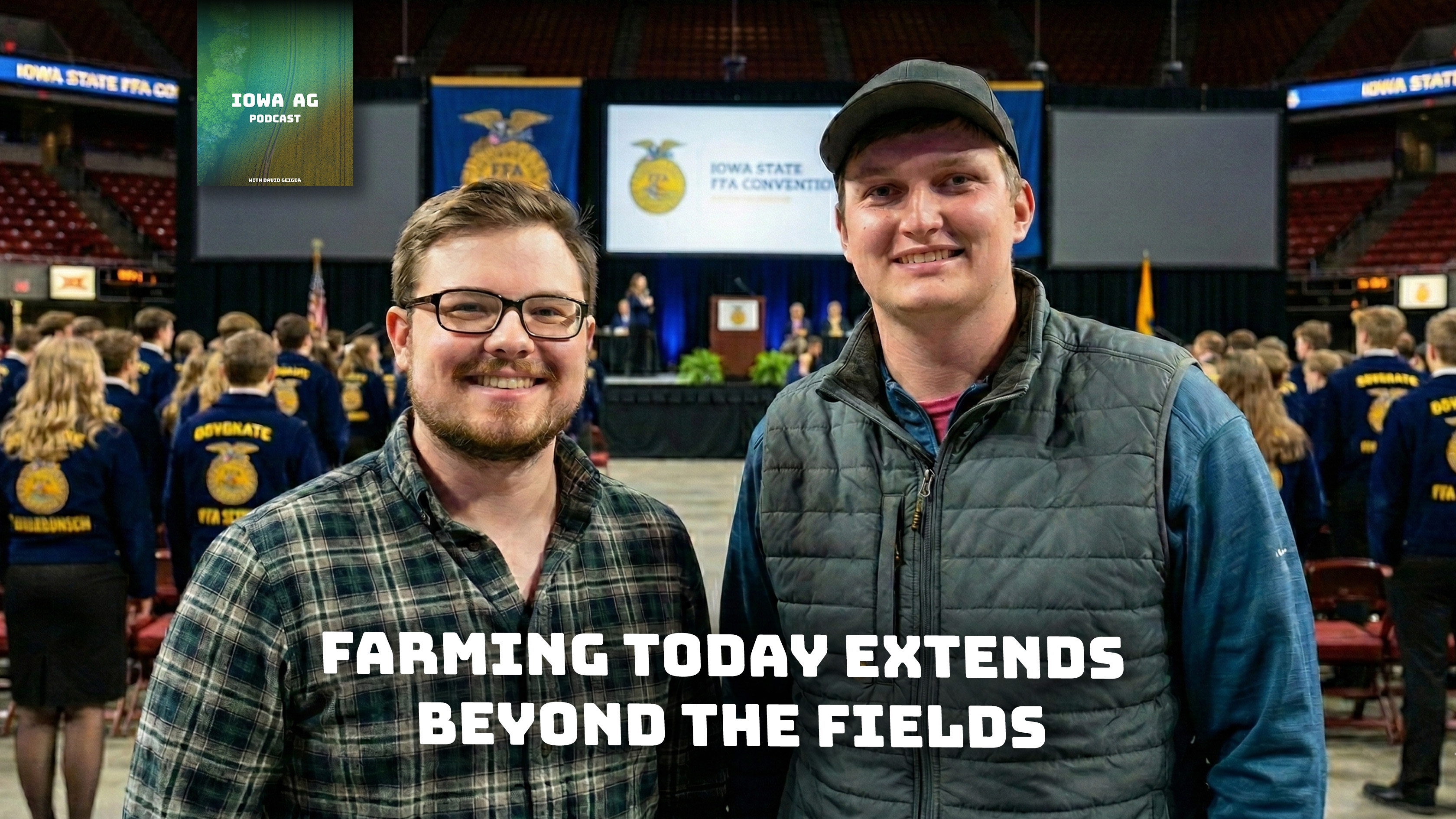


In this episode of the Iowa Ag Podcast, host David Geiger speaks with Cody Messer during National FFA Week about the intersection of farming, policy, and advocacy. Drawing from his experience as a producer and industry leader, Cody explains how modern farmers must balance production decisions with economic realities and an increasingly complex regulatory environment.
The conversation highlights current challenges facing agriculture, including volatile markets, rising input costs, and policy uncertainty. Cody discusses how farmers make risk-management decisions in an environment where margins can tighten quickly and outside forces often influence profitability. He emphasizes the importance of understanding not just agronomy and livestock management, but also trade, legislation, and public perception.
Hear from Iowans directly. No algorithms.
Don’t let the algorithms choose your news. Enter your email address to hear directly from Iowans leading news in politics, community, agriculture and business. No editing. No clickbait. No rage. No agenda.
A key theme of the discussion is engagement. Cody explains why involvement in agricultural organizations and grassroots advocacy plays a critical role in shaping farm policy. He outlines how farmers can work collectively to ensure their voices are heard at the local, state, and national levels. According to Cody, agriculture’s future depends not only on productivity but also on effective communication.
The episode also touches on the broader relationship between farmers and consumers. Cody shares why transparency and proactive storytelling are essential in bridging gaps between rural and urban communities. As agriculture continues to evolve, he believes producers must remain adaptable, informed, and willing to participate in conversations that affect their operations.
Overall, the discussion reinforces a central message: farming today extends far beyond the field. It requires business knowledge, policy awareness, and a commitment to engagement to ensure long-term sustainability for both individual operations and the agricultural industry as a whole.
Interview Transcript
This transcript was created with help from Ai. Please report errors to us and always refer to the video as your primary source.
David Geiger: Welcome to the IAG Podcast You’re at the Jet Rows Barbecue Studio. I’m your host, David Geiger. Thanks so much for joining us. And it is FFA week. That means we’re gonna talk about FFA some former students graduated. Retired as well right now. Cody Messer is with me right here. a past state and also a student with Iowa State University Animal Science International Ag. you so much for joining me today.
Cody Messer: Oh, thanks for having me, David. like you said, this week is FFA week, so we’re gonna have state the state. So last year when I was a state officer we had a visit every single day. So I’d be sleeping on people’s beds that I was friends with, you know, stuff like that. So, uh, a of being able to. Talk about uh, talk to students, be able to visit them for the whole day, do different activities with them, and overall just really share the mission of Culture So a good week ahead. Um,
David Geiger: I’ve been in
Cody Messer: with some of the for or some of the officers right now. Uh, so. uh, they’re all traveling today. They should be in schools ’cause it’s about nine, 10 o’clock right now, so. Right, right. They’re right in the middle of doing some workshops, visiting with students. Um, and they’ll be doing that all week. So all across the state, all nine it’s
David Geiger: really
Cody Messer: Really cool thing that they do. Um, it’s kind of like I compare this week to our Super Bowl, right? Uh, so it’s uh, you know, getting out there every single day and then Friday they’ll wrap it up and go back to, go back to Ames, go back to the enrichment center and get stuff ready for the next week So it’s gonna be a good week and uh, I know they’re gonna be having a lot of fun and you can follow ’em on their social media, as A-I-O-F-F-A and keep up with them. So,
David Geiger: And what’s cool in this
Cody Messer: When folks listen to this, it’s gonna be
David Geiger: Monday at the very earliest. Mm-hmm. So FFA week gonna be but if do go check out some of that to full history of all the things that went down this week.
Cody Messer: Yeah So, uh, you’ll be able to catch up on their Instagram They’ll have the little highlights, reels, um, and they always do an FFA recap. So, uh, you can up to see what every officer went and who they visited that week. Um, I know the week I did FFA week last year. single day. I think I clocked around Wow. the whole state and then ended back at the and there. And it, it’s a good week. It’s week Um, it’s that they plan a lot for we we have spreadsheets telling us when, where, be. Um, our director, uh, Scott Johnson, you know, is always calling and making sure we’re in the right spots. And overall, just making sure we have everything we need to keep going. But it, it’s a great week. Really good week.
David Geiger: Why is. you specific, is. week, make sure the public eye traveling 1200 miles. is the What why do it’s important?
Cody Messer: Yeah, I mean, FFA week, like I said, I, I kind of compare
David Geiger: it
Cody Messer: Super Bowl, know, like everyone’s watching Super Bowl. Well this, this is our week. This when we kind share our message. Um, just last week went to the governor’s, um, office and had her sign proclamation to, to, declare it, FFA Um, and that’s really big that really does get us a lot more, social coverage. really get the mission FFA out there. And, uh, for me, I, I think it’s really important because that is, when we talk about it, communication agriculture is really huge. Um, that’s a lot of this job, uh, as, as a being a state officer is able to communicate to students uh, legislators, uh, community stakeholders, whoever it may be. Uh, it’s just, that’s the whole part about it is communicating and. You know, we, we talked previously, communication agriculture is really important. And having that position and be able to talk about, uh, FFA and agriculture and getting that ag education to students in those schools, uh, that, that to me is what’s important about this too. ’cause I mean, the youth are our future, um, able to push them forward and doing that and finding their niche in ag. Um, and even if they have a spark, an interest in agriculture, it’s really cool. Just be able to. Kind of keep that going and, uh, help them find their path in it. And so that’s what I find this week to be really important. Um, when I did it last year, traveling around, I guess last year was my second year traveling. I was a district officer before that. And so I got to go to different schools with, uh, will Ek, he was my, uh, state president, my year or state, uh, vice president my year. So, uh, being able to do that two years in a row is just really cool to be, be able to go to those schools, talk to those students, uh, make those connections and relationships. Um, and you never really know. We, we always said our city officer here, if we even made an impact on one person, then we did our job. Right. And that’s something that I’ve always thought of when I went to every visit was if I made an impact on one person, I did my job. Right. So,
David Geiger: I think we can relate a lot. because I also Yeah, Talking on a podcast, news, doing all sorts of. work In the communication side of So why do you think younger people are important ambassadors or are valuable aspects relate important topics of agricul to not just others within the. industry, but everybody?
Cody Messer: Yeah. Uh, I, I think it’s really important it comes from students because it shows that. Uh, lot of times, you know, we have adults that talk about it. We can have lobbyists going to the capitol talking about it, but when, that person, stakeholder, legislator, whoever it may be, hears it from a, a student, a youth, I, think that’s just a volume. It, It shows that they do care. Um, sometimes I feel like there’s this stigma that they’re like, oh, your generation doesn’t really care about this. Well, we do. We do, uh, we take pride in Uh, we see that as our future, and we see that having youth involvement is just huge. I mean, if you show, if you show the students what their future is, they, they do care. Um, I I, I’ve had so many different talks with, uh, students. And when I traveled and, you know, I learned what they wanted to do. I mean, I mean, I’ll take a little step back. One of, we do different activities on chapter visits. So we go through each class and one that I always did, uh, it was called, uh, make Your Personal Brand. Um. And I highlighted this in my RA speech, uh, when I retired, but at every school I went to, I had a, I gave him a blank piece of paper and I gave them a di a a direction of just draw what your future is, draw what you want to be, whether that’s a business they want to own, um, whether they wanna be the President of the United States, something like that. Uh, and it really shows that their interest in the future and that they do care. And so being able to see all of those from across the state was, was huge. And I, I think that does speak volumes. Uh, it, it shows that the youth do care and that that’s a big thing.
David Geiger: I am interested in diving a bit more when you look at you are communicating do topics, maybe or. What have you, there is a conflict traditional and some of the seen even in the last five, 10 years, and that’s pretty much what you guys are being brought up on, taught on in your ag classes, in your seminars in college. Now, how impact you and your relationship with folks on the farm?
Cody Messer: Yeah, I, you know, I think a big stigma that there is is that, oh, to be in FFA to be in ag education, you have to be sure there’s more students off in FFA than there are off just kind of the trail of farming, A number of farms in Iowa is, is, slimming and a farms and.
David Geiger: think a big part
Cody Messer: of that is having the youth that are in FF. urban we’re giving them more opportunities. I’ll give you the example of the Waterloo Career Center. Um, that’s a really cool, cool center if you ever get the chance to go look at it. Uh, Mr. Hunter Hamilton’s the advisor there. Um, when I was a state officer, we got to do a visit there and really see the opportunities they have for their students. Um, that’s becoming more and more common. Uh, I know the Des Moines, uh, Des Moines School has an ag ag program there too. And, uh, that gives students in urban, uh, populations opportunities to kind of purs, pursue that, pursue those interests. Um. So whether bridging the divide between traditional agriculture on the farm and, uh, urban agriculture, I think there’s not really much of a divide as there is just kind of a miscommunication. Um, and saying that, I mean. Giving those students the opportunity to see what it’s like on the farm and then showing the people on the farm what opportunities the students have and how they can help, um, is, is really big. I know, uh, my school, back home, uh, high school, they, uh, tried passing a bond to be able to get a new Ag center. Um, and uh, they’ve been working on that for a few years and we’re not quite there yet, but in the future, hopefully they can get there. So it’s opportunities like that given the students in urban populations. And rural populations too. ’cause you can live in the country, but not on a farm. I mean, that, that’s also a big thing too. Uh, so giving them those opportunities is huge. And bridging that miscommunication, that divide. Um, but then on the flip side of that too, back home in my chapter, we always had farmers come in and help us. Or we’d go out to their farm, they’d dig a hole so we could soil judge, like, I mean, it, they really do care about. The future of ag education. ’cause I mean, they, they do know that is, that is who is on their side, who’s helping them. Uh, and I, I think it’s a really cool thing and I, I think we’re getting a lot better at bridging that divide and creating more opportunities for students, both rural and urban. Um, I, I really don’t even see a divide much anymore in the classroom on that because. There’s just so much more out there. Um, if you travel north of where I’m from, do Muscatine, they have the Muscatine Ag Center as well. So I know several students who live in town and they have livestock there. They show at the fair. Uh, so that’s really cool. And Iowa’s not the only one that’s doing that across the United States. There’s different chapters, Oklahoma, Texas, Maryland, New York, wherever. Uh, there’s just a lot of opportunity and bridging that gap that, um, and creating those opportunities for. Uh, agriculturalists, young agriculturalists pursue their passion.
David Geiger: Let’s table ’cause I wanna cover that Before we do, so I wanna just talk about you Yeah. What’s your background? How did you get involved
Cody Messer: So it’s a funny story. So my, uh, I have two older siblings, um, a little bit much older than me. Um, and so I always grew up kind of, you know, going to their banquets, doing stuff like that at the fair. Um, but really where it started was way back when I was, oh, six years old maybe. And my, uh, ag advisor just moved to Uh, and my family, I kind of say we adopted her, nobody down there. And so, we just became really close. She came over for dinner then brother had her as an advisor and then my sister. And so I’d always go into her classroom every now and then. And, uh, it’s really funny, when I was younger, I really had no, no deep interest in agriculture. I mean, I, I didn’t really know what it all was about. You know, I grew up on a farm, but I was like, oh, this isn’t really for me. And. Uh, as I grew older, um, I, I remember distinctly walking around at the Iowa State Fair. We were in the ag building, and I, I love the fair, it’s my family’s two week vacation every single year, and I’m walking around the building and my mom just randomly goes, you know, you’re gonna have to get your SAE figured out. And I’m like, what, like, what what are you talking about? I’m not doing that. Like, I, I don’t really want to do that. Uh, that, that’s Curtis and Katie’s thing, not mine. And I just went and grabbed the egg on a stick and walked away. And, uh, I, I, from that day on, it completely flipped, obviously. Um. Joined FFA when I was in eighth grade, uh, did different stuff. Our farmers, uh, feed the farmers event in the fall. Um, go into the feed mill, stuff like that. Uh, kind of just grew my passion more. I loved, I loved doing that. Um, I used to ride the bus, uh, for my grandma’s house every day. ’cause I was, uh. I was open enrollment, so I had to go, just drive a little bit to my grandma’s to get on the bus and every day when I’d get off, you know, we’d talk to her and, um, sometimes she’s there, sometimes she’s not. She was really involved in Farm Bureau, so she was always going to different events like that. Uh, for the state and going to DC every now and then too, uh, way back in the day. Um, and so she was kind of a real inspiration for me in agriculture and, uh, being on the advocacy side of that too. You know, my grandpa stayed home and he farmed, and, uh, she even drove the tractor too when she was home. She, she was not a, not afraid of that. So, um, those really sparked my opportunity or my interest in it. And then even being in four H too. Um, there’s one thing that I always, I always hate hearing is, well, I’m in four H, why should I be in FFA? Or I’m in FFA, why should I be in four H? Do both. That’s my message. Clear. Do both. Uh, because they both provide good opportunities. So I always say like four H kind of laid my groundwork and interest. I showed cattle and pigs. Um. And then when I was old enough, I got to show pigs and FFA as well. Uh, and then my advisor recruited me to help out at the Iowa State Fair at the Swine Show on that committee. Um, and so I got to know those advisors really well. So just having that influence, uh, really pushed me to want to be in FFA and be more involved, uh, at the chapter level and district and state. Um, later on, uh, in my freshman year, sophomore year, I got to be on the MCOM for district office and my, I was like, what even is that my advisor were like, just go do it. You’ll, you’ll be Have fun. So I went and did that, saw that process, and then, uh, next year I decided to run for district office and I didn’t even know then what, what my life would be like ahead. So I did that, met some awesome people, made great memories, traveled across the state. And then, uh, the year after that, my senior year decided to run for state office. And so. Uh, that year I, I ran for Southeast State Vice President. Got it. And had a wonderful year last year, traveling around the state with a great team of eight other students. Um, and, uh, and, uh, Made a lot of memories, uh, made a lot of impact on students. Uh, met a lot of cool people, good advisors. Uh, and it, it took me a lot of places too. We got to go to Spain and Portugal and see agriculture there. Uh, I got to go to Utah. I got to go to Ohio, uh, Oregon. Uh, just so many different places. Um, so I always say if they’ll take you more than just around Iowa, it’ll take you where you want to go. Um. Whether that’s in a career path, whether that’s just being able to travel. So, um, yeah, that, that’s really my FFA journey. I retired in April after we had our state convention. There’s a lot of work that goes into a convention. I’ll tell you what, we don’t just have the staff doing it, it’s all, all nine officers. Um, but it, takes a team, it takes a team of all the staff, our convention staff, um, consistently throughout the year. Uh, state staff’s about four people. Uh, but uh, when it comes to convention time, there’s around 30, 35 to 50 even going, like, there’s just so many people, um, doing that. So, yeah, that, that’s a huge, huge, uh, part of it. So, yeah.
David Geiger: Cody, I want to bring back the urban, rural divide, Yeah. conversation, what what I just learned from you. mentioned you feel like sometimes the urban rural divide isn’t even there when it comes cetera. But you also have done these tours miles What is something notice right now that you feel needs to be communicated more more within the agriculture industry a pursuit of bridging and continuing to mend that urban, rural divide
Cody Messer: I think a big part of it is, uh, not really spitting out facts or statistics, but rather sharing your story. People like to hear the stories, uh, invite them to their farm. I, I think that’s a part of it, is just sharing your background, story, because when you share your story and your background, giving them a look into your life and how it made it can make an impact on and always talk about, you know, growing membership with over 20,000 the national just reached over 1 million last year. And I think that really does show their, the students’ stories and what they find value in, in FFA and agriculture. Um, I, I think that’s huge. Just, just really sharing your story. Um. You know, I’ve gone to the Capitol a few times and talked to different, uh, legislators, my own, as well as other ones across the state. And sharing your background and being able to talk about what you find passionate in your life. I, I is, is, speaks, speak 10 folds. I mean, it, it’s, it’s amazing what you can do with just sharing your story. I mean, yeah, we’re talking on a podcast right now and there’s tons of podcasts across the state too that are just sharing their story. I can think of one down, uh, by Home Barn Talk and they really talk about everything. That’s great. Um, even, uh, other ones as well, like Farm for Profit or, uh. There, there’s just so many that, that talk about it and share their stories, and people tune in because they want to hear the stories. Uh, and, uh, even media, different media on TikTok, Instagram, Facebook, just, there’s so many different people out there. Um, being able to share those stories is, is what I feel really does mend the divide. Um. And it gives people an insight, a look into your life and how ag shaped it and, um, the people who shaped your life with that too. Uh, I, I, I, really do think just sharing your story is, is a huge, huge part of that.
David Geiger: you verged into my, my final question which was looking at it more from an optimistic perspective, what excites you the most about. Youth and, and your story, this hospitality aspect of agriculture that helps engage and relate to folks. what What makes you most excited about that?
Cody Messer: I think what really makes me excited about that is just getting the opportunity being able to share, like I said, your your getting them more involved. I think a great opportunity is a state fair too. I showed there for about eight years and. We always had people come up, be like, I pet your animal. And those are just opportunities they may not have that opportunity setting. being able to really about, like your background, why it’s important to you, and being able to share agriculture to them and giving the facts, give them, give them It straight is is important. And that, that’s what, that’s what excites me is just being able to talk about it and share those things. ’cause communication, agriculture is important and it’s, it, it’s what really helps us in the future too.
David Geiger: it is FFA week once again. this program’s gonna be airing Monday, the Monday after but it is an opportunity the rest of the folks on. you’re past FFA officer. So any, any words to mention as they, uh, wind down if they’re listening?
Cody Messer: Yeah. Uh, like I said, this week is FFA week, so, uh, you can go ahead and look at their socials and see how it went. Um, they always do a, uh, a monthly video too of a recap of the month and what they’ve been up to so watch those past videos. Uh, you can see what they’ve been up to for the whole past year. Uh, kind of route them on conventions coming up in April, uh, the 19th, 20 And, uh, it’s gonna be a good time. I’ll be back helping out too. So great
David Geiger: because that tends to be in Ames, I believe, right?
Cody Messer: Yep. Hilton The, uh, Hilton Magic is sure there when all the Blue jackets descend down on Ames, so it’s a great time. It’s a great place full of great people.
David Geiger: Cody Messer is a vast state, FFA officer, currently a student at Iowa State University, major with animal science and Cody, thank you so much for doing us on the Iowa Act Podcast.
Cody Messer: Thank you so much. Happy to be here
David Geiger: Again, this is the Iowa Ag Podcast here at the Jeff Rose Barbecue Studio. Thank you so much and you can follow me on some of my social media as well at Guy Your, and until next time, everybody