

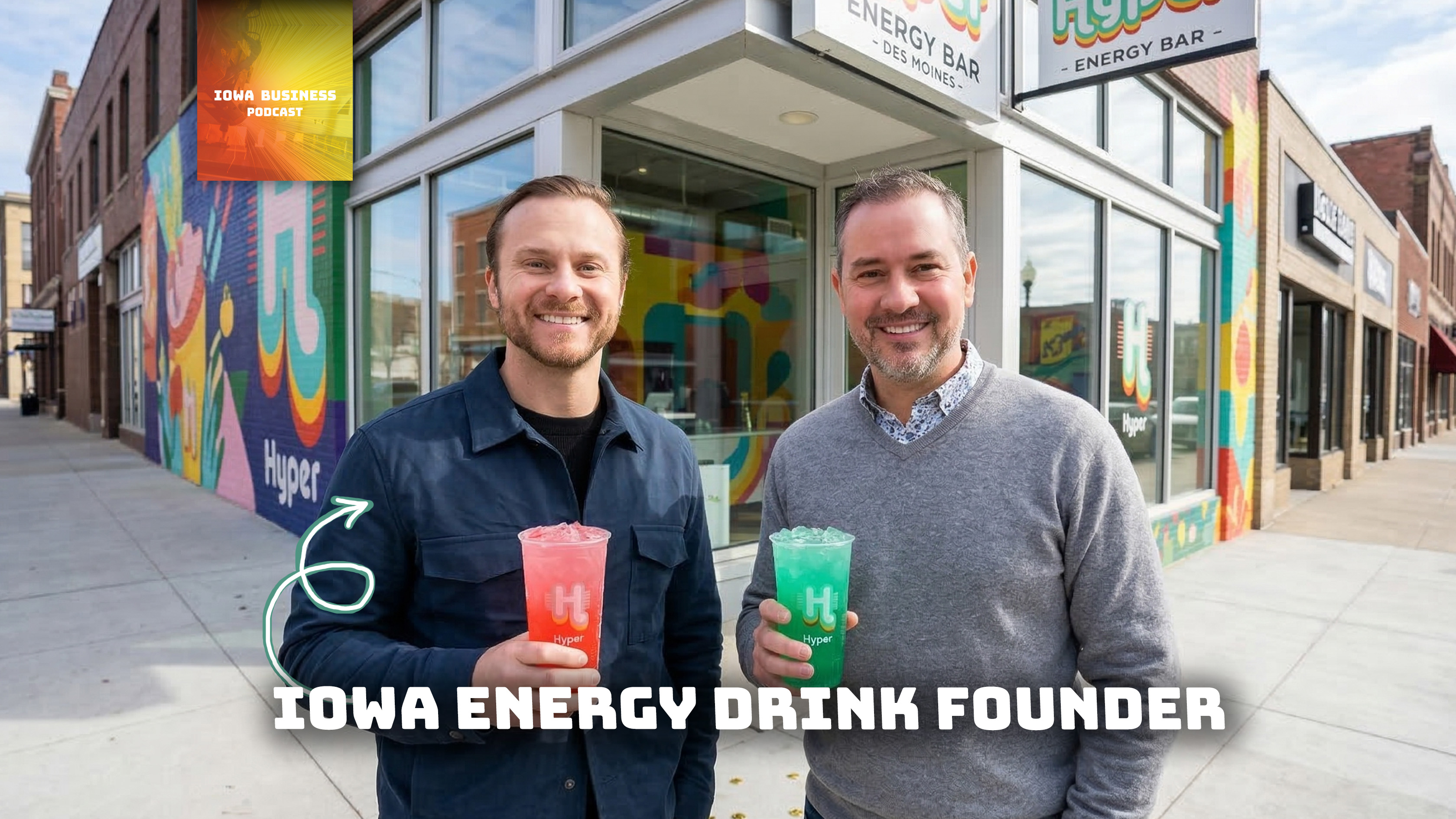


Can an Iowa-based drive-through brand focused on energy drinks survive? Can it take on the likes of Starbucks? Apparently the answer is yes. After building numerous stores across Iowa, the founder of Hyper Energy Bar, Chris Whalen, is expanding throughout the midwest.
Service runs in Whalen’s blood. As a kid he was surrounded by hotel and restaurant operations all under the Heart of America Group brand which is father Mike Whalen started. Hyper Energy Bar, partly owned by Heart of America, is growing because of what he learned about service. It turns out, creating unique experiences have given Whalen the edge he needed to build a growing brand.
Quick serve opportunity in Iowa?
Chris Whalen leveraged his family’s deep background in the hospitality industry to launch Hyper Energy Bar, a drive-up energy drink concept. Recognizing a gradual slip in general customer service right before the pandemic, Whalen saw an opportunity to pair a popular, highly-caffeinated product with exceptional face-to-face guest connection. By elevating the service experience, Whalen aimed to create something special, noting, “You can make anything a commodity, but how do you actually have that play towards people? Build a culture”.
Hear from Iowans directly. No algorithms.
Don’t let the algorithms choose your news. Enter your email address to hear directly from Iowans leading news in politics, community, agriculture and business. No editing. No clickbait. No rage. No agenda.
Recruiting retail workers in Iowa
Defying common industry complaints about the younger workforce, Whalen has built his company’s culture around hiring and developing teenagers and young adults. While he initially shared some generational doubts, his experience changed his perspective. Whalen stated, “I have reversed course on that. There are hardworking, wonderful kids everywhere”. He emphasizes the importance of mentoring, and this investment has paid off; currently, more than half of the company’s leadership team started out as hourly employees.
Growth during volatility
Despite fluctuating construction costs and a volatile market, Hyper Energy Bar is expanding rapidly. Starting with a single location in Iowa, the company now boasts 13 locations, expanding into the Nebraska and Missouri markets. Whalen attributes his aggressive growth strategy to both his natural optimism and the nature of the drive-up concept. He explained that their specific build-out is “not as variable as some of our other projects, you know, these long, full scale projects”.
Changing health trends impact on quick serve
When asked if evolving health trends and new dietary guidelines impact his business, Whalen remains unfazed. The brand adapts by offering fully customizable beverages, including sugar-free and caffeine-free options. Whalen ultimately believes that consumers will always make room for indulgences, saying, “I think treats are not going away… you get a treat, right? But you can also customize that treat to be healthier”.
Interview Transcript
This transcript was created with help from Ai. Please report errors to us and always refer to the video as your primary source.
Justin Brady: From The Jetro Barbecue, Studio, I’m Justin Brady. and this is the Iowa Business Podcast. We had Scott Carlson on one of the other shows on Iowa podcast.com, and he was talking about the Golden Circle and how restaurants and retail are struggling. But there is this weird anomaly where some people are thriving. One of those people is Chris Whalen, the owner of Hyper Energy Bar right here in Iowa. But. Not really just in Iowa anymore. It’s moved beyond proof of concept at this point. Has it? Thanks. Thanks for joining us.
Chris Whalen: i’m glad to be here. Thanks for having me, man.
Justin Brady: Uh, we’re gonna talk about all about what hyper energy is and why it’s growing, like a freaking weed. before we do that. immigration is also an issue. now too when We got into this deep. on Iowa podcast.com, not the political side, but the H one B Visa deadline is right now. Also, the uh, there are ICE raids happening on even organizations that think they’re in compliance because. There are some clever ways people can fake paperwork when they’re applying for your organization. So if you wanna see all that information, we broke it down with Davis Denton’s, uh, Denton’s Davis Brown, with Kaylee Blaik Raho, and she was on here discussing all the facts and figures behind that trend. You can see that. at Iowa podcast.com/business. So Chris, Thanks for coming in the studio. We’ve moved far beyond at this point, proof of concept. it’s basically an energy drink, bar drive up kind of, kind of, thing.
Chris Whalen: right?
Justin Brady: And so I think no one’s going. to disagree that energy drinks are popular. Mm-hmm. Right? But you saw an opportunity to do this in a drive up kind of thing, and kind of take on the convenience stores. Why a retail play on this? Where’s the opportunity that you saw?
Chris Whalen: Um, well, you know, it really starts from, from my background, you know, so growing up in the hospitality world, I mean, I always am looking for a way to have that guest connection. So take a product that I love, so number one, um, which is the energy side and caffeine in general, but when, how do you actually make it connect with guests? So that’s what we’ve always looked to do. Um, you know, since I was. Well, my whole life, how do we take a product and how do we make that guest connection? That’s what’s gonna make something special. I mean, you can, you can make anything a commodity, but how do you actually have that play towards people? Build a culture. And I think that’s where the magic, and that’s, that’s why we did it,
Justin Brady: you, so this is basically an experience play. Because. experiences are all, I mean, this sounds silly the way I say it this way, but experiences are all the rage. People kind of don’t wanna be isolated. They want to have unique experiences surrounding products they consume. And this is one of the plays that you saw, one of the opportunities.
Chris Whalen: Well, and, and you know, we kind of, we got started on this, you know, right before the pandemic, you know, putting, putting it
Justin Brady: Great timing. And
Chris Whalen: And I mean, I think one of the things that just cemented, uh, you know, prior to. Actually opening was, I just saw a gradual slip, you know, in, in service in general. Um, I think, you know, we were seeing, you know, this super tightening. We’re continuing to see it in certain ways, but this tightening of what is service, you know, um. And, and I said, I think we can do it right. You know, we can up that, we can make that connection like a full, you know, a full tenet of what we do. Um, and so that was a founding, founding principle was that everything’s gonna be face to face. We’re gonna have a killer product, but on top of that, we’re gonna have the best in class, uh, people, you know, best in class opportunities for young people. Um, and in turn that creates this. Basically this ecosystem of culture that’s inside our company and outside the company.
Justin Brady: So, um, the, for those wondering, Waylon is a name we all know around here in Iowa, your family owns like machine shed and a bunch of hotels. Wildwood Lodge is more one of the iconic Des Moines locations. yep. But some hotels, everywhere. full disclosure, you know this, but I actually used to work for Heart of America, which is the company your family owns. correct. Many, many years ago. And. That’s not how we met. We met somewhere else. We met at Drake, I think. Yeah. Many, many years ago. Mm-hmm. Uh, And so, the, your family, if there’s one thing your family knows, and obviously one thing that has been passed down to you, it’s that hospitality feel, that hospitality thing. Your dad, Mike, has talked previously about, we just saw this simple innovation, which is people come to hotels and they need to eat food. We’re gonna pair them together. And it’s like. That Really worked for
Chris Whalen: Totally.
Justin Brady: And so that hospitality play is a thing that runs in your bloodline.
Chris Whalen: It is. Um, you know, I think we try to establish those, you know, those true connections. Um, it’s not just a business model, but it’s who we are. And so that has been passed down and, and that’s really what started this whole thing was how do we. Take a killer product, but how do we move the needle up on service? Um, and that starts with just being extremely picky about who we hire, um, and really having people shine. And so that has worked. I’ve seen it. You know, this, uh, you know, majority of our customers are in a generation, I don’t think. That is super known for connection. And I said, I said, if we can just play a little part in reversing that to begin with, but then also, uh, inside our company is creating those opportunities for people, um, to have an experience like I did growing up in the restaurants, you know, working in the restaurants. When I got to college, I felt like I was far more prepared socially than a lot of my peers because I was. Working in the restaurant so much, you know, it’s how do you connect with young people and how do you connect with older people all in the same dinner? Right. You know, you gotta have all these different tables, you gotta, it’s different connection, but it’s the same attentiveness. And I think that was something that I felt was being lost to a degree.
Justin Brady: Yeah,
Chris Whalen: Yeah, absolutely. And we, you know, we really take it seriously and I think hopefully we’re preparing, you know, our, our young leaders to be, you know, even better leaders.
Justin Brady: I think that can’t be understated. It’s, you know, obviously you work at Hyper energy. You, you founded this company, you’ve worked in hospitality. So people might think like, well, you’re biased to, you know, of Course you’re gonna say, this is good for young people. ’cause you need young people to work for you. I will say. I, when I was wor, I did a ton of retail through college, and I did, I sold women’s shoes. I worked at a hotel front desk. actually, heart of America, is actually what brought me to des. Moines. Many years ago. I had a hotel experience up in Minneapolis, and that’s what got me here. Um, well, my family’s here. That’s what brought me back. Sure. But that was instrumental for me to be able to have an angry customer or a happy customer, but An angry customer and say it’s not personal. You just, your job is to make ’em happy and to kind of problem solve that in real time over and over and over again. That, that life lesson that I learned doing retail. Across the board. cannot be overstated. And you’re right, That young people, um, there not just young people in general, but there does seem to be a service vacuum right now, is that, just a post COVID thing, do you think? You might not know the answer to that, but
Chris Whalen: um, you know, I think it’s nuanced. I think that’s part of it,
Justin Brady: maybe,
Chris Whalen: I think, you know, I mean, you know, we can get into the social, the social side of things, but I think, you know, it’s, it’s part, being in the phone, it’s part of how people connect, right? So ev you know, a lot of it’s digital. There’s just. There’s just less, I think, face to face. Right. You know, we all used to have to be forced. If we wanted to go talk to somebody, we, we actually had to call ’em up and then we had to meet up. Right. Because, you know, right. So like, I think there was just way more opportunities for that. Um, sure. But I think, you know, you, you hit it. Right. I mean, being in those, those situations where you have to be cool and you have to learn how to get through situations like. When somebody’s mad at you, or you know, when somebody’s giving you compliments. Even, you know, that that’s sometimes a hard thing for young people to, to take and, and true. Um, so all these different things, they, but they prepare you for, you know, how a real professional, a real leader has to act, you know, in their life. Right? You know, you’re gonna have constant barrage moments of positives and negatives all in the same day. And so that’s, that’s what we really like to prepare our people for. And um,
Justin Brady: The. Have you figured out, you mentioned hiring young. The theme so far for the first, at least five minutes, has been like hiring young people. Developing young people. And so, uh, one common refrain, and we see this all over the place, is that, and again, this has been the refrain for 50 to a hundred Years, is that young people don’t wanna work hard. Young people are lazy, young people are entitled. and then you go to a Chick-fil-A and you realize that’s not the case. that clearly they’re out there somewhere. We just need to do a better job finding them. So. How have you. found them? Or are you still working on that? Is that one of the challenges?
Chris Whalen: Oh, well, I think it’s, it’s always the challenge of a business is to find the great people regardless of who you’re looking for. I mean, that’s a constant daily thing. But you know what, I will be honest and say that I have reversed course on what I think, and maybe that’s just a generational thing. You know, you always are looking down one or two generations and, and wondering, and hoping you know, that they’re, they’re gonna be, you know, hardworking, productive people. And I maybe had a. I had a, a incorrect assumption. Um, I had to actually, you know, we just never have hired maybe the, to this young generally, um, in our family company. And now that, you know, our probably average is, you know, late teens, early twenties, um, I have reversed course on that. I, there there are hardworking, wonderful kids everywhere. You just have to, I think, um, you have to. Pay attention. You have to find them. And then you also have to be willing to put the, the time into, you know, mentor ’em and train ’em and work with them. And I think when older generations have that, uh, that thought is maybe they aren’t. They don’t have maybe the patience to put in, you know, and they just
Justin Brady: oh, sure,
Chris Whalen: somebody else needs to train these people. Somebody else needs to work with them. Um, we probably just don’t have that much in common, and I think that’s just not true. And we just build a culture around that. Um, do you
Justin Brady: train people on lo certain locations? Uh, ’cause you, you started with a few locations, uh, Or one location? You started with
Chris Whalen: Start with one. Yeah. And
Justin Brady: And then. so do you just train people out of those locations and then just slowly expand as they’re trained up and then you say, great, you’re trained up, you’re good. Now you Go train others Is this is simple? Is this the simple strategy here or am I oversimplifying it to a
Chris Whalen: I mean, yeah. That’s always how it works, right? You know, you, you build your core and then, and then you move ’em out. And we’ve now, you know, we’ve taken a lot of people, um, from, you know, joining us at 17, 18 years old now, um, just as an hourly to now, you know. Uh, opening new markets. Um, so, you know, we’ve. Pretty much more than half of our, our leadership is, it all joined us in an hourly fashion really. So now they’re, you know, now they’re, they’re the general managers, um, you know, working on, uh, executive training roles. Um, so this is something we really pride ourselves on is building that internally, um, building our leadership internally and, and giving them the opportunities. So we we’re always looking for people to raise their hands and it’s exciting. That’s probably. In my very top topic side, but
Justin Brady: so they’re there. Mm-hmm. It’s just that when people complain, about not finding them, it’s either the recruiting process. sucks or the mentorship programs aren’t there, which is why people can’t find the young talent.
Chris Whalen: Right. And what, and you also have to have, you know, I, I think it helps to have a concept that is fun to work at. Sure. You know that they can actually have their real personalities. Right. So if you try to, anytime you try to. Box in somebody’s personality, it’s probably gonna be hard to, to get the full potential out of ’em. And we just allow it and encourage it. And so I think we, we are an attraction model than a, um, than, than a promotion model.
Justin Brady: You’re not in just Iowa anymore. You started in Iowa and now you’re, you’ve exp expand. Are you in. an additional three states now?
Chris Whalen: Um, so very soon, we’ll, so we’ll be in Iowa, uh, well, excuse me, we’re in Iowa, started here. Um, just so you know. Yes, we are great state. Um, but we opened last year, we opened our first store, uh, in Nebraska, our first stores. So we have two in Nebraska. Um, we have one in Missouri right now, so that’s part of the KC Metro. So we’re gonna be expanding in the Kansas City Metro, Omaha Metro. Um. You know, throughout Nebraska. And, uh, hopefully, uh, later on this year, we’ll be able to announce some new metros that we haven’t previously announced. And so we’ll,
Justin Brady: You can announce ’em here if you want.
Chris Whalen: Uh, not ready yet. Come on. Uh, will you, we will have, have me back. We’ll, we’ll do a follow
Justin Brady: Oh, look at this. Already going for a
Chris Whalen: already setting it up. So
Justin Brady: the expansion is, interesting because we have Starbucks. I don’t know if you even consider Starbucks a competitor or if you don’t, but, um. they’re kind of. Slowing a Little bit. and you know, Schultz had to come back a few times to keep Growth going and now they’re kind of, flatlining again. They’re trying to get people back in the stores. you’re taking a different approach, you’re doing the drive through kind. of thing. Mm-hmm. Um, so, you know, is the energy category in general, like, do people want that kind of stuff? Let me, let me ask a better question. The energy category in general, caffeine. in general, Uh, beverages. Are people kind of sick of coffee and they’re looking for something unique? Does this trend younger? Does this trend older? is it across the board? what, what’s the, uh, growth opportunity in the beverage? sector right now?
Chris Whalen: So, um, so coffee is always strong. It’s, it’s stronger than it ever has been. Um, you know, Starbucks, you know, to their credit, still one of the strongest brands internationally. Um, you know, uh. They have amazing systems. They’ve built an amazing company. There is absolutely no question about it. I think one thing that they’ve just over expanded, you know? Um, yeah. So I mean, they, they are closing
Justin Brady: stores. Yeah.
Chris Whalen: You know, they, I think that that’s, uh, and that’s, that maybe a natural, you know, uh, reset. It’s, you know, it’s not a, it is not, I think, a, a. A continuous trend. I think it’s a reset for a company like them. They’re always gonna be a strong company in my opinion. Um, there’s just other players that have entered the game and, you know, we’re, we’re one of them. Um, I think coffee is an expanding strong product. We really focused on the energy. Um. It’s a differentiation. I think we, we have a killer product, you know, we do great coffee too. Um, so, you know, we are a coffee brand, so anybody who sells coffee, anybody who sells caffeine is a competitor of ours. Um, I think we just kind of stand in our own lane and, um, you know, we’re, we’re coming and, and, uh, excited to be in these markets. And I think, you know, I’m, I’m a very competitive person, but I. I, I think that there is room in the sandbox for everybody, so it doesn’t bother me. Um, and, uh, yeah,
Justin Brady: I’m seeing. So I was looking at a bunch of locations and it does seem to be a trend, at least here in the metro, which is, don’t go into downtowns yet, um, which kind of lines up we had. Like I said, Scott Carlson, he’s like, honestly, I’m seeing golden circles in metros Because people are, are not going. into central hubs, at least for now. Yeah. And, but they do wanna hit places that are near their neighborhoods. And it seems like you’re focusing on. That golden circle, you’re focusing on these suburban areas where there’s high population density And, but there’s also, first of all. like is that the strategy? And then the second question is, I’m seeing a little bit of like Waylon methodology here where you’re co-locating some of these locations either close to Or, on top of existing properties in your portfolio. and or so, is this like a retail, like a, is this a construction play and a real estate? play, Or is this like a vertical integration play where you’re gonna try to work with your neighboring brands? to do, like to, to, uh, keep more revenue within the company?
Chris Whalen: It’s a good, uh, it’s a good analysis that you’ve done. Um, honestly, it’s. It’s really neither, and I’ll tell you why. Um, I mean some of the, some of the, some of the things locally, um, that we did, you know, just were opportunistic, right? It made sense. Um, you know, either we owned, I owned the land already, um, you know, I have the Tommy’s Express car washes as well, so early on.
Justin Brady: Some of them are co-located with
Chris Whalen: of ’em are co-located. So that just made sense early on. Long term, that’s not what we’re doing. Um,
Justin Brady: that’s kind of a quick scale kind.
Chris Whalen: Yeah. Well, early on it just made sense. Right. That makes sense. It made sense early on. Um, it, you know, it still makes sense, but that’s, you know, we’re just, um. We don’t, we’re not having that opportunity or chasing that opportunity onwards. Um, so when you talk about the real estate side, you know what, it is important. I mean, we generally, but it’s not necessarily like a business strategy, um, you know, for growth. It just happens to be something that we believe in, which is just owning our own land, um, and, and owning our own assets. Mm-hmm. Um, rather than. Lease, uh, like many Com competitors. Um, so it’s not, it’s not necessarily a strategy, it’s just really something that is more of like a, a just more of a core belief, I guess. Mm-hmm. Um, but, but it is, you know, it, it is something that we plan to do as much as possible, but the co-location, just something that happened early on was, um, was, was a good idea. Still is a good idea. Just. There’s just less and less opportunities to do that
Justin Brady: So it was more of a, It was a more of a way to start without over-leveraging yourself. yes. Uh, And then there’s going to be, a point though, ’cause Heart of America, um, and at least your footprint is Iowa. Like that’s what you know, but There comes a point. where you’re going to Get beyond Tommy’s and you’re gonna get beyond. like a Johnny’s Italian steakhouse, I think is one’s very close to there. you’re gonna get beyond that pretty quickly. And so it can’t be your rollout strategy
Chris Whalen: Yeah. I mean, most of our locations are not located by any of our other businesses, so. Sure, sure. You know, at this point, um, you know, we, we have about a, you know, we only have a few locations that are co-located now, um, out of 13. So it’s just we’ve far outgrown our Right. Those possibilities. But yeah, I mean.
Justin Brady: Is this an off sh, is this like part or going to be part, I don’t even know the right word here, of the Heart of America, family of brands, or is this a complete offshoot or there’s just like a kind of an overlap in partnership there because it’s your family, but it’s still its own thing
Chris Whalen: that the la the latter. Yes. So I mean, yes. So there’s a lot of overlap. Um, you know, uh, just in. Getting this going, right? I mean, we still consider ourselves like a startup. Um, you know, it’s, uh, it’s just we work like a startup. Um, you know, our, our whole culture is like a startup culture. Um, and I, I know I’m not a tech guy, but I, all my friends that are in tech, we just have a lot of, there’s a lot of ways that we approach things that are other similar, but, so, you know, we are, we’re digging in, um, to. You know, the things that we do well, um, as a Heart of America company and using some resources to overlap, um, you know, just to get things done. Uh, but no, it is, it is treated, you know, as a separate company. It’s just Yeah, yeah, yeah. So
Justin Brady: our, as. you are building out certain properties. Our construction costs, um, and like interest rates are all over the place. The tariffs are all over the place. People building stuff say that the market’s so volatile, it’s terrifying to grow anything. Uh, and this is actually a topic we had on the show a couple weeks ago with Joe Murphy, uh, the Iowa Business council, but
Chris Whalen: mm-hmm.
Justin Brady: You’re saying full steam ahead. in what could be volatile? So are construction costs, okay. You don’t seem to be scared that much. Why aren’t you scared that much? Like, you know, So just to ask this in a simple question, so don’t blather. On and on and on. Um, in a time of volatility. when people are kind of being careful and cautious and saying, we’re just gonna hold and not, we’re not gonna do anything, we’re just gonna stay put. You’re like saying, no, we’re gonna go full steam ahead. W why is that?
Chris Whalen: full. Um, you know, so I think there, I, I think.
Justin Brady: think
Chris Whalen: I, I, how do I put this? Um, you know, I think in, in a bunch of different factors, you know, globally looking at it, um, you know, I think there, there is a pullback. I think we’ll push through this, um, strong. And so I’m always a glass half full. Optimist. Um, and you know what? I just, I just am a natural optimist, and so maybe that’s part of it. Um, I think, uh, I think we’re just stubborn, optimist and, and going ahead, but, um, I just believe in this, in this concept so much. And, um, I think it works in a lot of different places. Um, I think we’re, we’re growing have. New opportunities. We have people who are hungry for new opportunities. Um, we have lots of people asking us to come to, you know, their areas. Um, so it’s, uh, I think this concept’s a little different than, you know, some of our other concepts, um, where construction costs are, you know, more of a factor. You know, we’ve, we’ve kind of, kind of, uh, built the model that we built, you know, isn’t. As variable, um, as some of our other projects, you know, these long, um, you know, full scale projects. This is, uh, we’ve kind of built our model. Mm-hmm. If you know what I mean. So the variables are, are there, of course, like any project, they’re just less, there’s just less of them. Um,
Justin Brady: um, are you still gonna focus um, going back to like a. Uh, locations. Are you still going to focus kind of on these and I’m Using the, I don’t even know if the, golden circle’s a
Chris Whalen: I listened to that podcast. Yeah, no. Scott hit something. I, he was spot
Justin Brady: Yeah. And so This is what you’re doing? This is like, you know, the playbook. He’s saying you restaurant people, this is the playbook you should be doing for those If I haven’t explained it clearly. Golden circles are basically like where people live surrounding metro areas or downtown areas, but not going into the downtown areas right now, ’cause they’re kind of struggling. Um, Des Moines. obviously being one of those. Is this a strategy you guys are following? As you go into other states, you’re kinda like saying, we’re gonna hold off on downtown right now, but we are absolutely gonna go into these golden circles. Is this a strategy you guys are actually doing? Well,
Chris Whalen: Well, I mean, I, I look at it a little differently. Scott’s right when he is talking about, you know, especially when he is talking about full service, um, because. You know, we’ve had, we’ve had to kinda look at, you know, where full service restaurants, you know, are, are doing well. Um, and I think the golden circles, absolutely. I think our concept more naturally has, you know, like our concept and its competitive set have always kind of been. Like a, a, a golden circle type of concept. Um, you know, do, do I think we can still do well in an urban, denser environment. Yes. Um, we’re just maybe more picky about how we do it and where we do it. Um, I think our concept is is, you know, retail nodes, you know, your, your high daily, uh, traffic, so you clearly want, you wanna be in places. If you look at like where fast food or, you know, any QSR concept does well. You’re looking at places that people are passing by on a daily, on their daily to and from, you know, um, less destination, right? So you wanna be near the home and less on the destination side of things.
Justin Brady: mm, that’s interesting.
Chris Whalen: So that’s, so it is, it is in theory, like that is an applicable name for it. It’s just maybe a different way of looking at it.
Justin Brady: Yeah. So That’s. interesting because destination, destination versus home, um, that is a di that Is a different, very different. strategy. So in the future, then, if people do start going downtown to major areas or hubs to work, and if that returns, does the strategy change?
Chris Whalen: uh, I think in our concept, um. Not necessarily, it doesn’t change, I think, I think, you know, when you think about quick service and full service, um, definitely two different. Two different things, right? And, um, there’s a lot of crossover. But when you talk about location wise, I think there’s a argument for both, right? Um, there’s an argument for your destination and you know, your beginning of your journeys, right? So like, um, but like in our concept, it’s, you know, people are hitting it not necessarily at their lunch break or, you know, um, you know, because, because downtown. Restaurants did so well because, you know, it was a spot, you know, you went to entertain, you went, you know, uh, you took out business dinners and, and then also you, you know, you got, you got a little fancy on Friday and Saturday night and you went downtown. Right? Right. There was just, there was like a hub of entertainment. You could hit four or five spots in a night. Um, and so I think that’s still a thing. It just maybe, you know, where. Exactly. The hotspots are kind of move and shake. Um, but for us it’s really, it’s, you wanna be a place that’s accessible from, you know, caffeine wise, it’s when you leave your house, it can’t be too far from, you know, where you leave your house. It’s probably gonna be in a retail node, you know? So like, that’s also, they wanna be, you know, near the home. But it’s also on your way out. It’s on your way, you know. Post work, it’s gonna be, you know, really it’s gonna be, you know, you’re gonna grab something on the way home, you’re gonna hit something on the, you know, before you, you know, after school. Um, you are gonna be studying or doing activities, um, or you’re gonna be on your way to the gym. You know, so those interesting, those type of things. Right. So you’re studying, working, you know, working at home. Uh, you know, you’re doing activities. It’s either, you know, it’s kids need a little boost before, you know, they go to soccer practice or football practice, and then moms are gonna be sitting through, you know, three hours activities. So they also want
Justin Brady: you’re getting a lot of different routines. You’re Getting students, you’re getting people, you’re kind of giving like a two. and a three o’clock swell. You’re getting an after work and after cool school swell. Yeah. Are you still getting The morning coffee run swell with people on their way to work or getting started for their day? Are you also getting that?
Chris Whalen: sure. That’s, that’s an important piece. Yeah, absolutely. So, you know, I mean, we, like I said, we sell both coffee and energy, so energy’s our primary. So it’s just people are choosing which caffeine they’re, they’re getting and yeah, so we’re definitely still, uh, big morning, um, big afternoon. Yeah, it’s fascinating
Justin Brady: cause, um. I, it, correct me if I’m wrong, it was either really close timeline or after you, but Starbucks is putting energy drinks in their, or At least like certain versions of that in their coffee shops. Now. I’ve only seen those, in the last year. Is that a new thing?
Chris Whalen: um, they’ve had it for probably two or three years. Okay. You know, so,
Justin Brady: they’re seeing some. Similar trend that you’re
Chris Whalen: Mm-hmm. Yeah. That’s interesting. You know, they’re, they’re, and, and we like to say, I mean, we are energy primary, so like that’s really what our brand’s built on. We do killer coffee, but we are our, our core is that energy. Um, and, you know, I think these other guys, they, they have decent products, um, don’t get me wrong, like on the energy side, but that’s, it’s really an. It’s a afterthought and it’s an also has or it also will offer, um, it’s
Justin Brady: not their focus. It’s not their
Chris Whalen: It’s not their focus. And so, you know, that’s from a branding aspect, but it’s also from what I think is a quality aspect.
Justin Brady: uh, last question. Um, and. With, with changing health trends. Now there’s like new SNAP guidelines. Obviously this doesn’t really apply to that, but There are new SNAP guidelines. There is new, the new Food Pyramid, people’s health. Um, they’re Really, really reading. labels now. Does this change the way you think about products or does this change the way you market products?
Chris Whalen: Um, not necessarily. No. You know, I mean, we, we offer, you know, all types, you know, we have our, our. Full sugar. Uh, ones we have are sugar free. We’re doing, um, you know, we can do sodas that are caffeine free, um, sugar free as well. So, I mean, we’re, we have all across the board. Um, you know, I think treats are not going away. Um, you know what, like, it, it, you know what, I’m a health guy. I’m a health guy. I still drink our products. Like you, you get, you get a treat, right? Um, and, but you can also, like you can. Customize that treat to be healthier. Um, so I think it’s, I think there’s always gonna be that market and, you know, um, so being a health guy, understanding it, like, absolutely, you know, it’s not, I don’t think it’s going away and I think people are more conscious, but they’re all more, they’re more conscious across the board. Um, so, you know, like I. If I’m gonna get a treat, you know, I’m just, I’m just paying attention more, you know, I will spend a little bit extra in the gym, I’ll, you know, just eat a healthier breakfast and lunch. Um, so, you know, you just balance and I think people are just getting smarter, um, over their whole day. Right?
Justin Brady: Yeah. Chris Whalen, the founder of Hyper Energy Bar. If people want to get something if they wanna taste it on their own, they wanna find. your locations, they wanna learn more. What’s the easiest way to do that?
Chris Whalen: Well, uh, we have lots of locations in the Des Moines Metro here, so, um, pretty much all sides of the city. If you’re out and about, check us out. Um, we’re also in the Iowa City Cedar Rapids, uh, corridor. Um, and, uh, over in, uh, Omaha, grand Island, Nebraska. And, uh, just open in south side of ca, Kansas City and Belton. And we have new locations coming soon. So check us out on social media. Um, see where we’re going. We’re always having fun there.
Justin Brady: Chris Waylon, thank you so much for coming on the Iowa Business Podcast.
Chris Whalen: Hey, thanks Justin. Appreciate it, man.