

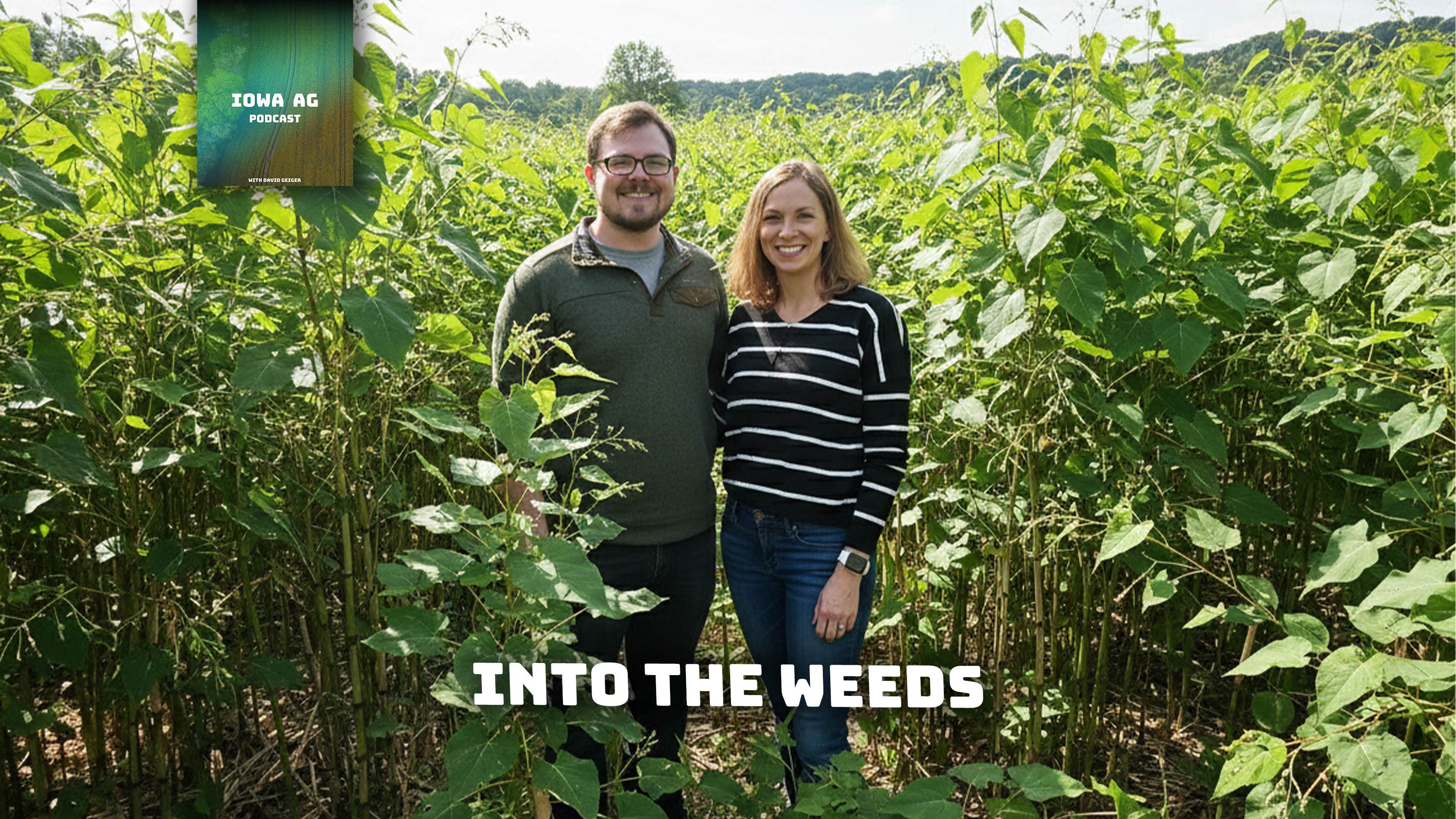


In this episode of the Iowa Ag Podcast, host David Geiger speaks with Meaghan Anderson, agronomist with Iowa State University Extension and Outreach, about preparing for the 2026 growing season and the broader challenges facing and science of crop production in Iowa.
As winter meetings wrap up and planting approaches, Meaghan reflects on lessons from 2025, including the widespread Southern Rust outbreak that caught many growers off guard. Moving into 2026, she encourages farmers to review hybrid resistance ratings, maintain good records, and take a strategic approach to fungicide decisions, especially in a tight commodity market.
Hear from Iowans directly. No algorithms.
Don’t let the algorithms choose your news. Enter your email address to hear directly from Iowans leading news in politics, community, agriculture and business. No editing. No clickbait. No rage. No agenda.
The conversation also explores the role of Extension agronomists as research translators and trusted advisors. Meaghan discusses how she balances science-based recommendations with the uncertainty inherent in biological systems. She often serves not just as an agronomist but as a sounding board for farmers navigating complex decisions.
Beyond row crop disease management, the episode highlights invasive species concerns. This includes Palmer Amaranth, which has been around for nearly a decade in Iowa, as well as emerging threats like Japanese Knotweed. Vigilance and education remain key tools in preventing further spread.
The discussion concludes on a broader note about communication. Meaghan emphasizes that farmers are working to make responsible, sustainable decisions, and that constructive dialogue between agriculture and the public is critical moving forward. As 2026 planting nears, preparation, perspective, and collaboration remain central themes.
Interview Transcript
This transcript was created with help from Ai. Please report errors to us and always refer to the video as your primary source.
David Geiger: Welcome to the Iowa Ag Podcast. I’m your host, David Geiger here at the Jeff Rose Barbecue Studio. Thank you so much for joining, and today we’re gonna go over a topic that we’re gonna be getting into in a month or two with planting agronomy. Joining me right now is Megan Anderson, an Iowa State University extension agronomist for Central Iowa. Megan, thank you so much for joining. We’ve had many conversations before, but I’m glad to have you here on the IAG podcast.
Meaghan Anderson: Yeah. Thanks for having me. What a cool setup you’ve got here
David Geiger: it’s a super cool setup and I’m glad you’re here because you have been doing conventions all winter long. uh, and by that I mean she’s been teaching people about what they’ve learned all year from the previous season, but we are now getting close to those starting months of planting, or at the very least, folks preparing their fields for planting. Megan. Let’s just start off with the basics of what are we seeing as we enter into 2026?
Meaghan Anderson: Well, a lot of snow today. So
David Geiger: snow today. Yeah. We both had to travel a little bit over, uh, ice to get here.
Meaghan Anderson: So it’s, it’s hard to think about planting, but you know, last weekend was, was absolutely beautiful. And so, so as we look forward to planting in, in 2026, I think of kind of. It is an opportunity to be a clean slate in a lot of ways, right? We do carry over a lot of issues from the prior years, but I think the big thing that’s been on a lot of people’s mind is the whole southern rust issue that we had in 2025 and. And that makes me feel very excited that we’ve got this kind of clean slate slate moving forward to 26. Um, but we’ve got a really good window of opportunity to make a lot of preparation so that we can be prepared in case of these kinda weird scenarios like we had in 2025. And I think we’re gonna be a lot better educated moving forward for things like that. Um, and there’s gonna be a lot of the same things that we do every single year, um, moving into 26, but it’s always interesting. Something will, something will catch us off guard, but we can try to be as prepared as possible here this time of year,
David Geiger: I’ve been told a couple times over the past year that Southern rust that advent in Iowa was primarily a best way to describe a freak accident. It, would, it required six things to happen simultaneously for us to have that experience of the spores from the south reaching all the way up here, and it does not survive the winner. So what are the, the new analysis, the new expectations of a advent like that? Yeah,
Meaghan Anderson: I mean, it’s not all that unusual for it to get to Iowa, so we uh, you know, keep fairly good track. of it. And I think over the last decade or so, the Crop Protection Network has been doing this mapping project where when people report a disease on, you know, we report it on a county level on the map. And so in the last five years, it’s been reported in Iowa for the last five. And so it’s not terribly unusual for it to get here, but there was a. Kind of freak occurrence that we had this huge combination of things, right? Probably a lot of corn planted in the south A lot of southerly winds, which was kind of bizarre. Winds coming outta the southeast are kind of a weird thing during the middle of the summer. Um. Probably a lot less. fungicide sprayed because of commodity prices in the south, and so more inoculum making it up here. But you know, all of those things could happen and we still may not have a big issue with it here in Iowa, but that weather issue. that we had in Iowa where we had just like the perfect storm of environmental conditions to be good for it, That was a pretty unusual occurrence. And hopefully we don’t see anything quite like that again in the future, but I think we’ll be a lot better prepared. Right. So we’ve been talking a lot about. you know, Hybrid resistance. is gonna be your best line of defense against any disease. And Even if you’re not purposely going out and choosing hybrids that are gonna be resistant against certain diseases, I think it’s a good time of year to be thinking about the sort of accounting of them. Okay. I’ve got These hybrids that I’ve, I’m planning to use this year. And This one, The company? tells me is really good against Tar Spot, but it’s weaker against this and this one, you know, the company, That one, that one looked really good against Southern Rust last year, but it’s, it, it’s reported, you know. numerically as being one of the weaker hybrids that that company has on this and this, and being able to kind of keep that mental accounting of things, or maybe a physical accounting, right, depending on how good your memory is, so that when these issues start to show up this summer and somebody says, oh, there’s. There’s southern rust and you know, the weather forecast is gonna be great for it to spread, right? It’s gonna be hot and wet. And you can say, look, these are our hybrids that we need to be prioritizing to take care of ahead of maybe some of our other hybrids, because we know that that’s where it’s gonna pay the best. And we know that there are certain fungicide products that work better on certain diseases. And so I think, um, It’s easy to sort of broad brush and just say, oh, I’m gonna spray everything. I’m gonna do this or that. But in the commodity market that we’re in right now, it’s a lot harder to do that. And so I think it, it pays to take that time to plan and, and manage your expectations and, and be a little pickier about when and how you use things.
David Geiger: I have a dozen questions that I’ve asked you before about all sorts of agronomic processes, but I think I’d like to dive more into the human side of that because what you just described is not something folks who aren’t within farming specifically will ever really encounter, and that is making all of those genome decisions ahead of planting, trying to take historical data, trying to anticipate what’s on the way. and you were one of the advisors, you, um, along with a bunch of Iowa State University extension specialists who take calls from farmers and talk to them from here, hopefully in a local way. Your base is central Iowa. You have that opportunity to talk to them about what you know, but there’s also the aspect of they are taking your advice and it feels like there would be a bit of cost. Decision paralysis, I think is the best way to decide on it. It’s hard to choose which one you’re going to go with. How do you go through that process when talking with farmers and, and, how do you take the, the result of I can’t know everything. I, I, can’t tell you the 100% truth. I can just give you what we know best. Yeah.
Meaghan Anderson: Well I totally went in the weeds before this and then you went in the weeds with that question, so I’ll try and make my way through it. Right. Um, yeah, I mean it’s it’s really difficult, right? Because we are working in, you know, biological systems and we are dealing with trying to decide what the weather’s going to do and how that’s going to affect how the crop’s growing and how diseases are developing and how all these other things are happening. Um, and. It makes decisions really difficult because you can’t necessarily have the correct best answer for every situation, and you really look in retrospect a lot and think like, oh, did I make this right decision this year? And so, so I’m, I’m somebody who. you know, I rely very heavily on research based information, Right. It’s, I, I don’t get real caught up in marketing claims and like, oh, this company says the product can do this, and I’m more of the, you know, sure they say that, but let’s test it ourselves, right? Let’s set it up in a way where we can, we can test it on our farm, we can see if it works, maybe we’re gonna do it multiple years or in multiple fields. And so I’m constantly trying to help, I guess, challenge farmers a little bit to, to really figure out like, okay. Are these broad brush claims that people make Um, are they relevant to me? And how can I make them best work on my farm? Or how can I, make things suit me? And in a lot of cases, when people call me, they already kind of know what they wanna do. And so that, does make it a little bit easier because I, I find that depending on the time of year, I’m, I’m like 60% agronomist and. 40% therapist a little bit, right? I’m helping to re reassure people that, you know, things are going okay. I am confirming what they already thought. I’m looking up information to help figure out a decision that they were trying to make. And, and just adding that last little piece that hopefully makes it easier for them to make a decision. And, and it’s not my job to make decisions for people, uh, but hopefully I can help them along the way in their decision making process, just by providing them. Good information.
David Geiger: Since you brought up the therapist aspect, that is a very difficult position And it requires a lot of disassociation work-life balance because you can’t just carry that emotional burden for someone else all the time, but your phone’s available for farmers all the time. it is. It weigh you to be someone that is relied on like that, And not in a negative way, but just how, how is that. experience,
Meaghan Anderson: uh. I’m sort of a weird person. I, uh, I don’t know. ire, I really like it, right? I very much, um, you know, my dad and grandpa farmed and my brother farms still now. And, And, to be somebody that someone relies on and trusts for information, I think is a really, um, honored position to be in. And so to me, like. you know, I know when I need, I feel like I need to shut things off. Uh, like that’s not a problem for me. My husband would say otherwise, though. Like he would totally say that I pick up my phone too often and, and I take my work phone on vacation with us and stuff, and he doesn’t like that, but but to me, you know, it’s really easy to answer questions if you’re like, sitting somewhere nice or you know, you’ve gotta drink in front of you or whatever. So, So I don’t mind that kind of stuff. I really, um, it, it, means a lot to me to be somebody who’s trusted by. People. And that’s, that’s like my number one goal in life, right? Is I wanna be that trusted advisor and, and farmers have all kinds of people to rely on like. They cannot be experts in anything. In everything. Right, right? They Can’t you know they’ve got equipment maintenance and purchasing decisions and accounting and
David Geiger: marketing decisions, marketing
Meaghan Anderson: decisions, and trying to be a pest management specialist and an agronomist and all of these things. and, and they can’t. Do all of those, right? So often you find farmers who you know, They are really interested in. a few of those aspects. They’re really good at them, right? Some farmers are really good at doing their own maintenance and some farmers are, you know, they’re creating their own chemical programs, right? They’re going and picking and choosing different generic products and putting them together in a way that works for them, making sure they mix, they’re doing their own application, but not everybody can, do everything. And so, you know, for those people who need that agronomist. As just kind of another ear and, and to have those conversations. It’s really, uh, you know, there’s a lot of agronomists out there. So if I’m one of them, that’s that’s a pretty cool place to be.
David Geiger: What made you choose agronomy? Why did you get into that? You mentioned you have family that farms, but why choose agronomy specifically? Uh,
Meaghan Anderson: Good question. Oh, man. I’m gonna give a. lot of credit to Bob Hartzler and it’s gonna make his ego very large. Uh, but
David Geiger: the weed guy, by the way,
Meaghan Anderson: Bob Hartzler. he’s retired now. He was a weed scientist at Iowa State, and, um, when I was an undergrad, I started as a biology major and I really love my biology classes, but I was. Having very much like crises my freshman year that I didn’t know what I wanted to do. And I went home in the fall in October, around my birthday, and I rode in the combine with my dad and I thought, You know, like if I could be in a career where I can help people like my dad, that’d be a pretty cool place to be. So I, uh, I think that? spring I took an agronomy, my first agronomy course. So I didn’t start as an agronomy, uh, major. And from there I just kept taking agronomy classes. I became a TA for like the you know, intro level agronomy, but then I took a weed science class, a weed identification, weed science with Bob Hartzler. Uh, and I learned that weeds always win and that like
David Geiger: They do that totally
Meaghan Anderson: settled it, right? I had to be an agronomist because I had to try to beat the weeds.
David Geiger: Everything is a weed until, you know, suddenly you have a soybean field and now corn’s the weed, you know, have, know?
Meaghan Anderson: yeah. I mean that’s debatable, right? Like we could go back and forth on whether corn is a good weed. It’s not, by the way. Uh, but yeah. right? Depending on the environment, that’s the most common definition of a weed that people use is a plant out of place, which is a, is a weed scientist by training. that’s a little bit broad brush again. Right. We’re, we’re just sort of speaking in general terms. Um, so I could think of more specific things that make weeds good, but I accept that because that’s pretty common terminology.
David Geiger: I I love that direction because that is a very common Motif reoccurring theme within agriculture, and that is generic words that have specific meanings sometimes, but generic, generic meanings. Most of the time. Weed is a perfect example of that, right? It is something that I’m sure if You ask a scientist yourself. What a wheat is, you could give me a scientific answer, but on a broader spectrum, it is just a plant where you don’t want it. How do you communicate that? How do you involve yourself in the, the process of talking about complex agricultural topics like that?
Meaghan Anderson: I mean, that’s my job, right? As an extension agronomist, my job is to make some of these challenging topics that. you know, I can go read and research literature and kind of distill them down to what’s the most important point and how can I communicate that effectively with other people. And so, uh, you know, I can joke that a corn is not, corn’s not a good weed. And that, uh, you know, A plant outta place is not a great definition for a weed. Uh, but that’s kind of how most people talk. And so I kind of have to bring, I bring myself down to other people’s levels all the time to just make it easy to communicate And
David Geiger: the common vernacular,
Meaghan Anderson: right? and so it’s, it’s, you know, not about having the, smartest sounding definition or, or being the most scientific and and having really long explanations for things. It’s being able to easily communicate with people the point of, you know, whatever the question is that they’re asking.
David Geiger: and you do get a lot of questions. I mentioned at the beginning that this is kind of the conference time, right? There’s not much agronomic data to collect in Iowa. in the middle of winter, so it’s a time to. Have naturally to talk about all these things without having calls to fields all the time. So tell me about the conferences you guys have had over the last few months here. Yeah,
Meaghan Anderson: our, uh, extension Crops team puts on a lot of conferences during the winter. our, first one is always the Integrated Crop Management Conference, and that’s sort of like the, you know, premier CCAs. A lot of people from, uh, research scientists and people with companies to agronomists that are working at co-ops and other locations can come and get kind of a little bit more of that science-based, uh. Update, right? All those research updates that we like to hear, and then maybe new things that are happening in Iowa. And so we do that in December. That’s always a really big conference. Um, and then in January we do our Crop Advantage series, and that’s where we, we bring our extension specialists out to farmers. We tailor programs on a location by location basis to try and make sure that they’re locally relevant. and it’s maybe not quite. as science heavy as the ICM conferences, right? Similar topic you know, same topics, similar topics, but maybe not quite so laden with tables and, and data and all that stuff. Uh, more of a discussion Hopefully Um, and then we do plan, we did Planner U in February. And so that’s a really cool opportunity where we bring out our digital ag group. Um, I always like to joke that they’re engineers who can talk to people, which is always a good thing. And
David Geiger: rare.
Meaghan Anderson: Yes. Well, I’m not, I’m not one to speak about that. I know a lot
David Geiger: good That’s my opinion. that’s a David Geiger exclusive opinion. It reflects nothing on behind my guess there.
Meaghan Anderson: right. I know a lot of good engineers that can talk to people, but it’s, it’s really cool to see them go out and, uh, be able To share their planter expertise, uh, to help kind of jumpstart that preparation process for all those people that are hopefully right now getting their planters ready. Right. For spring. Yes.
David Geiger: Getting, making sure they’re, you know, cleaned up, ready to go. Everything’s working.
Meaghan Anderson: Yes. Yeah. We are making sure our things are set correctly so that when we go outside in the spring. We’re not having to waste a bunch of time tinkering around on it. So that’s always really cool. and then I do all kinds of other stuff during the winter. Beyond that like all the field agronomists do pesticide training, so we train private pesticide applicators and then some of us will do commercial pesticide applicator training as well. Um, and then I do a lot of more like one-off programs as well, either, you know, hosted by. Iowa State Extension or as a guest to other meetings. So like, after I leave here today, I am gonna go run off and talk at the Invasive Species Conference, which is for the Iowa Wheat Commissioners,
David Geiger: And also a. a. Probably pretty interested, uh, folks, men, many folks interested in that are going to see what the next invasive issue is in Iowa. Is there a bit of a sneak pre peak? I mean, this, this is gonna be airing after the conference is done, but, uh, any, any bit of a sneak previous, but post
Meaghan Anderson: Yeah. so, uh, well there’s, you know, they’re always interested primarily in, in weed species that are showing up in non crop areas, right. Because they’re managing a lot of, uh, rights of way and
David Geiger: conservation Prairie grounds.
Meaghan Anderson: Yes. Yeah. Places, uh, city owned properties.
David Geiger: Oh, right, yeah. things like that.
Meaghan Anderson: And, and so, uh. I mean, jokes on them. Last winter, I spent the whole time talking, about Japanese, not weed or the invasive, uh, knotweed species. There’s three species. They’re
David Geiger: is it weed or is it not weed?
Meaghan Anderson: Oh, well it’s, it’s KNOT weed, of course. Right. Ha ha, ha.
David Geiger: yes.
Meaghan Anderson: yes. Um.
David Geiger: So
Meaghan Anderson: I spent the whole time talking about that and they had like a big poll where they were, they did like a March madness thing and they were trying to pick the winner of what the worst weed was, and it came down to Teasel and Japanese knotweed and they finished it right after I presented. And I’m convinced that I am the reason that the knotweed won. Right? It beat Tsel. There was a big tsel group there, but, Uh, jokes on them. I’m gonna talk a little bit about Japanese, not wheated again this year, but Japanese stilt grass is probably the biggest one that I’m hearing more about, uh, which is uh, grass primarily, it’s a really bad invader of like forest grounds. And we hear about it like over in the eastern Iowa area in particular in some of those, You know, like new developments where they’re, they’re sort of creeping in back by like wooded areas and streams and stuff, and it’s just this grass that forms a total monoculture. It’ll look like a cornfield of Japanese still grass. Um, and just smothers out everything around it. It’s a prolific seed producer. It’s incredible. And so We just had, uh, I think two new IDs of it. One in Des Moines and one in Ames last year. And so I wanna make sure that everybody’s on the lookout for that new species and knows a little bit more about it.
David Geiger: all right. Keep on the lookout for knotweed, which is a weed. Yes. And. my follow up to that This. is a purely personal bias because it was, uh, the big invasive boogeyman of my start in ag journalism and interviewing people for the first time. And that was Palmer amaranth. Like, that was like, that’s that’s something that, you know, was, this is the most terrible weed. You can’t, like, it’s so hard to take care of It’s so hard to kill. And. I believe it still continues to be that, but I don’t hear it talked about as much as, you know, the next invasive species. Is it because it’s just not talked about among like the, the average agriculture person and it’s still very much talked about among farmers or is it We figured out better ways to manage it.
Meaghan Anderson: So for brevity’s sake, I, I didn’t mention Palmer, but I have Palmer Aerth plants in my car right now.
David Geiger: you didn’t bring ’em up here? No,
Meaghan Anderson: I didn’t bring em up yet, but I have them because I’m also gonna talk about Palmer Aerth with this group today, and I have a few seedlings to show them so that they, you know, can kind of get the visual.
David Geiger: is 1 million seeds on this one plant.
Meaghan Anderson: That’s right. Well, I’m not carrying seeds. Don’t worry. I’m
David Geiger: right, right.
Meaghan Anderson: I’m not moving the seeds around. But, um, I actually did my first kind of big update on our well Crops TV program, which I didn’t mention, but that’s our like, online programming this winter. And so I did my first real big pulmonary amaranth update that I’ve probably done in five or six years. And part of the reason that I did it is because this is gonna be basically 10 years out from the year that we found all the Palmer amaranth in conservation plantings. And the reason that that’s important is because a number of those conservation plantings would’ve been on 10 year, um, terms. And so some of them could be coming out this year. And so I think it was a good time to have that discussion about this boogeyman weed as you put it. And that it really, it’s, it’s not gone anywhere. I would say that it certainly is. A lot quieter and part of that is, is my fault and, you know, the pandemic and all these things that, that it just, you know, we weren’t getting out as much. and keeping as close an eye on some of those sites. And So that was sort of my renewal thought this year is that I really need to get out and take a look at some of these sites that we haven’t looked at in several years because we have made a few. new identifications. There’s a new site that was found in Benton County. There’s one in Boone County, um, which is very concerning and localized to me. Um, and then there were a couple fields in Cass County, and so we don’t necessarily know in every scenario how the Palmer Amaranth is getting here. Um. The good news for us still remains that, that if you don’t know you, you have Palmer amaranth, it would be managed in the same way that you would manage water hemp. And so I think we have a little bit of a leg up on trying to manage it, at least to begin with, but we still need to be vigilant in keeping an eye and making sure that like if we have a water waterhemp population that’s surviving in a field. It would be good to know that that is a hundred percent for sure, waterhemp, and that you’re not noticing any of those, you know, the very tall flowers at the end of the growing season. That would be really indicative that it could be Palmer amaranth and just making sure that we’re still staying vigilant and keeping an eye out for it.
David Geiger: Megan, what are you looking at next? What’s the process as we head into planting? Any more conferences on the way as we move forward? Or are you just all like the farmers prepping their, their machinery getting prepped for the new season.
Meaghan Anderson: Yeah, so we’re at this point in the season, right, things usually start to slow down about the time that things are picking up for farmers, which is a, a good thing for me from a meeting season perspective because it. gets a little a little burnout, I guess. Um, but I think I think big things that we’re doing is, is looking at how can we share material out. Revamping things that, we’ve used in prior years regarding planting and fertilizer and nitrogen applications and, and controlling weeds in the spring, and things to think about for your pastures in the spring and all the all that stuff, and trying to put that out in a timely manner so that people can use it as sort of a heads up to think, okay, I’m, you know, oh, they said this about. About the, fertilization Or about the timing of nitrogen or the rate of nitrogen, and I need to be thinking about that here in a couple weeks when I go out to do whatever I need to do in the field. And so we’re definitely doing a lot of that. I’m very excited at the prospect of things starting to green up here at some point. maybe
David Geiger: first uh, whited up a bit as we drove in today. In the. middle of February.
Meaghan Anderson: Yeah. I think my kids are getting Pretty desperate because my youngest daughter this morning told me that that trees aren’t supposed to be green. They’re supposed to be brown and white And I was like, no. Hopefully at some point she remembers that they do turn green again here.
David Geiger: That’s such that that is a. quintessential kid thing. Yeah, It’s wonderful.
Meaghan Anderson: Yes, so that’s, I’m looking forward to being able to get out as I’m sure. You know, everybody else in agriculture is too, wanting to get out in fields and start see things greening up and, and hopefully, I mean, something that I’m really hoping for is, I’m hoping that I see less residue, Uh, this spring. Then I’ve seen the past several springs because we finally have had moisture, I think, to help break down some of that residue. And that’s been a real challenge for farmers to manage in the spring, especially with planters. ’cause there’s not very much you can do with the planter to get residue out of the way. And so I’m, I’m really hoping that that things start greening up here fairly soon and we can start to, to get out and look at stuff.
David Geiger: the Megan, I have to let you go, but I do want to ask one final question before I do so and that is. On a more broad scope of agronomy, your specialty work with Iowa State, When it comes to just talking to folks, both farmers and folks who aren’t involved in farming, what do you think needs to be more acknowledged or more thought of As a part of the conversation? As part of how we talk to each other?
Meaghan Anderson: wow, that’s a really good question. Um. You know, I think that There’s a lot of especially nowadays with like social media and with how charged everything feels in public, um, I think that it’s really important and I hope people can take into consideration that, that everybody’s human And so, uh, people are doing their best and, you know, somebody else’s best might not be what you would consider to be best And uh. I think that there’s a lot of, opportunity for, education and learning just from from different people’s perspectives. And so, you know, there’s no farmer, especially like with all the stuff going on with, With nitrates and water and, you know, there’s a lot of conversation about chemicals that are being used. There’s no farmer that, that thinks they’re not doing the best thing for their farm, right? Preserving the sustainability of their farm, uh, you know, managing their weeds So their neighbors don’t get mad about weeds and making sure that they’re being cautious about how they use them and not overusing them, you know, because of the environment, because they don’t wanna overspend money. And so I think there’s a lot of opportunity for, you know, the sort of consumer end and the farmer end to learn from each other. And I hope that we can get some more of that in 2026 than maybe we’ve had in recent years.
David Geiger: Thank you so much for that answer. Now a more funny question, next time we talk, I was thinking about it when you were speaking about how you got into agronomy and your family being involved. I’d like to see the data of before you became the agronomist for your family farm, and then, uh, after you became, well,
Meaghan Anderson: whoa, whoa, whoa, whoa, I’m not, no. My brother will, he will come at me with a pitchfork if somebody says, I’m the agronomist for the family farm. But I will tell you that I am especially honored every time he calls with a
David Geiger: There you go.
Meaghan Anderson: me, he is not wanting to call his little sister to ask her questions. So when he calls, that makes me feel really good.
David Geiger: It’s a full on. Oh, hello. Oh, you wish to what? What words are you going to lavish upon me to give you my wisdom?
Meaghan Anderson: Yes. He does joke. He’s like, should I call your work phone or do I call your personal phone?
David Geiger: That’s wonderful. Megan Anderson is an ISU extension agronomist for Central Iowa. Megan, thank you so much for joining me today.
Meaghan Anderson: Thank you for having me.
David Geiger: me. This is the Iowa Ag Podcast. I’m your host, David Geiger here at the jetro Barbecue Studio. Thanks so much for joining us, and if you wanna follow more of what I do, you can see that. on X at Geiger reports. That’s one of the best ways to see that. And until next time, everybody, thanks for being here.