

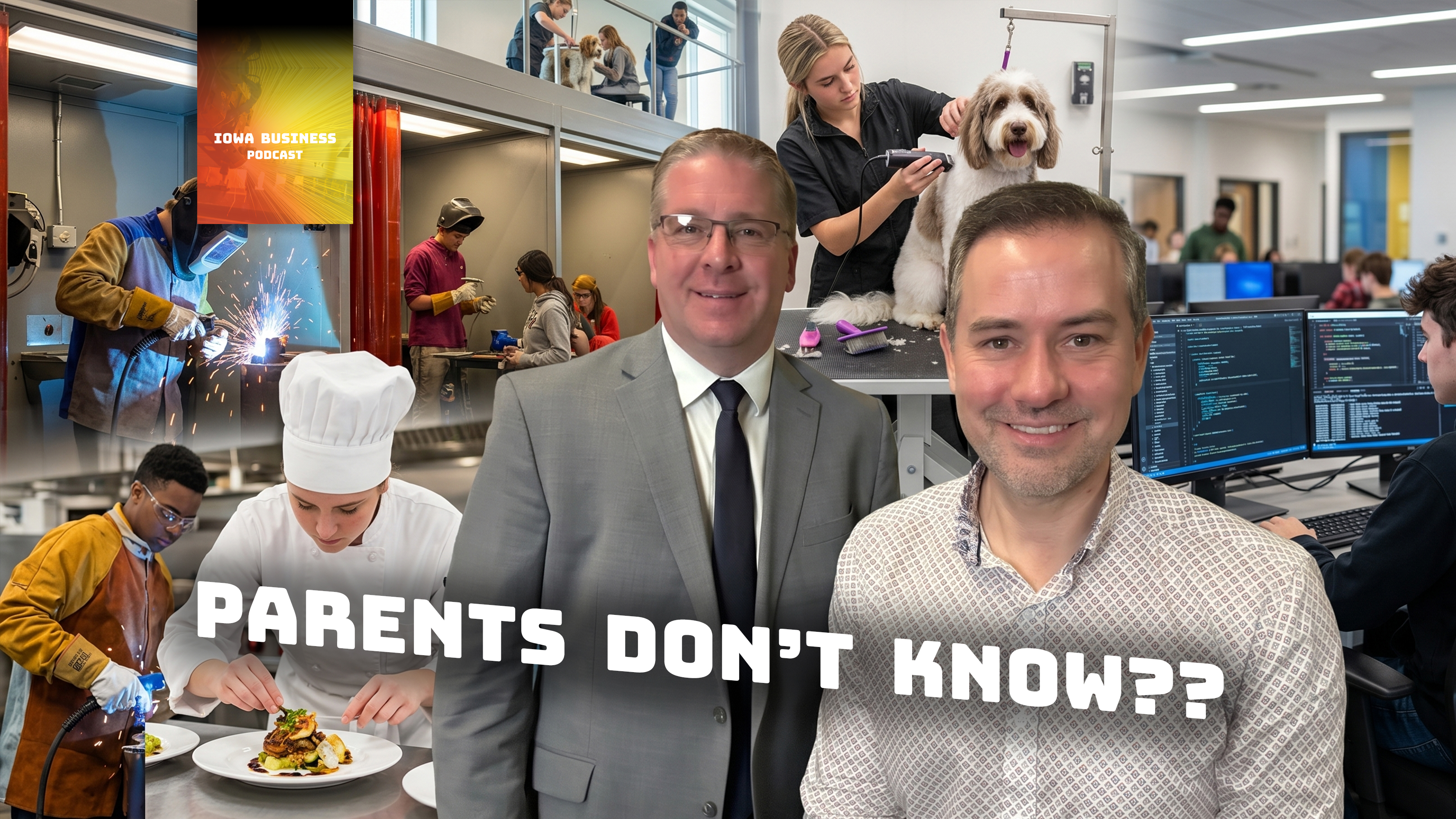


As we recognize apprenticeship week and the massive opportunity it brings, we learned an alarming number of parents are still pushing students to get 4-year college degrees. Why? Tim Felderman, Chair of the Iowa Apprenticeship council and Superintendent of Hampton-Dumont school district is concerned.

Hear from Iowans directly. No algorithms.
Don’t let the algorithms choose your news. Enter your email address to hear directly from Iowans leading news in politics, community, agriculture and business. No editing. No clickbait. No rage. No agenda.
Felderman explains why Iowa’s process is far more adaptive to business, and how apprenticeships have evolved into tech, food service, and other growing fields. He explains apprenticeship is essentially precision education, and says helping students find fulfilling careers can be a challenge, especially as parents still push 4-year degrees on students, adding to their debt-load.
Thanks to Dentons Davis Brown for collaborating with The Iowa Business Podcast to bring incredible value to our listeners! Collaborators compensate our hosts directly for their time and effort crafting exclusive content.

Interview Transcript
This transcript was created with help from Ai. Please report errors to us and always refer to the video as your primary source.
Justin Brady: From the jetro Barbecue Studio, this is the Iowa Business Podcast, and it is National Apprenticeship Week, of course, national Apprenticeship Week in Iowa, and that’s what we’re talking about today is apprenticeship, filling that trade gap is apprenticeship doing its job. And I didn’t know this until this morning when I was researching this. There’s like different kind of apprenticeships. So we’re going to ask about that as well. I actually learned a lot already. I haven’t, he even interviewed this gentleman, but he, he is Tim Felderman, the chair of the Iowa Apprenticeship Council and of course superintendent of the Hampton Dumont Community School District. Thank you so much for coming on the Iowa
Tim Felderman: Great to be here. Justin. Thank you.
Justin Brady: I’m really appreciative of, uh, Dentons Davis Brown for helping us on this show and providing us some insight. We have three deep dives on various aspects of business law right now, immigration, H one B, visas and m and a deals. The state of m and MM and A deals in 2026, and. Those patterns to look for ahead of time when you may be losing key talent. I had Beth Koonin in here. We had Kaylee Blaik Naranjo in here, and Jason Stone, all from Dentons Davis Brown to break all those topics down. The deep dives are all available at Iowa podcast.com/business. I learned a lot from them, so we appreciate their sponsorship. Uh, chairman Felderman obviously appreciate you being in here. One of the things I noticed when I was getting ready for this and doing some research on apprenticeship in Iowa. Is one word that kept repeating and I was like, whenever I see a word that keeps repeating, I, I gotta ask a question about that. So I’m gonna ask about the, the trade gap here. I’m going to ask about skilled trades. I’m going to ask about the college thing, you know. Oh, do you need the piece of paper? We go back and forth. Uh, I’m going to ask, is the trade gap at this point, even closable? Is that even possible? But I wanna start with. Why do I see the word registered before the word apprenticeship? It’s over. It’s, it’s not an accident. So why is that significant?
Tim Felderman: Sure. I believe. it’s significant, Justin, just because you know, there needs to be the documentation through a high quality apprenticeship program. Anyone could say that we, you have an apprenticeship. The fact that there is the on the job training in the workforce aspect, but it’s also important to have the related training and instruction, the classroom aspect of it, to understand the technical skills. So to have that word registered in front of it, make sure that it has that solid foundation behind the apprenticeship
Justin Brady: So when you say registered, um, you, you mentioned it has to be a solid foundation. I mean, maybe this is a stupid question. It’s not a trick question. Maybe it’s just a dumb question. Um, can you have a quality apprenticeship program without being registered? Or is the registration process something that happens with the state? It’s hitting certain curriculum markers. What’s the difference?
Tim Felderman: I suppose you could have an apprenticeship program, something just kind of off the cuff, but there is different components with specific competencies that are required. So that way when you take your apprenticeship from one business to another, it’s guaranteed that you have those requisite skills behind you.
Justin Brady: Oh, got it. So it’s like more of a the state ’cause you’re on the council. Yes. And so the more the state is like, Hey, here are the basic, basic things we’re looking and if you hit these basic things, we vouch for you. You can go to any trade within the state and say, Hey, I, I have this red, this certification. You call it a certification,
Tim Felderman: yeah, that’d be a big word for it. Uh, you know, through a lot of the skills and conversations that happen behind the scenes between. The state office and the business sector. ’cause there’s gotta be that partnership there. They can define what those requisite skills are, then make sure that those are in place for the apprentice when they go into the workplace.
Justin Brady: Got it. So like an employer would be able to say, yeah, we, we understand what it takes to be a registered apprentice in the state of Iowa. We like those markers. Therefore, if someone comes to us and says, Hey, I’m certified in X, Y, Z, they immediately get bumped to the top of the resume
Tim Felderman: Absolutely. That transferability is extremely important. Yeah.
Justin Brady: Yeah. Okay. Got it. So the register now, like, what does it To be a register? Like if, if an apprentice wants to pursue a registered apprenticeship, um, is there, do they go to a class? Do they go to a community college? Is this all within a certain, I think you call them
Tim Felderman: yes.
Justin Brady: Um, what’s the process for someone to receive certification of a registered apprenticeship?
Tim Felderman: So I’ll give you the, uh, pre-K 12 angle to your question. That’s a great sure. No, in my background as a high school principal, uh, when we would advertise for the position, and we call them truly positions, we use the word apprenticeship. We didn’t call them a student, happens to be a workplace. We call them an actual employee or apprentice. What we would do is we would go to something called the Rapids System, and that is the Federal Government Department of Labor, uh, management system where we would register this student to make sure that we are documenting the hours, we’re getting the information behind that student, and then they’re in this federal system. So as we would complete our quarterly reports as to whether or not the students were demonstrating their competencies. We would register that into the system and then make sure that the tracking is there. Once they’d hit their hours, there would then be graduates of the program. Then from there, what was happening behind the scenes is that we’d have a mentor teacher, mentor teacher would go with the apprentice into the workplace and they would meet with the workplace, Hey, where does this student need to grow? What’s that future pathway? And make sure that they are demonstrating that, um, The competency is necessary for completion. It was also a great opportunity for that apprentice to go through those soft skills necessary. So that way if there is a, some type of a disagreement with a coworker, they could problem solve together. And I say problem solve together deliberately to you. That way, you know, that’s an essential skill that all of us need as we go into the workplace, not just for a high school student.
Justin Brady: Yeah. I’m glad you brought that up because right now people are talking about, and we talk about this on the show a lot, so I’m sorry if it dries anyone crazy, but you need to hear about it. We’re talking a lot about AI disrupting jobs, which on the show we talk about is not gonna happen. It’s gonna create more opportunity. It’s a whole nother topic. Um, we’ve had several shows on that, but what you bring up, the problem solving and the critical these are the skills that sounds like you’re focusing on. Uh, I would say I will happily have a street fight with anyone who disagrees with me, but I would say that the critical thinking, creativity, and problem solving skills are the ones that AI will never
Tim Felderman: Absolutely. In fact, we had a great presentation at our last apprenticeship council meeting as to what are the types of jobs that AI will be disrupting, you know, the behind the counter types of jobs where they could naturally turn into, um, working. With an AI bot or something like that, but there’s also about 50% of the types of careers that are out there that may not ever be able to be replicable with an ai. Again, as you just spoke to the flexibility and adaptability skills, critical thinking, decision making, those types of necessary skills and ai. Bot will never be able to replicate. So, uh, but we’re kind of focusing on, on how we can manage that gap at the moment to make sure that there is good information out there for businesses to make sure that they don’t think that everything’s going ai. ’cause obviously it can’t.
Justin Brady: Yeah. it’s, um, we heavily discount the creativity and problem solving simply because we don’t understand it. And that’s. like, it’s hard to quantify and qualify how that works in the brain. Like a neuroscientists have studied this for decades and I feel like have gotten almost no further on this problem. And because of that, because we can’t really qualify, quantify, or measure it and we can’t repeat it and we can’t train an AI to do it, we almost don’t understand it ourselves. And so, um, you know, what we do see AI doing is like what I call the 80% work. This, I don’t know if this is a term, I just call it this, um, but like the 80% work where the creativity and the problem solving, that’s what gets students. That’s what gets people and occupations really, really excited. But then some of the work that’s just kind of the grind that you have to go through because it’s part of the job. Nobody likes the grind stuff, the toil stuff. That’s the stuff AI’s gonna So the way I like to say it is. If we do AI right, and AI develops the correct way, I think it’s going to, jobs are gonna get more fulfilling, more purpose driven, more, um, they’re, they’re gonna kind of fuel us rather than being a drain. And so I see this a lot in skilled trades and I see this a lot in apprenticeship programs, students that really, really, and anyway, I could, I could go,
Tim Felderman: But, but that is fascinating in that what are the types of jobs gonna make you wanna get up in the morning?
Justin Brady: yeah, absolutely.
Tim Felderman: and the, the ones that are mundane and, uh, repetitive, just like Ford and the assembly line. Yeah. You know, there was that moment in our history Right. where there had to be a major, um, shift in our thinking about production, uh, of items. And AI is just the new assembly line.
Justin Brady: Yeah, it, no, it absolutely is. And that took those production jobs into jobs that no one wanted, that were miserable, that were toxic on your health into jobs right now that you see everyday people want. Like, you know, they’re fulfilling jobs, they’re good jobs, great pay, great benefits. So that change like robotics and automation changed that career field into something positive that is desirable now. And so ai, I think AI is gonna do the same thing to a lot of different industries. You mentioned your education background. This is fascinating because. Um, and I don’t know if this is right or wrong, but the lines used to be a little bit more clear cut. We’d go through school and then you are done with school. Now you go to a job or you’ll go to college and you know, there is no crossover that it sounds like right now the way you talk about apprenticeship is like school. So is there some handoff where it’s not a, you graduate and then get an apprenticeship, but rather it’s almost a spectrum to your career now?
Tim Felderman: E Exactly. I would say the, the shifting of that spectrum from. 15 to 20 years ago, as all students were herded into a two year or four year educational program, that spectrum, that that pendulum is shifting now more into the middle ground, and that based upon what a student’s true interest their passion is, counselors are helping students find that passion. What are the next steps beyond that versus hurting them all into that? It’s good for students, but we cannot forget about, especially in the education world, how do we help train parents because they’re used to the two year, four year model that I just spoke to.
Justin Brady: pushing for
Tim Felderman: There is. still a lot of push on that and I’ll, I’ll think about my own case. I have two high school daughters.
Justin Brady: Uh huh.
Tim Felderman: One of my daughters will probably go directly into the world of work, and I’m very proud of Maddie for doing that. I have another daughter who will probably go into a four year type of educational setting. And even as a dad who’s been immersed into this program for however long, I sometimes have this psychological interplay about how do I manage both of those worlds? But it’s having to make sure that parents understand, at least in the manufacturing sector of apprenticeships, it’s not all dirty work. Okay? There’s a lot of clean air conditioned jobs versus what we think about in the thirties, forties, and fifties. Come out of a, a workforce, so all over their face. Yeah. A lot of great manufacturing jobs out there that are not of that mentality. And high paying too. Yeah,
Justin Brady: and it again, that’s also a spectrum. ’cause I would even say art is dirty You know what I mean? Yeah. Um, because I, I know a lot of artists and sculptors and metal and like people who do, that’s dirty work. So like, like any occupation, there are dirtier aspects to any occupation, but like, uh, former, a whole nother topic, but former client of mine is acum mold and, uh, for the, the business side of what I do, and that’s like. You could, you could, uh, dump your lunch on their floor and eat it off the floor and be totally fine. Their floor is probably way cleaner than most people’s like dishes are. So, yeah. Um, that I, I’m glad you bring that up. Um, are you seeing a lot of students in freshman year then start to prep for careers then? Is this, is this like a thing? Because I feel like that didn’t, when I was in high school, that wasn’t a thing. You almost didn’t think about. Your career at all. You just went to college and in college you kind of figured it out. But are we seeing students get ready for that a little earlier now?
Tim Felderman: I would say so. Especially as we start to look at. College debt. What can we do to better prepare our students at an earlier age, how that they can understand what the career exploration aspects are decision making at an earlier age so we can get them on the right pathway. Now, I’m not gonna say to you that it’s gotta be the pathway from, you know, age 16 until the end of time. It shouldn’t But again, how are we making, providing students and parents. The right information that can make those informed decision making skills. I sometimes use the example of my wife and I, of course love my wife very dearly, but she chose through the information that she received to go and receive an anthropology degree. What do you really do with an anthropology degree in the state of Iowa?
Justin Brady: sell furniture, right? Anthropology, the store.
Tim Felderman: yeah, exactly. Yeah. Yeah. Big sentence. Yeah. But it, Yeah. I know the story. as you’re speaking of, at least I haven’t been in there.
Justin Brady: Restoration Hardware, but yeah. Yeah. Anthropology, the store.
Tim Felderman: But as my wife traveled around with me in my advance, in my educational career, she decided, you know what? If I’m going to continue this journey with Tim, I need to have some type of transferrable career. So she became a registered nurse.
Justin Brady: Mm-hmm. So.
Tim Felderman: So with the great education she received at Nyak in Mason City. She’s able to now have gainful employment as she followed me around. I also wanna make sure that I quickly say during all this, apprenticeships are not just blue collar jobs. There’s a lot of white collar jobs too. We easily forget about that. You know, again, we have this, even as adults, we have this mindset. Apprenticeships are only welders, farmers, agronomists, auto trades, things of that sort. The business sector is a lot of valuable. Apprenticeships as well, healthcare as well. So I just wanna make sure that I point that out. But again, exactly, uh, we talked about decision making, critical thinking before. Yeah. definitely in that area is unnecessary.
Justin Brady: it a good way to, okay. Is this a good way to say it then? That apprenticeship program is mostly precision education. It’s just highly focused, whereas I would say in some cases college is a bit more broad. Not all the time, but, um, like, uh, apprenticeship is just, you know, there’s no general gen ed credits that you have to go through. When I went to college, there were a lot of credits I had to take that had absolutely nothing to, you know, to do with my degree. Were they helpful? Yes. Were they informative? Yes, but they had nothing to do with my degree. I could have done those elective on my own time. So is that a fair, I don’t, maybe it’s not technically correct, but is it Is an apprenticeship essentially, any trade, any skill, highly precision focused
Tim Felderman: Absolutely that, that’s bringing those two worlds that you just talked about together, where previous models of how to receive your education was you learn about in high school or at a two year, four year, and you actually demonstrated those skills post. High school, two year or four year in what you receive your diploma. Now you’re learning about it and find out if you actually want to do it at the exact same time, which I think is a better model. So you can make those informed career decision, make decisions in the moment versus I get all this education, I get all this college debt, and then when I actually get into the workplace, like That’s wasting a lot of time, wasting a lot of money as
Justin Brady: Um, you mentioned parents, and I wanna go back to that. This is still an issue, like parents
Tim Felderman: It is
Justin Brady: are. Do you see, if you had to break it down, ’cause you’re obviously a superintendent and then you’re also on the apprentice apprenticeship board. So you see you have a really good perspective here. How, if you had to guess, I mean, I, I never like to ask people to guess. It can be super
Tim Felderman: sure.
Justin Brady: but um, if you had to guess a percentage, how many parents as a percentage in Iowa are still pushing? Just go get the piece of paper. Just go get the four year degree.
Tim Felderman: I would still say on the upper side of the majority,
Justin Brady: The majority.
Tim Felderman: would say that I wouldn’t, I would not say that to you with an honest face
Justin Brady: cow.
Tim Felderman: again, it’s what we know they could, that we come through a certain system and it takes multiple years. I don’t wanna say it’s a generational but it takes multiple years to kind of break that stigma of what an apprenticeship work-based learning is all
Justin Brady: Goodness gracious. I was thinking you were gonna say, oh, about 50 but you’re saying the ma, like nine, maybe 80, 90% 75.
Tim Felderman: go, let’s go. Like a 75 number. That’d probably be fair.
Justin Brady: gracious. What like do you have then the apprenticeship council, the state, I don’t your, your school in and of, in and of itself. Do you focus educational programs then and should companies who need to fill open roles, focus educational programs for parents around this
Tim Felderman: I would say in my current role at Hampton Dumont, we focus a lot on the parent communication aspect of it. Talking about, well, these are great paying local jobs ’cause it’s a little bit in rural Iowa, it’s about rural vitality. Making sure those students stay local to expand our communities. And my previous employment, west Delaware, up in northeast Iowa, we focus a lot of, uh. Parent programming as well, but I think that one of the big breakthroughs that we have is promoting what’s going on within our school, how we’re preparing students for these work-based learning opportunities, showing our parents that Tommy, Susie, or Juan can go into a local business, they can get a great paying job. They, they are now prepared for it versus the model of, well, I’m gonna go onto a four year and I’m gonna waste a couple of years. I’m trying to find myself along the way. That’s, that’s antiquated
Justin Brady: Yeah, no, it absolutely is. And I think that, um, one of the things that we’ve struggled with in the past is student development. Uh, PE basically people in early education, helping people find their career path. I, I feel like there’s a change in thinking, like, we used to think like you had a calling, there was a job that was right for you, and now we’re realizing that actually you have a bunch of skills that are applicable to a, uh, quite a few different areas. Are we helping students figure that out earlier now?
Tim Felderman: I, I believe that we are, and when we start to teach those critical thinking, problem solving, adaptability skills in our curriculum and at the high school level, and more and more at the middle school level as well. No matter what type of career you want to go into, you’re better prepared because again, you’re not trying to memorize a technical guide anymore. You’re trying to interpret the technical guide when you, uh, actually receive that job.
Justin Brady: So again, you’re in education, um, and you’re in the apprenticeship council. What are the shortage areas you do see here in Iowa that you guys are rushing to fill?
Tim Felderman: as much as we can, advanced manufacturing, hvac, electrical, um, there’s a lot of, because of the, the data centers that are coming to Iowa a lot more, tweaking about the skills even behind welding that is necessary. Not all welders are the same.
Justin Brady: yeah, they’re very different.
Tim Felderman: Yeah, you came from the stick to the wire to take, and the Megan. Now there’s even some advancement in those types of welding skills that we’re working to better prepare our students
Justin Brady: So, okay. This is interesting. So those shortage areas then, um, are we, are they growing now or are you closing that gap?
Tim Felderman: I don’t know if we’re necessarily closing the gap. I, I don’t wanna promise anyone that but I wanna say that we’re definitely aware of it and refining our program. Again, that’s the beauty of being on the app apprenticeship council, is I can hear from business leaders across the table from me, and then I can go back at least to my school district and the other superintendents and educators that I deal we can learn from them to know how do we try to shrink that gap between the need and the available talent
Justin Brady: Are you seeing a disconnect between what you see on the apprenticeship council and your. School. School and then other superintendents and principals throughout the state. Like are you seeing a lot of other school districts still push the four year degree like that is the goal or are you starting to see school districts now saying, no, no, no. The goal is getting these students into great jobs in great pay as fast as possible, whatever that, whatever that path looks like.
Tim Felderman: I would say that that goal is. Starting to become overcome. Uh, I’m not gonna say that we have 100% buy-in amongst all school districts in the state of Iowa. Again, school districts are based upon what local needs are, you know, what is necessarily what is necessary in, um, Spencer is not the same as what’s necessary in Burlington based upon geographical needs and the demographics of their community. I would also say that. Sometimes in education we have to lead with a What I mean by that, uh, because we, we can be very antiquated and slow and, and our pacing, but I appreciate from the IO department of Education that one of the report card factors now is some work-based learning indicators. What is the percentage of students that are in a credential program? An apprenticeship program going through a work-based learning experience? And that’s clearly defined now through a lot of the great work in the Department of Education that’s forcing school districts to rise to the occasion because we’re not being evaluated So that’s raising the
Justin Brady: What are the holdouts like if, if there are school districts that are holding out and they’re still trying to push the four year degree, or they’re not really interested in the apprenticeship, uh, programs registered, what, what are the holdouts or reasons for that?
Tim Felderman: I, I think it’s a change of thought. Again, you know, we’re, we can be a dinosaur in education. This is what I’m used to. This is what our, our parents, or this is what our community is asking us to do. We have staffing issues and more and more requirements that are being asked as schools. How do you try to prioritize when the plate is only so full, you try to put another scoop of something on it, something’s gotta potentially get pushed off the edge of it. So it’s trying to prioritize all those different needs are some of the factors I think go into the decision making process for educators.
Justin Brady: I think one of the things that has starting to change, it’s still a problem in some areas is when, I remember in high school when people would essentially applaud when you are like, you had picked a school you were going to and you got accepted. That was a big deal. But if you’re. Gonna go and do apprenticeship program or a job immediately. People are like, oh, like it was, I remember that vividly. Like if you went to college, that’s the way you’re supposed to do it. And if you’re going to get a job or something like that, that’s not how you’re supposed to do it. And the irony of that today is that some of these people with these like four year degrees or eight years of school, are making. Of what some of these people went, just went right into skilled trades or went right into what you may consider a dirtier trade, which is, I mean, sad and funny at the same time. I don’t know if that makes sense to people, but I don’t want to be insensitive, but it’s kind of, it’s interesting how our culture has pushed this one thing is the thing. Well then now it’s just saddled a bunch of people with debt. So I hope students are paying attention.
Tim Felderman: it’s interesting that you bring up, you know, the, that mindset the visual of know this kid is going to a four year, so we have the signing day, the table, the tablecloth, the
Justin Brady: Yeah. Yeah.
Tim Felderman: more and more schools, if that’s what’s the accepted norm is on how to celebrate students. Now we have signing days for them going into a workplace or a separate apprenticeship, graduation ceremony, and you invite the parents, the moms, dads, the grandparents, the business leaders of your community in and celebrate those student achievements that way as well. Versus, well, if, if you’re going and you’re gonna play sports, you get the special tablecloth and the, and the, the local photographer and take those pictures. We do that now for apprenticeship students too, as much as we can to celebrate their They deserve that compliment
Justin Brady: Yeah. For, you know, for anybody who’s been in their, their career field or working for years, they know that finding a fulfilling career early is a major insane, crazy blessing for the individual, but also for the organization they Um, what is, I guess, last couple questions before I let you go. Iowa is like one, you sent this early, one of 35 states. Where we’re actually have some type of structure and organization around this. Talk about that a little bit. And then I also wanna ask you how organizations can become a sponsor if they feel like they have a shortage area, they want to attract apprentices. But we’ll start with the, how is Iowa doing it different?
Tim Felderman: Yeah, so Iowa doing different reduces some of the federal bureaucracy, you know, some of the paperwork and different things like that. And you have a, a local trusted contact that you know you can get ahold of right away. Uh, here in the state of Iowa and Dane and the Iowa Apprenticeship Council and the Iowa Workforce Development Director, Townsend are doing a great job of making sure that responsive in a timely manner. Because when you capture that energy of wanting to do an apprenticeship, let’s roll that. Energy as quickly as we can versus going through some of the hoops, things like that, that there were previously in some of the, the federal The second part of your question again was what
Justin Brady: just to, um, so the state actually kind of bypasses a lot of red tape and allows us to be faster. It sounds like the advantage to businesses then is they don’t, if they see gap areas or they see needs, they can go right to the state and say, Hey. We don’t know how to attract a bunch of students. We don’t know the structure. We don’t know what to do. Can you help us? And it sounds like the response and action from your council is way faster, and the mobilization is way faster. And this is one of the advantage of having it state controlled rather than federally controlled
Tim Felderman: Absolutely. So if a business out there wants to participate in an apprenticeship program, they can of course contact Iowa Workforce Development, uh, and the Iowa Apprenticeship Division, uh, Dane and his staff of Warren Ling, and happy to help out of that case, if there is a little bit of some, well, I don’t know that person type of mentality. If you contact any local The school can definitely help
Justin Brady: Oh, the school can be a bridge.
Tim Felderman: And make that bridge there too. And maybe that school doesn’t have an apprenticeship as of right now, but in the educational community, everyone knows everyone. They’ll go, Hey, we don’t have it here, but if I call the next school district over, I know they probably do. That person will get us hooked up with who we need to. So there’s a lot of camaraderie in all of that
Justin Brady: because this is state controlled, then would it make sense if an employer has a shortage area and they’re like, we can never find talent for this area. It is constantly gr, it’s just constantly wearing on us for like a decade. Do they reach out to the state and say, please help us. We will work with you. We will be a sponsor so we can create an apprenticeship program where we can get more talent in here. Is this something they can do?
Tim Felderman: Absolutely. ’cause there’s over a thousand different types of apprenticeship occupations that are developed at the moment with the competencies and the records and knowledge behind all of that. The best model that I have to actually start organically and make it stickable, sorry, that’s a cheesy word that I use all the way
Justin Brady: No, I like it. Stickable. It’s
Tim Felderman: you know, you get, uh, a mentor in the room with your county or your local economic development. Have that related training and instruction partner at the table too, versus, well, we’re just gonna do something over here in isolation, and then maybe if we call a business over here, get everyone at the table right away. Is building those relationships extremely important in Then it just goes organically. Uh, Dane and his crew can help out from there, but you’ve, you’ve gotta have that face-to-face and develop that reciprocal relationship.
Justin Brady: I think a lot of people don’t understand, a lot of employers in Iowa don’t understand they have access to that. I, because I’ve never, you know, I have a business show, I’ve had a business for a while. I didn’t really understand that the, like Iowa apprenticeship program was this flexible. How do they reach out to you, your team? If employers want to get involved and they’re like, bro, we gotta, we gotta get this talent pipeline focused on us and our, how do they create an apprenticeship program with you or become a, I think you call that becoming a Yeah.
Tim Felderman: Um, the first thing I wanna make mention before I answer your question directly is one of the biggest misperceptions that’s also also from the business aspect is there’s all this paperwork that’s Having it at the state level brings down that paperwork as well. And if there is paperwork, and I’ll say this on behalf of the school level, I can’t speak for other entities for the related training and instruction. We’re happy to take care of the paperwork ’cause we see the value of it so we can reduce that paperwork burden. ’cause I understand that can be an issue. How do you set up that meeting? I would simply, if I was a business, I wanted to learn more. Just Google Iowa office apprenticeship. You’re gonna find out the Iowa Workforce Development website. It kind of glazed out a process for you, the contact information for you as well. And just start having that conversation and, um. I would be shocked if any organization would not wanna have that conversation
Justin Brady: And that’s how I found you. I just went to the website and all your contact information is just right there. It was really easy. I emailed you or I know I called your, your school and they’re like, oh yeah. You know? So super easy to get in touch
Tim Felderman: My social security number, we took that off there last
Justin Brady: Oh, thank goodness. Okay, good. Well, I won’t open any credit cards in your name. Um, national Apprenticeship Week. Thank you so much for coming and talking about it. Tim Felderman, of course, the chair of the Apprenticeship Council here in Iowa and superintendent of the Hampton Dumont Community School District. Thank you so much for coming on the Iowa Business Podcast.
Tim Felderman: Thank you. for us and thank you for recognizing National Apprenticeship Week.
Justin Brady: Absolutely.