


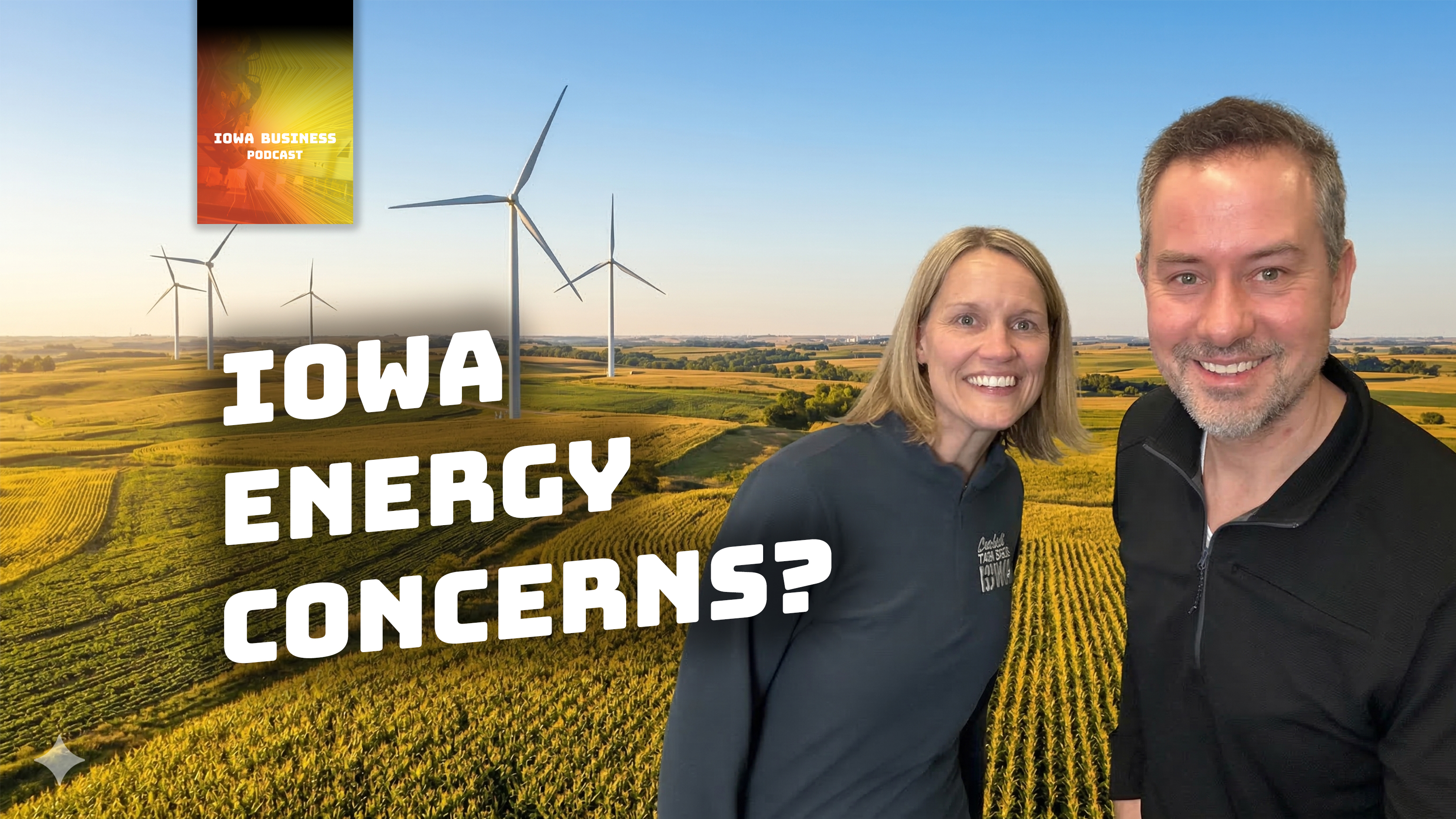


The ABI Survey results are out and energy is now a growing concern alongside healthcare and talent acquisition for Iowa leaders. Nicole Crain, President of the Iowa Association of Business and Industry (ABI), breaks down fresh Q2 survey data out today.
To be clear, energy is cheap and accessible in Iowa, but Iowa business leaders wonder how long that will last as new data centers pop up, all with future Ai energy demands. The quarterly survey from ABI board members shows cautious optimism, but may show two very different Iowa economies developing. Traditional manufacturing vs advanced manufacturing.
Hear from Iowans directly. No algorithms.
Don’t let the algorithms choose your news. Enter your email address to hear directly from Iowans leading news in politics, community, agriculture and business. No editing. No clickbait. No rage. No agenda.
Iowa leaders cautiously optimisic

Iowa business leaders remain cautiously optimistic despite a landscape of increasing economic volatility. Early data from ABI’s quarterly survey indicates that 48% of leaders feel optimistic about the next quarter, while nearly 75% of businesses are planning capital expenditures. Crain notes that while these numbers are on par with previous results, the willingness to reinvest suggests a deep-seated confidence in individual business health.
“Anytime we see businesses reinvesting into the business, there is some type of positive feeling of what’s happening with their own business,” Crain observed. She emphasized that Iowa’s regulatory environment and stable state policies provide a necessary anchor for leaders as they navigate national uncertainty.
Addressing the Talent Pipeline and Rising Costs
Workforce remains the most pressing challenge, with 85% of ABI members identifying talent acquisition as their primary hurdle. Crain argues that the solution requires engaging students as early as elementary school to showcase manufacturing careers. Beyond talent, energy and healthcare have emerged as dominant cost drivers. Concerns regarding energy capacity have spiked due to local ordinances and the rising demands of AI data centers.
“Workforce is still the number one issue,” Crain stated, later adding that regarding healthcare, “there’s only so much as those costs continue to climb that employers can continue to take on”. As businesses pivot to address these pressures, many are turning to internal promotion and employee stock ownership plans (ESOPs) as vital retention tools. Crain concluded by highlighting the “Coolest Thing Made in Iowa” campaign, noting, “There are thousands of products made in Iowa that we just haven’t told our story to let people know they’re made here”.
ABI Survey Results Overview
Over the next quarter, do you expect sales to:
- 62% Expand
- 0% Retract
- 38% Stay about the same
Over the next quarter, do you expect the number of employees in your business to:
- 57% Grow
- 0% Decrease
- 43% Stay About the Same
Do you plan to make capital expenditures in the next quarter?
- 19% Yes, significant investment
- 52% Yes, modest investment
- 19% No
- 10% Undecided
What is your overall outlook on the economy going into the second quarter of 2026?
- 48% Optimistic
- 14% Pessimistic
- 38% Neutral
- 0% Other
How would you describe your company’s financial health entering Q2 2026?
- 38% Strong and growing
- 48% Stable
- 14% Beginning to experience a downturn
- 0% Under significant pressure
Please select the issues that are creating challenges for your business.
- Healthcare costs
- Energy
- Workforce and talent
- Property taxes
- Supply chain
- Other
Coolest Thing Made In Iowa
Interview Transcript
This transcript was created with help from Ai. Please report errors to us and always refer to the video as your primary source.
Justin Brady: From the Jetro Barbecue Studio, I’m Justin Brady, and this is the Iowa Business Podcast. What do you think as a business leader, what are we, are we doing pretty well in Iowa? Are we not doing so well? We’re going to go over early data from the quarterly business survey results from a BI. Today and to do that is Nicole Crane, the president of the Iowa Association of Business and Industry. Nicole, thanks for coming on the show.
Nicole Crain: Thanks for having me, Justin. Looking forward to the conversation.
Justin Brady: Absolutely. Before we get started, everybody, immigration is one of those hot topics. We did talk about this in the studio with Nick, uh, with Haley Blaik Rajo, uh, immigration attorney with Dentons Davis Brown. We didn’t talk about the political side. We talked about the practical side that is impacting Iowans such as. Should you actually pay a hundred thousand dollars to get an H one B Visa employee, you might not actually have to. There’s a workaround, and if your HR is like above board, everybody’s compliant, everything’s perfect from a legal perspective, you still could get a knock on the door from ice. And there are some very simple things you can do to. Prevent that and to be prepared for that. We talked about all that on Iowa podcast.com/business. Nicole, thank you so much for coming in the studio. Uh, early numbers. Can I go through just some really broad stuff? It just looks like. Sales, 62% plan on expanding, 38% planned on not are basically the same employees. 57% of the members look like they’re going, they’re planning on growth. 43% kind of sim you know, same, same, as same as capital expenditures. 19%. Yeah, we’re gonna do it 53%, eh, a little bit. And then of course 19%, no 10% undecided. But here’s the thing that caught my eye. Um, 48. I think Iowans are pretty optimistic, like all the time. Like everything could be on fire, like all, and there’s, they’re still pretty much optimistic. But this is the number that stuck out to me is 48% are optimistic about the next quarter. Um, and of course, only 38% report strong and growing from a financial health standpoint. So is that a big change from previous survey results?
Nicole Crain: you know, I think it’s pretty on par with previous, uh, Survey results, especially as you look at. The overall outlook on the economy We didn’t. Dive into whether we expect that to be the state economy. or the national economy. So When we’ve asked this question in the past, you know, we add a couple new questions each time. Sometimes we break those out. So keep in mind we were in the field on this survey, um, prior to the attacks in Iran, but uh, also Open during that time. So there’s a lot of things as we look at energy um, what’s happening with gas prices that are going on, right now as you and I are having this conversation. And some of that may be reflected a little bit in the survey. depending on when the respondents responded to the survey.
Justin Brady: Right. And I do appreciate you pointing that out. This was before the Middle East thing, which, uh, is just another beautiful layer of volatility on top of a year that’s already been kind of volatile from a business standpoint, and what business
Nicole Crain: want. businesses want. Certainty. You know, we saw after the tax bill at the federal level passed, uh, we saw a big jump in capital expenditures, businesses planning to make capital expenditures. You’re still seeing that, you know, when you, when you put those numbers together. um, significant Investment. That’s 20% in a moderate investment. Another. 52. So you’re still at 75% are planning to make or almost 75% planning to make capital expenditures, which that’s a, that’s a big number. Um, so I think Anytime we see businesses. Reinvesting into the business. There is some type of positive feeling of what’s happening, um, with their own business. Now, as we talk about the greater economy. that’s always a, a wild card.
Justin Brady: So you think this is kind of in line with previous survey results? It didn’t really shock you or nothing really stuck out to you that
Nicole Crain: Not really. Um, You know, I think what was maybe a little bit of surprise was um. I think as we look at beginning, to experience a downturn, there was about 14% there, but that, that isn’t a large number. Um, but I, I, overall, this was right on par. Um, you know, in the Past, we just asked do you plan to make capital expenditures yes or no? We didn’t say big medium. So that’s actually a really good number, the lowest number we ever saw on capital expenditures. Was really about third quarter last year.
Justin Brady: Mm.
Nicole Crain: we had been seeing um, some more conservative responses. or, um, kind of, you know, there businesses on the trade side that This still comes up in here, but. a Lot of businesses have learned how to react. and to do business within the uncertainty.
Justin Brady: Mm-hmm. Um,
Nicole Crain: Um, and so I see this, pretty typical from what we’ve been seeing in the last couple quarters.
Justin Brady: so is, is the o are the optimism numbers? I tend to look at that. Um, are the optimism numbers generally around 50% then? Is it generally kind of a coin flip kind of thing? Yeah, really.
Nicole Crain: and they’re a little lower on the national side. And how, How do you feel. about the national economy or how do you feel about National policies? Uh, but when we look at the state, our, our numbers that we get from our members is. They feel pretty good about the state economy. They feel pretty good about state policies, and I think that’s because they know what to expect. We’re a pretty good state to do business in. We have a fair regulatory environment. But as we look to other states whether it be extended producer responsibility, regulations and laws, whether it be, um, healthcare costs, those are things that. we are seeing come up more in the surveys than we’ve had in the past. So really Where we’ve seen kind of some of those changes are in the open-ended Answers, um, kind of What federal or state policy proposals. are causing the most concern. Oh, but overall, the, the rest of. these answers are, are in line with what we see quarter to quarter.
Justin Brady: Was there any, ’cause you have a lot of private conversations with a lot of business leaders in the state and private conversations don’t always make their way into the data. So were there, are there like routine pattern conversations? You have a lot that did not make their way into the data and you’re like, ah, that’s interesting. I, I would’ve thought to see X in the data. Why isn’t that there? Because I’ve heard this conversation a lot.
Nicole Crain: Yeah. You know, um, one thing we always hear. and see and read in the data and has Always comes up in conversations is workforce. So when we looked at the issues that are creating challenges for your business, workforce is still, um, the number one issue. And we had, I think 85% of people respond, workforce
Justin Brady: 85% are ta having talent
Nicole Crain: Yes.
Justin Brady: Goodness. Yeah. Is that any particular, okay, so Iowa Businesses talent is, I mean, it’s been a conversation as you know, for decades at this point. So is this kind of one of those, um, people? Is this kind of one of those, you know, whatever metaphor you wanna use, the dudes at the bar kind of complaining about stuff? Um, or the, the women complaining about. Like, is this one of those things where you just, it’s the same thing for decades. Y’all are complaining about talent all the time, knock it off. And is it one of those things, or is something different about talent now?
Nicole Crain: it’s a perennial issue. We know our population is not increasing at the rate it needs to.
Justin Brady: Mm-hmm.
Nicole Crain: It’s, it’s one of those issues that, It’s not do X and you solve it. ’cause we’re dealing with people. yeah, and we’re all humans and we all have different personalities. and different strengths. And So really what we’re seeing from. talent, it’s, it’s both, right? It’s upskilling Your current team members, but it’s also when someone comes in, if you’re talking about manufacturing company, you’re talking about construction or even financial services. what are those core skill sets? that they have? Is there a standard. and are they ready to go to work? So really from and, and we asked this question, they could pick multiple answers. It wasn’t just workforce or energy or healthcare cost. So what we’ve seen from this is that As an organization we need to make sure that we’re listening to our members that we’re leaning in, and that we’re providing solutions or tools to be able to, address those workforce. So I know you’ve volunteered many times with our business Horizon program for, um,
Justin Brady: and we had, uh, Anna on the show a couple weeks ago on this very show as
Nicole Crain: And so, you know, we bring in high school students talk critical skills. you know, Uh, soft skills, all of those things are things that employers are still looking for regardless of the industry so that’s that’s where we’re at on workforce and talent. Um. and it depends on what part of the state you’re from too, what kind of workforce challenges you, you have.
Justin Brady: It’s, I do feel like there’s a disconnect there though because, um, we were talk, I was talking with Anna in here. For those that didn’t get hit, that show, it’s a huge, you, you need to listen to the show. It was a couple weeks ago on this very podcast, but I feel like there’s a disconnect, whereas we’re, we’re like, Iowa employees are like, oh my gosh, we really want young talent. We want talent. It’s such a big problem. They’re not really committed to looking two to three years out for, to solve that because, um, like she said, that it has been a little harder to get sponsors and to get people to really pay attention to the Business Horizons program when it comes to, like employers in the state, they’ve been noticing they’re running into more barriers and so are businesses saying, you know what? We’re gonna handle this internally, we don’t need anybody else’s help, or are they pretty much fixated on. I care about the next 30 days and anything other than that as far as talent acquisition, I just can’t, I can’t put any resources or time into that.
Nicole Crain: You know? I think it’s, uh, what we’re seeing is it’s getting to those employers and letting them know here are some opportunities, and this is how this relates to skill development. This is how this relates to getting students, um, aware of your business. And what we see. employers that are very successful in this space, it’s not just two to three years out in high school, but we gotta get in sooner even. So we even have a Whole initiative. um, where we get into fourth through ninth graders. That are interested in manufacturing or Maybe not interested in manufacturing, but there’s a board game that does circuitry. Uh, you make paper airplanes and you put a par a circuit together to help it fly. There are, you use a 3D pen. So getting in at the very, early age of letting them know this is, this is cool. This also could be a career. And so That’s really where I think we’re trying to lean into is, um, we’re already in the high school. PA space, we’re in the college space, but we gotta get in even sooner. So we’re partnering with iJAG and coder and Ed tech company, um, on work-based learning. We’re doing this program for upper elementary to middle school students. Because to your point, I think employers are willing to invest and I think as we see, you know, we talked about the numbers of, are they. Adding employees a lot are staying stable, But they need to, know what their pipeline is and is there a pipeline And so that’s where we’re leaning in saying, here’s your pipeline. Let’s get in those local schools and let them know your business exists and how can we get them into your business. So in five years when they’re ready to go to work? um, you have, you have a lot of candidates waiting for you.
Justin Brady: Yeah, and I, I, I’m obviously not being paid by a BI or Business Horizons at all. I’ve volunteered at Business Horizons and for me that was the eyeopener, truthfully, and maybe I’m, maybe I. Maybe I have a huge blind spot here, Nicole, but every time local employers complain about TA talent acquisition problems, in the back of my head, I roll my eyes and I’m like, me. I don’t wanna hear it because I going to Business Horizons was a huge eye-opener for me. I’m like, you don’t have a talent problem. You have a finding the talent problem because it’s all here and you’re either ignoring it or letting it go to other states, and this is something in your control. You probably have a different, different framing of that. But just me personally, I’m like, I don’t wanna hear it. Go out there and find the people. They’re there and you’re ignoring them. Um, again, just my own personal opinion, but, uh, in, in this, in this data, one of the things that stuck out to me, and you just mentioned this, you mentioned that you, uh, a lot of your members and. A BI itself is going way out into like elementary schools now and middle schools and preparing students for, look, you could do this cool stuff in the state and stay close to your family like it’s already here. And when you mentioned like advanced manufacturing and circuitry and stuff like that. So I have. I do know quite a few of your members and I have been kind of surveying them on my own and I am wondering if the data paints, um, kind of a polarizing picture. And we kind of touched on this with the 50% optimism
Nicole Crain: mm-hmm.
Justin Brady: is the data right now, I would call it kind of not bad, not good, just kind of, Hmm. That’s probably the best word to describe it that doesn’t even transcribe. Mm. Is it is underneath the data, individual responses. Is it very much polarizing? Like some people are way over here, uh, in the negative territory and some are like exuberant territory. In other words, is this data really paint the accurate picture or is it a tale of two cities where you have the advanced manufacturing sector really exploding, but then maybe more of the traditional manufacturing is a little concerned and sliding a little bit in the state?
Nicole Crain: And so you know, this survey reflects all industries, not just manufacturers. As far as the respondents, there are more than 50% that are in manufacturing for this, for this survey, for this quarter, Talking to members, it just To your point about the meh, I think maybe that’s how everyone feels right now. There’s so much coming at you, whether you’re in business, whether you’re you know, going to work every day, no matter what your role is that. um, it’s kinda like, I, I tell people all the time when you’re talking about legislative and, and elected officials. On the congressional side, No one likes Congress, but we all like our congressmen. And so that old saying, I’ve heard a, you know, a million times. So I, I think as we think about business, I think people feel okay about their business. I think we’re less certain probably about what’s happening, just. overall. Um, but when I talk to members, it. It’s more on probably what they, on the manufacturing side, it’s probably more on what they manufacture than what type of manufacturer. We talk about tariffs,
Justin Brady: Oh sure.
Nicole Crain: some of our manufacturers actually are benefited by some of the tariffs. Um, when we were asking about unfair trade practices. Many of our members have been. subject to unfair trade practices by other countries.