

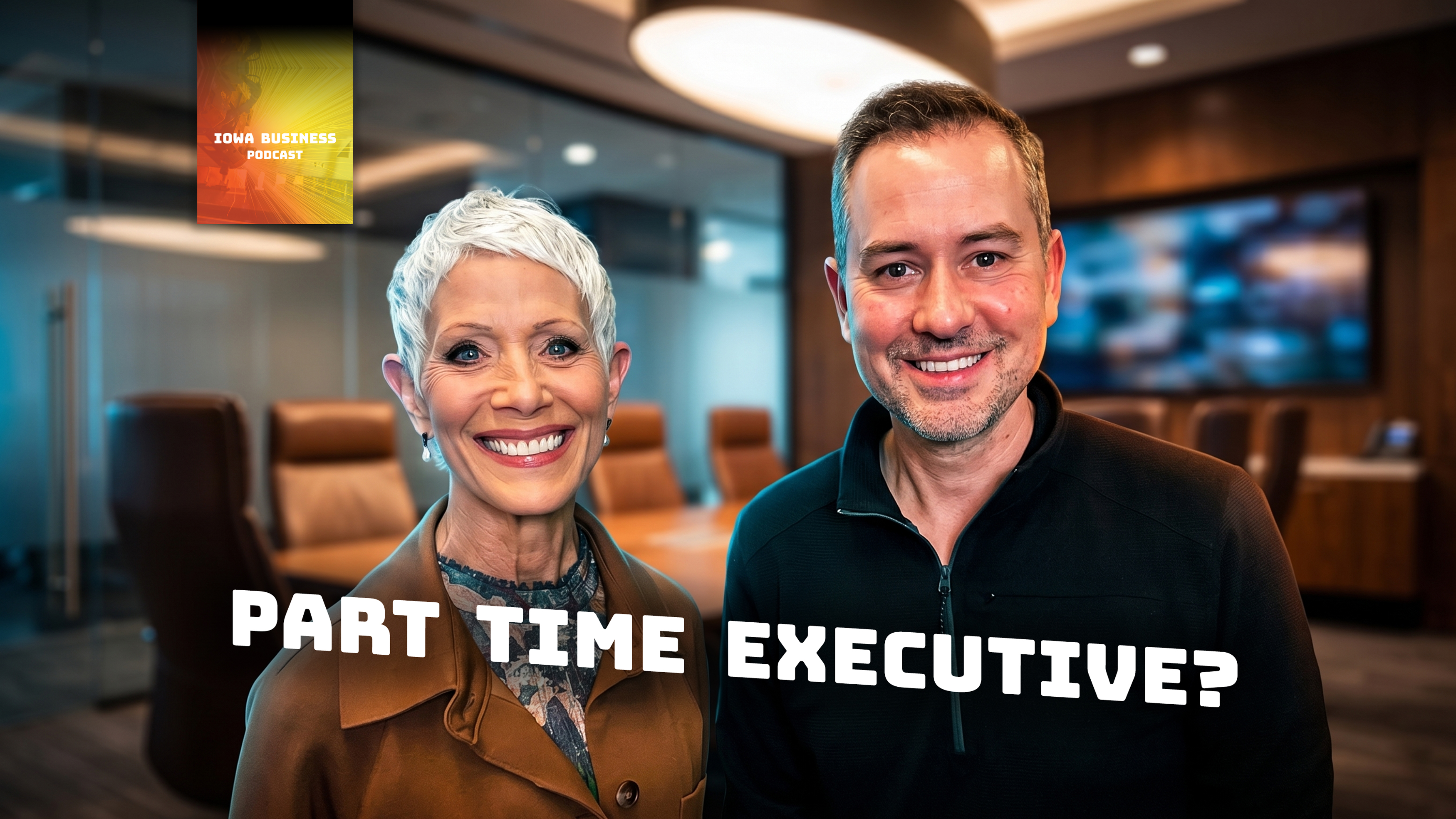


Iowa’s talent gap has long been a headache for local businesses, but Michelle Book, CEO of Altus CXO, reveals a “shot in the arm” solution that is currently seeing a 5,400% surge in LinkedIn roles. Unlike traditional consultants who simply hand over a plan and leave, these fractional leaders embed themselves directly into the C-suite to solve high-stakes problems with “muscle memory” gained from decades of experience. As Book explains, “It gets hot when you want it hot, and it cools down fast when you turn it off”.
Hear from Iowans directly. No algorithms.
Don’t let the algorithms choose your news. Enter your email address to hear directly from Iowans leading news in politics, community, agriculture and business. No editing. No clickbait. No rage. No agenda.

From $1 billion commodity giants to 30-year-old family manufacturers, companies are increasingly using this “gas range” approach to leadership to bypass the months-long hunt for full-time hires. Whether it’s navigating a major tech implementation or professionalizing operations for a future sale, these seasoned pros offer high-impact results without the long-term overhead or benefits costs. “I certainly think that this is the way we’re going to employ executives and get work done in the future,” Book notes. Tune in to discover why she believes “these are people that want a dynamic work environment, status quo they get bored easily, so they’re ready to go, hit it hard”.
Thanks to Dentons Davis Brown for collaborating with The Iowa Business Podcast to bring incredible value to our listeners! Collaborators compensate our hosts directly for their time and effort crafting exclusive content.

Interview Transcript
This transcript was created with help from Ai. Please report errors to us and always refer to the video as your primary source.
Justin Brady: From the Jet Throws Barbecue Studio. This is the Iowa Business Podcast. I’m, of course Justin Brady. Talent retention in Iowa is one of those things that just won’t go away. We’ve talked about that several times. Look, I’m sitting so excited, I’m smacking my mic around. We’ve talked about it several times, and one of the solutions, at least nationally, we’ll see how well it’s doing here in Iowa is fractional executive. Roll. Did I get that right? Michelle?
Michelle Book: that’s close. Fractional executive services. How do you bring executive leadership to a team and uh, not create a lot of overhead? when you do it, uh, in a nimble way, uh, when it is tough getting professional people to think seriously about moving to Iowa.
Justin Brady: For sure, and that’s what we’re gonna be talking about today. I don’t know why I’m hitting my microphone so many times, but, um, Michelle will join us today. Michelle book, of course, the CEO of Altus, CXO, which is also a fractional role. Things are getting crazy up in here. Before we do that, thank you so much to Dentons Davis. Brown who sponsors the Iowa Business Podcast. We had Beth in here. We had Jason in here. We had Kaylee in here. We were talking about immigration law and how that affects your business. We were talking about m and a deals in 2026, and we were also talking about talent retention from a legal standpoint and how to retain them so they don’t leave. And of course, that can be found at Iowa podcast.com/business. All three interviews are right there. Go check them out. Michelle, like I said, thank you so much for coming in here. This. So Garner thinks there’s gonna be 30% growth for fractional executive roles. And it looks like LinkedIn profiles, people labeling themselves as a fractional executive. Now it is LinkedIn, people labeled themselves as all sorts of sorts of things, but 5400% up in LinkedIn roles,
Michelle Book: Not a surprise. Not a
Justin Brady: I I was like, I was like, that’s clearly wrong. So I like researched it several times. That number keeps coming back. Maybe I, I’m like, is my computer broken? And so clearly this is an area that’s growing really, really fast. Is that one of the reasons? Um, because talent acquisition is hard across the country, but of course it’s really hard here in Iowa. So is this problem that’s a national problem, kind of compounded here in Iowa?
Michelle Book: I think COVID opened the door for this kind of work arrangement
Justin Brady: Really.
Michelle Book: And Since. COVID, I think we are seeing steady growth in that fractional executive space. And, and I’ll tell you, um, part of it is you have executives, individuals who have had. Rich careers. Uh, they’re late thirties, forties, fifties, sixties. Uh, this isn’t retirement. This is repurposing and this is finding opportunities to continue to use your wisdom, your knowledge, your experience, help build companies, um, and do it in a flexible environment. These are people that want a dynamic work environment, uh, status quo. They get bored easily, uh, so they’re ready to go, hit it hard. Also on the business side of this, businesses are looking for this kind of expertise. Uh, they can dial it up, they can dial it down. It’s like cooking on a gas range. It gets hot when you want it hot, and it cools down fast when, when you turn it off. So it gives businesses a lot of flexibility to hit some specific targets quickly without a lot of overhead.
Justin Brady: Are we seeing a challenge then bringing executive, you mentioned this earlier here, just as we started off, that it’s actually challenging to get executives here to Iowa and you, we know, like you talk to anybody on the coast, they’re like, Iowa not going there. So is this, is this one of the challenges that you’re, that the fractional executive idea role solves for?
Michelle Book: Well, I’m an Iowa girl, so I think there’s no place like home. Yeah,
Justin Brady: I live, I’ve lived here most of my life too.
Michelle Book: Come to Iowa, you’re gonna love it. But, uh, that being said, uh, some of our fractional executives are Iowans that winter elsewhere or have moved south to get away from Iowa winters. I think today with our systems, the changes in systems, business dynamics, you know, the world today, the business environment today just moves so quickly that having. Um, that right person in your back door when you need them, that’s not easy to do. So a lot of this work is done virtually. Of course, meeting the client is important. If we need to be on site, we can be, but a lot of the work today is done from anywhere in the world Coffee shop in Paris, uh, vacation home in Minnesota, or at the kitchen counter in Des Moines,
Justin Brady: Now you say we, and we should clarify this a little bit, is that you’re the CEO of Altus, CXO. Now we should point out you’re actually the fractional CFO of Altus, CXO
Michelle Book: I’m the fractional CEO Yeah. Of Altus. CXOI became the CEO in January of this year. I met, uh, the, the primary owners of Altus, CXO about a year and a half ago in a networking event, and thought, well, this is interesting. I’d, I’d not heard of this. I did a lot of research. I thought, well, is this fractional stuff a trend or a fad? Mm-hmm. And similar to your research, this is truly a trend. And so last summer I thought, well, yeah, why don’t I jump on board and see if somebody out there needs a fractional CEO. And so I, I joined my, my face is on the website. Uh, they came to me last fall and said, actually, we’d like you to be our fractional C CEOs. So Altus is my client, and it’s also the company under which I’m engaged
Justin Brady: It makes my brain hurt just a little bit, if I’m
Michelle Book: try not to, I think we just move on. Oh,
Justin Brady: Move on. Oh, well that’s not what our listeners are gonna do. So, um, tell me then how this is different because in my mind I’m like, maybe in the eighties we call, we would call this like a consultant, but it’s not quite a consultant either. So how is a fractional executive role different than like a. Lone Wolf consultant type.
Michelle Book: Well, fractional executives are seasoned C-Suite executives. They’ve been in that hot seat. They’ve done that work. They have muscle memory because they’ve solved those problems, but they’ve actually been embedded in businesses that have had to achieve similar goals and meet similar objectives. They work part-time. They can work on an interim basis. They can be project based. One thing they always are is embedded in the business, so it’s not a consultant that comes in, evaluates the situation, determines the problem, gives you a plan, and walks out the door. We’re there to help you solve the problem, and we’re there. Through the very end of that. So we will help identify what are the issues, what’s keeping you up on Sunday night. Uh, we’ve got a great, um, we’ve got a great protocol called Clear XO, where we do a system diagnostic and we get a report back to a client within a week. Um, this is where it’s broken. This is what you need to fix. Um, we can help if we want. Otherwise, we give you the report and you can be off to the races. There’s a lot of flexibility with fractional. Um, but I think the most important thing between that and a consultant is that the fractional people are there. They’re gonna stick with you all the way to the end and do the work alongside the rest of your leadership team.
Justin Brady: So the fractional, we treat them even though they’re not full-time. We treat them as if they’re embedded in the team.
Michelle Book: they are embedded in the
Justin Brady: Then a consultant is more, here’s the plan, you guys do it. A fractional is here’s the plan, let’s do it together.
Michelle Book: Exactly.
Justin Brady: To, to oversimplify it. The now is this like, we’re kind of living in an era of gig work. Um, like, you know, you think of your Uber driver or you think of, is this basically the same thing as making its way, uh, into the C-suite, into organ or larger organizations and, and leadership? Is this basically the idea?
Michelle Book: Well, I think very often when a business calls on. This kind of, of bench strength, they need this, this kind of leadership in the C-suite, there’s a growth phase that’s happening. They may need somebody to support a turnaround. Uh, they’re getting their business ready for sale in three to five years. Um, they have technology issues and we’re seeing that more and more and more. Hmm. Um. They’re just so many people stretched thin. You think about all the wonderful Iowa businesses, the manufacturing that we have. Some of these are in their second or third generation right now. Um, and you’ve got, you know, a couple of executives in those businesses that wear all the hats. Uh, growth can only, you can only get so far with the team you have before you hit a, a growth ceiling. Uh, bringing in a fractional can help you get over that.
Justin Brady: So is I what I’m hearing. Correct me if I’m wrong, this may not be correct, but what I’m hearing is. I guess I should back up a little bit ’cause there are some studies that show like some CEOs are right for the right, some CEOs are the right person for an organization, but only at a specific time. Like some CEOs are really good at starting something and then others are really good at growing something. ’cause like the person who started the thing was super bored. So is this something where you see organizations, I don’t know if you guys are seeing this or you’re seeing it in the data. But are you seeing organizations, I think it’s smaller, medium sized organizations typically are hiring fractional, but are you seeing people like have a CFO for this startup phase because we’re doing a series A and B, but then we’re gonna swap out that CFO for someone who’s more familiar with a larger company and how they operate and we’re not raising anymore. So are you seeing fractional as an opportunity to swap in leadership for the right, like the right time, in the right position at a company throughout the cycles of their growth? Is this a thing?
Michelle Book: Just had that conversation last week. Uh, most of the companies I see that are leaning on fractional expertise are anywhere from 5 million to 1 billion, less than one. The range. Well, and the 1 billion are, are commodity companies. That might be your ethanol. Companies, some of the, some of those, uh, their, their revenue’s high, generally less than a hundred employees, so they don’t have the, the HR bandwidth. Um, but it, to your point, uh, right now I’m working with an Iowa company, uh, uh, sole proprietor, very successful company. It’s 30, 40 years old now. Um, they’ve never had a CFO. Not sure if they need a CEO. Not sure if they can talk the entire leadership team into A CEO. They’ve had a controller and a bookkeeper and they’re thinking maybe we need higher level. Thinking at the executive strategic team. Uh, so let’s bring in A-C-C-F-O. Let’s talk about KPIs. Let’s talk about cost accounting. How do we know if A, B and C are making money? Uh, so they, they wanna bring somebody and dip their toe in the water, understand how that can make a difference. And so 20 hours a week. To bring a new C-E-F-O-C-F-O in, uh, get a feel for what value that adds. And then, um, I imagine that they would transition to a full-time hire within a year. Uh, so they’ll go from a 10 99, 50% of the time, CFO to a W2 employee maybe in a year, 18 months.
Justin Brady: So you do like placement as well then? So some of these executives will actually transition out of the fractional role sometimes and into a full-time role at the organization they’ve been working with.
Michelle Book: It happens, but generally these people, uh, people that wanna serve as a fractional, uh, don’t want to work 40, 50, 60 hours a week. And once you become a full-time executive, uh, time becomes elastic at that point. That’s answers. and. um, they’re looking for dynamic environments. They’re looking for new challenges. So most of the folks that wanna serve as a fractional executive are not looking for W2 employment.
Justin Brady: Interesting. So we have a lot of executive types, um, whether they retired early or whatever their situation is, and they, they have the executive expertise, but previously there’s not. If I’m thinking about this correctly, previously, there’s not really a part-time executive thing that has not really been a thing.
Michelle Book: oh, every executive. I know works all the time.
Justin Brady: and so this is kind of, this is the new thing, is that you’ve provide this fraction, this idea of fractional, whether it be social permission or through the structure of Altus is like social permission or at least economic and business per permission for these executives who want to lead organizations but don’t want to have the 60 hour a week work week. This is kind of gives, this is a vehicle for that.
Michelle Book: Exactly. And this, this is an hourly, It’s an hourly arrangement.
Justin Brady: Really, it’s an hour. Okay.
Michelle Book: Uh, it can be set up as a retainer, uh, maybe up to 30 hours a week for a certain amount, but for the most part, it’s an hourly arrangement. Um, and these individuals, they’re coming into a situation with deep experience. They’re gonna contribute quickly. They’re gonna add value immediately. Um, and so that, that working a certain sub subset of hours or a certain number of hours, um, they can be incredibly productive, um, and not work every night and every weekend and holidays
Justin Brady: Gimme. So give people a, uh, again, for me, uh, I have a couple friends who are fractional. I have a friend who’s a fractional CFO, and so I generally kind of know what she does. Like I kind of get it, but.
Michelle Book: but. Yeah.
Justin Brady: Um, so I only know about fractional executive work through her, and so that’s one scenario that she usually works in. So I’m sure there are several because there are probably fractional CMOs, fractional CFOs, fractional CEOs. So can you give us just a few kind of normal scenarios that you encounter that people are like. This, it’s this. I can’t do this any other way. I can’t do a part-time person. I can’t like just a regular consultant. I can’t hire someone. Like this scenario is good for a fractional executive.
Michelle Book: Uh, let’s talk about tech and it.
Justin Brady: Sure.
Michelle Book: So, uh, there is a company that’s going through a major SaaS. Um, implementation and they probably have the team in place that can take it forward after it’s been built, uh, but they don’t have the bandwidth today. To do the assessment that’s needed to understand how to configure their system and how to get it up and running. And even to make some management, some executive level decisions on exactly what you need in building out your new system. So they’re gonna bring in a fractional to do a system analysis, make sure that they’re not missing anything, that they’re buying the right product and they’re implementing it in the right way. Uh, and that person will be on board until. You know, the owner of the company feels comfortable saying, okay, we can move on. We’ve got this, we can handle it on our own. But that’s what’s different about Altus. CXO. You just hit it, is that Altus, CXO has, um, executives in a diverse number of areas. It’s, there are a lot of CFO fractional companies out there. Um, some mark that’s
Justin Brady: normal fractional thing as CFO.
Michelle Book: Right. There’s several. And I think that’s primarily where it started with fractional CFOs, but Alta CXO, uh, the two founders are CFOs. They came from a CFO fractional Company and they said, you know what? we want, we wanna provide more bandwidth than that. So there are, within Alta CXO, uh, finance and accounting people, it and tech, uh, executives, marketing executives, operations. HR executives, uh, people with an expertise in EOS. So when you hire an Altus CXO executive, uh, you might have one person that’s, um, billing their hours and serving the client, but you’ve got 30 experts that stand behind them on beside them. So you really bring, we bring a team of expertise to any particular client assignment.
Justin Brady: Are fractional CFOs, and I don’t know if you have the data set available, so if you don’t know, that’s fine. But are fractional CFOs, are they trending on the older side or retired side, or what? Where do they fall as far as experience level?
Michelle Book: Again, I think coming outta COVID, a lot of people are looking for more flexibility. So we have several CFOs that are in their forties. Mm-hmm. Uh, they. have kids at home or they have kids activities. Uh, they might be farming with their husbands. Uh, so they’ve got plenty going on and they want the flexibility, uh, to take care of stuff at home or on the farm and serve clients Some. The executives we work with, they want a maximum of 20 hours a week. Others, others wanna work 30 or 40 or 50 hours a week. Some of the executives have one or two clients, some have four or five clients. So you can, you, you can, the executive themselves, just like the businesses, the executives can dial it up and dial it down.
Justin Brady: Oh, interesting. With the, I obviously working with the company that hired them.
Michelle Book: Well, Well, or the companies? the companies. I’m not gonna be
Justin Brady: 10 additional hours.
Michelle Book: Well, I’ve got, I, one of our executives, uh, she’s working full-time at a bank right now supporting a bank that’s gonna wind down, um, in June. She’s going to, she’s gonna take it easy over the summer and spend some time with her teenage kids before she ramps back up. Picks up a couple more clients in the fall.
Justin Brady: Got, and so this is like, she’s gonna take time, um, more time for herself because the, I dunno if you call ’em a contract or something, those are like ending. And so she sees that natural lull in her schedule and she’s gonna take advantage of that time off because. Kind of a thing.
Michelle Book: It’s like, really paying attention to that work life balance. We’ve talked about it. yeah. Forever.
Justin Brady: you’re the, the, I, I don’t even know if you call them employees, you probably call ’em Correct. Um.
Michelle Book: We call ’em associates. Okay.
Justin Brady: Oh, okay. Got
Michelle Book: Mm-hmm. Alright, Mm-hmm.
Justin Brady: so they work with you guys and they can essentially turn off or on like, kind of like almost like lawyers, they can turn off or dial up or dial down their client list
Michelle Book: Very similar, Yeah. Okay. Very similar.
Justin Brady: does it work then, because I’m assuming there are certain protections in place, I’m assuming, like you, they’re contracted under your company and so a fractional, at least within your structure. Would be under certain non-disclosure for IP reasons. Um, and I’m assuming also that if it’s an organizational setup like this, that they’re not working for like competitors at the same
Michelle Book: time. Exactly. Okay. Exactly. If you’re, if, uh, you’re going to work as a 10 99. Uh, executive, uh, we prefer that all that be done under the Altus CXO umbrella. Uh, people have clients that they’ve had before they come into Altus, and, and, and that’s always to be honored. Uh, but for the most part, we get folks that really love being part of the Alta CXO team. Um, we, we work together, we collaborate to solve client problems. We support one another. Um. Just because they wanna be a fractional executive doesn’t mean they wanna be a lone wolf. Uh, they want flexibility. But I think the folks that have joined Alta CXO really wanna be part of that collaborative team environment. okay,
Justin Brady: this is interesting because. Now when you say part of the collaborative team environment, are they collaborating on the Alta side as well? Yes. As the client side? Yes. So it’s almost like a support group.
Michelle Book: Well,
Justin Brady: Can I call it that?
Michelle Book: It’s not quite like rehab, but, um,
Justin Brady: Well,
Michelle Book: but I think most of us to
Justin Brady: on your side.
Michelle Book: Yeah. Yeah. So this is,
Justin Brady: okay. This is interesting ’cause my next question was going to be the fractional role is, is not a thing you invented, right? It’s a, it’s a, it’s just a thing. That exists. You can hire freelancer fractional CFOs or CMOs. You can also hire them through an organization like Altus. And so the big difference here is that Altus has some organization, and this isn’t an ad for Altus, as we’ve said Altus a lot. But, um, the difference in an organizational setting is that you have some of those NDAs and that structure baked in, and you kind of have the mastermind group on your side, whereas a lone wolf. Who is also an
Michelle Book: executive, mm-hmm.
Justin Brady: fractional executive might not have that support system. It’s neither good nor bad. It’s just different.
Michelle Book: Well, they have to have their own attorney. They have to have their own back office billing. Probably have to have their own kind of HR support.
Justin Brady: they’d be an entrepreneur
Michelle Book: Yeah. they’d be an entrepreneur. So what a fractional company offers, a well organized fractional company is gonna provide that back office. Um, some legal support as well. All the contractual work. Uh, when somebody brings a new client in, uh, and there are, we, we hit the button and the process begins. New client intake form, the NDA goes out, there’s a contract, the billing gets set up. Um, That’s crazy. Invoices happen monthly, so the fractional executive. Doesn’t have to worry about a lot of that, that’s taken care of for them. Um, they’ve got challenges with a client or need some new ideas as, as, as far how to solve a particular problem. There are people there. Um, so as you said, mastermind, um, I think most of us wanna be part of something bigger than ourselves
Justin Brady: Always. That’s one of the top values for Americans right now is belonging.
Michelle Book: And studies have shown that when you work as part of a team, you perform better. Mm-hmm. Uh, the team helps you perform better and you wanna perform better with the team. So I think that team environment is also a very rich, dynamic place for fractionals to, to succeed.
Justin Brady: Yeah, and also I think there’s a element of on on your side, there’s an element of your fractional executive associates. I like that. Don’t have to hunt and kill, um, their own food, if that makes any sense. Right. Unless they are, maybe they are, are they bringing their own clients to the board or are you pretty much feeding them?
Michelle Book: Both.
Justin Brady: Oh, really? So it is kind of like a law firm?
Michelle Book: Both. It hap It happens where a lot of, um, the associates, um, will bring the client with them. mm-hmm. And then they have so much experience in their particular industry that often these people are sought. Out. So they’ll go from one engagement to the next to the next. Uh, but also business development is important. Uh, getting the word out, let people know what fractional means, and, and talking about the company. A year and a half ago, I did not understand what fractional executive work meant. And even today, I say fractional executive work and people look at me with, you know, a big deer in the headlight look. Uh. East coast and West coast I think is probably more common than it is here in the Midwest in Iowa. But I certainly think that this is the way we’re going to employ executives and get work done in the future.
Justin Brady: So that, that’s what you said right there is interesting because you mentioned on the coast it’s kinda like, yeah, we know what that is. That’s fine. You know, it’s kind of accepted. Um, but maybe the Midwest not as much. And so I guess this is a double-edged sword maybe, which is. Iowa has had trouble with talent retention and talent attraction. This is comes from the leading executives, the Iowa Business Council, Iowa a BI. They all say the same thing. This is a challenge here. Everybody knows it is. So with that challenge, is this a thing that Iowans are embracing and they’re like, oh my gosh, we get it, we need it. Or is this a thing where Iowans are like. Mm. This is, this is fairly new. I think we’re gonna wait and watch the coast and see if they screw up doing this. And then we will give you a look. Is this, where do Iowa executives, or of at least Iowa founders of smaller, medium sized businesses, fall on that spectrum?
Michelle Book: once they understand it, they’re willing to give it a chance. It’s low risk. It’s a low risk venture. When you are hiring an executive, it can take months and years. To find the right person for an executive position within your business. Sure. Then it takes a good period of time to onboard them. Um, and then if they don’t work out, it’s hard to get rid of them. Um, with fractional executive services, again, it’s a pretty fast startup. Um, and, and, and the wind down as well when the work is done. So once people understand the flexibility, uh, business owners are embracing it. Interesting this, this. you are getting immediate value. Uh, for your dollar, no overhead. There. There are no benefits, no social security tax, uh, no workers’ comp. Um, you’re getting somebody in the door that’s gonna hit the ground running because they’ve done this before. You’re gonna have results quickly. Um, and again, you turn it up, you turn it down, and you don’t have to pay the overhead
Justin Brady: So that, okay, so this is interesting because, um. Some of the, well, I guess I should ask, ask this in the form of a question. It is new. Uh, I see the value and I see Iowans embracing this thing. I don’t know if they will in droves or not. Um, Iowa is very, as, as Joe Murphy over at the Iowa Business Council puts it, he’s like, they’re very Iowans are very calculated. Never in any Iowa history time have we ever just jumped on the new thing. We wait, we’re calculated. We watch it play out. Then we embrace it when it’s tried and true, which is why Iowa’s economy through ups and downs. It doesn’t really go haywire. It’s always pretty calm here
Michelle Book: Very consistent, you know,
Justin Brady: that could, that there’s some drawbacks there, which is, we’re sometimes on the innovation side, we’re a little late, but there are also some positives, which is, it’s not chaos here ever. So that’s, you know, um, but that being said, what are some of the drawbacks? Are there any I’m, I’m sure, I’m sure there are some, or what do small, medium sized businesses tell you? They’re like, this couldn’t work for us because X or because of y.
Michelle Book: And again, if you focus on the need being part-time, interim, or project-based, this is a great solution. It’s not a great solution for everybody all the time. And there are businesses that want their executive to be completely at their disposal. Sure. If you want a hundred percent of somebody fractional might not be the best way for your business to go. Sure,
Justin Brady: Sure. Yeah.
Michelle Book: yeah. But I think we’re also, you said it earlier, between a bit of a rock and a hard place these days in getting the right talent at the right time, and I think Iowa businesses are going to see, again, if it’s. Part-time, interim or project base that this is a viable solution. And Iowa business owners are pretty smart. They’re frugal, they’re conservative, they’re hardworking, they’re innovative. So I do believe that this is something that they will adopt once they get a chance to understand it.
Justin Brady: Are fractional executives in general always remote or, I, mean, I, it sounds like there are some that are local, but it also sounds like there are a lot that are remote
Michelle Book: Can be both.
Justin Brady: It can be both. It can. Okay,
Michelle Book: so if you can you specify
Justin Brady: that then?
Michelle Book: Certainly. Yeah. And there are, there are businesses and there are roles within businesses where you just simply have to be there. You have to be there to see the machinery running. Uh, so in those cases, the folks have to be on site. We have some of both. Um, and we have some that are hybrid Where. you’re on site two or three days a week and you’re offsite or you’re on site one week a month. Then you’re offsite. Um, so it can go, it can go both ways. It’s whatever the client needs.
Justin Brady: And it does sound like if you’re in a really volatile business and you’re just like, we don’t have need for this role anymore, you can adapt and get rid of the role. Not saying you should, you know, get rid of people, but that is one of the areas of flexibility you have in something like
Michelle Book: well, without engaging. your HR team and, and your, your attorney to, to do it. Yeah. Um. Most contracts, our contract is 30 days, uh, 30 days
Justin Brady: 30 days. Oh, just notice.
Michelle Book: 30 Days 30 day. notice, and you can,
Justin Brady: Wow, that’s fast.
Michelle Book: is fast. So it gives you,
Justin Brady: there is, I mean, there is, I would say maybe I’m wrong. There is one little drawback to this, which is I don’t like it being super easy for people to get rid of people, because that makes long-term vision and execution very, very difficult. But that being said, you’re in the short term game. So I guess this is kind of like what is an executive role? Is an executive role a come in and get it done thing or in, is an executive role a bring your vision, bring the long-term ideas and like push the company that direction over years? Or are you saying, or maybe you would say like some executive roles are long-term vision. That’s the whole point. That’s not us.
Michelle Book: Exactly. the
Justin Brady: term. Get it done people. Yeah.
Michelle Book: We’re, we’re the jumpstarters.
Justin Brady: Hmm.
Michelle Book: We’ll come in. and jump, jumpstart the, perhaps it’s cash flow and forecasting. Forecasting where they need a CFO to help get that set up and built and somebody else can take it forward or it’s a CIO or they need a system built or expanded, um, and hr. Person where they need to get hiring protocol, um, policies, procedures in place, and somebody else can take it forward. Um, an operations person. Um, the operations have to be professionalized for growth or perhaps for sale in the future, or a marketing person that’s gonna come in and do that alignment of marketing to business goals. Um, and then. It’s ready to go. It’s good. to go. So these, for the most part, fractional is not a long-term solution. It’s a shot in the arm, it’s a jumpstart. It’s gonna get you course corrected and down the right path.
Justin Brady: That’s Fascinat. Yeah, that’s, that’s absolutely fascinating. I, I do From, from the business side, from the customer side, like integrating a fractional executive makes all the sense in the world. To me, it’s, it’s very obvious, I think, to get it. From your side, from the business side. I’m like, my gosh, that sounds like an organizational structure and nightmare. Like to structure something like this. Oh my gosh, it’s not something I want to think about.
Michelle Book: there are a lot of, moving parts. a lot of moving parts. but think about, think about, an Iowa business who can get, um, who has access to a Honeywell executive. Mm-hmm. Uh, fellow worked at Honey,
Justin Brady: do you do this? Do you like, so do you brand kind of the executive bench you have and say they have experience at these kind of brands? Is this one of the selling points as well?
Michelle Book: Their bios are, out
Justin Brady: oh, they’re bio. Okay,
Michelle Book: So we, We know where they’ve been and we have a menu. And we share that. We share that with with prospective clients, what their background. is. But you know, we have a CMO that we’re working with that has, um, amazing experience in international business, uh, leading A. sales organization. Um, Sure he can bring that. expertise. To an Iowa business, um, at a fraction of what it would be to hire A CMO full time. Um, there’s a and move him to Iowa.
Justin Brady: There’s a joke in when you said he can’t bring that with a fraction. There’s a joke in there somewhere. But,
Michelle Book: a pun, pun intended. Pun intended. Michelle,
Justin Brady: Michelle book, the CEO of Alta, CXO, uh, what’s the website so people can reach out to you if they have questions.
Michelle Book: uh, Altus. CXO, Google Altus, CXO, I’m not sure. http://www.altuscxo.com.
Justin Brady: Michelle, thank you so much for coming on the Iowa Business
Michelle Book: Thank you so much. for having me.